
EARLY MODERN EUROPEAN ART A Slide Show This
- Slides: 29
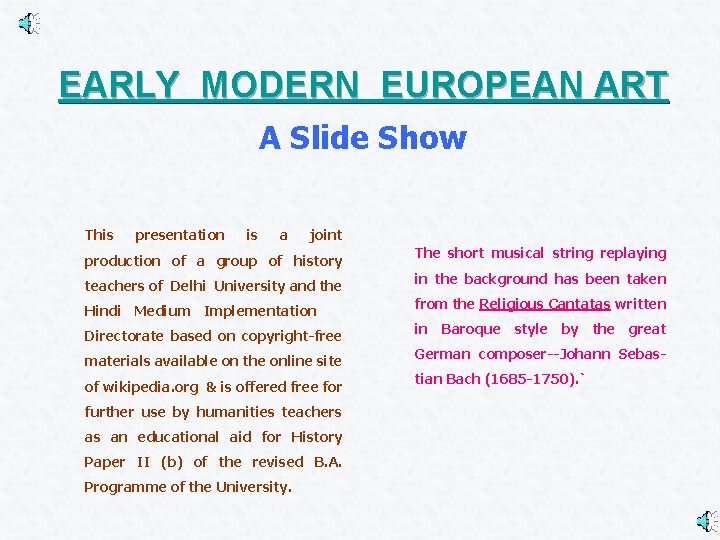
EARLY MODERN EUROPEAN ART A Slide Show This presentation is a joint production of a group of history teachers of Delhi University and the Hindi Medium Implementation Directorate based on copyright-free materials available on the online site of wikipedia. org & is offered free for further use by humanities teachers as an educational aid for History Paper II (b) of the revised B. A. Programme of the University. The short musical string replaying in the background has been taken from the Religious Cantatas written in Baroque style by the great German composer--Johann Sebastian Bach (1685 -1750). `
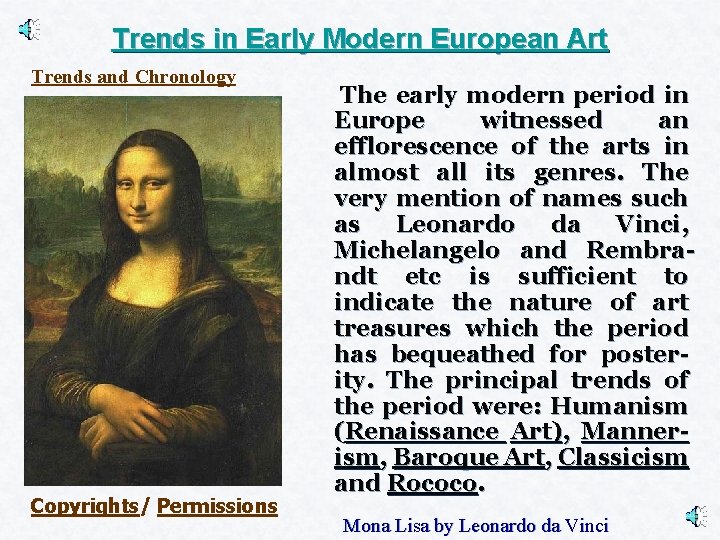
Trends in Early Modern European Art Trends and Chronology Copyrights/ Permissions The early modern period in Europe witnessed an efflorescence of the arts in almost all its genres. The very mention of names such as Leonardo da Vinci, Michelangelo and Rembrandt etc is sufficient to indicate the nature of art treasures which the period has bequeathed for poster- ity. The principal trends of the period were: Humanism (Renaissance Art), Manner- ism, Baroque Art, Classicism and Rococo. Mona Lisa by Leonardo da Vinci
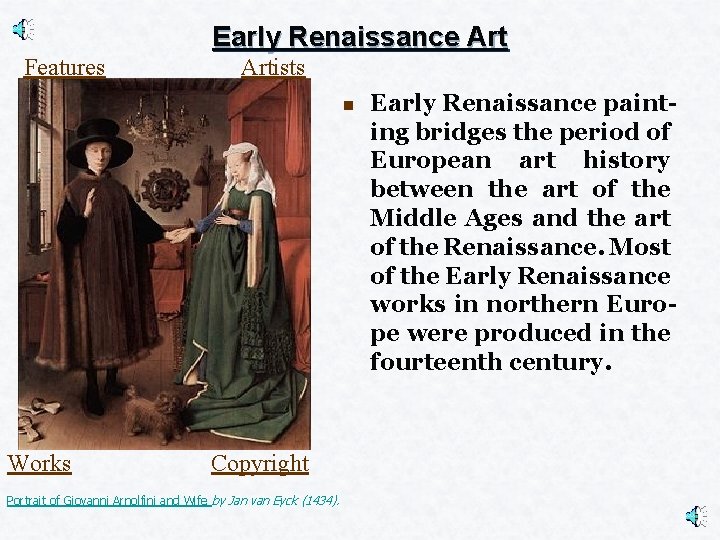
Features Early Renaissance Artists n Works Copyright Portrait of Giovanni Arnolfini and Wife by Jan van Eyck (1434). Early Renaissance painting bridges the period of European art history between the art of the Middle Ages and the art of the Renaissance. Most of the Early Renaissance works in northern Europe were produced in the fourteenth century.
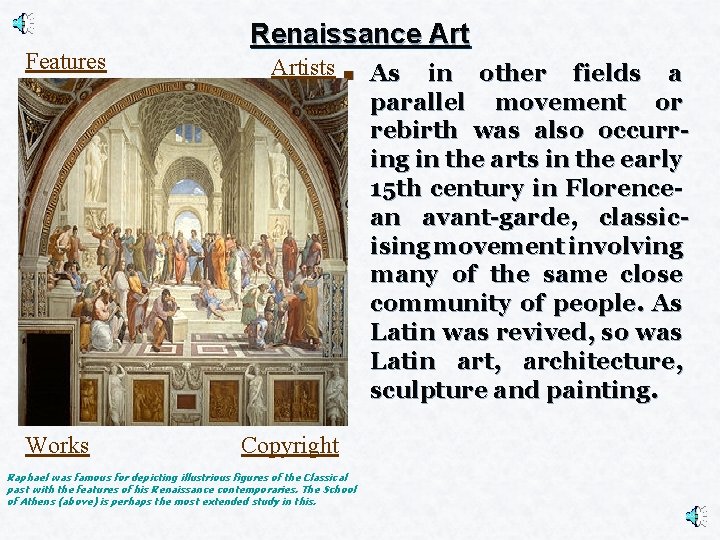
Features Works Renaissance Artists n Copyright Raphael was famous for depicting illustrious figures of the Classical past with the features of his Renaissance contemporaries. The School of Athens (above) is perhaps the most extended study in this. As in other fields a parallel movement or rebirth was also occurring in the arts in the early 15 th century in Florence- an avant-garde, classicising movement involving many of the same close community of people. As Latin was revived, so was Latin art, architecture, sculpture and painting.
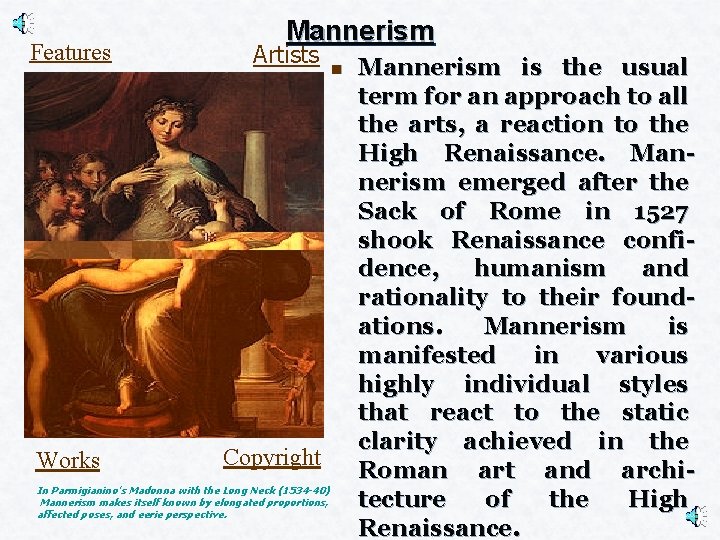
Features Works Mannerism Artists Copyright In Parmigianino's Madonna with the Long Neck (1534 -40) Mannerism makes itself known by elongated proportions, affected poses, and eerie perspective. n Mannerism is the usual term for an approach to all the arts, a reaction to the High Renaissance. Mannerism emerged after the Sack of Rome in 1527 shook Renaissance confidence, humanism and rationality to their foundations. Mannerism is manifested in various highly individual styles that react to the static clarity achieved in the Roman art and architecture of the High Renaissance.
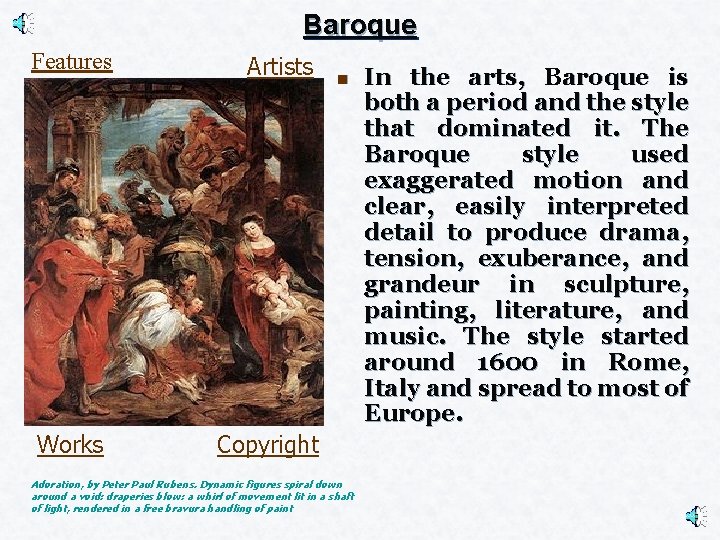
Baroque Features Works Artists n Copyright Adoration, by Peter Paul Rubens. Dynamic figures spiral down around a void: draperies blow: a whirl of movement lit in a shaft of light, rendered in a free bravura handling of paint In the arts, Baroque is both a period and the style that dominated it. The Baroque style used exaggerated motion and clear, easily interpreted detail to produce drama, tension, exuberance, and grandeur in sculpture, painting, literature, and music. The style started around 1600 in Rome, Italy and spread to most of Europe.
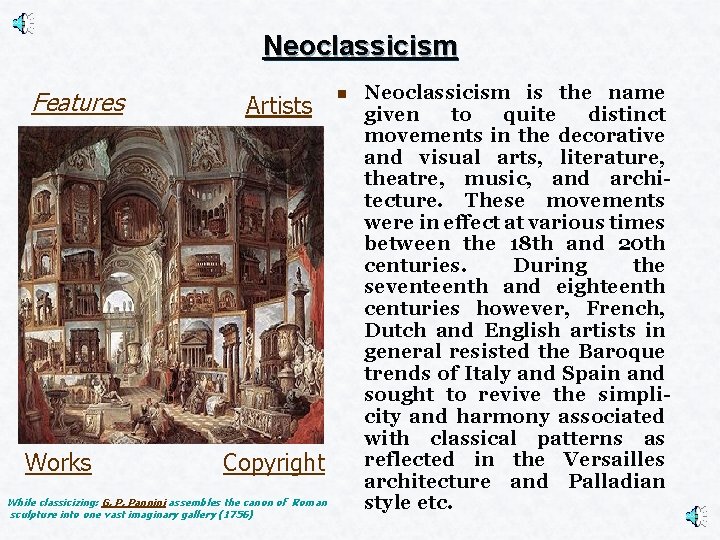
Neoclassicism Features Works Artists Copyright While classicizing: G. P. Pannini assembles the canon of Roman sculpture into one vast imaginary gallery (1756) n Neoclassicism is the name given to quite distinct movements in the decorative and visual arts, literature, theatre, music, and architecture. These movements were in effect at various times between the 18 th and 20 th centuries. During the seventeenth and eighteenth centuries however, French, Dutch and English artists in general resisted the Baroque trends of Italy and Spain and sought to revive the simplicity and harmony associated with classical patterns as reflected in the Versailles architecture and Palladian style etc.
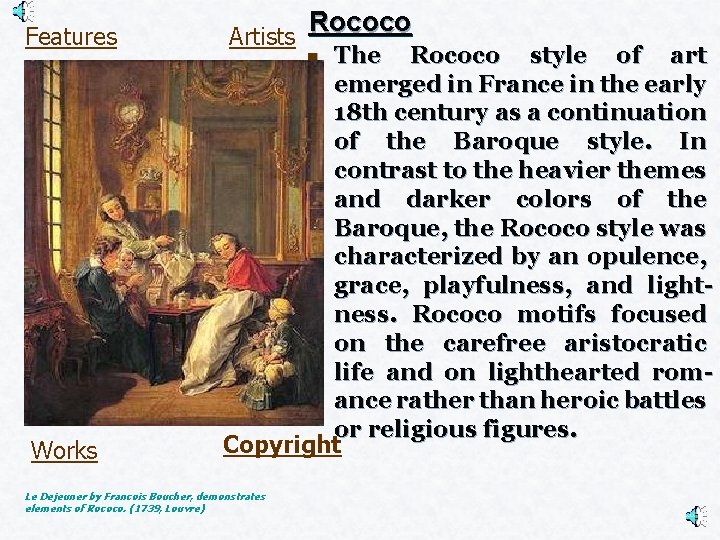
Features Works Rococo Artists The Rococo style of art emerged in France in the early 18 th century as a continuation of the Baroque style. In contrast to the heavier themes and darker colors of the Baroque, the Rococo style was characterized by an opulence, grace, playfulness, and lightness. Rococo motifs focused on the carefree aristocratic life and on lighthearted romance rather than heroic battles or religious figures. Copyright Le Dejeuner by Francois Boucher, demonstrates elements of Rococo. (1739, Louvre) n
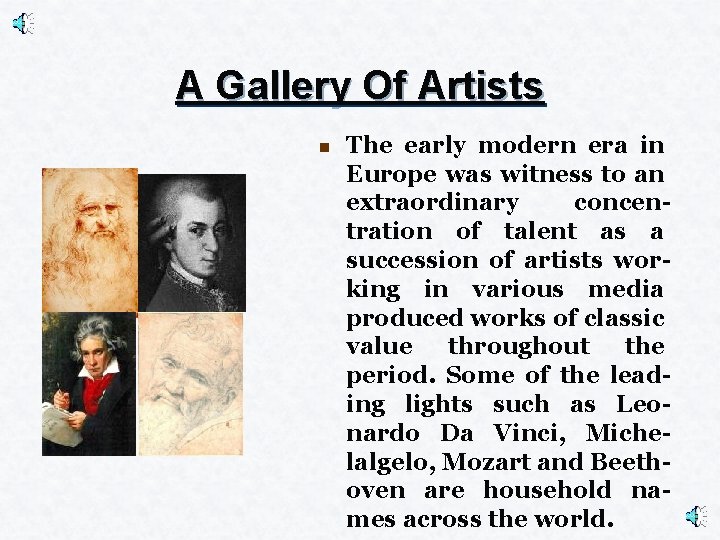
A Gallery Of Artists n The early modern era in Europe was witness to an extraordinary concentration of talent as a succession of artists working in various media produced works of classic value throughout the period. Some of the leading lights such as Leonardo Da Vinci, Michelalgelo, Mozart and Beethoven are household names across the world.
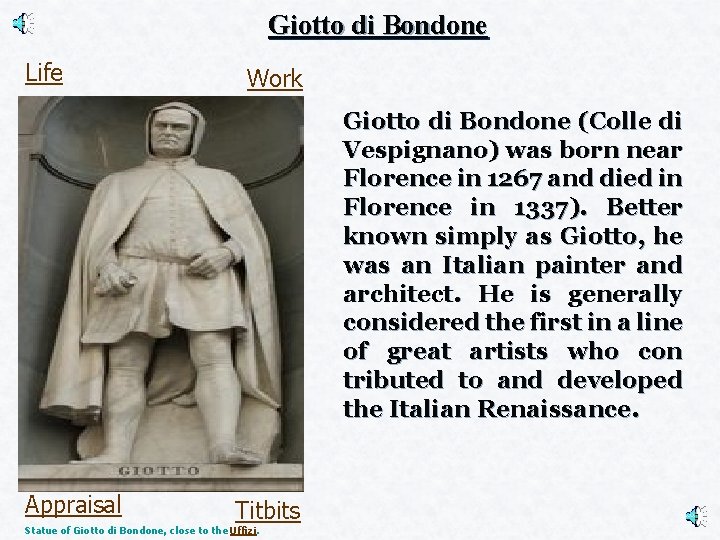
Giotto di Bondone Life Work Giotto di Bondone (Colle di Vespignano) was born near Florence in 1267 and died in Florence in 1337). Better known simply as Giotto, he was an Italian painter and architect. He is generally considered the first in a line of great artists who con tributed to and developed the Italian Renaissance. Appraisal Titbits Statue of Giotto di Bondone, close to the Uffizi.
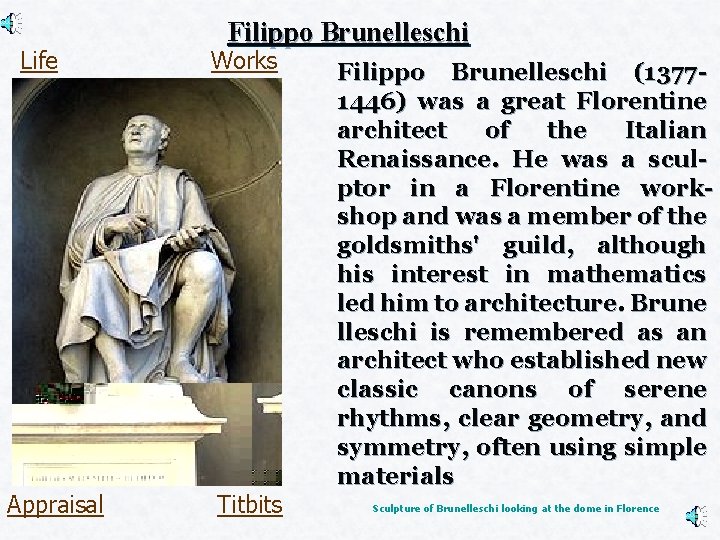
Life Appraisal Filippo Brunelleschi Works Titbits Filippo Brunelleschi (1377 - 1446) was a great Florentine architect of the Italian Renaissance. He was a scul- ptor in a Florentine workshop and was a member of the goldsmiths' guild, although his interest in mathematics led him to architecture. Brune lleschi is remembered as an architect who established new classic canons of serene rhythms, clear geometry, and symmetry, often using simple materials Sculpture of Brunelleschi looking at the dome in Florence
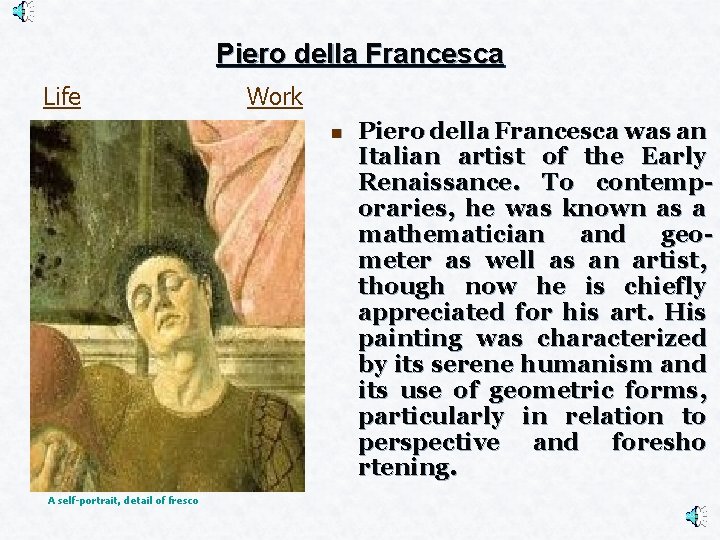
Piero della Francesca Life Work n A self-portrait, detail of fresco Piero della Francesca was an Italian artist of the Early Renaissance. To contemporaries, he was known as a mathematician and geometer as well as an artist, though now he is chiefly appreciated for his art. His painting was characterized by its serene humanism and its use of geometric forms, particularly in relation to perspective and foresho rtening.
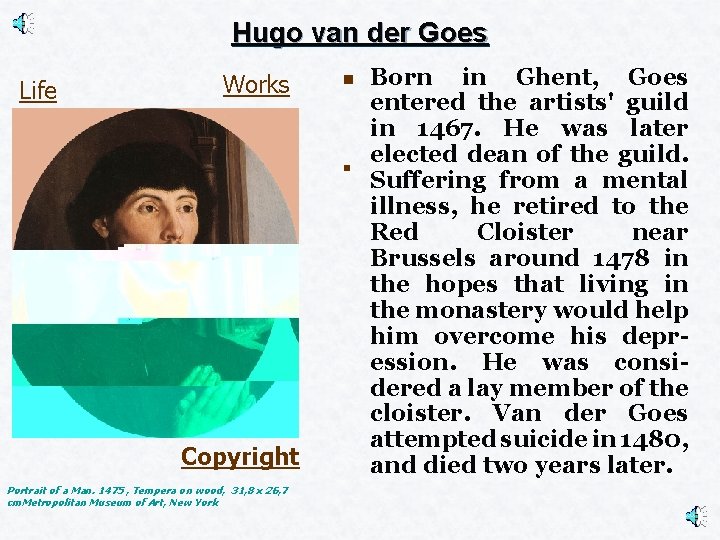
Hugo van der Goes Life Works n n Copyright Portrait of a Man. 1475 , Tempera on wood, 31, 8 x 26, 7 cm. Metropolitan Museum of Art, New York Born in Ghent, Goes entered the artists' guild in 1467. He was later elected dean of the guild. Suffering from a mental illness, he retired to the Red Cloister near Brussels around 1478 in the hopes that living in the monastery would help him overcome his depr- ession. He was consi- dered a lay member of the cloister. Van der Goes attempted suicide in 1480, and died two years later.
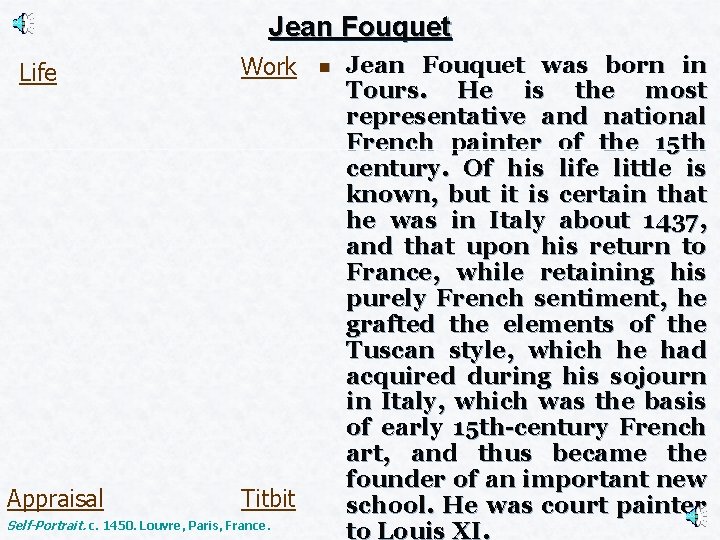
Jean Fouquet Life Appraisal Work Titbit Self-Portrait. c. 1450. Louvre, Paris, France. n Jean Fouquet was born in Tours. He is the most representative and national French painter of the 15 th century. Of his life little is known, but it is certain that he was in Italy about 1437, and that upon his return to France, while retaining his purely French sentiment, he grafted the elements of the Tuscan style, which he had acquired during his sojourn in Italy, which was the basis of early 15 th-century French art, and thus became the founder of an important new school. He was court painter to Louis XI.
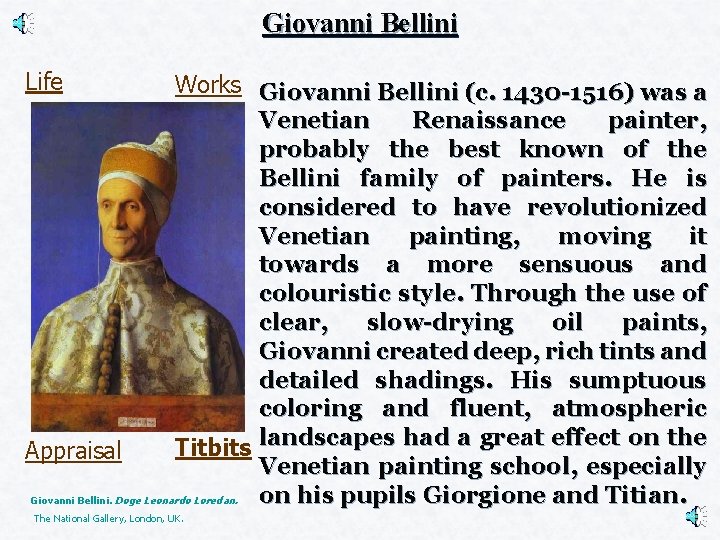
Giovanni Bellini Life Works Giovanni Bellini (c. 1430 -1516) was a Venetian Renaissance painter, probably the best known of the Bellini family of painters. He is considered to have revolutionized Venetian painting, moving it towards a more sensuous and colouristic style. Through the use of clear, slow-drying oil paints, Giovanni created deep, rich tints and detailed shadings. His sumptuous coloring and fluent, atmospheric Titbits landscapes had a great effect on the Appraisal Venetian painting school, especially on his pupils Giorgione and Titian. Giovanni Bellini. Doge Leonardo Loredan. The National Gallery, London, UK.
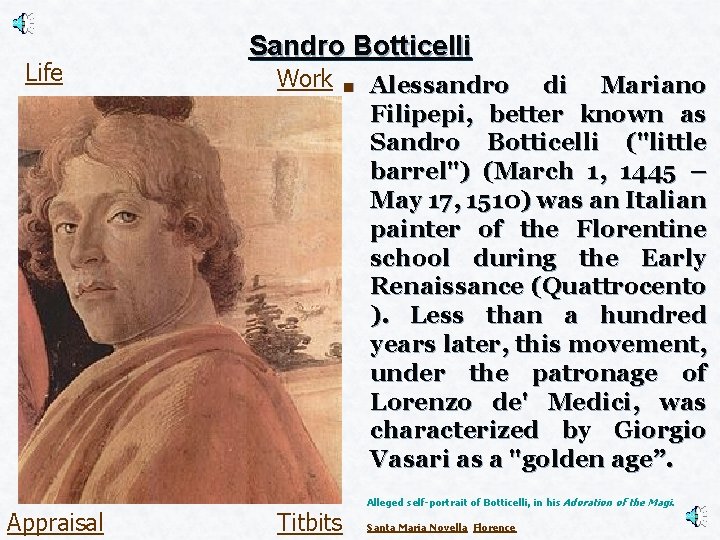
Life Appraisal Sandro Botticelli Work Titbits n Alessandro di Mariano Filipepi, better known as Sandro Botticelli ("little barrel") (March 1, 1445 – May 17, 1510) was an Italian painter of the Florentine school during the Early Renaissance (Quattrocento ). Less than a hundred years later, this movement, under the patronage of Lorenzo de' Medici, was characterized by Giorgio Vasari as a "golden age”. Alleged self-portrait of Botticelli, in his Adoration of the Magi. Santa Maria Novella, Florence.
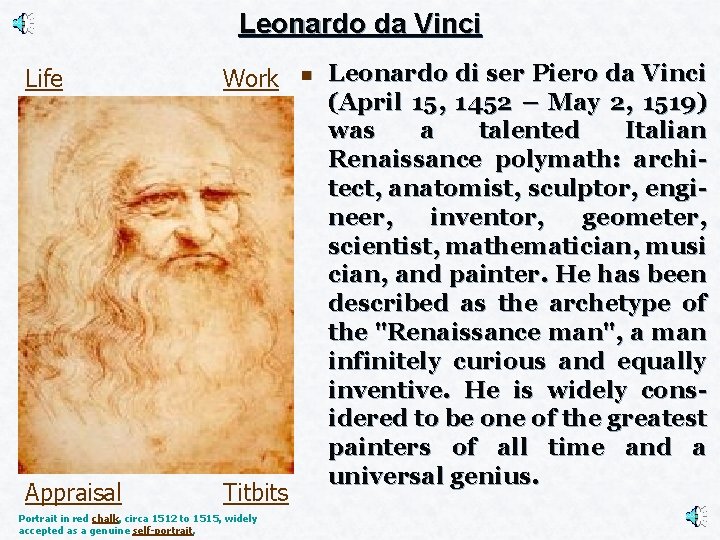
Leonardo da Vinci Life Work Appraisal Titbits Portrait in red chalk, circa 1512 to 1515, widely accepted as a genuine self-portrait. n Leonardo di ser Piero da Vinci (April 15, 1452 – May 2, 1519) was a talented Italian Renaissance polymath: archi- tect, anatomist, sculptor, engi- neer, inventor, geometer, scientist, mathematician, musi cian, and painter. He has been described as the archetype of the "Renaissance man", a man infinitely curious and equally inventive. He is widely cons- idered to be one of the greatest painters of all time and a universal genius.
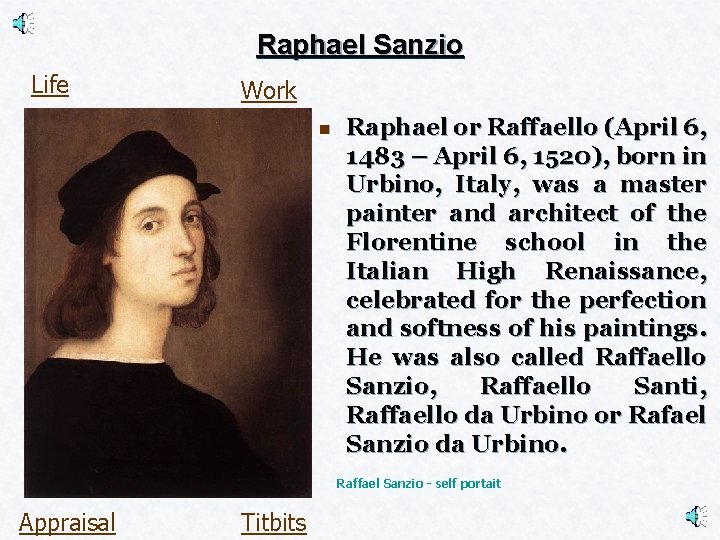
Raphael Sanzio Life Work n Raphael or Raffaello (April 6, 1483 – April 6, 1520), born in Urbino, Italy, was a master painter and architect of the Florentine school in the Italian High Renaissance, celebrated for the perfection and softness of his paintings. He was also called Raffaello Sanzio, Raffaello Santi, Raffaello da Urbino or Rafael Sanzio da Urbino. Raffael Sanzio - self portait Appraisal Titbits
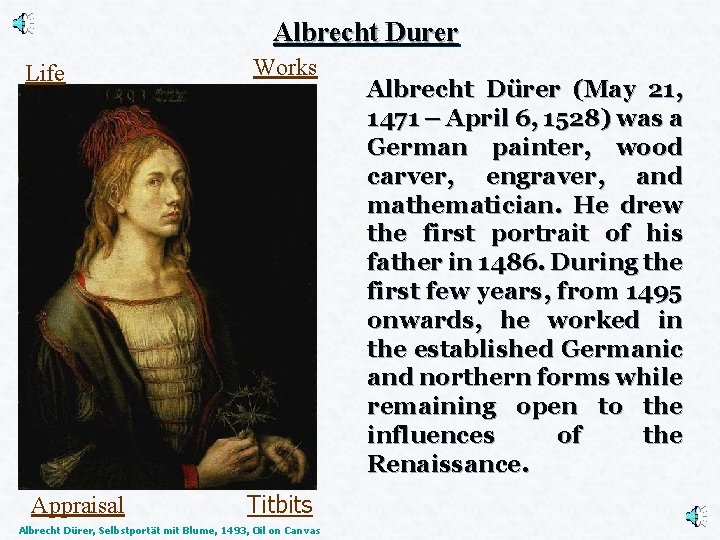
Albrecht Durer Life Works Appraisal Titbits Albrecht Dürer, Selbstportät mit Blume, 1493, Oil on Canvas Albrecht Dürer (May 21, 1471 – April 6, 1528) was a German painter, wood carver, engraver, and mathematician. He drew the first portrait of his father in 1486. During the first few years, from 1495 onwards, he worked in the established Germanic and northern forms while remaining open to the influences of the Renaissance.
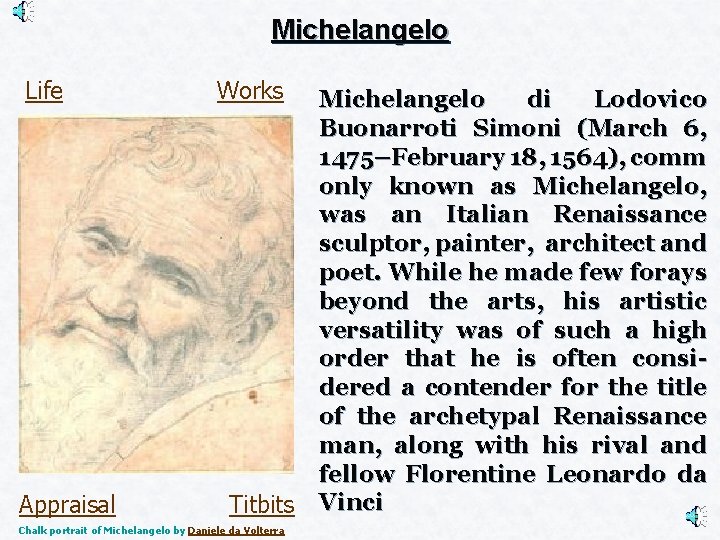
Michelangelo Life Appraisal Works Titbits Chalk portrait of Michelangelo by Daniele da Volterra Michelangelo di Lodovico Buonarroti Simoni (March 6, 1475–February 18, 1564), comm only known as Michelangelo, was an Italian Renaissance sculptor, painter, architect and poet. While he made few forays beyond the arts, his artistic versatility was of such a high order that he is often consi- dered a contender for the title of the archetypal Renaissance man, along with his rival and fellow Florentine Leonardo da Vinci
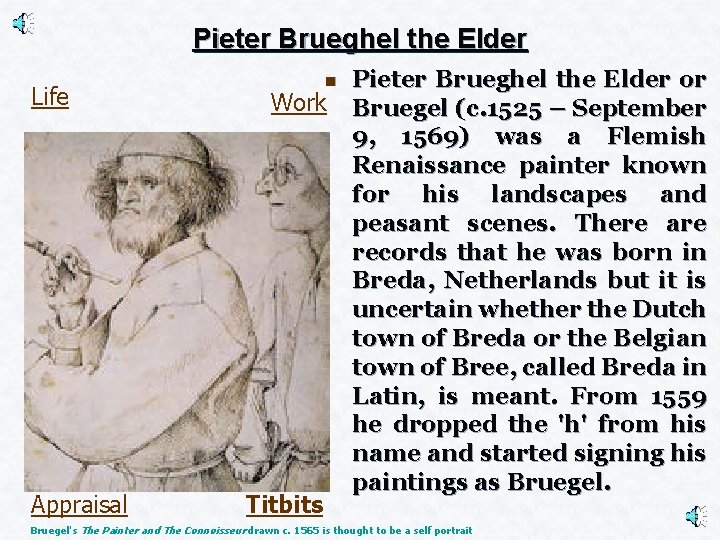
Pieter Brueghel the Elder Life Appraisal n Work Titbits Pieter Brueghel the Elder or Bruegel (c. 1525 – September 9, 1569) was a Flemish Renaissance painter known for his landscapes and peasant scenes. There are records that he was born in Breda, Netherlands but it is uncertain whether the Dutch town of Breda or the Belgian town of Bree, called Breda in Latin, is meant. From 1559 he dropped the 'h' from his name and started signing his paintings as Bruegel's The Painter and The Connoisseur drawn c. 1565 is thought to be a self portrait
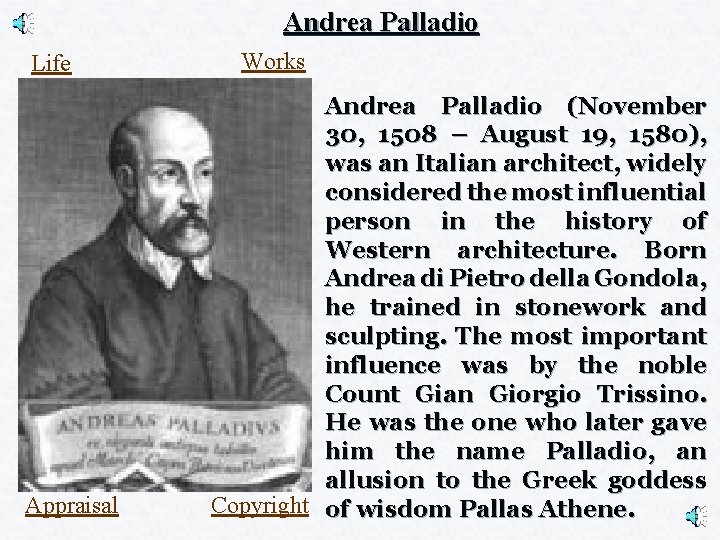
Andrea Palladio Life Appraisal Works Andrea Palladio (November 30, 1508 – August 19, 1580), was an Italian architect, widely considered the most influential person in the history of Western architecture. Born Andrea di Pietro della Gondola, he trained in stonework and sculpting. The most important influence was by the noble Count Gian Giorgio Trissino. He was the one who later gave him the name Palladio, an allusion to the Greek goddess Copyright of wisdom Pallas Athene.
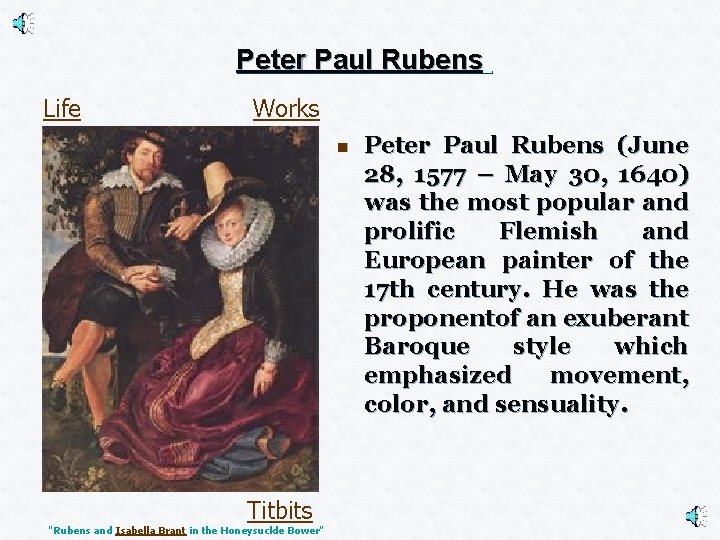
Peter Paul Rubens Life Works n Titbits "Rubens and Isabella Brant in the Honeysuckle Bower" Peter Paul Rubens (June 28, 1577 – May 30, 1640) was the most popular and prolific Flemish and European painter of the 17 th century. He was the proponentof an exuberant Baroque style which emphasized movement, color, and sensuality.
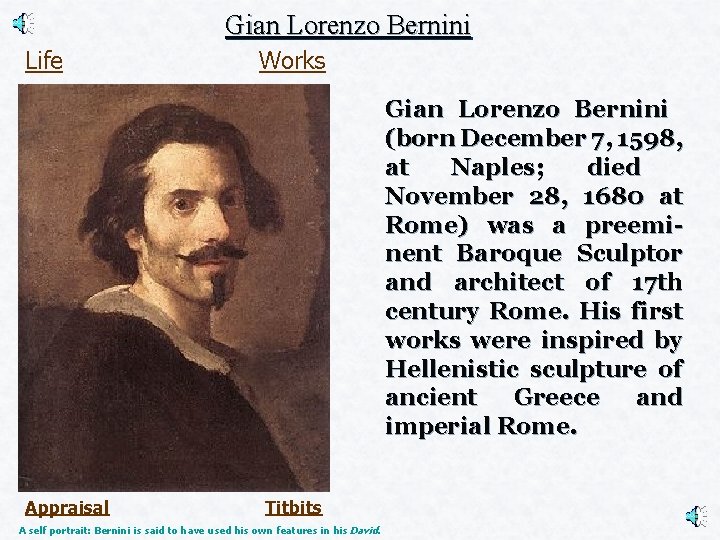
Gian Lorenzo Bernini Life Works Gian Lorenzo Bernini (born December 7, 1598, at Naples; died November 28, 1680 at Rome) was a preemi- nent Baroque Sculptor and architect of 17 th century Rome. His first works were inspired by Hellenistic sculpture of ancient Greece and imperial Rome. Appraisal Titbits A self portrait: Bernini is said to have used his own features in his David.
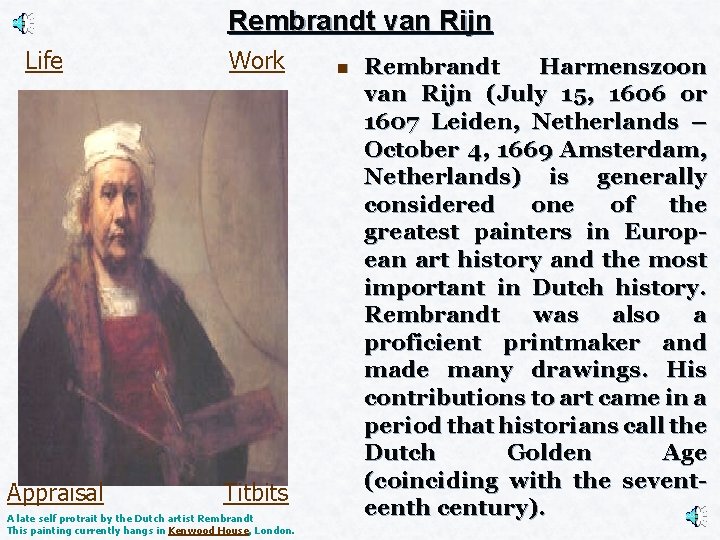
Rembrandt van Rijn Life Appraisal Work Titbits A late self protrait by the Dutch artist Rembrandt This painting currently hangs in Kenwood House, London. n Rembrandt Harmenszoon van Rijn (July 15, 1606 or 1607 Leiden, Netherlands – October 4, 1669 Amsterdam, Netherlands) is generally considered one of the greatest painters in Europ- ean art history and the most important in Dutch history. Rembrandt was also a proficient printmaker and made many drawings. His contributions to art came in a period that historians call the Dutch Golden Age (coinciding with the sevent- eenth century).
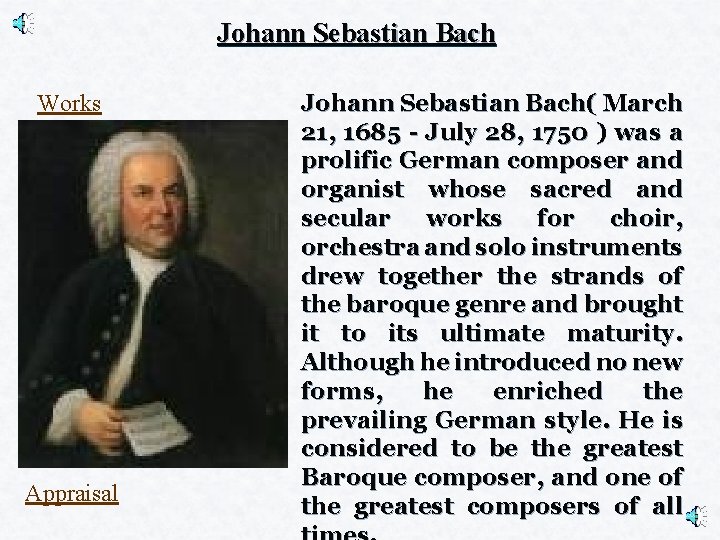
Johann Sebastian Bach Works Appraisal Johann Sebastian Bach( March 21, 1685 - July 28, 1750 ) was a prolific German composer and organist whose sacred and secular works for choir, orchestra and solo instruments drew together the strands of the baroque genre and brought it to its ultimate maturity. Although he introduced no new forms, he enriched the prevailing German style. He is considered to be the greatest Baroque composer, and one of the greatest composers of all
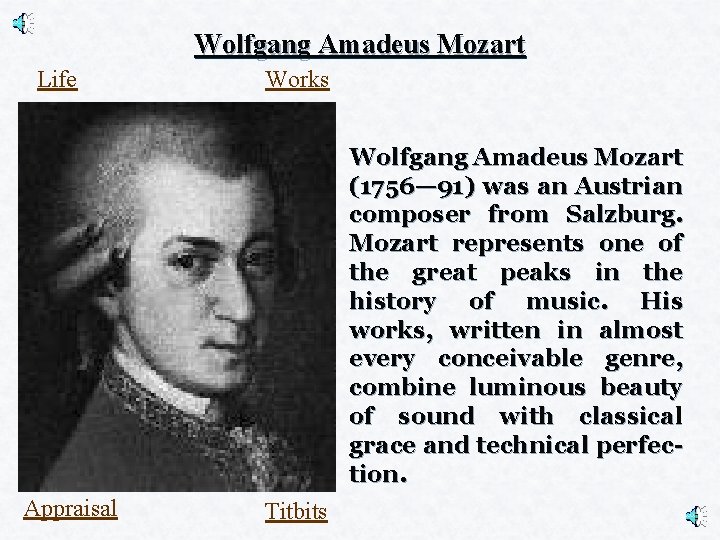
Wolfgang Amadeus Mozart Life Works Wolfgang Amadeus Mozart (1756— 91) was an Austrian composer from Salzburg. Mozart represents one of the great peaks in the history of music. His works, written in almost every conceivable genre, combine luminous beauty of sound with classical grace and technical perfec- tion. Appraisal Titbits
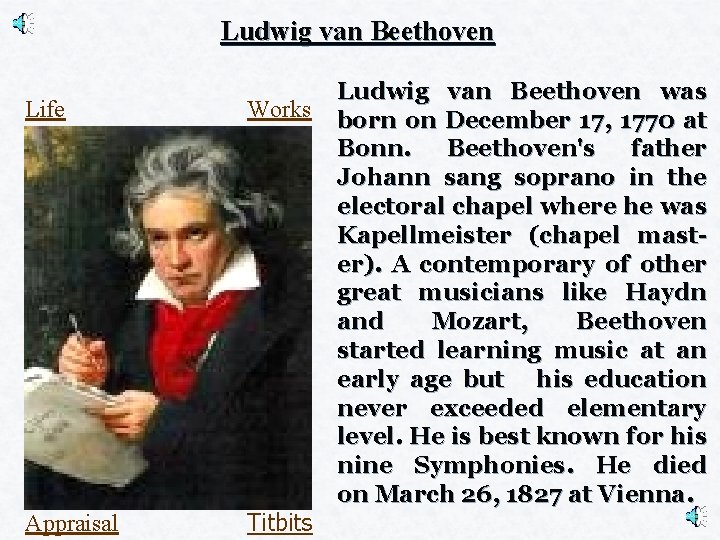
Ludwig van Beethoven Life Works Appraisal Titbits Ludwig van Beethoven was born on December 17, 1770 at Bonn. Beethoven's father Johann sang soprano in the electoral chapel where he was Kapellmeister (chapel mast- er). A contemporary of other great musicians like Haydn and Mozart, Beethoven started learning music at an early age but his education never exceeded elementary level. He is best known for his nine Symphonies. He died on March 26, 1827 at Vienna.
THE END of a beginning …… Conceived, Designed & Scripted by Dr. Devesh Vijay Searched & Pooled by Pragya Vijay & Shilpi Singh Sorting by Dr. Yuthika Mishra and Pragya Mishra Narration by Dr. Devesh Vijay & Dr. Yuthika Mishra Technical Assistance Computer Centre, Delhi University Additional Help Dr. Anita Narayan, Ankit Vijay and Tanmoy Vijay Music Played by Prabhjot Uday singh Burman Financial Support Hindi Medium Implementation Directorate Copyright: All Homo Sapiens The musical string being played is from a piano rendition of an unforgettable melody by a great Indian composer- late Shri Roshan