
Early models of an expanding Universe Paramita Barai
Early models of an expanding Universe Paramita Barai Astr 8900 : Astronomy Seminar 5 th Nov, 2003
Contents l Introduction l Discuss papers : – 1922 : Friedmann – 1927 : Lemaître – 1932 : Einstein & De Sitter l Present cosmological picture l Some results – SN project, WMAP, SDSS
Cosmological foundations l Cosmological principle – Universe is Homogeneous & Isotropic on large scales (> 100 Mpc) l l l Universe (space itself) expanding, d. D/dt ~ D (Hubble Law) Universe expanded from a very dense, hot initial state (Big Bang) Expansion of universe – mass & energy content – explained by laws of GTR Dynamics of universe Structure formation in small scales (<10 -100 Mpc) by gravitational self organization WHAT IS THE GEOMETRY OF OUR UNIVERSE, & IT’S CONSEQUENCES ? ?
Cosmological parameters l. R – Scale factor of Universe l Critical density , C – density to make universe flat (it just stops expanding) l Density parameter, = / C l H = Hubble constant = v / r l = Cosmological Constant (still speculative!!) – Dark Energy – Repulsive force, opposing gravity
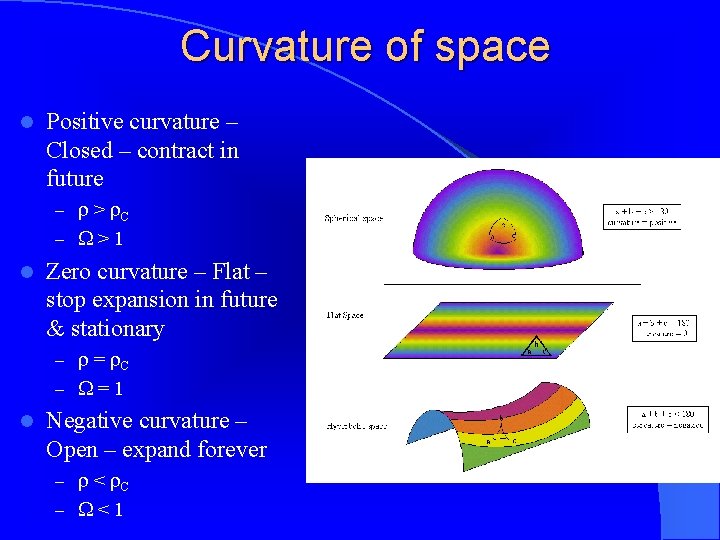
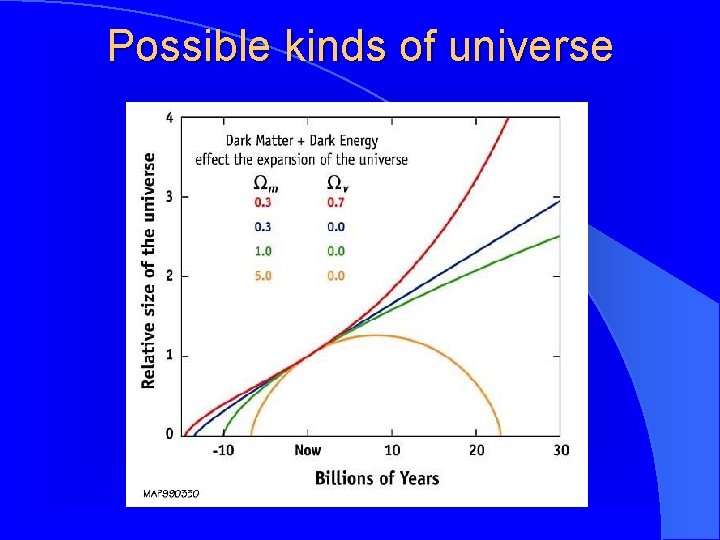
Curvature of space l Positive curvature – Closed – contract in future – > C – >1 l Zero curvature – Flat – stop expansion in future & stationary – = C – =1 l Negative curvature – Open – expand forever – < C – <1
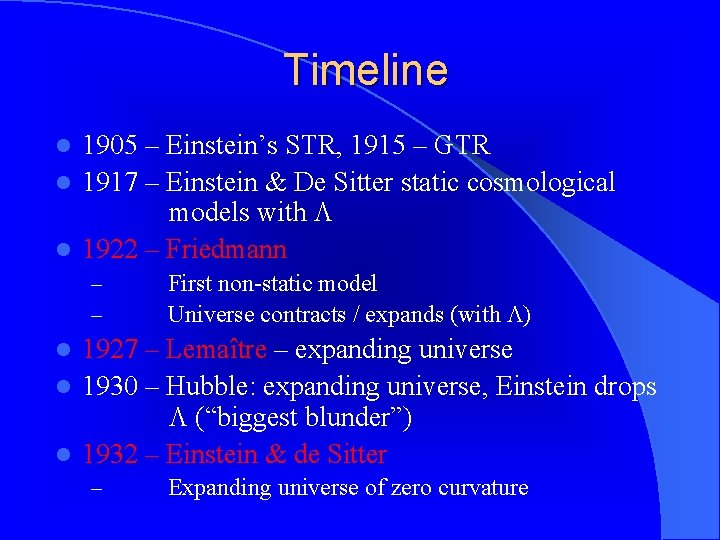
Timeline 1905 – Einstein’s STR, 1915 – GTR l 1917 – Einstein & De Sitter static cosmological models with l 1922 – Friedmann l – – First non-static model Universe contracts / expands (with ) 1927 – Lemaître – expanding universe l 1930 – Hubble: expanding universe, Einstein drops (“biggest blunder”) l 1932 – Einstein & de Sitter l – Expanding universe of zero curvature
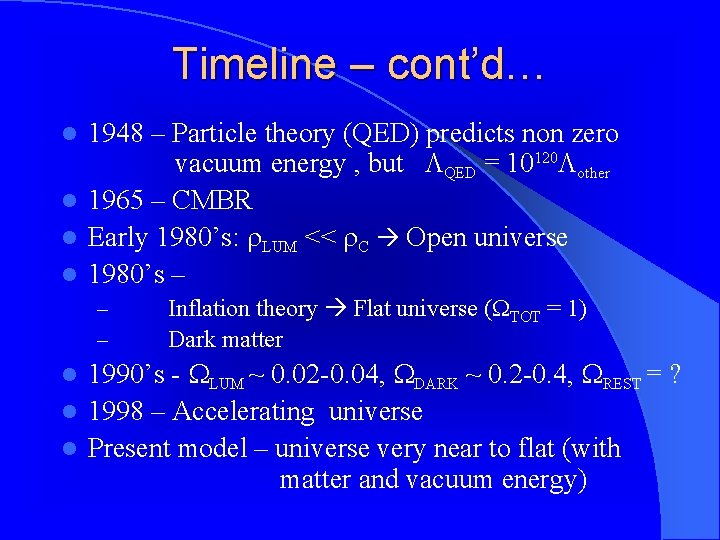
Timeline – cont’d… 1948 – Particle theory (QED) predicts non zero vacuum energy , but QED = 10120 other l 1965 – CMBR l Early 1980’s: LUM << C Open universe l 1980’s – l – – Inflation theory Flat universe ( TOT = 1) Dark matter 1990’s - LUM ~ 0. 02 -0. 04, DARK ~ 0. 2 -0. 4, REST = ? l 1998 – Accelerating universe l Present model – universe very near to flat (with matter and vacuum energy) l
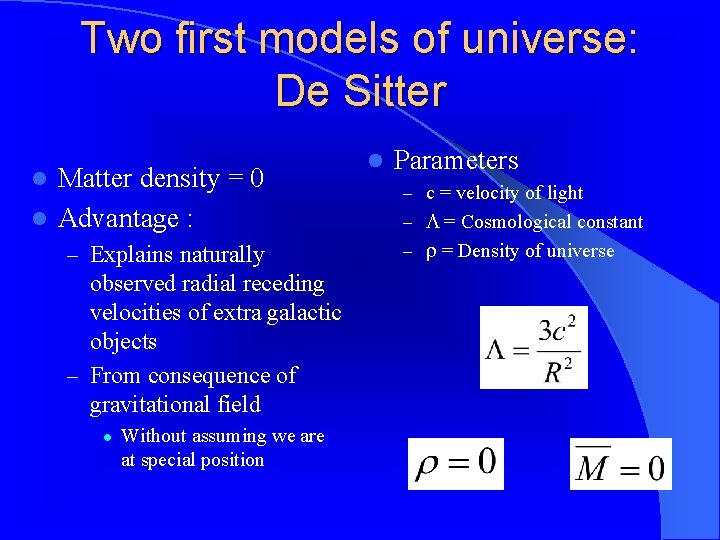
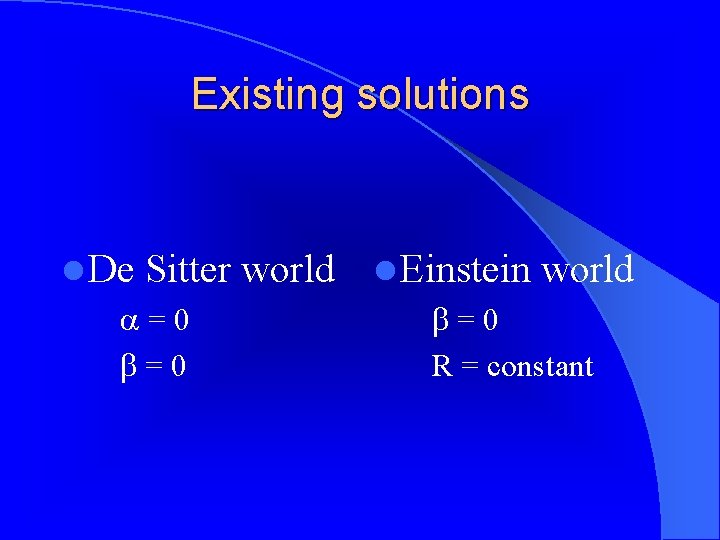
Two first models of universe: De Sitter Matter density = 0 l Advantage : l – Explains naturally observed radial receding velocities of extra galactic objects – From consequence of gravitational field l Without assuming we are at special position l Parameters – c = velocity of light – = Cosmological constant – = Density of universe
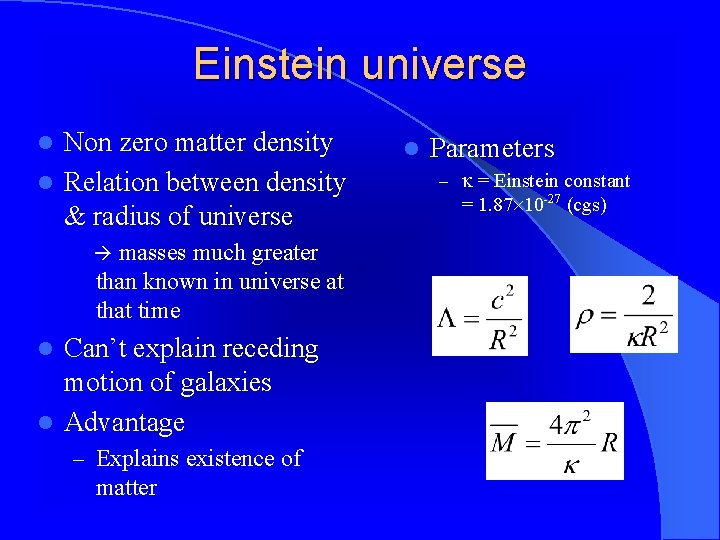
Einstein universe Non zero matter density l Relation between density & radius of universe l masses much greater than known in universe at that time Can’t explain receding motion of galaxies l Advantage l – Explains existence of matter l Parameters – = Einstein constant = 1. 87 10 -27 (cgs)
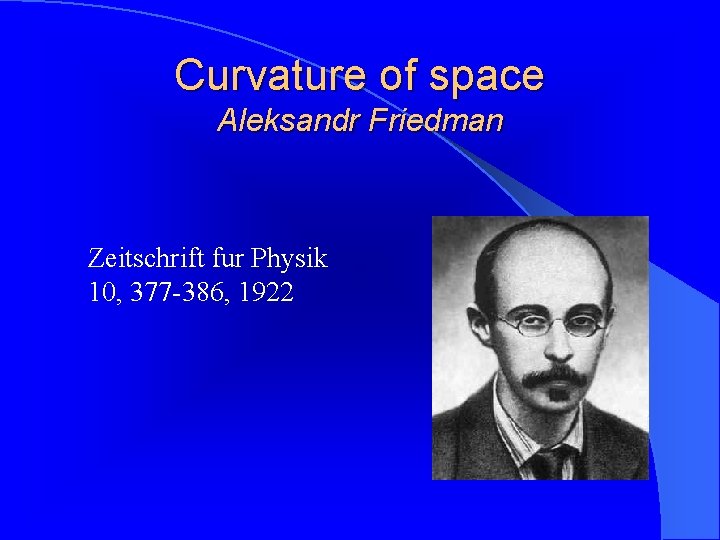
Curvature of space Aleksandr Friedman Zeitschrift fur Physik 10, 377 -386, 1922
Summary l First non static model of universe l Work immediately noticed, but found important later … l R independent of t : – Stationary worlds of Einstein & de Sitter l. R depends on time only : – Monotonically expanding world – Periodically oscillating world l depending on chosen
Goal of the paper l Derive the worlds of Einstein & de Sitter from more general considerations
Assumptions of 1 st class l Same as Einstein & de Sitter Gravitational potentials obey Einstein field equations with cosmological term 2. Matter is at relative rest 1.
Assumptions of 2 nd class 1. Space curvature is constant wrt 3 space coordinates; but depends on time 2. Metric coefficients: g 14, g 24, g 34 = 0, suitable choice of time coordinate
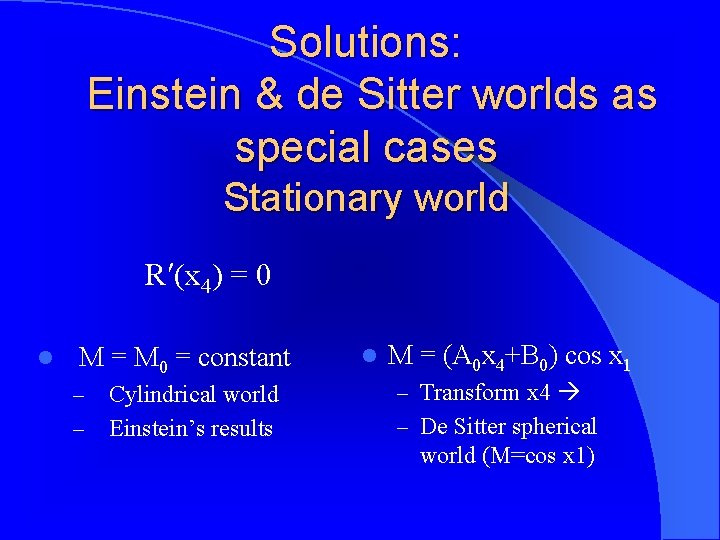
Solutions: Einstein & de Sitter worlds as special cases Stationary world R (x 4) = 0 l M = M 0 = constant – – Cylindrical world Einstein’s results l M = (A 0 x 4+B 0) cos x 1 – Transform x 4 – De Sitter spherical world (M=cos x 1)
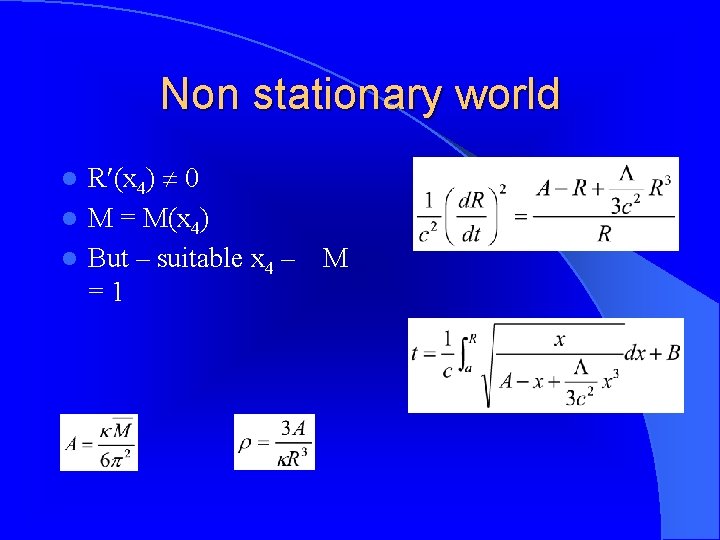
Non stationary world R (x 4) 0 l M = M(x 4) l But – suitable x 4 – =1 l M
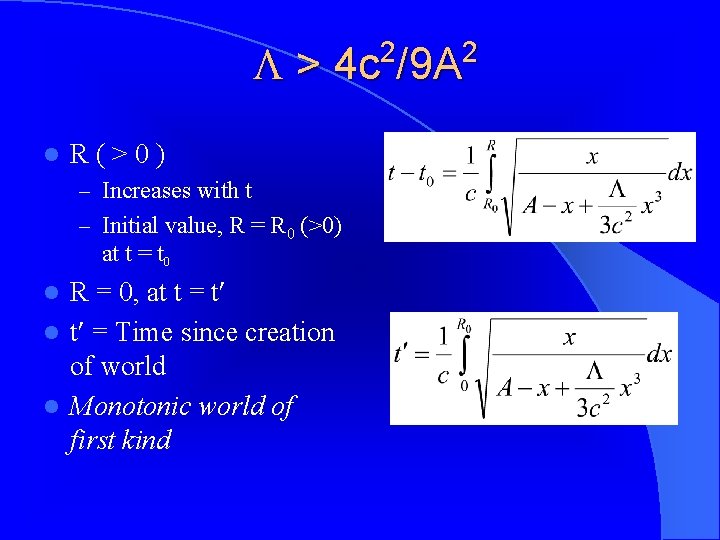
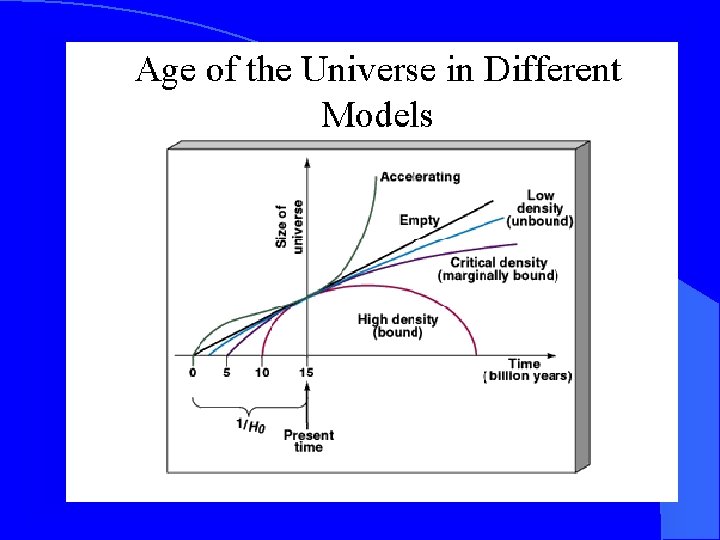
> 4 c /9 A 2 l R(>0) – Increases with t – Initial value, R = R 0 (>0) at t = t 0 R = 0, at t = t l t = Time since creation of world l Monotonic world of first kind l 2
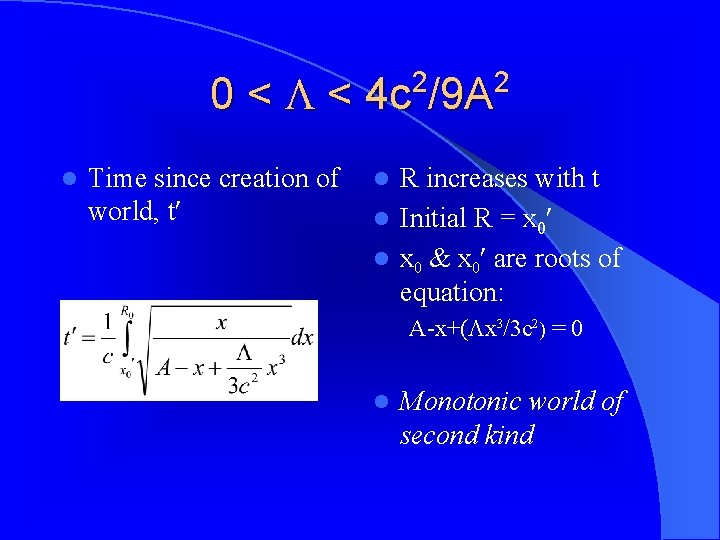
0 < < 4 c /9 A 2 l Time since creation of world, t 2 R increases with t l Initial R = x 0 l x 0 & x 0 are roots of equation: l A-x+( x 3/3 c 2) = 0 l Monotonic world of second kind
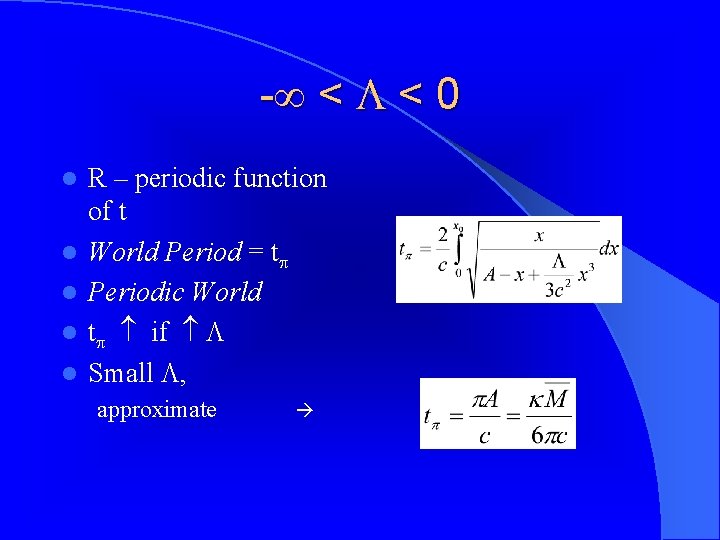
- < < 0 l l l R – periodic function of t World Period = t Periodic World t if Small , approximate
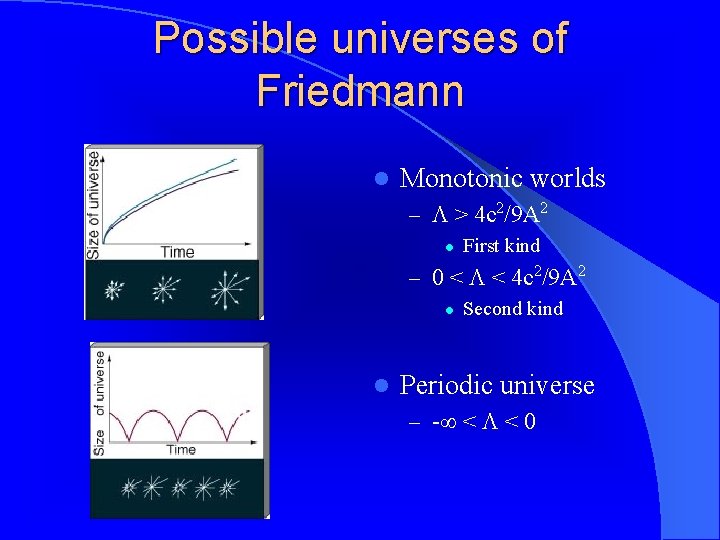
Possible universes of Friedmann l Monotonic worlds – > 4 c 2/9 A 2 l First kind – 0 < < 4 c 2/9 A 2 l l Second kind Periodic universe – - < < 0
Conclusions l Insufficient data to conclude which world our universe is … l Cosmological constant, is undetermined … l If = 0, M = 5 1021 M – Then, world period = 10 billion yrs – But this only illustrates calculation
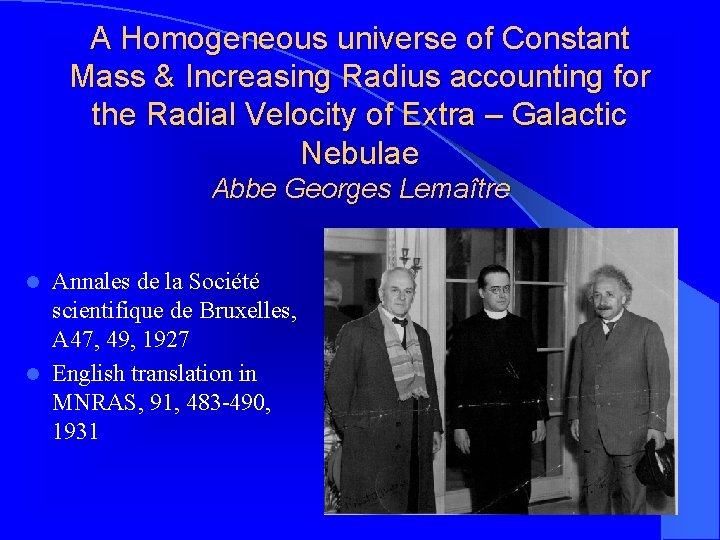
A Homogeneous universe of Constant Mass & Increasing Radius accounting for the Radial Velocity of Extra – Galactic Nebulae Abbe Georges Lemaître Annales de la Société scientifique de Bruxelles, A 47, 49, 1927 l English translation in MNRAS, 91, 483 -490, 1931 l
Summary l Dilemma between de Sitter & Einstein world models l Intermediate solution – advantages of both l R = R(t) – R(t) as t – Similar differential equation of R(t) as Friedmann
Summary cont’d. … l Accounted the following: – Conservation of energy – Matter density – Radiation pressure l l Role in early stages of expansion of universe First idea: – Recession velocities of galaxies are results of expansion of universe – Universe expanding from initial singularity, the ‘primeval atom’
Intermediate model l Solution intermediate to Einstein & De Sitter worlds – Both material content & explaining recession of galaxies l Look for Einstein universe – Radius varying with time arbitrarily
Assumptions of model Universe ~ Sparsely dense gas l Molecules ~ galaxies l l – p = (2/3) K. E. – Negligible w. r. t energy of matter l – Uniformly distributed l Ignore local condensation Radiation pressure of E. M. wave – Weak – Evenly distributed – Density – uniform in space, time variable Internal stresses ~ Pressure Keep p in general eqn l For astronomical applications, p = 0 l
Field equations : conservation of energy l Einstein field equations – = Cosmological Constant (unknown) – = Einstein Constant l Total energy change + Work done by radiation pressure in the expanding universe =0
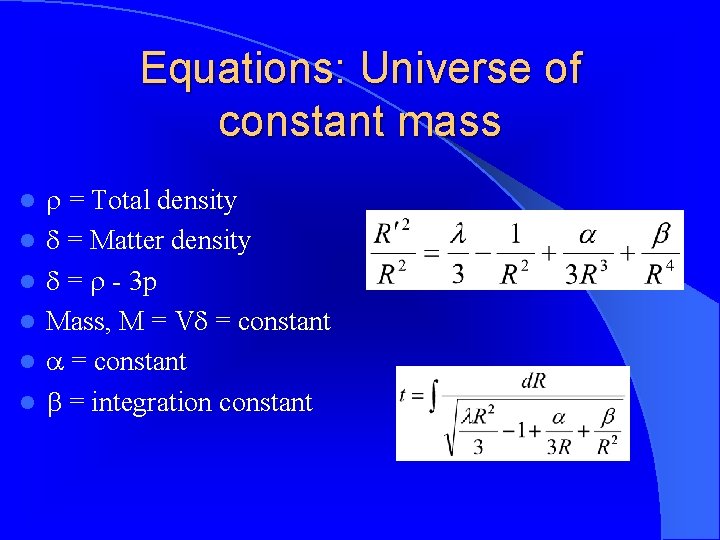
Equations: Universe of constant mass l l l = Total density = Matter density = - 3 p Mass, M = V = constant = integration constant
Existing solutions l De Sitter =0 =0 world l Einstein world =0 R = constant
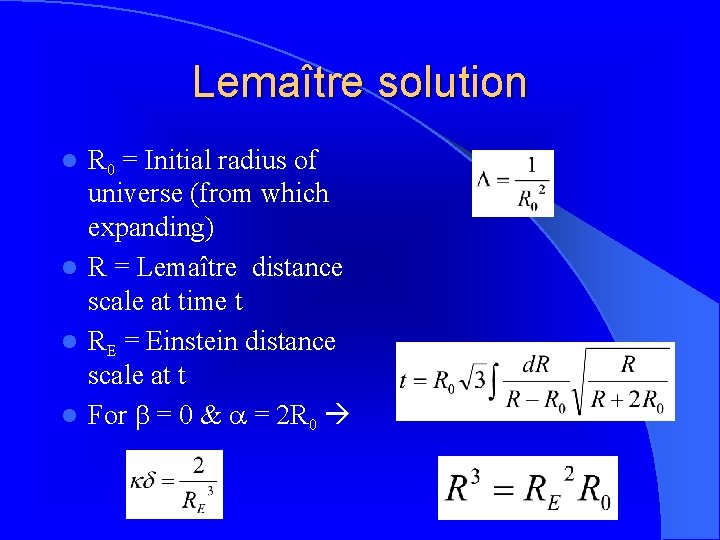
Lemaître solution R 0 = Initial radius of universe (from which expanding) l R = Lemaître distance scale at time t l RE = Einstein distance scale at t l For = 0 & = 2 R 0 l
Solution
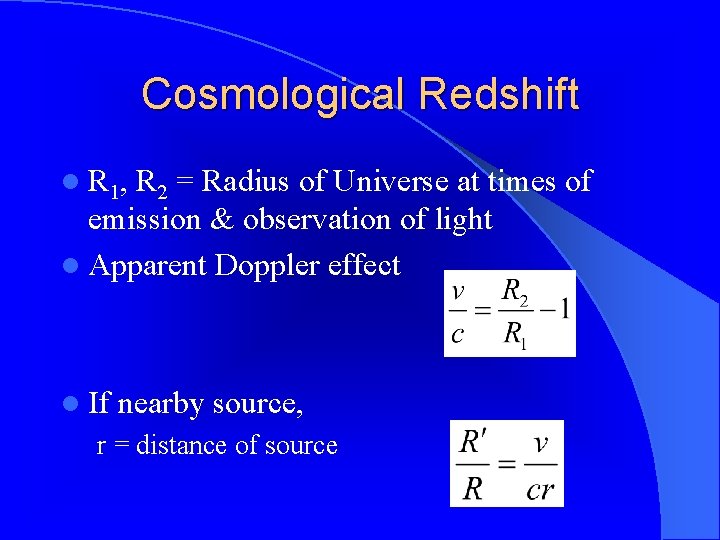
Cosmological Redshift l R 1, R 2 = Radius of Universe at times of emission & observation of light l Apparent Doppler effect l If nearby source, r = distance of source
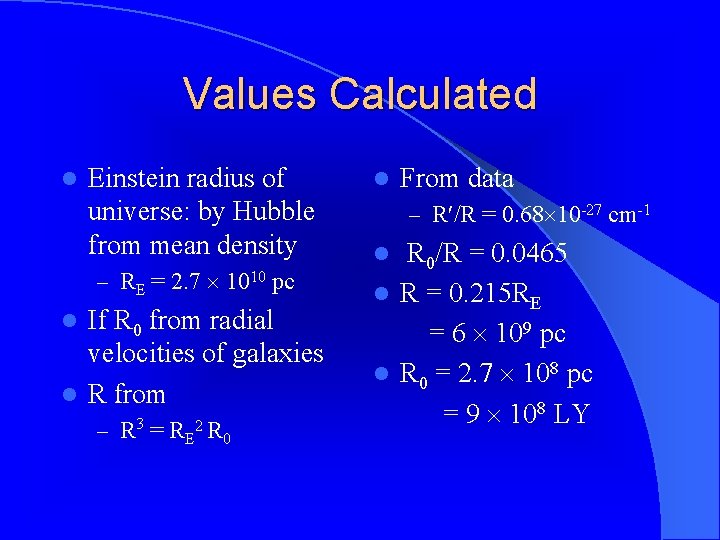
Values Calculated l Einstein radius of universe: by Hubble from mean density – RE = 2. 7 1010 pc If R 0 from radial velocities of galaxies l R from l – R 3 = R E 2 R 0 l From data – R /R = 0. 68 10 -27 cm-1 R 0/R = 0. 0465 l R = 0. 215 RE = 6 109 pc l R 0 = 2. 7 108 pc = 9 108 LY l
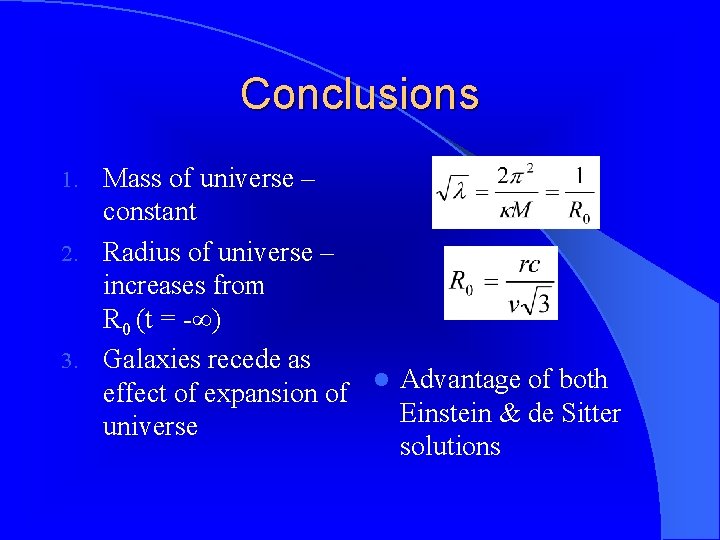
Conclusions Mass of universe – constant 2. Radius of universe – increases from R 0 (t = - ) 3. Galaxies recede as effect of expansion of l Advantage of both Einstein & de Sitter universe solutions 1.
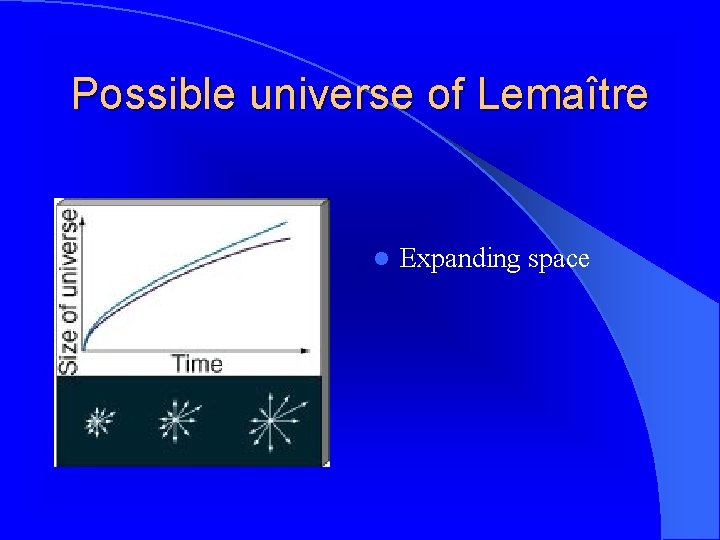
Possible universe of Lemaître l Expanding space
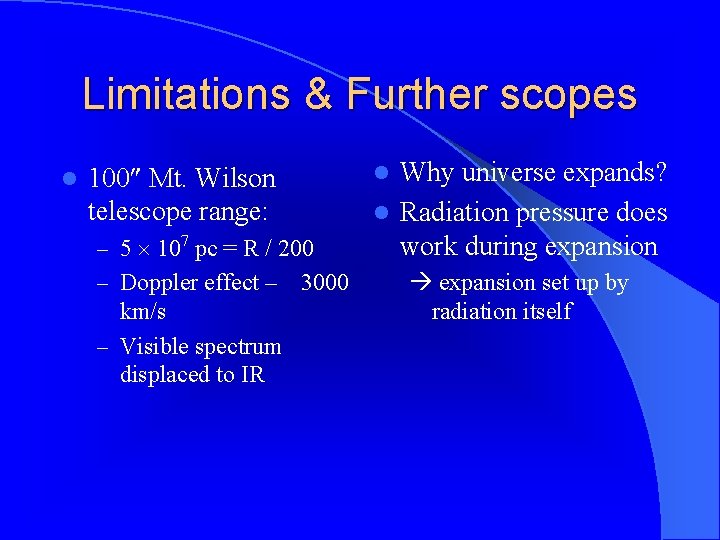
Limitations & Further scopes l – 5 107 pc = R / 200 – Doppler effect – km/s – Visible spectrum displaced to IR Why universe expands? l Radiation pressure does work during expansion l 100 Mt. Wilson telescope range: 3000 expansion set up by radiation itself
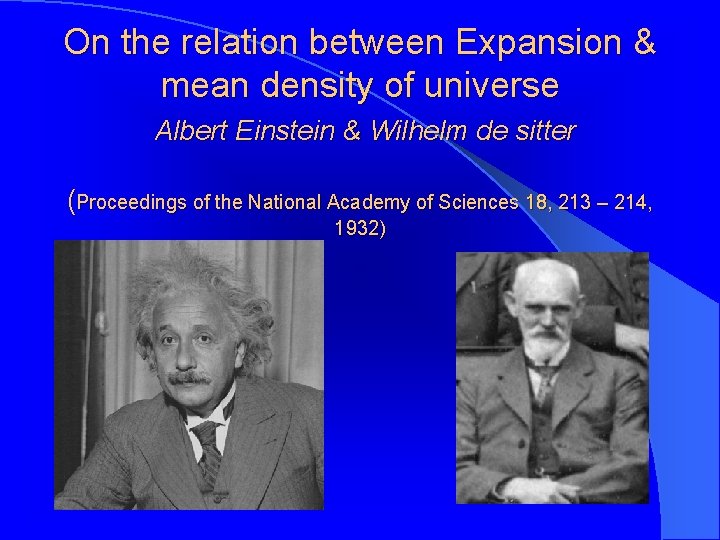
On the relation between Expansion & mean density of universe Albert Einstein & Wilhelm de sitter (Proceedings of the National Academy of Sciences 18, 213 – 214, 1932)
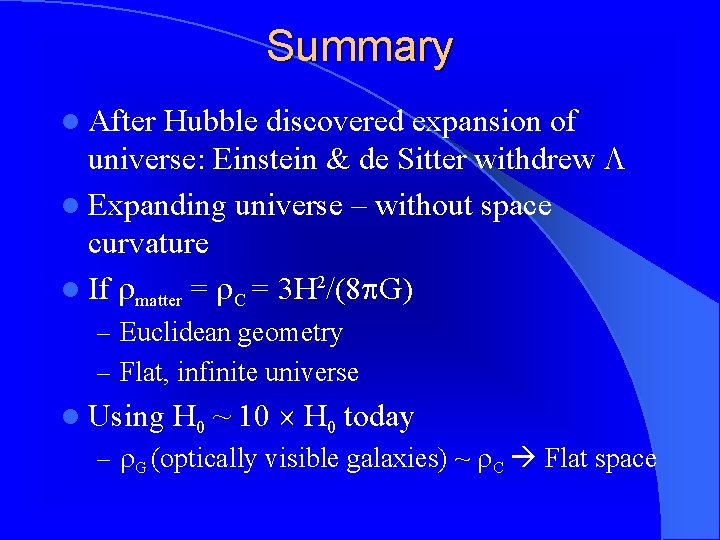
Summary l After Hubble discovered expansion of universe: Einstein & de Sitter withdrew l Expanding universe – without space curvature l If matter = C = 3 H 2/(8 G) – Euclidean geometry – Flat, infinite universe l Using H 0 ~ 10 H 0 today – G (optically visible galaxies) ~ C Flat space
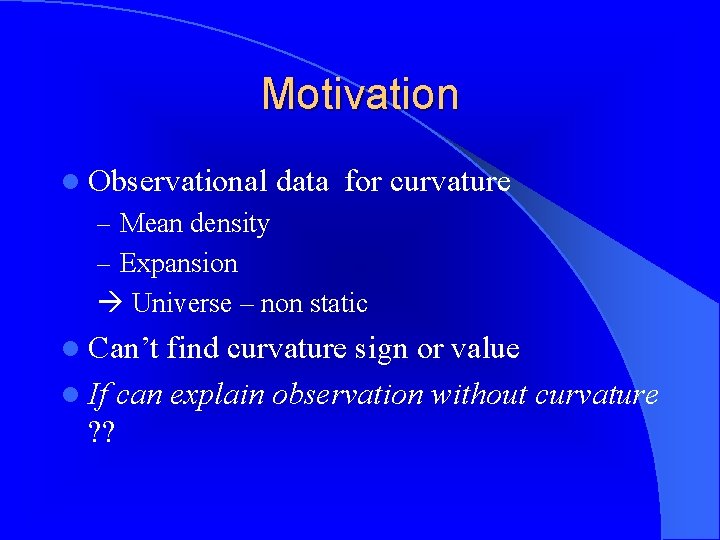
Motivation l Observational data for curvature – Mean density – Expansion Universe – non static l Can’t find curvature sign or value l If can explain observation without curvature ? ?
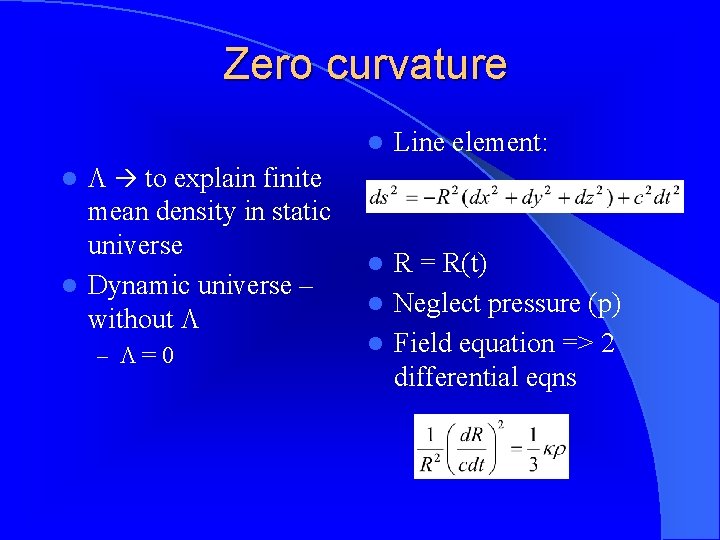
Zero curvature l to explain finite mean density in static universe l Dynamic universe – without Line element: l – =0 R = R(t) l Neglect pressure (p) l Field equation => 2 differential eqns l
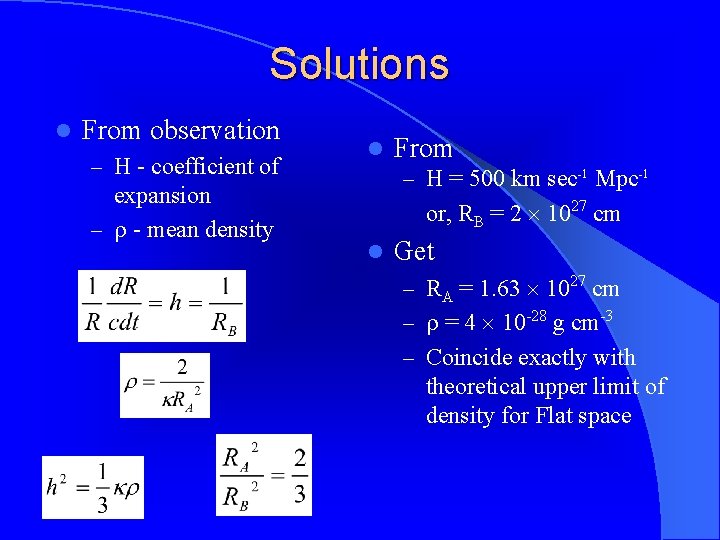
Solutions l From observation – H - coefficient of expansion – - mean density l From – H = 500 km sec-1 Mpc-1 or, RB = 2 1027 cm l Get – RA = 1. 63 1027 cm – = 4 10 -28 g cm-3 – Coincide exactly with theoretical upper limit of density for Flat space
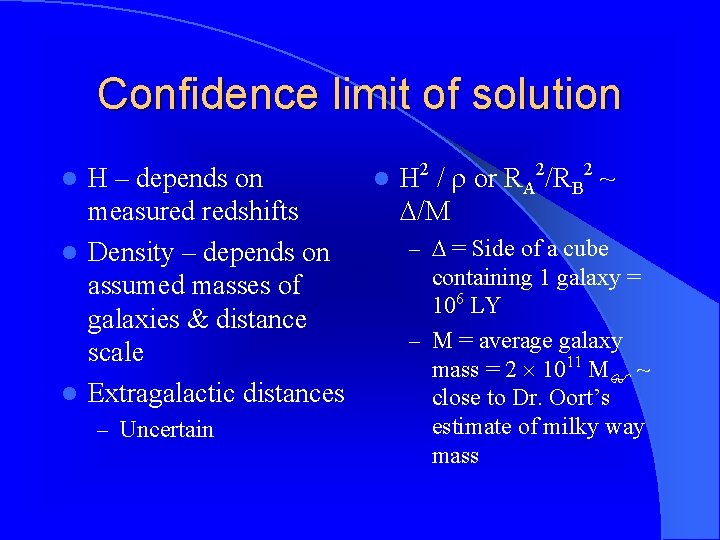
Confidence limit of solution H – depends on measured redshifts l Density – depends on assumed masses of galaxies & distance scale l Extragalactic distances l – Uncertain l H 2 / or RA 2/RB 2 ~ /M – = Side of a cube containing 1 galaxy = 106 LY – M = average galaxy mass = 2 1011 M ~ close to Dr. Oort’s estimate of milky way mass
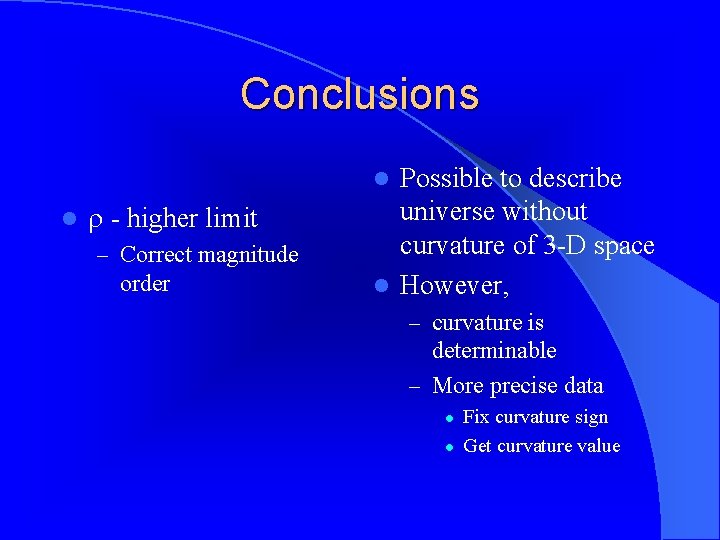
Conclusions Possible to describe universe without curvature of 3 -D space l However, l l - higher limit – Correct magnitude order – curvature is determinable – More precise data l l Fix curvature sign Get curvature value
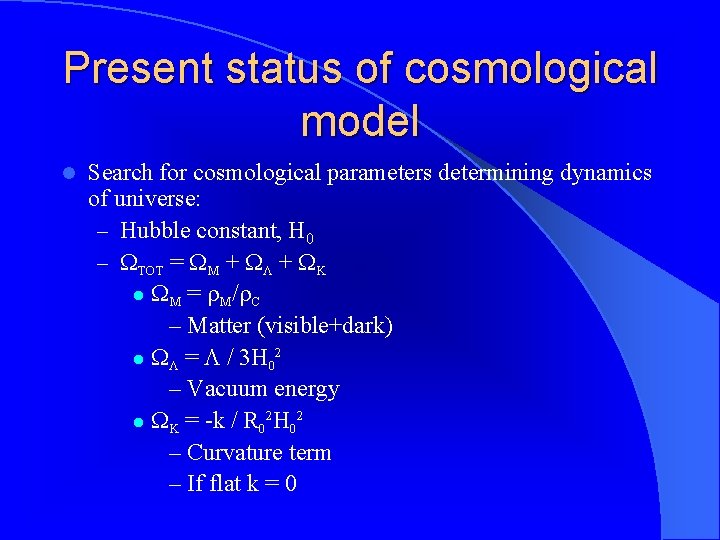
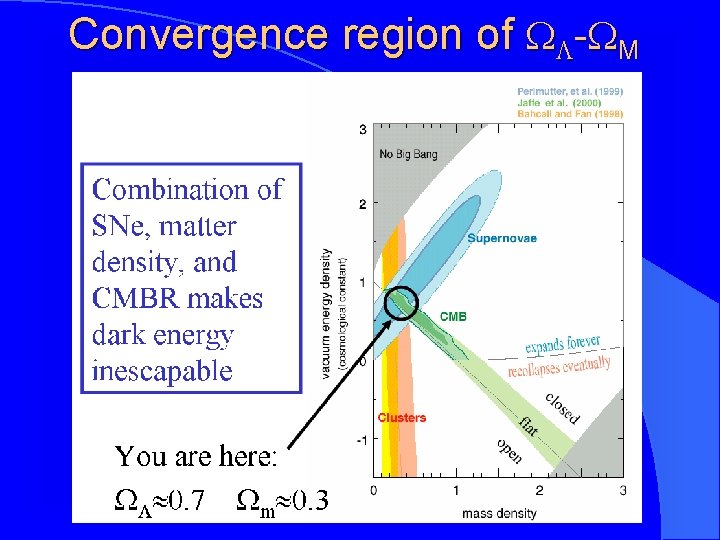
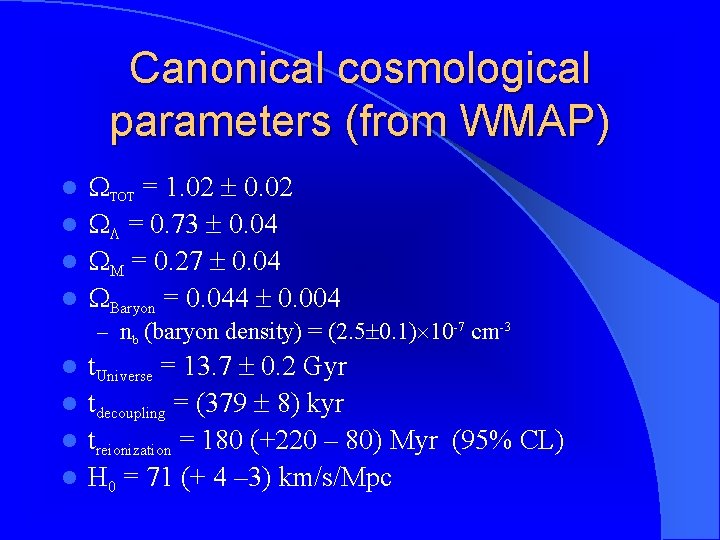
Present status of cosmological model l Search for cosmological parameters determining dynamics of universe: – Hubble constant, H 0 – TOT = M + + K l M = M/ C – Matter (visible+dark) 2 l = / 3 H 0 – Vacuum energy 2 2 l K = -k / R 0 H 0 – Curvature term – If flat k = 0
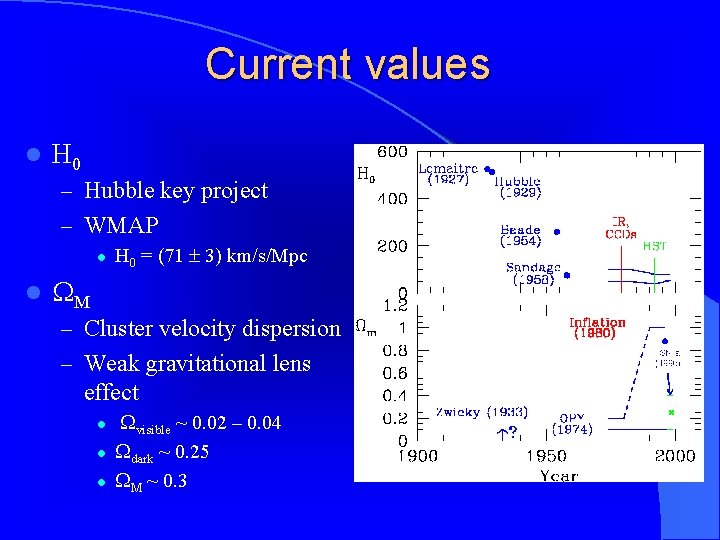
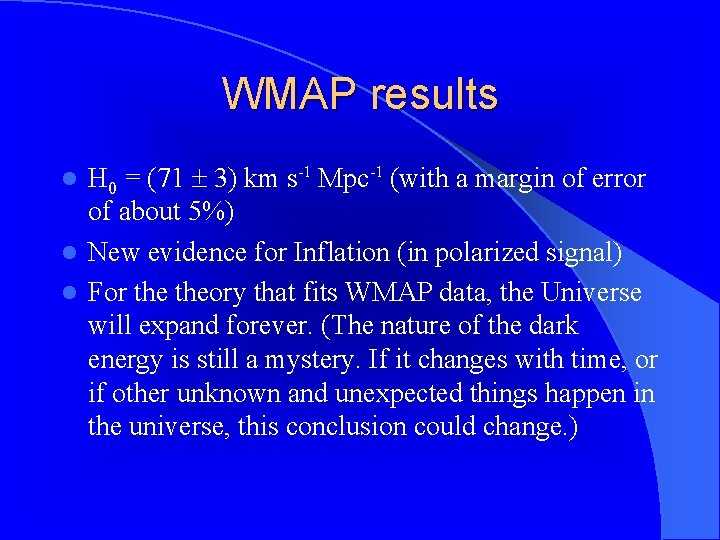
Current values l H 0 – Hubble key project – WMAP l l H 0 = (71 3) km/s/Mpc M – Cluster velocity dispersion – Weak gravitational lens effect l l l visible ~ 0. 02 – 0. 04 dark ~ 0. 25 M ~ 0. 3
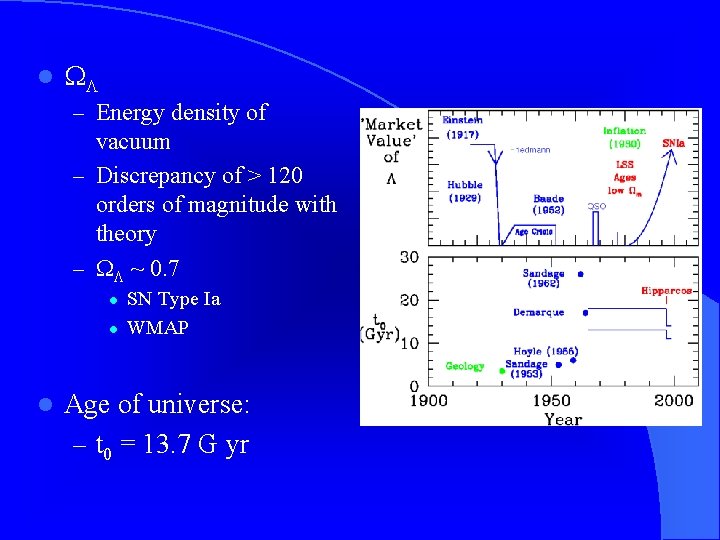
l – Energy density of vacuum – Discrepancy of > 120 orders of magnitude with theory – ~ 0. 7 l l l SN Type Ia WMAP Age of universe: – t 0 = 13. 7 G yr
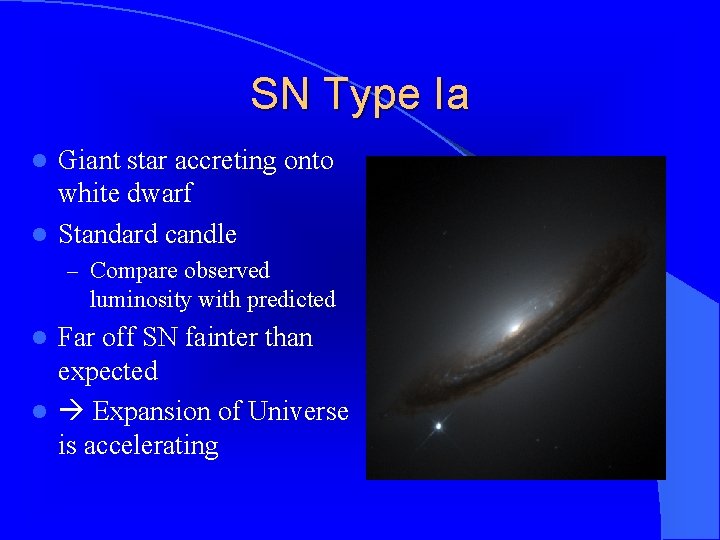
SN Type Ia Giant star accreting onto white dwarf l Standard candle l – Compare observed luminosity with predicted Far off SN fainter than expected l Expansion of Universe is accelerating l
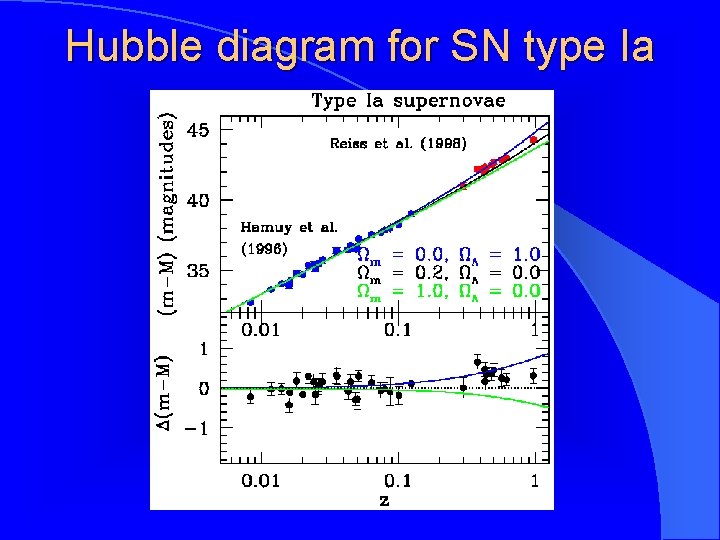
Hubble diagram for SN type Ia
Microwave background fluctuations l Brightest microwave background fluctuations (spots): 1 deg across l Ground & balloon based experiments – Flat – 15 % accuracy l WMAP – Measures basic parameters of Big Bang theory & geometry of universe – Flat – 2 % accuracy
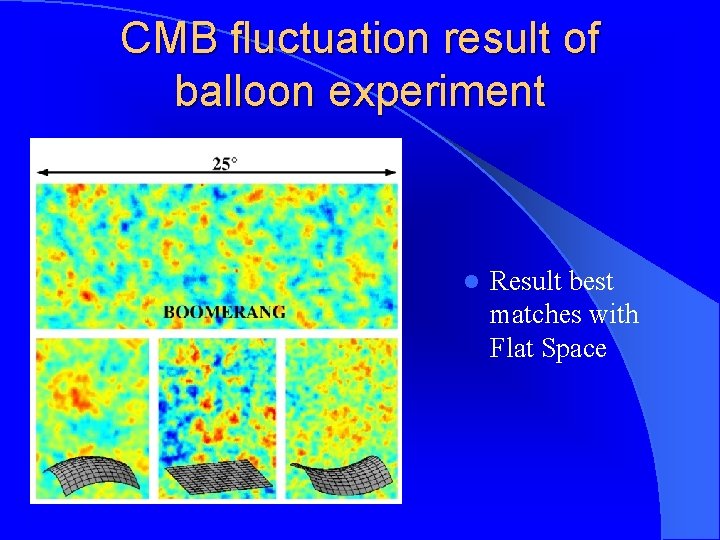
CMB fluctuation result of balloon experiment l Result best matches with Flat Space
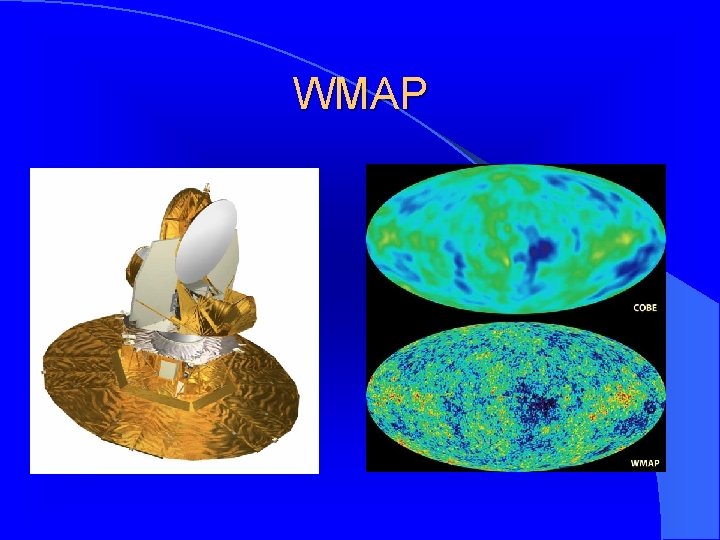
WMAP
Convergence region of - M
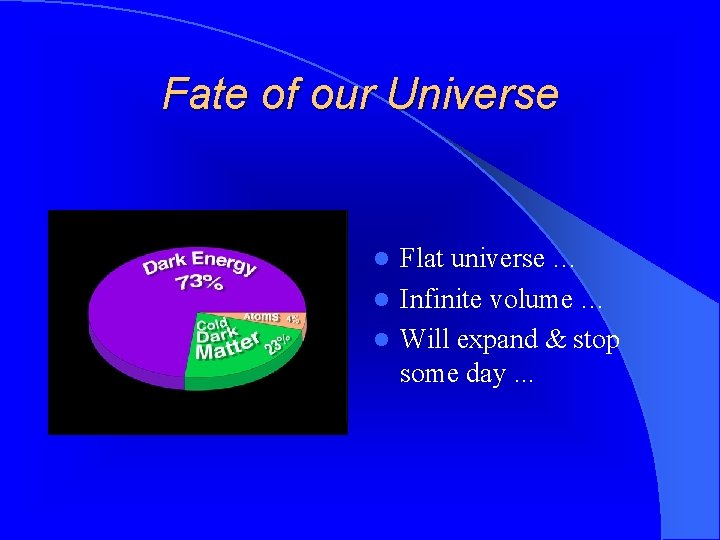
WMAP result summary Light in WMAP picture from 379, 000 years after Big Bang l First stars ignited 200 million years after Big Bang l Contents of Universe : l – 4 % atoms, 23 % Cold Dark Matter, 73 % Dark Energy Data places new constraints on nature of dark energy (? ? ) l Fast moving neutrinos do not play any major role in evolution of structure of universe. They would have prevented the early clumping of gas in the universe, delaying the emergence of the first stars, in conflict with new WMAP data. l
WMAP results H 0 = (71 3) km s-1 Mpc-1 (with a margin of error of about 5%) l New evidence for Inflation (in polarized signal) l For theory that fits WMAP data, the Universe will expand forever. (The nature of the dark energy is still a mystery. If it changes with time, or if other unknown and unexpected things happen in the universe, this conclusion could change. ) l
Canonical cosmological parameters (from WMAP) TOT = 1. 02 0. 02 l = 0. 73 0. 04 l M = 0. 27 0. 04 l Baryon = 0. 044 0. 004 l – nb (baryon density) = (2. 5 0. 1) 10 -7 cm-3 t. Universe = 13. 7 0. 2 Gyr l tdecoupling = (379 8) kyr l treionization = 180 (+220 – 80) Myr (95% CL) l H 0 = 71 (+ 4 – 3) km/s/Mpc l
Possible kinds of universe
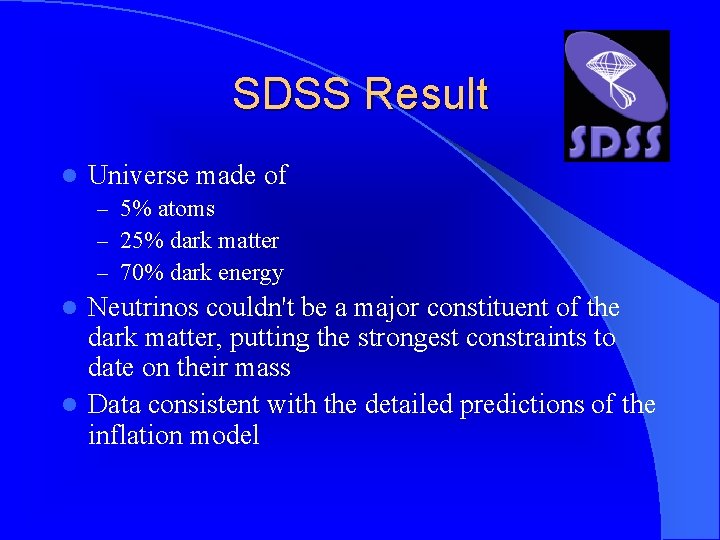
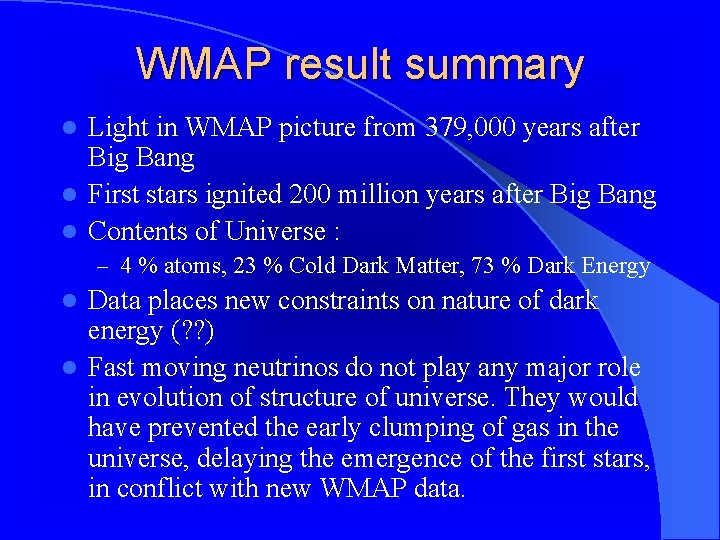
SDSS Result l Universe made of – 5% atoms – 25% dark matter – 70% dark energy Neutrinos couldn't be a major constituent of the dark matter, putting the strongest constraints to date on their mass l Data consistent with the detailed predictions of the inflation model l
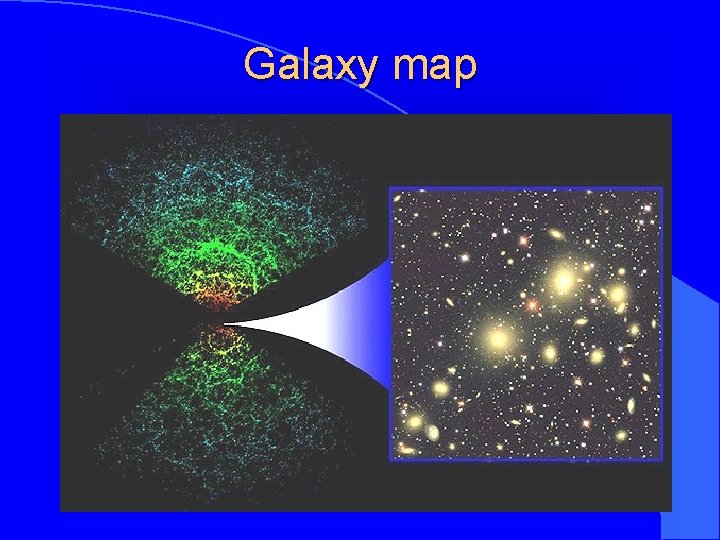
Galaxy map
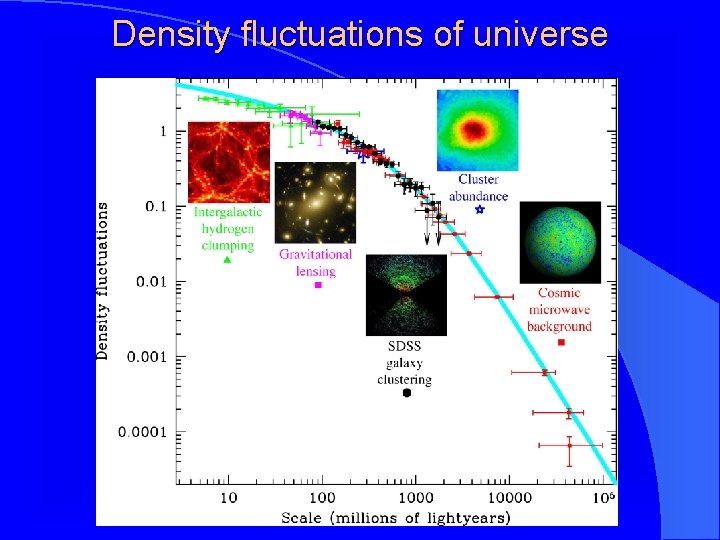
Density fluctuations of universe
Fate of our Universe Flat universe … l Infinite volume … l Will expand & stop some day. . . l

Thank you all …
- Slides: 62