
EARLY MOBILIZATION FOLLOWING ELBOW DISLOCATION IMMOBILIZATION AND Grant
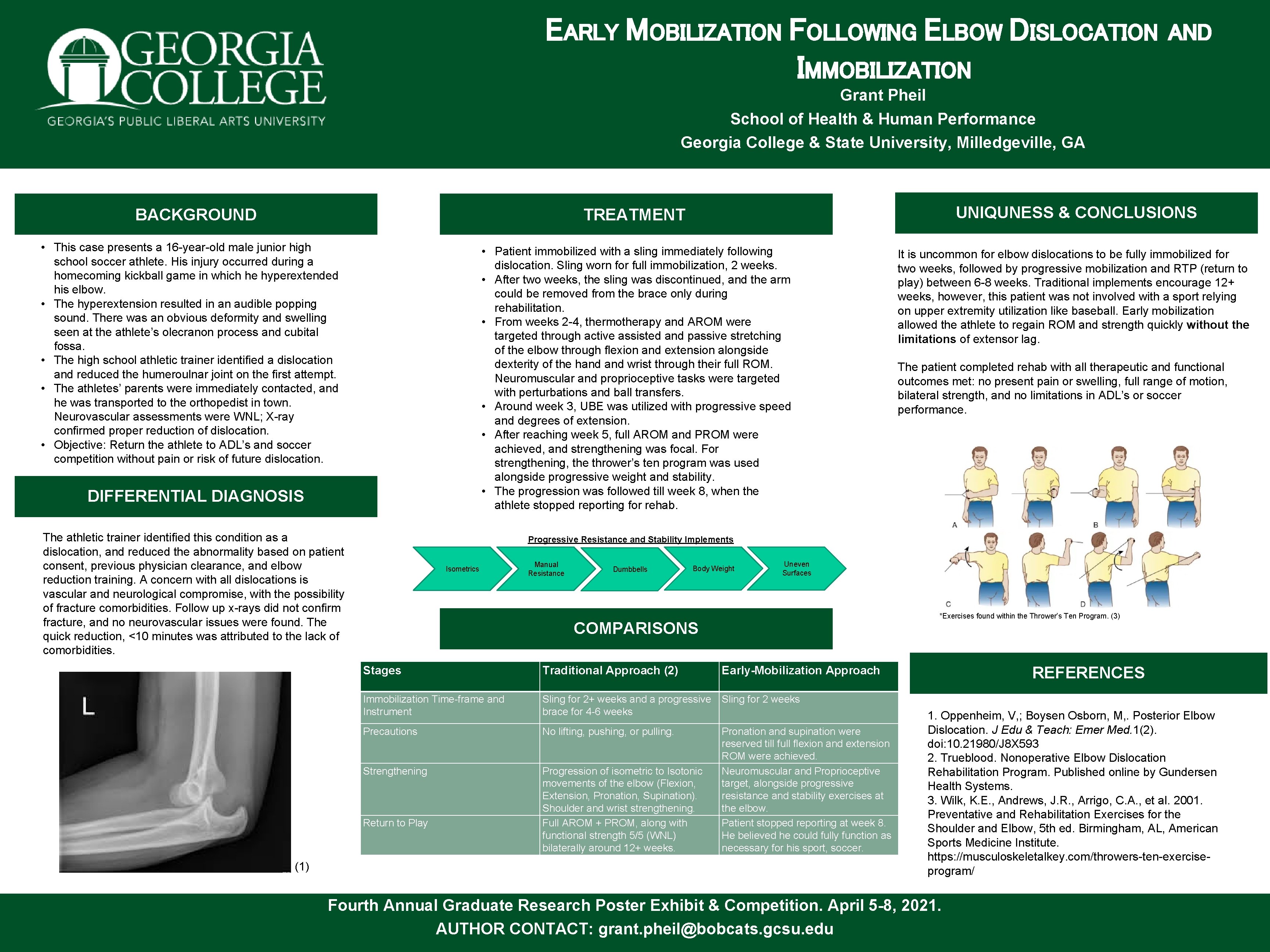
EARLY MOBILIZATION FOLLOWING ELBOW DISLOCATION IMMOBILIZATION AND Grant Pheil School of Health & Human Performance Georgia College & State University, Milledgeville, GA TREATMENT UNIQUNESS & CONCLUSIONS • Patient immobilized with a sling immediately following dislocation. Sling worn for full immobilization, 2 weeks. • After two weeks, the sling was discontinued, and the arm could be removed from the brace only during rehabilitation. • From weeks 2 -4, thermotherapy and AROM were targeted through active assisted and passive stretching of the elbow through flexion and extension alongside dexterity of the hand wrist through their full ROM. Neuromuscular and proprioceptive tasks were targeted with perturbations and ball transfers. • Around week 3, UBE was utilized with progressive speed and degrees of extension. • After reaching week 5, full AROM and PROM were achieved, and strengthening was focal. For strengthening, the thrower’s ten program was used alongside progressive weight and stability. • The progression was followed till week 8, when the athlete stopped reporting for rehab. It is uncommon for elbow dislocations to be fully immobilized for two weeks, followed by progressive mobilization and RTP (return to play) between 6 -8 weeks. Traditional implements encourage 12+ weeks, however, this patient was not involved with a sport relying on upper extremity utilization like baseball. Early mobilization allowed the athlete to regain ROM and strength quickly without the limitations of extensor lag. BACKGROUND • This case presents a 16 -year-old male junior high school soccer athlete. His injury occurred during a homecoming kickball game in which he hyperextended his elbow. • The hyperextension resulted in an audible popping sound. There was an obvious deformity and swelling seen at the athlete’s olecranon process and cubital fossa. • The high school athletic trainer identified a dislocation and reduced the humeroulnar joint on the first attempt. • The athletes’ parents were immediately contacted, and he was transported to the orthopedist in town. Neurovascular assessments were WNL; X-ray confirmed proper reduction of dislocation. • Objective: Return the athlete to ADL’s and soccer competition without pain or risk of future dislocation. DIFFERENTIAL DIAGNOSIS The athletic trainer identified this condition as a dislocation, and reduced the abnormality based on patient consent, previous physician clearance, and elbow reduction training. A concern with all dislocations is vascular and neurological compromise, with the possibility of fracture comorbidities. Follow up x-rays did not confirm fracture, and no neurovascular issues were found. The quick reduction, <10 minutes was attributed to the lack of comorbidities. Progressive Resistance and Stability Implements Isometrics Manual Resistance Dumbbells Body Weight Uneven Surfaces *Exercises found within the Thrower’s Ten Program. (3) COMPARISONS Stages Traditional Approach (2) Early-Mobilization Approach Immobilization Time-frame and Instrument Sling for 2+ weeks and a progressive brace for 4 -6 weeks Sling for 2 weeks Precautions No lifting, pushing, or pulling. Strengthening Progression of isometric to Isotonic movements of the elbow (Flexion, Extension, Pronation, Supination). Shoulder and wrist strengthening. Full AROM + PROM, along with functional strength 5/5 (WNL) bilaterally around 12+ weeks. Pronation and supination were reserved till full flexion and extension ROM were achieved. Neuromuscular and Proprioceptive target, alongside progressive resistance and stability exercises at the elbow. Patient stopped reporting at week 8. He believed he could fully function as necessary for his sport, soccer. Return to Play (1) The patient completed rehab with all therapeutic and functional outcomes met: no present pain or swelling, full range of motion, bilateral strength, and no limitations in ADL’s or soccer performance. REFERENCES 1. Oppenheim, V, ; Boysen Osborn, M, . Posterior Elbow Dislocation. J Edu & Teach: Emer Med. 1(2). doi: 10. 21980/J 8 X 593 2. Trueblood. Nonoperative Elbow Dislocation Rehabilitation Program. Published online by Gundersen Health Systems. 3. Wilk, K. E. , Andrews, J. R. , Arrigo, C. A. , et al. 2001. Preventative and Rehabilitation Exercises for the Shoulder and Elbow, 5 th ed. Birmingham, AL, American Sports Medicine Institute. https: //musculoskeletalkey. com/throwers-ten-exerciseprogram/ Fourth Annual Graduate Research Poster Exhibit & Competition. April 5 -8, 2021. AUTHOR CONTACT: grant. pheil@bobcats. gcsu. edu
- Slides: 1