
Early Mesopotamia 3500 B C 146 B C
Early Mesopotamia 3500 B. C. ~ 146 B. C.
Mesopotamia means “land between two river” in Greek
3500 B. C. ~ 2004 B. C. THE SUMER
The First Civilization • Sumer was the first civilization ever known – Located in Mesopotamia (a. k. a. Fertile Crescent) – In between Tigris, Euphrates River
Geography of Mesopotamia • Northern Mesopotamia – Foothills of Taurus and Zagros mountain chain • Southern Mesopotamia – Plain land, Good soil
Fertile Crescent • • Most in Mesopotamia Is a good land to farm Hot Lands are rich with nutrient – Good land because of two rivers’ overflow
Two Rivers • Tigris & Euphrates River – Flood ; carries silt to land • • Land fresh Flood too less-land not fresh Flood enough-good Flood too much-wash away city

Technology - I • Made Irrigation Canals – Water crops – Crops-able to get water in hot summer

Technology - II • Before dropped seed in furrow by hand – When oxen made furrows…… – Seeds automatically dropped inside
Sumerians were…… •
Governing System • War period, priest chose military leaders – After war, military leader had to be normal • They stayed in power, claimed as king • Supported priest to stay in power – Took away many priest’s job
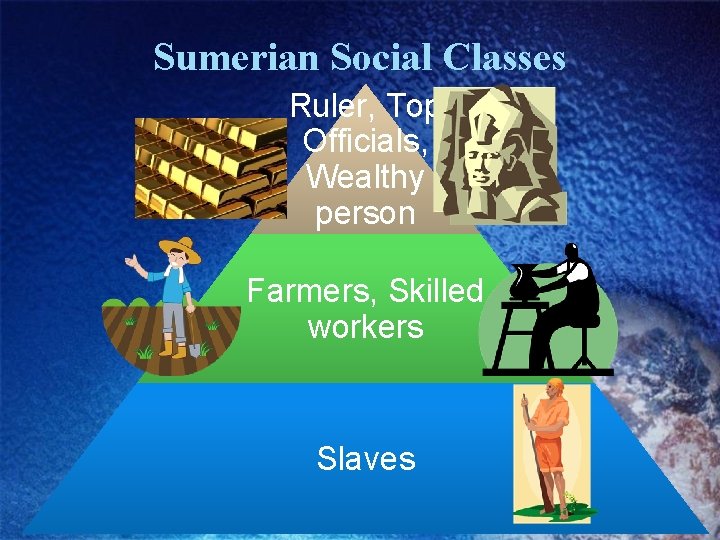
Sumerian Social Classes Ruler, Top Officials, Wealthy person Farmers, Skilled workers Slaves
2334 B. C. -2193 B. C. AKKADIAN EMPIRE
The First Empire
Conflict • There was conflict in Sumerian City-States – There was Akkadia, north of Sumer • Different from Sumer
Sargon • Became king of Sumerian City-State, Kush – His army conquered many City-States. – After having Empire, loyal Akkadian at high position – Ruled for 50 years • After his death, Akkadia fell, Zagros mountain warriors took away.
Between Akkadia and Babylon…… • Ur! – 2100 B. C. – Ur-Nammu law code • First law code ever known! – Rebellion ended Ur
1900 B. C. ~ 1600 B. C. OLD BABYLONIAN EMPIRE
Old Babylon • Babylon, an unimportant land – Amorites took over Sumer including Babylon • Hammurabi conquered city states including Babylon • Made Babylon the center of Babylon
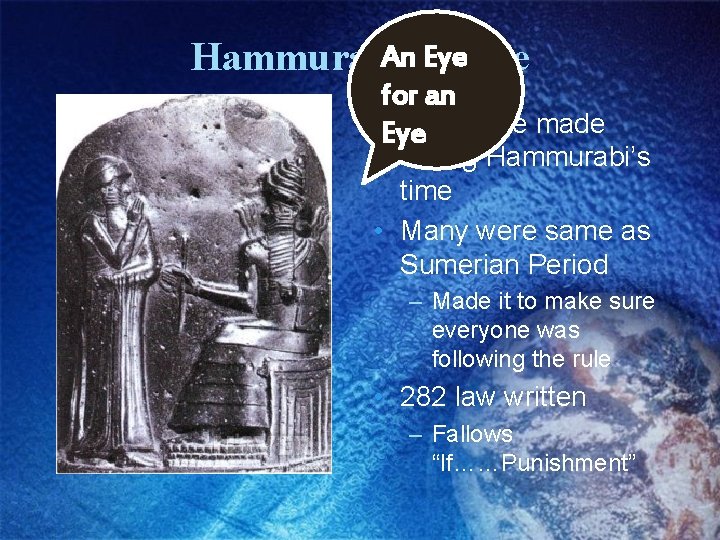
An Eye Hammurabi’s Code for an • Eye Law code made during Hammurabi’s time • Many were same as Sumerian Period – Made it to make sure everyone was following the rule • 282 law written – Fallows “If……Punishment”
Hammurabi’s Code-How about us? • Introduced Rule of Law – Everyone must get punished; Strong people too! • Punishment of higher hitting lower is less than…… • Lower hitting higher • Hammurabi’s Code give us idea of Babylon’s life

Babylon’s Life • Most people lived with farming • Cities people bought, sold goods • Used new technology to make tools
934 B. C. -612 B. C. ASSYRIAN EMPIRE
Assyrians • Frequent war made Assyrians fierced Warriors • Had one of the world’s first calvary – Calvary is soldiers riding horse – Territory stretched from Persian Gulf to Egypt
Governing • Divided into 70 Provinces • Assigned ruler for each – Rulers reported to the Assyrian ruler
Ashurbanipal • Assyrian Ruler • Nineveh as capital • Built library and filled with cuneiform tablet – About law, math, science, etc. – 20, 000 survive today • After his death, civil war & New Empire arose
626 B. C. -539 B. C. NEO-BABYLONIAN EMPIRE
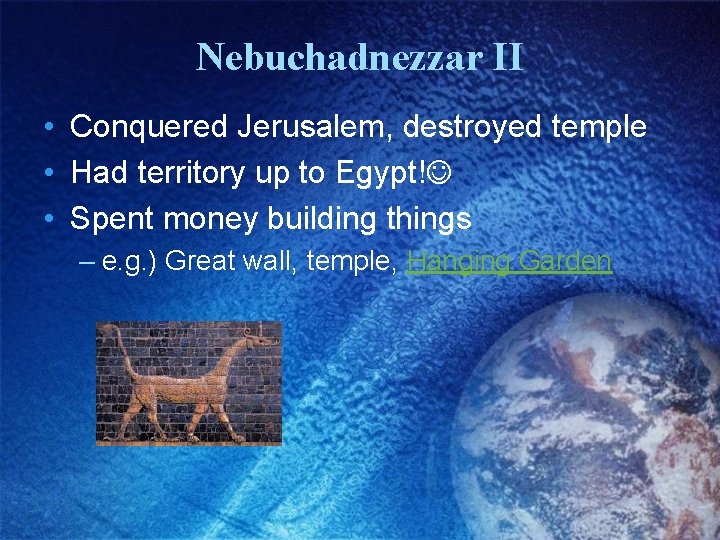
Nebuchadnezzar II • Conquered Jerusalem, destroyed temple • Had territory up to Egypt! • Spent money building things – e. g. ) Great wall, temple, Hanging Garden
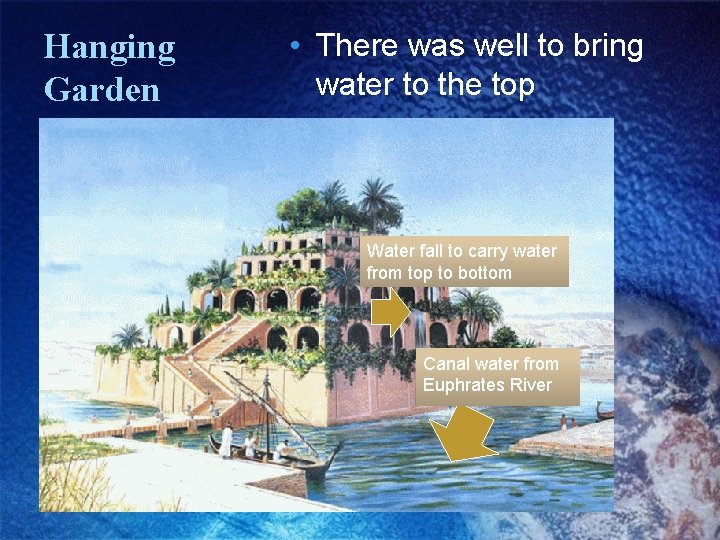
Hanging Garden • There was well to bring water to the top Water fall to carry water from top to bottom Canal water from Euphrates River
539 B. C. -331 B. C. PERSIAN EMPIRE
History • Ruled my Medes – Medes located from Iran to Zagros mountain – However, Cyrus the Great led Persia to conquer Medes! • Now Persia has an empire
The Dream of Cyrus the Great • Cyrus the Great dreamed to build a larger empire – Conquered…… • Turkey • Kingdom of Lydia • India • But how did they conquer?
Standing Army • Standing Army helped Persia conquer • Permanent army of professional soldiers • Made of 10, 000 elite soldiers – They were called immortals
Persian rule • Under Cyrus’s rule, Babylon became the wealthiest province • Cyrus treated his people well – Allowed Jewish to return and build their temple – However, Egypt was happy that Alexander freed them from Persia
Cambyses II • Son of Cyrus – Conquered Egypt • Attacked Kush – Failed • Lack of food in desert • Many died before invading

Darius the Great • Took power by force • Persia grew very large – Conquered…… • Indus Valley • War with Greece
War with Greece � Thrace � Conquered at first…… � However, Battle of Marathon and Battle of Salamis
Why did Persia attack? � Persia attacked Ionian city-states � Ionian rebelled in 500 B. C. � To help Ionians, Athens burned Sardis, Persian city Darius became angry, attacked Greece
Battle of Marathon � Persia had 20, 000 soldiers � Athens had 10, 000 soldiers only � Athens had no archers or cavalry However, Greek Phalanx raced across the plain Greeks won! � According to legend, messenger ran 26 miles from Marathon to Athens to announce they won …… And died
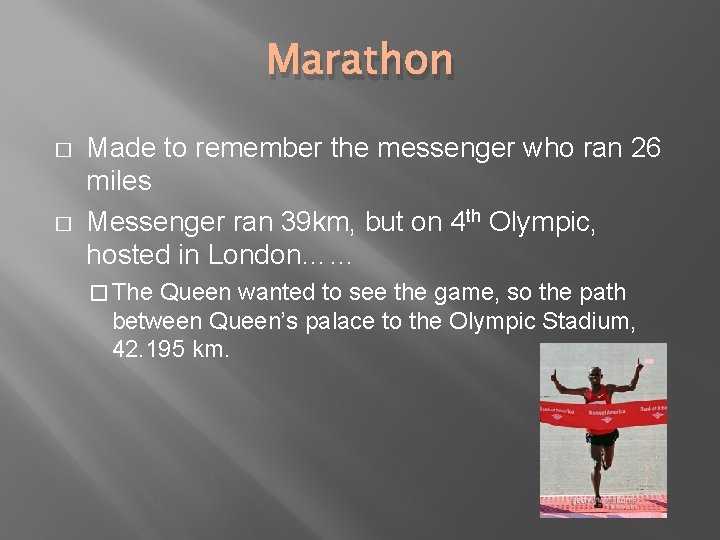
Marathon � � Made to remember the messenger who ran 26 miles Messenger ran 39 km, but on 4 th Olympic, hosted in London…… � The Queen wanted to see the game, so the path between Queen’s palace to the Olympic Stadium, 42. 195 km.
Wondering what Phalanx is? � � � Phalanx is foot soldiers who moved together They were citizen soldiers Had overlapping shield to each other Shield on left had, Spear or sword on right hand Well trained Phalanx could defend almost all force
Battle of Salamis-1 � � � Xerex, Darius’s son, brought 100, 000 soldiers Had Egyptian army and Phoenician navy Sparta tried to defend at Thermopylae � Greek traitor showed another path, so Sparta died
Battle of Salamis-2 � � � Now, Persia could attack Athens!! Athens moved to nearby island Athens was burnt Persian Ship-1. 200/Athens-400 However……Result
Result � � Themistocles had a trap! Greek ship hid at narrow strait � When Persian came, Greek attacked Persians ships stuck! � Persia lost 200 ships, Greeks lost 40 ships

Back to Darius……
Government-1 • Local self-Government – Country divided into provinces • Assigned ruler for each • Rulers had good amount of freedom • Allowed to keep tradition
Government-2 • Central control – Conquered people paid tribute • Amount set by wealth of people in the province
Currency • Face of himself in gold coin • Persian payment for good • Unified economy by making it able to trade with another
Zoroastrianism-1 • Most people believed in many gods • 600 B. C. – Zoroaster taught that there is one god, Ahura Mazda – Also told that there is evil opponent • Became the official religion of Persian Empire
Zoroastrianism-2 • Sacred Text-Avesta – Includes prayers, hymns, and other writings • Believes that universe is struggle between good and evil • Believes that people play important role playing in conflict • Believes in afterlife
1150 B. C. -146 B. C. PHOENICIANS
History • Developed from earlier Canaanites • Egypt controlled from around 1500 B. C. • Phoenician city-state began to emerge in 1150 B. C. , when Egyptian rule ended
Government • Rulers were priest-kings – Shared power leading merchants, citizen assembly
Geography • East, Lebanon Mountain • West Mediterranean coast – Had little land to farm

Manufacturing • Weavers-rare purple dye from tiny sea snails – Sold in high price • Also produced pottery, glass, metal object • Trees-wood furnitures
Trade • Few natural resources – Traded • Import: raw materials like gold, silver, tin, copper, ivory, precious stone • Export: bronze, silver bowls, iron tools, weapons, gold jewelry, cedar logs, wine, olive, oil, salt, fish, etc. • Trading Ship as much as 60 ft.
Navigation • First to navigate using North Star • Had knowledge of wind patterns, ocean current
Exploration • Explored unknown waters – North & Western Africa – Italian Peninsulas – Modern day Spain, Portugal – Britain • Explored to find precious metals
Colonization • At first, used as trading station – Ship stopped to get water, food, etc. • Fertile land-settlement, became colony – 800 s B. C. Assyrians attack! • Phoenicians arrived in colony safely Carthage
Carthage • One of Phoenician Colony, became powerful – Challenged Rome! – Eventually, Carthage lost all 3 wars(146 B. C. when destroyed) • At last, Phoenician colony became part of Rome

Legacy • Cultural Diffusion – Phoenician Culture Rome & Greek – Through Trade v. Alphabet
Alphabet • Alphabet is developed by Phoenicians – Small set of letter standing for each sound – 22 symbols • Writing was easier – Only had to memorize 22 symbols! • Greeks adopted Phoenician Alphabet • Traders of Phoenicians learned Alphabet to communicate
Greeks & Romans using Alphabet ØGreeks • 750 B. C. , Greeks started using Alphabet • 500 B. C. , Added vowels ØRomans • 100 B. C. , adopted Greek Alphabet – Changed few letters • Looks like our Alphabet today

Thank you!
- Slides: 64