
EARLY MANAGEMENT IDEAS CLASSICAL THEORISTS This viewpoint emphasises
- Slides: 30
EARLY MANAGEMENT IDEAS
CLASSICAL THEORISTS ‘This viewpoint emphasises efficiently managing work and organisations. It comprises three different management approaches: Scientific Administrative Bureaucratic
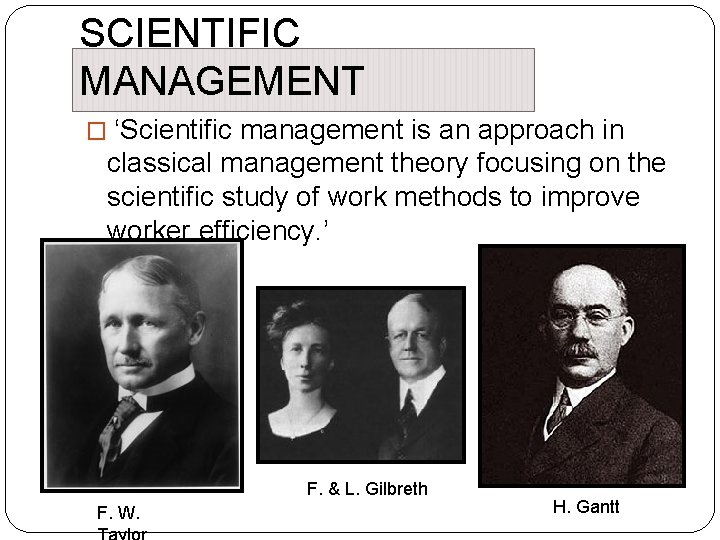
SCIENTIFIC MANAGEMENT � ‘Scientific management is an approach in classical management theory focusing on the scientific study of work methods to improve worker efficiency. ’ F. & L. Gilbreth F. W. H. Gantt
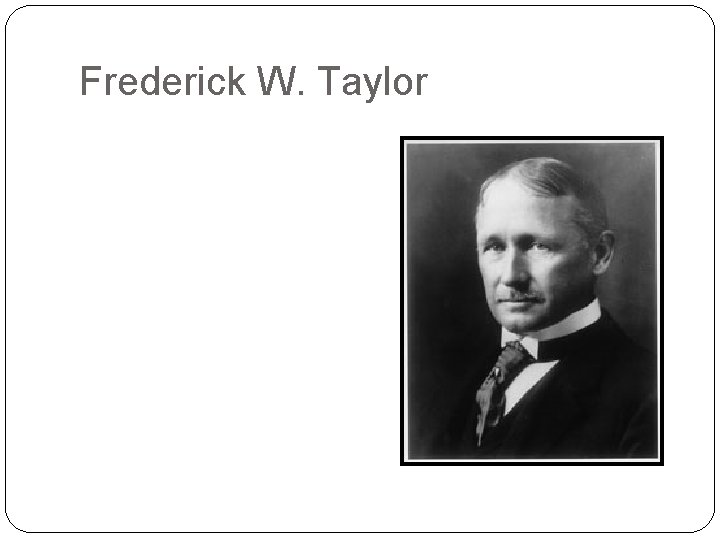
Frederick W. Taylor
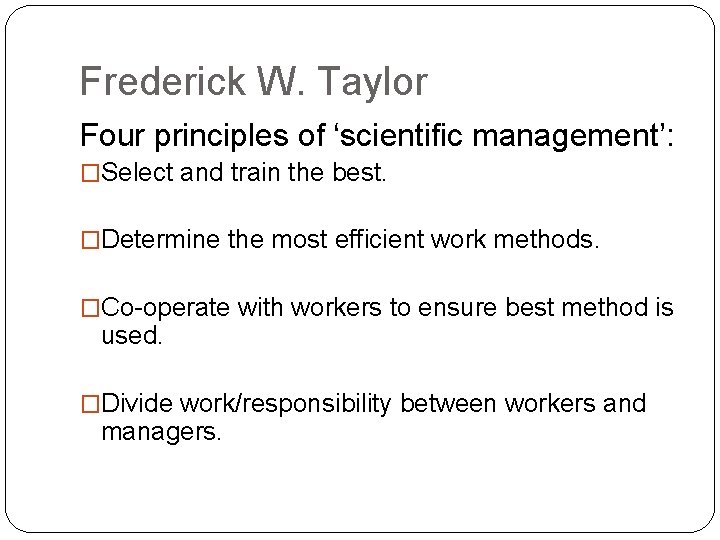
Frederick W. Taylor Four principles of ‘scientific management’: �Select and train the best. �Determine the most efficient work methods. �Co-operate with workers to ensure best method is used. �Divide work/responsibility between workers and managers.
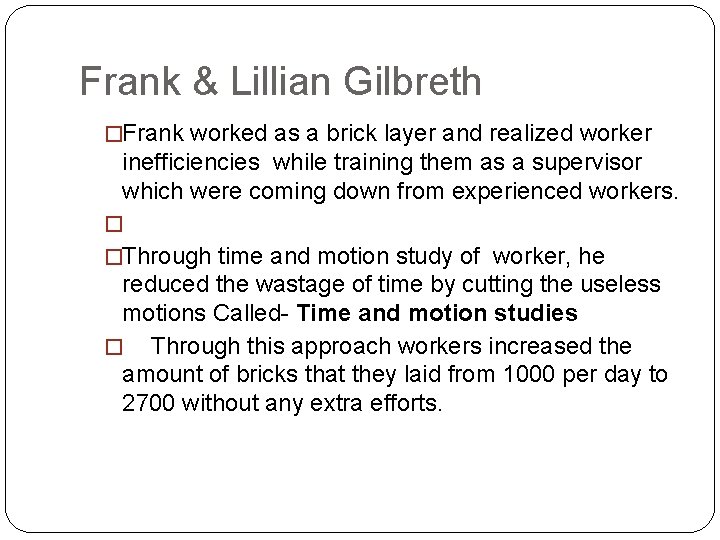
Frank & Lillian Gilbreth �Frank worked as a brick layer and realized worker inefficiencies while training them as a supervisor which were coming down from experienced workers. � �Through time and motion study of worker, he reduced the wastage of time by cutting the useless motions Called- Time and motion studies � Through this approach workers increased the amount of bricks that they laid from 1000 per day to 2700 without any extra efforts.
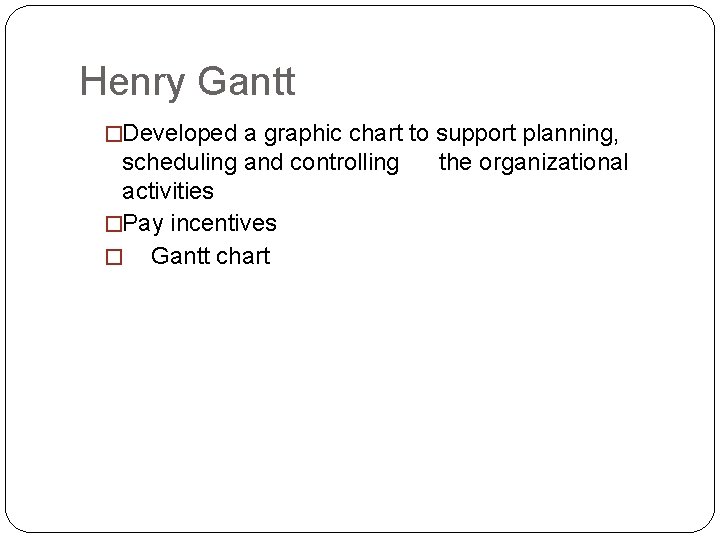
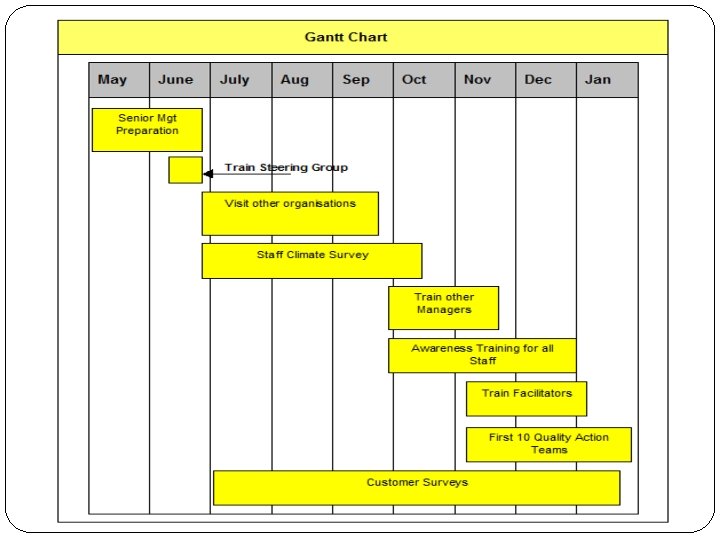
Henry Gantt �Developed a graphic chart to support planning, scheduling and controlling activities �Pay incentives � Gantt chart the organizational
BUREAUCRATIC MANAGEMENT � An Approach which ‘saw the need of an organisation to operate rationally rather than relying on the arbitrary whims of owners and managers. ’
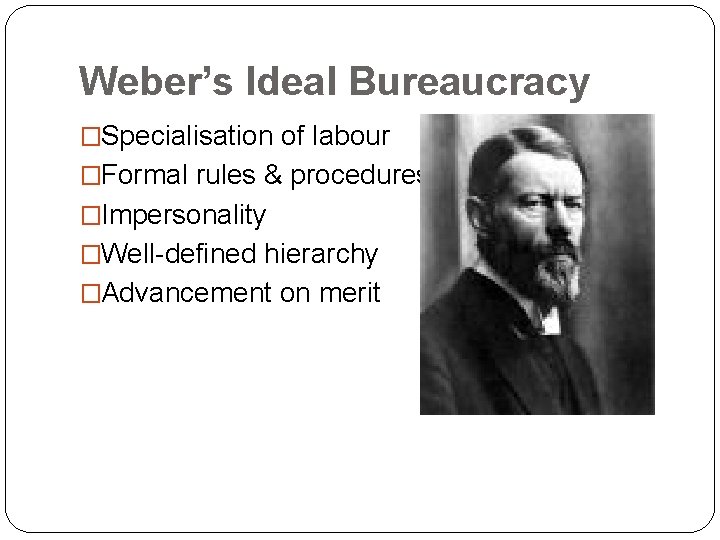
Max Weber (1864 -1920) �A German Sociologist who worked as a consultant, professor and author. �Weber initial ideas were against the class culture and the idea of favoritism. �Therefore he outlined the characteristics of ‘Ideal Bureaucracy’ – Weber actually coined the term bureaucracy. �Weber gave major characteristics of an ideal rational (Bureaucratic) organization.
Weber’s Ideal Bureaucracy �Specialisation of labour �Formal rules & procedures �Impersonality �Well-defined hierarchy �Advancement on merit
ADMINISTRATIVE MANAGEMENT � ‘Approach focused on principles for managers to co-ordinate organisations’ internal activities. ’
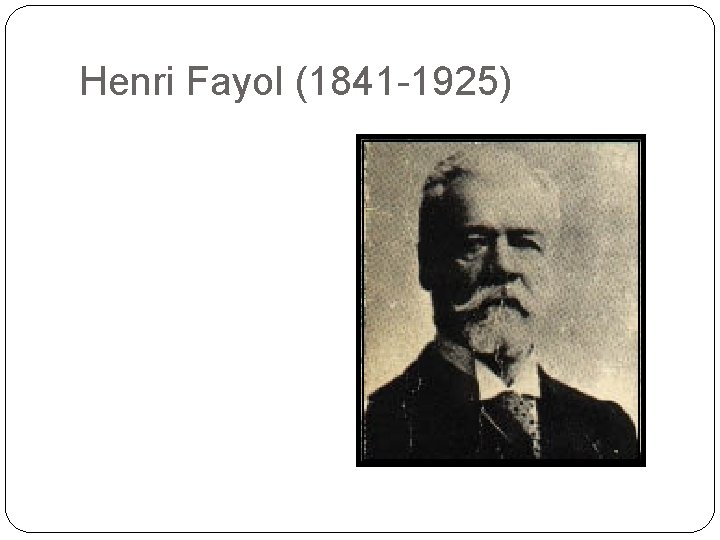
Henri Fayol (1841 -1925)
14 Principles of Management by Henry Fayol (1841 -1925) 1. 2. 3. 4. 5. 6. 7. Division of Work. Specialization allows the individual to build up experience, and to continuously improve his skills. Thereby he/she can become more productive. Authority. Right to give orders and the power to make employees obey. It should be derived from the formal authority of the concerning department, office or based on special features like intelligence, experience. Discipline. Employees must obey, but this is two-sided: employees will ONLY obey orders if management play their part by providing good leadership. Unity of Command. Each worker should have only one boss with no other conflicting lines of command. Unity of Direction. People engaged in the same kind of activities must have the same objectives in a single plan. This is essential to ensure unity and coordination in the enterprise. Subordination of individual interest (to the general interest). Management must see that the goals of the firms are always paramount. Remuneration. Payment is an important motivator and it should be fair on both the sides.
8) Centralization (or Decentralization). This is a matter of degree depending on the condition of the business, type of the business and the quality of its personnel. 9) Scalar chain (Line of Authority). A hierarchy is necessary for unity of direction. But lateral communication is also fundamental, as long as superiors know that such communication is taking place. Scalar chain refers to the number of levels in the hierarchy from the ultimate authority to the lowest level in the organization. It should not be over -stretched and consist of too-many levels. Every subordinate should keep its supervisor well informed about all the organizational happenings within his/her domain. 10) Order. There should be a proper, systematic and orderly arrangement of physical and social factors such as land, raw materials, equipments, employees etc. in short every thing should be used as fairly and equally as possible. 11) Equity. Kindness and Justice. All employees should be treated equally. 12) Stability of Tenure of Personnel. Employees work better if job security and career progress are assured to them. Time is required to become effective in new jobs also. 13) Initiative. Management should encourage and develop subordinate initiative to the fullest. 14) Esprit de Corps. Union is strength, harmony and teamwork are
Henri Fayol’s ‘Principles of Management’ � Division of work � Authority � Discipline � Unity of command/direction � Primacy of general interest � Remuneration � Esprit de corps � Centralisation � Scalar chain � Order � Equity � Low turnover � Initiative � Esprit De Corps
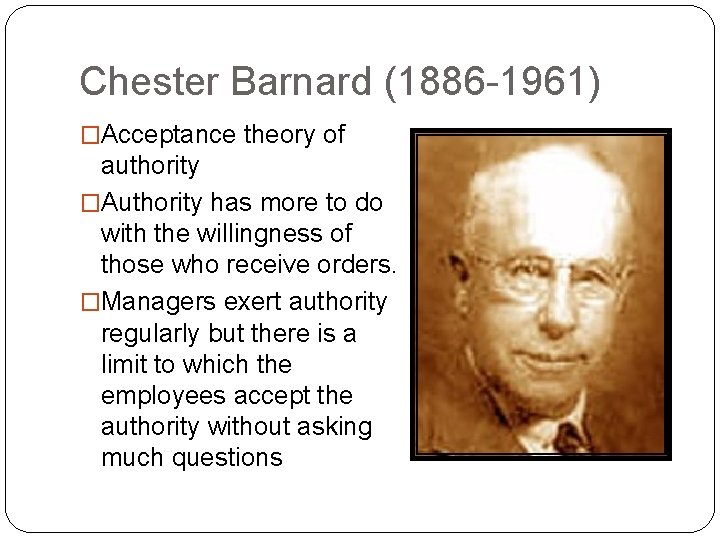
Chester Barnard (1886 -1961) �Acceptance theory of authority �Authority has more to do with the willingness of those who receive orders. �Managers exert authority regularly but there is a limit to which the employees accept the authority without asking much questions
Chester Barnard’s proposition Acceptance increases among employees if: �Understand the communication �See the communication as consistent with organizational purpose �Believe that actions asked for, suits both their need and the needs of the employer �See themselves as able mentally and physically to comply
2) BEHAVIOURAL VIEWPOINT � Perspective on management emphasising ‘the need to understand the effect of different factors on human behaviour in organisations. ’
Early Behavioural Theorists: �Hugo Munsterberg (Psychologist) Creating optimal psychological conditions, behaviour shaping Ø He argued that through studying the psychology and with the help of psychologists, organizations can study jobs and find out ways to get the best people for the company. Ø Secondly, his theory suggests that psychologists could also help industries to find out the psychological conditions in which employees are likely to do their best. Ø Lastly, theory also suggests that through psychology an organization could develop such strategies that would make employees to behave in such manner that is compatible with the management interests/needs/desires.
�Mary Parker Follett Importance of group functioning. She highlighted that members of organizations are completely influenced by groups within which they work. Therefore People perform far more better when they are in teams and have control and authority over their activities.
�Hawthorne studies Impact of the personal attention and group members relations plays a massive role in increasing productivity. Importance of supervisory style
Human relations movement �Abraham Maslow (Ph. D Psychology) Hierarchy of needs �Douglas Mc. Gregor Theory X & Y
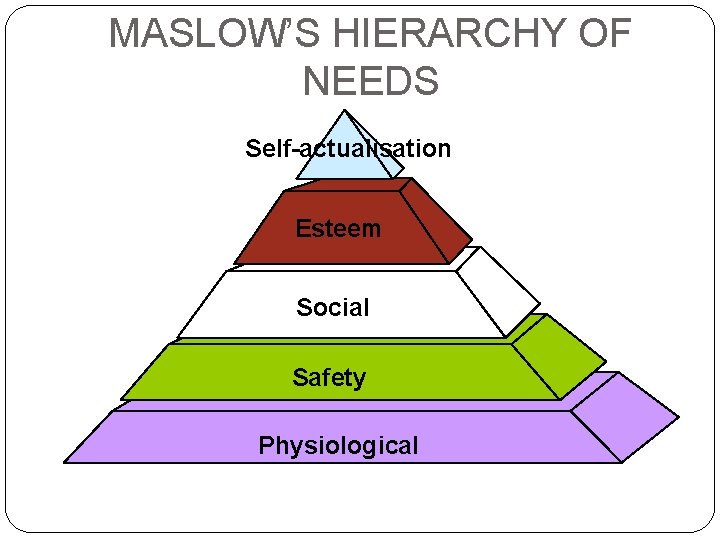
MASLOW’S HIERARCHY OF NEEDS Self-actualisation Esteem Social Safety Physiological
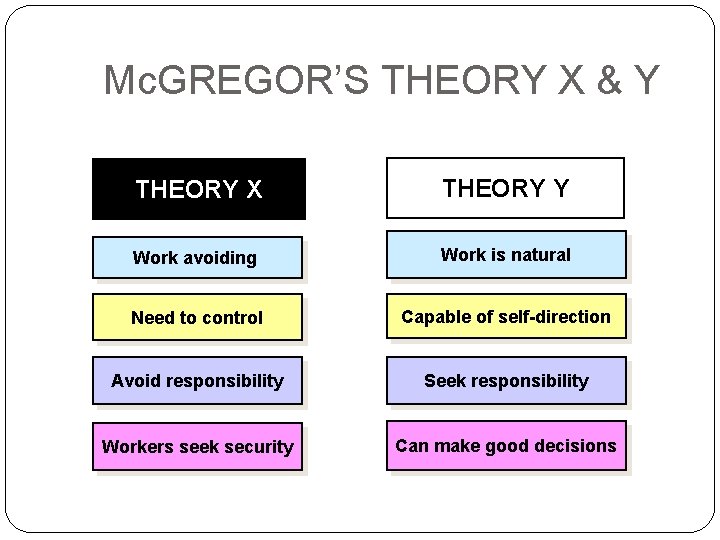
Mc. GREGOR’S THEORY X & Y THEORY X THEORY Y Work avoiding Work is natural Need to control Capable of self-direction Avoid responsibility Seek responsibility Workers seek security Can make good decisions
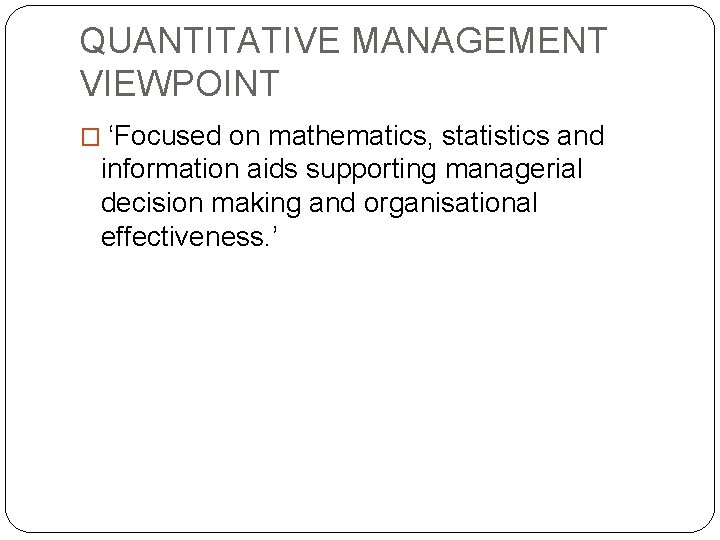
QUANTITATIVE MANAGEMENT VIEWPOINT � ‘Focused on mathematics, statistics and information aids supporting managerial decision making and organisational effectiveness. ’
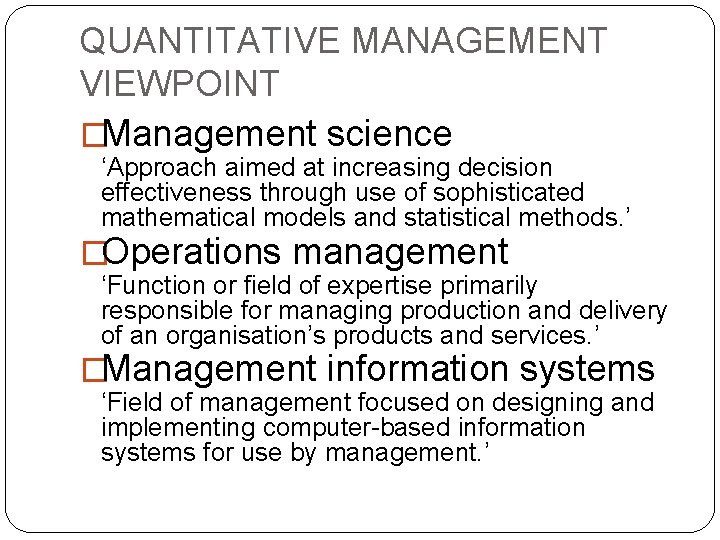
QUANTITATIVE MANAGEMENT VIEWPOINT �Management science ‘Approach aimed at increasing decision effectiveness through use of sophisticated mathematical models and statistical methods. ’ �Operations management ‘Function or field of expertise primarily responsible for managing production and delivery of an organisation’s products and services. ’ �Management information systems ‘Field of management focused on designing and implementing computer-based information systems for use by management. ’
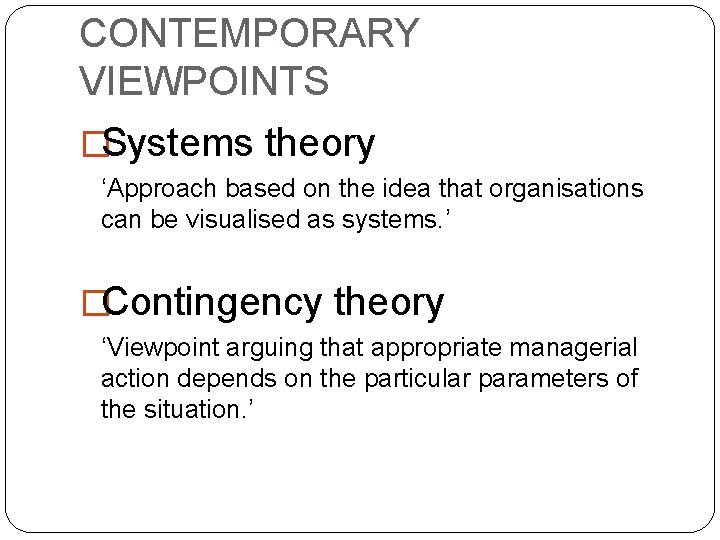
CONTEMPORARY VIEWPOINTS �Systems theory ‘Approach based on the idea that organisations can be visualised as systems. ’ �Contingency theory ‘Viewpoint arguing that appropriate managerial action depends on the particular parameters of the situation. ’
Theory Z �‘Concept combining positive aspects of American and Japanese management into a modified approach aimed at increasing managerial effectiveness while remaining compatible with the norms and values of American society and culture. ’
Total Quality Management (TQM) � ‘Approach highlighting collective responsibility for product and service quality, and encouraging individuals to work together to improve quality. ’