
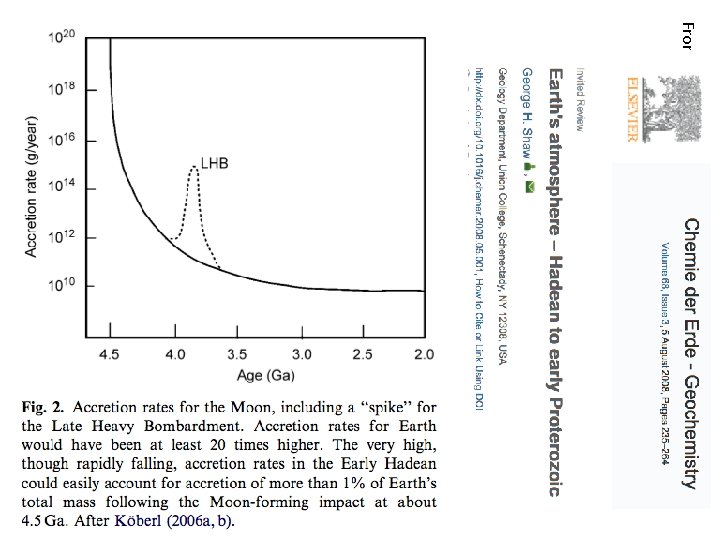
Early Life and the Late Heavy Bombardment Fig

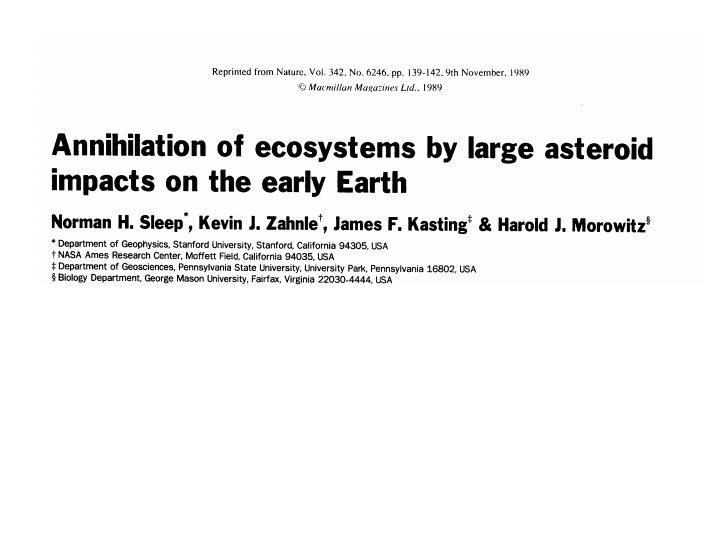
Early Life and the Late Heavy Bombardment
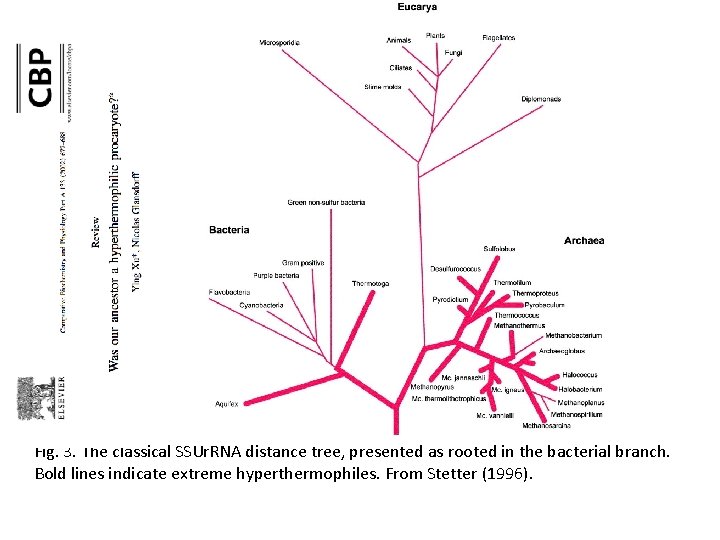
Fig. 3. The classical SSUr. RNA distance tree, presented as rooted in the bacterial branch. Bold lines indicate extreme hyperthermophiles. From Stetter (1996).
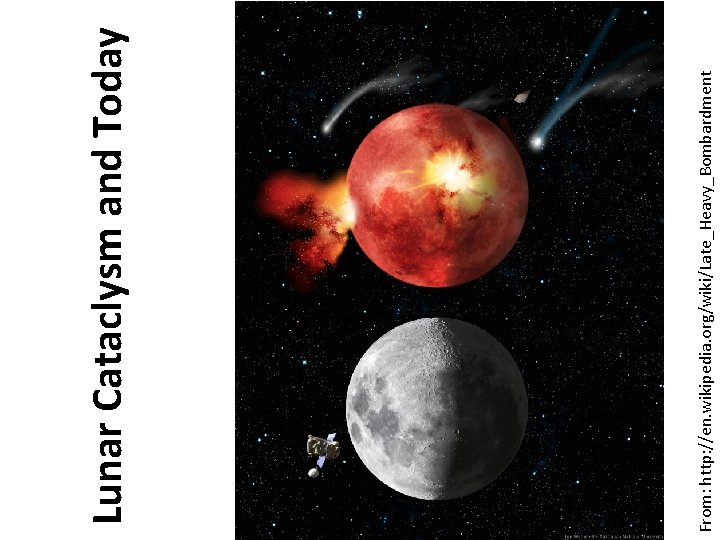
From: http: //en. wikipedia. org/wiki/Late_Heavy_Bombardment Lunar Cataclysm and Today
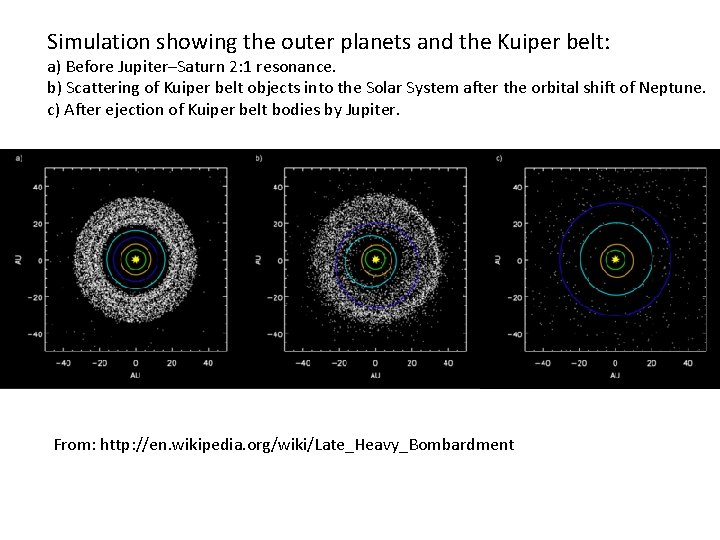
Simulation showing the outer planets and the Kuiper belt: a) Before Jupiter–Saturn 2: 1 resonance. b) Scattering of Kuiper belt objects into the Solar System after the orbital shift of Neptune. c) After ejection of Kuiper belt bodies by Jupiter. From: http: //en. wikipedia. org/wiki/Late_Heavy_Bombardment
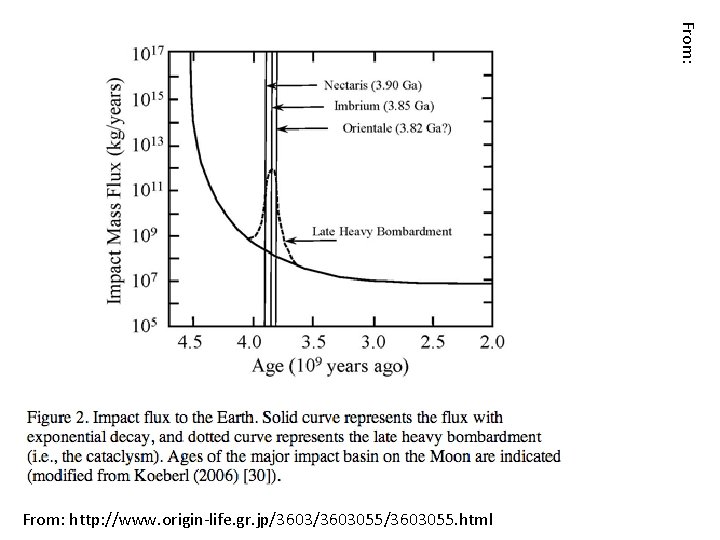
From: http: //www. origin-life. gr. jp/3603055/3603055. html
From:
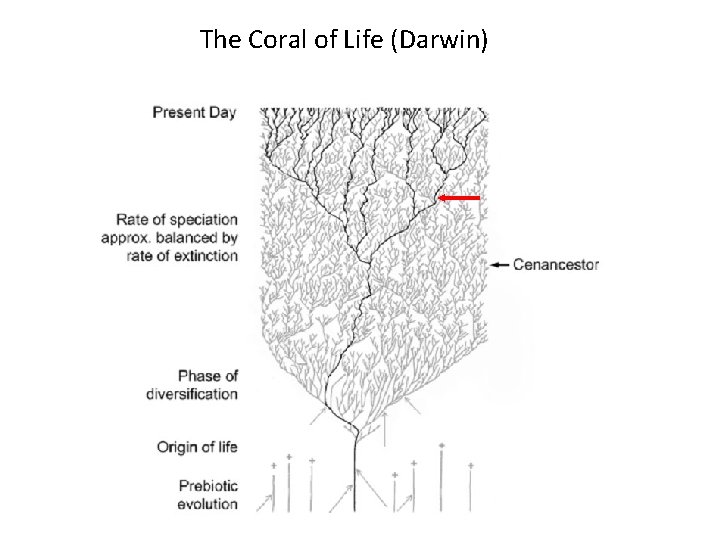
The Coral of Life (Darwin)
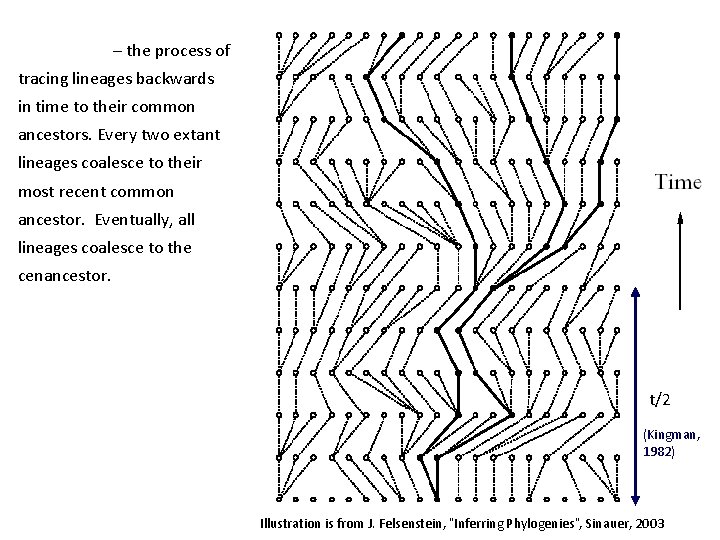
Coalescence – the process of tracing lineages backwards in time to their common ancestors. Every two extant lineages coalesce to their most recent common ancestor. Eventually, all lineages coalesce to the cenancestor. t/2 (Kingman, 1982) Illustration is from J. Felsenstein, “Inferring Phylogenies”, Sinauer, 2003
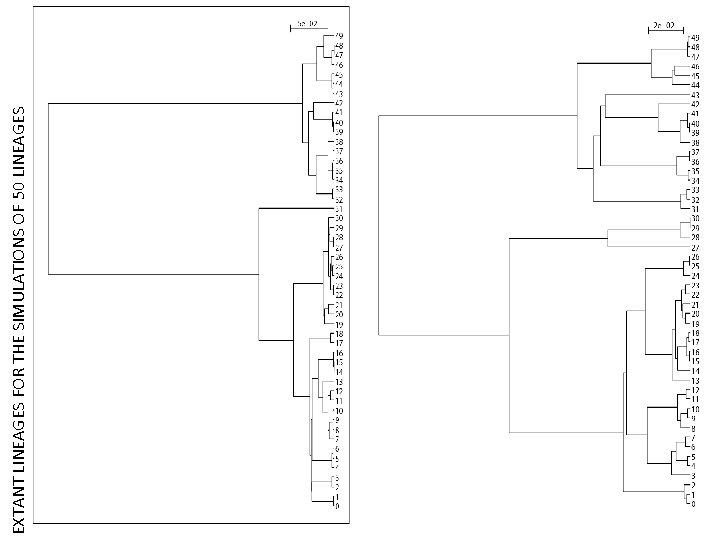
EXTANT LINEAGES FOR THE SIMULATIONS OF 50 LINEAGES
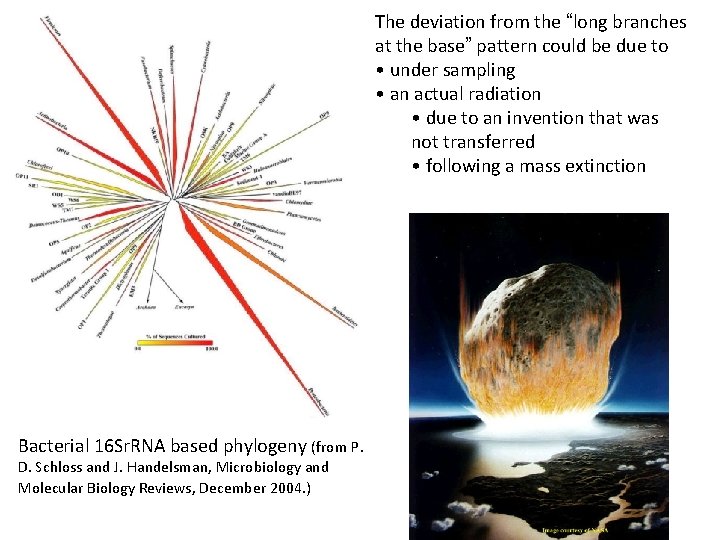
The deviation from the “long branches at the base” pattern could be due to • under sampling • an actual radiation • due to an invention that was not transferred • following a mass extinction Bacterial 16 Sr. RNA based phylogeny (from P. D. Schloss and J. Handelsman, Microbiology and Molecular Biology Reviews, December 2004. )
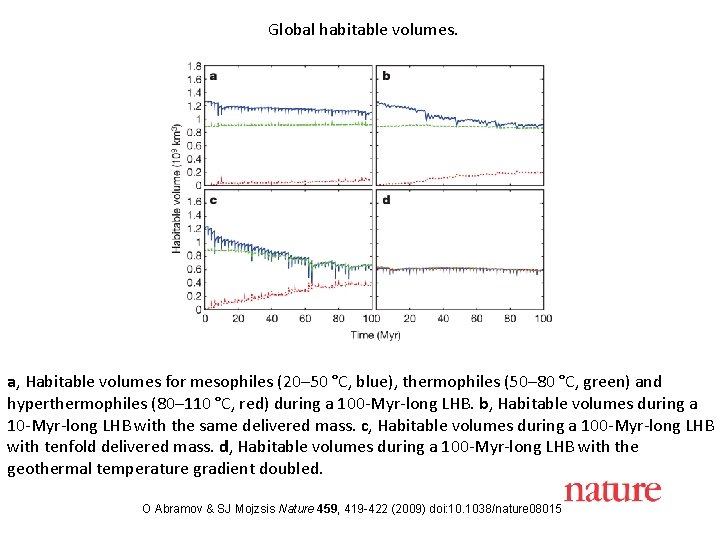
Global habitable volumes. a, Habitable volumes for mesophiles (20– 50 °C, blue), thermophiles (50– 80 °C, green) and hyperthermophiles (80– 110 °C, red) during a 100 -Myr-long LHB. b, Habitable volumes during a 10 -Myr-long LHB with the same delivered mass. c, Habitable volumes during a 100 -Myr-long LHB with tenfold delivered mass. d, Habitable volumes during a 100 -Myr-long LHB with the geothermal temperature gradient doubled. O Abramov & SJ Mojzsis Nature 459, 419 -422 (2009) doi: 10. 1038/nature 08015
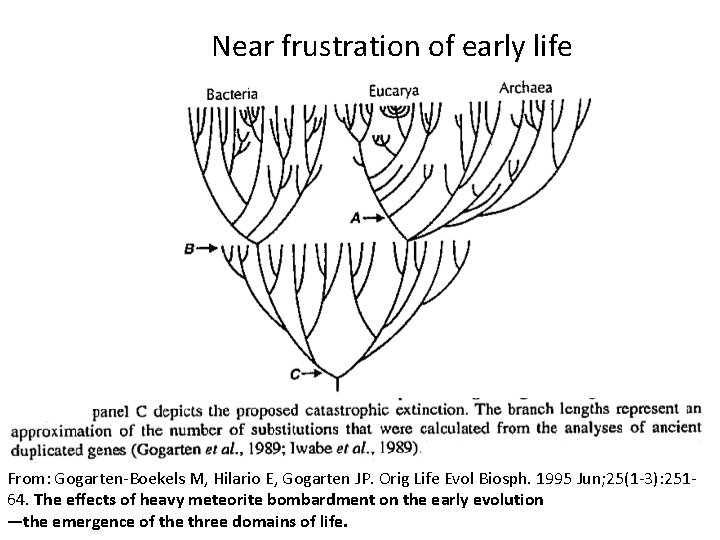
Near frustration of early life From: Gogarten-Boekels M, Hilario E, Gogarten JP. Orig Life Evol Biosph. 1995 Jun; 25(1 -3): 25164. The effects of heavy meteorite bombardment on the early evolution —the emergence of the three domains of life.
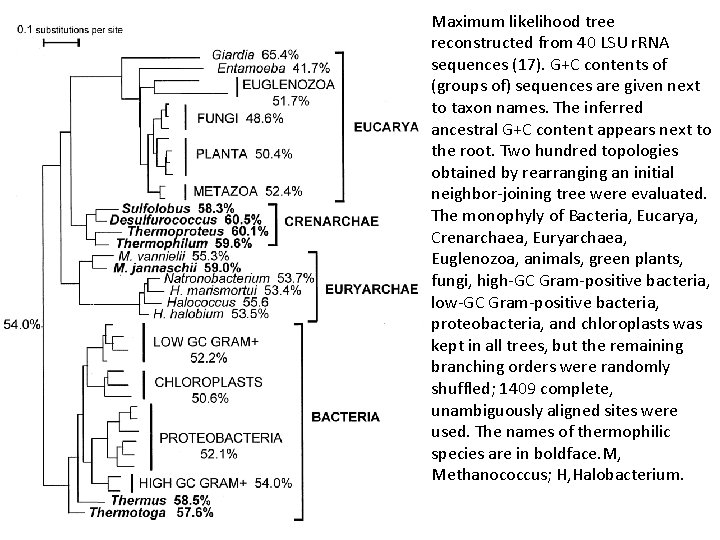
Maximum likelihood tree reconstructed from 40 LSU r. RNA sequences (17). G+C contents of (groups of) sequences are given next to taxon names. The inferred ancestral G+C content appears next to the root. Two hundred topologies obtained by rearranging an initial neighbor-joining tree were evaluated. The monophyly of Bacteria, Eucarya, Crenarchaea, Euryarchaea, Euglenozoa, animals, green plants, fungi, high-GC Gram-positive bacteria, low-GC Gram-positive bacteria, proteobacteria, and chloroplasts was kept in all trees, but the remaining branching orders were randomly shuffled; 1409 complete, unambiguously aligned sites were used. The names of thermophilic species are in boldface. M, Methanococcus; H, Halobacterium.
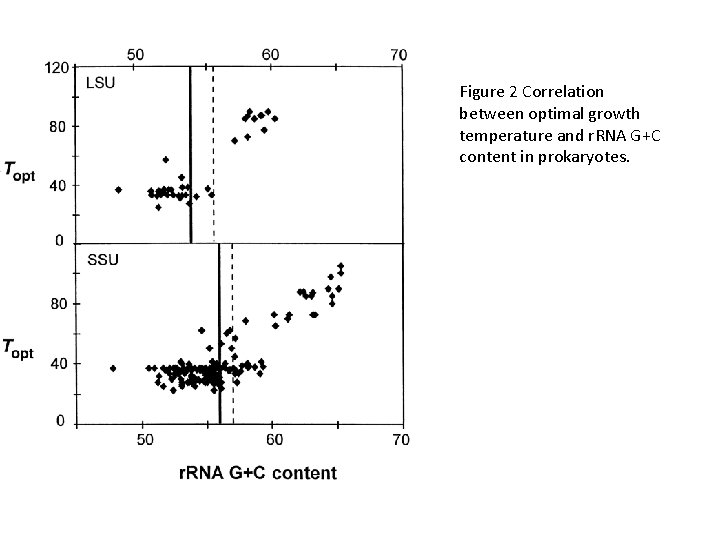
Figure 2 Correlation between optimal growth temperature and r. RNA G+C content in prokaryotes.
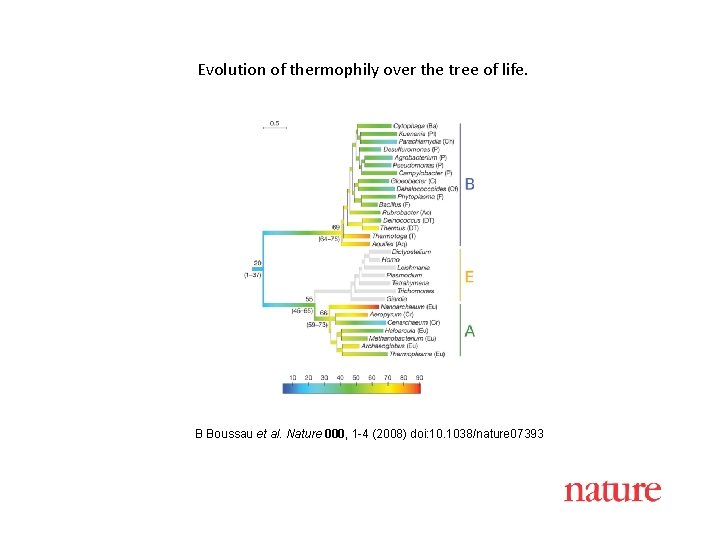
Evolution of thermophily over the tree of life. B Boussau et al. Nature 000, 1 -4 (2008) doi: 10. 1038/nature 07393
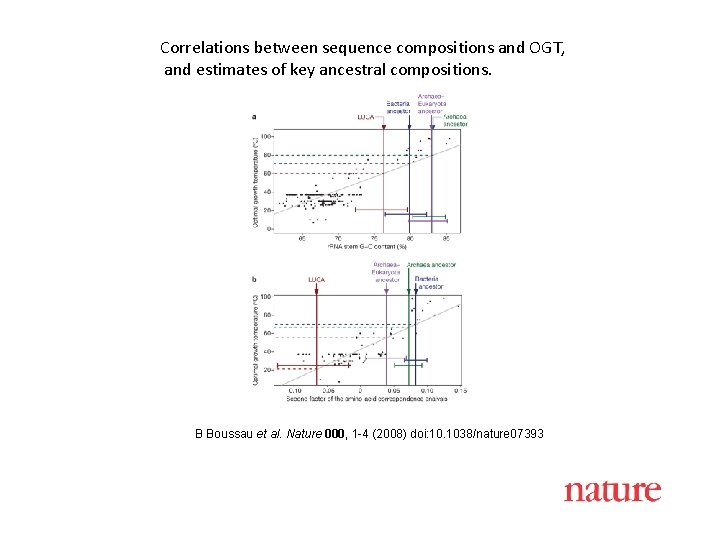
Correlations between sequence compositions and OGT, and estimates of key ancestral compositions. B Boussau et al. Nature 000, 1 -4 (2008) doi: 10. 1038/nature 07393
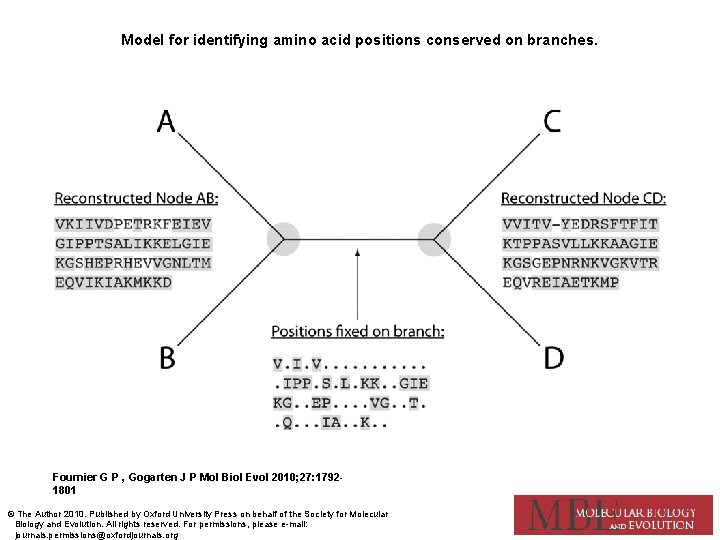
Model for identifying amino acid positions conserved on branches. Fournier G P , Gogarten J P Mol Biol Evol 2010; 27: 17921801 © The Author 2010. Published by Oxford University Press on behalf of the Society for Molecular Biology and Evolution. All rights reserved. For permissions, please e-mail: journals. permissions@oxfordjournals. org
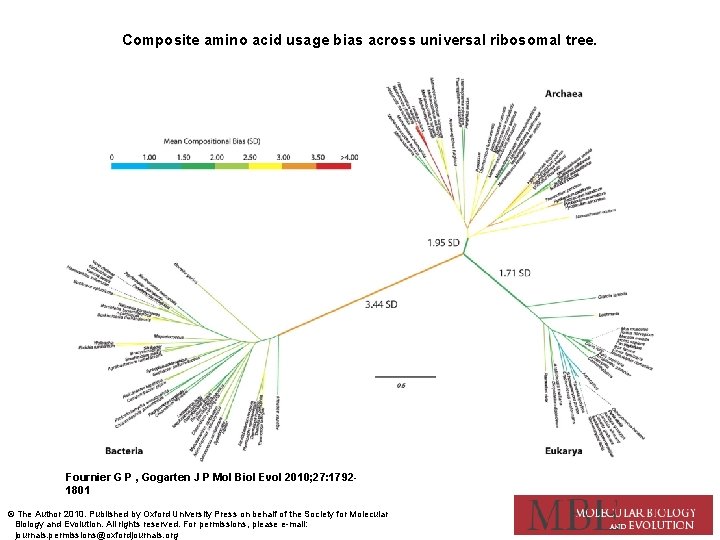
Composite amino acid usage bias across universal ribosomal tree. Fournier G P , Gogarten J P Mol Biol Evol 2010; 27: 17921801 © The Author 2010. Published by Oxford University Press on behalf of the Society for Molecular Biology and Evolution. All rights reserved. For permissions, please e-mail: journals. permissions@oxfordjournals. org
- Slides: 20