
Early Level Play Pedagogy Toolkit For Scotlands learners
- Slides: 16
Early Level Play Pedagogy Toolkit For Scotland's learners, with Scotland's educators
Contents Introduction Section 1: Why play pedagogy? Section 2: Play environment – considering spaces, interactions and experiences Section 3: Moving forward For Scotland's learners, with Scotland's educators
Early Level Play Pedagogy Toolkit Introduction For Scotland's learners, with Scotland's educators
Introduction 1 Curriculum for Excellence has established clear values, purposes and principles for education from 3 to 18 in Scotland. It aims to enable children and young people to develop their capacities as successful learners, confident individuals, responsible citizens and effective contributors. For Scotland's learners, with Scotland's educators
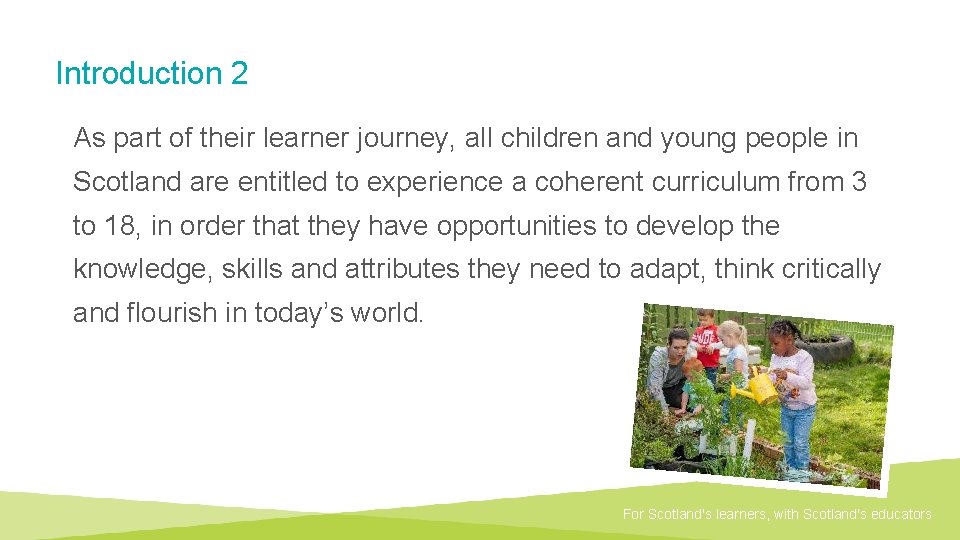
Introduction 2 As part of their learner journey, all children and young people in Scotland are entitled to experience a coherent curriculum from 3 to 18, in order that they have opportunities to develop the knowledge, skills and attributes they need to adapt, think critically and flourish in today’s world. For Scotland's learners, with Scotland's educators
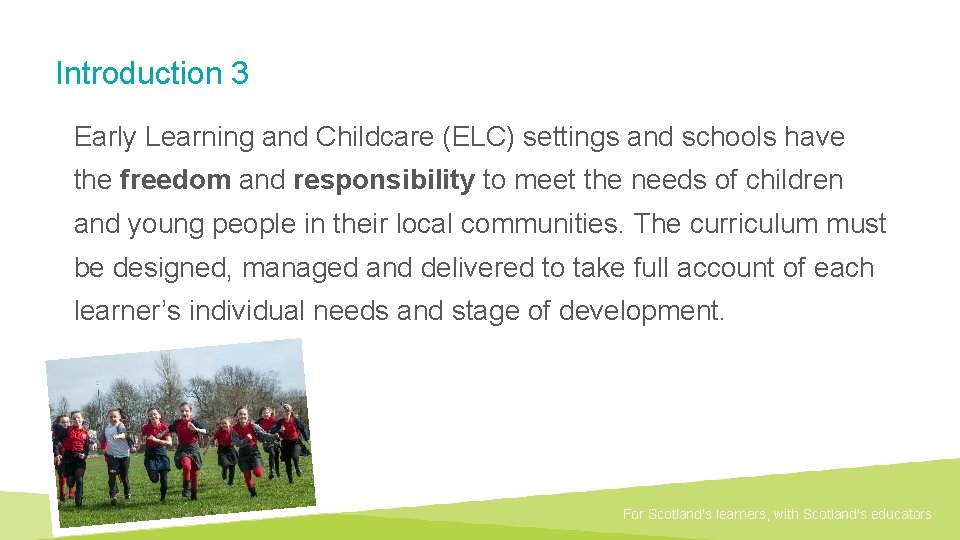
Introduction 3 Early Learning and Childcare (ELC) settings and schools have the freedom and responsibility to meet the needs of children and young people in their local communities. The curriculum must be designed, managed and delivered to take full account of each learner’s individual needs and stage of development. For Scotland's learners, with Scotland's educators
Introduction 4 In Scotland we benefit from a curriculum model that spans the ELC and the early years of Primary School. The Early Level of Curriculum for Excellence is intended to support the implementation of a responsive, continuous, play-based curriculum for children aged 3 – 6. It describes experiences and outcomes for children’s learning in ways which have supported a more active, play-based approach to learning and teaching in early primary school and encouraged better continuity and progression for all children across all settings. For Scotland's learners, with Scotland's educators
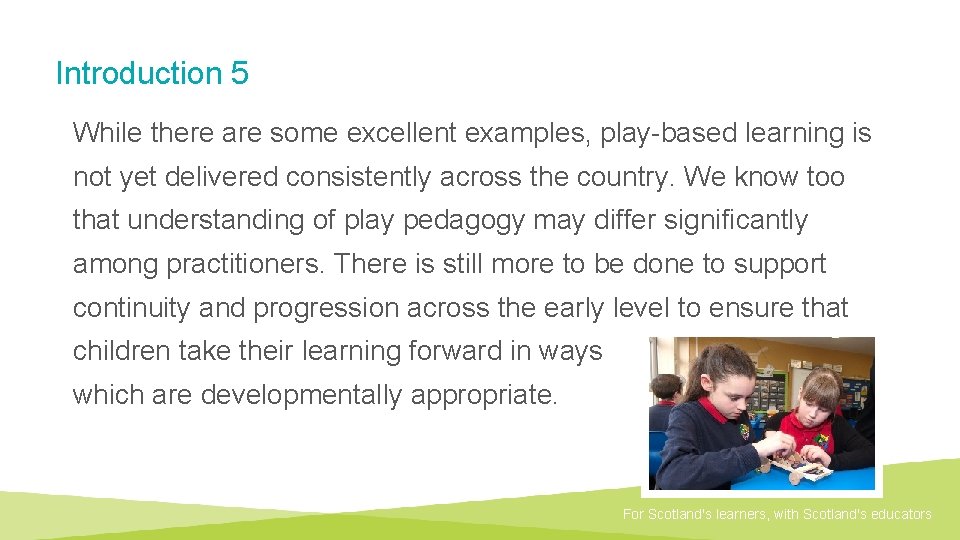
Introduction 5 While there are some excellent examples, play-based learning is not yet delivered consistently across the country. We know too that understanding of play pedagogy may differ significantly among practitioners. There is still more to be done to support continuity and progression across the early level to ensure that children take their learning forward in ways which are developmentally appropriate. For Scotland's learners, with Scotland's educators
Introduction 6 This toolkit seeks to support practitioners working with children in the Early Level to appropriately use play pedagogy to support learning and development. It is designed to be used in conjunction with Curriculum for Excellence and national practice guidance “Building the Ambition”. The toolkit is fully aligned with the refreshed and strengthen practice guidance which will be published in 2020, for those working with young children in Scotland. For Scotland's learners, with Scotland's educators
The Toolkit In the toolkit you will find information and evidence to support the use of play pedagogy as a key element of your practice. There are reflective questions throughout the toolkit. These encourage you to think deeply about your values, vision and practice. You can use these questions as prompts for professional dialogue with colleagues. Parents will also be interested to know more about your approaches and the impact these have on their children’s learning and development. Your dialogue and thinking will support self-evaluation and improvement in your play pedagogy. The toolkit also links to other professional learning resources you may find useful. At the end of the toolkit you will find suggestions for further reading. Education Scotland is working with practitioners to continue to develop the toolkit will continue to develop the toolkit, including examples of improvement journeys. For Scotland's learners, with Scotland's educators
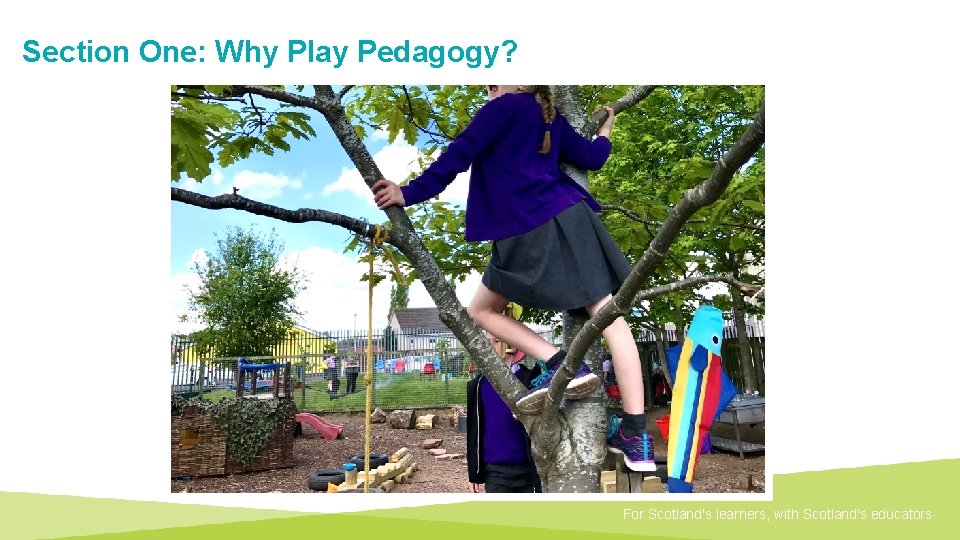
Section One: Why Play Pedagogy? For Scotland's learners, with Scotland's educators
Why Play Pedagogy? ‘… play at this time is not trivial, it is highly serious and of deep significance’ (Froebel, 1826) Play is an intrinsic part of human nature and development. For babies and children, the essential role of play is well documented. Through play a child develops their cognitive, social, emotional and physical capacities. For Scotland's learners, with Scotland's educators
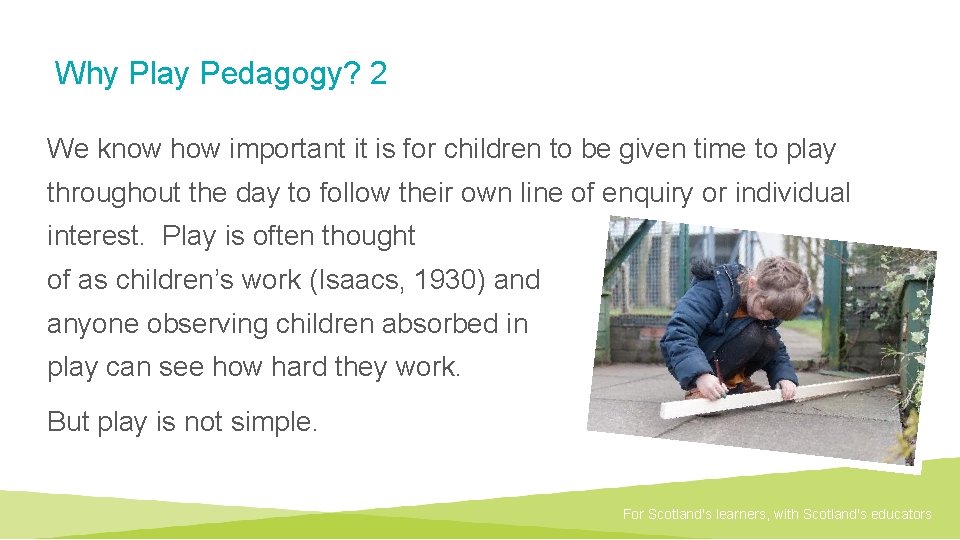
Why Play Pedagogy? 2 We know how important it is for children to be given time to play throughout the day to follow their own line of enquiry or individual interest. Play is often thought of as children’s work (Isaacs, 1930) and anyone observing children absorbed in play can see how hard they work. But play is not simple. For Scotland's learners, with Scotland's educators
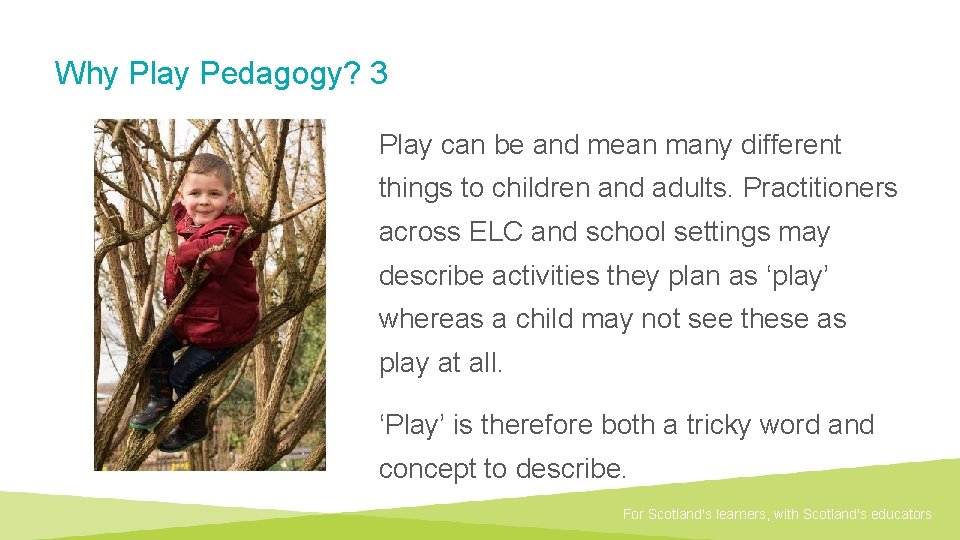
Why Play Pedagogy? 3 Play can be and mean many different things to children and adults. Practitioners across ELC and school settings may describe activities they plan as ‘play’ whereas a child may not see these as play at all. ‘Play’ is therefore both a tricky word and concept to describe. For Scotland's learners, with Scotland's educators
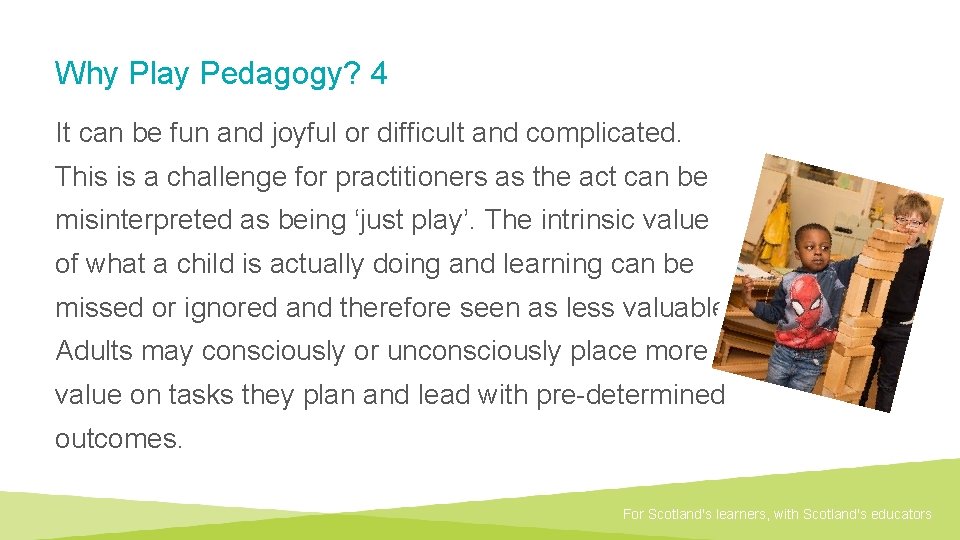
Why Play Pedagogy? 4 It can be fun and joyful or difficult and complicated. This is a challenge for practitioners as the act can be misinterpreted as being ‘just play’. The intrinsic value of what a child is actually doing and learning can be missed or ignored and therefore seen as less valuable. Adults may consciously or unconsciously place more value on tasks they plan and lead with pre-determined outcomes. For Scotland's learners, with Scotland's educators
Why Play Pedagogy? To continue with the toolkit move on to Powerpoint presentation: Early Level Play Pedagogy Toolkit – Why Play Pedagogy? to learn more about why play pedagogy is important. For Scotland's learners, with Scotland's educators