
EARLY LANGUAGE DEVELOPMENT TODDLERS 12 24 mos We










- Slides: 68
EARLY LANGUAGE DEVELOPMENT: TODDLERS (12 -24 mos. )
We need to know about normal milestones in all areas…** • Often, when a young child has a delay or challenge (language delay, mental retardation, autism spectrum), the speech pathologist is the first one to see him • Thus, we need to know “basics” of development in all areas—cognitive, social, motor • If we see problems in any of these areas, we can immediately refer to appropriate professionals and the child can receive early intervention
We need to know typical language milestones • For clinical purposes • And for the PRAXIS!
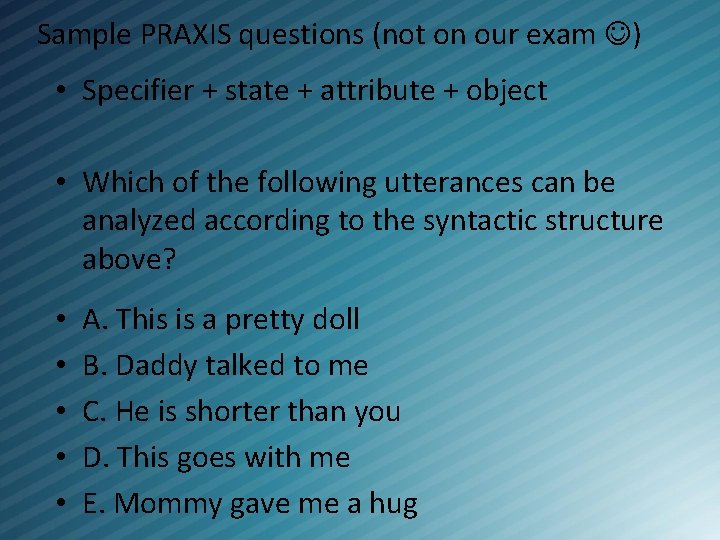
Sample PRAXIS questions (not on our exam ) • Specifier + state + attribute + object • Which of the following utterances can be analyzed according to the syntactic structure above? • • • A. This is a pretty doll B. Daddy talked to me C. He is shorter than you D. This goes with me E. Mommy gave me a hug
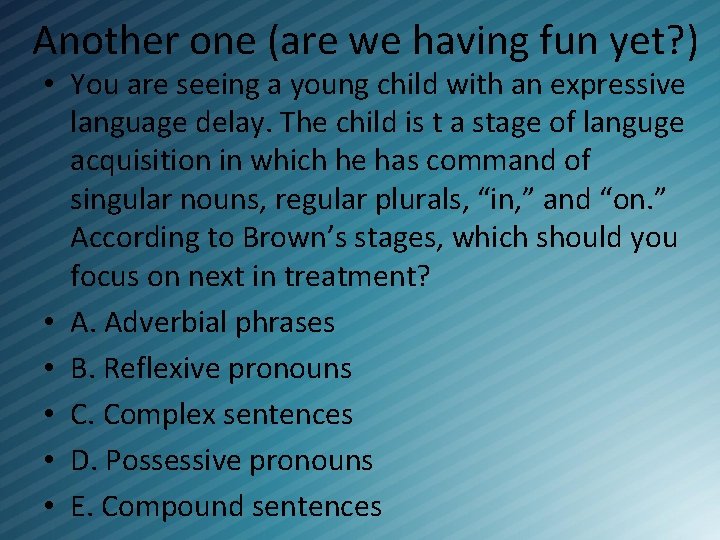
Another one (are we having fun yet? ) • You are seeing a young child with an expressive language delay. The child is t a stage of languge acquisition in which he has command of singular nouns, regular plurals, “in, ” and “on. ” According to Brown’s stages, which should you focus on next in treatment? • A. Adverbial phrases • B. Reflexive pronouns • C. Complex sentences • D. Possessive pronouns • E. Compound sentences
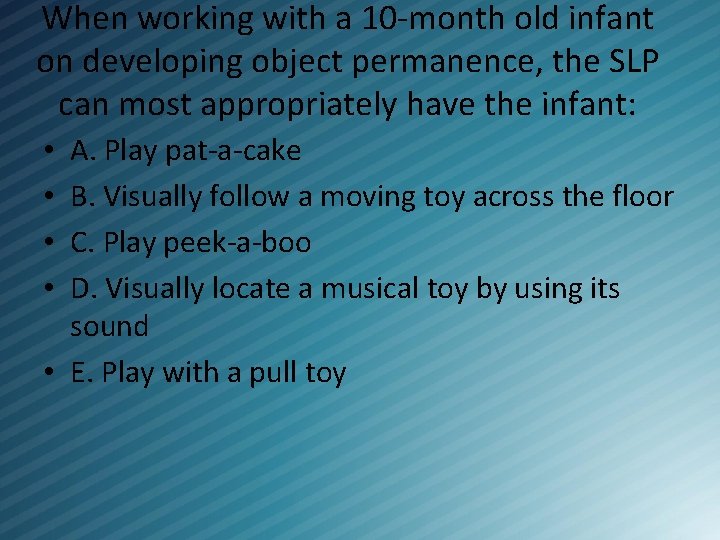
When working with a 10 -month old infant on developing object permanence, the SLP can most appropriately have the infant: A. Play pat-a-cake B. Visually follow a moving toy across the floor C. Play peek-a-boo D. Visually locate a musical toy by using its sound • E. Play with a pull toy • •
I. DEVELOPMENT IN RELATED DOMAINS (Mc. Laughlin Development Milestones pp. 219 -220—lecture only) • A. Social Development
B. Motor Developments
Motor developments continued
C. Cognitive Developments
Cognitive developments continued
II. FIRST WORDS** • First word around 12 mos. of age; may emerge 8 -16 mos. • With production of first true words, toddlers→locutionary period.
To qualify as a true word: ** • It needs to occur with consistency in a given context in apparent response to an identifiable stimulus • It should be produced consistently in the presence of the same person, object, or event • It must bear some phonetic resemblance to a conventional adult word; it can be an approximation of a real adult word
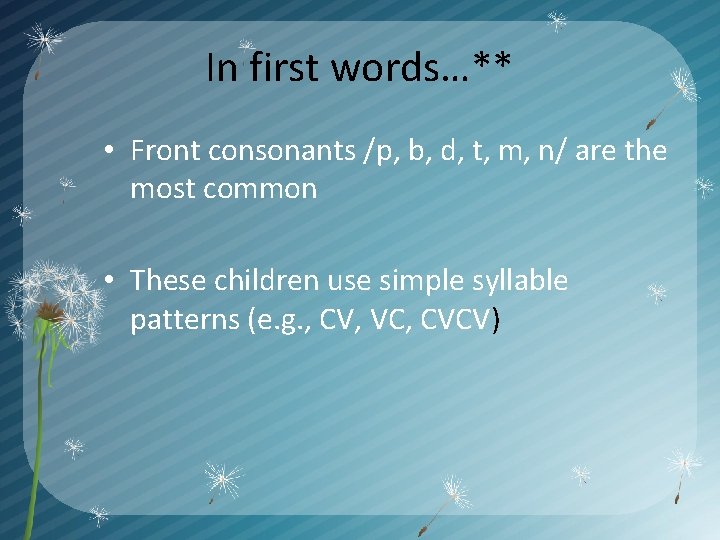
In first words…** • Front consonants /p, b, d, t, m, n/ are the most common • These children use simple syllable patterns (e. g. , CV, VC, CVCV)
There is rapid vocabulary growth:
Youtube • Toddler Tries to Argue Like an Adult • This child is 20 months old
According to Berko Gleason & Ratner 2013:
If the child does not have a major language growth spurt between 18 -24 months of age…
Therapy implication:
Remember that:
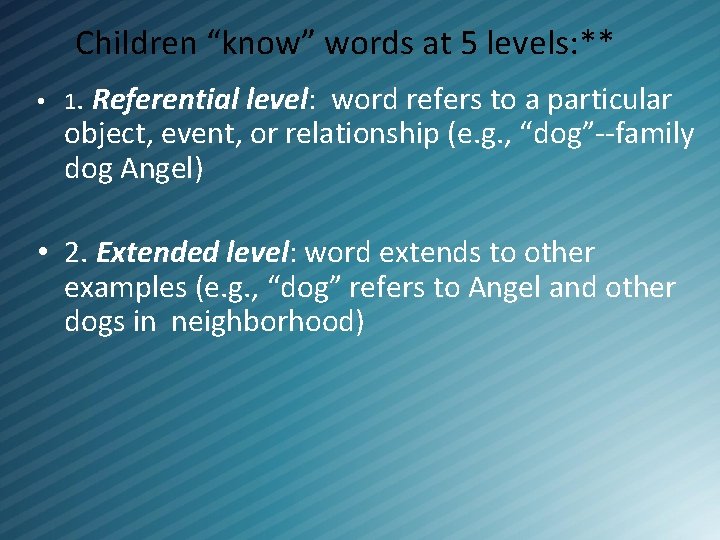
Children “know” words at 5 levels: ** • 1. Referential level: word refers to a particular object, event, or relationship (e. g. , “dog”--family dog Angel) • 2. Extended level: word extends to other examples (e. g. , “dog” refers to Angel and other dogs in neighborhood)
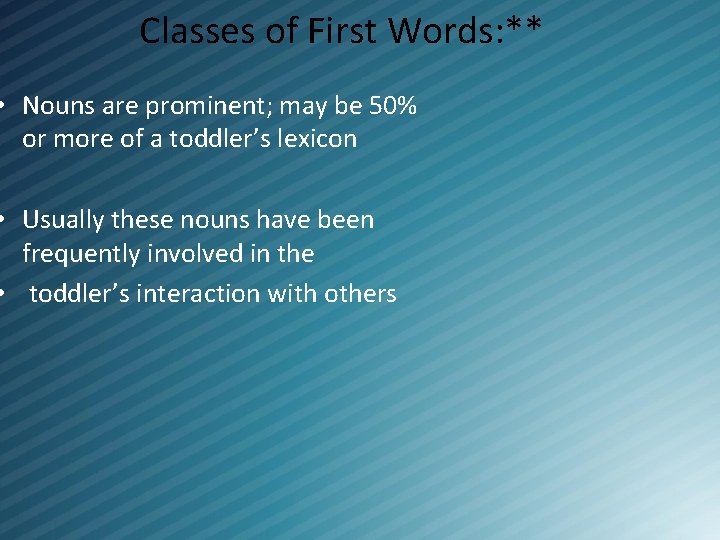
Classes of First Words: ** • Nouns are prominent; may be 50% or more of a toddler’s lexicon • Usually these nouns have been frequently involved in the • toddler’s interaction with others
• Mark Mc. Kibbin’s nouns: (not on test)
Toddlers often use reflexive relations: ** • **For the test, please be sure to know the chart at the bottom of p. 237 (Table 6 -3) • Reflexive relations are early words that indicate the state of objects
These reflexive relations include: • !”
Reflexive relations also include:
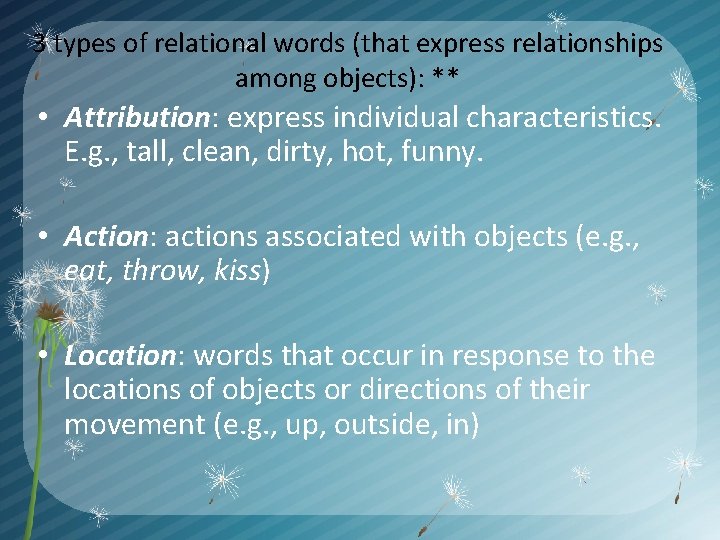
3 types of relational words (that express relationships among objects): ** • Attribution: express individual characteristics. E. g. , tall, clean, dirty, hot, funny. • Action: actions associated with objects (e. g. , eat, throw, kiss) • Location: words that occur in response to the locations of objects or directions of their movement (e. g. , up, outside, in)
Pages 239 -242** • Are not on the exam—yay!
III. COMBINING WORDS, MEANING, AND FUNCTIONS** • Pages 244 -the middle of 248 are not on the exam; pick up your reading in the middle of page 248 where it says Semantic-Syntactic Considerations
A. Introduction Combining words is significant because it indicates that toddlers:
Characteristics of true 2 -word utterances:
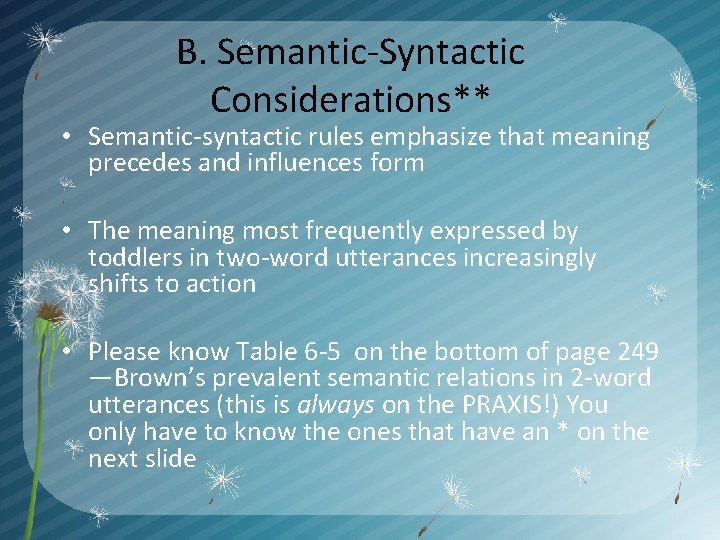
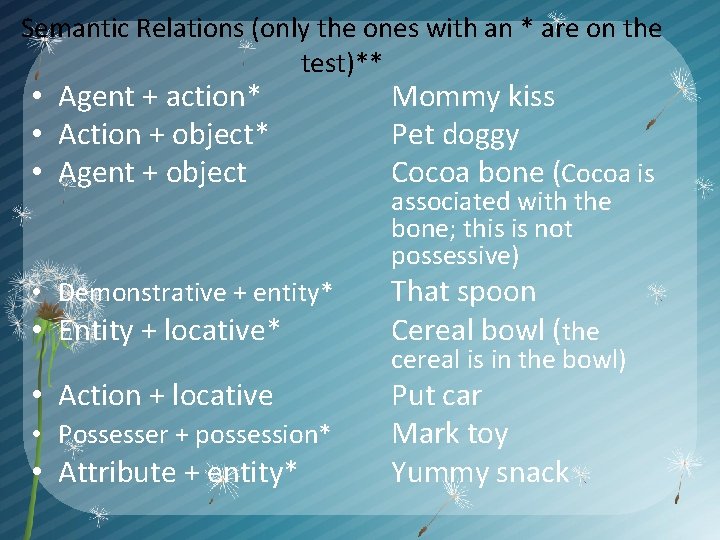
B. Semantic-Syntactic Considerations** • Semantic-syntactic rules emphasize that meaning precedes and influences form • The meaning most frequently expressed by toddlers in two-word utterances increasingly shifts to action • Please know Table 6 -5 on the bottom of page 249 —Brown’s prevalent semantic relations in 2 -word utterances (this is always on the PRAXIS!) You only have to know the ones that have an * on the next slide
Semantic Relations (only the ones with an * are on the test)** • Agent + action* • Action + object* • Agent + object Mommy kiss Pet doggy Cocoa bone (Cocoa is • Demonstrative + entity* That spoon Cereal bowl (the • Entity + locative* • Action + locative • Possesser + possession* • Attribute + entity* associated with the bone; this is not possessive) cereal is in the bowl) Put car Mark toy Yummy snack
IV. DEVELOPMENT IN PRAGMATICS • A. Introduction
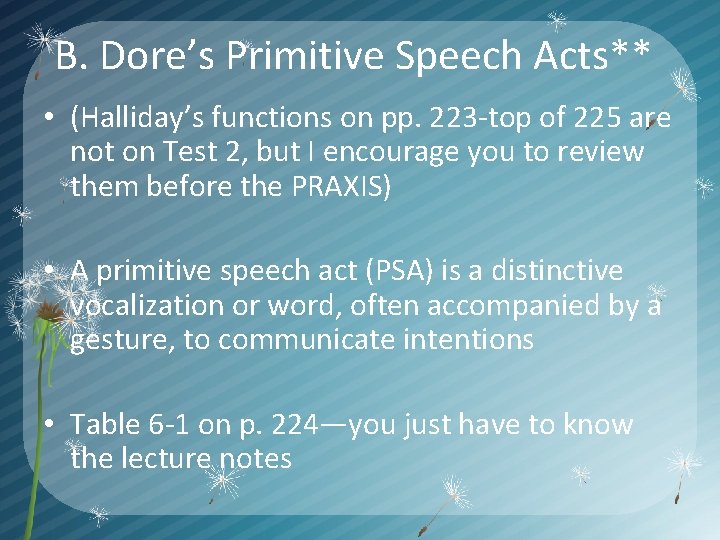
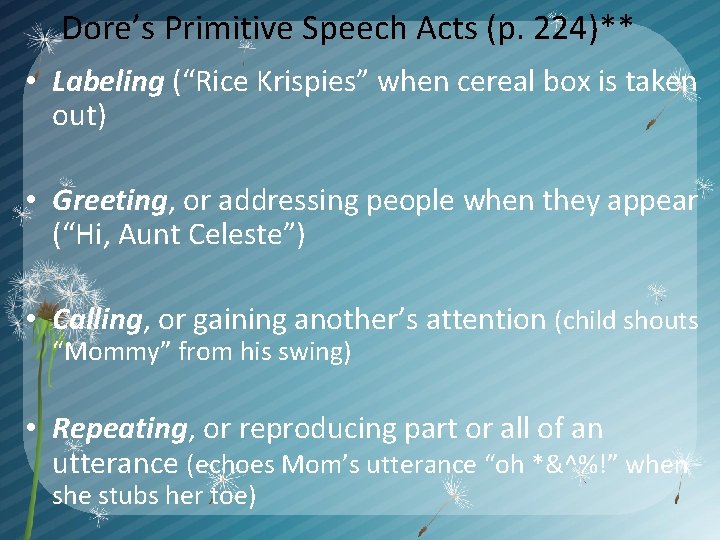
B. Dore’s Primitive Speech Acts** • (Halliday’s functions on pp. 223 -top of 225 are not on Test 2, but I encourage you to review them before the PRAXIS) • A primitive speech act (PSA) is a distinctive vocalization or word, often accompanied by a gesture, to communicate intentions • Table 6 -1 on p. 224—you just have to know the lecture notes
Dore’s Primitive Speech Acts (p. 224)** • Labeling (“Rice Krispies” when cereal box is taken out) • Greeting, or addressing people when they appear (“Hi, Aunt Celeste”) • Calling, or gaining another’s attention (child shouts “Mommy” from his swing) • Repeating, or reproducing part or all of an utterance (echoes Mom’s utterance “oh *&^%!” when she stubs her toe)
Dore (continued)
Dore continued
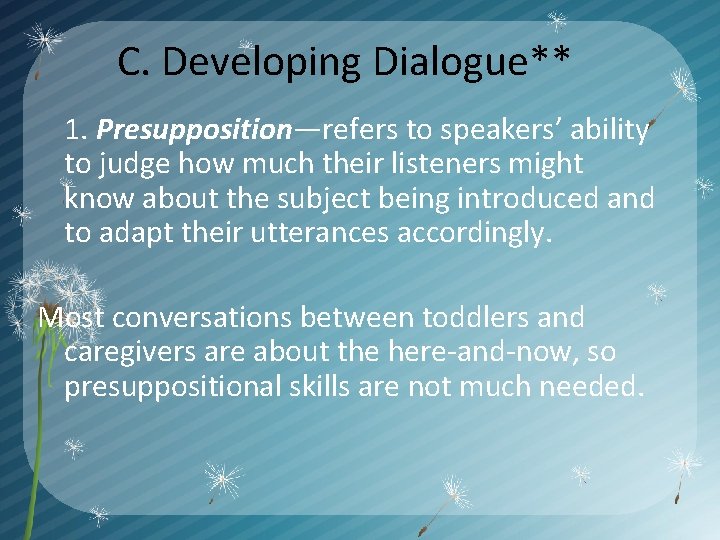
C. Developing Dialogue** 1. Presupposition—refers to speakers’ ability to judge how much their listeners might know about the subject being introduced and to adapt their utterances accordingly. Most conversations between toddlers and caregivers are about the here-and-now, so presuppositional skills are not much needed.
2. Turn-taking
For example, ** • Hey, get this. You know that Pay. Less Shoe store on Greenback where we love to get those $15. 99 pairs of shoes? • Well, they closed! Now the only one even remotely nearby is at Arden Fair mall.
Conversations with toddlers…** • Develop out of things that have just engaged their attention. • “Drive car!” • Usually dialogue follows.
V. TODDLERS’ TOOLS FOR LANGUAGE DEVELOPMENT • A. Selective Imitation
B. Interrogative Utterances** • Request for appropriate word • “What’s that? ”
C. Hypothesis Testing
VI. CAREGIVERS’ TOOLS FOR THEIR TODDLERS’ LANGUAGE DEVELOPMENT** • We previously discussed “motherese, ” also called CDS (child-directed speech) • Caregivers often use prompts, which evoke toddler utterances
Types of Prompts Include: ** • 1. Open-ended questions, e. g. “What happens if we don’t feed the dog? ” • 2. Wh-constituent questions, which require toddlers to recall associated information from their experience and formulate a specific response. For example, “What does a policeman do? ”
Youtube • I poo in my pants funny toddler at Disney World
Caregivers can also use:
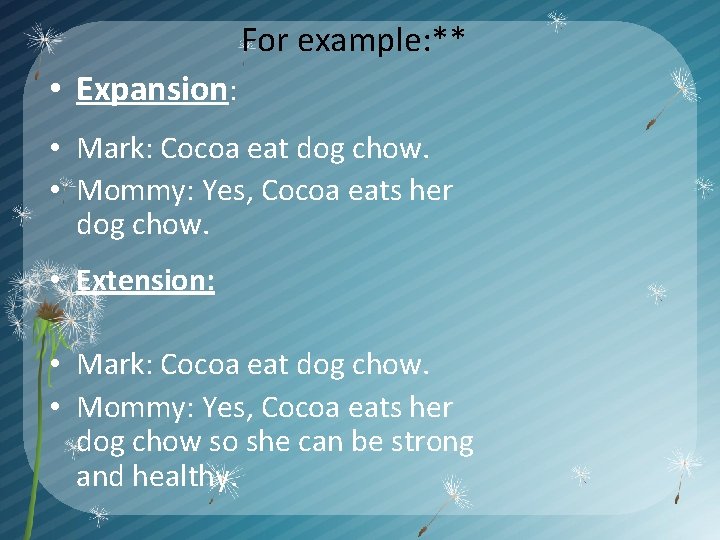
For example: ** • Expansion: • Mark: Cocoa eat dog chow. • Mommy: Yes, Cocoa eats her dog chow. • Extension: • Mark: Cocoa eat dog chow. • Mommy: Yes, Cocoa eats her dog chow so she can be strong and healthy.
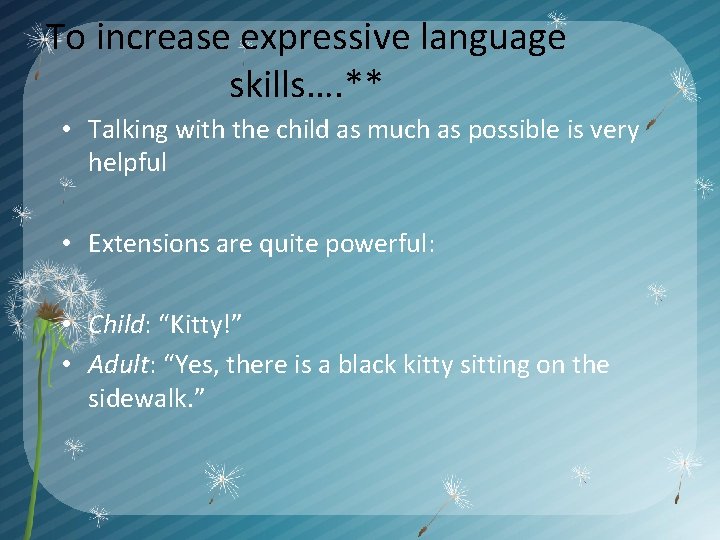
To increase expressive language skills…. ** • Talking with the child as much as possible is very helpful • Extensions are quite powerful: • Child: “Kitty!” • Adult: “Yes, there is a black kitty sitting on the sidewalk. ”
When we use extensions…
• A terrific recent article about working with parents to increase language skills in young children: ** • Roberts & Kaiser 2011 August (American Journal of Speech-Language Pathology, 20, 180 -199) • “The Effectiveness of Parent-Implemented Language Interventions: A Meta-Analysis”
Roberts & Kaiser found:
In terms of books with toddlers…
Hulit, Fahey, & Howard 2015—summary of new research on child-directed speech:
Hulit et al 2015 continued:
The more TV in a ch’s day…
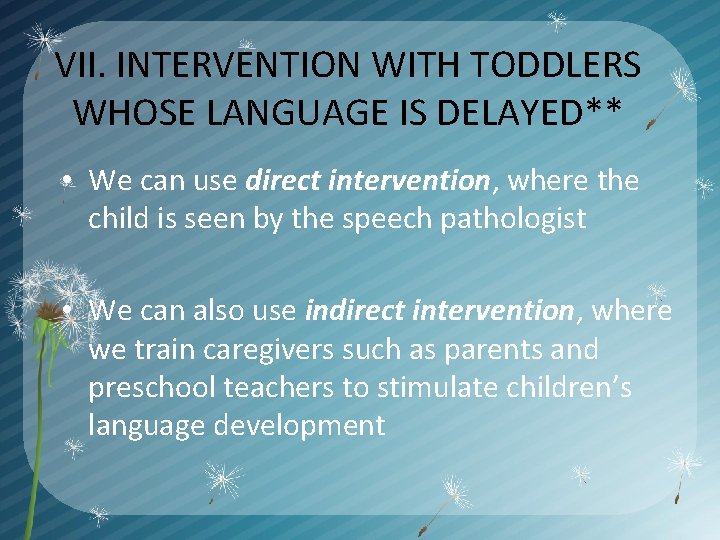
VII. INTERVENTION WITH TODDLERS WHOSE LANGUAGE IS DELAYED** • We can use direct intervention, where the child is seen by the speech pathologist • We can also use indirect intervention, where we train caregivers such as parents and preschool teachers to stimulate children’s language development
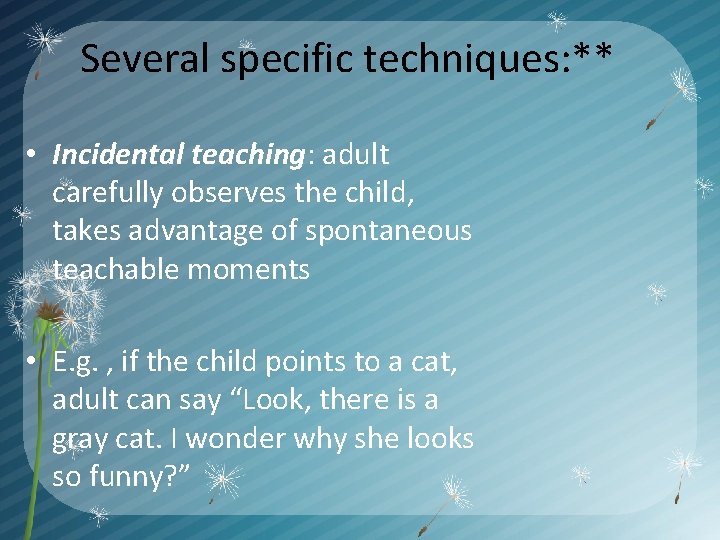
Several specific techniques: ** • Incidental teaching: adult carefully observes the child, takes advantage of spontaneous teachable moments • E. g. , if the child points to a cat, adult can say “Look, there is a gray cat. I wonder why she looks so funny? ”
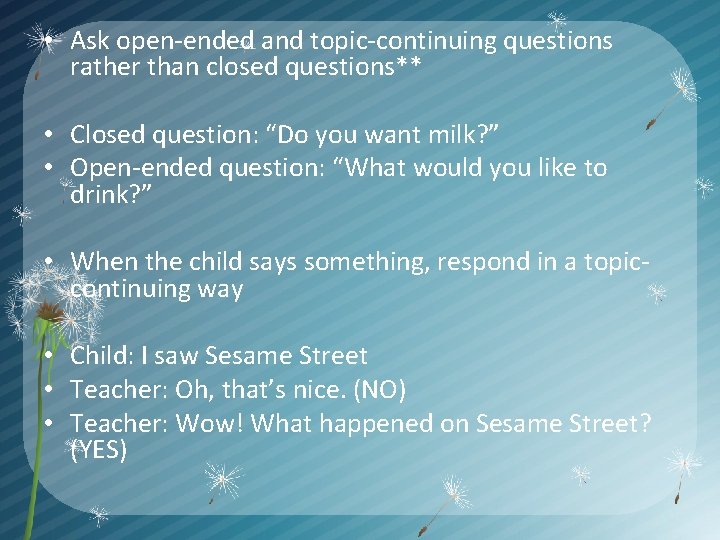
• Ask open-ended and topic-continuing questions rather than closed questions** • Closed question: “Do you want milk? ” • Open-ended question: “What would you like to drink? ” • When the child says something, respond in a topiccontinuing way • Child: I saw Sesame Street • Teacher: Oh, that’s nice. (NO) • Teacher: Wow! What happened on Sesame Street? (YES)
Use communicative temptations:
Paul & Norbury, 2012—suggestions for communicative temptations:
• (Paul & Norbury continued)
Most of all…** • Language develops optimally when children get plenty of attention • Attention is the greatest reinforcer of all