
Early Greece and the Bronze Age Ancient Greece
Early Greece and the Bronze Age Ancient Greece
Greece – Bronze age • Origins of civilization – Prehistory – History
Greece – Bronze age • Origins of civilization – Prehistory • Includes Paleolithic and other prehistorical categories – History
Greece – Bronze age • Origins of civilization – Prehistory • Includes Paleolithic (=old stone age) and other prehistorical categories – History
Greece – Bronze age • Origins of civilization – Prehistory • Includes Paleolithic (=old stone age) and other prehistorical categories • Relies on old age of earth and very long natural history of human existence – History
Greece – Bronze age • Origins of civilization – Prehistory • Includes Paleolithic (=old stone age) and other prehistorical categories • Relies on old age of earth and very long natural history of human existence – History • Begins with evidence
Greece – Bronze age • Origins of civilization – Prehistory • Includes Paleolithic (=old stone age) and other prehistorical categories • Relies on old age of earth and very long natural history of human existence – History • Begins with evidence – Material
Greece – Bronze age • Origins of civilization – Prehistory • Includes Paleolithic (=old stone age) and other prehistorical categories • Relies on old age of earth and very long natural history of human existence – History • Begins with evidence – Material (bones, buildings, pots, etc. )
Greece – Bronze age • Origins of civilization – Prehistory • Includes Paleolithic (=old stone age) and other prehistorical categories • Relies on old age of earth and very long natural history of human existence – History • Begins with evidence – Material (bones, buildings, pots, etc. ) – Textual
Greece – Bronze age • Origins of civilization – Prehistory • Includes Paleolithic (=old stone age) and other prehistorical categories • Relies on old age of earth and very long natural history of human existence – History • Begins with evidence – Material (bones, buildings, pots, etc. ) – Textual (writing on metal, stone, bones, other media)
Greece – Bronze age • Major periods of Greek history: – Ancient history • Neolithic 5000 -2500 • Bronze age 2500 -1100 • Dark age / Iron age 1100 -700 – Archaic Period 700 -500 – Classical Period 500 -350 – Hellenistic Period 350 -150 – Roman Period 150 bc – 31 bc
Greece – Bronze age • 3 ages we deal with in ancient history:
Greece – Bronze age • 3 ages we deal with in ancient history: – Neolithic
Greece – Bronze age • 3 ages we deal with in ancient history: – Neolithic – Bronze
Greece – Bronze age • 3 ages we deal with in ancient history: – Neolithic – Bronze – Iron
Greece – Bronze age • 3 ages we deal with in ancient history: – Neolithic ( = new stone age) – Bronze – Iron
Greece – Bronze age • 3 ages we deal with in ancient history: – Neolithic ( = new stone age) • ~ 5000 -2500 bc – Bronze – Iron
Greece – Bronze age • 3 ages we deal with in ancient history: – Neolithic ( = new stone age) • ~ 5000 -2500 bc – Bronze – Iron
Greece – Bronze age • 3 ages we deal with in ancient history: – Neolithic ( = new stone age) • ~ 5000 -2500 bc – Bronze • Technological advance in metallurgy – Iron
Greece – Bronze age • 3 ages we deal with in ancient history: – Neolithic ( = new stone age) • ~ 5000 -2500 bc – Bronze • Technological advance in metallurgy • Lasts till the late second to early first millennium – Iron
Greece – Bronze age • 3 ages we deal with in ancient history: – Neolithic ( = new stone age) • ~ 5000 -2500 bc – Bronze • Technological advance in metallurgy • Lasts till the late second to early first millennium – Iron • Another technological advance in metallurgy
Greece – Bronze age • 3 ages we deal with in ancient history: – Neolithic ( = new stone age) • ~ 5000 -2500 bc – Bronze • Technological advance in metallurgy • Lasts till the late second to early first millennium – Iron • Another technological advance in metallurgy • Names based on materials in common use – assume overlap
Greece – Bronze age • Comparative history (cf. timeline in your text)
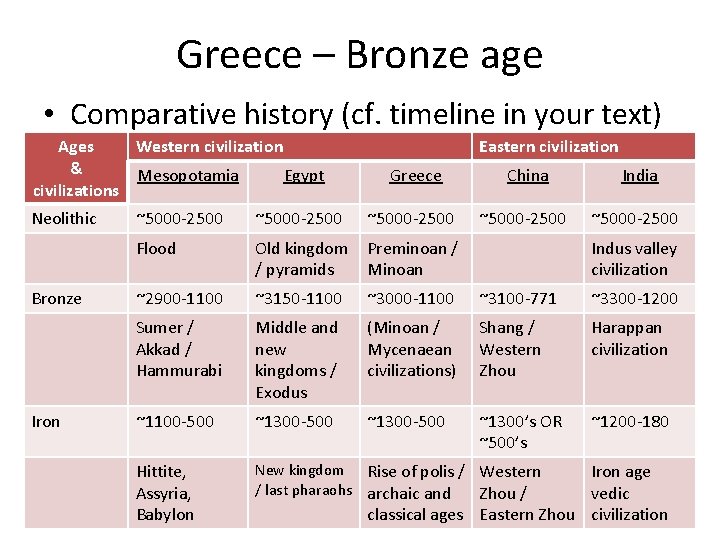
Greece – Bronze age • Comparative history (cf. timeline in your text) Ages Western civilization & Mesopotamia Egypt civilizations Neolithic Bronze Iron Eastern civilization Greece China India ~5000 -2500 ~5000 -2500 Flood Old kingdom / pyramids Preminoan / Minoan ~2900 -1100 ~3150 -1100 ~3000 -1100 ~3100 -771 ~3300 -1200 Sumer / Akkad / Hammurabi Middle and new kingdoms / Exodus (Minoan / Mycenaean civilizations) Shang / Western Zhou Harappan civilization ~1100 -500 ~1300 -500 ~1300’s OR ~500’s ~1200 -180 Hittite, Assyria, Babylon New kingdom Rise of polis / Western / last pharaohs archaic and Zhou / Indus valley civilization Iron age vedic classical ages Eastern Zhou civilization
Greece – Bronze age • Material remains give their names to this relative epochal dating system
Greece – Bronze age • Material remains give their names to this relative epochal dating system • Historicity relies on historiography
Greece – Bronze age • Material remains give their names to this relative epochal dating system • Historicity relies on historiography – Advent of hellenism in Greece (500’s sq. ) – Writing in any language is necessary
Greece – Bronze age • Early Bronze Age – 3000 -2000 bc – Crete and mainland Greece: civilization rises because of contact with palace-kingdoms of the East – 4 th millennium bc: Rise of civilization in Mesopotamia and Egypt
Greece – Bronze age • Early Bronze Age – 3000 -2000 bc – Crete and mainland Greece: civilization rises because of contact with palace-kingdoms of the East – 4 th millennium bc: Rise of civilization in Mesopotamia and Egypt – Early bronze-age culture in Greece exists – the Aegean peoples
Greece – Bronze age • Bronze age civilizations: – Cycladic (>2200 -1800<) – Minoan (>1900 -1600) – Mycenaean (1600 -1100)
Greece – Bronze age • Middle Bronze Age 2000 -1600 bc – Early bronze-age peoples replaced by Indo. Europeans (cf. language) • Early Greek speakers • A fused Hellenic culture dependent on civilization: – Herders, farmers – Metallurgy – Pottery and clothmaking • Patrilineal and Patriarchal
Greece – Bronze age • Sources: – Heinrich Schliemann (1822 -1890) (Troy and Mycenae) – Sir Arthur Evans (1851 -1941) (Cnossus)
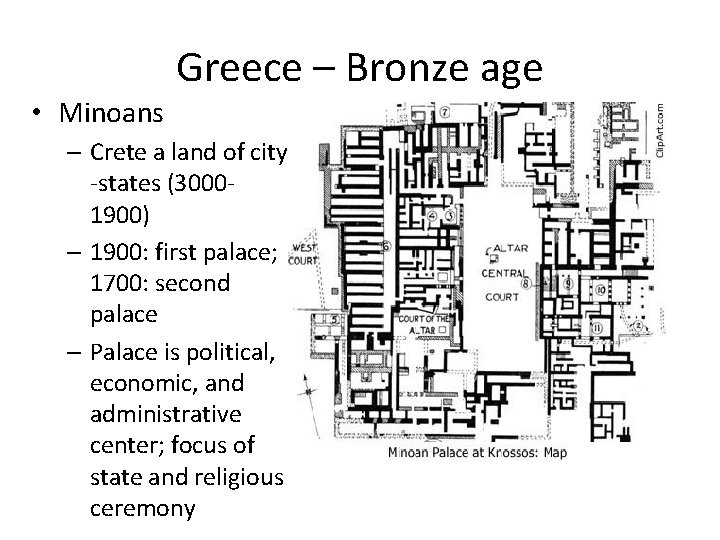
• Minoans Greece – Bronze age – Crete a land of city -states (30001900) – 1900: first palace; 1700: second palace – Palace is political, economic, and administrative center; focus of state and religious ceremony
Greece – Bronze age • Minoans – Palace economy: redistribution and trade • Requires record: WRITING (Linear A) – Art and Architecture • Color, painting, and bulls – Eruption of Thera (1628 bc)
Greece – Bronze age • Mycenaeans – Late Bronze Age – 1600 -1100 bc – Chiefs evolve into monarchs – Shaft graves shift to tholos tombs – Cretan takeover: 1450 bc – 1375 bc: Mycenae becomes the dominant center in Greece – Mycenaean palace system, again requires WRITING: Linear B
Greece – Bronze age • Mycenaeans – Walled citadels • Focus on megaron (long rectangular hall) – Separate small kingdoms – Reach their zenith 1400 -1200 – In literature, the generations of the heroes (leading up to and including the heroes of the Trojan war) • Cf. king lists
Greece – Bronze age • Minoan and Mycenaean religion – Gods and goddesses – Honored with processions, music, dance – Propitiated with gifts and sacrifice • Animal sacrifice • Human sacrifice – Pantheon (be familiar with the big 12!)
Greece – Bronze age • Warfare – Wanax – warrior king • Heavy armor – Soldiers: large shields, bronze daggers and swords, two spears, bows and arrows – Mycenaean chariot
Greece – Bronze age • Decline of bronze age Greece – 1200 -1100 : devastation – Sea peoples? Dorians? – Greece settles into the “Dark Age” (1100 -700 bc)
Greek sources and the Bronze age • Homeric epics: Iliad and Odyssey (You MUST be familiar with these) • Hesiod: – Theogony (to understand religion and tradition of literature for the rest of the Greek material) – Works & days 109 -201 (cf. West’s edition) • Herodotus (Finley, 29 -31) • Thucydides (Finley, 218 -225)
- Slides: 40