
Early Gods and Mythology Bell Ringer How did
Early Gods and Mythology
Bell Ringer • How did organized religion evolve? • Word of the Day: • Ritual: the procedure for conducting religious ceremonies Ritual: el procedimiento para realizar ceremonias religiosas.
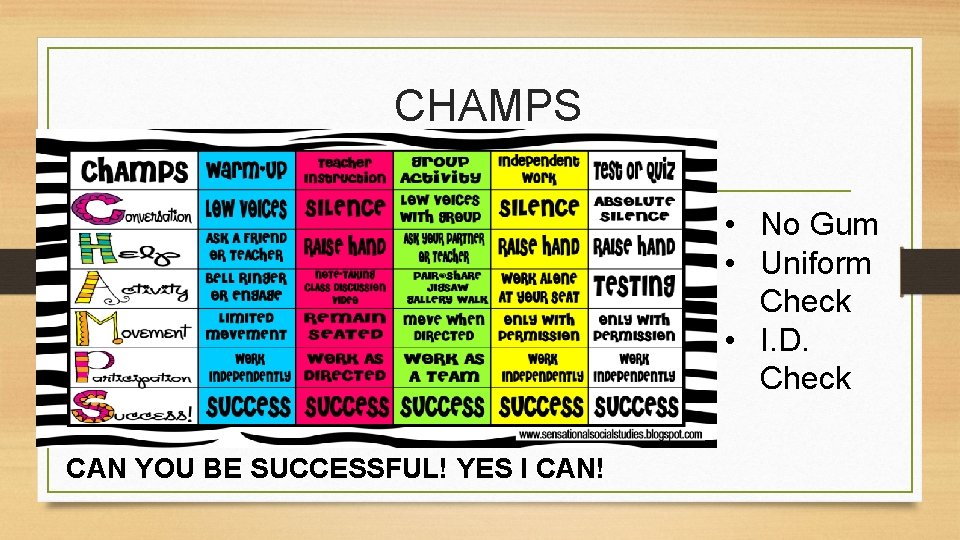
CHAMPS • No Gum • Uniform Check • I. D. Check CAN YOU BE SUCCESSFUL! YES I CAN!
Gods and Mythology • We know about the earliest Gods from the beginning of writing. Most of what was written about were stories relating to the Gods, called Mythology. • Mythos=stories logy=the study of • Why study mythology? • Myths are humanity’s earliest attempt to explain the universe. The study of the mythology reveals how a culture thought about the world.
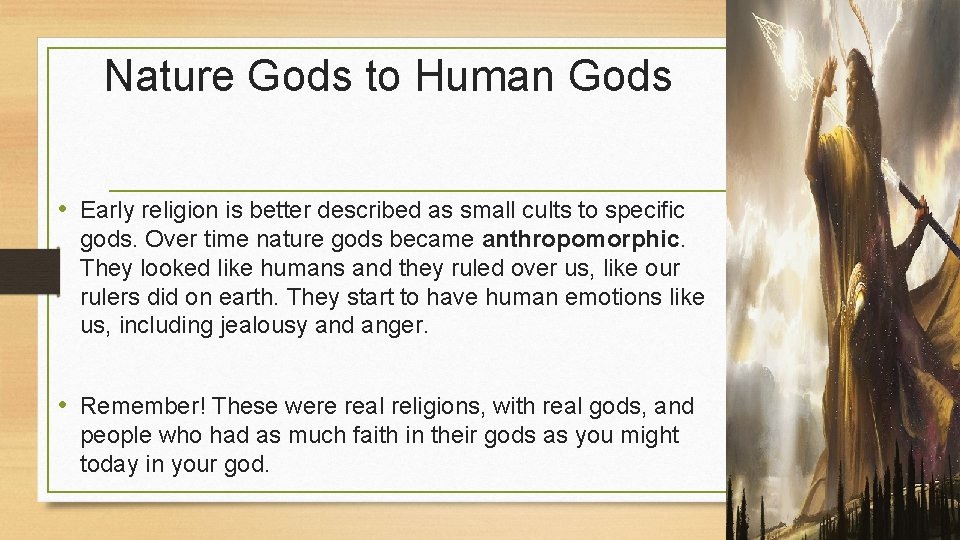
Nature Gods to Human Gods • Early religion is better described as small cults to specific gods. Over time nature gods became anthropomorphic. They looked like humans and they ruled over us, like our rulers did on earth. They start to have human emotions like us, including jealousy and anger. • Remember! These were real religions, with real gods, and people who had as much faith in their gods as you might today in your god.
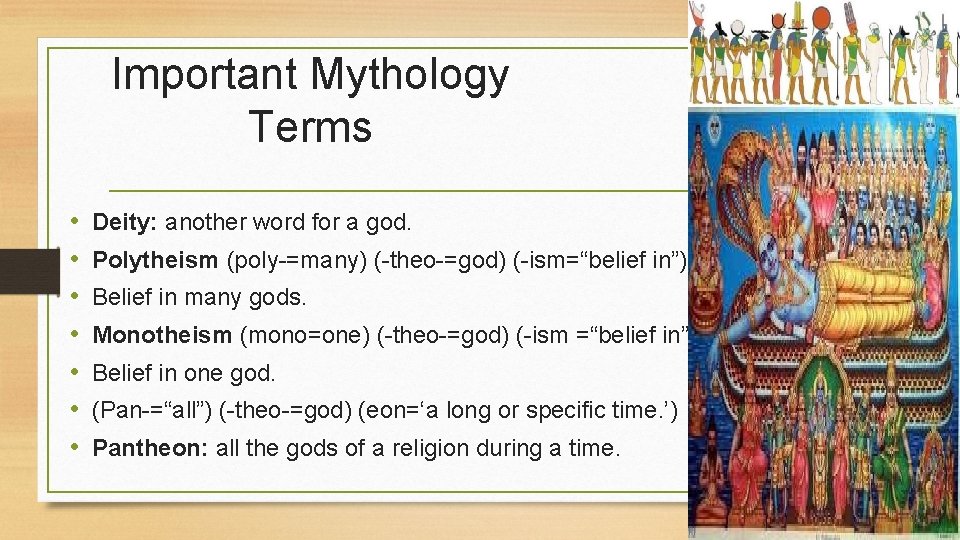
Important Mythology Terms • • Deity: another word for a god. Polytheism (poly-=many) (-theo-=god) (-ism=“belief in”) Belief in many gods. Monotheism (mono=one) (-theo-=god) (-ism =“belief in”) Belief in one god. (Pan-=“all”) (-theo-=god) (eon=‘a long or specific time. ’) Pantheon: all the gods of a religion during a time.
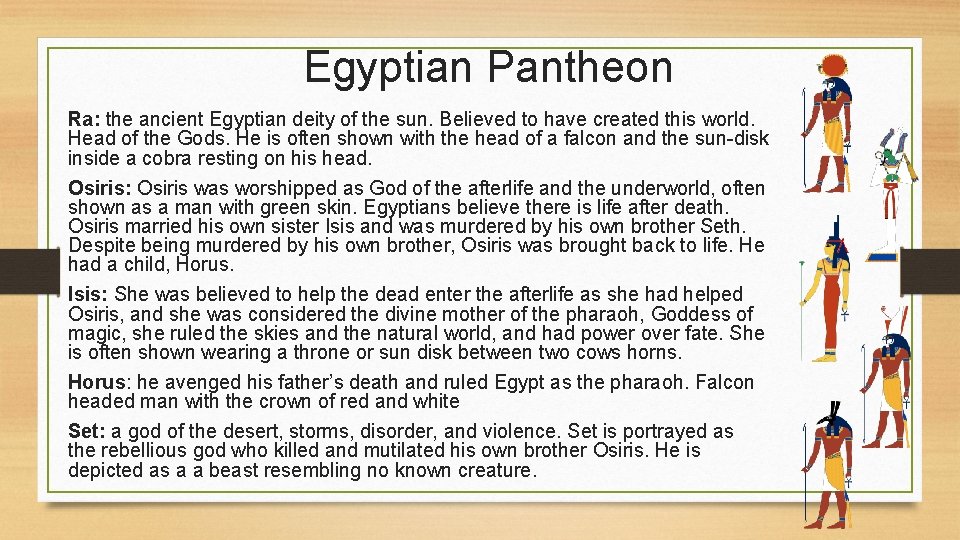
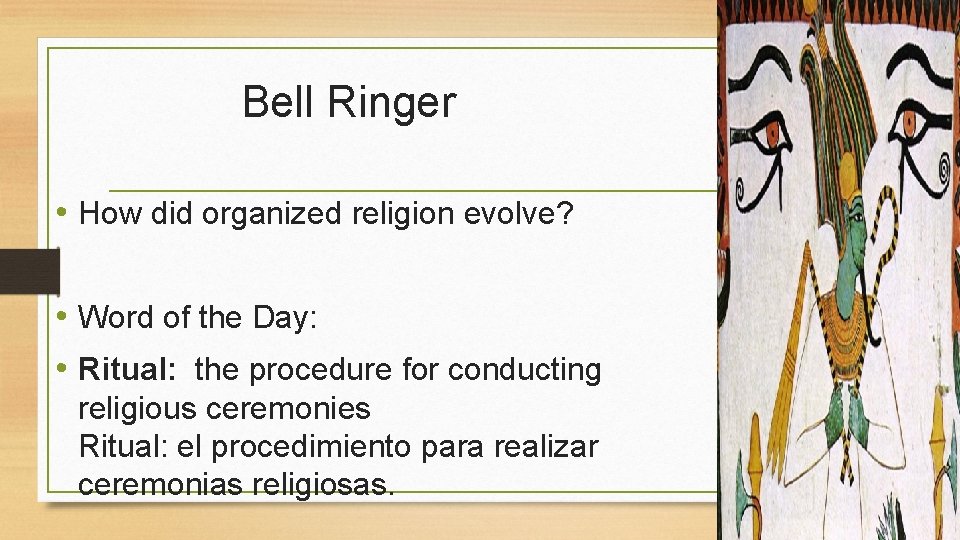
Egyptian Pantheon Ra: the ancient Egyptian deity of the sun. Believed to have created this world. Head of the Gods. He is often shown with the head of a falcon and the sun-disk inside a cobra resting on his head. Osiris: Osiris was worshipped as God of the afterlife and the underworld, often shown as a man with green skin. Egyptians believe there is life after death. Osiris married his own sister Isis and was murdered by his own brother Seth. Despite being murdered by his own brother, Osiris was brought back to life. He had a child, Horus. Isis: She was believed to help the dead enter the afterlife as she had helped Osiris, and she was considered the divine mother of the pharaoh, Goddess of magic, she ruled the skies and the natural world, and had power over fate. She is often shown wearing a throne or sun disk between two cows horns. Horus: he avenged his father’s death and ruled Egypt as the pharaoh. Falcon headed man with the crown of red and white Set: a god of the desert, storms, disorder, and violence. Set is portrayed as the rebellious god who killed and mutilated his own brother Osiris. He is depicted as a a beast resembling no known creature.
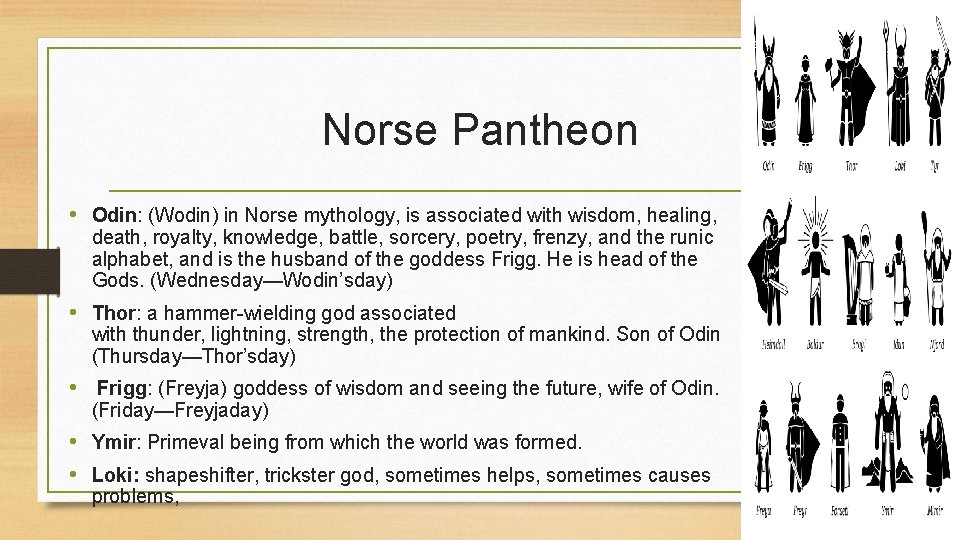
Norse Pantheon • Odin: (Wodin) in Norse mythology, is associated with wisdom, healing, death, royalty, knowledge, battle, sorcery, poetry, frenzy, and the runic alphabet, and is the husband of the goddess Frigg. He is head of the Gods. (Wednesday—Wodin’sday) • Thor: a hammer-wielding god associated with thunder, lightning, strength, the protection of mankind. Son of Odin (Thursday—Thor’sday) • Frigg: (Freyja) goddess of wisdom and seeing the future, wife of Odin. (Friday—Freyjaday) • Ymir: Primeval being from which the world was formed. • Loki: shapeshifter, trickster god, sometimes helps, sometimes causes problems,
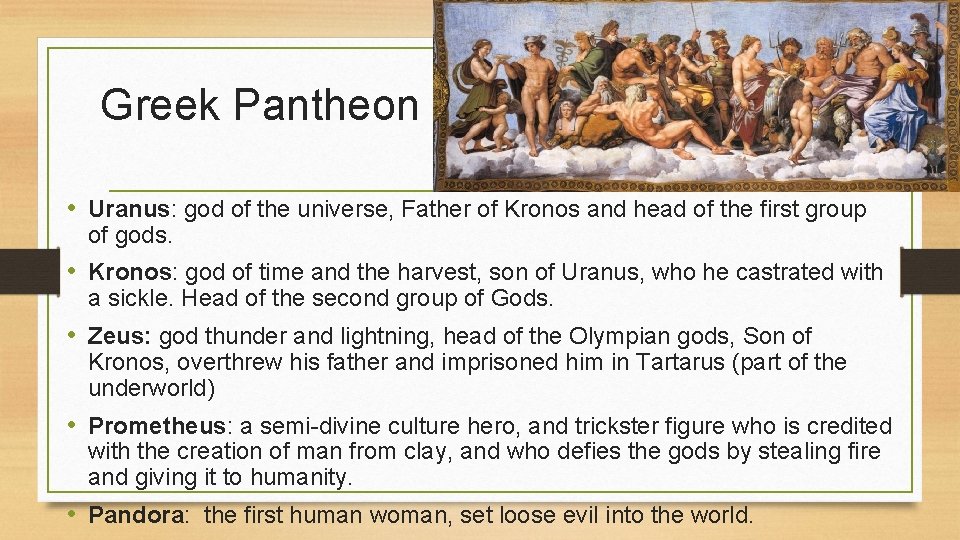
Greek Pantheon • Uranus: god of the universe, Father of Kronos and head of the first group of gods. • Kronos: god of time and the harvest, son of Uranus, who he castrated with a sickle. Head of the second group of Gods. • Zeus: god thunder and lightning, head of the Olympian gods, Son of Kronos, overthrew his father and imprisoned him in Tartarus (part of the underworld) • Prometheus: a semi-divine culture hero, and trickster figure who is credited with the creation of man from clay, and who defies the gods by stealing fire and giving it to humanity. • Pandora: the first human woman, set loose evil into the world.
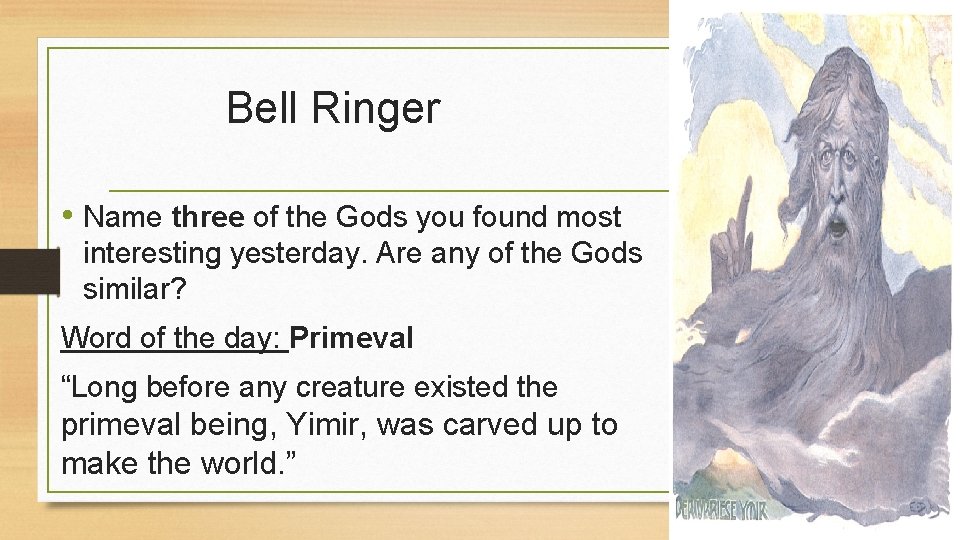
Bell Ringer • Name three of the Gods you found most interesting yesterday. Are any of the Gods similar? Word of the day: Primeval “Long before any creature existed the primeval being, Yimir, was carved up to make the world. ”
Primeval • Primeval: earliest, original, ancient, existing since the beginning of everything. • Primeval: primitivo, original, antiguo, existente desde el principio de todo.
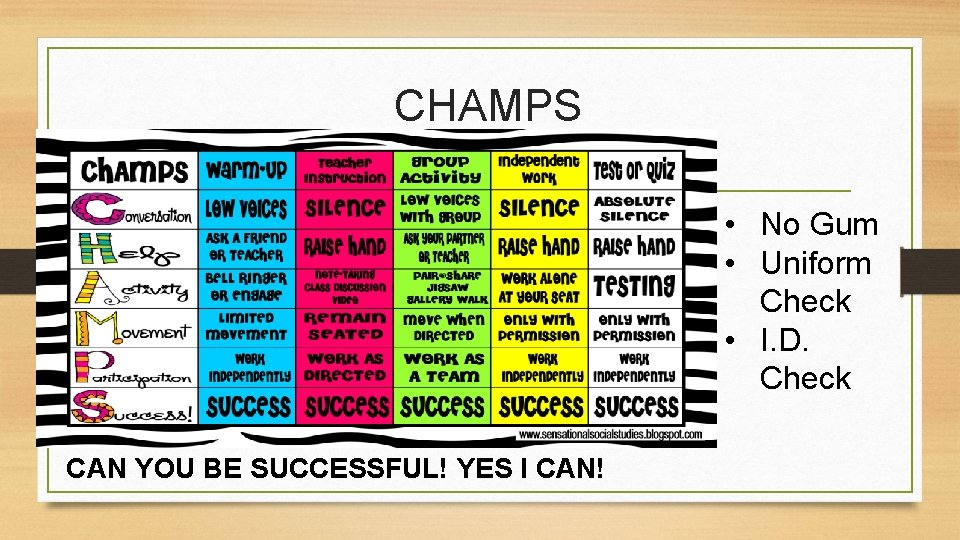
CHAMPS • No Gum • Uniform Check • I. D. Check CAN YOU BE SUCCESSFUL! YES I CAN!
Objectives • SWBAT: describe different belief systems from around the world. • SWBAT: determine their own belief systems in comparison to other religions and belief systems. SWBAT: describe diferentes sistemas de creencias de todo el mundo. SWBAT: determina sus propios sistemas de creencias en comparación con otras religiones y sistemas de creencias.
Big Question • What do people around the world believe? What do you believe? • ¿En qué creen las personas de todo el mundo? ¿Qué crees?
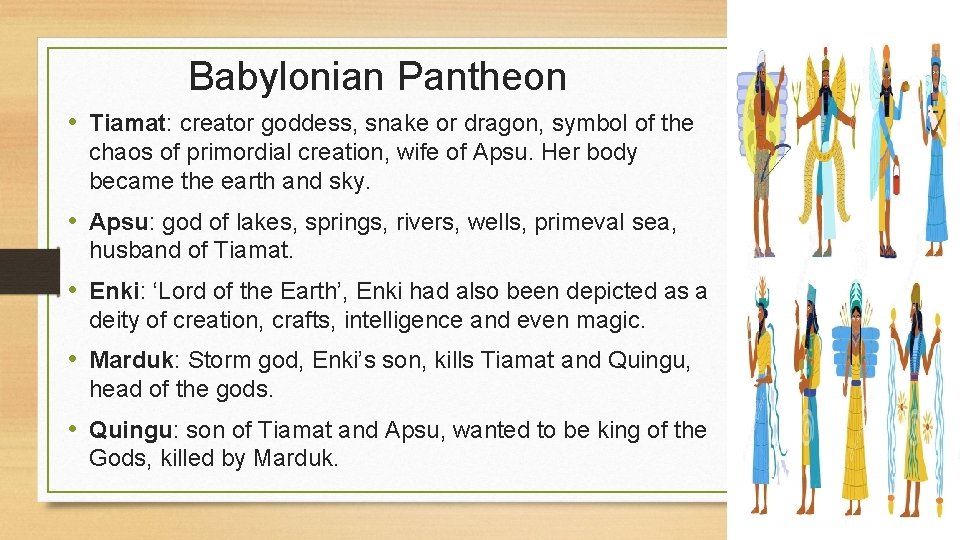
Babylonian Pantheon • Tiamat: creator goddess, snake or dragon, symbol of the chaos of primordial creation, wife of Apsu. Her body became the earth and sky. • Apsu: god of lakes, springs, rivers, wells, primeval sea, husband of Tiamat. • Enki: ‘Lord of the Earth’, Enki had also been depicted as a deity of creation, crafts, intelligence and even magic. • Marduk: Storm god, Enki’s son, kills Tiamat and Quingu, head of the gods. • Quingu: son of Tiamat and Apsu, wanted to be king of the Gods, killed by Marduk.
Read Creation Stories • PARTICIPATE! • Annotate as we read • Look for similarities • Look for the Gods we discussed
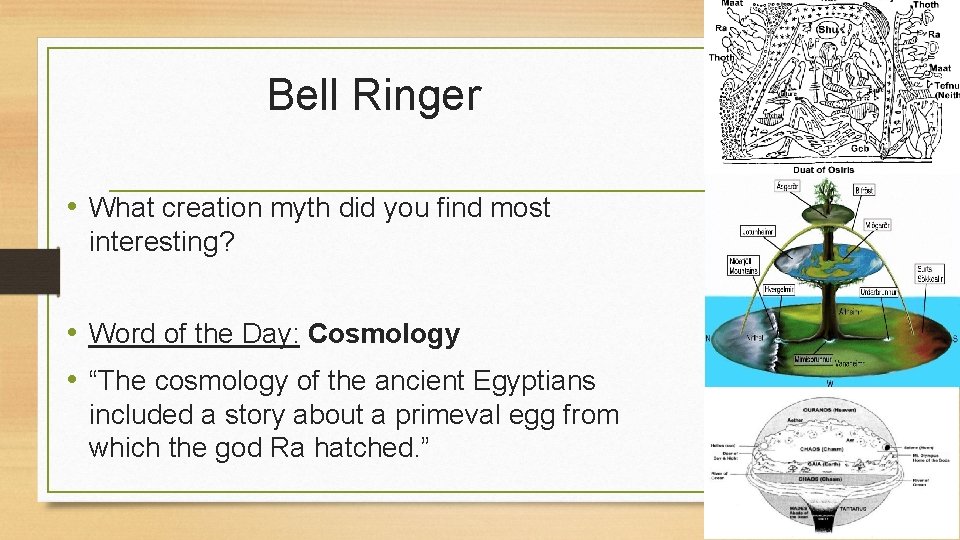
Bell Ringer • What creation myth did you find most interesting? • Word of the Day: Cosmology • “The cosmology of the ancient Egyptians included a story about a primeval egg from which the god Ra hatched. ”
Cosmology • Cosmo/s-=“the universe” -ology= “the study of” • Cosmology: a theory, hypothesis, or story, about the origin of the universe. • REMEMBER: If you hear the word of the day, raise your hand for a CHAMPS DOLLAR!
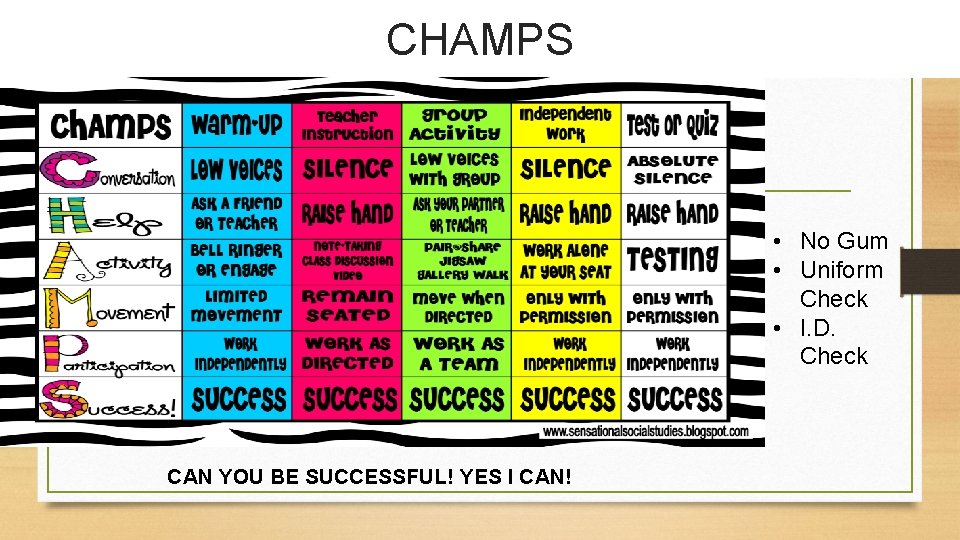
CHAMPS • No Gum • Uniform Check • I. D. Check CAN YOU BE SUCCESSFUL! YES I CAN!
Objectives • SWBAT: describe different belief systems from around the world. • SWBAT: determine their own belief systems in comparison to other religions and belief systems. SWBAT: describe diferentes sistemas de creencias de todo el mundo. SWBAT: determina sus propios sistemas de creencias en comparación con otras religiones y sistemas de creencias.
Big Question • What do people around the world believe? What do you believe? • ¿En qué creen las personas de todo el mundo? ¿Qué crees?
Writing a Five Paragraph Essay • Mythology Graphic Organizer • Write along with me! • Checked at the end of the period for points. FIVE PARAGRAPH ESSAY= 1. 2. 3. 4. 5. Introduction (thesis statement) Body Paragraph 1 Body Paragraph 2 Body Paragraph 3 Conclusion.
CLOSURE: Journal entry • Write a journal entry about indigenous religions and mythology: • Ideas to consider: • What do you think about shamanism, animism, power animals, possession, exorcism, superstition, the creation myths we read, the first gods? • AT LEAST 6 SENTENCES!
- Slides: 23