
Early Forms of Writing History of Writing Many
- Slides: 15
Early Forms of Writing
History of Writing Many legends associated with the inventions of writing. Greek legend – Prince of Phonecia, Cadmus Chinese Fable – their 4 -eyed dragon god, Cang Jie did it. Babylonian God Nebo gave it to the Egyptians. In Islam – the alphabet was invented by Allah and presented to humans, but not the angels.
Early writing Began with PETROGLYPHS – or cave drawings 20, 000 yrs ago in Spain PICTOGRAMS – pix drawings Represent direct objects Once it was accepted as representing an object – then it was extended to representing ideas associated with the objects, thus Ideograms.
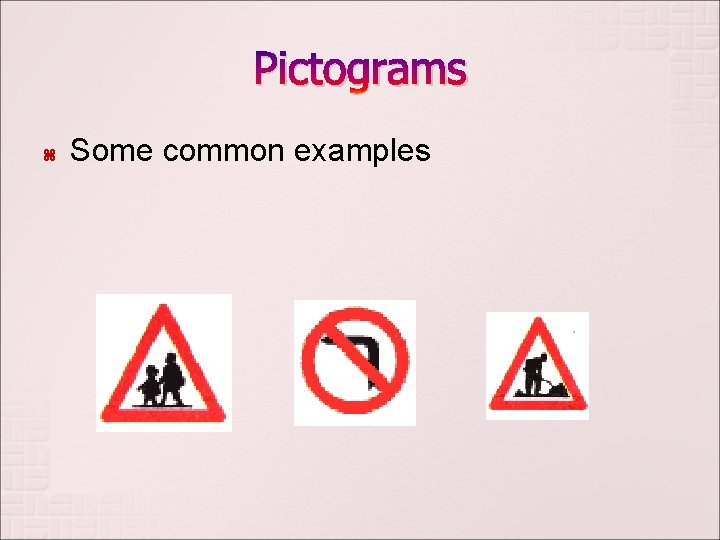
Pictograms Some common examples
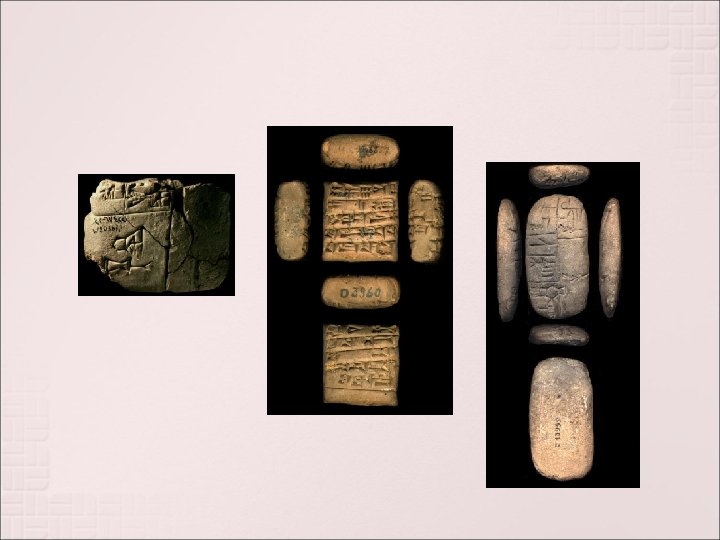
Cuneiform Writing Cuneiform – latin words ‘wedge’ and ‘shape’. Originated in Sumeria More than 6, 000 years ago The oldest known writing system On clay slabs – writing about prayers, epics, poems, docs, etc.
Cuneiform writing (cont) Its Evolution It evolved and later became known as logographic, or word writing Each symbol represents both word and concept – like ideograms Later borrowed by the Babylonians, Assyrians and Persians – spread thruout Asia Minor They used them to represent the sounds in their language
Cuneiform writing (cont) Its Evolution Cuneiform later evolved into syllabic writing The Persians greatly simplified the original cuneiform writing.
Emoticons Modern pictographic system Similar to cuneiform – many symbols are combined to form meanings /concepts : -) : ’-( B-(
The Rebus Principle When a graphic symbol no longer has a visual relationship to the word it represents, it becomes a phonographic symbol, standing for the sounds that represent the word. A single sign can represent all words with the same sound – eg. means ‘sun’ and ‘son’. An advert which uses this principle – ‘ 31 wonderful flavours’ This is not an efficient system, why?
Hieroglyphs At the same time as the Sumerian’s cuneiform – 4000 BC – Egyptians using same form of writing Greeks term it as Hieroglyphs This system represents both concept and word for the concept. So – became logographic writing system.
Modern Writing System A majority of the alphabets of today’s modern writing system comes from the Greeks. Word Writing – or logographic writing system A written character represents both the meaning and pronunciation of each word or morpheme(smallest meaningful unit of language). English words – 26 words and symbols Chinese and Japanese – many characters that represent sounds or words – an exception.
Syllabic Writing A system without consonant clusters (-ght, -ng) more efficient than word-writing systems, but has many variation of sounds – in the Jap lang all words can be phonologically represented in 100 syllables. Cherokee people also adopted the syllabic writing system but only recently invented in 1821.
Consonantal Alphabet Writing Hebrew and Arabic are languages with alphabets that consist of only consonants. Eg Arabic consonant ktb forms the root words for kitab (book), katab (write), etc. Compared to English, I like to eat out. = LK T T T. Works well with person who knows the spoken language.
Reading assignmet Chap 12 – Fromkin et al. The end