
Early Fermi LAT observations of the Vela pulsar
Early Fermi LAT observations of the Vela pulsar Massimiliano Razzano on behalf of the Fermi LAT Collaboration INFN-Pisa massimiliano. razzano@pi. infn. it M. Razzano - 44 th Rencontres de Moriond
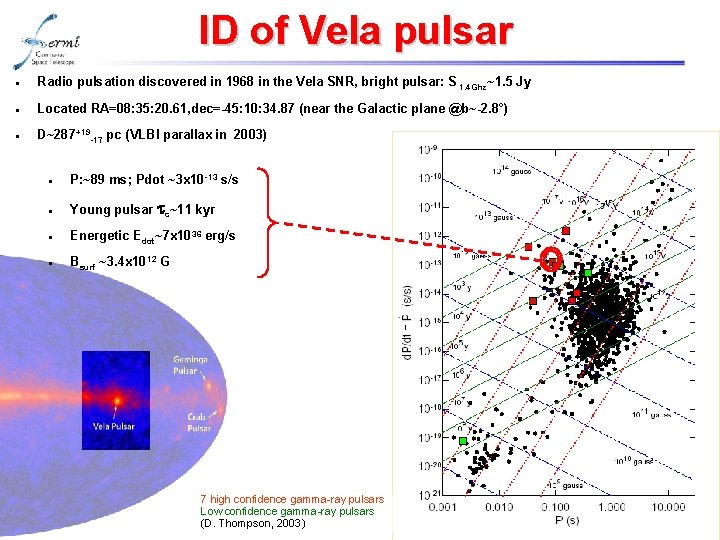
ID of Vela pulsar Radio pulsation discovered in 1968 in the Vela SNR, bright pulsar: S 1. 4 Ghz~1. 5 Jy Located RA=08: 35: 20. 61, dec=-45: 10: 34. 87 (near the Galactic plane @b~-2. 8˚) D~287+19 -17 pc (VLBI parallax in 2003) P: ~89 ms; Pdot ~3 x 10 -13 s/s Young pulsar Energetic Edot~7 x 1036 erg/s Bsurf ~3. 4 x 10¹² G tc~11 kyr 7 high confidence gamma-ray pulsars Low confidence gamma-ray pulsars (D. Thompson, 2003)
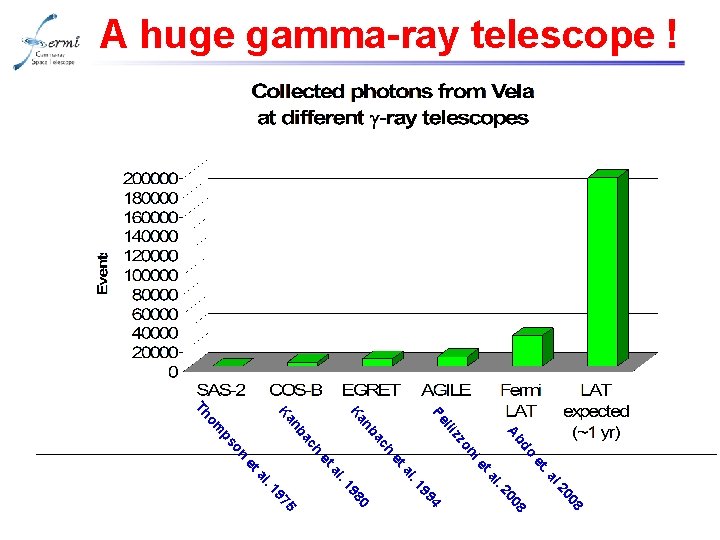
A huge gamma-ray telescope ! do Ab . et al 08 20 8 00 2 l. ta 94 19 75 19 80 19 l. a et . al et ie on zz lli Pe h ac nb Ka on ps om Th
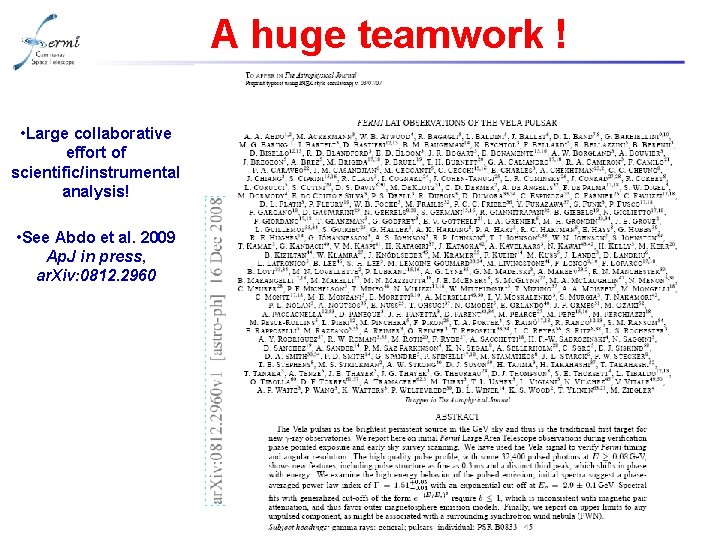
A huge teamwork ! • Large collaborative effort of scientific/instrumental analysis! • See Abdo et al. 2009 Ap. J in press, ar. Xiv: 0812. 2960
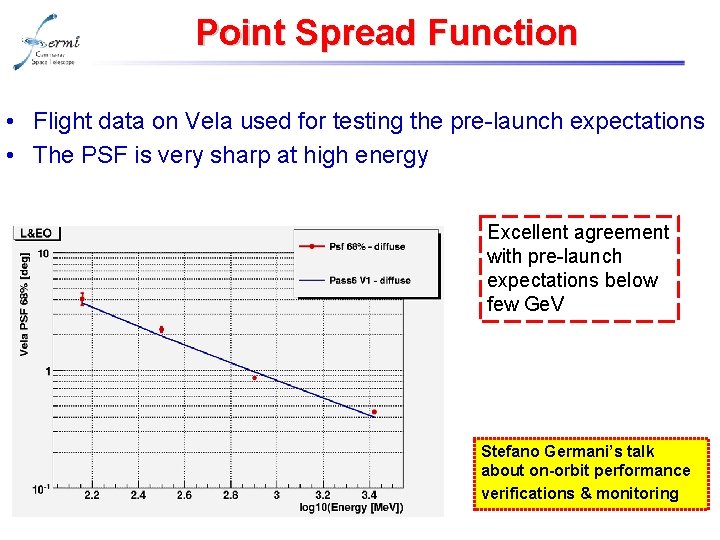
Point Spread Function • Flight data on Vela used for testing the pre-launch expectations • The PSF is very sharp at high energy Excellent agreement with pre-launch expectations below few Ge. V Stefano Germani’s talk about on-orbit performance verifications & monitoring
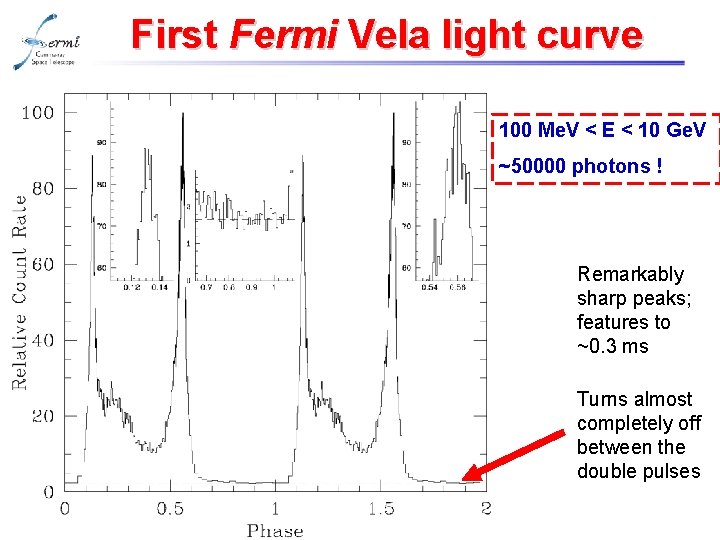
First Fermi Vela light curve 100 Me. V < E < 10 Ge. V ~50000 photons ! Remarkably sharp peaks; features to ~0. 3 ms Turns almost completely off between the double pulses
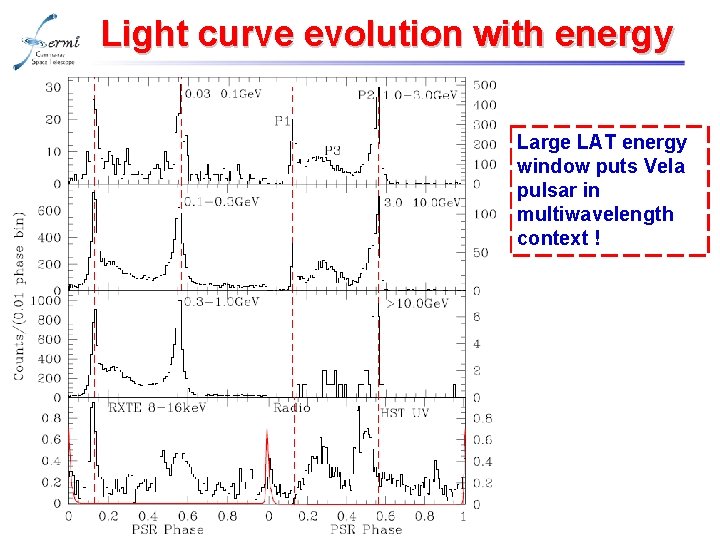
Light curve evolution with energy Large LAT energy window puts Vela pulsar in multiwavelength context !
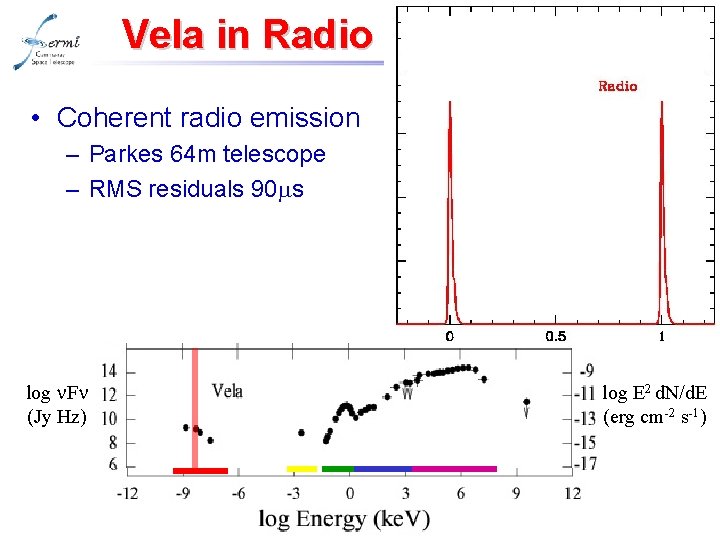
Vela in Radio • Coherent radio emission – Parkes 64 m telescope – RMS residuals 90 s log n. Fn (Jy Hz) log E 2 d. N/d. E (erg cm-2 s-1)
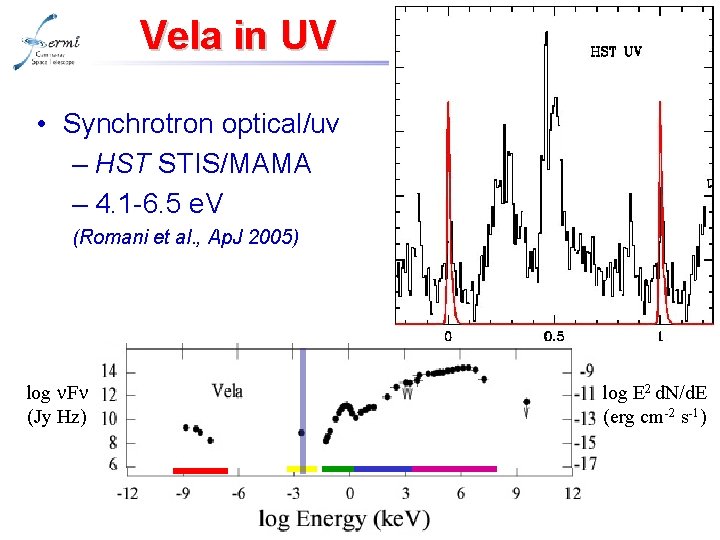
Vela in UV • Synchrotron optical/uv – HST STIS/MAMA – 4. 1 -6. 5 e. V (Romani et al. , Ap. J 2005) log n. Fn (Jy Hz) log E 2 d. N/d. E (erg cm-2 s-1)
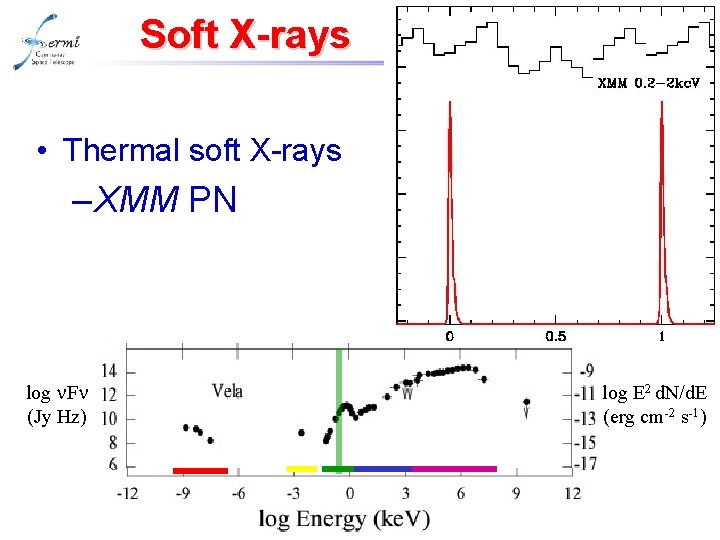
Soft X-rays • Thermal soft X-rays – XMM PN log n. Fn (Jy Hz) log E 2 d. N/d. E (erg cm-2 s-1)
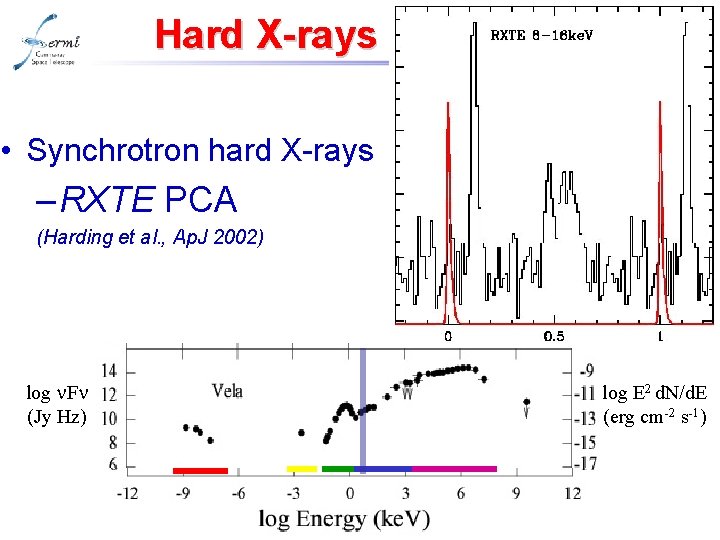
Hard X-rays • Synchrotron hard X-rays – RXTE PCA (Harding et al. , Ap. J 2002) log n. Fn (Jy Hz) log E 2 d. N/d. E (erg cm-2 s-1)
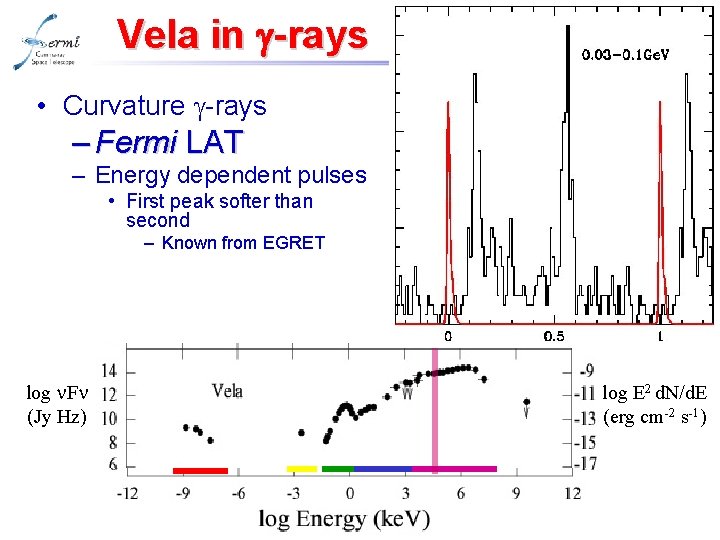
Vela in g-rays • Curvature g-rays – Fermi LAT – Energy dependent pulses • First peak softer than second – Known from EGRET log n. Fn (Jy Hz) log E 2 d. N/d. E (erg cm-2 s-1)
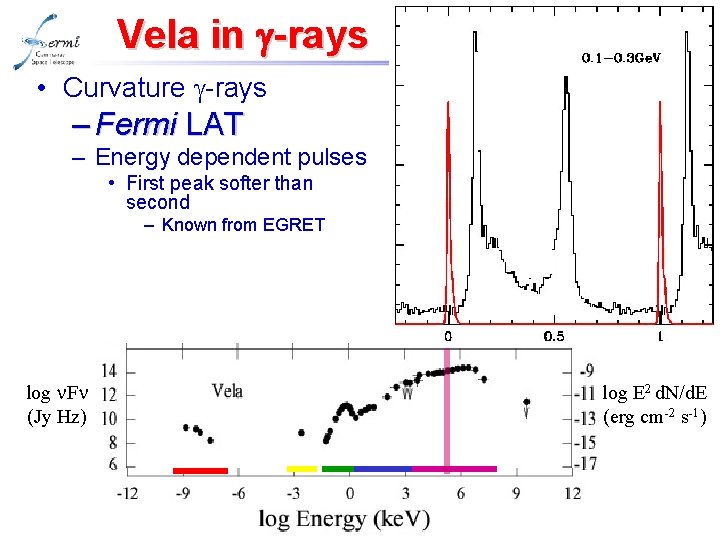
Vela in g-rays • Curvature g-rays – Fermi LAT – Energy dependent pulses • First peak softer than second – Known from EGRET log n. Fn (Jy Hz) log E 2 d. N/d. E (erg cm-2 s-1)
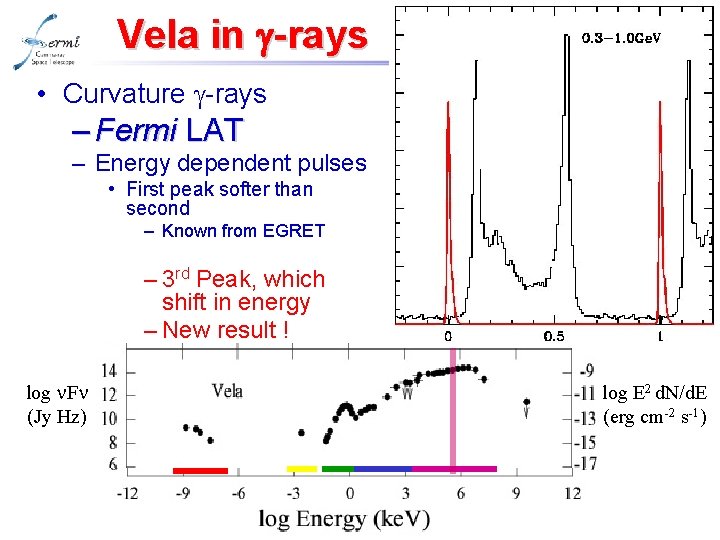
Vela in g-rays • Curvature g-rays – Fermi LAT – Energy dependent pulses • First peak softer than second – Known from EGRET – 3 rd Peak, which shift in energy – New result ! log n. Fn (Jy Hz) log E 2 d. N/d. E (erg cm-2 s-1)
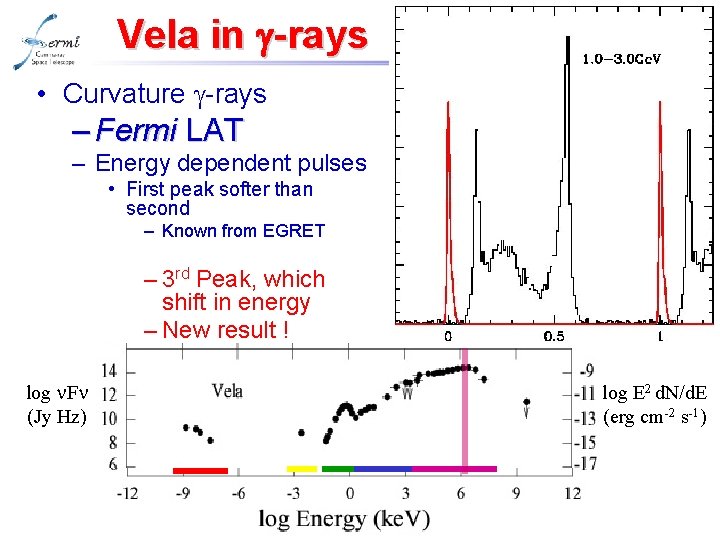
Vela in g-rays • Curvature g-rays – Fermi LAT – Energy dependent pulses • First peak softer than second – Known from EGRET – 3 rd Peak, which shift in energy – New result ! log n. Fn (Jy Hz) log E 2 d. N/d. E (erg cm-2 s-1)
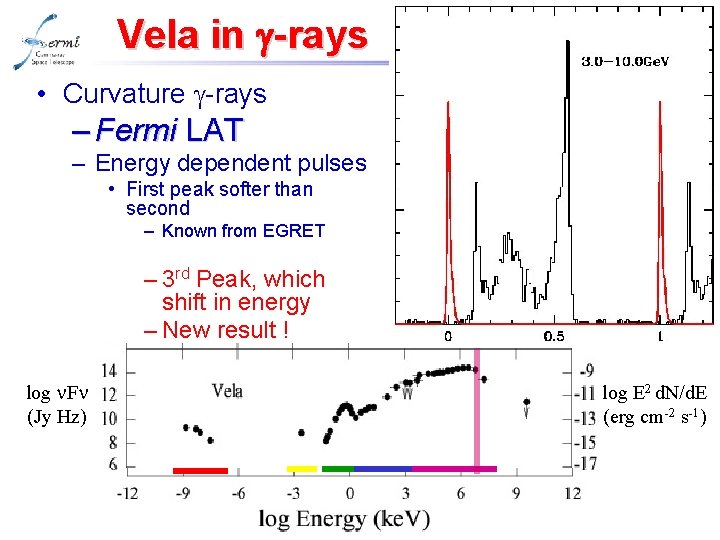
Vela in g-rays • Curvature g-rays – Fermi LAT – Energy dependent pulses • First peak softer than second – Known from EGRET – 3 rd Peak, which shift in energy – New result ! log n. Fn (Jy Hz) log E 2 d. N/d. E (erg cm-2 s-1)
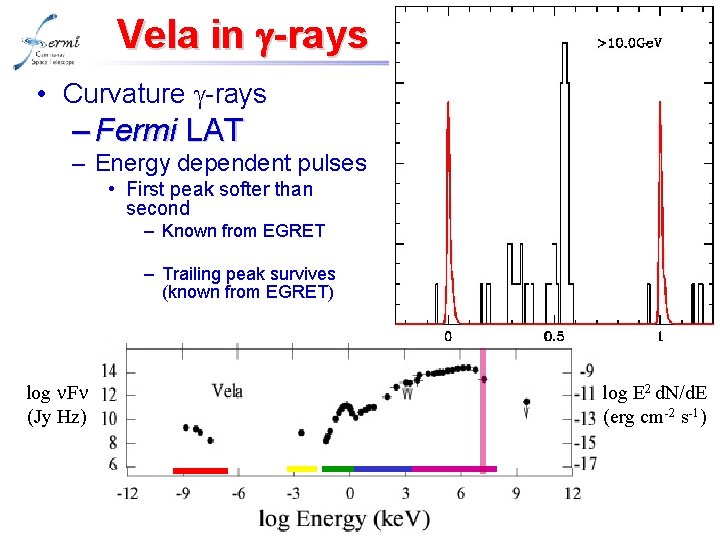
Vela in g-rays • Curvature g-rays – Fermi LAT – Energy dependent pulses • First peak softer than second – Known from EGRET – Trailing peak survives (known from EGRET) log n. Fn (Jy Hz) log E 2 d. N/d. E (erg cm-2 s-1)
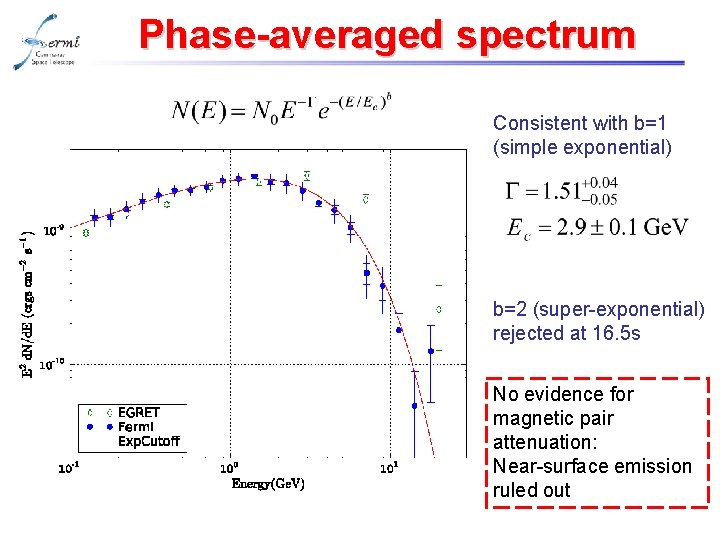
Phase-averaged spectrum Consistent with b=1 (simple exponential) b=2 (super-exponential) rejected at 16. 5 s No evidence for magnetic pair attenuation: Near-surface emission ruled out
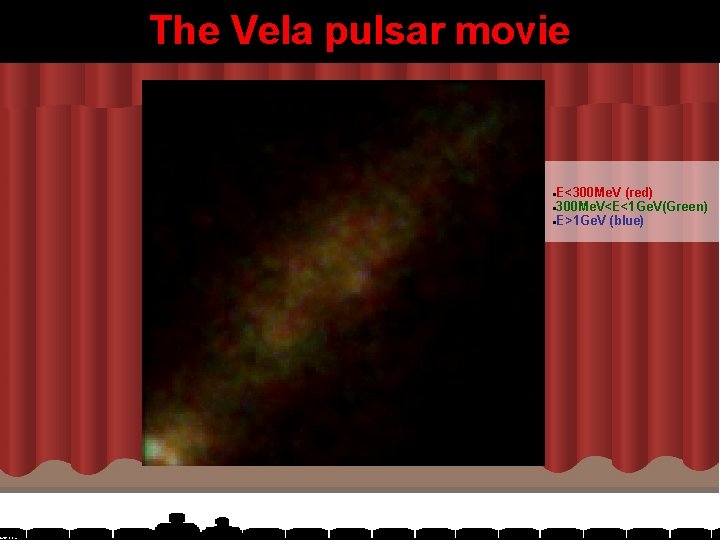
The Vela pulsar movie E<300 Me. V (red) 300 Me. V<E<1 Ge. V(Green) E>1 Ge. V (blue)
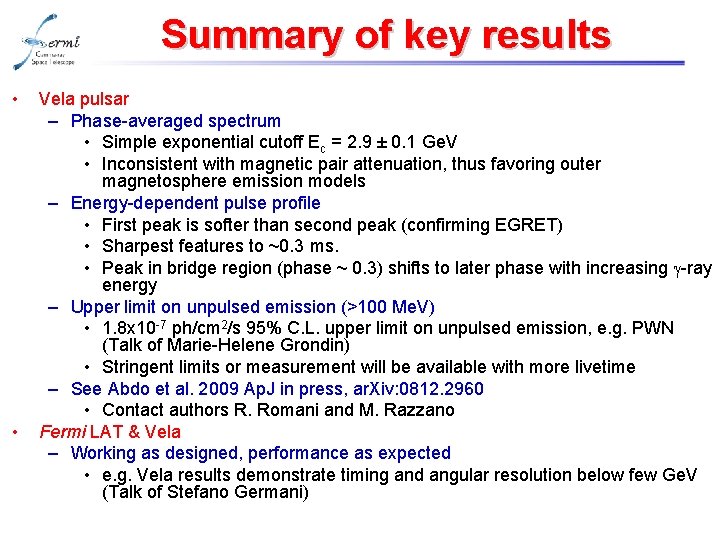
Summary of key results • • Vela pulsar – Phase-averaged spectrum • Simple exponential cutoff Ec = 2. 9 ± 0. 1 Ge. V • Inconsistent with magnetic pair attenuation, thus favoring outer magnetosphere emission models – Energy-dependent pulse profile • First peak is softer than second peak (confirming EGRET) • Sharpest features to ~0. 3 ms. • Peak in bridge region (phase ~ 0. 3) shifts to later phase with increasing g-ray energy – Upper limit on unpulsed emission (>100 Me. V) • 1. 8 x 10 -7 ph/cm 2/s 95% C. L. upper limit on unpulsed emission, e. g. PWN (Talk of Marie-Helene Grondin) • Stringent limits or measurement will be available with more livetime – See Abdo et al. 2009 Ap. J in press, ar. Xiv: 0812. 2960 • Contact authors R. Romani and M. Razzano Fermi LAT & Vela – Working as designed, performance as expected • e. g. Vela results demonstrate timing and angular resolution below few Ge. V (Talk of Stefano Germani)
- Slides: 20