
Early Differentiation of Terrestrial Planets The Relative Importance
- Slides: 21
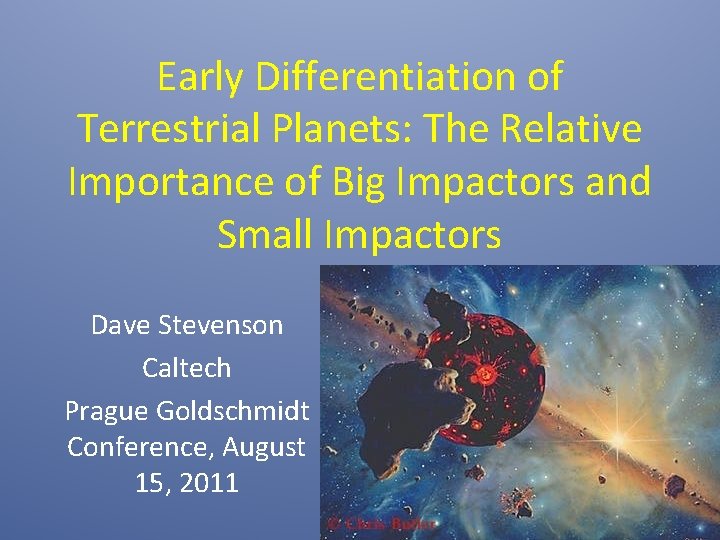
Early Differentiation of Terrestrial Planets: The Relative Importance of Big Impactors and Small Impactors Dave Stevenson Caltech Prague Goldschmidt Conference, August 15, 2011
The Main Points • Giant impacts are an essential part of Earth formation. Not just the lunar forming impact. • Small impactors are also essential & contemporaneous. • These two classes have different geochemical & geophysical consequences even if they have same timing and composition • Implications for the core & mantle , isotopic signatures and chronology.
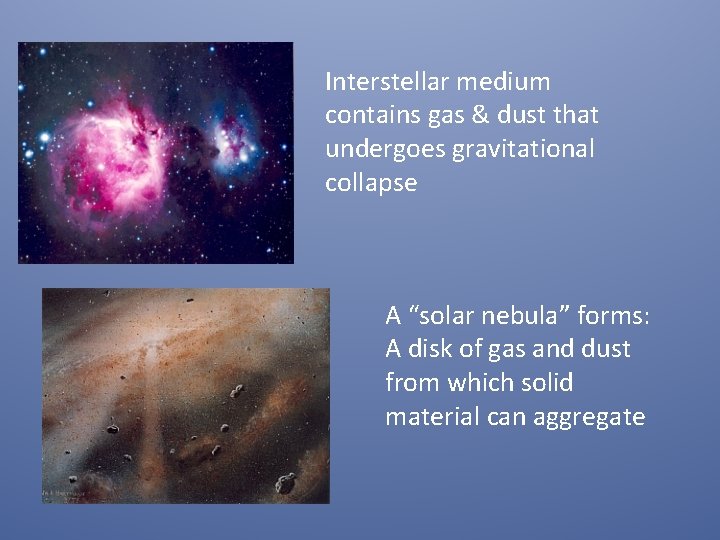
Interstellar medium contains gas & dust that undergoes gravitational collapse A “solar nebula” forms: A disk of gas and dust from which solid material can aggregate
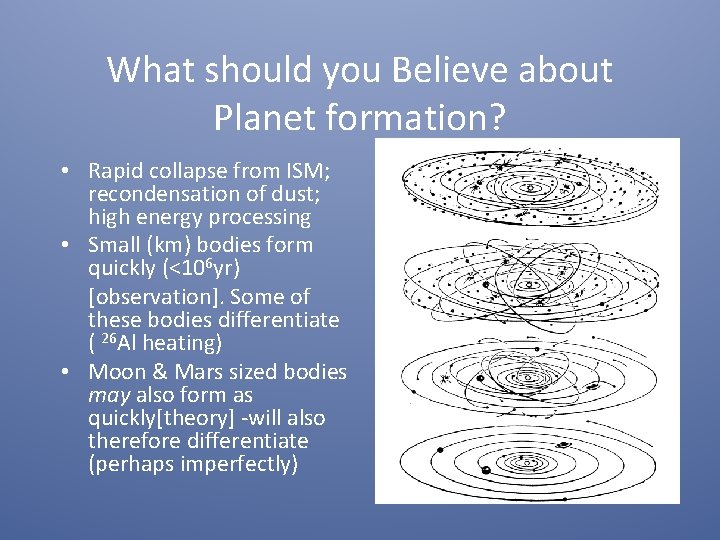
What should you Believe about Planet formation? • Rapid collapse from ISM; recondensation of dust; high energy processing • Small (km) bodies form quickly (<106 yr) [observation]. Some of these bodies differentiate ( 26 Al heating) • Moon & Mars sized bodies may also form as quickly[theory] -will also therefore differentiate (perhaps imperfectly)
Current State of Play • Nice model (and other similar work) shows how dynamical properties of the terrestrial planets are linked to both giant impacts and small bodies (dynamical friction). • In these models, the giant impacts are an essential ingredient. But the small bodies are also an essential ingredient.
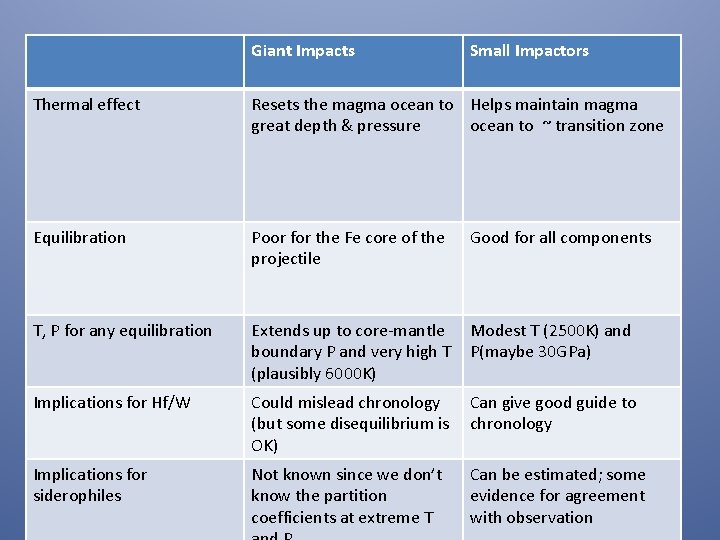
Giant Impacts Small Impactors Thermal effect Resets the magma ocean to Helps maintain magma great depth & pressure ocean to ~ transition zone Equilibration Poor for the Fe core of the projectile Good for all components T, P for any equilibration Extends up to core-mantle boundary P and very high T (plausibly 6000 K) Modest T (2500 K) and P(maybe 30 GPa) Implications for Hf/W Could mislead chronology (but some disequilibrium is OK) Can give good guide to chronology Implications for siderophiles Not known since we don’t know the partition coefficients at extreme T Can be estimated; some evidence for agreement with observation
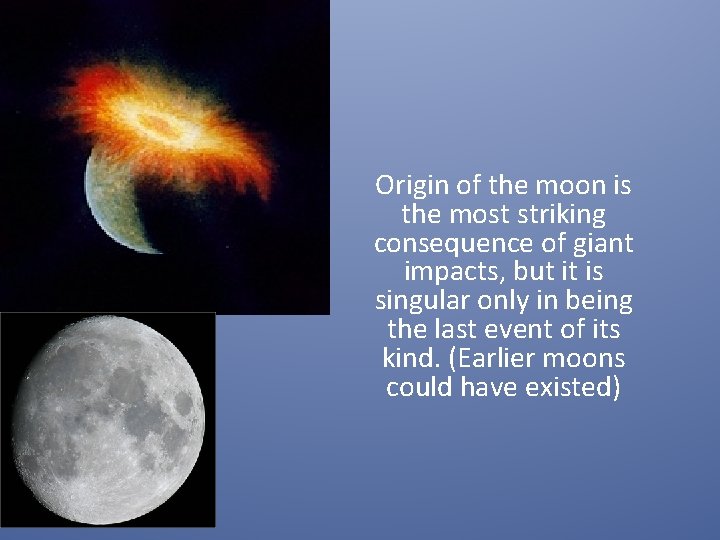
Origin of the moon is the most striking consequence of giant impacts, but it is singular only in being the last event of its kind. (Earlier moons could have existed)
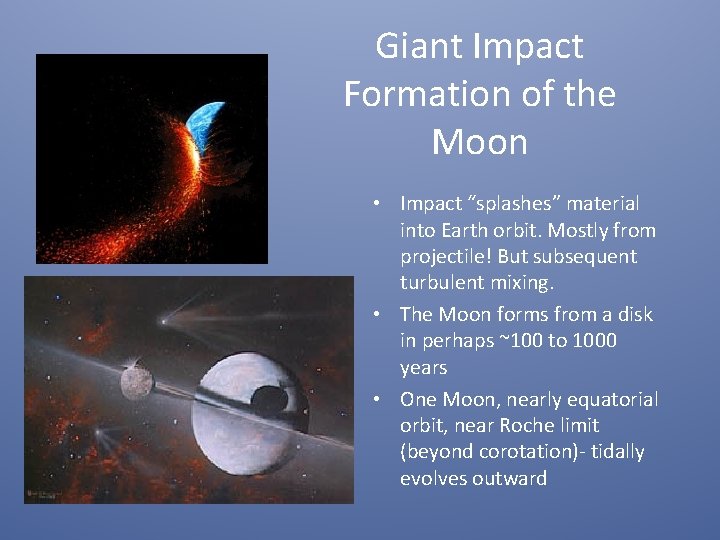
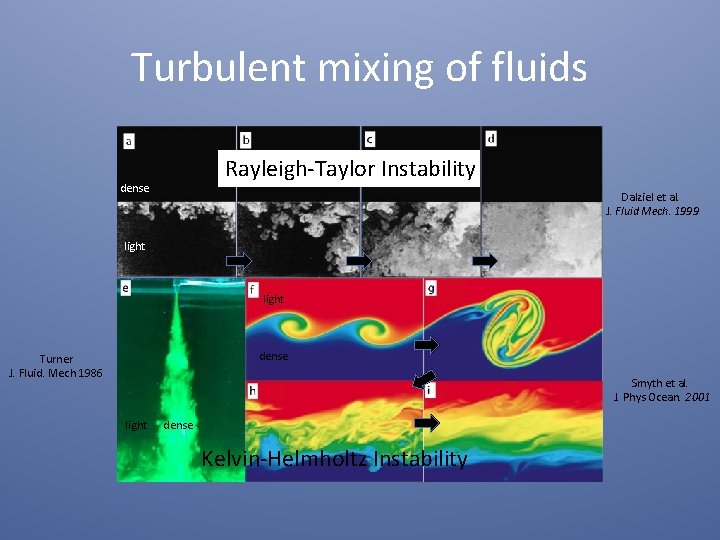
Giant Impact Formation of the Moon • Impact “splashes” material into Earth orbit. Mostly from projectile! But subsequent turbulent mixing. • The Moon forms from a disk in perhaps ~100 to 1000 years • One Moon, nearly equatorial orbit, near Roche limit (beyond corotation)- tidally evolves outward
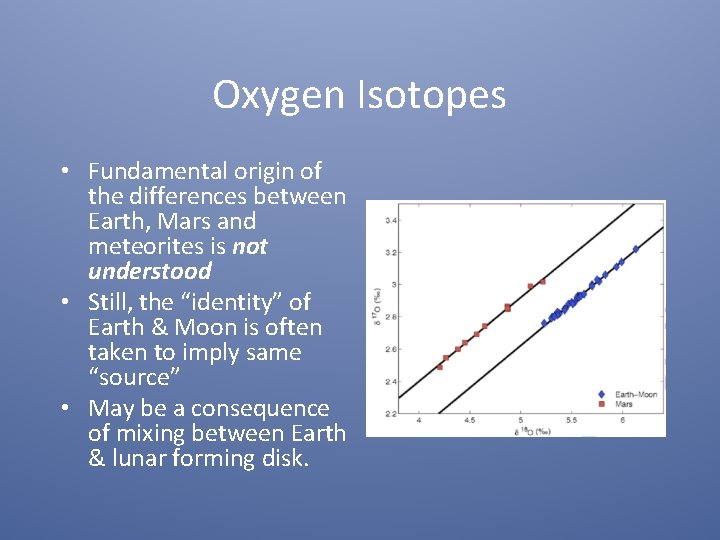
Oxygen Isotopes • Fundamental origin of the differences between Earth, Mars and meteorites is not understood • Still, the “identity” of Earth & Moon is often taken to imply same “source” • May be a consequence of mixing between Earth & lunar forming disk.
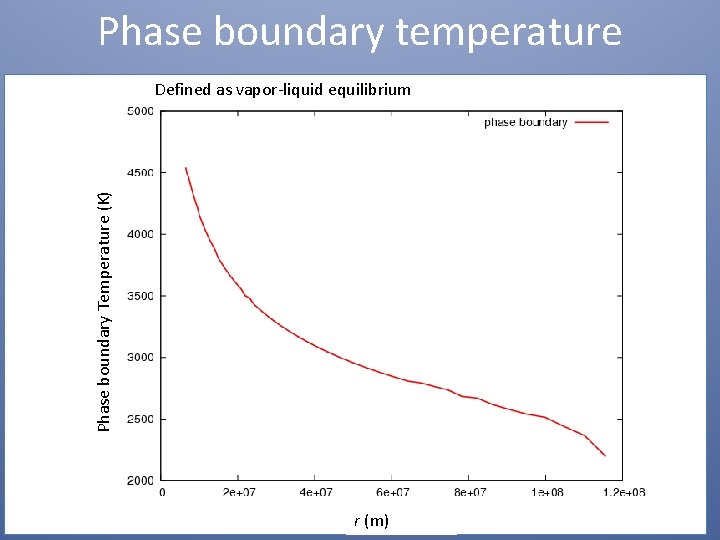
Phase boundary temperature Phase boundary Temperature (K) Defined as vapor-liquid equilibrium r (m)
Entropy Distribution • Post giant impact, the disk is of almost uniform entropy • But the outermost earth is of higher entropy: higher than both the disk an the deeper earth. This suppresses mixing of the mantle initially and also suppresses core-mantle equilibration. Does this mean the deep earth has different oxygen (and other isotopic) signature than the rest of Earth? Open question.
Core-Mantle Equilibration • If there is a magma ocean right at the CMB then the thickness of mantle that can chemically equilibrate with core is ~ (Dt)1/2. (T/t) where D is diffusivity, t is the convective instability time, T is total elapsed time. This is 100 km for t ~104 sec, T ~1011 sec, D ~10 -4 cm 2/sec. This probably means that the lowermost mantle is isolated from the rest of the mantle over geologic time.
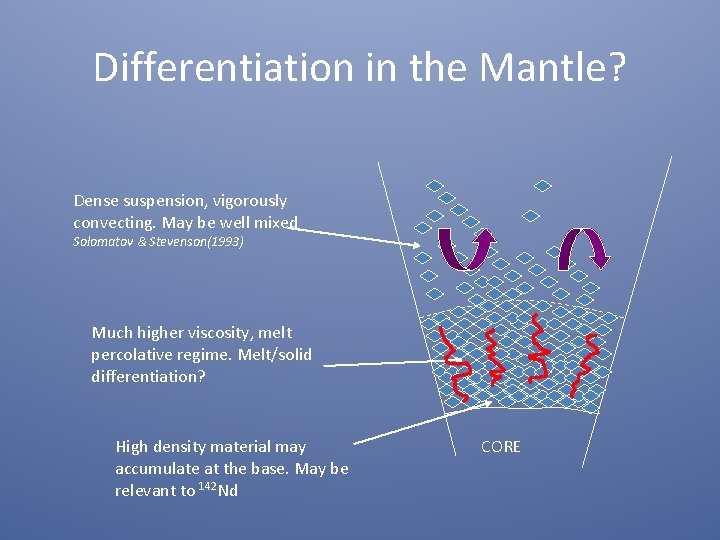
Differentiation in the Mantle? Dense suspension, vigorously convecting. May be well mixed Solomatov & Stevenson(1993) Much higher viscosity, melt percolative regime. Melt/solid differentiation? High density material may accumulate at the base. May be relevant to 142 Nd CORE
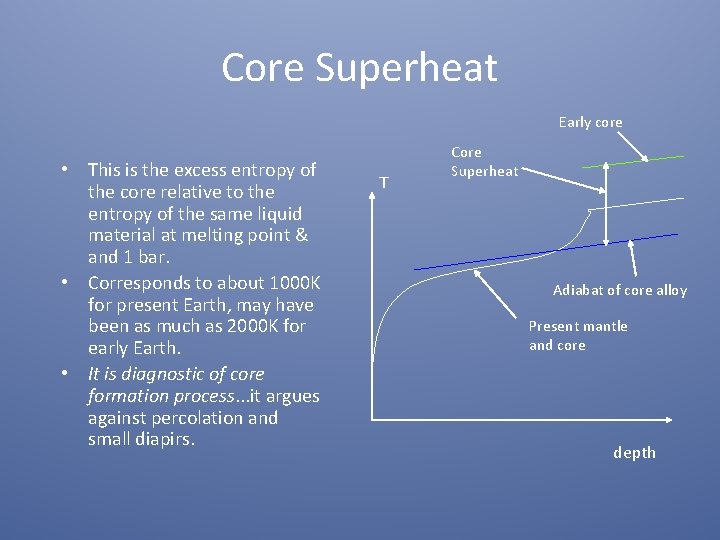
Core Superheat Early core • This is the excess entropy of the core relative to the entropy of the same liquid material at melting point & and 1 bar. • Corresponds to about 1000 K for present Earth, may have been as much as 2000 K for early Earth. • It is diagnostic of core formation process. . . it argues against percolation and small diapirs. T Core Superheat Adiabat of core alloy Present mantle and core depth
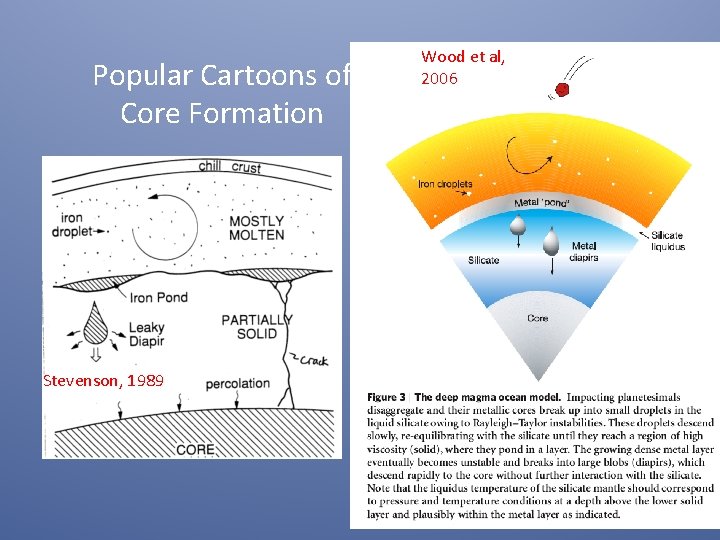
Popular Cartoons of Core Formation Stevenson, 1989 Wood et al, 2006
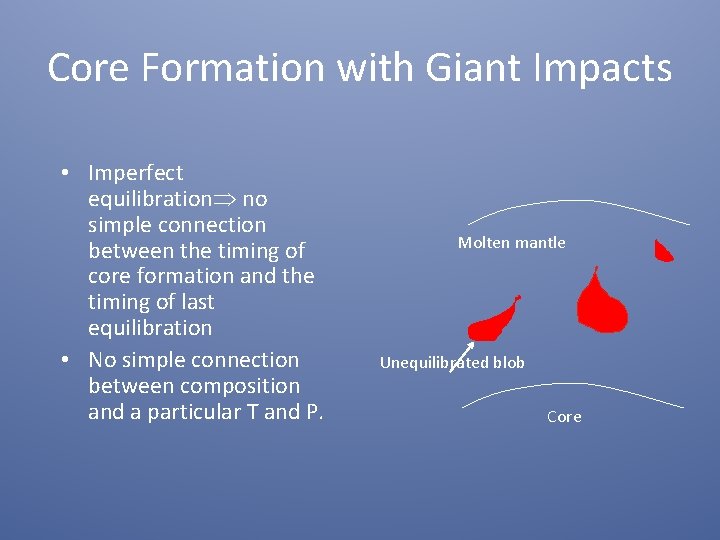
Core Formation with Giant Impacts • Imperfect equilibration no simple connection between the timing of core formation and the timing of last equilibration • No simple connection between composition and a particular T and P. Molten mantle Unequilibrated blob Core
Turbulent mixing of fluids Rayleigh-Taylor Instability dense Dalziel et al. J. Fluid Mech. 1999 light dense Turner J. Fluid. Mech 1986 Smyth et al. J. Phys Ocean. 2001 light dense Kelvin-Helmholtz Instability
Heterogeneous Accretion? • The Nice model predicts some heterogeneous accretion, both for the large and small bodies. • Bottke et al (2010) : Late impacts of lunar sized bodies (not as big as the moon forming impact) may occur. • Giant impact story is (still) falling short in geochemical explanation or prediction, partly because the physics is imperfectly understood “Doubt may be uncomfortable but certainty is absurd” Voltaire
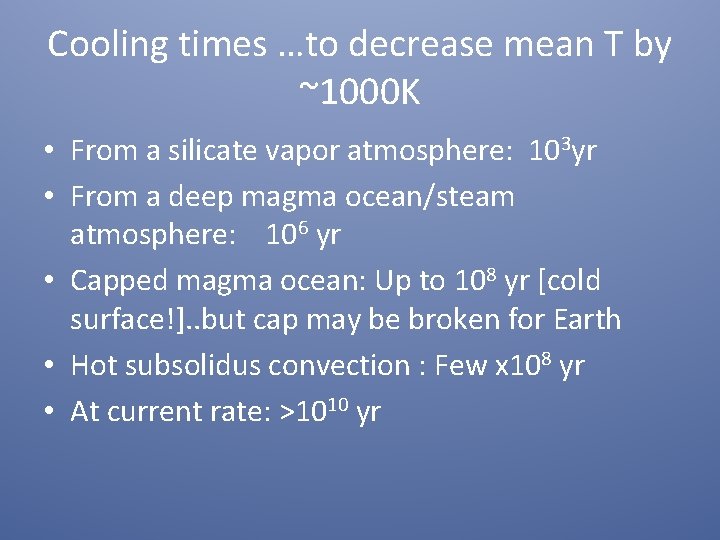
Cooling times …to decrease mean T by ~1000 K • From a silicate vapor atmosphere: 103 yr • From a deep magma ocean/steam atmosphere: 106 yr • Capped magma ocean: Up to 108 yr [cold surface!]. . but cap may be broken for Earth • Hot subsolidus convection : Few x 108 yr • At current rate: >1010 yr
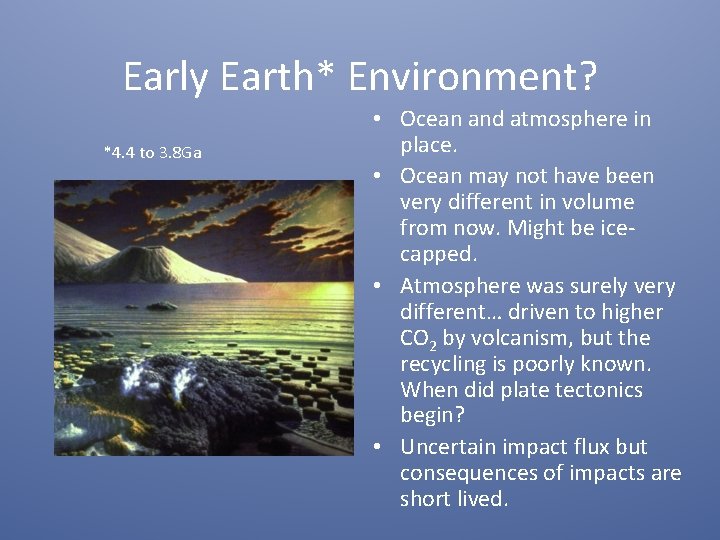
Early Earth* Environment? *4. 4 to 3. 8 Ga • Ocean and atmosphere in place. • Ocean may not have been very different in volume from now. Might be icecapped. • Atmosphere was surely very different… driven to higher CO 2 by volcanism, but the recycling is poorly known. When did plate tectonics begin? • Uncertain impact flux but consequences of impacts are short lived.
The Main Points • Giant impacts are an essential part of Earth formation. Not just the lunar forming impact. • Small impactors are also essential & contemporaneous. • These two classes have different geochemical & geophysical consequences even if they have same timing and composition • Implications for the core & mantle , isotopic signatures and chronology.