
Early Development of Quantum Mechanics Dr Prinson P
- Slides: 18
Early Development of Quantum Mechanics Dr. Prinson P Samuel Department of Chemistry Christian College Chengannur
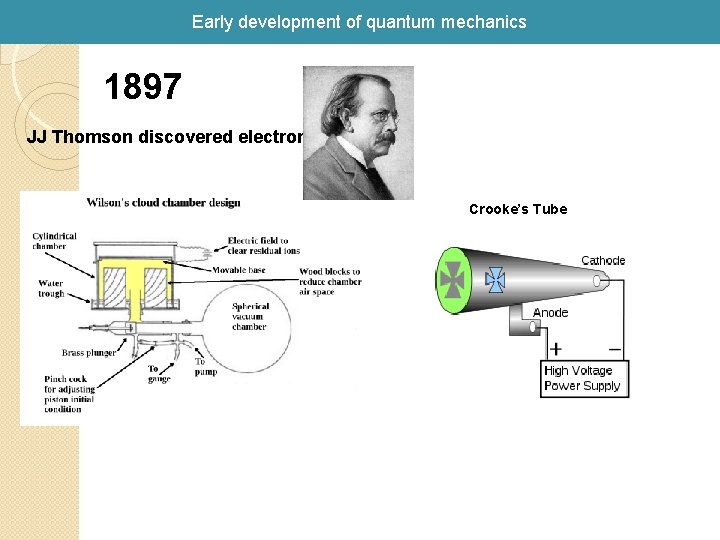
Early development of quantum mechanics 1897 JJ Thomson discovered electron Crooke’s Tube
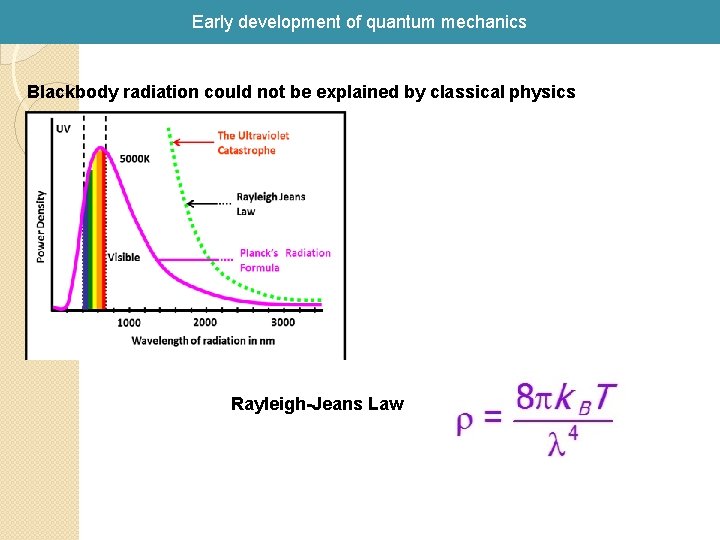
Early development of quantum mechanics Blackbody radiation could not be explained by classical physics Rayleigh-Jeans Law
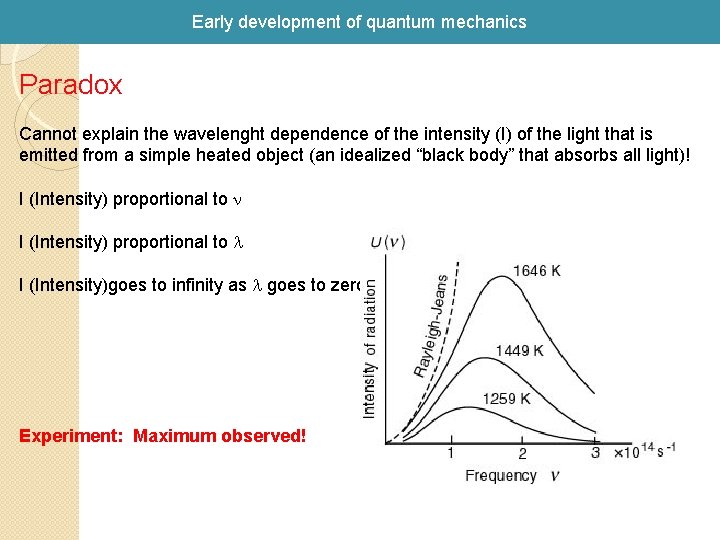
Early development of quantum mechanics Paradox Cannot explain the wavelenght dependence of the intensity (I) of the light that is emitted from a simple heated object (an idealized “black body” that absorbs all light)! I (Intensity) proportional to n I (Intensity) proportional to l I (Intensity)goes to infinity as l goes to zero! Experiment: Maximum observed!
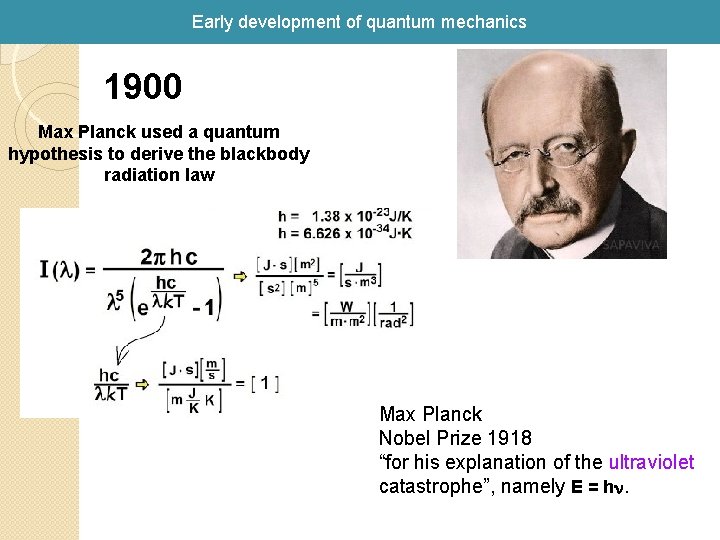
Early development of quantum mechanics 1900 Max Planck used a quantum hypothesis to derive the blackbody radiation law Max Planck Nobel Prize 1918 “for his explanation of the ultraviolet catastrophe”, namely E = hn.
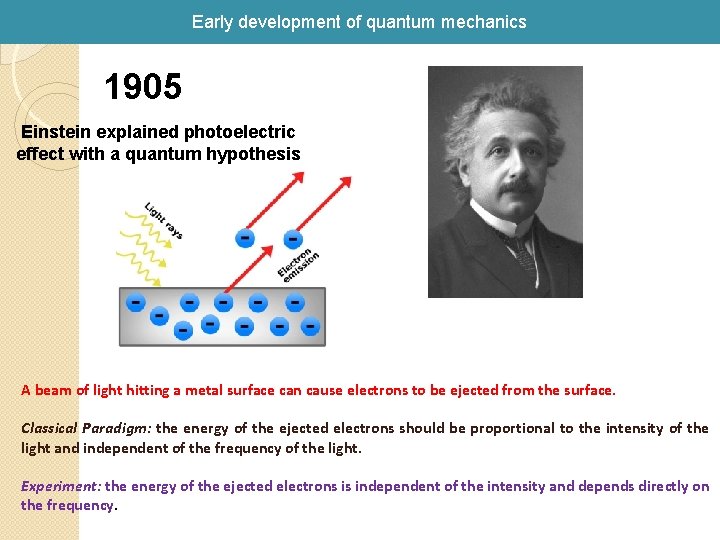
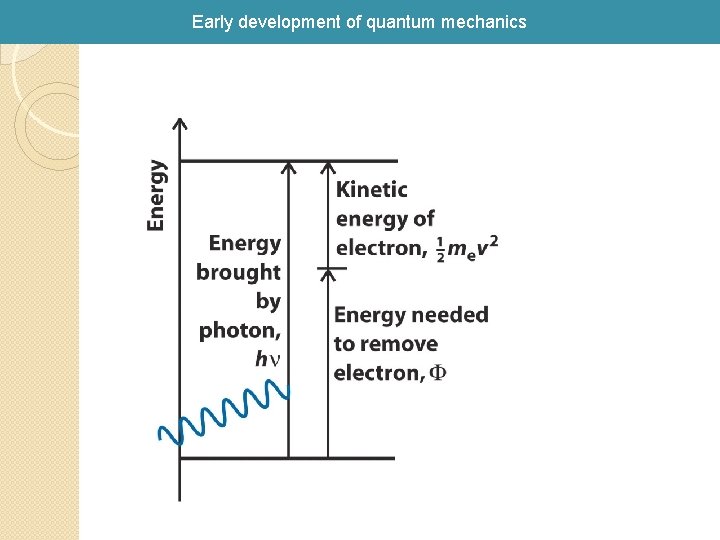
Early development of quantum mechanics 1905 Einstein explained photoelectric effect with a quantum hypothesis A beam of light hitting a metal surface can cause electrons to be ejected from the surface. Classical Paradigm: the energy of the ejected electrons should be proportional to the intensity of the light and independent of the frequency of the light. Experiment: the energy of the ejected electrons is independent of the intensity and depends directly on the frequency.
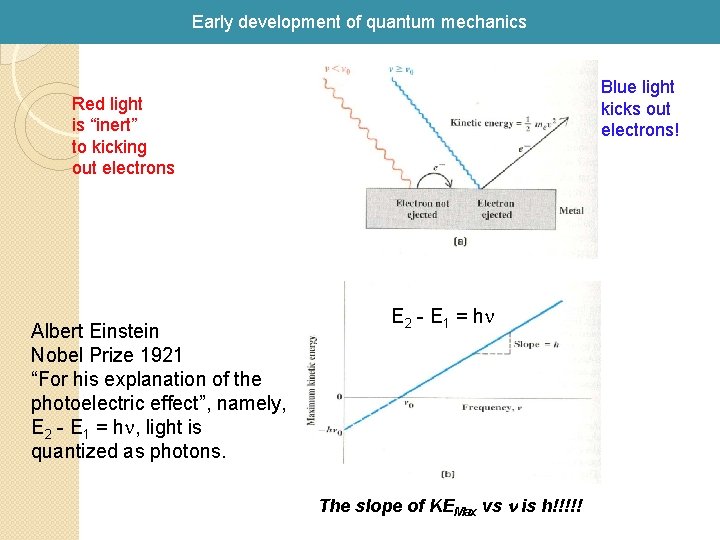
Early development of quantum mechanics Blue light kicks out electrons! Red light is “inert” to kicking out electrons Albert Einstein Nobel Prize 1921 “For his explanation of the photoelectric effect”, namely, E 2 - E 1 = hn, light is quantized as photons. E 2 - E 1 = hn The slope of KEMax vs n is h!!!!!
Early development of quantum mechanics
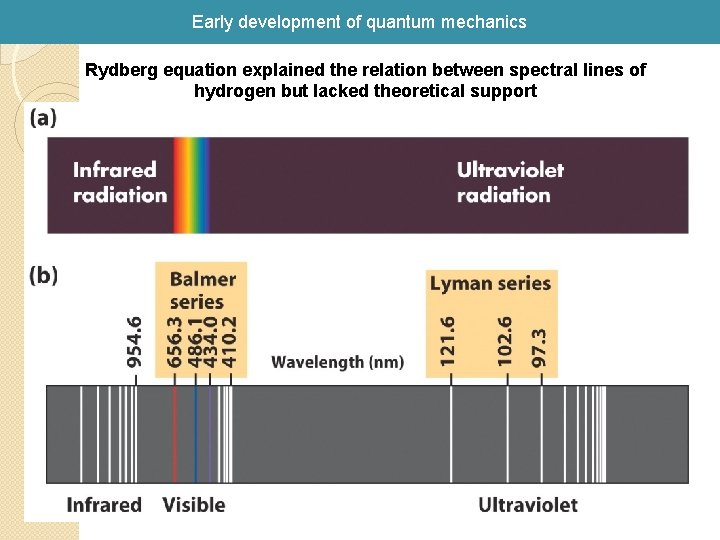
Early development of quantum mechanics Rydberg equation explained the relation between spectral lines of hydrogen but lacked theoretical support
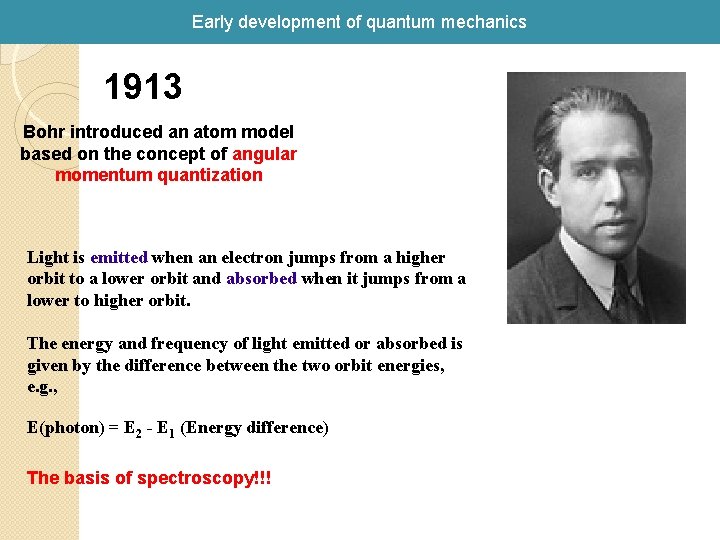
Early development of quantum mechanics 1913 Bohr introduced an atom model based on the concept of angular momentum quantization Light is emitted when an electron jumps from a higher orbit to a lower orbit and absorbed when it jumps from a lower to higher orbit. The energy and frequency of light emitted or absorbed is given by the difference between the two orbit energies, e. g. , E(photon) = E 2 - E 1 (Energy difference) The basis of spectroscopy!!!
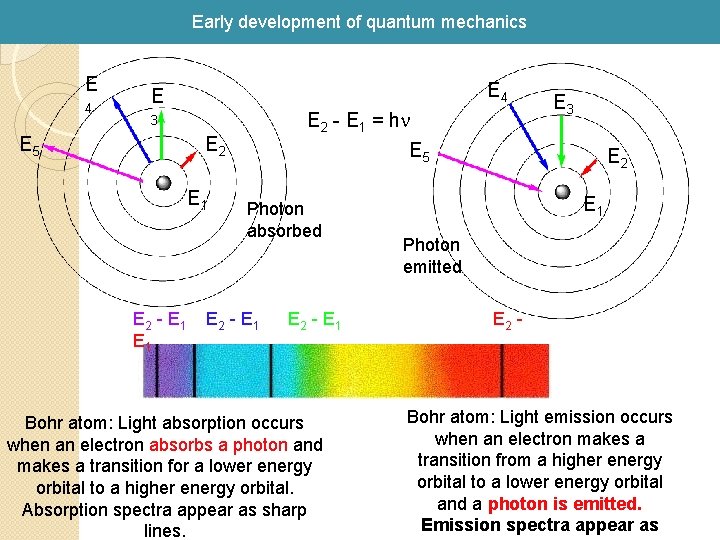
Early development of quantum mechanics E 4 E E 2 - E 1 = hn 3 E 5 E 2 E 1 E 2 - E 1 E 3 E 5 Photon absorbed E 2 - E 1 Bohr atom: Light absorption occurs when an electron absorbs a photon and makes a transition for a lower energy orbital to a higher energy orbital. Absorption spectra appear as sharp lines. E 2 E 1 Photon emitted E 2 - Bohr atom: Light emission occurs when an electron makes a transition from a higher energy orbital to a lower energy orbital and a photon is emitted. Emission spectra appear as
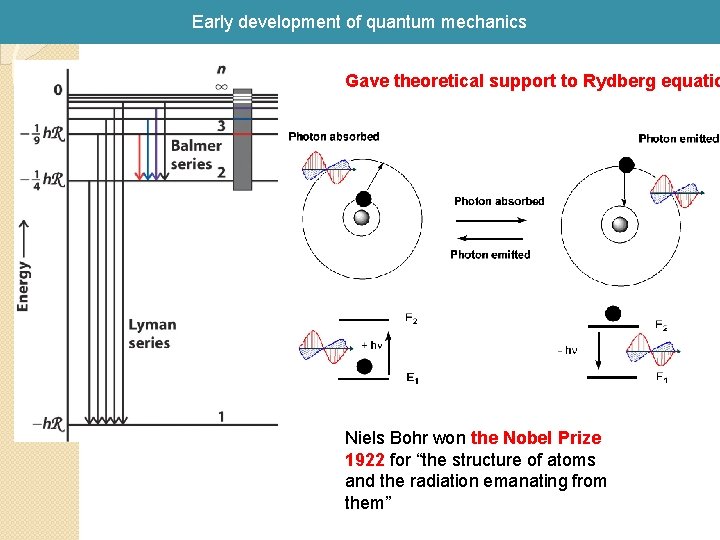
Early development of quantum mechanics Gave theoretical support to Rydberg equatio Niels Bohr won the Nobel Prize 1922 for “the structure of atoms and the radiation emanating from them”
Early development of quantum mechanics Quantization is a highly manifested phenomenon in the microscopic domain
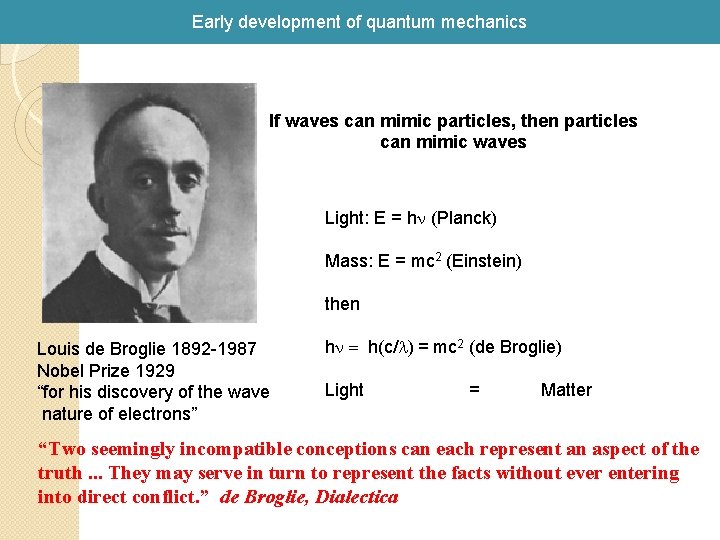
Early development of quantum mechanics If waves can mimic particles, then particles can mimic waves Light: E = hn (Planck) Mass: E = mc 2 (Einstein) then Louis de Broglie 1892 -1987 Nobel Prize 1929 “for his discovery of the wave nature of electrons” hn h(c/l) = mc 2 (de Broglie) Light = Matter “Two seemingly incompatible conceptions can each represent an aspect of the truth. . . They may serve in turn to represent the facts without ever entering into direct conflict. ” de Broglie, Dialectica
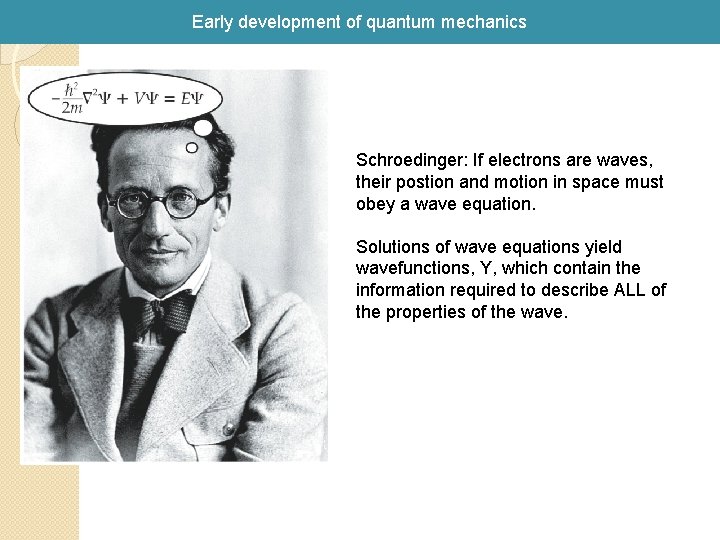
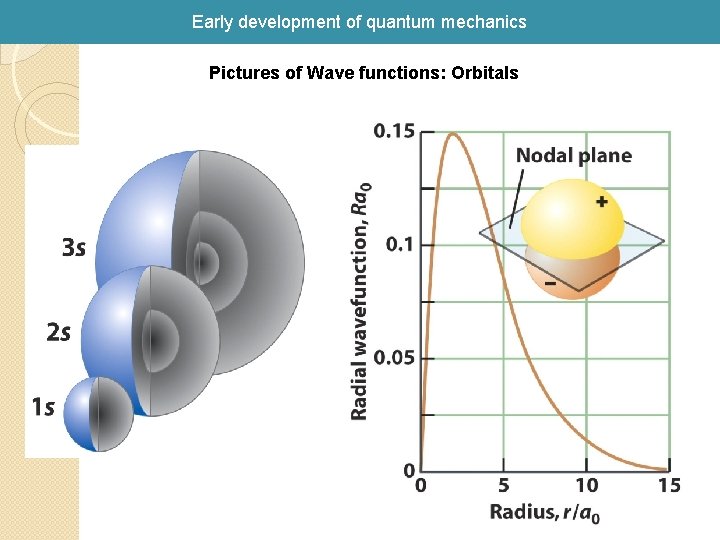
Early development of quantum mechanics Schroedinger: If electrons are waves, their postion and motion in space must obey a wave equation. Solutions of wave equations yield wavefunctions, Y, which contain the information required to describe ALL of the properties of the wave.
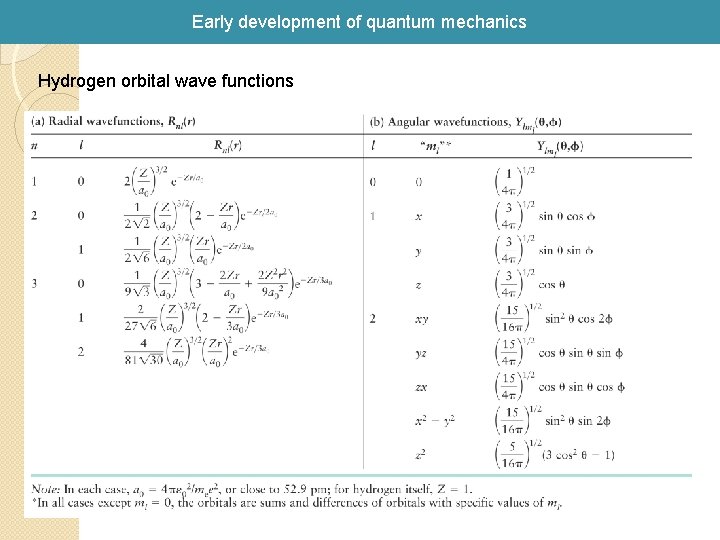
Early development of quantum mechanics Hydrogen orbital wave functions
Early development of quantum mechanics Pictures of Wave functions: Orbitals
Early development of quantum mechanics When I visited the grave of Max Planck in Göttingen. Thank You