
Early Computer History How it all began 1102022
Early Computer History How it all began 1/10/2022 1
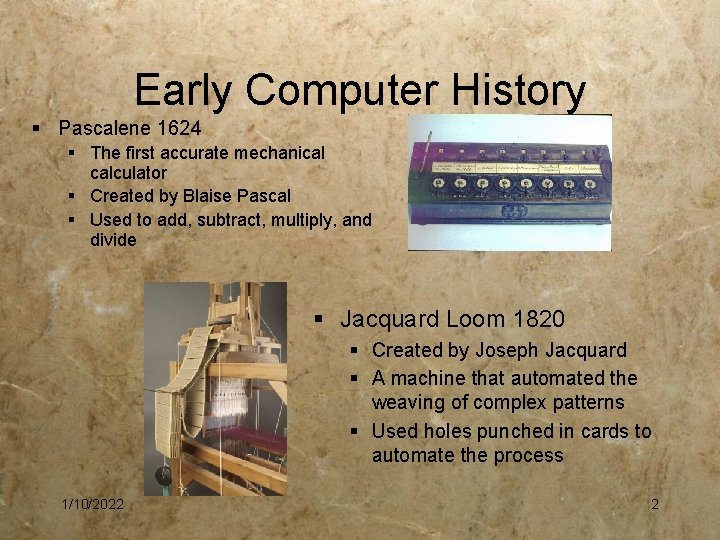
Early Computer History § Pascalene 1624 § The first accurate mechanical calculator § Created by Blaise Pascal § Used to add, subtract, multiply, and divide § Jacquard Loom 1820 § Created by Joseph Jacquard § A machine that automated the weaving of complex patterns § Used holes punched in cards to automate the process 1/10/2022 2
Early Computer History Analytical Engine 1834 Created by Charles Babbage The father of computing The first automatic calculator Includes components similar to those found in today's computers § Hollerith Tabulating Machine 1890 § Created by Herman Hollerith § Used punch cards to tabulate census data § Hollerith started the Tabulating Machine Company, which later became IBM 1/10/2022 3
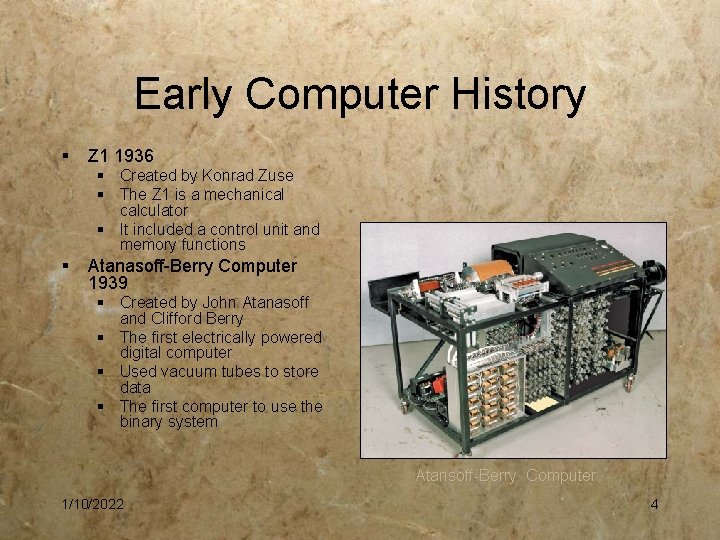
Early Computer History § Z 1 1936 § Created by Konrad Zuse § The Z 1 is a mechanical calculator § It included a control unit and memory functions § Atanasoff-Berry Computer 1939 § Created by John Atanasoff and Clifford Berry § The first electrically powered digital computer § Used vacuum tubes to store data § The first computer to use the binary system Atansoff-Berry Computer 1/10/2022 4
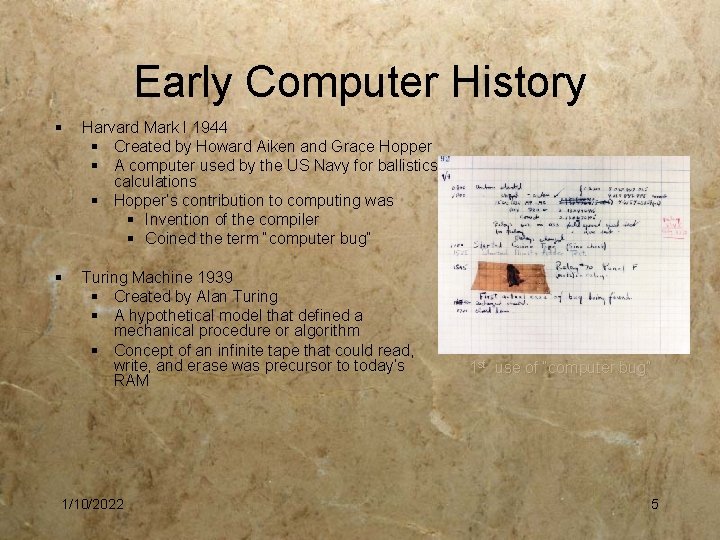
Early Computer History § Harvard Mark I 1944 § Created by Howard Aiken and Grace Hopper § A computer used by the US Navy for ballistics calculations § Hopper’s contribution to computing was § Invention of the compiler § Coined the term “computer bug” § Turing Machine 1939 § Created by Alan Turing § A hypothetical model that defined a mechanical procedure or algorithm § Concept of an infinite tape that could read, write, and erase was precursor to today’s RAM 1/10/2022 1 st use of “computer bug” 5
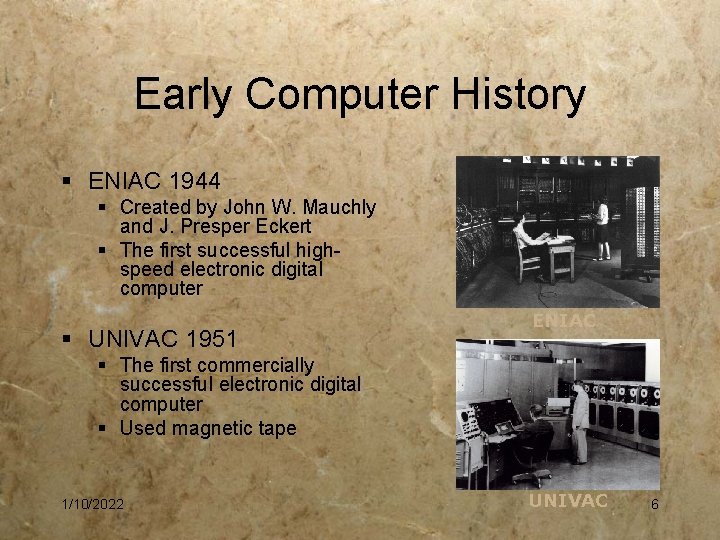
Early Computer History § ENIAC 1944 § Created by John W. Mauchly and J. Presper Eckert § The first successful highspeed electronic digital computer § UNIVAC 1951 ENIAC § The first commercially successful electronic digital computer § Used magnetic tape 1/10/2022 UNIVAC 6
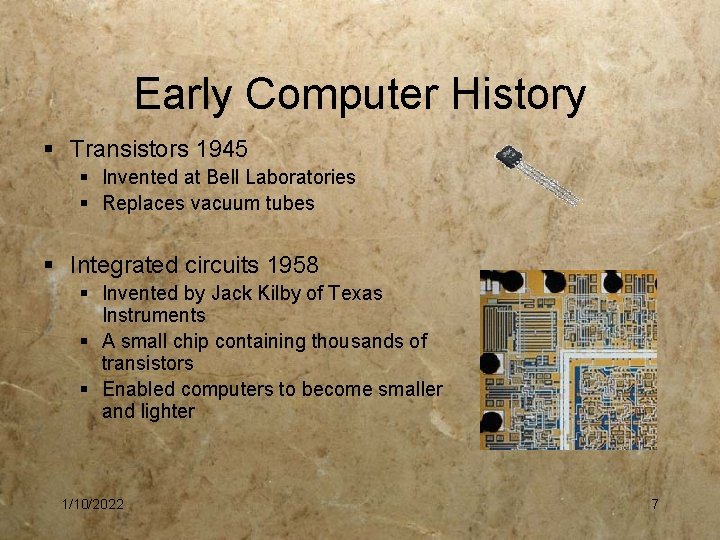
Early Computer History § Transistors 1945 § Invented at Bell Laboratories § Replaces vacuum tubes § Integrated circuits 1958 § Invented by Jack Kilby of Texas Instruments § A small chip containing thousands of transistors § Enabled computers to become smaller and lighter 1/10/2022 7
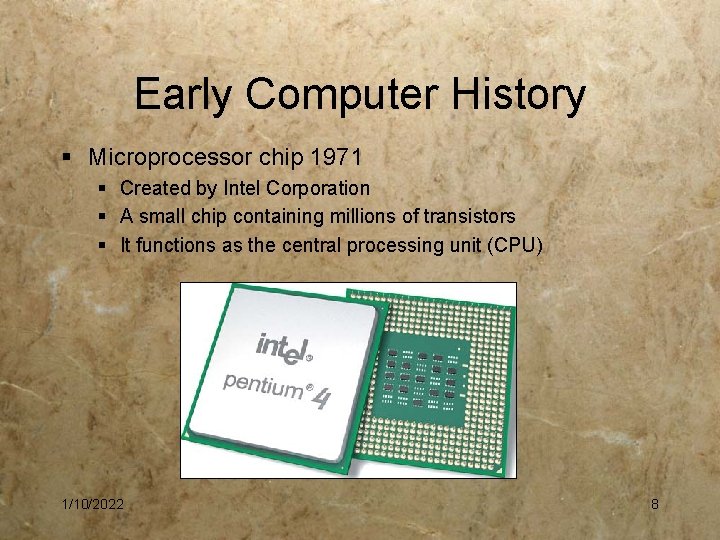
Early Computer History § Microprocessor chip 1971 § Created by Intel Corporation § A small chip containing millions of transistors § It functions as the central processing unit (CPU) 1/10/2022 8
Computer Generations § First-generation computers (1946– 1958) § UNIVAC § Use vacuum tubes to store data § Second-generation computers (1959– 1964) § Use transistors to store data § Third-generation computers (1965– 1970) § Use integrated circuits § Fourth-generation computers (1971–Today) § Use a microprocessor chip 1/10/2022 9
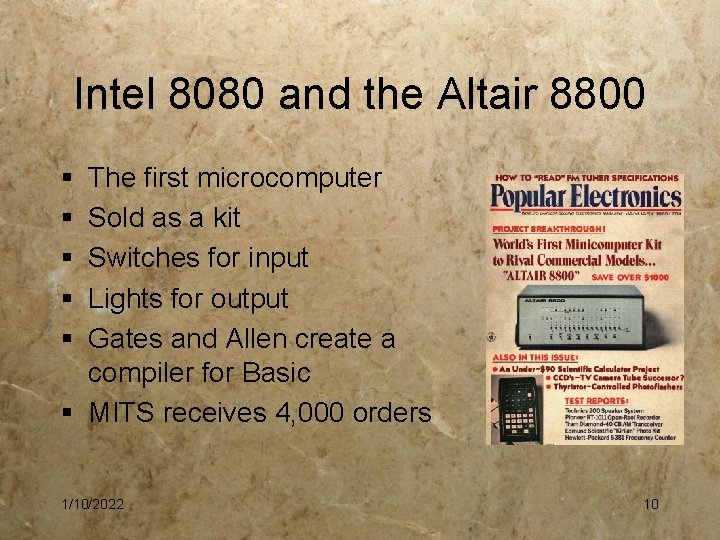
Intel 8080 and the Altair 8800 § § § The first microcomputer Sold as a kit Switches for input Lights for output Gates and Allen create a compiler for Basic § MITS receives 4, 000 orders 1/10/2022 10

Beginners All-Purpose Symbolic Instruction Code (BASIC) § Revolutionized the software industry § Programming language that beginners could easily learn § Key language of the PC § Bill Gates and Paul Allen used BASIC to write the program for the Altair § Led to the creation of Microsoft 1/10/2022 11
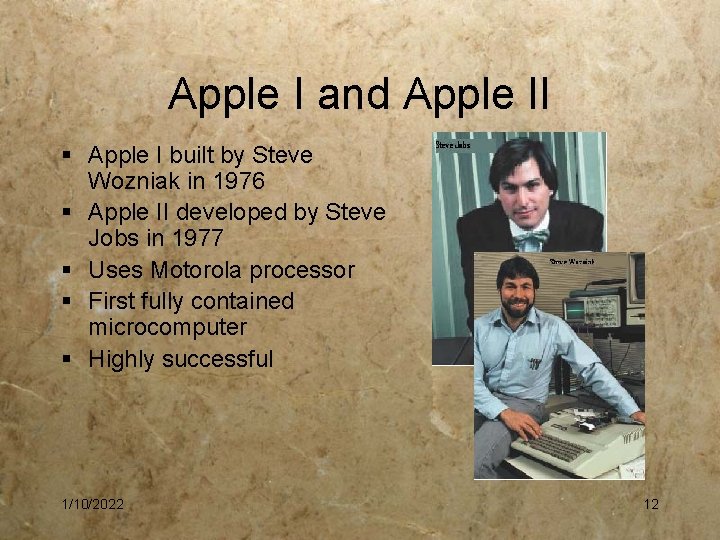
Apple I and Apple II § Apple I built by Steve Wozniak in 1976 § Apple II developed by Steve Jobs in 1977 § Uses Motorola processor § First fully contained microcomputer § Highly successful 1/10/2022 12
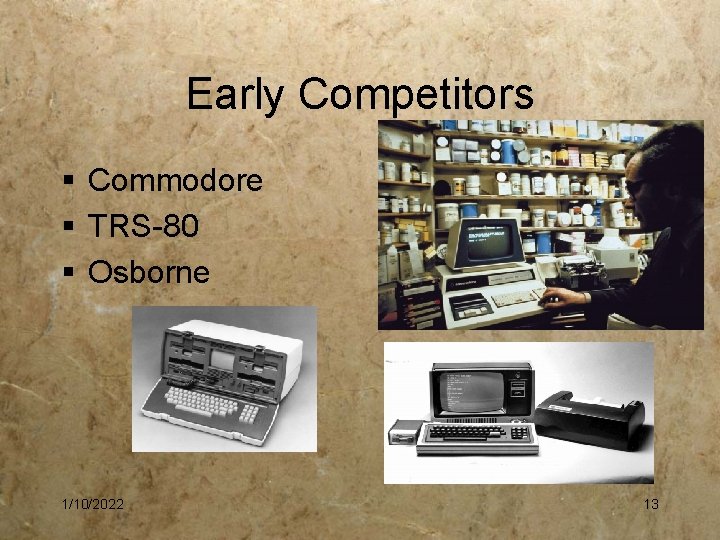
Early Competitors § Commodore § TRS-80 § Osborne 1/10/2022 13
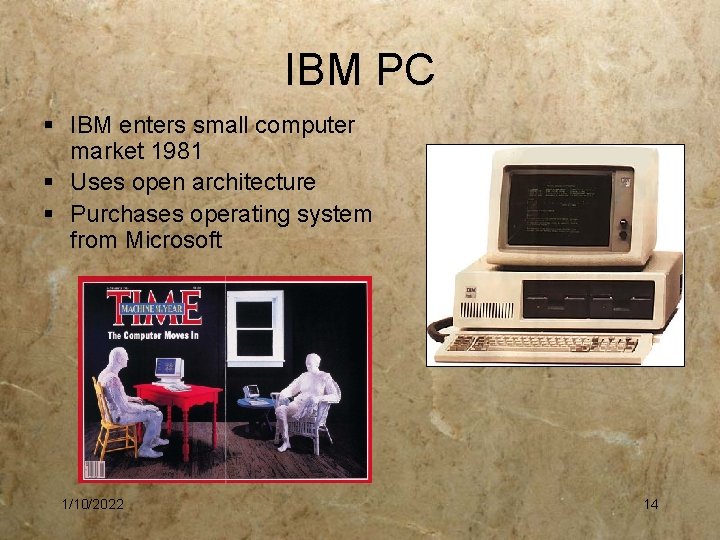
IBM PC § IBM enters small computer market 1981 § Uses open architecture § Purchases operating system from Microsoft 1/10/2022 14
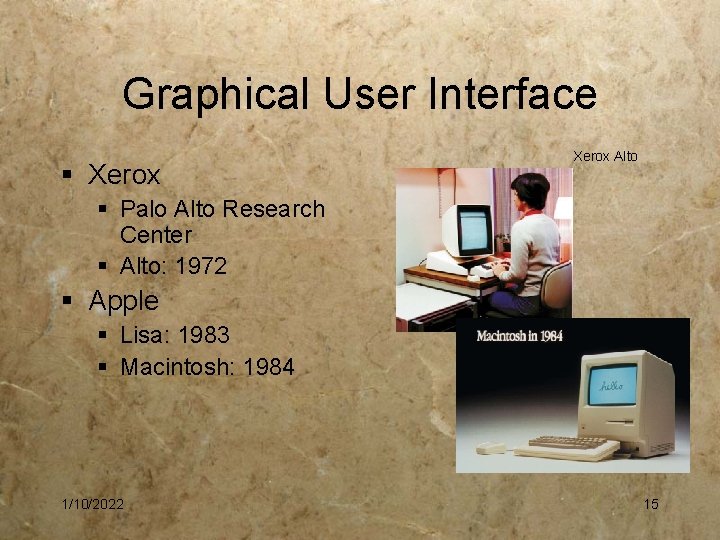
Graphical User Interface § Xerox Alto § Palo Alto Research Center § Alto: 1972 § Apple § Lisa: 1983 § Macintosh: 1984 1/10/2022 15
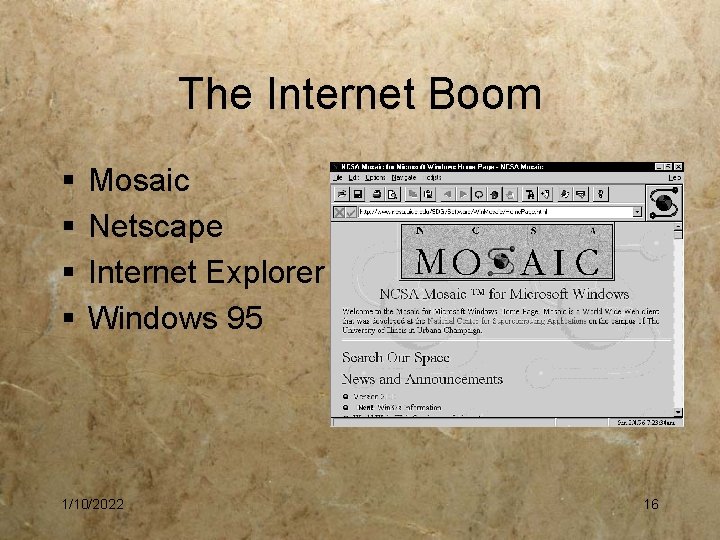
The Internet Boom § § Mosaic Netscape Internet Explorer Windows 95 1/10/2022 16
Computer Hardware Central Processing Unit & Random Access Memory 1/10/2022 17
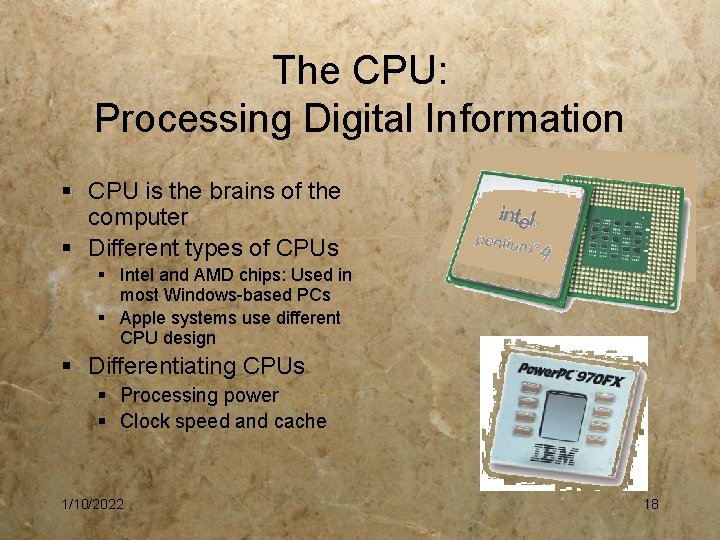
The CPU: Processing Digital Information § CPU is the brains of the computer § Different types of CPUs § Intel and AMD chips: Used in most Windows-based PCs § Apple systems use different CPU design § Differentiating CPUs § Processing power § Clock speed and cache 1/10/2022 18
The Control Unit • Manages the switches inside the CPU § Is programmed by CPU designers to remember the sequence of processing stages for that CPU § Moves each switch to its correct setting (on or off) and then performs the work of that stage 1/10/2022 19
The Arithmetic Logic Unit (ALU) • Part of the CPU designed to perform mathematical operations (addition, subtraction, multiplication, division, etc. ) • Also performs logical OR, AND, and NOT operations § Is fed data from the CPU registers § Word size: Number of bits a computer can work with at a time 1/10/2022 20
Registers § Small areas of storage in the CPU § Holds data and results of current operations § Holds current instruction § Holds address in memory of next instruction to execute 1/10/2022 21
The CPU Machine Cycle § Fetch § The program’s binary code is “fetched” from its temporary location in RAM and moved to the CPU § Decode § The program’s binary code is decoded into commands the CPU understands. § Execute § The ALU performs the calculations. § Store § The results are stored in the registers 1/10/2022 22
The System Clock § Located on the motherboard § Controls the CPU’s processing cycles § Clock cycle § Pulse or tick § Clock speed § Number of pulses per second § Measured in hertz (Hz) 1/10/2022 23
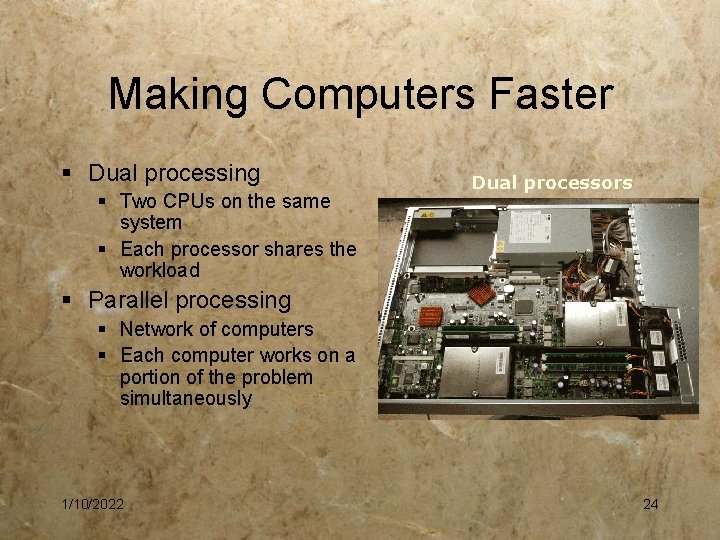
Making Computers Faster § Dual processing § Two CPUs on the same system § Each processor shares the workload Dual processors § Parallel processing § Network of computers § Each computer works on a portion of the problem simultaneously 1/10/2022 24
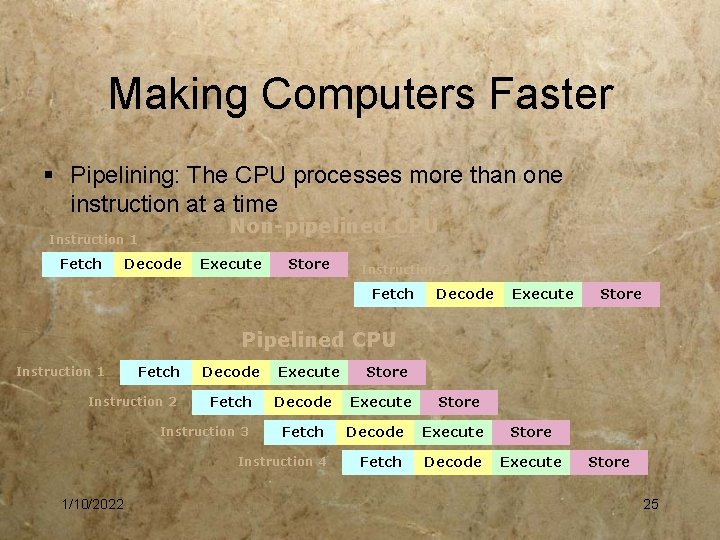
Making Computers Faster § Pipelining: The CPU processes more than one instruction at a time Non-pipelined CPU Instruction 1 Fetch Decode Execute Store Instruction 2 Fetch Decode Execute Store Pipelined CPU Instruction 1 Fetch Instruction 2 Decode Fetch Decode Store Execute Store Fetch Decode Execute Store Instruction 4 Fetch Decode Execute Instruction 3 1/10/2022 Execute Store 25
Moore’s Law § Number of transistors on a CPU will double every 18 months § First chip had 29, 000 transistors § Pentium chip 169, 000 transistors § Moore’s Law has been accurate for 25 years 1/10/2022 26
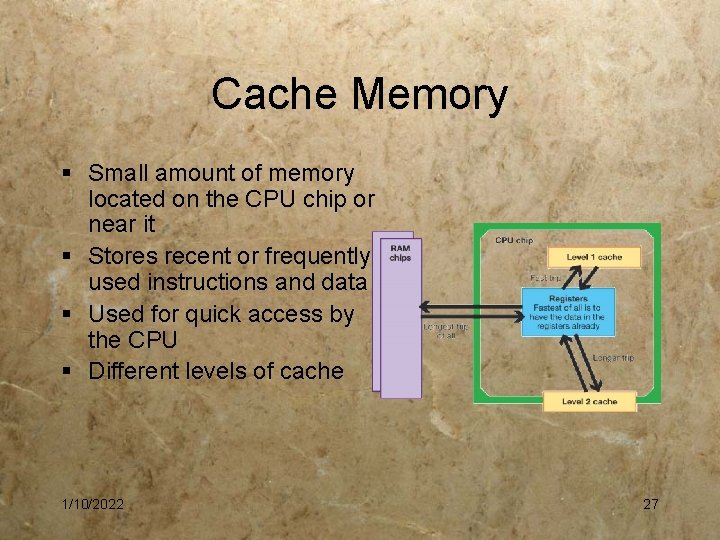
Cache Memory § Small amount of memory located on the CPU chip or near it § Stores recent or frequently used instructions and data § Used for quick access by the CPU § Different levels of cache 1/10/2022 27
RAM: The Next Level of Temporary Storage § Volatile: When you turn off your computer, the data is erased § Several kinds of RAM exist § Each type of RAM has a different design § Some types work at much faster speeds § Some transfer data more quickly § Primary Storage 1/10/2022 28
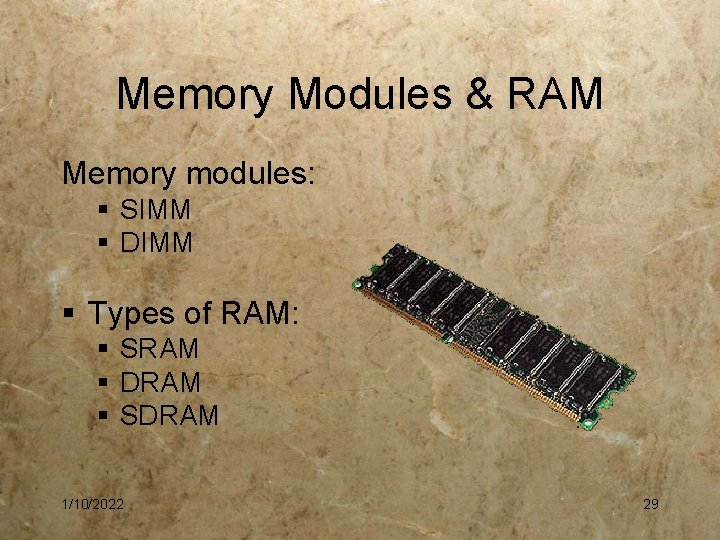
Memory Modules & RAM Memory modules: § SIMM § DIMM § Types of RAM: § SRAM § DRAM § SDRAM 1/10/2022 29
Types of RAM: DRAM § Dynamic RAM (DRAM) § § Cheapest and most basic type of RAM Loses its electrical charge Needs to be refreshed Many types of DRAM § SDRAM: Synchronous DRAM § DDR SDRAM: Double data rate SDRAM 1/10/2022 30
Types of RAM: SRAM § Static RAM (SRAM) § Does not lose its electrical charge § Faster than DRAM § More expensive than DRAM § Used only in locations like cache memory 1/10/2022 31
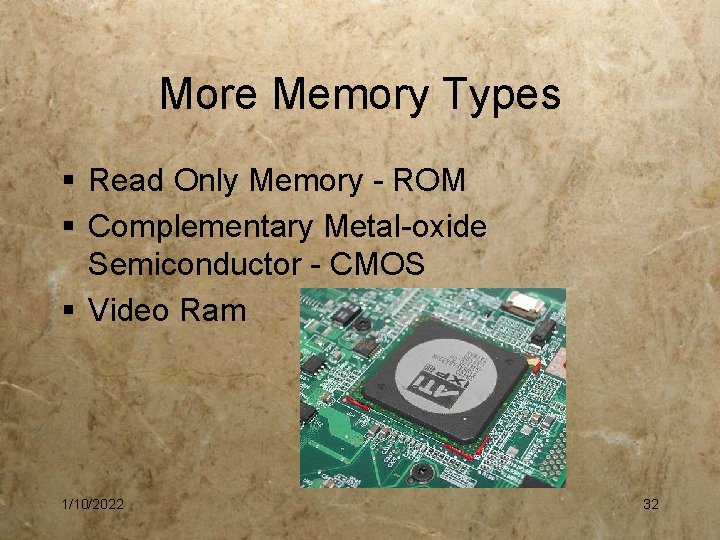
More Memory Types § Read Only Memory - ROM § Complementary Metal-oxide Semiconductor - CMOS § Video Ram 1/10/2022 32
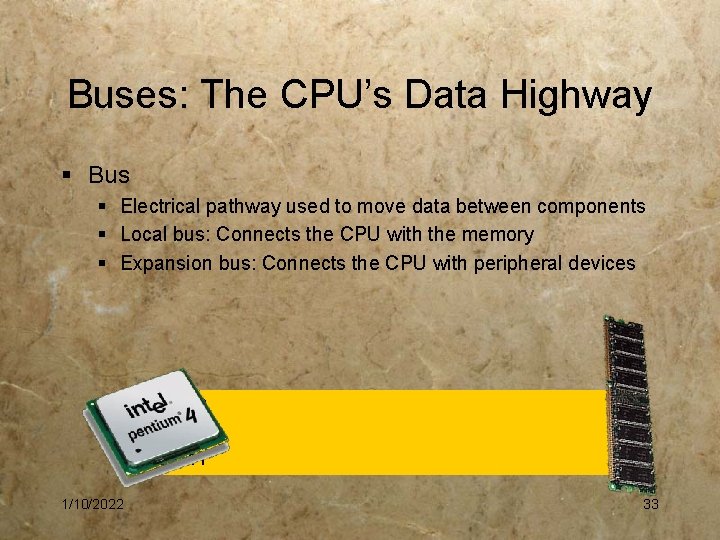
Buses: The CPU’s Data Highway § Bus § Electrical pathway used to move data between components § Local bus: Connects the CPU with the memory § Expansion bus: Connects the CPU with peripheral devices 01100010 01001000 01110011 00100111 1/10/2022 33
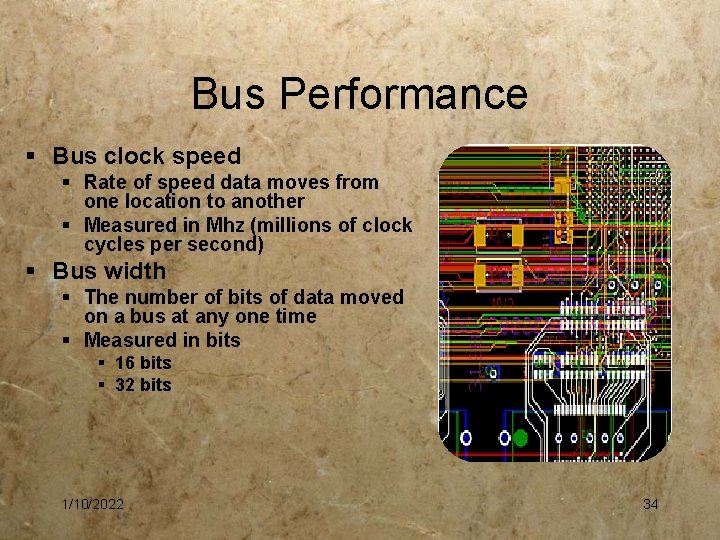
Bus Performance § Bus clock speed § Rate of speed data moves from one location to another § Measured in Mhz (millions of clock cycles per second) § Bus width § The number of bits of data moved on a bus at any one time § Measured in bits § 16 bits § 32 bits 1/10/2022 34
- Slides: 34