
EARLY COLONIAL AMERICA Unit One APUSH Birth of
EARLY COLONIAL AMERICA Unit One APUSH
Birth of the Atlantic World Columbus’ voyage led to the reshaping of every culture Effects of Voyage Causes of Voyage • Quest for knowledge • Columbian Exchange of the world • Conquest of Native • Wish to bring Americans Christianity to other • Search for Northwest lands and people Passage • Desire for new trade route to the East • Establishing European Empires in the Americas • Spain’s rivalry with Portugal • Death of Native Americans b/c of disease • Desire for wealth • Enslavement of Africans • Blending of cultures in
Effect on Native Americans • At first, the Indians were helpful and friendly • Pocahontas • Squanto • Then there was Disease • Smallpox, measles, chicken pox, influenza, tuberculosis, typhus • Finally, there was Conflict and Atrocities • Powhatan’s fight in Chesapeake • King Philip’s War • Bartolome de Castas
Reasons for Building Overseas Colonies Add wealth and power to home country Source of valuable raw materials Gold and silver New markets for goods manufactured in home country Base for Privateers (Sea Dogs) European overpopulation
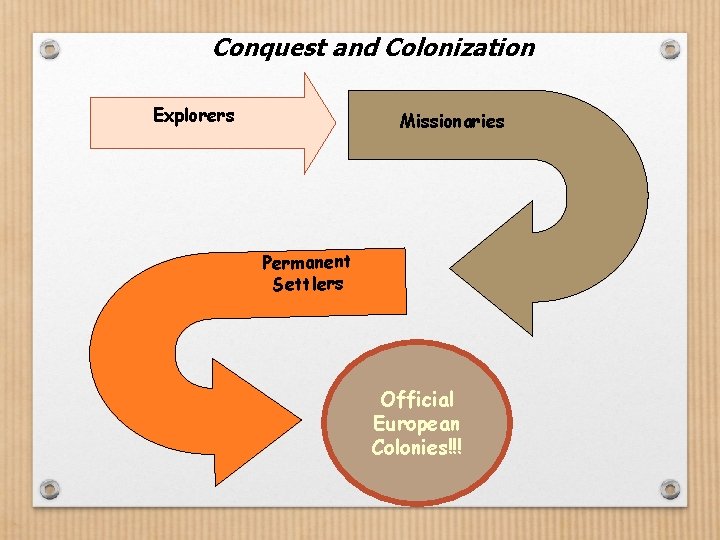
Conquest and Colonization Explorers Missionaries Permanent Settlers Official European Colonies!!!
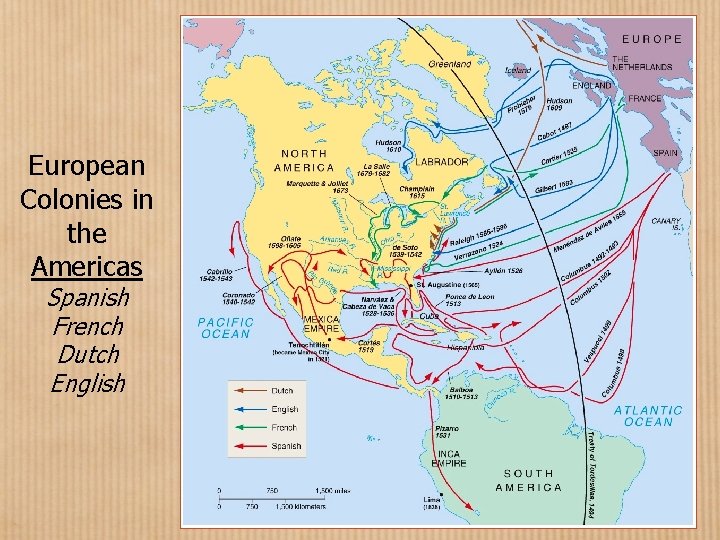
European Colonies in the Americas Spanish French Dutch English
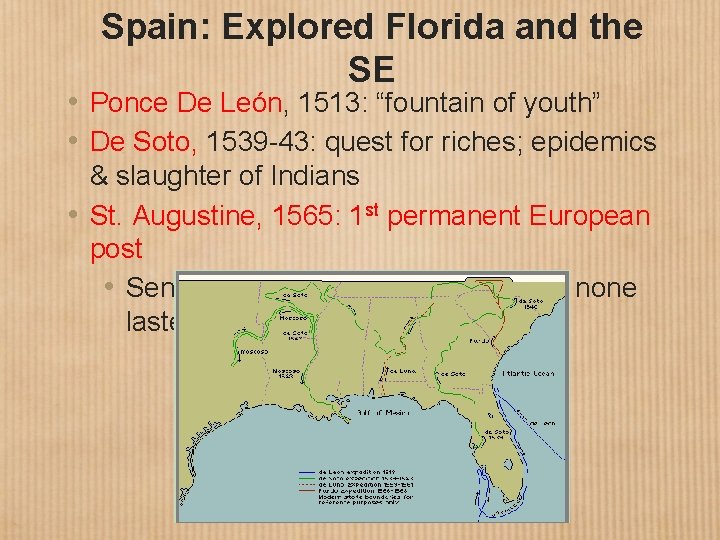
Spain: Explored Florida and the SE • Ponce De León, 1513: “fountain of youth” • De Soto, 1539 -43: quest for riches; epidemics & slaughter of Indians • St. Augustine, 1565: 1 st permanent European post • Sent a series of missions to VA, but none lasted
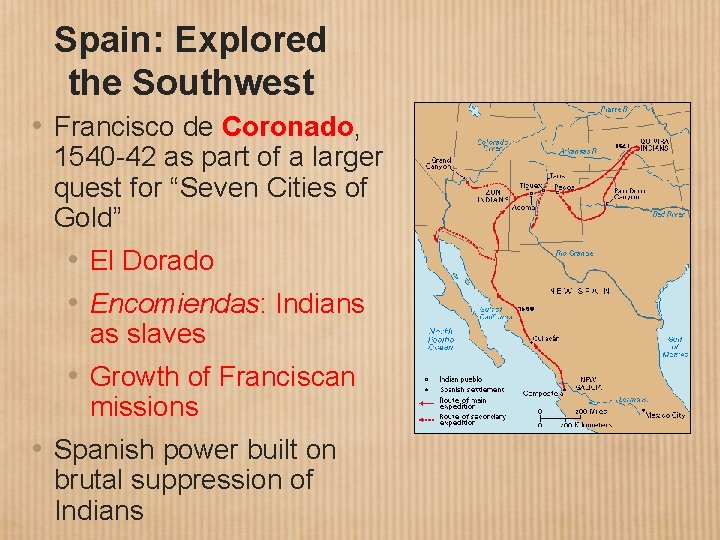
Spain: Explored the Southwest • Francisco de Coronado, 1540 -42 as part of a larger quest for “Seven Cities of Gold” • El Dorado • Encomiendas: Indians as slaves • Growth of Franciscan missions • Spanish power built on brutal suppression of Indians
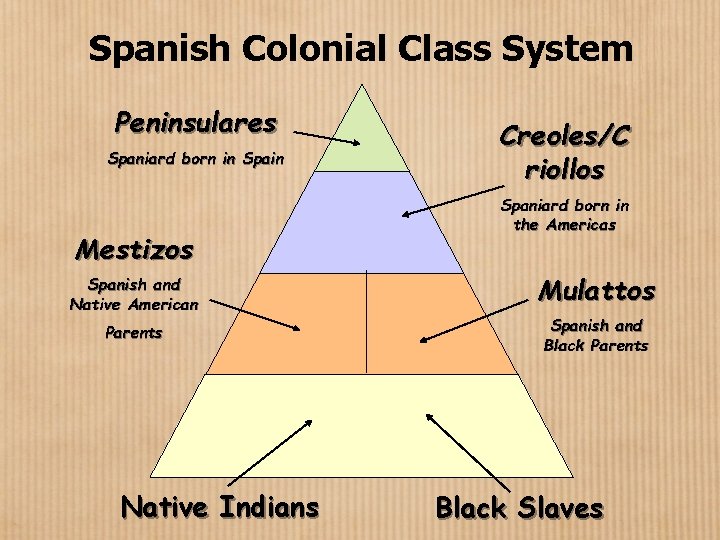
Spanish Colonial Class System Peninsulares Spaniard born in Spain Mestizos Spanish and Native American Parents Native Indians Creoles/C riollos Spaniard born in the Americas Mulattos Spanish and Black Parents Black Slaves
The Encomienda System ► Forced Labor System ► The system gave the conquistador control over the native populations by requiring them to pay tribute from their lands, which were “granted” to deserving subjects of the Spanish crown. ►The natives often rendered personal services as well. ► In return the conquistador was theoretically obligated to protect, instruct them in the Christian faith, and defend their right to use the land for their own subsistence.
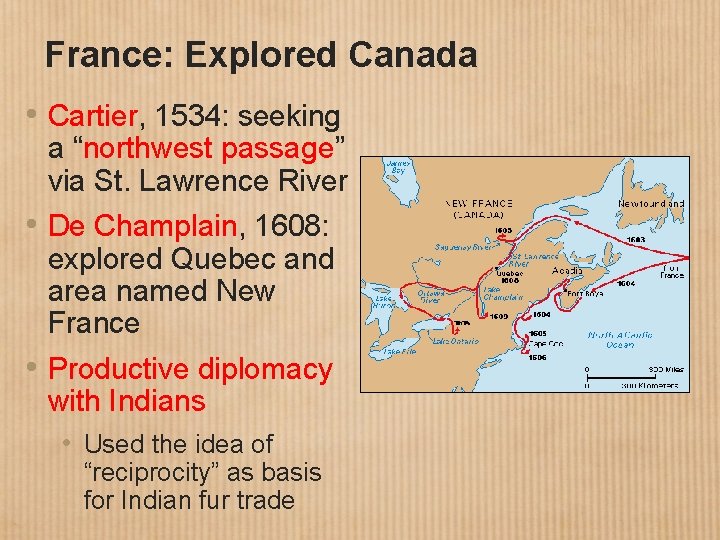
France: Explored Canada • Cartier, 1534: seeking a “northwest passage” via St. Lawrence River • De Champlain, 1608: explored Quebec and area named New France • Productive diplomacy with Indians • Used the idea of “reciprocity” as basis for Indian fur trade
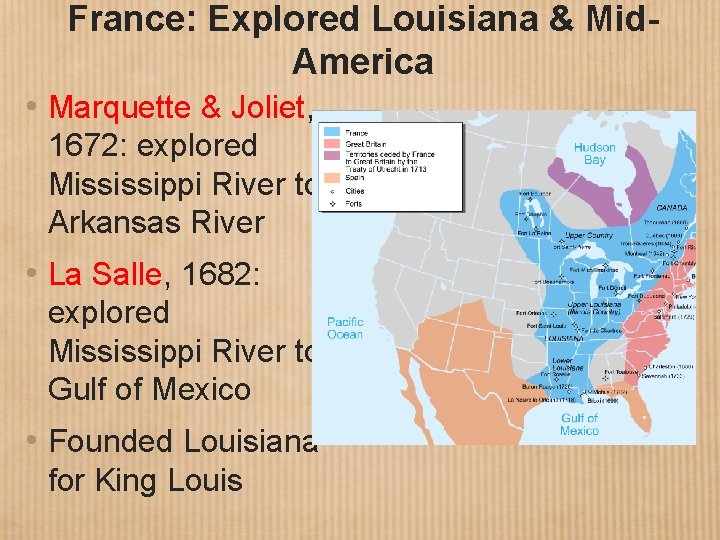
France: Explored Louisiana & Mid. America • Marquette & Joliet, 1672: explored Mississippi River to Arkansas River • La Salle, 1682: explored Mississippi River to Gulf of Mexico • Founded Louisiana for King Louis
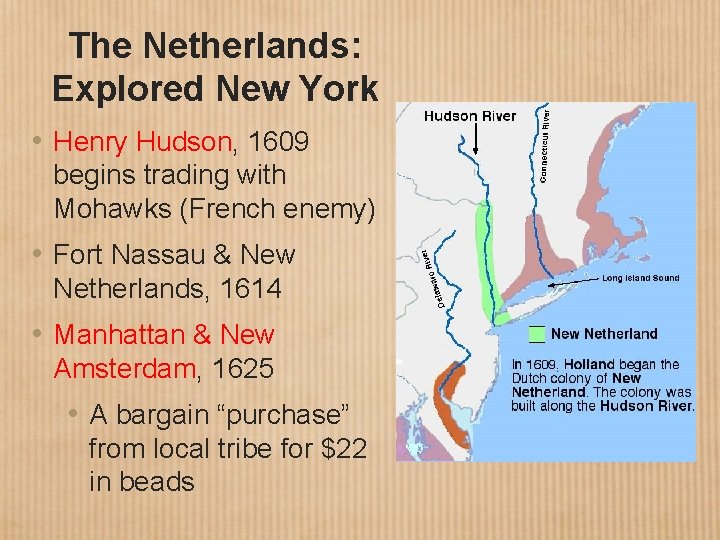
The Netherlands: Explored New York • Henry Hudson, 1609 begins trading with Mohawks (French enemy) • Fort Nassau & New Netherlands, 1614 • Manhattan & New Amsterdam, 1625 • A bargain “purchase” from local tribe for $22 in beads
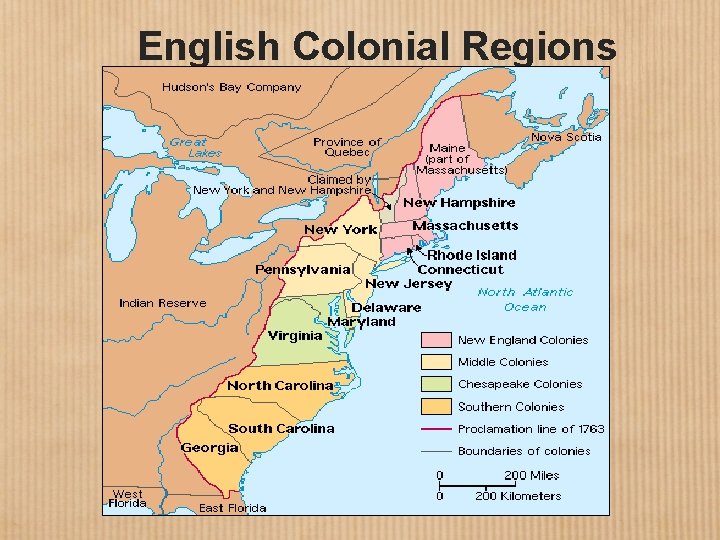
English Colonial Regions
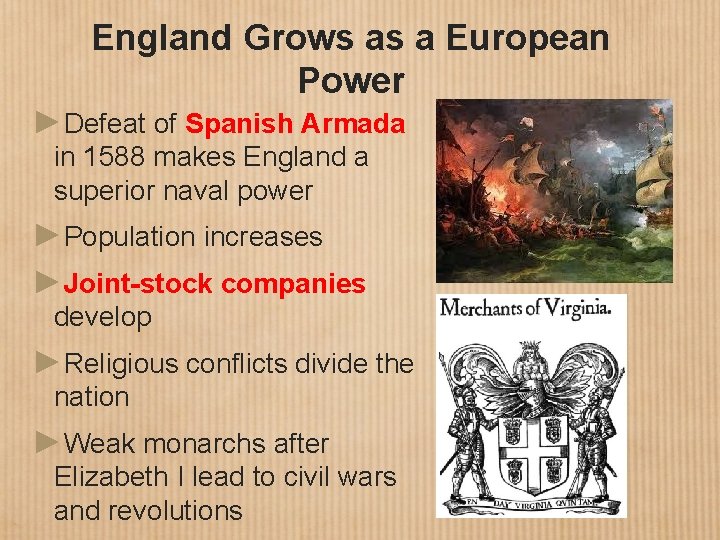
England Grows as a European Power ►Defeat of Spanish Armada in 1588 makes England a superior naval power ►Population increases ►Joint-stock companies develop ►Religious conflicts divide the nation ►Weak monarchs after Elizabeth I lead to civil wars and revolutions
English Colonies ►Granted Charters to groups interested in colonizing America 1. Corporate Colonies • Granted a charter to stockholders looking for a profit • Ex. Virginia 2. Proprietary Colonies • Granted a charter to individual or group looking for new start… freedom • Ex. Maryland, Pennsylvania 3. Royal Colonies • Under direct control of the monarch • Ex. New Hampshire • Eventually, 8 of the 13 colonies became royal colonies,
The First English Colonies ►First Attempt: Roanoke in 1585 ►First Permanent: Jamestown, Virginia in 1607
The Lost Colony: Roanoke • Sir Walter Raleigh, 1584: obtains charter to start a colony • Area named “Virginia” (for “virgin queen”) • Location as base for anti. Spanish privateers • First English baby born in New World- Virginia Dare • British, Spanish, & Croatoan feuds prevented supply reinforcements from arriving on time • Colony was “missing” when they finally arrived
JAMESTOWN – 1 Permanent English Settlement st • Chartered after the disaster of the Lost Colony • Roanoke, NC • Jamestown was a Charter Colony • Formed as a Joint-Stock Company for profit • Hardships • Hard work • Site • Poor leadership
Jamestown Colony ►Unfortunately was settled in swampy coastal Virginia. ►What they found ►Mosquitos, humidity, famine, disease, and death ►John Smith – “he that will not work shall not eat” ► 38 of 105 survived ►What they didn’t find ►Gold!
The Survival of the Colony • John Smith • Governing the Colony • Royal Colony • Legislature – House of Burgesses • Native Americans • Battle • Pocahontas and Powhatan • Tobacco = $$$ • Promise of Land = population • Bacon’s Rebellion = need for better government
Tobacco • John Rolfe (Mr. Pocahontas) was the first Englishman to see tobacco as a potential cash crop • Adapts tobacco to VA’s climate • Crop “saves” Virginia • Lead to the Headright system & Indentured Servants
Plymouth and Massachusetts Bay Colonies • Plymouth Colony • Pilgrims on the Mayflower • Scrooby separatists • William Bradford • Pilgrimage to Americas • Massachusetts Bay Colony • Puritans • John Winthrop • Founded for religious freedom BUT had No
Pilgrims- Plymouth Colony ►English separatists to Holland then head for Virginia ►Mayflower takes Separatists and others to Jamestown but weather complicates matters ►Settlers decide to remain and establish Plymouth (1620)
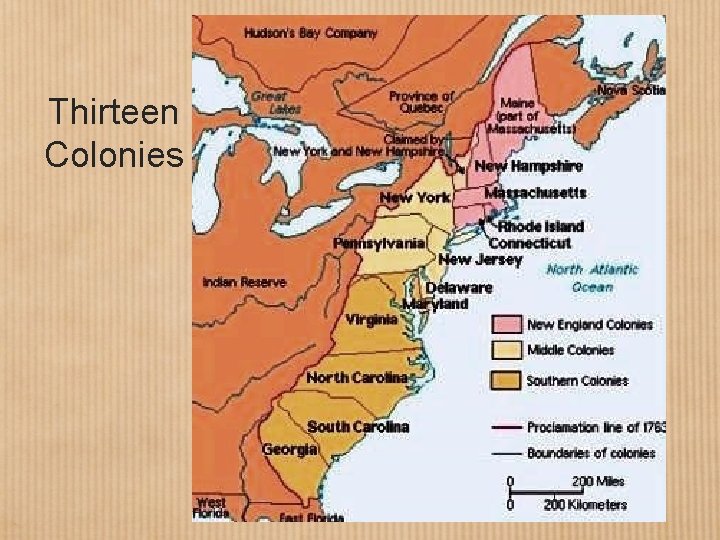
Thirteen Colonies
New England • Massachusetts Bay Colony and Puritans (1630) • John Winthrop • “city upon a hill” • Rhode Island • Providence (1636) • Roger Williams • Portsmouth (1638) • Anne Hutchinson • Connecticut • Hartford (1637) • Thomas Hooker • New Haven (1638) • New Hampshire (1679)
New England Religion • Puritanical lifestyle in Massachusetts • Religious toleration and dissent Rhode Island • Roger Williams and “wall of separation” • Anne Hutchinson and Antinomianism • Halfway Covenant (1662) • Attempt to increase members • Salem Witch Trials (1692 -1693) • 185 accused • 141 women; 44 men
Early New England Politics ►Fundamental Orders of Connecticut (1639) • First written constitution in America ►Relations with Natives Americans • New England Confederation (1643 -1684) • Defense alliance among Plymouth, Massachusetts, Connecticut, New Haven • King Philip’s (Metacom) War (1675 -1676) • New England Confederation
Middle Colonies ►Development • New York ►New Amsterdam transferred to Duke of York in 1664 • New Jersey (1702) • Pennsylvania settled by Quakers • Delaware (1702) ►Economics • Develop wheat and corn farms ►“Bread basket” of the colonies • Eventually into manufacturing and trade
Pennsylvania ►William Penn (1681) ►Religious Society of Friends aka Quakers ►“Holy Experiment” • Religious refuge • Liberal political ideals • Economic success • Frame of Government and Charter of Liberties
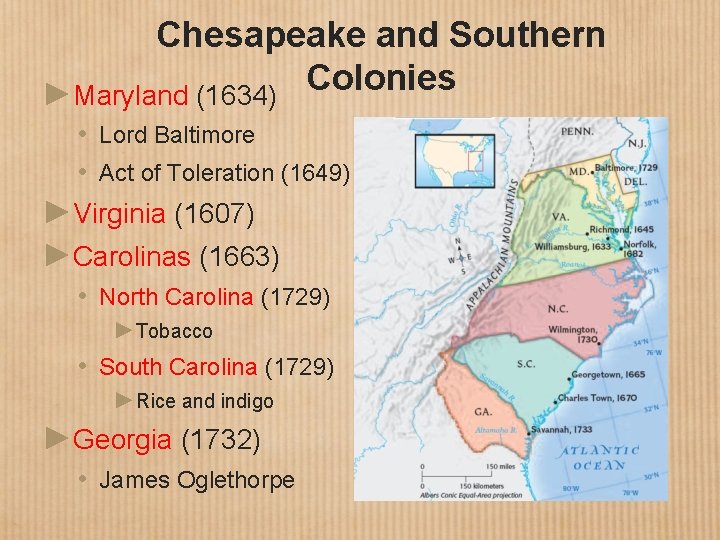
Chesapeake and Southern Colonies ►Maryland (1634) • Lord Baltimore • Act of Toleration (1649) ►Virginia (1607) ►Carolinas (1663) • North Carolina (1729) ►Tobacco • South Carolina (1729) ►Rice and indigo ►Georgia (1732) • James Oglethorpe
Virginia ►Jamestown (1607) ►House of Burgesses in 1619 • First legislative assembly in the colonies ►Becomes royal colony in 1624 ►Bacon’s Rebellion (1676) • Inequities between large landowners and western farmers • Nathanial Bacon vs. William Berkeley ►Headright System • 50 acres to each paying immigrant or plantation owner who paid for "Here shoot me before God, fair mark shoot. ” Governor William Berkeley in response to Nathanial Bacon’s threat for demands.
Georgia ►James Oglethorpe establishes in 1732 near present day Savannah ►Sought charter as a “Social experiment” ► The crown also needed a defensive buffer to Spanish Florida ►First envisioned as a debtors colony for poor working class English ►However, the colony did
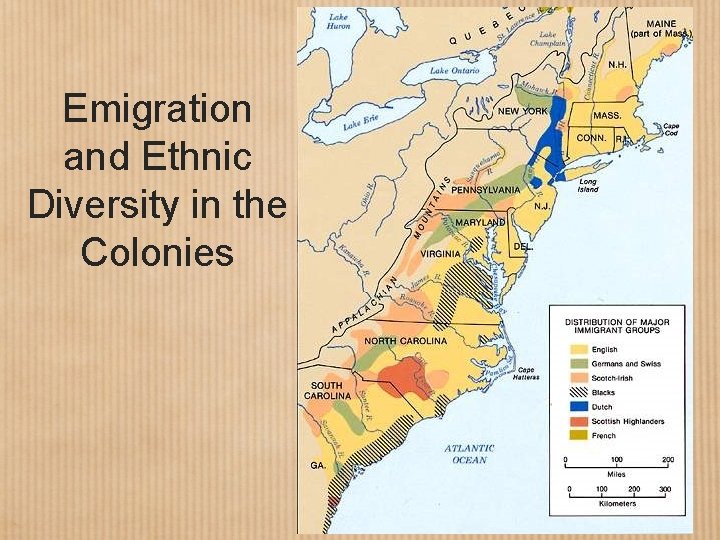
Emigration and Ethnic Diversity in the Colonies
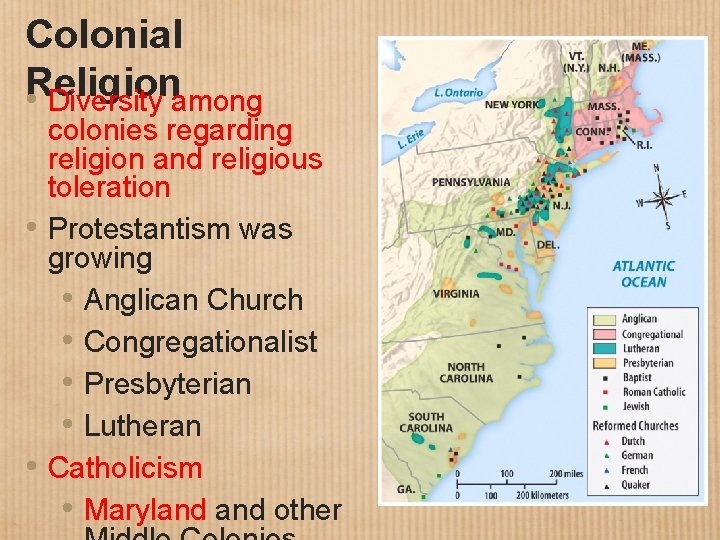
Colonial Religion • Diversity among colonies regarding religion and religious toleration • Protestantism was growing • Anglican Church • Congregationalist • Presbyterian • Lutheran • Catholicism • Maryland other
Preview: The “First” Great Awakening • (1730 s-1740 s) • Jonathan Edwards • “Sinners in the Hands of an Angry God” • George Whitefield • • • Evangelism Worship outside Tent meetings Baptists Methodists • John and Charles Wesley
Colonial Politics • Limited Self-Government • Ideas from John Locke • Elected bicameral legislative assemblies • Governors • Local governments • Voting • Limited to educated adult males and/or property owners • Freedom of the Press and Expression • John Peter Zenger Case (1735)
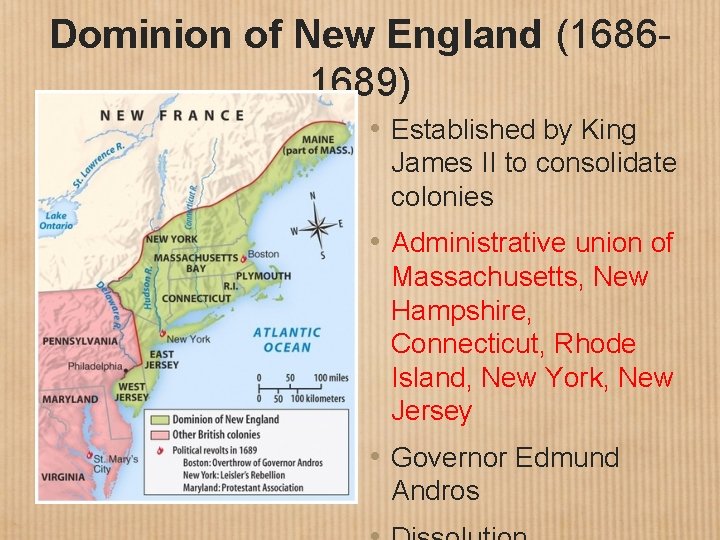
Dominion of New England (16861689) • Established by King James II to consolidate colonies • Administrative union of Massachusetts, New Hampshire, Connecticut, Rhode Island, New York, New Jersey • Governor Edmund Andros
Colonial Society And Colonial Culture • American Social Structure • Wealthy landowners • Merchants • Small farmers • Craftspeople • Slaves
Colonial Society And Colonial Culture • Opportunity to move freely between classes • Less dependent on heredity like in Europe • But there were regional differences • Gender Roles • Men • Patriarchal society, landowners, workers • Women • Submissive to men but respected, domestic responsibilities, limited to no political rights
Colonial Culture - The Arts • Architecture • Early colonies centered around a church • Urban structures typical of English structures • Frontier log cabins • Literature • Newspapers • Religious sermons, political essays, nonfiction books • Poor Richard’s Almanac - Benjamin Franklin
Colonial Culture - Education ►Limited to wealthy males ►Females learned domestic chores ►Higher Education • Most established for ministry/theological studies
Colonial Culture - Education ►New England Colonies • Education by mothers • Towns with over 50 families required primary schools; over 100 families, required grammar schools ►Middle Colonies • Private and church education ►Southern Colonies • Limited education due to agricultural lifestyle
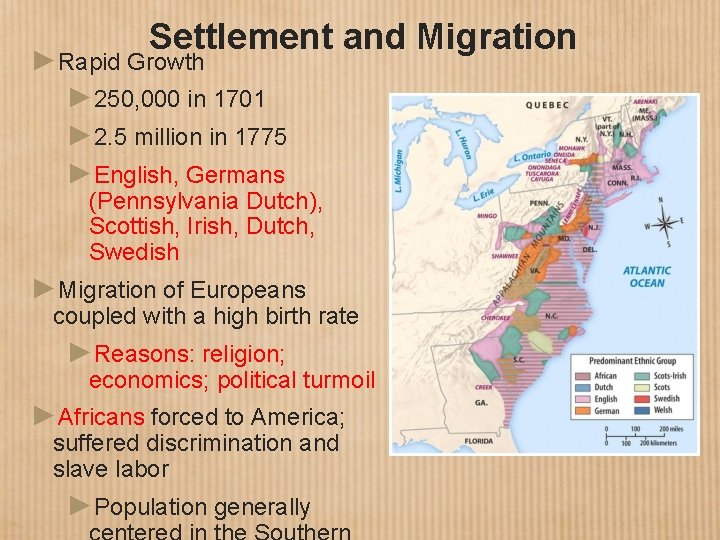
Settlement and Migration ►Rapid Growth ► 250, 000 in 1701 ► 2. 5 million in 1775 ►English, Germans (Pennsylvania Dutch), Scottish, Irish, Dutch, Swedish ►Migration of Europeans coupled with a high birth rate ►Reasons: religion; economics; political turmoil ►Africans forced to America; suffered discrimination and slave labor ►Population generally
Colonial Slavery ►Indentured servitude ►Set for 5, 7, 9…years but ended in earning freedom ►Why Slavery Increased • Increased wages in England • Labor shortages lead to importing slaves • Dependable work force • Cheap labor ►Slave Rebellions and Reactions • Stono Rebellion/Cato Rebellion (1739) • New York “Conspiracy” (1741) • Slave laws
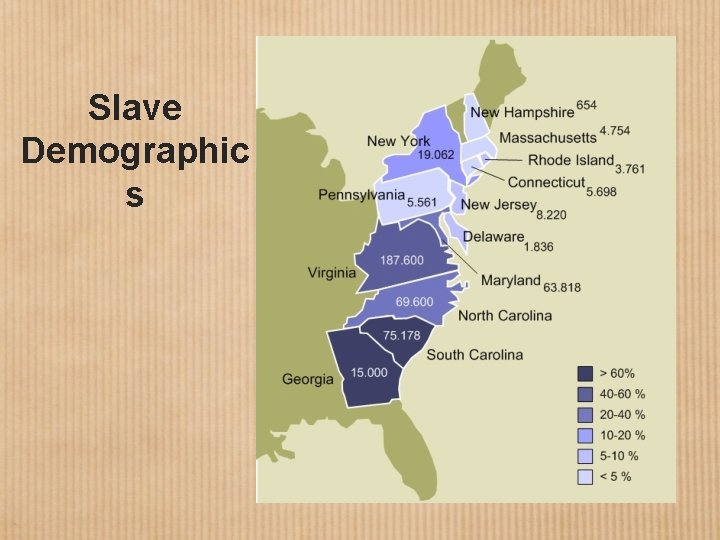
Slave Demographic s
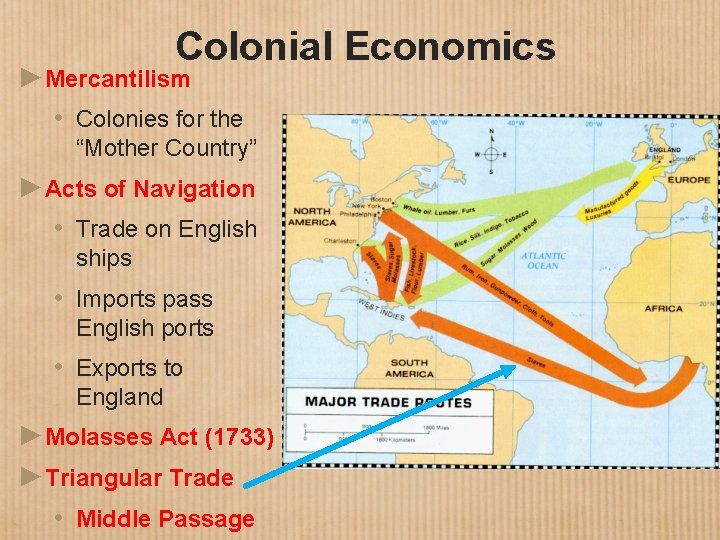
Colonial Economics ►Mercantilism • Colonies for the “Mother Country” ►Acts of Navigation • Trade on English ships • Imports pass English ports • Exports to England ►Molasses Act (1733) ►Triangular Trade • Middle Passage
Colonial Economics • Money • Commodity money (gold/silver) • Fiat money (paper currency) • Transportation • Rivers and coasts • Horse and carriage • Taverns and postal services
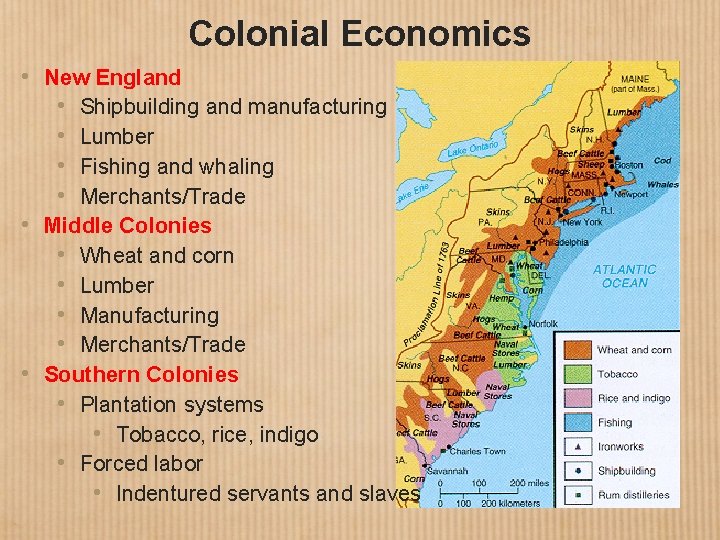
Colonial Economics • New England • Shipbuilding and manufacturing • Lumber • Fishing and whaling • Merchants/Trade • Middle Colonies • Wheat and corn • Lumber • Manufacturing • Merchants/Trade • Southern Colonies • Plantation systems • Tobacco, rice, indigo • Forced labor • Indentured servants and slaves
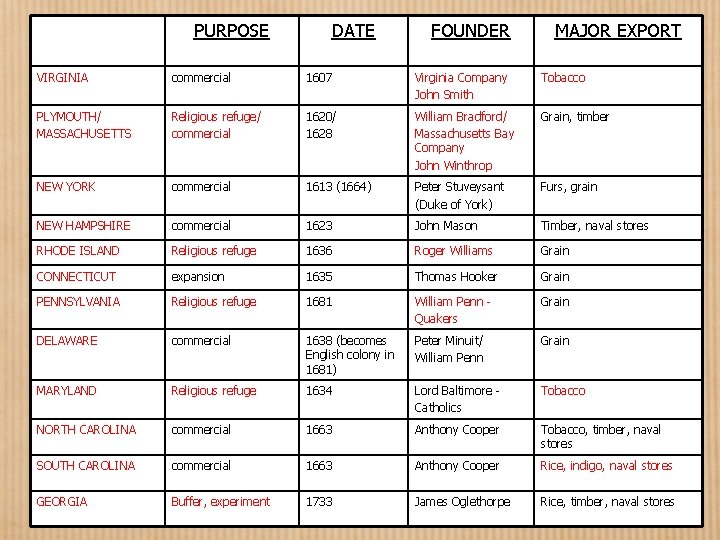
PURPOSE DATE FOUNDER MAJOR EXPORT VIRGINIA commercial 1607 Virginia Company John Smith Tobacco PLYMOUTH/ MASSACHUSETTS Religious refuge/ commercial 1620/ 1628 William Bradford/ Massachusetts Bay Company John Winthrop Grain, timber NEW YORK commercial 1613 (1664) Peter Stuveysant (Duke of York) Furs, grain NEW HAMPSHIRE commercial 1623 John Mason Timber, naval stores RHODE ISLAND Religious refuge 1636 Roger Williams Grain CONNECTICUT expansion 1635 Thomas Hooker Grain PENNSYLVANIA Religious refuge 1681 William Penn Quakers Grain DELAWARE commercial 1638 (becomes English colony in 1681) Peter Minuit/ William Penn Grain MARYLAND Religious refuge 1634 Lord Baltimore Catholics Tobacco NORTH CAROLINA commercial 1663 Anthony Cooper Tobacco, timber, naval stores SOUTH CAROLINA commercial 1663 Anthony Cooper Rice, indigo, naval stores GEORGIA Buffer, experiment 1733 James Oglethorpe Rice, timber, naval stores
Mercantilism • Mercantilism stipulates that in order to build economic strength, a nation must export more than it imports. • And since the economy and trade are essential to the health and safety of the nation you need to…. • Get as much gold and silver as you can. • Establish a favorable balance of trade. • How? • Get colonies!!! Preview Beginning around 1650, the British government pursued a policy of mercantilism in international trade.
Read Your Chapters and Take Notes!
- Slides: 52