
Early coagulopathy and lethal triad in burns patients
Early coagulopathy and lethal triad in burns patients: an issue for pre-hospital care? Sherren PB, Kundishora T, Hussey J, Martin R, Emerson B Department of Anaesthesia and Intensive Care, St. Andrew’s Burn Centre
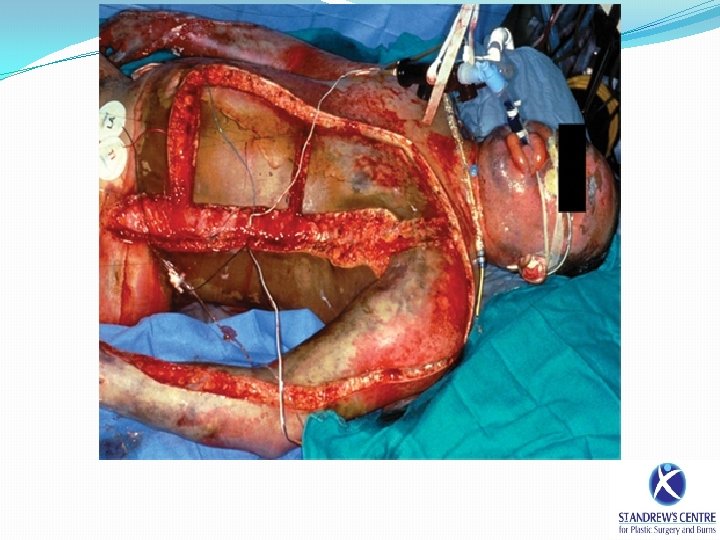
The lethal triad �The ‘lethal triad’ is a well described entity in the trauma population and is associated with significant mortality. Moore EE. Am J Surg 1996; 172: 405 -410 �Major burn patients are exposed to similar physiological insults �Little is known about the incidence and effect of an early coagulopathy and lethal triad in burns patients �A lethal triad could impact on early surgical procedures, CVS stability and septic complications
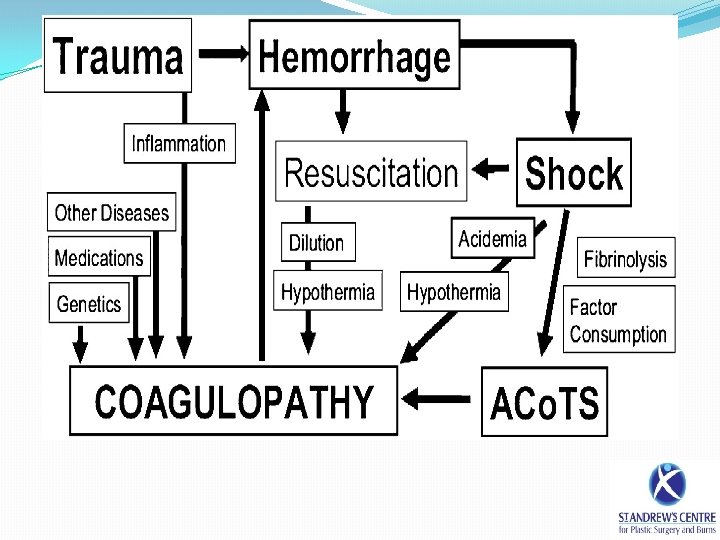
Coagulopathy �Acute traumatic coagulopathy (ATC) is a well described phenomenon in the trauma population associated with significant mortality Brohi K et al. J Trauma. 2003; 54: 1127 -1130 �ATC is an impairment of haemostasis involving a complex dynamic interaction between endogenous anticoagulants and fibrinolysis �ATC is driven by an endothelial injury and hypoperfusion, which results in in increased thrombomodulin expression and APC �An early burn induced coagulopathy has yet to be demonstrated
Hypothermia �Significant problem! �Factors involved • Large volume fluid resuscitation • Thermal tissue injury impairs skin’s insulating ability • Anaesthesia impacts thermoregulation • Impaired endogenous heat production as a result of anaerobic metabolism • Reluctance to warm burn patients by medical professionals?
Acidaemia �Major burns are characterised by • Direct endothelial injury • Systemic hypoperfusion • Hypovolaemia/ haemoconcentration • Impaired myocardial contractility and cellular hypoperfusion. �This decreased oxygen delivery results in a shift to anaerobic metabolism, lactate production and metabolic acidaemia �The initial lactate is a strong predictor of mortality in burns patients. Latenser BA. Crit Care Med. 2009 Oct; 37(10): 2819 -26
Aim �The primary aim of this study was to identify a clinically significant early burn induced coaguloapthy and lethal triad in thermal injuries �We also sought any association with the validated abbreviated burn severity index (ABSI), fluid administration and mortality
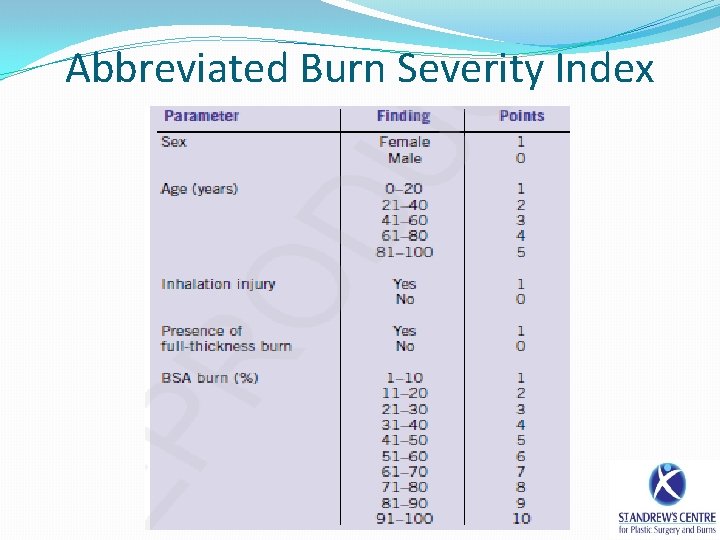
Abbreviated Burn Severity Index
Methods �Patients with TBSA burns ≥ 30% from October 2008 to December 2011 were identified from the metavision database �A structured anonymous metavision review was conducted �The database was scrutinised for a predetermined list of demographics, interventions, admission observations and investigations �Exclusion criteria were: associated major trauma, arrival at the burn centre>12 hours after burn, significant CO/Cyanide poisoning, pre-existing coagulopathy, any PRBC/FFP/PCC administration and non-thermal injuries
Definitions �Coagulopathy - PT≥ 14. 7/APTT≥ 45 seconds (Local lab. reference & Davenport et al. Crit Care Med 2011; 39(12): 26522658) �Hypothermia - Temperature≤ 35. 5°C �Acidaemia - p. H≤ 7. 25

Lethal Triad total cases reviewed (n=205) excluded (n=60) missing data (n=28) Lethal triad (n=15) Non Triad group (n=102)
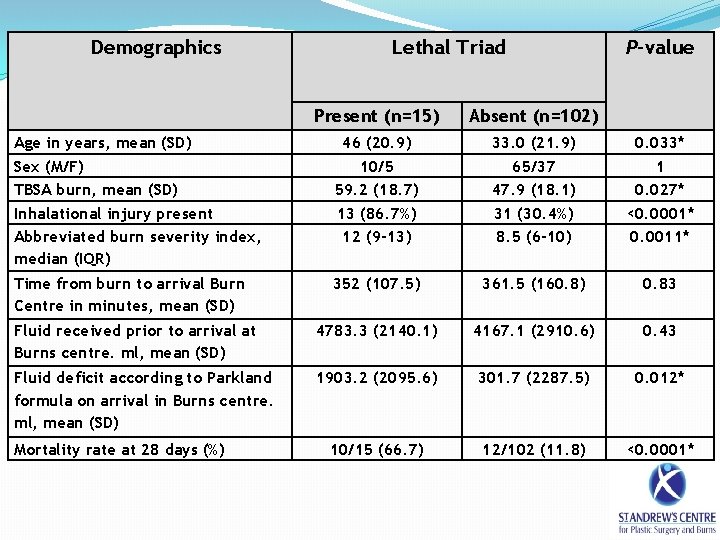
Demographics Lethal Triad P-value Present (n=15) Absent (n=102) Age in years, mean (SD) Sex (M/F) TBSA burn, mean (SD) Inhalational injury present Abbreviated burn severity index, median (IQR) 46 (20. 9) 10/5 59. 2 (18. 7) 13 (86. 7%) 12 (9 -13) 33. 0 (21. 9) 65/37 47. 9 (18. 1) 31 (30. 4%) 8. 5 (6 -10) 0. 033* 1 0. 027* <0. 0001* 0. 0011* Time from burn to arrival Burn Centre in minutes, mean (SD) 352 (107. 5) 361. 5 (160. 8) 0. 83 Fluid received prior to arrival at Burns centre. ml, mean (SD) 4783. 3 (2140. 1) 4167. 1 (2910. 6) 0. 43 Fluid deficit according to Parkland formula on arrival in Burns centre. ml, mean (SD) 1903. 2 (2095. 6) 301. 7 (2287. 5) 0. 012* 10/15 (66. 7) 12/102 (11. 8) <0. 0001* Mortality rate at 28 days (%)
Coagulopathy � 39. 3% of the 117 patients were coagulopathic on admission �There was no significant correlation between the PT and volume of fluid administered (p - 0. 095, r - 0. 155) �The 28 day mortality rate for patients with a coagulopathy of 39. 1% was significantly higher than the 8. 5% of those with normal coagulation (p-0. 0001) �The predictive value of an early coagulopathy in regards to 28 day mortality was sought using logistic regression analysis. All components of the ABSI were adjusted for �An earlier coagulopathy was an independent predictor of 28 day mortality, OR 3. 42 (1. 11 -10. 56)
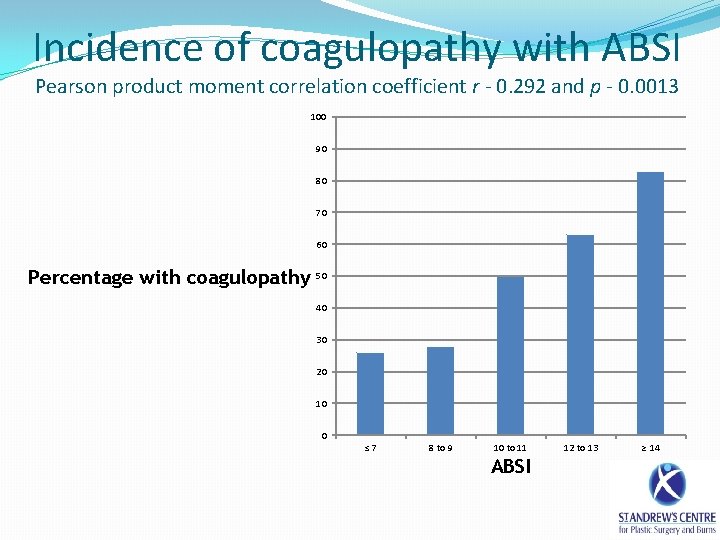
Incidence of coagulopathy with ABSI Pearson product moment correlation coefficient r - 0. 292 and p - 0. 0013 100 90 80 70 60 Percentage with coagulopathy 50 40 30 20 10 0 ≤ 7 8 to 9 10 to 11 ABSI 12 to 13 ≥ 14
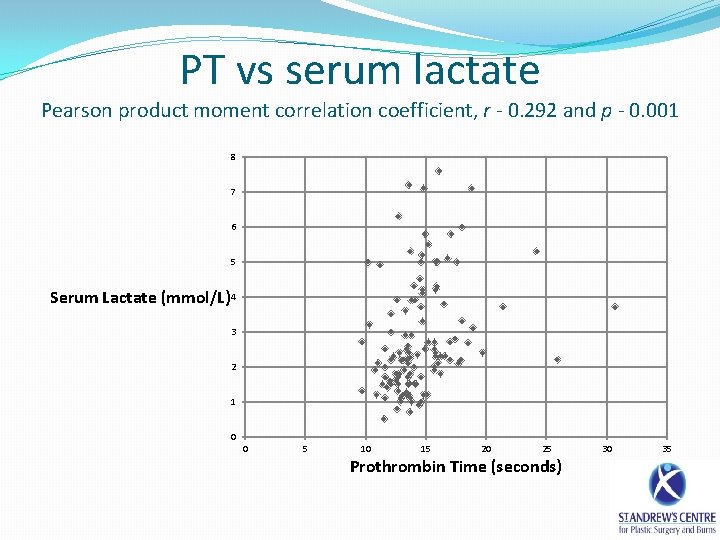
PT vs serum lactate Pearson product moment correlation coefficient, r - 0. 292 and p - 0. 001 8 7 6 5 Serum Lactate (mmol/L) 4 3 2 1 0 0 5 10 15 20 25 Prothrombin Time (seconds) 30 35
Summary �In patients with major thermal injuries there is a clinically significant early burn induced coagulopathy �This coagulopathy correlates to serum lactate and ABSI but is unrelated to fluid administration �An earlier coagulopathy was an independent predictor of 28 day mortality �A subgroup of major burns patients exhibit the lethal triad which is associated with an increased mortality
Conclusion �In the pre-hospital management of major burns it is vital to accurately assess the burn area and resuscitate appropriately to limit tissue hypoperfusion �An acute burn induced coagulopathy has significant bleeding implications for any surgical procedures �Ensure temperature conservation • Highest possible ambient temperature • Use of Clingfilm, space blankets and layering techniques • Use of active warming methods such as heat pads and the En-Flow fluid warmer

Questions?
- Slides: 19