
Early Civilizations Mesopotamia Ancient Egypt Mesopotamia Emerged as
- Slides: 30
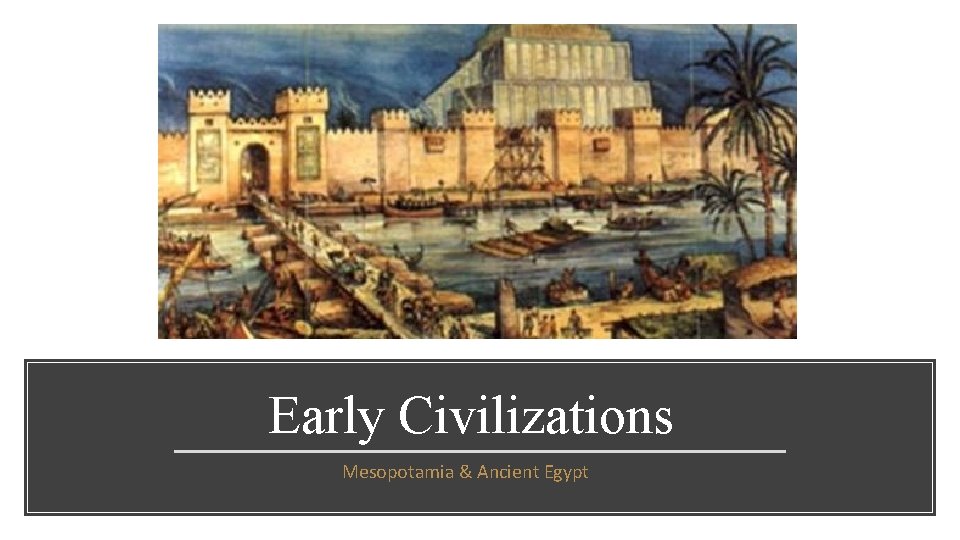
Early Civilizations Mesopotamia & Ancient Egypt
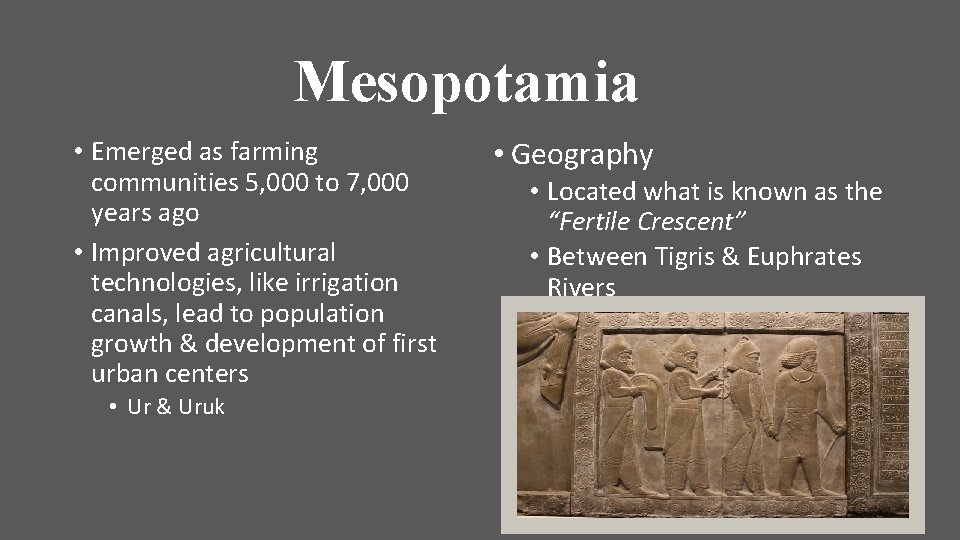
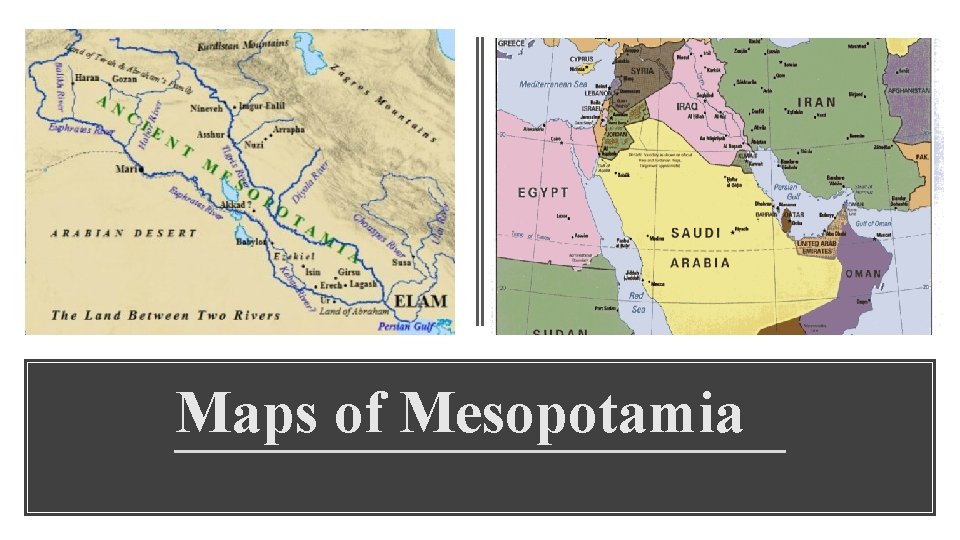
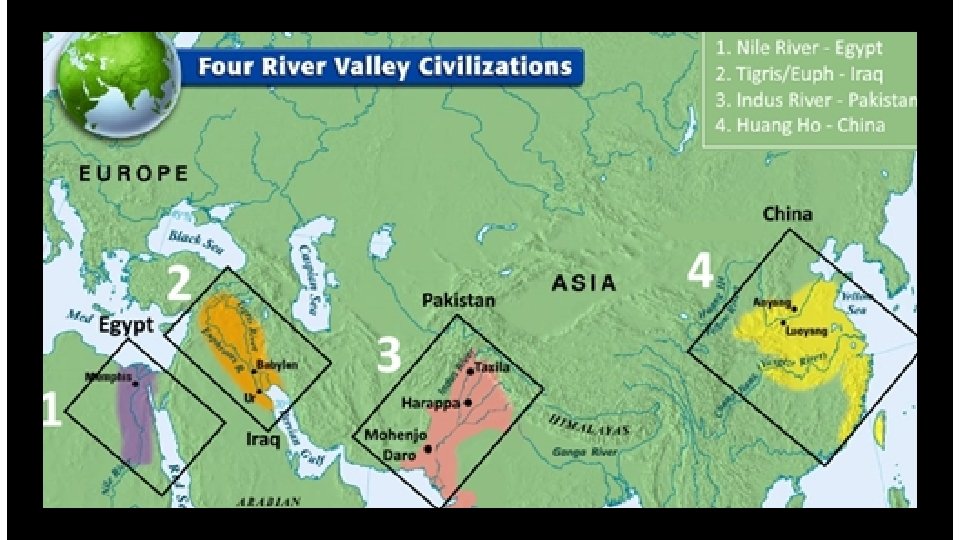
Mesopotamia • Emerged as farming communities 5, 000 to 7, 000 years ago • Improved agricultural technologies, like irrigation canals, lead to population growth & development of first urban centers • Ur & Uruk • Geography • Located what is known as the “Fertile Crescent” • Between Tigris & Euphrates Rivers
Maps of Mesopotamia
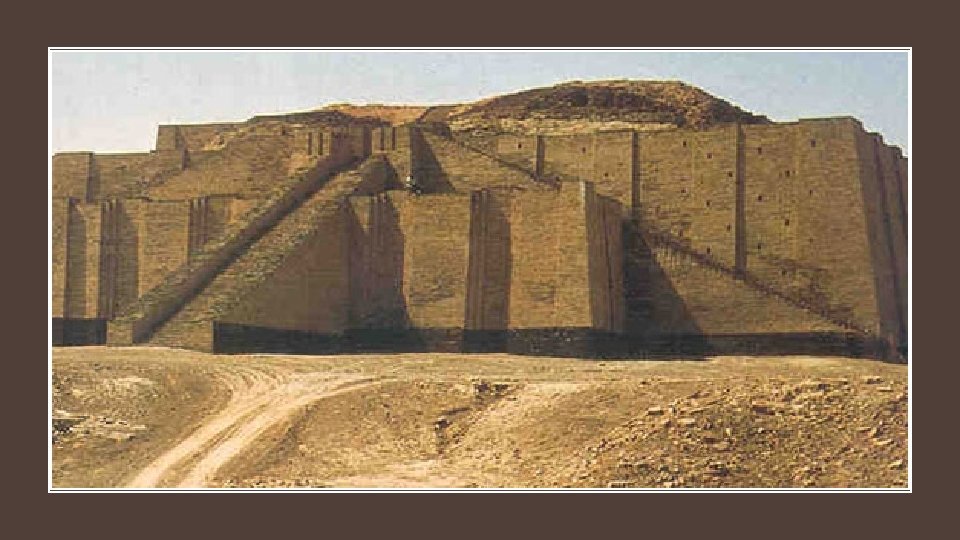
Mesopotamia • Geography • Desert Region • Susceptible to flooding • Left silt deposits which made land fertile • Flooding was very unpredictable • No natural boundaries • Open to invasion • Religion • Polytheistic • Gods represented elements of nature • Gods feared & seen as unpredictable • Sacrifices given to appease gods • Ziggurats built in honor of gods • Belief that afterlife was a fearful and gloomy place
Mesopotamia Political History • First phase of Mesopotamia’s political history, known as Sumer • Dominated by several independent & warring citystates (hereditary monarchs) • Each city-state had a walled urban area made up of simple mudbrick dwellings & a ceremonial and administrative center dominated by a Ziggurat. • Outside of city walls, city-state controlled the large areas of surrounding farmland • Around 4, 000 years ago King of Akkad, Sargon, conquered this region creating the world’s first empire • Empire short lived due to invasions & insurrection • Babylonians (2 nd phase) brought important political innovation when they unified the region in the 18 th century BCE
Mesopotamia Political History • Babylonian King Hammurabi introduced the World’s first written law code • The Old Babylonian Empire as it is known by historians also witnessed a flowering in mathematics and literature • Babylonian Empire also fell to invasion • Led to rise of many warring empires • Hittites (Indo European people) arrived about 2000 BCE bringing iron technology • Assyrians, rose in power around 1900 BCE • Persians who began to build a long-lived empire around 550 BCE.
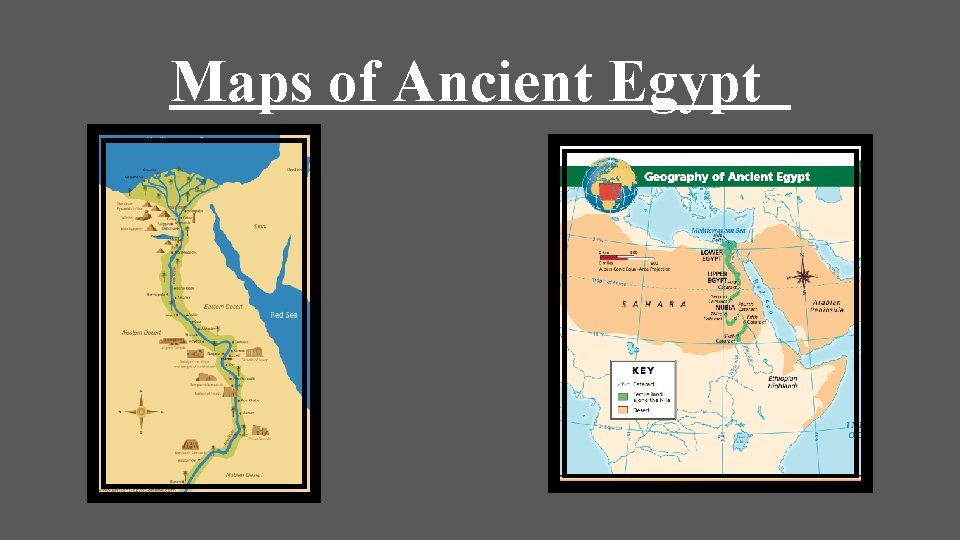
Ancient Egypt • Also developed as farming communities around 5, 000 to 7, 000 years ago • Improved technology led to rise of the kingdoms of Upper & Lower Egypt • Geography • Located in desert region of N. Africa • Nile River Valley • Annual Flooding • Left silt deposits which made the land fertile • “Gift of the Nile” • Natural boundaries • vast desert and seas
Maps of Ancient Egypt
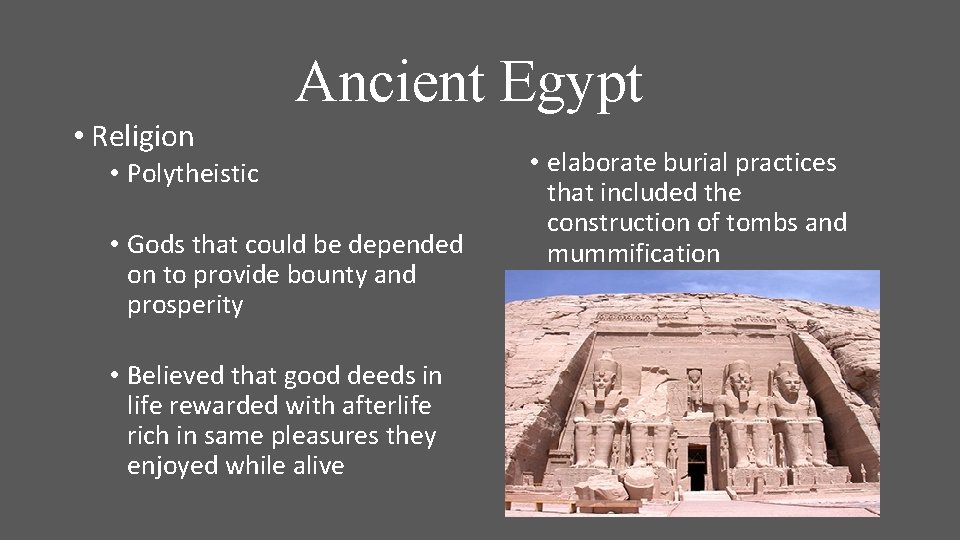
Ancient Egypt • Religion • Polytheistic • Gods that could be depended on to provide bounty and prosperity • Believed that good deeds in life rewarded with afterlife rich in same pleasures they enjoyed while alive • elaborate burial practices that included the construction of tombs and mummification
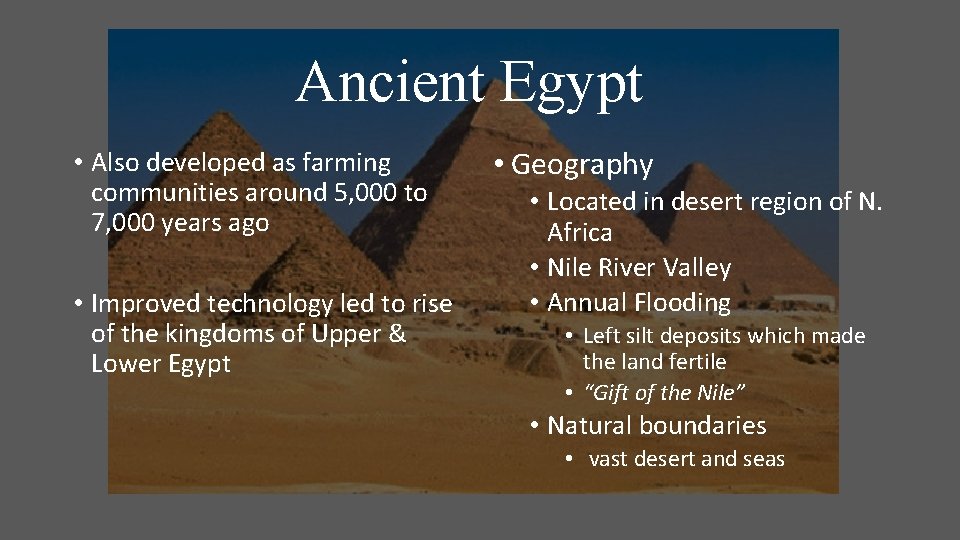
Ancient Egypt Political History • Egypt saw fewer invasions • Relatively stable for over 2, 000 years • Began about 3, 000 BCE with unification of Upper and Lower Egypt into a single kingdom ruled by a divine hereditary monarch known as the Pharaoh • Pharaohs aided by elaborate bureaucracy that included priests, administrators and scribes • Government was able to undertake elaborate public works projects like construction of Pyramids that served as tombs for the Pharaoh
Ancient Egypt Political History • Periods of Ancient Egypt • The intermediate periods mark the only major times instability in Egypt • Old Kingdom (c. 2649 to before 1070 BCE. 2150 BCE) • First Intermediate Period • Middle Kingdom (c. 20301640 BCE) • Second Intermediate Period • New Kingdom (c. 15501070) • During the Second Intermediate Period, Egypt experienced its first major invasion from the Hyksos of Mesopotamia who introduced the region to the horse, chariot and compound bow.
Mesopotamia & Egypt Links • After 1070, the political histories • Agricultural surplus allowed for specialization & development of social of Egypt and Mesopotamia classes intersected as they both experienced invasions from groups • Both societies had the same basic social hierarchy with the royal family like the Hittites (who introduced at the top followed by priests, Iron to the region), Assyrians and government officials, landowners, Persians soldiers, and scribes constituting a • Fertile river valleys combined with ruling class followed by merchants technological advances like and artisans in the middle and irrigation canals and plows peasant farmers at the bottom allowed both Mesopotamia and Egypt to produce surplus food
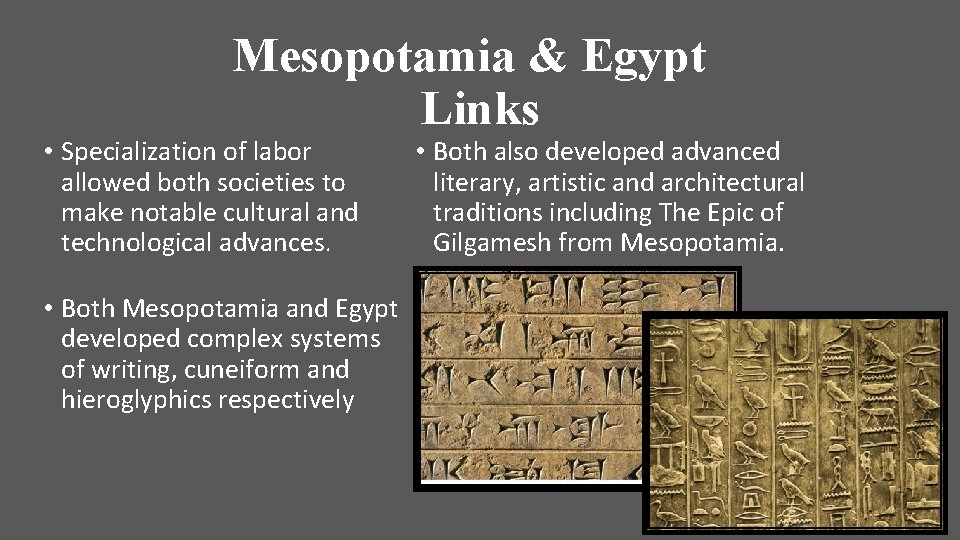
Mesopotamia & Egypt Links • Specialization of labor allowed both societies to make notable cultural and technological advances. • Both Mesopotamia and Egypt developed complex systems of writing, cuneiform and hieroglyphics respectively • Both also developed advanced literary, artistic and architectural traditions including The Epic of Gilgamesh from Mesopotamia.
Early Civilizations Indus Valley & Yellow River
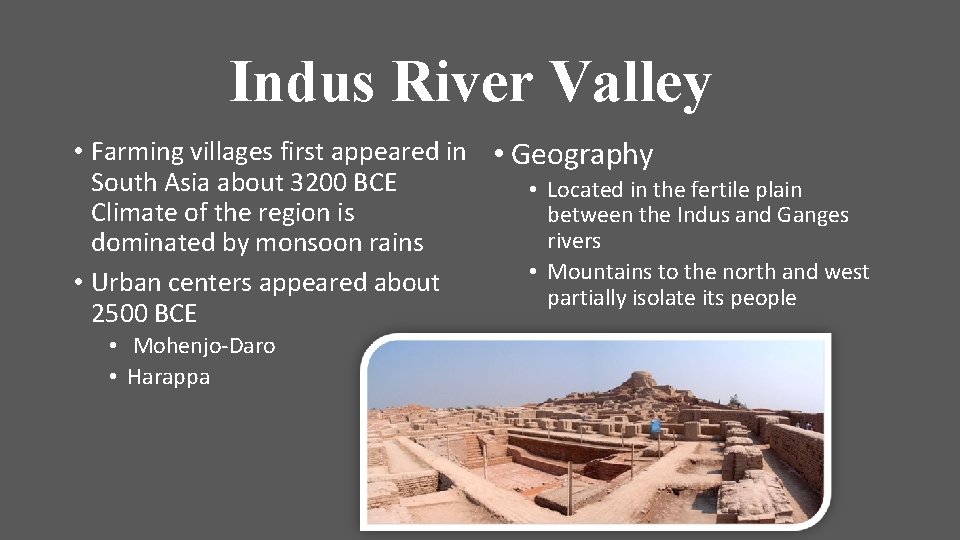
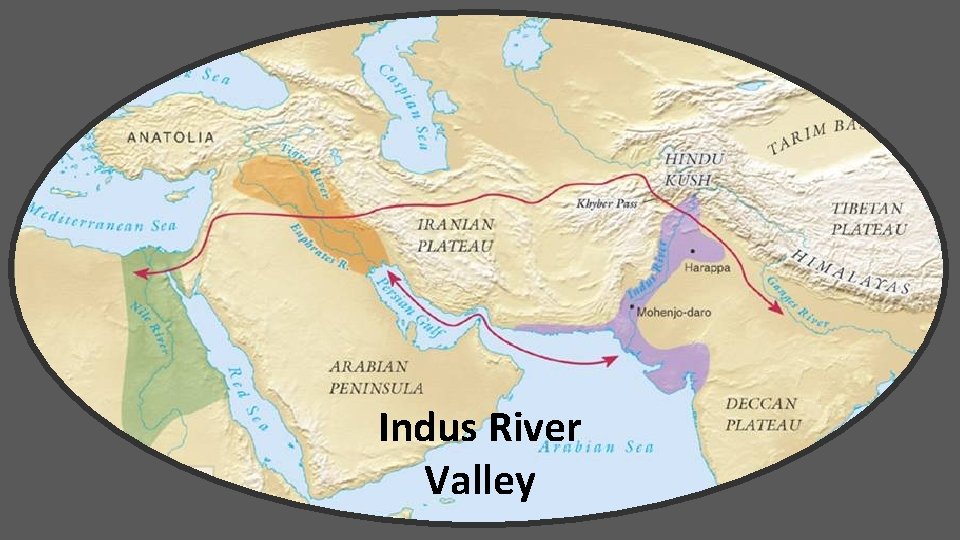
Indus River Valley • Farming villages first appeared in • Geography South Asia about 3200 BCE • Located in the fertile plain Climate of the region is between the Indus and Ganges rivers dominated by monsoon rains • Mountains to the north and west • Urban centers appeared about partially isolate its people 2500 BCE • Mohenjo-Daro • Harappa
Indus River Valley
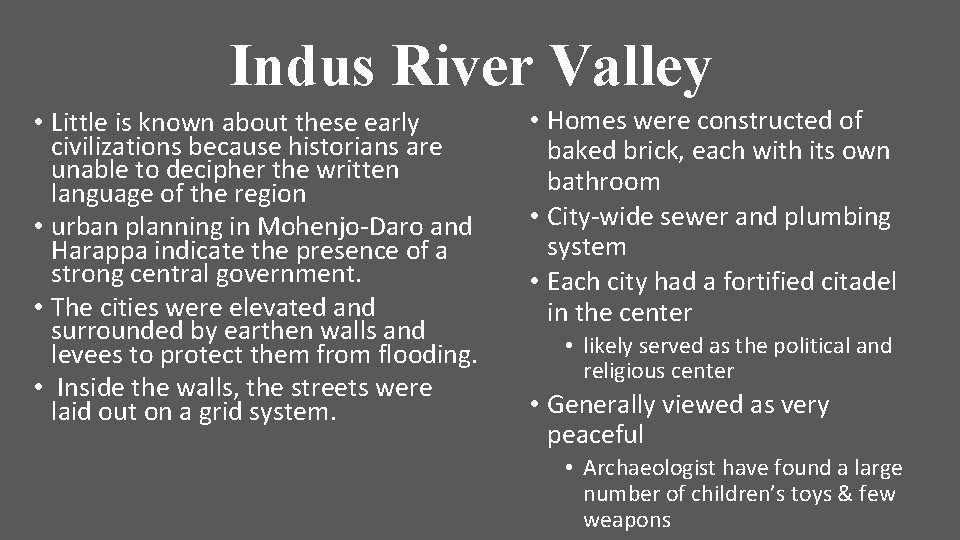
Indus River Valley • Little is known about these early civilizations because historians are unable to decipher the written language of the region • urban planning in Mohenjo-Daro and Harappa indicate the presence of a strong central government. • The cities were elevated and surrounded by earthen walls and levees to protect them from flooding. • Inside the walls, the streets were laid out on a grid system. • Homes were constructed of baked brick, each with its own bathroom • City-wide sewer and plumbing system • Each city had a fortified citadel in the center • likely served as the political and religious center • Generally viewed as very peaceful • Archaeologist have found a large number of children’s toys & few weapons
Indus River Valley • Economy • Dependent on agriculture • Evidence of trade with Middle East and Central Asia. • Urban decay set in around 1750 BCE • possibly brought on by earthquakes & soil exhaustion • A new group of people, the Indo-European Aryans, migrated into the region in about 1500 BCE • Eventually established the Magadha Kingdom which controlled a portion of northeast India by the second century BCE.
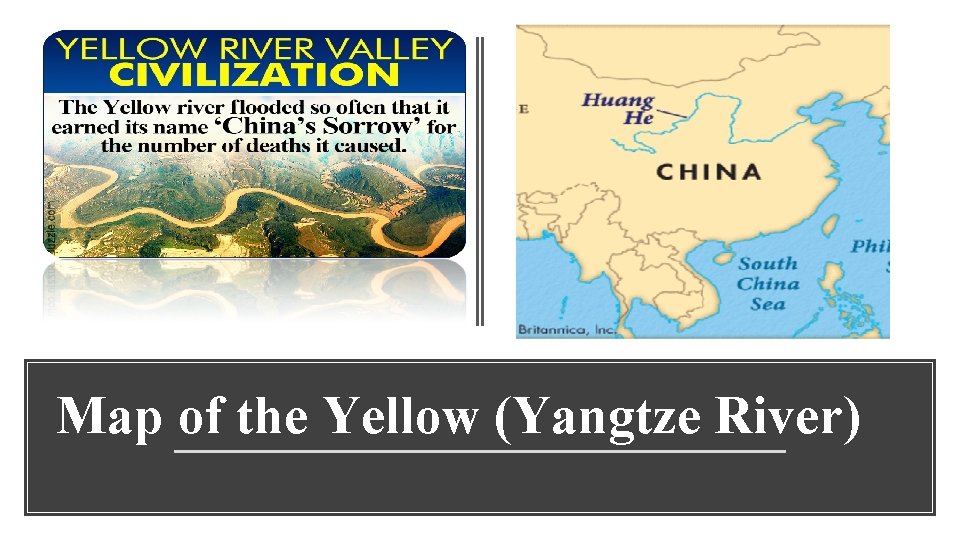
Yellow River (China) • Geography • The farming villages between the Huang He and Yangtze Rivers of China grew into cities about 2000 BCE • Urban areas both benefited & suffered because of the rich but loose yellow silt deposited by the flooding of Yangtze • Loess • While the soil supported agriculture its loose nature made major shifts in the course of the river and massive floods common. • These struggles are recorded in Chinese legend as the Xia Dynasty whose Emperor Yu is said to have brought flood control and irrigation to China.
Map of the Yellow (Yangtze River)
Yellow River (China)Political History • 1700 BC – Shang emerges as first • Writing system, complex urban documented dynasty of China planning, irrigation and flood control developed during this • Began long tradition of period governance that included hereditary monarch supported • Economy by a complex bureaucracy • Dominated by agriculture • Trade & craft production also • Urban centers were walled & surrounded by large agricultural areas
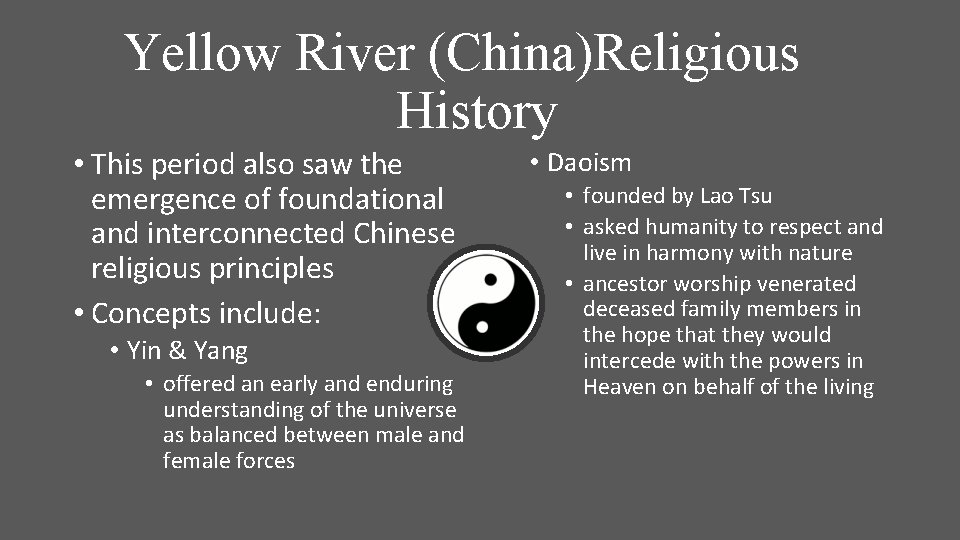
Yellow River (China)Religious History • This period also saw the emergence of foundational and interconnected Chinese religious principles • Concepts include: • Yin & Yang • offered an early and enduring understanding of the universe as balanced between male and female forces • Daoism • founded by Lao Tsu • asked humanity to respect and live in harmony with nature • ancestor worship venerated deceased family members in the hope that they would intercede with the powers in Heaven on behalf of the living
Early Civilizations Bantu & Olmec
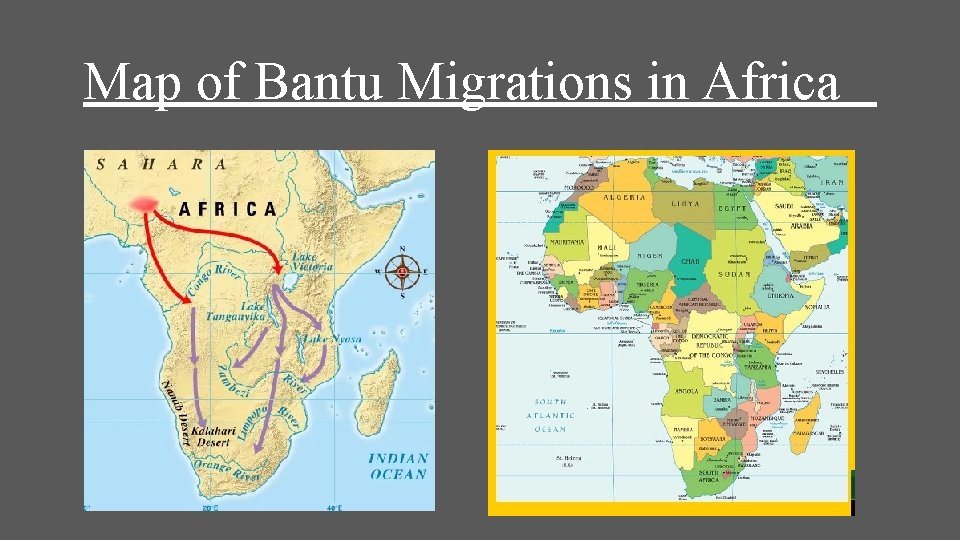
Bantu (Africa) • Agricultural villages became common in West Africa below the Sahara desert about 4, 000 years ago • These villages developed iron technology in time, which they used to produce tools of agriculture • Extensive linguistic evidence suggests that West Africans from around the modern border between Nigeria and Cameroon began to use this technology to clear forest to the southeast for farming • This led to a slow migration of these Bantu speaking people to the southeast and south from about 500 BCE to 600 CE • This migration brought agriculture, iron technology, and a new language to a region previously dominated by hunter gathers • Anthropologist believe that this migration laid the foundation for a common cultural heritage present in much of West, Central, East and South Africa.
Map of Bantu Migrations in Africa
Olmec (Meso-America) • Civilizations also developed in the Americas in this period • Geographic isolation made them more unique but they followed many of the same patterns of civilizations in Afro-Eurasia • Agricultural villages based on the cultivation of corn, beans, and squash emerged about 3500 BCE. • These villages grew into a variety of urban centers around 1200 BCE • The most influential was the Olmec culture found in modern Mexican states of Veracruz and Tabasco • Political authority and social stratification developed in these urban areas as a result of agricultural surplus and the need to mobilize large numbers of people to construct irrigation systems, ceremonial buildings and to drain land for farming
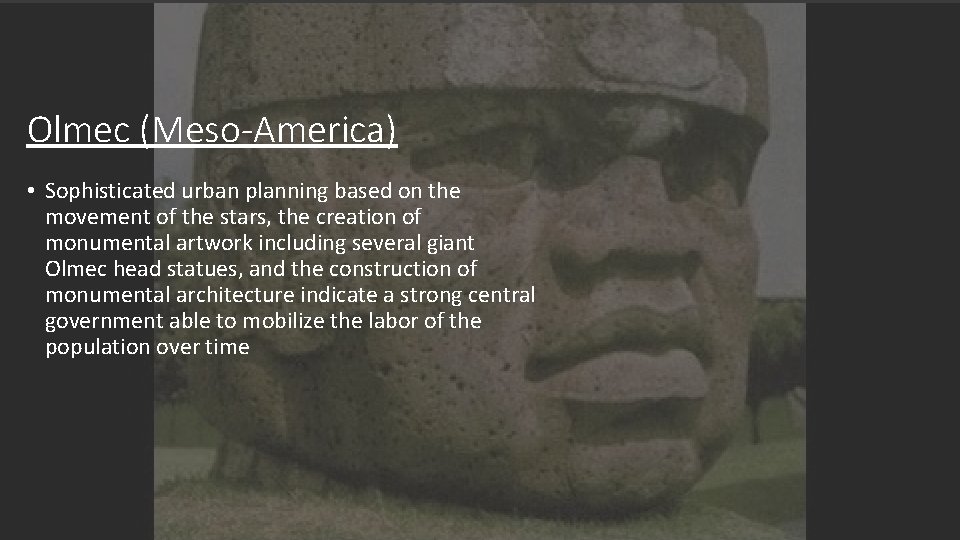
Olmec (Meso-America) • Sophisticated urban planning based on the movement of the stars, the creation of monumental artwork including several giant Olmec head statues, and the construction of monumental architecture indicate a strong central government able to mobilize the labor of the population over time
Olmec (Meso-America) • Each Olmec city was likely independently ruled by a hereditary monarch who maintained power by presenting himself as an intermediary to the gods • These rulers, assisted by a class of priests, performed awe inspiring rituals on large platforms in the center of each city that included bloodletting and human sacrifice • These rituals served to reinforce the power of the state & laid the cultural foundations for the civilization that followed • Olmec economy like other ancient civilizations was dominated by agriculture but sophisticated trade networks and craft production also existed