
EARLY CIVILIZATIONS I EGYPTIANS Overview of Ancient Egypt
- Slides: 14
EARLY CIVILIZATIONS
I. EGYPTIANS � Overview of Ancient Egypt � Early inhabitants (Neolithic's) called the land Kemet � Renamed � The Egypt by the Greeks Nile River Valley (annual floods) � World’s Longest River – flows from South to North � Two Kingdoms by 4, 000 B. C. � Lower Kingdom in the North � Upper Kingdom in the South � 3000 B. C. – Narmer invaded Lower Egypt � Marked the first Egyptian Dynasty
II. THREE EGYPTIAN DYNASTIES � The Old Kingdom (2700 -2200 B. C. ) � Established a theocracy (god-king) � Built pyramids to honor god-kings (mummification) � The Middle Kingdom (2050 -1700 B. C. ) � Egypt was reunited after a time of upheaval � The capital was moved to Thebes � Were invaded by the Hyksos (from Western Asia) � The New Kingdom (1600 -1200 B. C. ) � Egyptians overthrew the Hyksos – led by Ahmose � Kings began to use the title Pharaoh
III. NEW KINGDOM PHARAOHS � Hatshepsut (1480 B. C. ) - female pharaoh � Ruled because her son was too young to rule � Extensive building projects � Thutmose III (Hatshepsut’s son) � Expanded the Dynasty to include Syria � Made an “empire” for Egypt – cultural diffusion � Amenhotep: � Decided (1370 B. C. ) – wife Nefertiti to make Egypt monotheistic (Aton) � Changed his name to Akhenaton � Moved the capital to central Egypt
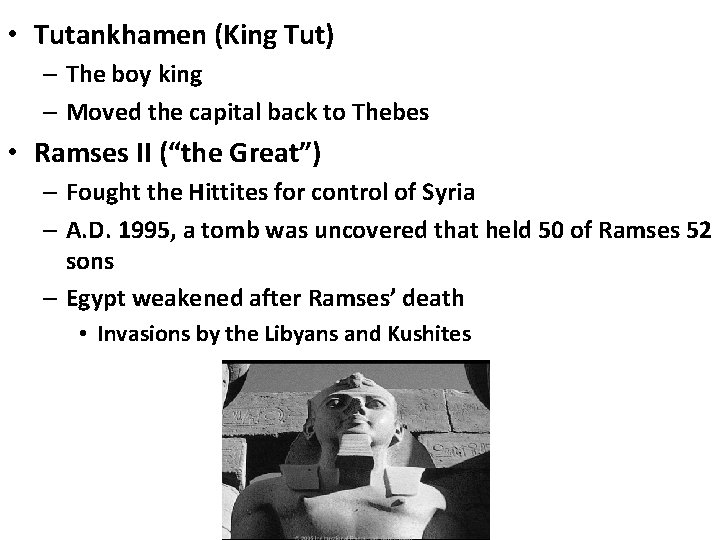
• Tutankhamen (King Tut) – The boy king – Moved the capital back to Thebes • Ramses II (“the Great”) – Fought the Hittites for control of Syria – A. D. 1995, a tomb was uncovered that held 50 of Ramses 52 sons – Egypt weakened after Ramses’ death • Invasions by the Libyans and Kushites
IV. EGYPTIAN LIFE � Social Order � Upper class; middle class; lower class � Women's’ rights improved btwn. Old & New Kingdoms � Religion: � Gods � Writing polytheistic (other than Akhenaton) were depicted as part human part animal System � Hieroglyphics: carved picture symbols � Hieratic: cursive for everyday use � Rosetta Stone: part Greek and part Egyptian � Book of the Dead
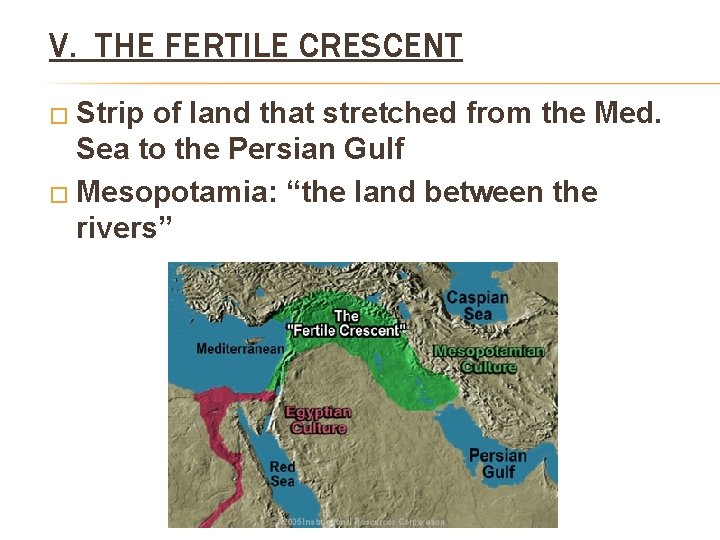
V. THE FERTILE CRESCENT � Strip of land that stretched from the Med. Sea to the Persian Gulf � Mesopotamia: “the land between the rivers”
VI. THE SUMERIANS � Settled in Mesopotamia in 3500 B. C. � Built the world’s first cities (Ur, Uruk, Eridu) � Built ziggurats – temples in each city-state � only priests could enter the temples � Government: �A each city was independent military leader was chosen to lead/protect � 2700: military leaders were viewed as kings � Leaders served as king and high priest � The legal systems were not clear or consistent
� Roles of Men and Women � Men had ultimate authority over families � Women possessed very few rights (buy/sell prop. ) � Writing System � Cuneiform: pictograms on wet clay � Gilgamesh was written @ 1850 B. C. � Religion: � The each god was over a natural force gods were viewed as unpredictable/angry � Inventions: � The wheel, 12 mo. Calendar, arch, and sundial � Developed bronze and metal plow
VII. MESOPOTAMIAN EMPIRES � Invaders dreamt of controlling an empire � Sargon I and the Akkadians � Came to power in the 2300 s B. C. � United the Mesopotamian city-states � Hammurabi’s Babylonian Empire � Amorites overran Sumerian centers (Babylon) � Hammurabi became the dominant ruler � Increased Babylon's prosperity � Law Code: “Made Justice Appear in the Land” � Law covered the entire region � 282 sections on Daily Life � Clear punishment for crimes
� Babylonian � Upper Society Class: Kings, priests, nobles � Middle Class: artisans, merchants, scribes, farmers � Lower Class: slaves (from war/had not paid debts) � Borrowed ideas and techniques from Sumerians �Writing system, farming techniques, & religion
VIII. THE INDUS RIVER VALLEY � Larger than both Sumer and Egypt � Located in South Asia � Reached its height @ 2500 – 1500 B. C. � Used the natural boundaries of the Himalayas and Hindu Kush � Seasonal “Monsoons” affect the climate � Winter temps of 70º; Summer temps of 100º � Flooding of the Rivers enriches the soil
VIII. INDUS RIVER VALLEY CONT. � Harappan and Mohenjo-Daro civilizations � Centrally planned cities �A citadel, city laid out in a grid � Language and Religion � Written records (pictograms) � Animal/human deities � Collapse � Flooding and violent invasion
IX. EARLY CHINA � Zhong Guo – “Middle Kingdom” � Isolated � Shang from much of the world Dynasty (1700 -1000 B. C. ) � Myths (Creation and founding individuals) � Early Religion – leaders were both pol. /relig. � polytheistic � Achievements: � Mandate metal workings, silk cloth of Heaven: � Justified rulers’ authority � If a ruler governed improperly, they lost the mandate