
Early Cities Which of the following was not

- Slides: 48
Early Cities • Which of the following was not an area where early civilizations and the first cities begin? a. Thames River area (Britain) b. Nile River Valley (Egypt) c. Tigris and Euphrates River Valley (Mesopotamia) d. Indus River Valley (India) e. Yangzi and Yellow (Huang) River Valleys (East Asia)
Early Cities • Which of the following was not an area where early civilizations and the first cities begin? a. Thames River area (Britain) b. Nile River Valley (Egypt) c. Tigris and Euphrates River Valley (Mesopotamia) d. Indus River Valley (India) e. Yangzi and Yellow (Huang) River Valleys (East Asia)
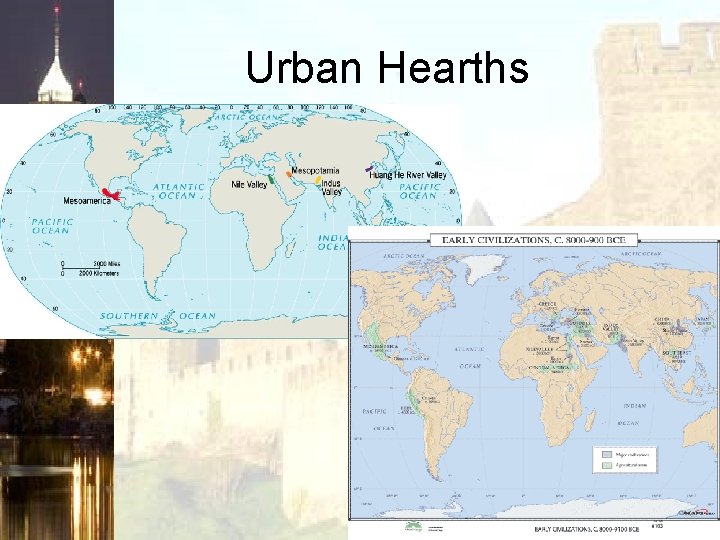
Early Cities • Urban Hearth Areas – – • First Urban Revolution – – • Follows the same pattern as agricultural hearth areas Areas: Mesopotamia, Indus Valley, Huang He River Valley, Egypt, & Meso. America Leadership class developed Population of cities was 10, 000 -15, 000 Ancient Cities were centers of religion, power & economics
Urban Hearths
Classical Cities: The Diffusion of Urbanization • Athens – population 250, 000 • • A global city, rather than regional Urbanization diffused from Greece Had acropolis & agora Rome • Combine acropolis & agora = forum • Urban Morphology- form & structure of cities, incl. street patterns, size and shape
• Which of the following was among the largest cities in the world around the end of the first millennium (1000 AD)? a. b. c. d. e. Baghdad London New York Rome Paris
• Which of the following was among the largest cities in the world around the end of the first millennium (1000 AD)? a. b. c. d. e. Baghdad London New York Rome Paris
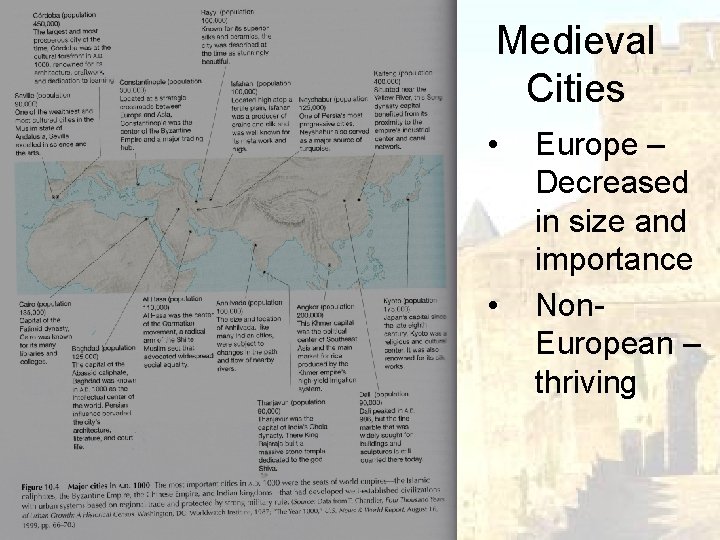
Medieval Cities • • Europe – Decreased in size and importance Non. European – thriving
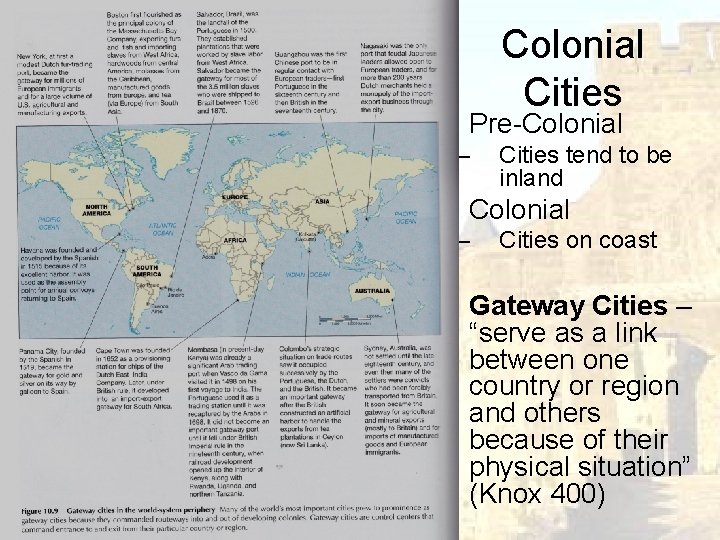
• Colonial Cities Pre-Colonial – • Cities tend to be inland Cities on coast Gateway Cities – “serve as a link between one country or region and others because of their physical situation” (Knox 400)
• Which of the following was most directly responsible for the acceleration of urbanization in the 1800 s in Europe and North America? a. Drought conditions in Eastern Europe that stimulated westward migration b. The colonization of the Western Hemisphere c. The Protestant Revolution d. The Industrial Revolution e. Increasing competitiveness of China in world trade
• Which of the following was most directly responsible for the acceleration of urbanization in the 1800 s in Europe and North America? a. Drought conditions in Eastern Europe that stimulated westward migration b. The colonization of the Western Hemisphere c. The Protestant Revolution d. The Industrial Revolution e. Increasing competitiveness of China in world trade
Industrialization • • • Second Urban Revolution prompted by second revolution in agriculture Increased urbanization Location choice based solely on power source
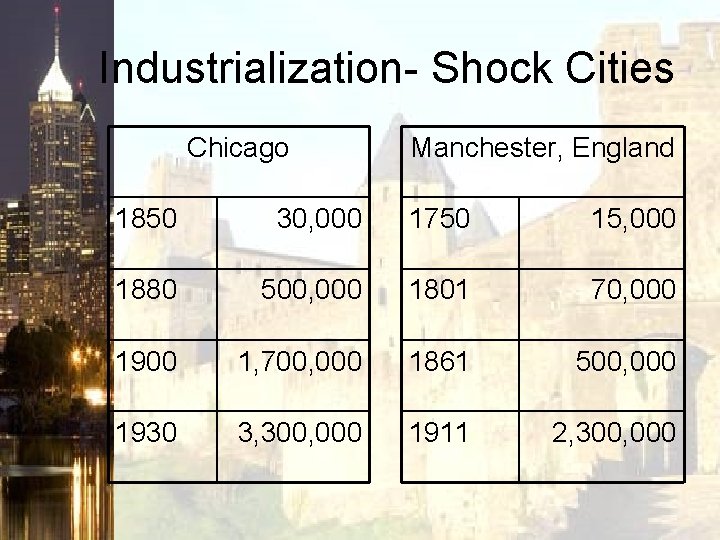
Industrialization- Shock Cities Chicago Manchester, England 1850 30, 000 1750 15, 000 1880 500, 000 1801 70, 000 1900 1, 700, 000 1861 500, 000 1930 3, 300, 000 1911 2, 300, 000
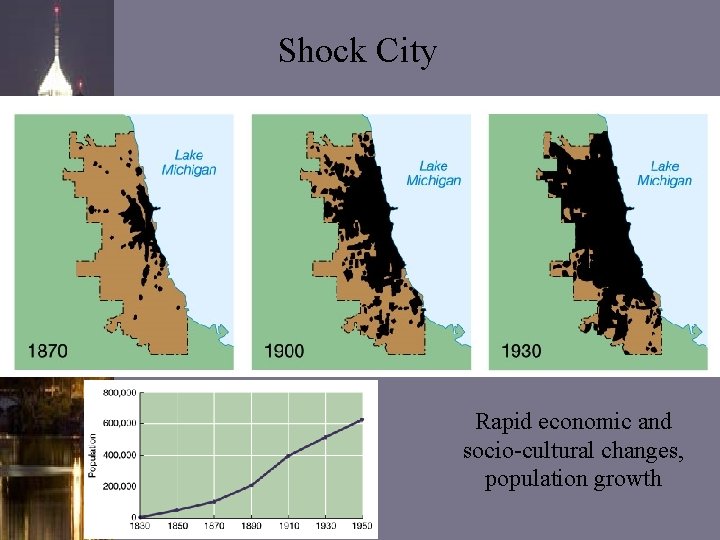
Shock City Rapid economic and socio-cultural changes, population growth
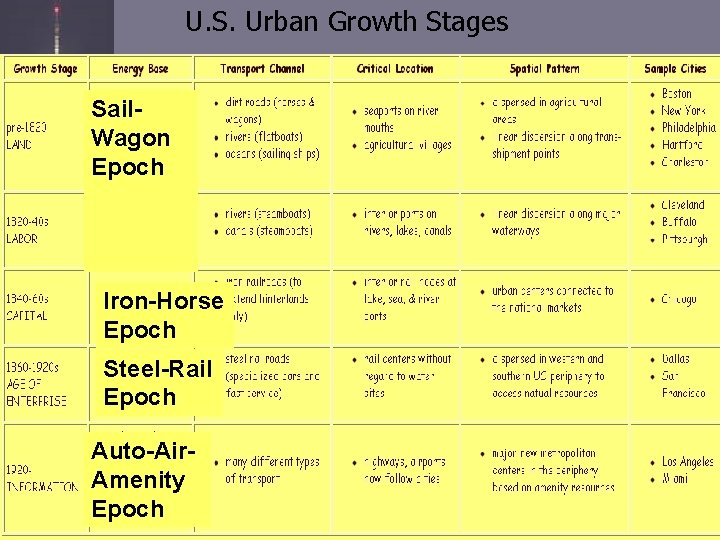
U. S. Urban Growth Stages Sail. Wagon Epoch Iron-Horse Epoch Steel-Rail Epoch Auto-Air. Amenity Epoch
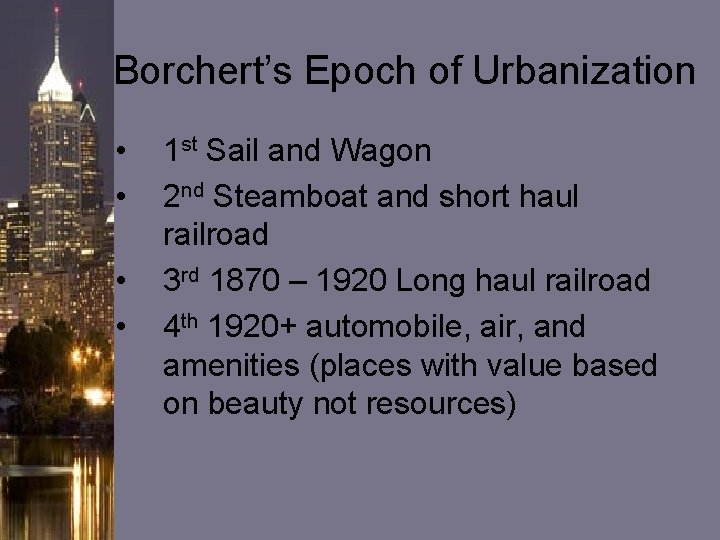
Borchert’s Epoch of Urbanization • • 1 st Sail and Wagon 2 nd Steamboat and short haul railroad 3 rd 1870 – 1920 Long haul railroad 4 th 1920+ automobile, air, and amenities (places with value based on beauty not resources)
• According to John Borchert, the Steel-Rail Epoch in the evolution of the American metropolis occurred between a. b. c. d. e. 1790 and 1830 and 1870 and 1920 and 1960 and present
• As you travel from center city to the outskirts of the city, the cost of landrents (bid-rents 0 usually a. b. c. d. Go up Stays the same Goes down Fluctuates according to regional factors e. Goes up if the topography is flat, but goes down if the topography around the city is hilly
• As you travel from center city to the outskirts of the city, the cost of landrents (bid-rents 0 usually a. b. c. d. Go up Stays the same Goes down Fluctuates according to regional factors e. Goes up if the topography is flat, but goes down if the topography around the city is hilly
• According to John Borchert, the Steel. Rail Epoch in the evolution of the American metropolis occurred between a. b. c. d. e. 1790 and 1830 and 1870 and 1920 and 1960 and present
• • Bid-Rent Theory Multiplier Effect
Gravity Model • • Predicts the optimal location of a service is directly related to the number of people in the area and inversely related to the distance people must travel to access it Threshold – number of people needed Range – distance willing to travel Hinterland (market area) – area surrounding a service from which customers are attracted
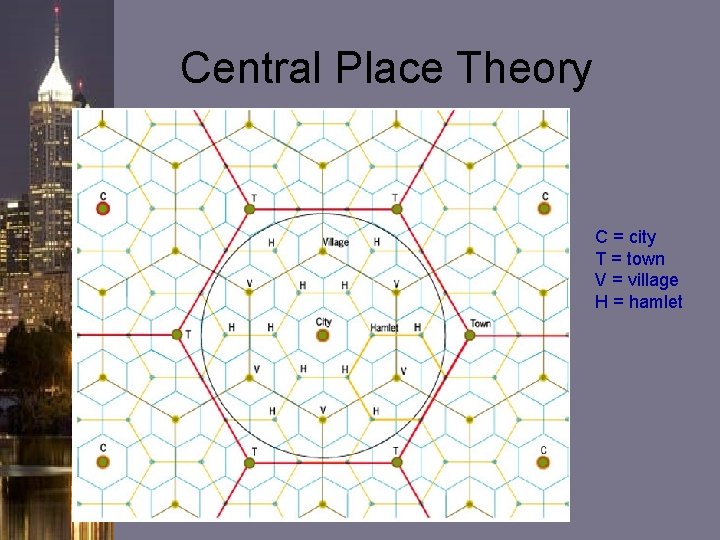
Central Place Theory • • by Walter Christaller in the 1930’s Assumed – region would be flat with no physical barriers – Soil fertility would be equal – Power and purchasing power would be even • Utilizes hexagons, rather than circles • Studies confirm the distribution of cities, towns, & villages are tied to trade areas, population size and distance
Central Place Theory C = city T = town V = village H = hamlet
• Which of the following characteristics do the Burgess Model & Hoyt Model have in common? a. Both show that the poorest residents live on the city’s outskirts b. Both show heavy manufacturing located near the city’s center c. Both show that the wealthiest residents live on the city’s outskirts d. Both show that middle-class residents live mid -way between the city’s center and the city’s outskirts e. Both show only one central business district (CBD)
• Which of the following characteristics do the Burgess Model & Hoyt Model have in common? a. Both show that the poorest residents live on the city’s outskirts b. Both show heavy manufacturing located near the city’s center c. Both show that the wealthiest residents live on the city’s outskirts d. Both show that middle-class residents live mid -way between the city’s center and the city’s outskirts e. ) Both show only one central business district (CBD
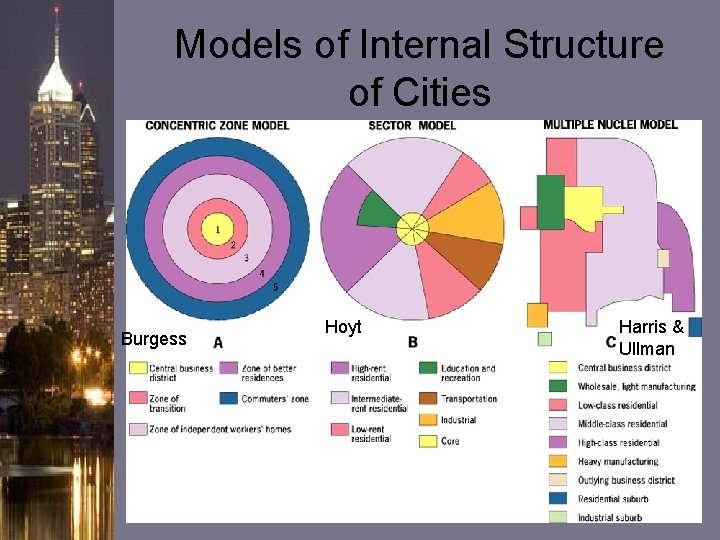
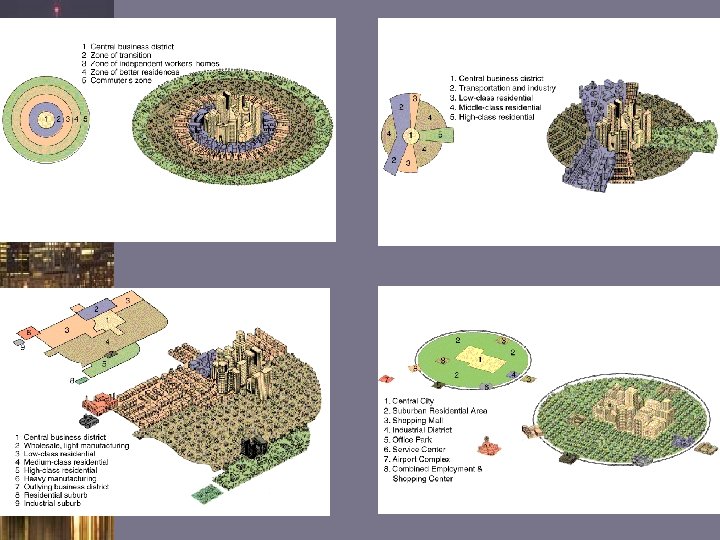
Models of Internal Structure of Cities Burgess Hoyt Harris & Ullman
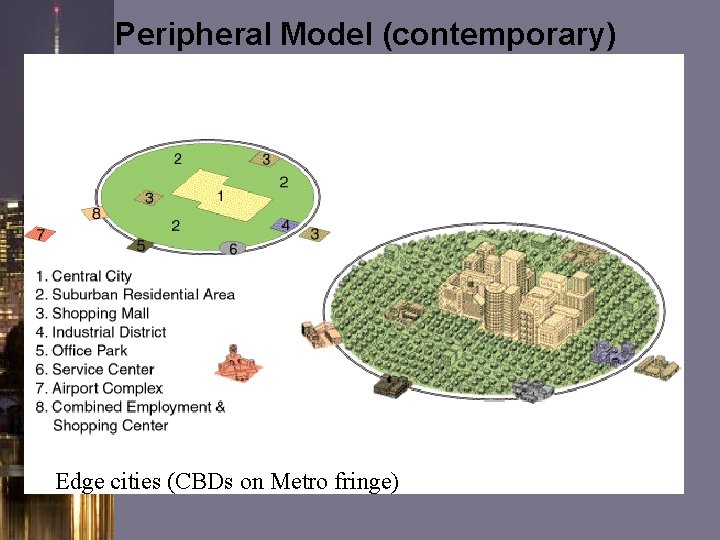
The Peripheral Model • • Created by Chauncey Harris Urban area consists of an inner city surrounded by large suburban residential business areas tied together by a beltway or ring road Around beltway are nodes of consumer & businesses – edge cities Edge Cities started out as suburb residences that gained shopping malls then manufacturing & business parks
Peripheral Model (contemporary) Edge cities (CBDs on Metro fringe)
• Which of the following is most likely to have a large religious building and a market bazaar at its center? 1. 2. 3. 4. A traditional city in Northern Africa A post-colonial city in Sub. Saharan Africa A colonial-based city in Southeast Asia A modern city on the west coast of the United States 5. A manufacturing city in Western Europe
• Which of the following is most likely to have a large religious building and a market bazaar at its center? 1. 2. 3. 4. A traditional city in Northern Africa A post-colonial city in Sub. Saharan Africa A colonial-based city in Southeast Asia A modern city on the west coast of the United States 5. A manufacturing city in Western Europe
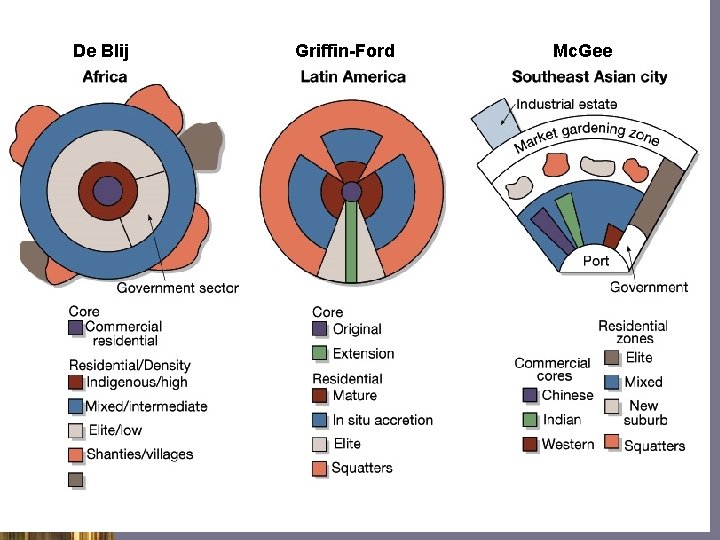
De Blij Griffin-Ford Mc. Gee
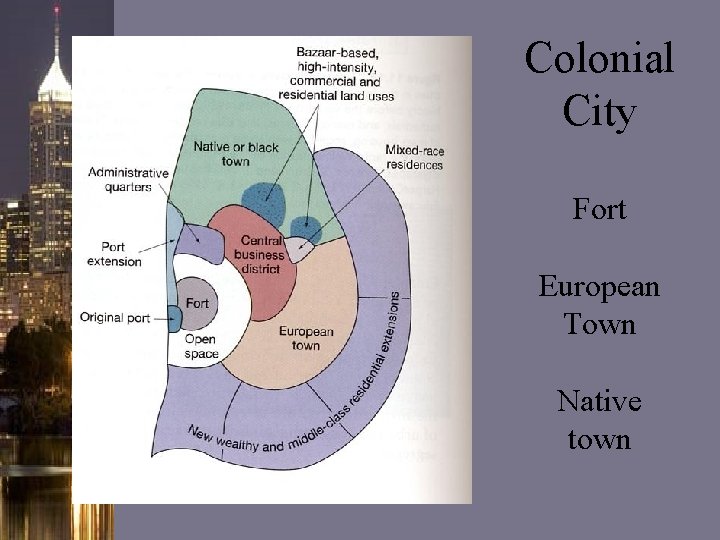
Colonial City Fort European Town Native town
• One major difference between land use in European and US cities is that 1. European cities usually have more dispersed populations that US cities 2. Europeans cities are less likely to have large urban parks than US cities 3. European cities are less likely to have ring roads than US cities 4. European suburbs are less likely to have high crime rates than US suburbs 5. Wealthy Europeans are more likely than wealthy Americans to live close to center city
• One major difference between land use in European and US cities is that 1. European cities usually have more dispersed populations that US cities 2. Europeans cities are less likely to have large urban parks than US cities 3. European cities are less likely to have ring roads than US cities 4. European suburbs are less likely to have high crime rates than US suburbs 5. Wealthy Europeans are more likely than wealthy Americans to live close to center city
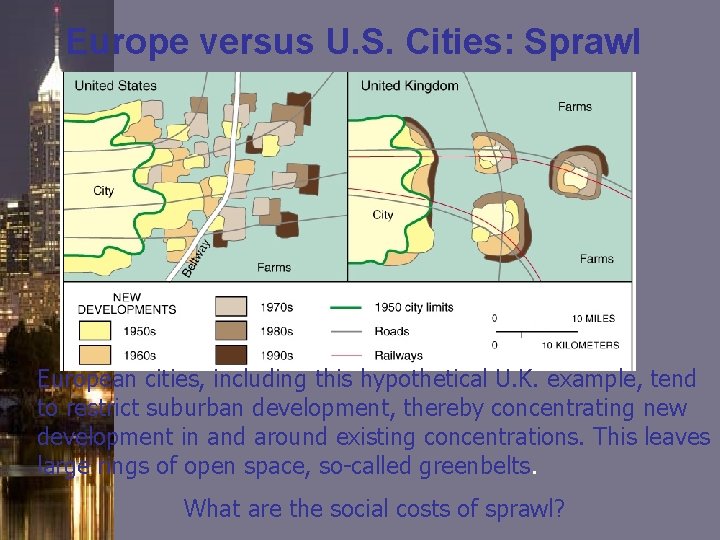
Europe versus U. S. Cities: Sprawl European cities, including this hypothetical U. K. example, tend to restrict suburban development, thereby concentrating new development in and around existing concentrations. This leaves large rings of open space, so-called greenbelts. What are the social costs of sprawl?
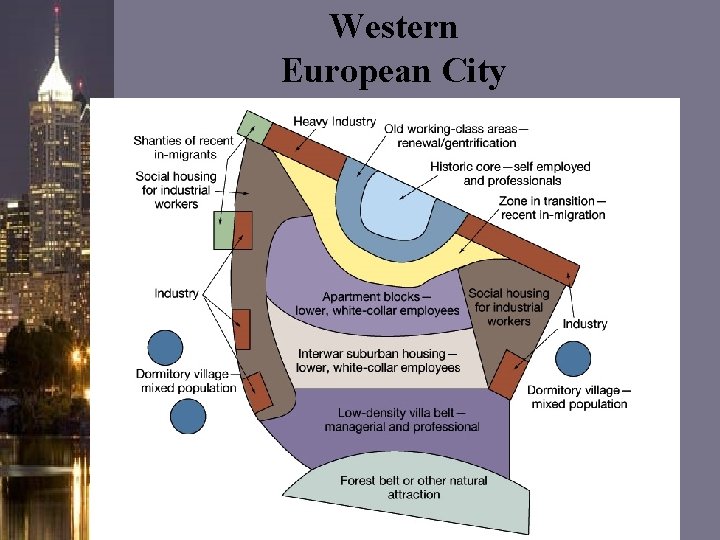
Western European City
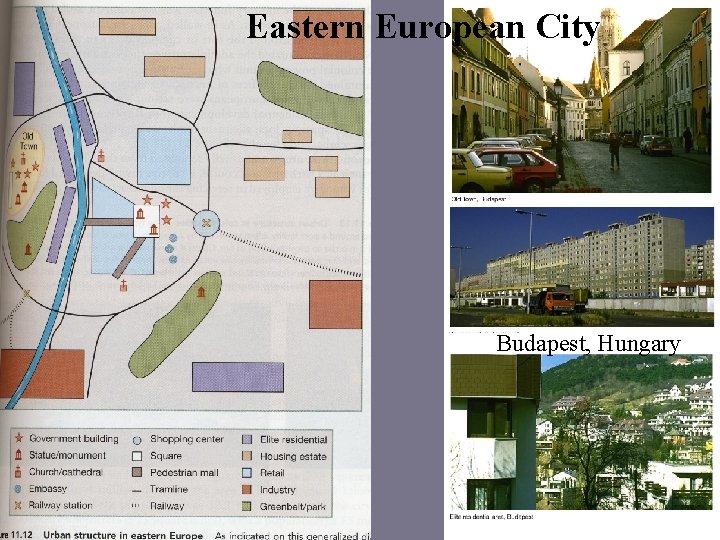
Eastern European City Budapest, Hungary
• The basic sector activities of a city’s economy include production of goods and services for a. b. c. d. e. Resident of the city itself Areas outside the city The poorest people in the city Basic needs, such as housing and food People and businesses in the CBD only
• The basic sector activities of a city’s economy include production of goods and services for a. b. c. d. e. Resident of the city itself Areas outside the city The poorest people in the city Basic needs, such as housing and food People and businesses in the CBD only
• What term did the United Nations first coin in the 1970 s for cities that had more than 10 million inhabitants? a. b. c. d. e. Megalopolis World Cities Megacities Urban Influence Zones Primate Cities
• What term did the United Nations first coin in the 1970 s for cities that had more than 10 million inhabitants? a. b. c. d. e. Megalopolis World Cities Megacities Urban Influence Zones Primate Cities
• • Megalopolis / Conurbation Urbanization, counterurbanization Reurbanization, gentrification Basic and nonbasic (service) sector of the economy
• • • Rank-size Rule Primate City World Cities Megacities Overurbanization Squatter settlements
• You can even bring in the DTM as a way to look at the historical development of urbanization and its effects on nations or the different population distributions in different neighborhoods within a city. – Sarah Bednarz
• Classify cities by predominant function – – – Fortress Entrepot, ports Resource sites Central places Industrial sites Political or cultural factors