
EARLY CHURCH FATHERS Identify early Church Fathers and
- Slides: 18
EARLY CHURCH FATHERS Identify early Church Fathers and other key figures from the first three centuries of the Church
EARLY CHURCH FATHERS • Objectives • Describe some of the early Church Fathers • Basic Questions • What are the qualities that make a Church Father?
CHURCH FATHERS • The Church Fathers wrote apologetic pieces in response to the heresies that arose during the first few centuries of the Church. • Must meet these 4 qualities: • Antiquity--Must have lived within the first centuries of the Christian era; Pope Saint Gregory the Great (died 604) is regarded as the last Father in the West; St. John of Damascus is the last to die (749) • Sanctity--Must have lived a saintly life • Orthodoxy--Writings must be free from heresy and excel in the explanation and defense of Catholic doctrine; some of these teachings might have changed over time, but their teachings were correct at their time • Church Approval--Writings must bear the seal of the Church • Most were bishops.
CHURCH FATHERS • During the Golden Age of Church Fathers, from 320 -461, a number of holy leaders arose who shared these characteristics: orthodoxy in doctrine, holiness, notoriety, and antiquity. • The Church Fathers are divided into Latin (West) and Greek (East), and the study of patristics examines their writings. • The title “Church Father” is not a formal title. In ancient times, teachers were commonly regarded as fathers. Due to the writings and teachings of these men, they were referred to as “the fathers” or “the Fathers of the Church” and the title stuck. • The title generally refers to all the great Catholic authors from about 100 AD to 800 AD which roughly covers the time period of the first seven ecumenical councils. • Most of them are saints, but some are not.
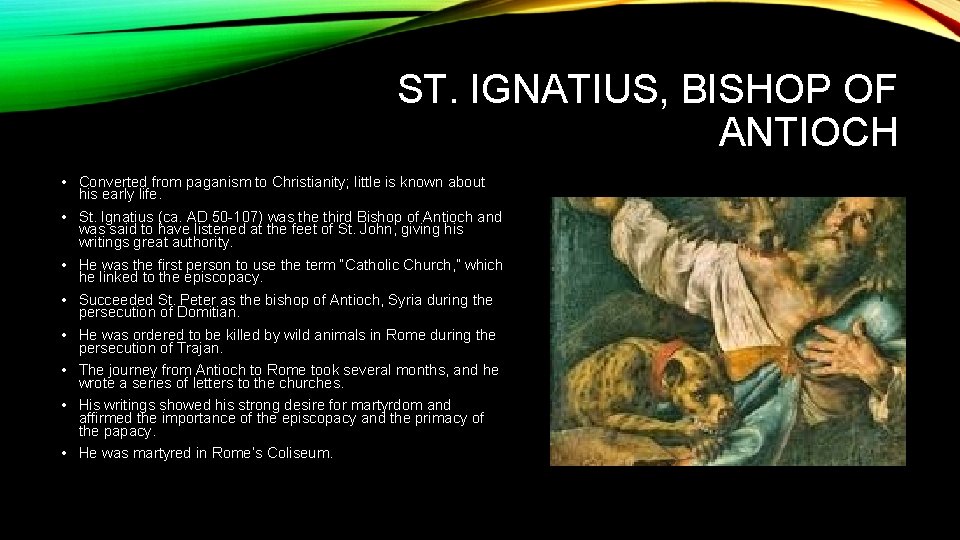
ST. IGNATIUS, BISHOP OF ANTIOCH • Converted from paganism to Christianity; little is known about his early life. • St. Ignatius (ca. AD 50 -107) was the third Bishop of Antioch and was said to have listened at the feet of St. John, giving his writings great authority. • He was the first person to use the term “Catholic Church, ” which he linked to the episcopacy. • Succeeded St. Peter as the bishop of Antioch, Syria during the persecution of Domitian. • He was ordered to be killed by wild animals in Rome during the persecution of Trajan. • The journey from Antioch to Rome took several months, and he wrote a series of letters to the churches. • His writings showed his strong desire for martyrdom and affirmed the importance of the episcopacy and the primacy of the papacy. • He was martyred in Rome’s Coliseum.
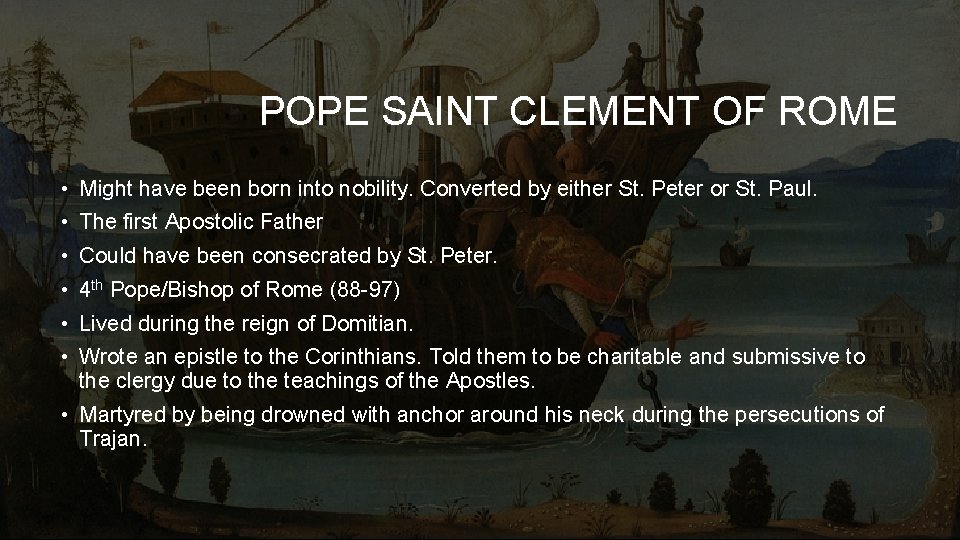
POPE SAINT CLEMENT OF ROME • Might have been born into nobility. Converted by either St. Peter or St. Paul. • The first Apostolic Father • Could have been consecrated by St. Peter. • 4 th Pope/Bishop of Rome (88 -97) • Lived during the reign of Domitian. • Wrote an epistle to the Corinthians. Told them to be charitable and submissive to the clergy due to the teachings of the Apostles. • Martyred by being drowned with anchor around his neck during the persecutions of Trajan.
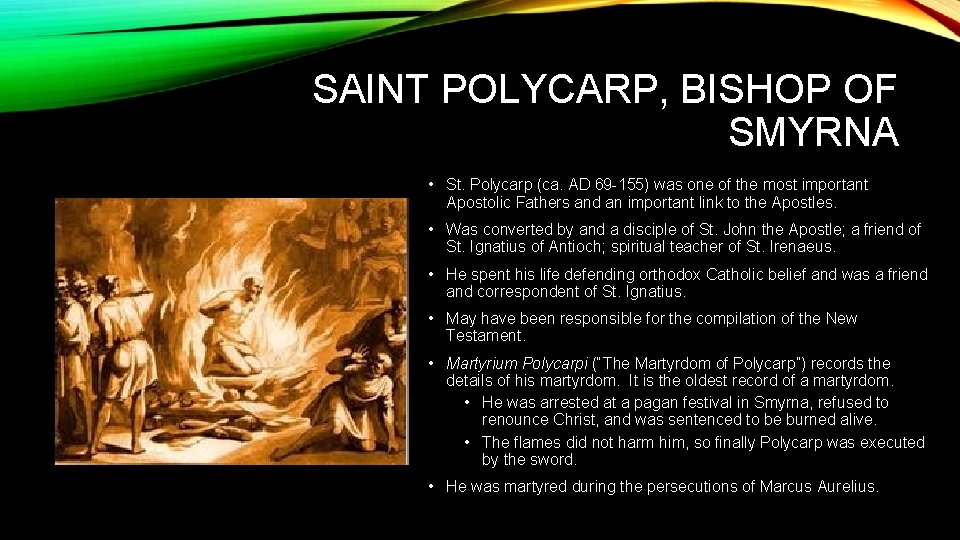
SAINT POLYCARP, BISHOP OF SMYRNA • St. Polycarp (ca. AD 69 -155) was one of the most important Apostolic Fathers and an important link to the Apostles. • Was converted by and a disciple of St. John the Apostle; a friend of St. Ignatius of Antioch; spiritual teacher of St. Irenaeus. • He spent his life defending orthodox Catholic belief and was a friend and correspondent of St. Ignatius. • May have been responsible for the compilation of the New Testament. • Martyrium Polycarpi (“The Martyrdom of Polycarp”) records the details of his martyrdom. It is the oldest record of a martyrdom. • He was arrested at a pagan festival in Smyrna, refused to renounce Christ, and was sentenced to be burned alive. • The flames did not harm him, so finally Polycarp was executed by the sword. • He was martyred during the persecutions of Marcus Aurelius.
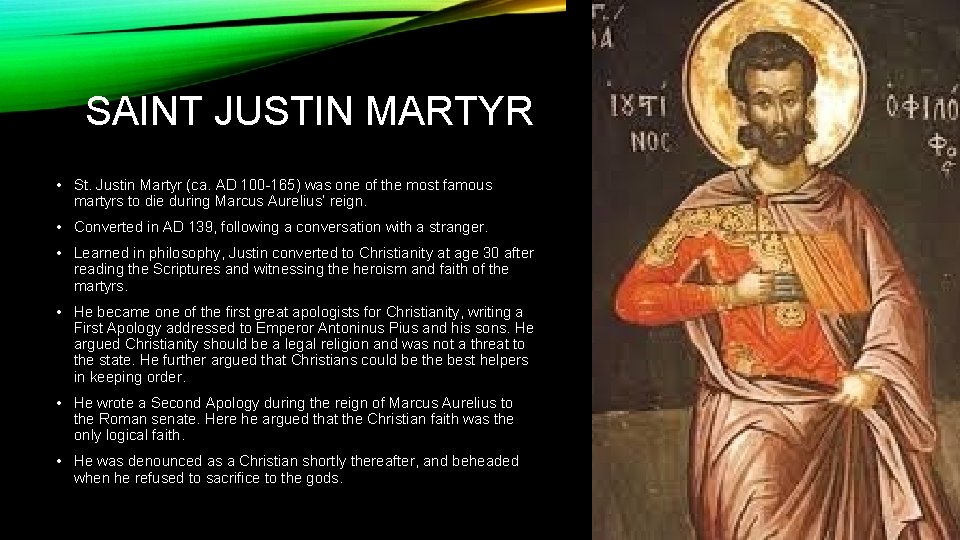
SAINT JUSTIN MARTYR • St. Justin Martyr (ca. AD 100 -165) was one of the most famous martyrs to die during Marcus Aurelius’ reign. • Converted in AD 139, following a conversation with a stranger. • Learned in philosophy, Justin converted to Christianity at age 30 after reading the Scriptures and witnessing the heroism and faith of the martyrs. • He became one of the first great apologists for Christianity, writing a First Apology addressed to Emperor Antoninus Pius and his sons. He argued Christianity should be a legal religion and was not a threat to the state. He further argued that Christians could be the best helpers in keeping order. • He wrote a Second Apology during the reign of Marcus Aurelius to the Roman senate. Here he argued that the Christian faith was the only logical faith. • He was denounced as a Christian shortly thereafter, and beheaded when he refused to sacrifice to the gods.
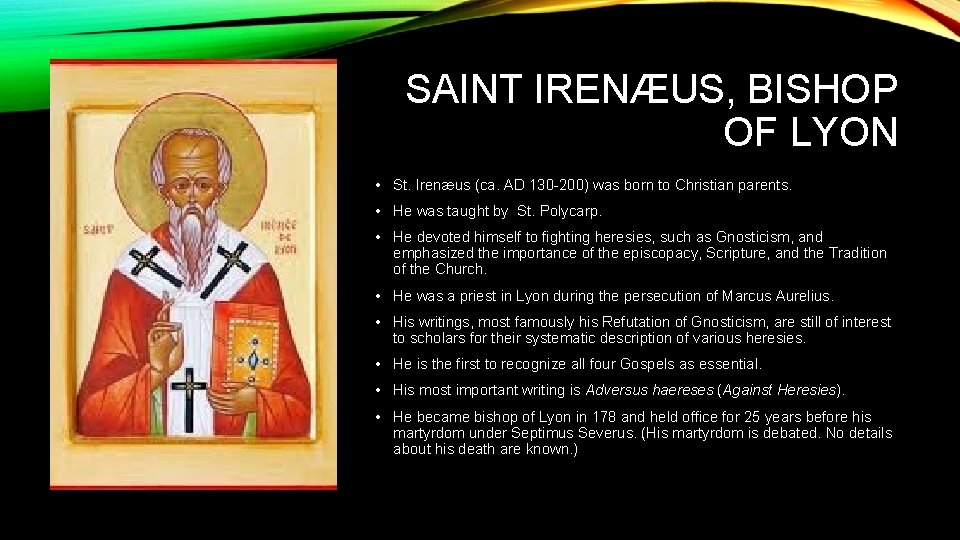
SAINT IRENÆUS, BISHOP OF LYON • St. Irenæus (ca. AD 130 -200) was born to Christian parents. • He was taught by St. Polycarp. • He devoted himself to fighting heresies, such as Gnosticism, and emphasized the importance of the episcopacy, Scripture, and the Tradition of the Church. • He was a priest in Lyon during the persecution of Marcus Aurelius. • His writings, most famously his Refutation of Gnosticism, are still of interest to scholars for their systematic description of various heresies. • He is the first to recognize all four Gospels as essential. • His most important writing is Adversus haereses (Against Heresies). • He became bishop of Lyon in 178 and held office for 25 years before his martyrdom under Septimus Severus. (His martyrdom is debated. No details about his death are known. )
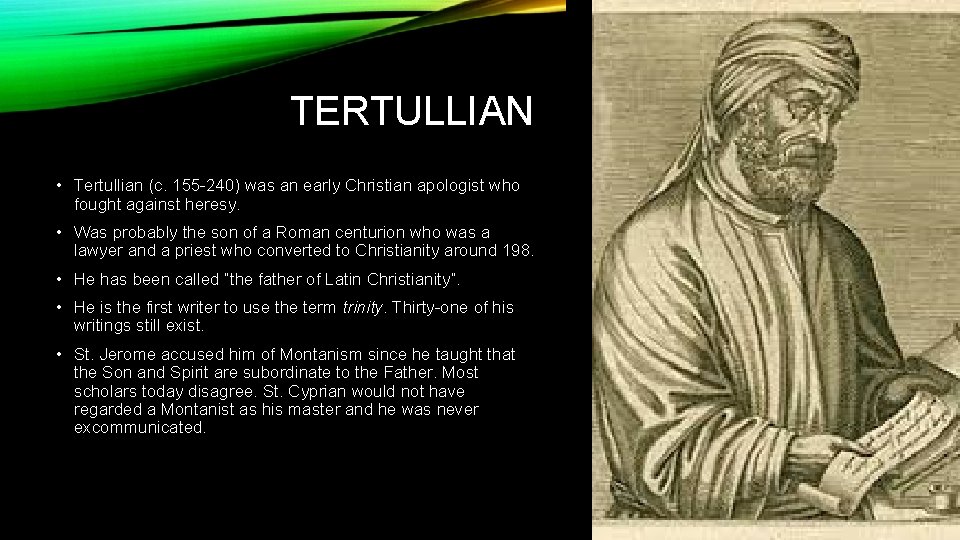
TERTULLIAN • Tertullian (c. 155 -240) was an early Christian apologist who fought against heresy. • Was probably the son of a Roman centurion who was a lawyer and a priest who converted to Christianity around 198. • He has been called “the father of Latin Christianity”. • He is the first writer to use the term trinity. Thirty-one of his writings still exist. • St. Jerome accused him of Montanism since he taught that the Son and Spirit are subordinate to the Father. Most scholars today disagree. St. Cyprian would not have regarded a Montanist as his master and he was never excommunicated.
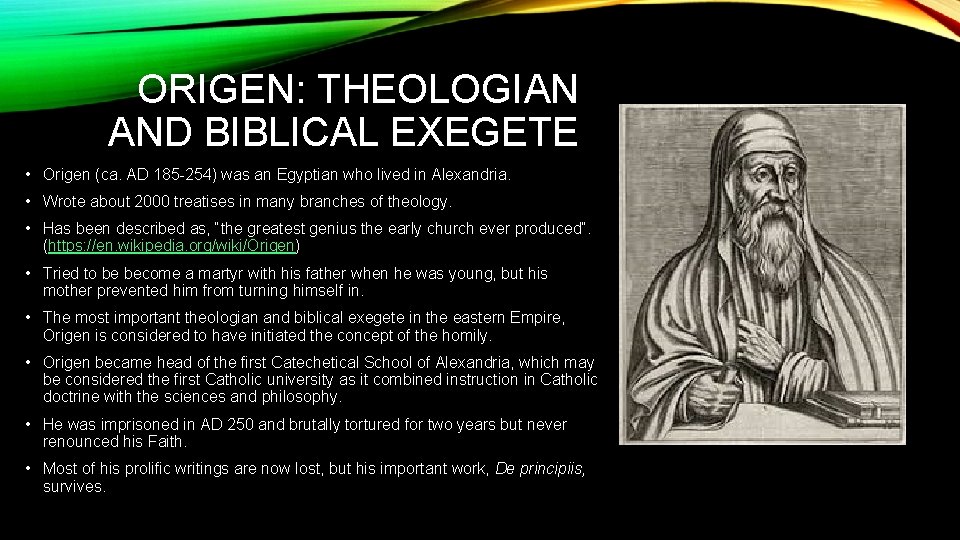
ORIGEN: THEOLOGIAN AND BIBLICAL EXEGETE • Origen (ca. AD 185 -254) was an Egyptian who lived in Alexandria. • Wrote about 2000 treatises in many branches of theology. • Has been described as, “the greatest genius the early church ever produced”. (https: //en. wikipedia. org/wiki/Origen) • Tried to be become a martyr with his father when he was young, but his mother prevented him from turning himself in. • The most important theologian and biblical exegete in the eastern Empire, Origen is considered to have initiated the concept of the homily. • Origen became head of the first Catechetical School of Alexandria, which may be considered the first Catholic university as it combined instruction in Catholic doctrine with the sciences and philosophy. • He was imprisoned in AD 250 and brutally tortured for two years but never renounced his Faith. • Most of his prolific writings are now lost, but his important work, De principiis, survives.
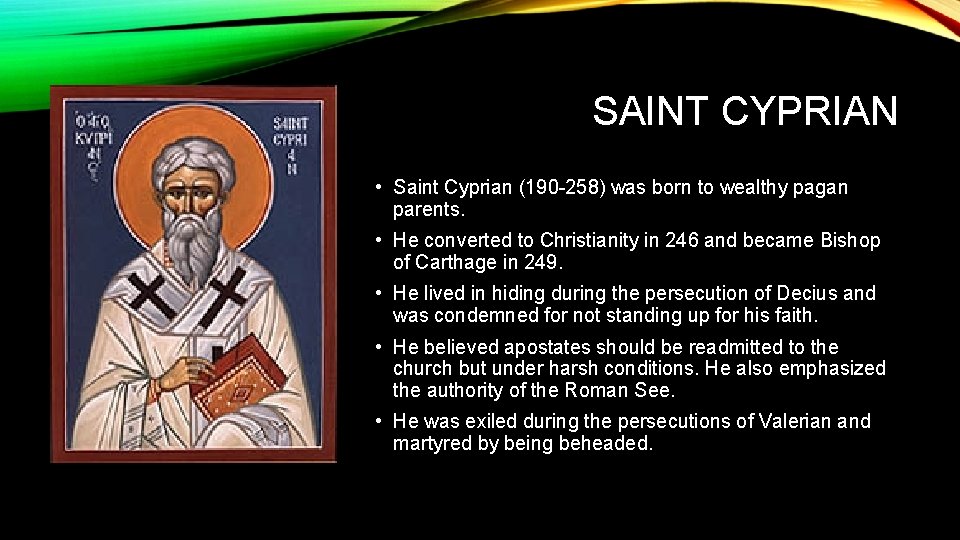
SAINT CYPRIAN • Saint Cyprian (190 -258) was born to wealthy pagan parents. • He converted to Christianity in 246 and became Bishop of Carthage in 249. • He lived in hiding during the persecution of Decius and was condemned for not standing up for his faith. • He believed apostates should be readmitted to the church but under harsh conditions. He also emphasized the authority of the Roman See. • He was exiled during the persecutions of Valerian and martyred by being beheaded.
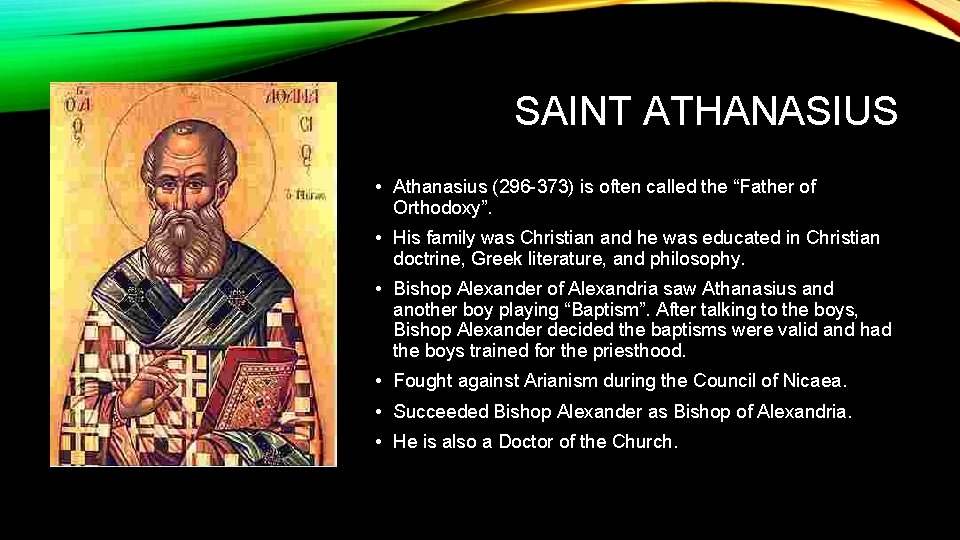
SAINT ATHANASIUS • Athanasius (296 -373) is often called the “Father of Orthodoxy”. • His family was Christian and he was educated in Christian doctrine, Greek literature, and philosophy. • Bishop Alexander of Alexandria saw Athanasius and another boy playing “Baptism”. After talking to the boys, Bishop Alexander decided the baptisms were valid and had the boys trained for the priesthood. • Fought against Arianism during the Council of Nicaea. • Succeeded Bishop Alexander as Bishop of Alexandria. • He is also a Doctor of the Church.
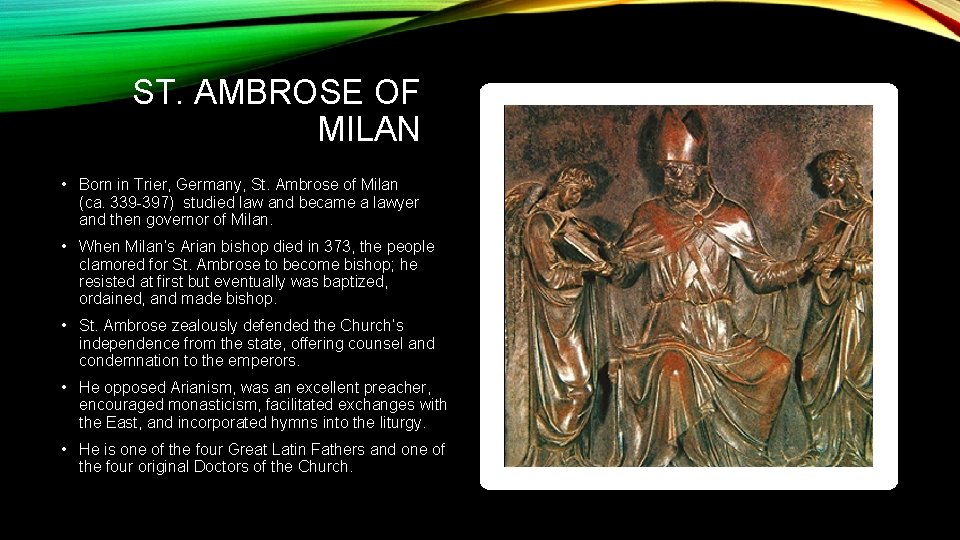
ST. AMBROSE OF MILAN • Born in Trier, Germany, St. Ambrose of Milan (ca. 339 -397) studied law and became a lawyer and then governor of Milan. • When Milan’s Arian bishop died in 373, the people clamored for St. Ambrose to become bishop; he resisted at first but eventually was baptized, ordained, and made bishop. • St. Ambrose zealously defended the Church’s independence from the state, offering counsel and condemnation to the emperors. • He opposed Arianism, was an excellent preacher, encouraged monasticism, facilitated exchanges with the East, and incorporated hymns into the liturgy. • He is one of the four Great Latin Fathers and one of the four original Doctors of the Church.
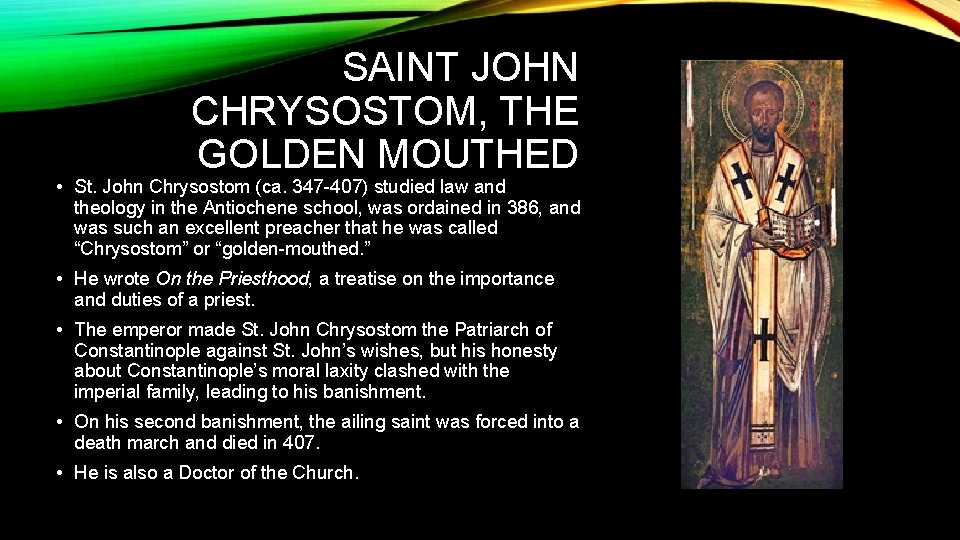
SAINT JOHN CHRYSOSTOM, THE GOLDEN MOUTHED • St. John Chrysostom (ca. 347 -407) studied law and theology in the Antiochene school, was ordained in 386, and was such an excellent preacher that he was called “Chrysostom” or “golden-mouthed. ” • He wrote On the Priesthood, a treatise on the importance and duties of a priest. • The emperor made St. John Chrysostom the Patriarch of Constantinople against St. John’s wishes, but his honesty about Constantinople’s moral laxity clashed with the imperial family, leading to his banishment. • On his second banishment, the ailing saint was forced into a death march and died in 407. • He is also a Doctor of the Church.
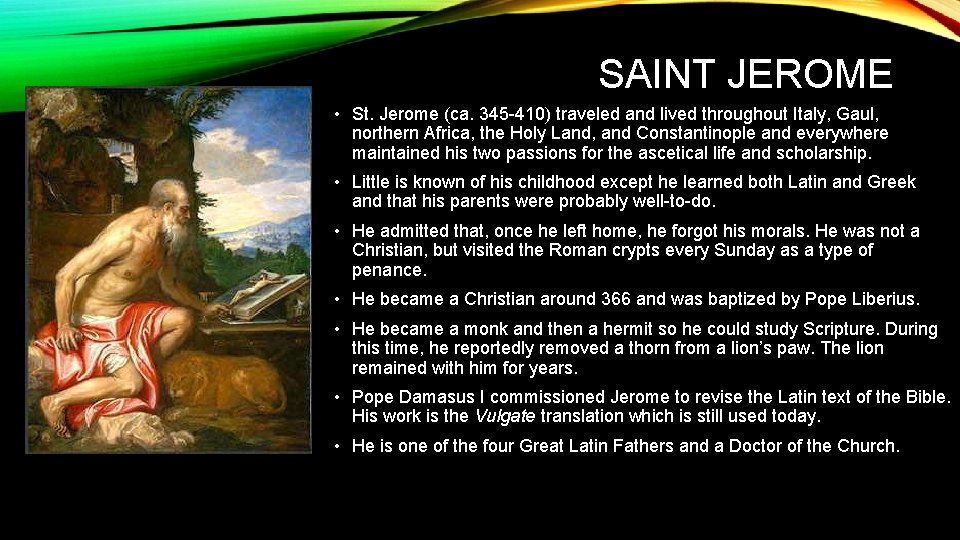
SAINT JEROME • St. Jerome (ca. 345 -410) traveled and lived throughout Italy, Gaul, northern Africa, the Holy Land, and Constantinople and everywhere maintained his two passions for the ascetical life and scholarship. • Little is known of his childhood except he learned both Latin and Greek and that his parents were probably well-to-do. • He admitted that, once he left home, he forgot his morals. He was not a Christian, but visited the Roman crypts every Sunday as a type of penance. • He became a Christian around 366 and was baptized by Pope Liberius. • He became a monk and then a hermit so he could study Scripture. During this time, he reportedly removed a thorn from a lion’s paw. The lion remained with him for years. • Pope Damasus I commissioned Jerome to revise the Latin text of the Bible. His work is the Vulgate translation which is still used today. • He is one of the four Great Latin Fathers and a Doctor of the Church.
EARLY CHURCH FATHERS • Objectives Describe some of the early Church Fathers • Basic Questions What are the qualities that make a Church Father? • Key Ideas • The Church Fathers wrote apologetic pieces in response to the heresies that arose during the first few centuries of the Church. • Must meet these 4 qualities: • • Antiquity Sanctity Orthodoxy Church Approval • Most were bishops.
IN CONCLUSION • Kahoot • Complete the questions posted on “Early Church Fathers”. • You will have a QUIZ on Wednesday, November 28 on “Early Church Fathers”. • You will have a TEST on Friday, November 30 on “Persecutions and the Five Good Emperors”, “Later Persecutions” and “Early Church Fathers”.