
EARLY CHRISTIAN ART History of Western Art BFAII
EARLY CHRISTIAN ART History of Western Art BFA-II (Visual Arts) Course Incharge: Ms. Farah Khan Institute of Design & Visual Arts (LCWU)
EARLY CHRISTIAN ART • Early Christian art is also called Paleo-Christian art or primitive Christian art. • The Early Christian period of art corresponds roughly with the Late Empire phase of the Roman Empire (ca. 200 -500). Very little is known about the art of the first Christians. When art historians speaks of the early Christian art, they are referring to the earliest preserved artworks with Christian subjects, not the art of Christians at the time of Christ. • During the Early Christian period, Roman art forms were coupled for Christian purposes. Early Christian visual art embodies a transition away from realism to stylization, given the focus of Christian artists on conveying spiritual ideas (namely biblical figures and events) rather than physical accuracy. • Early Christian art thus served as the transitional phase from Roman art to medieval art, the latter of which is highly stylized. • The beginnings of an identifiable Christian art can be traced to the end of the second century and the beginning of the third century. This term covers all figurative expressions related to new religion, spread in the 1 st century Palestine in the entire Roman Empire. For almost two centuries the faithful Christians have acknowledged a religion that was not recognized by the Central Government, Indeed many emperors met and deeply opposed the new cult, for this the faithful would gather in private homes (Domus ecclesiae) or in underground cemeteries (burial ground), the catacombs.
EARLY CHRISTIAN ART • The earliest evidence of painting or sculpture does not have characters that differ with respect to Roman art. The first Christian faithful Roman citizens were converted to the new faith, sharing culture, language and traditions with the Romans by pagan faith. • The early Christian art is no longer apt to celebrate the power or to decorate private and public buildings but to show the basic contents of the new faith. • The early Christian art fades at the beginning of the sixth century, after the fall of the Western Roman Empire. • Christianity introduced the burial of the deceased, for this reason the cemeteries require very large spaces and was also necessary to dig underground cemeteries outside the city, the catacombs. • The word catacomb, of Greek origin in the specific character of cave or cavity of these places. The latter are structured on several levels and are connected by a network of tunnels, calls ambulatory, in whose walls are dug the graves, the Loculi, the cubicles that housed the tombs of wealthy families or Crypts, where were buried martyrs or bishops.
MAIN FEATURES OF EARLY CHRISTIAN ART • The catacombs were very important because they were allowed to keep the first testimonies of Christian art, very often contained symbolic images or writings relating to the deceased. The painting technique that we can observe is extremely rapid and immediate, with colorful strokes and a purely spiritual reserved message. • The General characteristics of early Christian art revolves around two symbologies: 1) Abstract symbols • Abstract symbols feature shapes and symbols that distance from the natural world, as the cross and crucifix, the Greek letters alpha and omega, Ichthys, Chi Rho etc. 2 2 Figurative symbols. • Figurative symbols are recognizable signs and figures or reference characters and events in the Bible such as the Good Shepherd, Dove, Peacock, Pelican etc. • We do not find in this early period images of the Nativity (birth), Crucifixion (execution), or Resurrection (rebirth) of Christ.
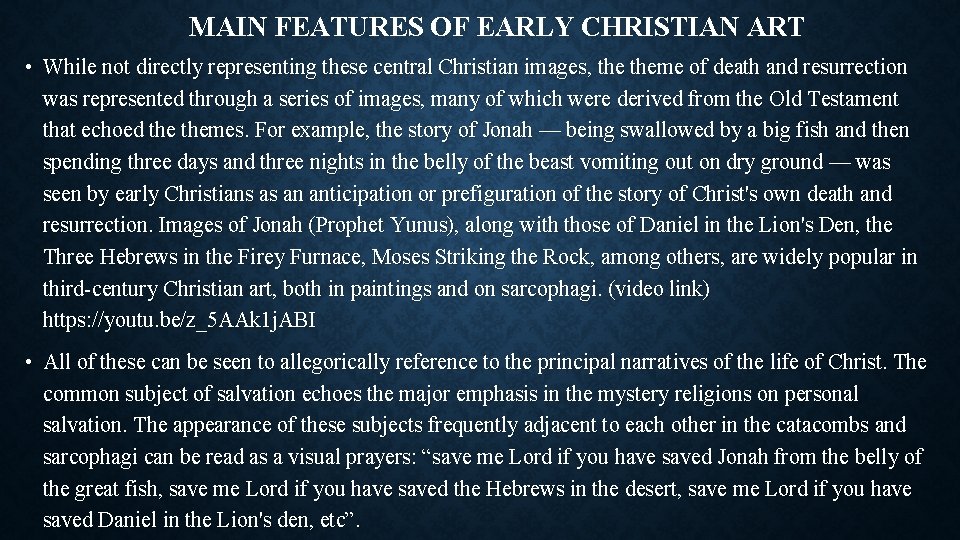
MAIN FEATURES OF EARLY CHRISTIAN ART • While not directly representing these central Christian images, theme of death and resurrection was represented through a series of images, many of which were derived from the Old Testament that echoed themes. For example, the story of Jonah — being swallowed by a big fish and then spending three days and three nights in the belly of the beast vomiting out on dry ground — was seen by early Christians as an anticipation or prefiguration of the story of Christ's own death and resurrection. Images of Jonah (Prophet Yunus), along with those of Daniel in the Lion's Den, the Three Hebrews in the Firey Furnace, Moses Striking the Rock, among others, are widely popular in third-century Christian art, both in paintings and on sarcophagi. (video link) https: //youtu. be/z_5 AAk 1 j. ABI • All of these can be seen to allegorically reference to the principal narratives of the life of Christ. The common subject of salvation echoes the major emphasis in the mystery religions on personal salvation. The appearance of these subjects frequently adjacent to each other in the catacombs and sarcophagi can be read as a visual prayers: “save me Lord if you have saved Jonah from the belly of the great fish, save me Lord if you have saved the Hebrews in the desert, save me Lord if you have saved Daniel in the Lion's den, etc”.
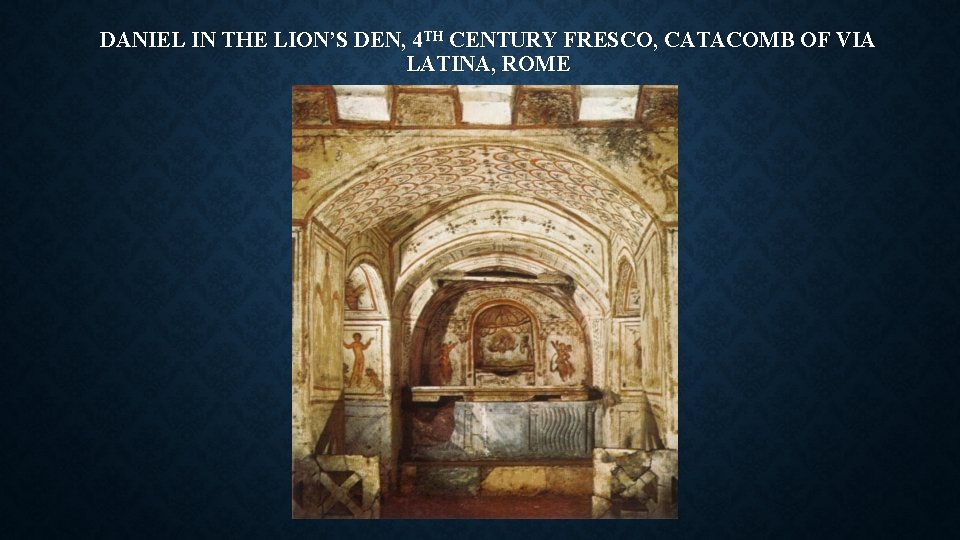
DANIEL IN THE LION’S DEN, 4 TH CENTURY FRESCO, CATACOMB OF VIA LATINA, ROME
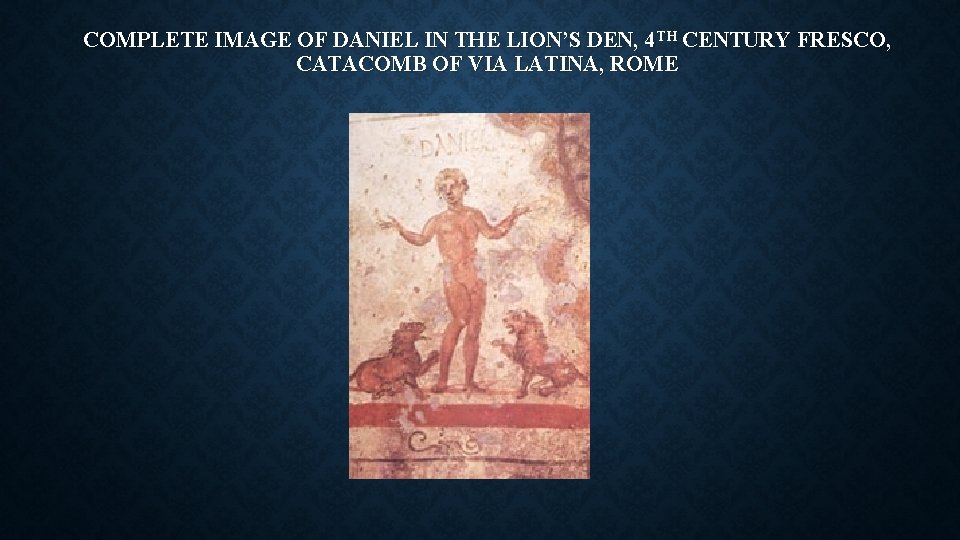
COMPLETE IMAGE OF DANIEL IN THE LION’S DEN, 4 TH CENTURY FRESCO, CATACOMB OF VIA LATINA, ROME
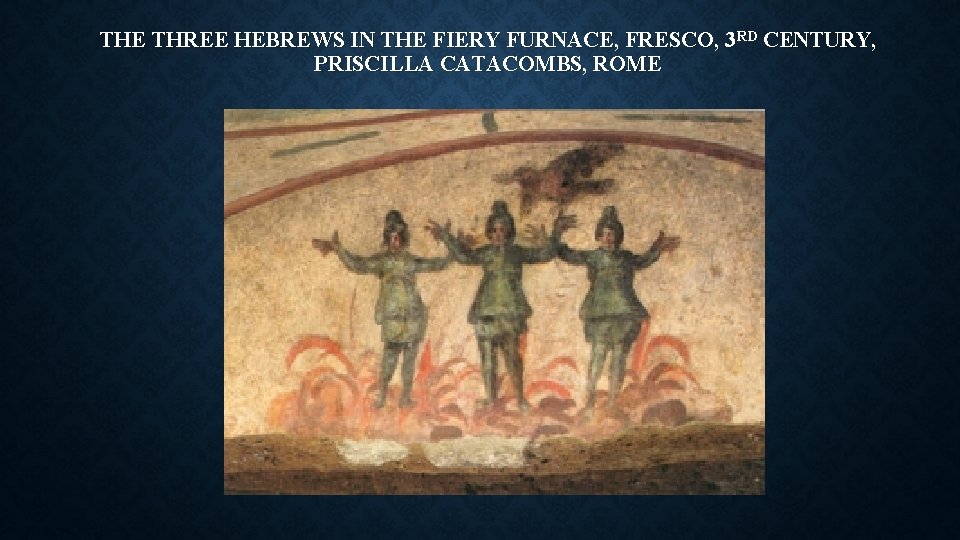
THE THREE HEBREWS IN THE FIERY FURNACE, FRESCO, 3 RD CENTURY, PRISCILLA CATACOMBS, ROME
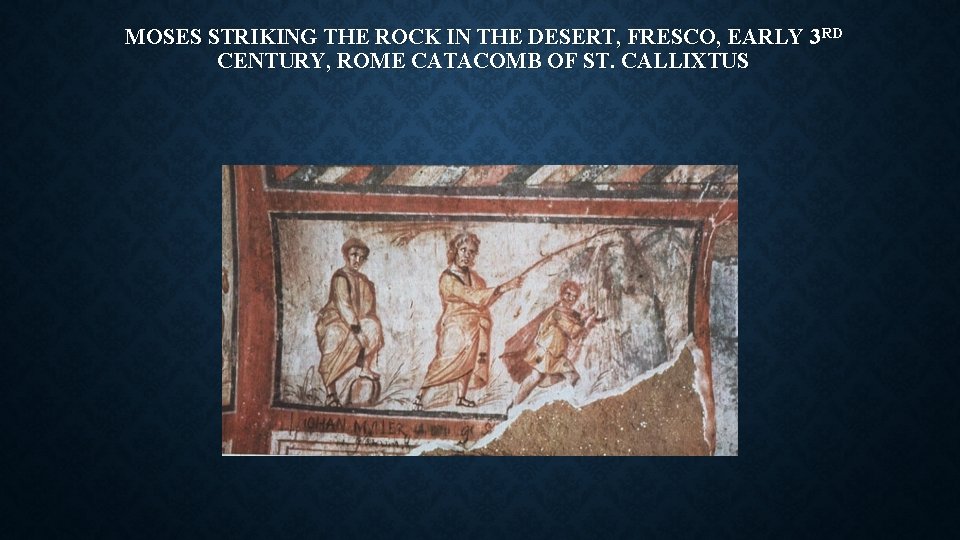
MOSES STRIKING THE ROCK IN THE DESERT, FRESCO, EARLY 3 RD CENTURY, ROME CATACOMB OF ST. CALLIXTUS
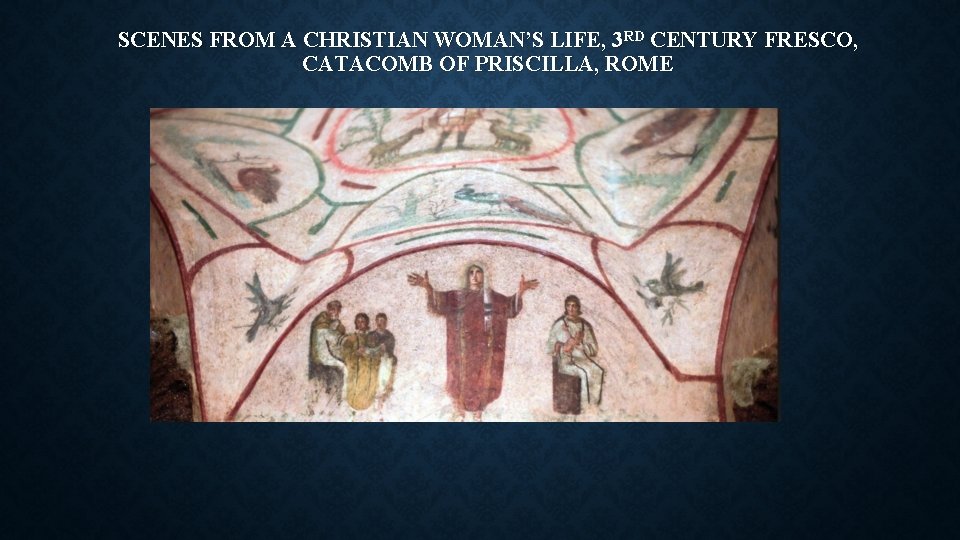
SCENES FROM A CHRISTIAN WOMAN’S LIFE, 3 RD CENTURY FRESCO, CATACOMB OF PRISCILLA, ROME
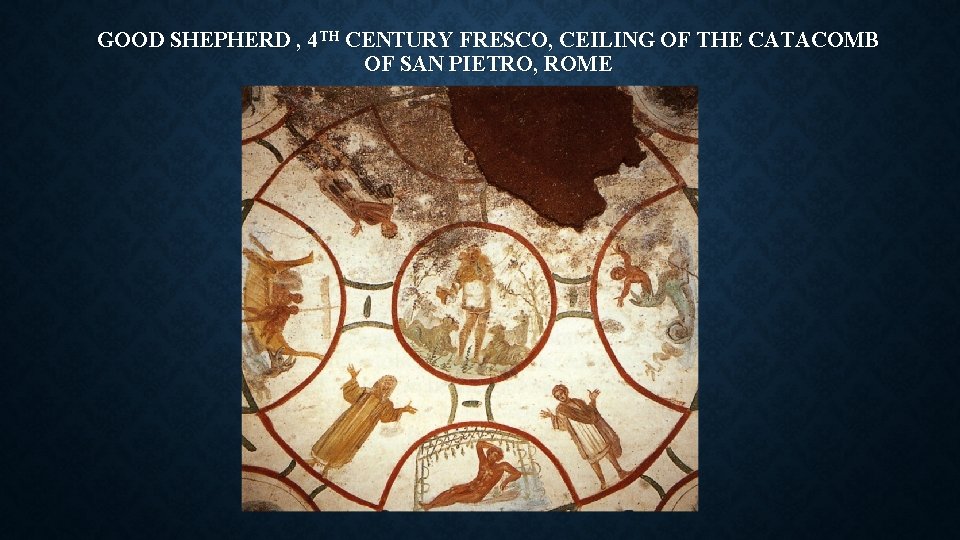
GOOD SHEPHERD , 4 TH CENTURY FRESCO, CEILING OF THE CATACOMB OF SAN PIETRO, ROME
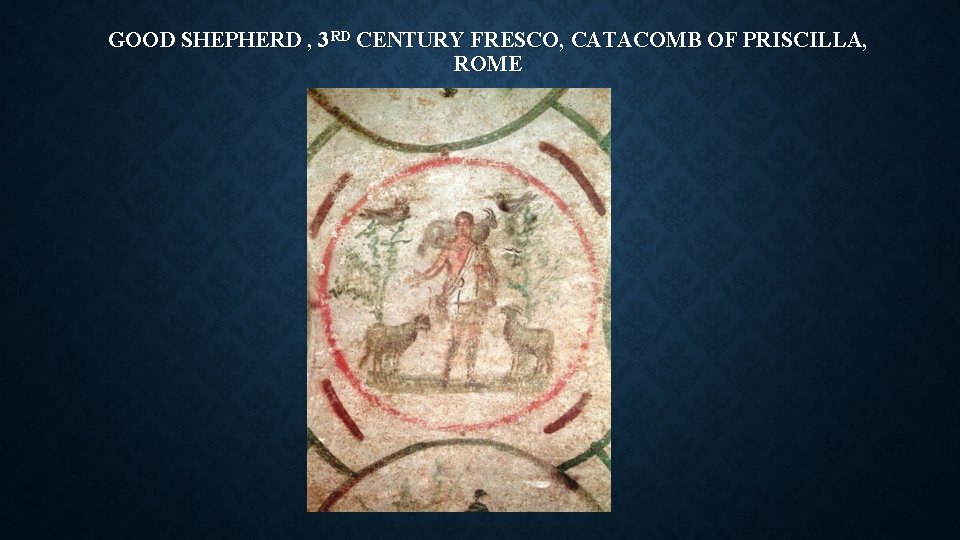
GOOD SHEPHERD , 3 RD CENTURY FRESCO, CATACOMB OF PRISCILLA, ROME
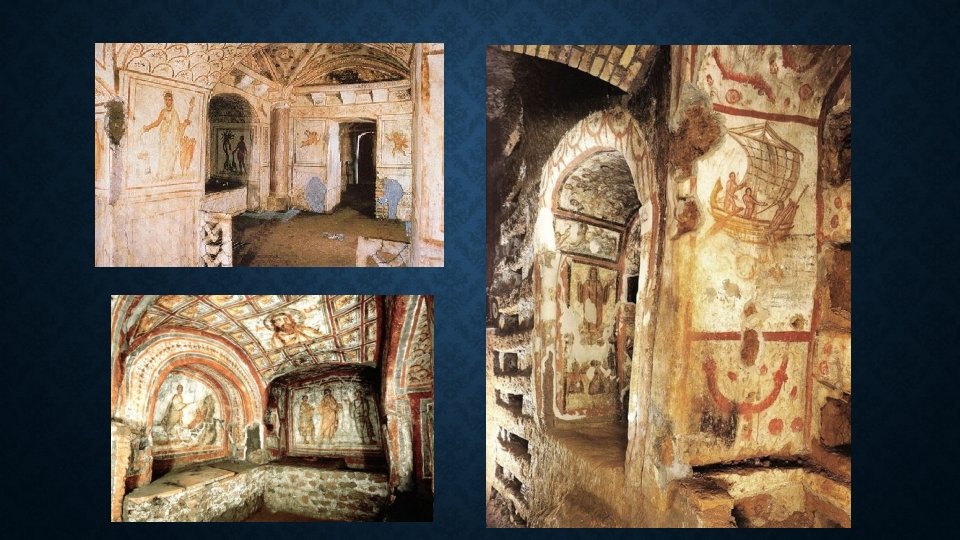
MAIN FEATURES OF EARLY CHRISTIAN ART • The nature of Jesus could all be summed up with a simple fish, allowing Christians to identify their secret places of worship as well as the burial places of the faithful. • Christians were not fans of cremation. Christians believed in a bodily resurrection. • It is in the catacombs that we begin to see the first traces of Christian art. • Early Christians decorated their catacombs with frescoes, or paintings on fresh plaster. These frescoes are very simple and allegorical; not refined at all. • After the Emperor Constantine fully legalized Christianity with the 313 Edict of Milan, Christians began moving their burials above ground, with grand sarcophagi, or stone caskets. These sarcophagi provide us with our first examples of Christian sculpture. • The early Christians saw pagan sculptures of gods as what they were - graven images, which are strictly prohibited by the Bible as idolatry. For this reason, sculpture took a back seat during the early Christian years.
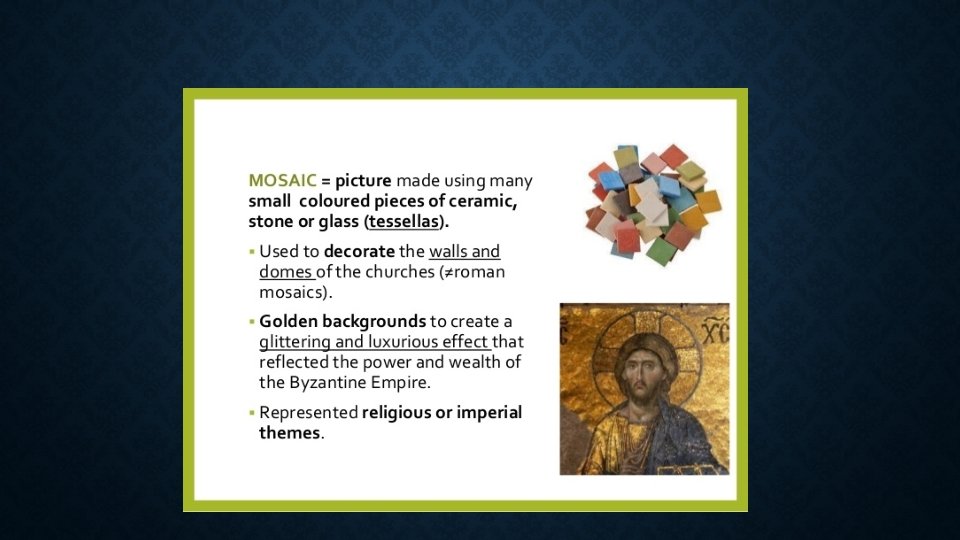
MAIN FEATURES OF EARLY CHRISTIAN ART • Early Christian sculpture avoided the life-sized scale of their pagan predecessors, and almost completely avoided full statues or sculpture in the round. Instead, Christians used shallow relief sculpture and depicted biblical scenes and Christian allegory. • Early Christians took the art form of mosaic from the floor and spread it onto the ceilings, the walls, everywhere. • Early Christians created mosaics of biblical narratives and with symbolism. Instead of natural stone, they used colored glass, allowing them to create vibrant colors. This glass also gives the mosaic a sort of glittery, semi-translucent quality that you really must see in person to appreciate. The figures seem to shimmer as you move about. • Symbolic meaning of a leaf: Leaf while green leaves depict hope, renewal, and revival, dead leaves represent decay and sadness. In general, leaves are symbolic of fertility and growth, and in the Chinese tradition the leaves of the Cosmic Tree represent all the beings in the universe. https: //youtu. be/Fx 4 l 41 R 5 nx. Y

BYZANTINE ART

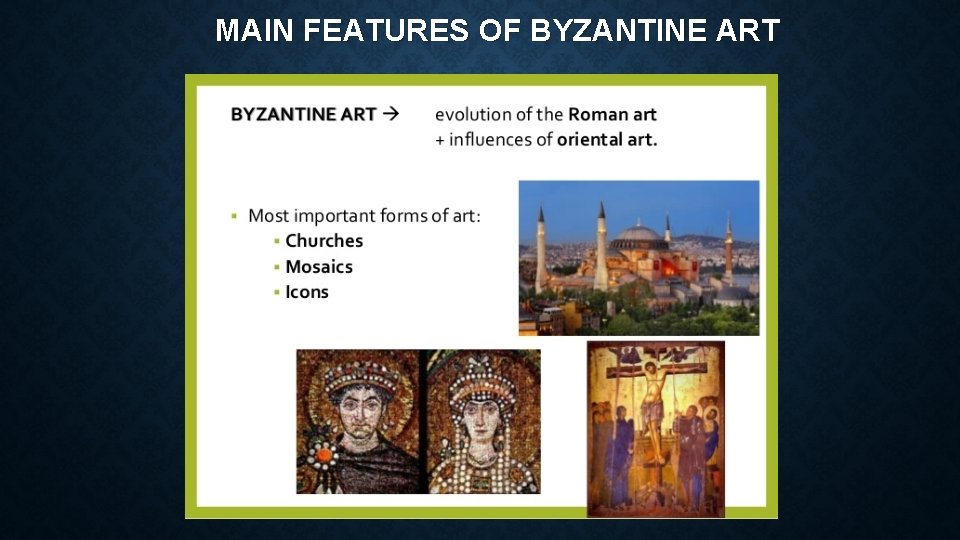
THE DIVISION OF EASTERN AND WESTERN ROMAN EMPIRE • By 285 CE the Roman Empire had grown so vast that it was no longer feasible to govern all the provinces from the central seat of Rome. The Emperor Diocletian divided the empire into two halves with the Eastern Empire governed out of Byzantium (later Constantinople) and the Western Empire governed from Rome. Both sections were known equally as ‘The Roman Empire’ The Western Roman Empire was known as The Holy Roman Empire. • The Byzantine Empire was the eastern continuation of the Roman Empire after the Western Roman Empire’s fall in the fifth century CE. It lasted from the fall of the Roman Empire until the Ottoman conquest in 1453. The capital was well-positioned near active trade routes connecting east and west. Constantinople was named after Emperor Constantine I, the first Byzantine emperor. • The Byzantine Empire initially maintained many Roman systems of governance and law and aspects of Roman culture. although, in time, the Eastern Empire adopted Greek instead of Latin and lost much of the character of the traditional Roman Empire. • Major Changes: The Byzantine Empire shifted its capital from Rome to Constantinople, changed the official religion to Christianity, and changed the official language from Latin to Greek.
MAIN FEATURES OF BYZANTINE ART
BEGINNING OF CHRISTIAN CHURCHES • Christianity was made an official state religion in 380, and its emergence into the open and subsequent rise in popularity necessitated buildings for meeting and worship. As pagan temples were abandoned, they were not suitable for repurposing as churches. Constantine looked to the style of the basilica as an option. Pagan temples had been windowless because most of the worship took place outside, but Christianity saw a rise in the use of windows for both practical purposes and to inspire awe. • The Basilica: In creating these churches, Constantine and his architects confronted a major challenge: what should be the physical form of the church? • Since Christianity was a mystery religion that demanded initiation to participate in religious practices, Christian architecture put greater emphasis on the interior. The Christian churches needed large interior spaces to house the growing worshippers and to mark the clear separation of the faithful from the unfaithful. At the same time, the new Christian churches needed to be visually meaningful. The buildings needed to convey the new authority of Christianity. These factors were instrumental in the formulation during the Constantinian period of an architectural form that would become the core of Christian architecture to our own time: the Christian Basilica.
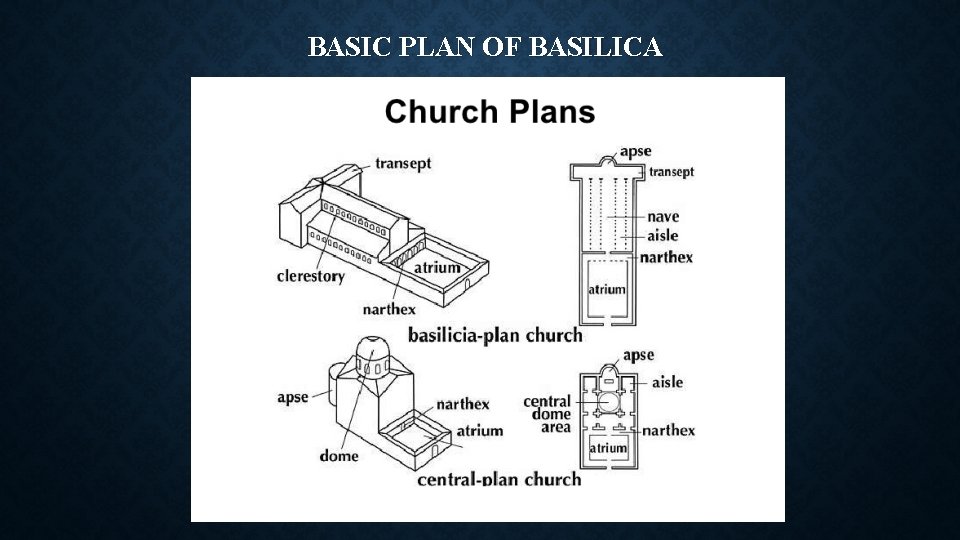
BASIC PLAN OF BASILICA
CHRISTIAN CHURCHES (BASILICAS) • After the legalization of Christianity, the need for religious art increased rapidly. New churches were built on the design of Roman architecture as center’s of worship, using the architectural design of the basic Roman Basilica (used for civic administration and justice). A typical basilica church had a central nave with one or more aisles on either side and a semicircular/polygonal apse at one end, covered by a semi-dome or sectional vault; the apse contained a raised platform, upon which sat the bishop, his priests, and also the altar. • Most of the interior decoration of these new religious buildings was done with mosaics. The sculptural decoration of sarcophagi became more intricate, often illustrating numerous scenes from the bible. • Realistic perspective, proportions, color and light were downgraded in favor of standardized conventions and symbols, when portraying Biblical figures and events. • One of the first and the most important churches of the early Christian period was Old St. Peter’s Cathedral.
CHRISTIAN CHURCHES (BASILICAS) • Justinian becomes emperor of Byzantium in 527. Justinian launches a program to beautify the capital, Constantinople. Constructs new buildings; builds magnificent church, Hagia Sophia. Byzantines preserve Greco-Roman culture and learning. Wanted to restore Roman glory. City becomes trading hub with major marketplace. Years of Turmoil: Justinian dies in 565; the empire faces many crises after his death. Attacks from East and West. Byzantium faces attacks from many different groups. Empire survives through bribery, diplomacy, and military power. Constantinople falls in 1453; brings an end to the Byzantine Empire. • In 730, the Byzantine Emperor (Leo III) banned the use of icons (religious images) because he viewed it as idol worship. This caused a rebellion amongst the people. • Christianity officially split into two separate religions in 1054: Roman Catholic Church in the West (Pope); Eastern Orthodox Church in the East (Patriarch)
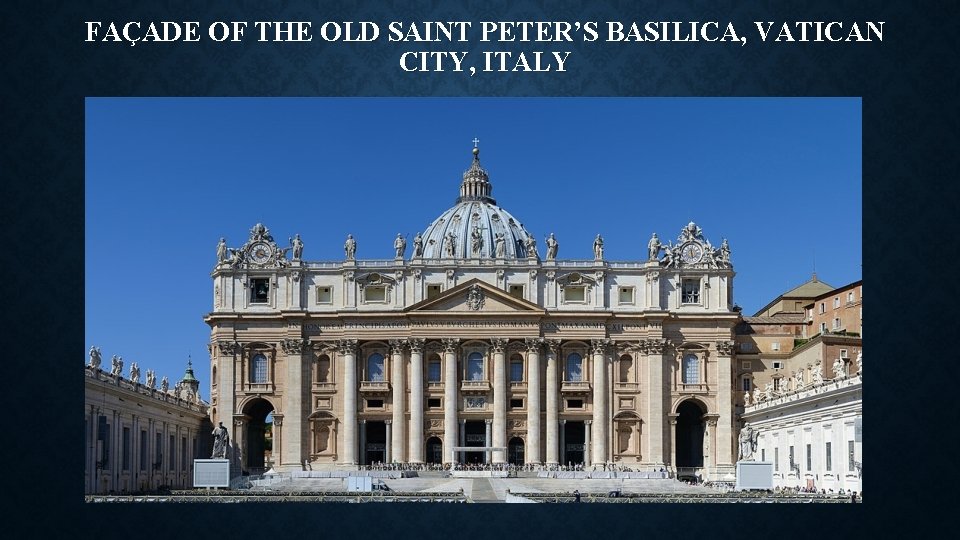
FAÇADE OF THE OLD SAINT PETER’S BASILICA, VATICAN CITY, ITALY
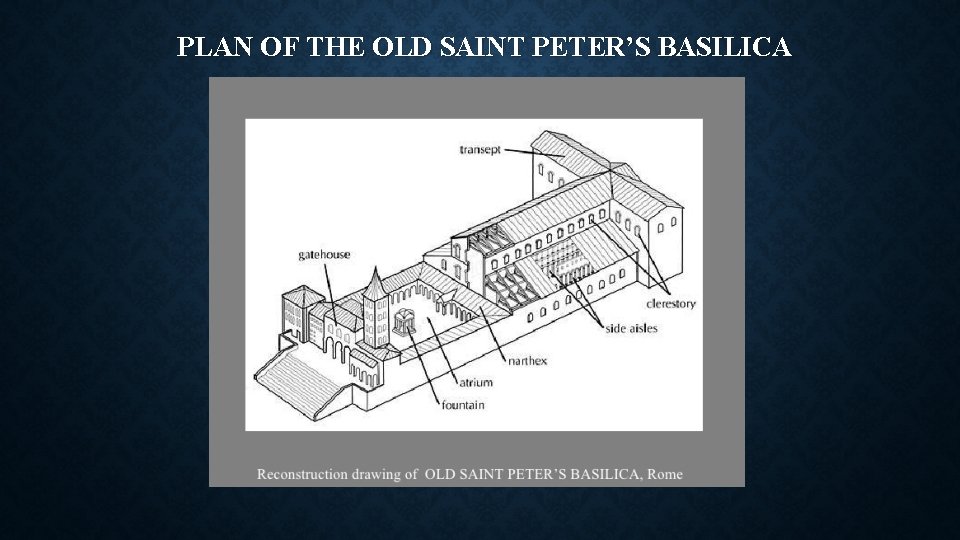
PLAN OF THE OLD SAINT PETER’S BASILICA
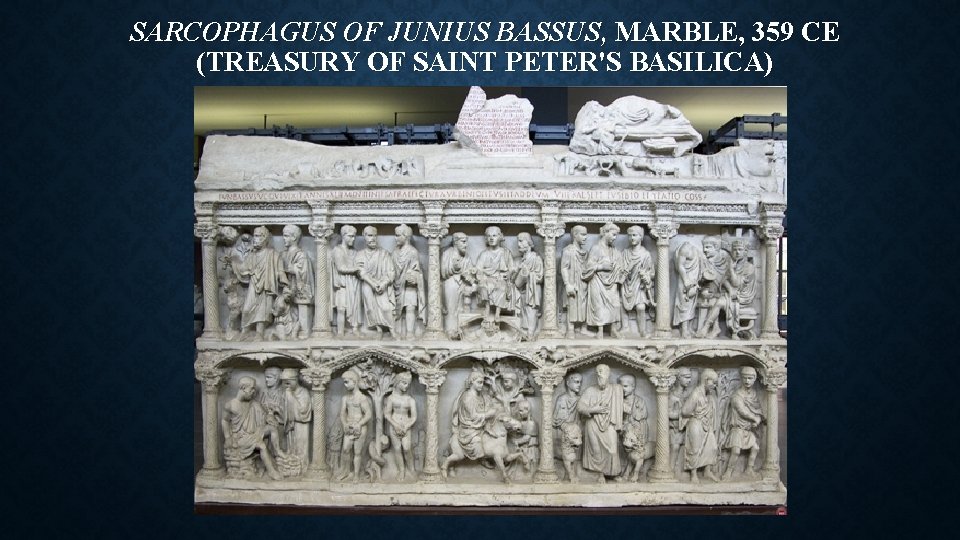
SARCOPHAGUS OF JUNIUS BASSUS, MARBLE, 359 CE (TREASURY OF SAINT PETER'S BASILICA)
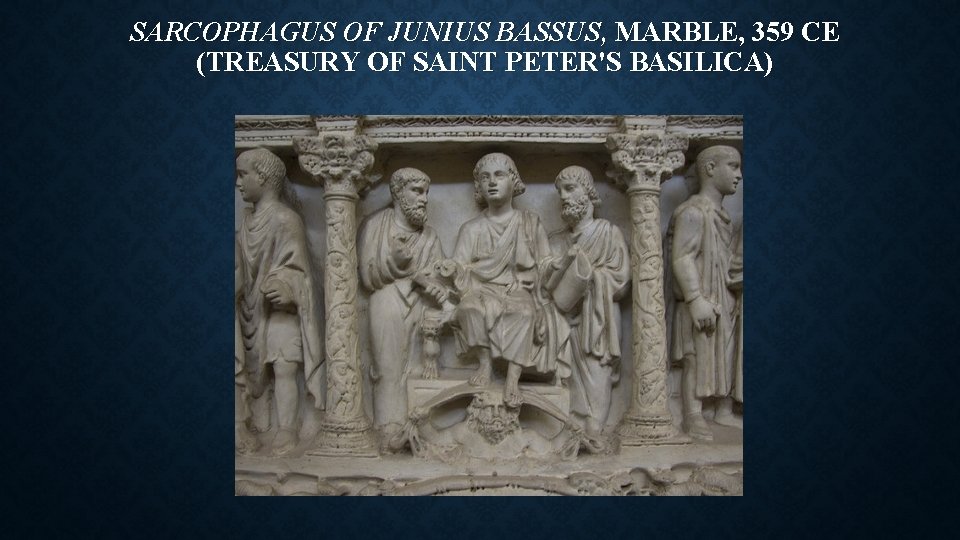
SARCOPHAGUS OF JUNIUS BASSUS, MARBLE, 359 CE (TREASURY OF SAINT PETER'S BASILICA)
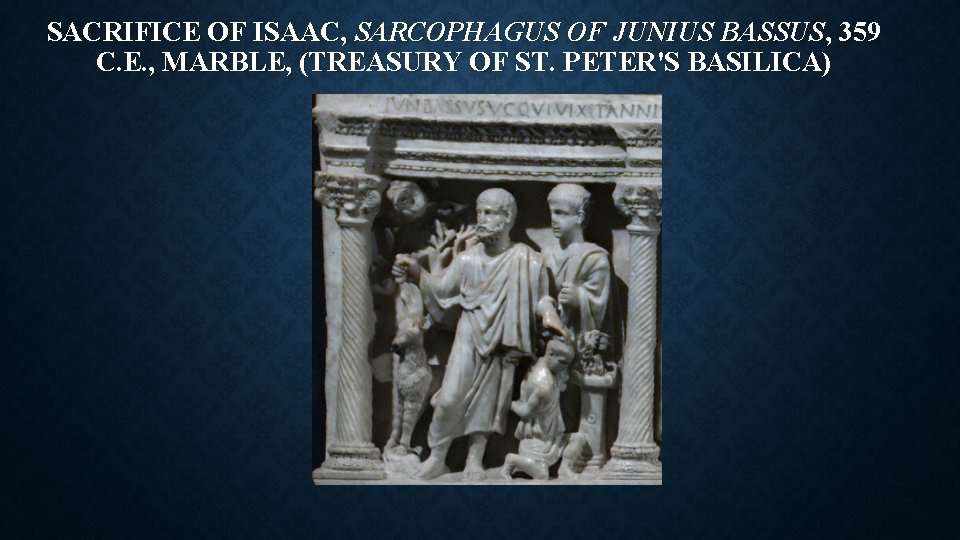
SACRIFICE OF ISAAC, SARCOPHAGUS OF JUNIUS BASSUS, 359 C. E. , MARBLE, (TREASURY OF ST. PETER'S BASILICA)
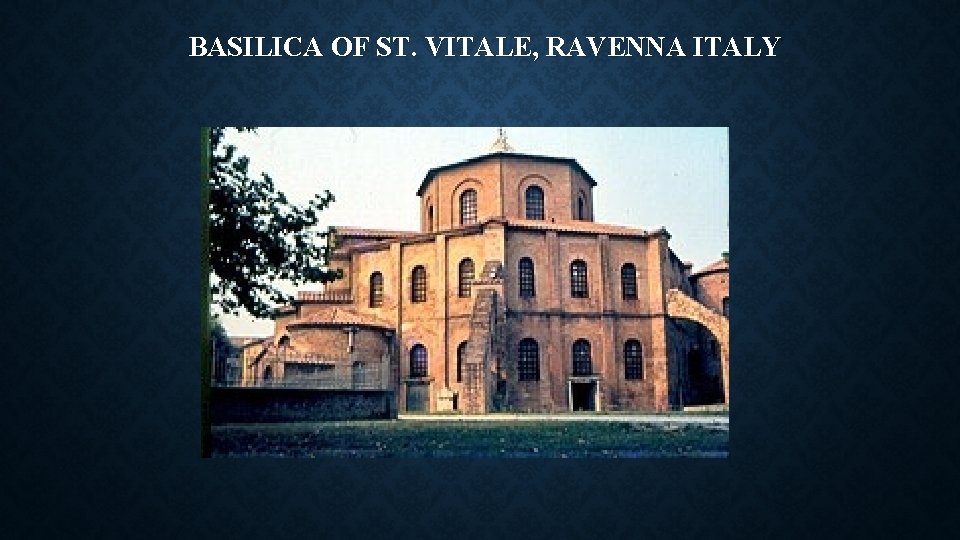
BASILICA OF ST. VITALE, RAVENNA ITALY
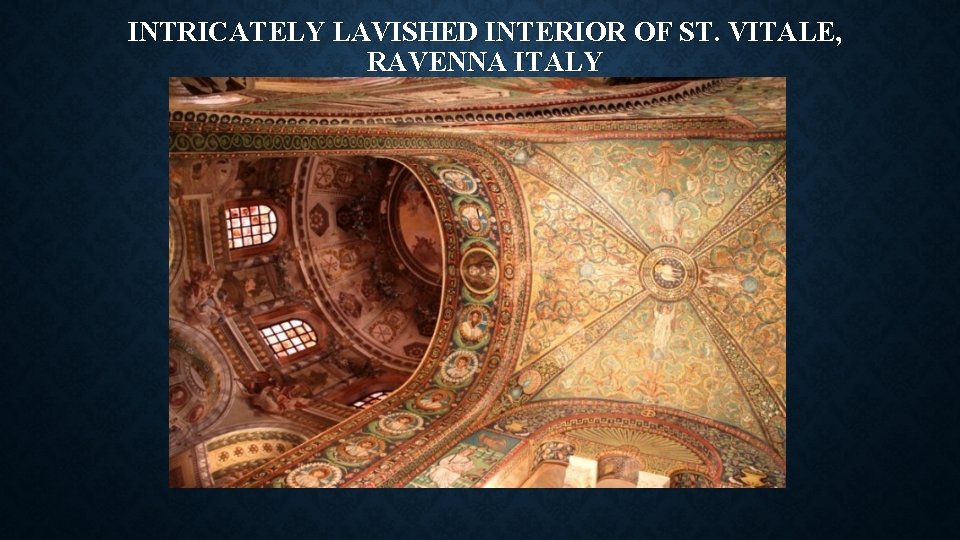
INTRICATELY LAVISHED INTERIOR OF ST. VITALE, RAVENNA ITALY
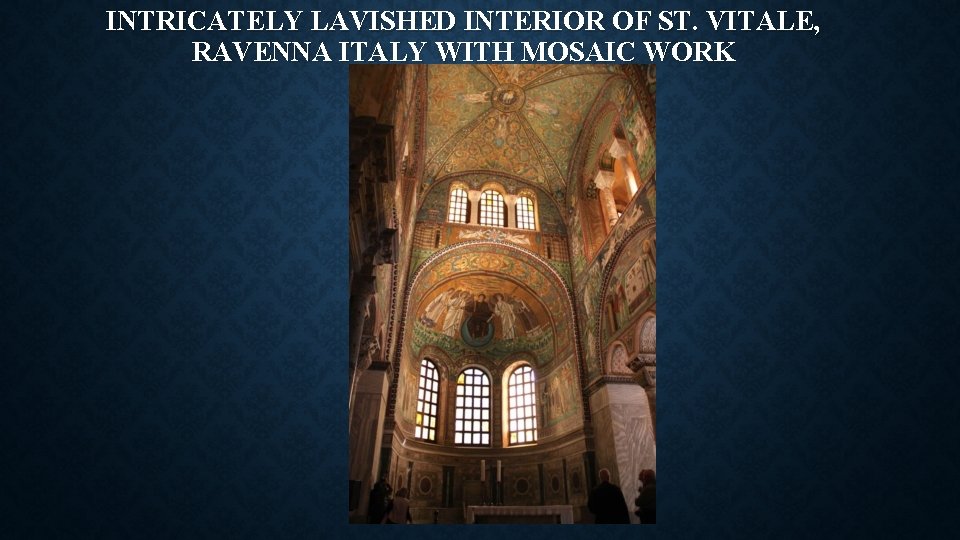
INTRICATELY LAVISHED INTERIOR OF ST. VITALE, RAVENNA ITALY WITH MOSAIC WORK
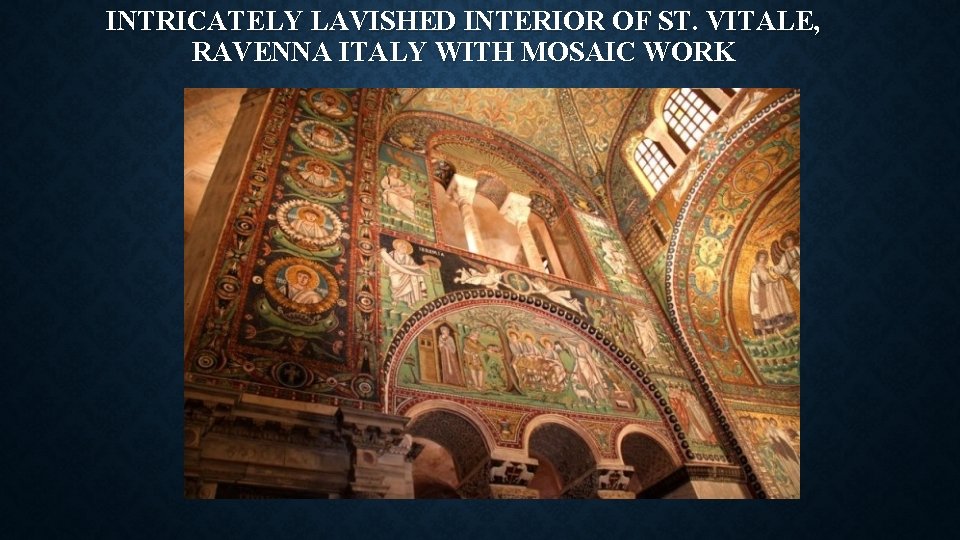
INTRICATELY LAVISHED INTERIOR OF ST. VITALE, RAVENNA ITALY WITH MOSAIC WORK
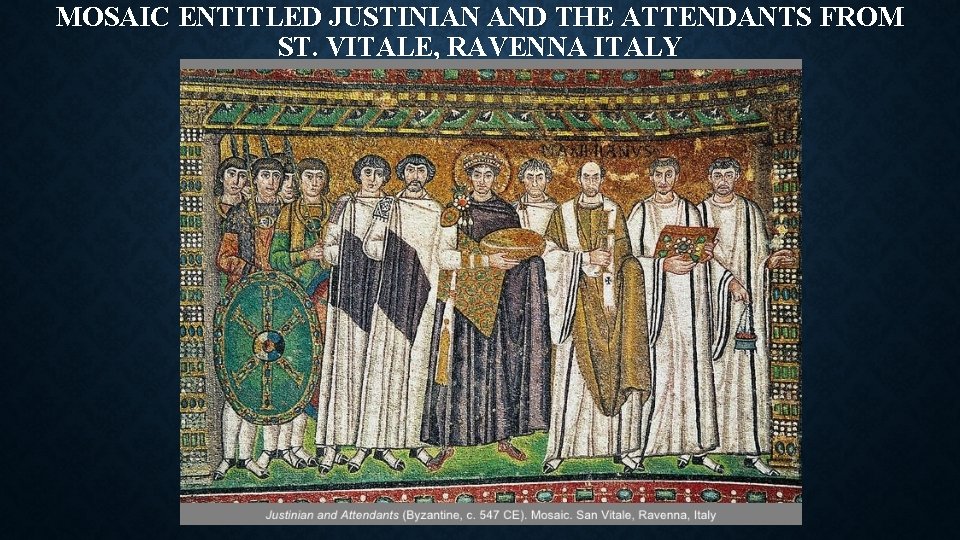
MOSAIC ENTITLED JUSTINIAN AND THE ATTENDANTS FROM ST. VITALE, RAVENNA ITALY
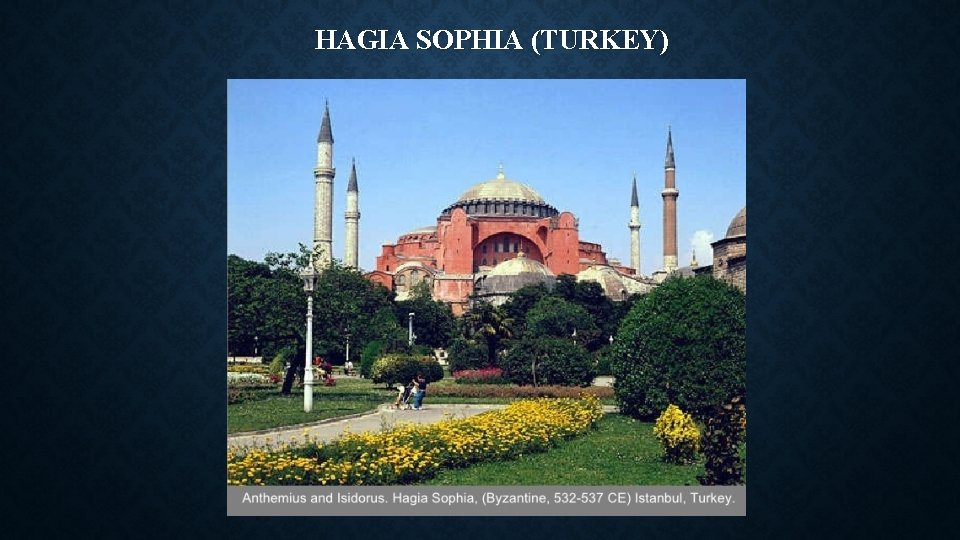
HAGIA SOPHIA (TURKEY)
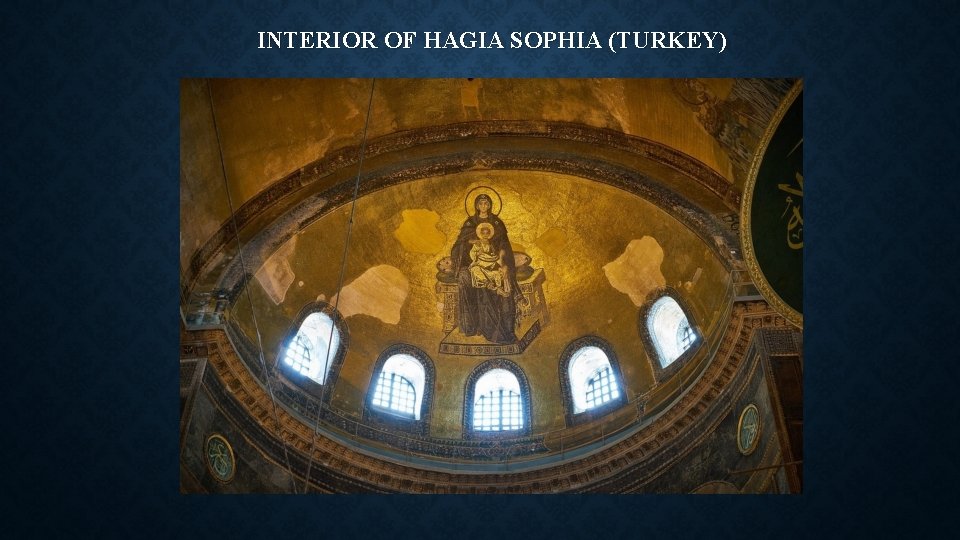
INTERIOR OF HAGIA SOPHIA (TURKEY)
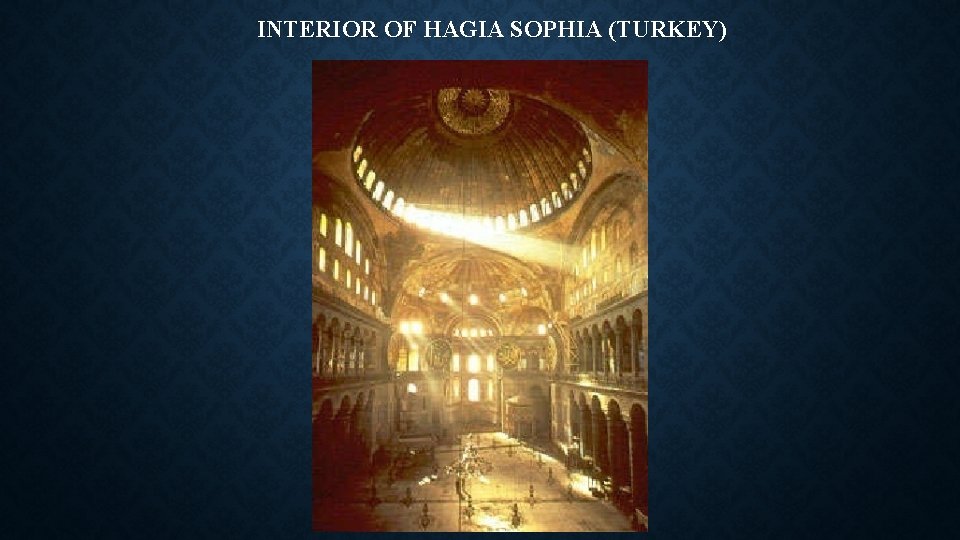
INTERIOR OF HAGIA SOPHIA (TURKEY)
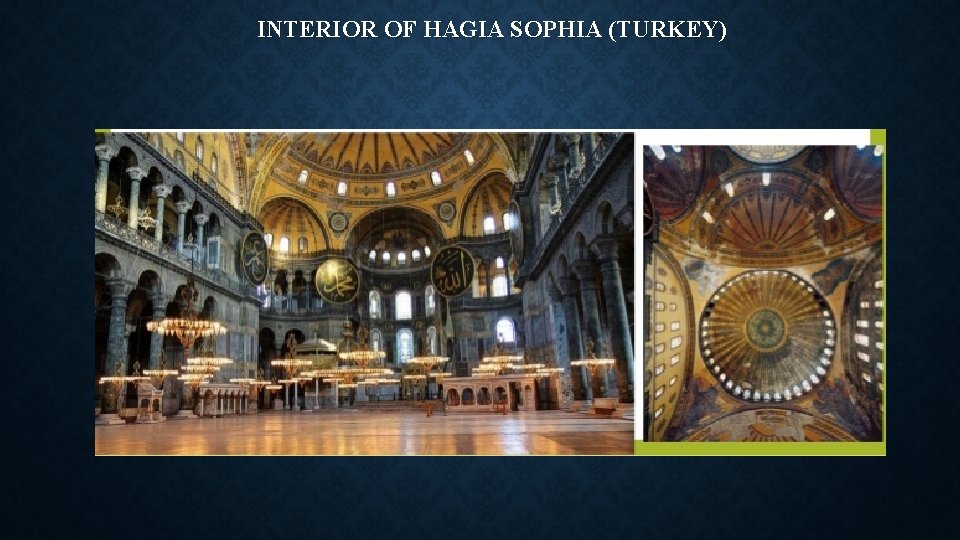
INTERIOR OF HAGIA SOPHIA (TURKEY)
BYZANTINE ART • The term Byzantine came from the city of Byzantium where Constantine made his capital, Constantinople (now Istanbul). • The difference between early Christian and Byzantine art is a transfer from an earthbound naturalism to a more spiritual, otherworldly style. • Byzantine art was a departure from classical art forms that were highly realistic in nature. Byzantine artists were less concerned with imitating reality and more in tune with religious symbolism in particular. It reflects many ancient influences such as the widespread use of mosaic art, but, by and large, a more abstract view of reality was preferred. • Two centres where Byzantine style emerged: Eastern Empire (Turkey) and Western Empire (Italy). Eastern Roman Empire had Orthodox Christianity. The Western Roman Empire fell in 476 A. D. However, the eastern portion of the empire survived. It began the Byzantine Empire. The Byzantine Empire survived for one thousand years after the fall of Rome. Constantinople became its capital, now known as Istanbul.
BYZANTINE ARCHITECTURE • A formal shift from early Christian to Byzantine architecture can be seen in the early sixth century A. D. Timber-roofed Latin basilican churches gave way to domed, central-plan structures in the Eastern Empire. • Video link https: //youtu. be/c 2 x. F 3 Bk 70 NQ, https: //youtu. be/93 EYDY 4 v. Yp 4 • No two Byzantine churches were identical. • Main Features of the ideal Byzantine church includes : Central plan Pendentive dome, String focus on structure, lighting, and elaborate decoration. • Domes were used to invoke powerful images of the Christian heaven. • Not a single surface in the interior of the churches was left in a natural state, all was dissolved in color and light with the addition of glowing marble pavements, richly veined marble walls, extensive mosaic cycles, rich patterns of light created by glass and structural features. • Hagia Sofia (Church of Holy Wisdom) symbolizes the ‘ideal’ Christian Church. It was an architectural marvel with its huge dome tops and spires.

ROMANESQUE ART
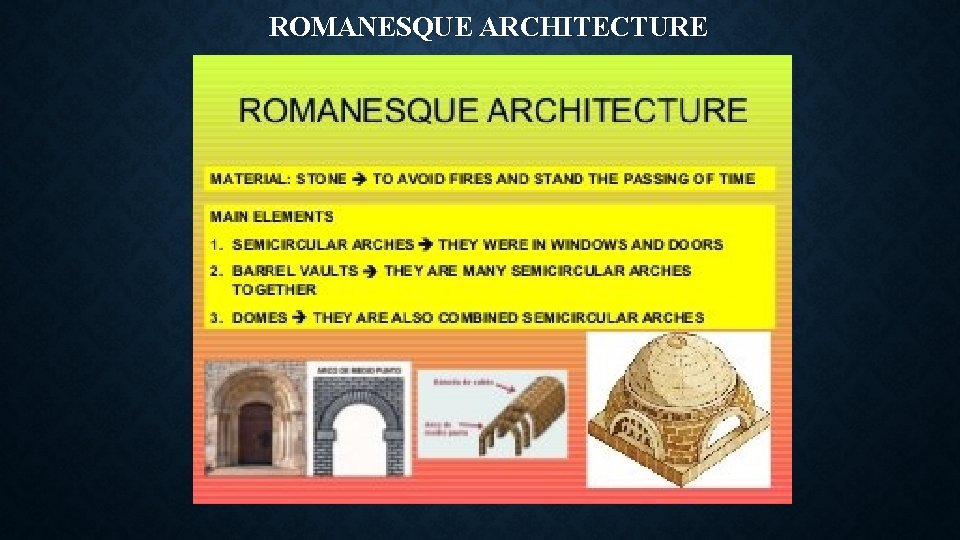
ROMANESQUE ART • Romanesque art refers to the art of Europe from the late 10 th century to the rise of the Gothic style in the 13 th century. It was the first major movement of Medieval art which was used to cover all derivations of Roman architecture in the West, from the same period. Traditionally, however, the term Romanesque refers to the specific style of architecture, along with sculpture and other minor arts that appeared across France, Germany, Italy and Spain during the 11 th century. The Romanesque style was the first to spread across the whole of Catholic Europe. • Combining features of Roman and Byzantine buildings and other local traditions, Romanesque architecture exhibits massive quality, thick walls, round arches , sturdy piers , groin vaults , large towers, and symmetrical plans. • The art of the period was characterized by a vigorous style in both painting and sculpture. Colors, which we can now see in their original brightness only in stained glass and well-preserved manuscripts, tended to be very striking. • Combining features of Roman and Byzantine buildings along with other local traditions, Romanesque architecture is distinguished by massive quality, thick walls, round arches, sturdy piers, groin vaults, large towers, and decorative arcades.
ROMANESQUE ART • Each building has clearly defined forms and a symmetrical plan, resulting in a much simpler appearance than the Gothic buildings that would follow. The style can be identified across Europe, despite regional characteristics and materials. • Richer and more magnificent than anything witnessed during the era of early Christian art, the Romanesque style is characterized by a massiveness of scale, reflecting the greater social stability of the new Millennium, and the growing confidence of the Christian Church in Rome. • Architecture, painting, illuminated manuscripts and sculpture were among the characteristic features. The relation of art to architecture—especially church architecture—is fundamental in this period. • The style of Romanesque painting was highly sophisticated that sacrifices optical accuracy to narrative clarity. The Romanesque style is the creation of a people imbued with deep religious conviction, and if the artist felt that he could achieve wider emotional significance by stylizing the portrayal of the human figure, by taking him out of his earthly environment, he did not hesitate to do so. To obtain narrative impact the figures are sometimes drawn directly onto the bare parchment or set against a solid, brightly colored background of gold or blue. The figures themselves are flattened into two dimensions and often clothed in draperies broken up into a pattern of geometric shapes.
ROMANESQUE ARCHITECTURE
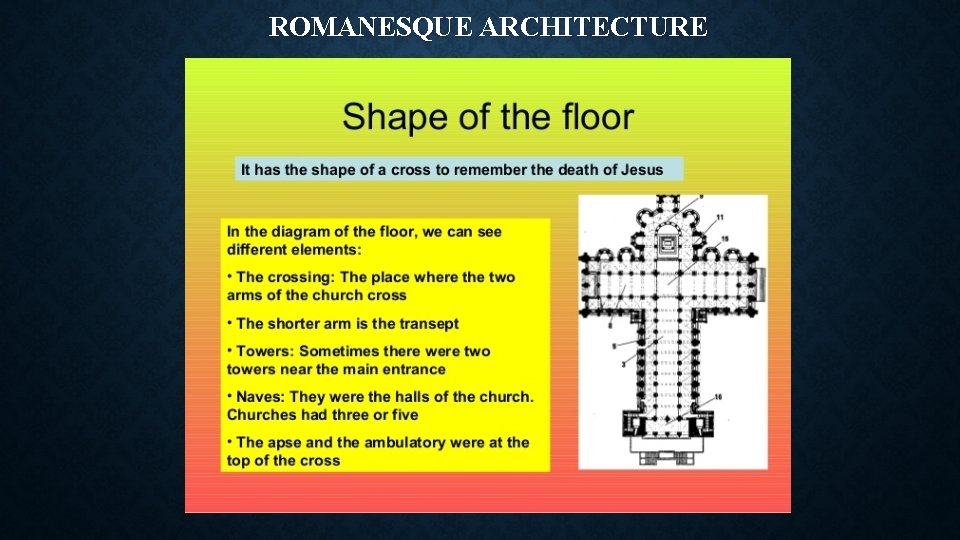
ROMANESQUE ARCHITECTURE
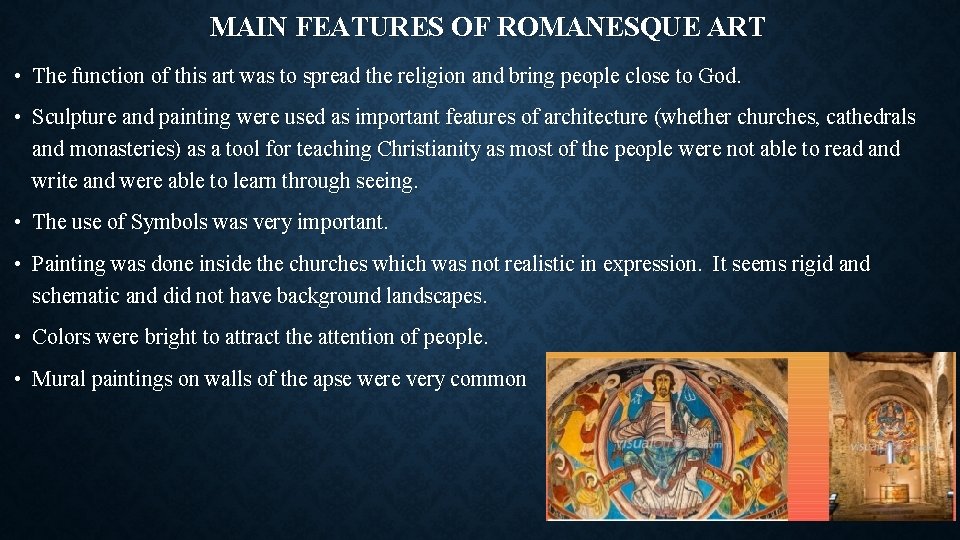
MAIN FEATURES OF ROMANESQUE ART • The function of this art was to spread the religion and bring people close to God. • Sculpture and painting were used as important features of architecture (whether churches, cathedrals and monasteries) as a tool for teaching Christianity as most of the people were not able to read and write and were able to learn through seeing. • The use of Symbols was very important. • Painting was done inside the churches which was not realistic in expression. It seems rigid and schematic and did not have background landscapes. • Colors were bright to attract the attention of people. • Mural paintings on walls of the apse were very common
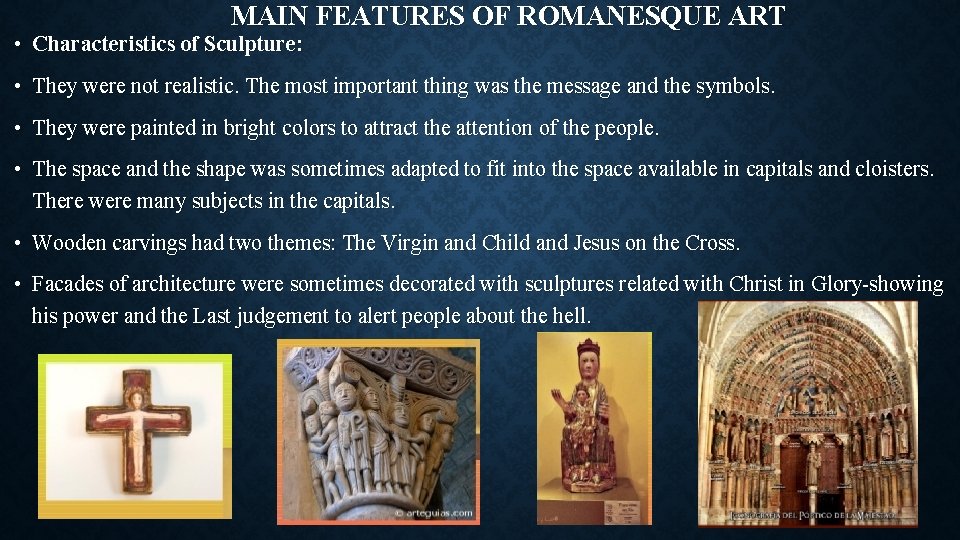
MAIN FEATURES OF ROMANESQUE ART • Characteristics of Sculpture: • They were not realistic. The most important thing was the message and the symbols. • They were painted in bright colors to attract the attention of the people. • The space and the shape was sometimes adapted to fit into the space available in capitals and cloisters. There were many subjects in the capitals. • Wooden carvings had two themes: The Virgin and Child and Jesus on the Cross. • Facades of architecture were sometimes decorated with sculptures related with Christ in Glory-showing his power and the Last judgement to alert people about the hell.

GOTHIC ART
GOTHIC ART • The term Gothic style refers to the style of European architecture, sculpture (and minor arts) which linked medieval Romanesque art with the Early Renaissance. Gothic art flourished in western and central Europe during the Middle Ages. • Gothic art evolved from Romanesque art and lasted from the mid- 12 th century to the end of 16 th century. The period is divided into Early Gothic (1150 -1250), High Gothic (1250 -1375), and International Gothic (1375 -1450). Primarily a public form of Christian art, it flourished initially in the Ile de France and surrounding region in the period 1150 -1250, and then spread throughout northern Europe. • Its main form of expression was architecture - represented by the great “Gothic cathedrals” of Northern France. • In Gothic design, the planar forms of the previous Romanesque idiom were replaced by a new focus on line. And its soaring arches and buttresses permitted the opening up of walls for unprecedently huge windows of stained glass filled with beautifully inspirational translucent images of Biblical art, far surpassing anything that wall painting or mosaic art had to offer. All this created an evocative humanistic atmosphere quite different from the Romanesque period. (During the late 14 th century, a more secular Gothic style emerged, known as International Gothic, which spread across Burgundy, Bohemia and northern Italy.
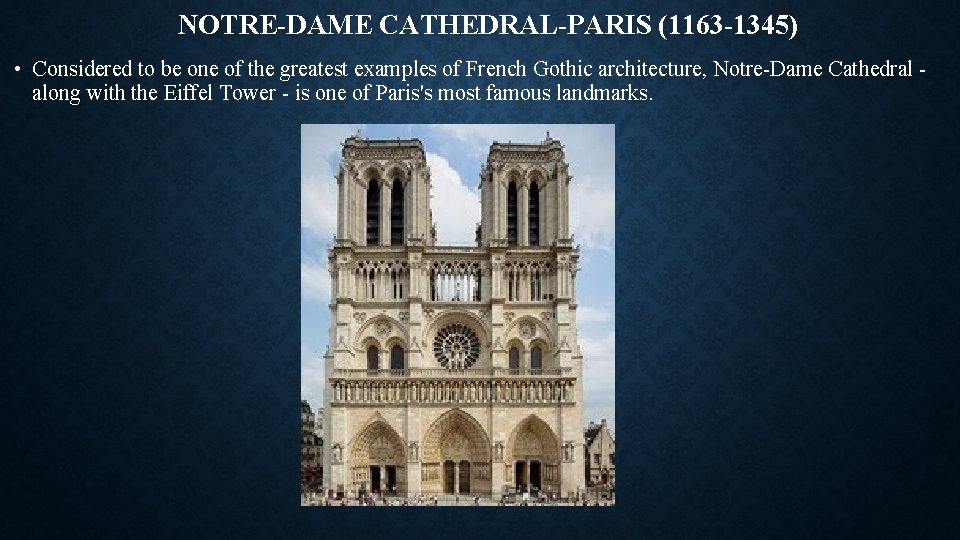
NOTRE-DAME CATHEDRAL-PARIS (1163 -1345) • Considered to be one of the greatest examples of French Gothic architecture, Notre-Dame Cathedral along with the Eiffel Tower - is one of Paris's most famous landmarks.
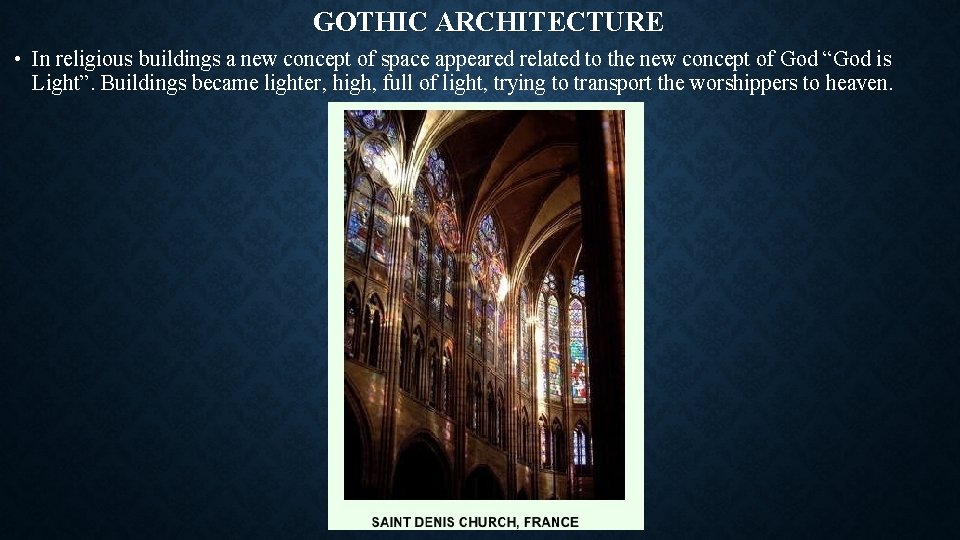
GOTHIC ARCHITECTURE • In religious buildings a new concept of space appeared related to the new concept of God “God is Light”. Buildings became lighter, high, full of light, trying to transport the worshippers to heaven.
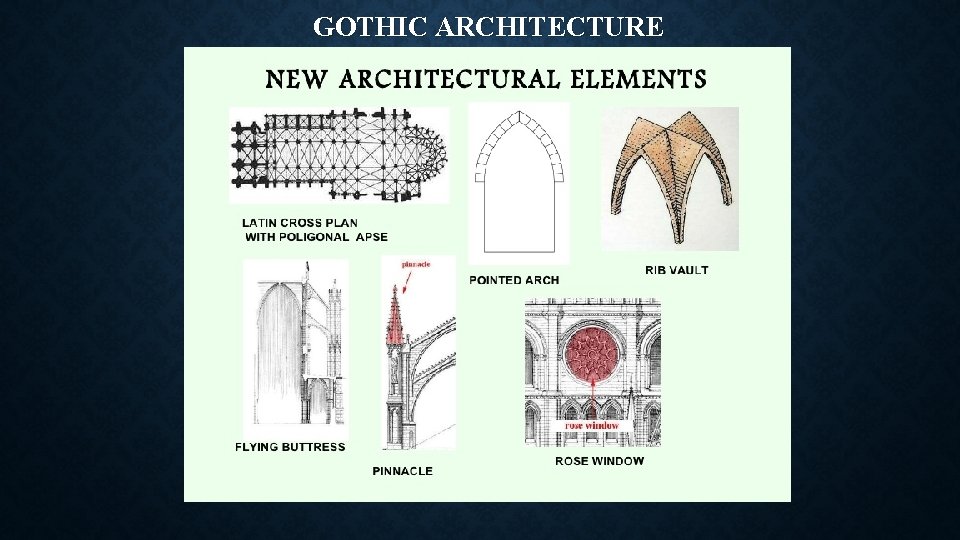
GOTHIC ARCHITECTURE
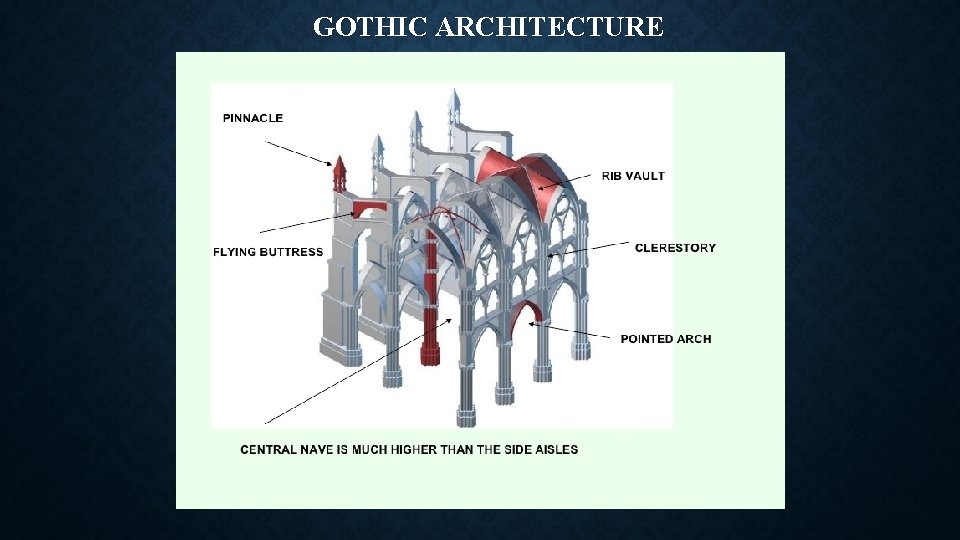
GOTHIC ARCHITECTURE
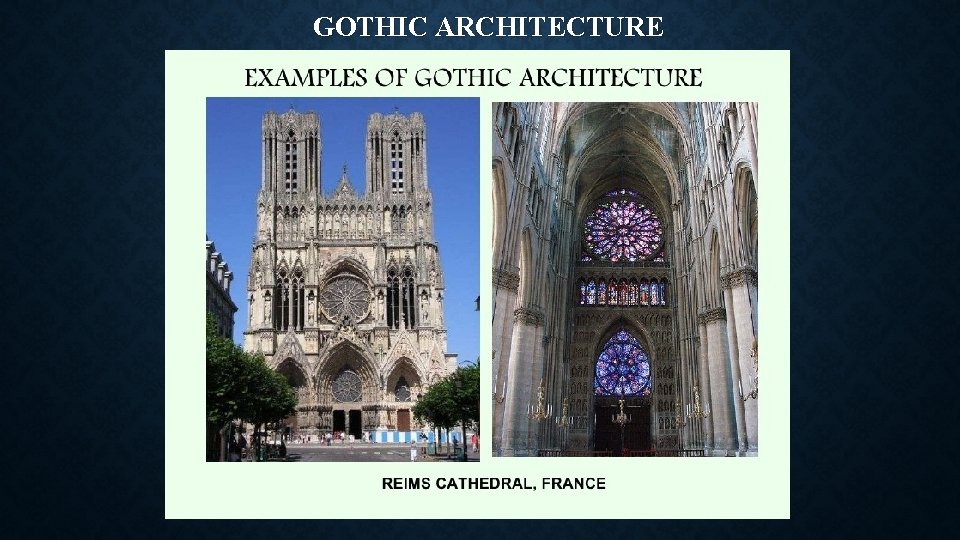
GOTHIC ARCHITECTURE
GOTHIC ART • Gothic art, being exclusively religious art, lent powerful tangible weight to the growing power of the Church in Rome. This not only inspired the public, as well as its secular leaders but also it firmly established the connection between religion and art, which was one of the foundations of the Italian Renaissance (1400 -1530). • Sculpture and painting continued having educational purpose, but they also attained independent position. Artists started becoming famous and respected but they were still considered to be craftsmen. • Among famous medieval artists in the Gothic style were Giovanni Pisano and Simone Martini of the Sienese School of painting.
- Slides: 54