
Early Childhood Outcomes Summary Form References Completely Age
- Slides: 2
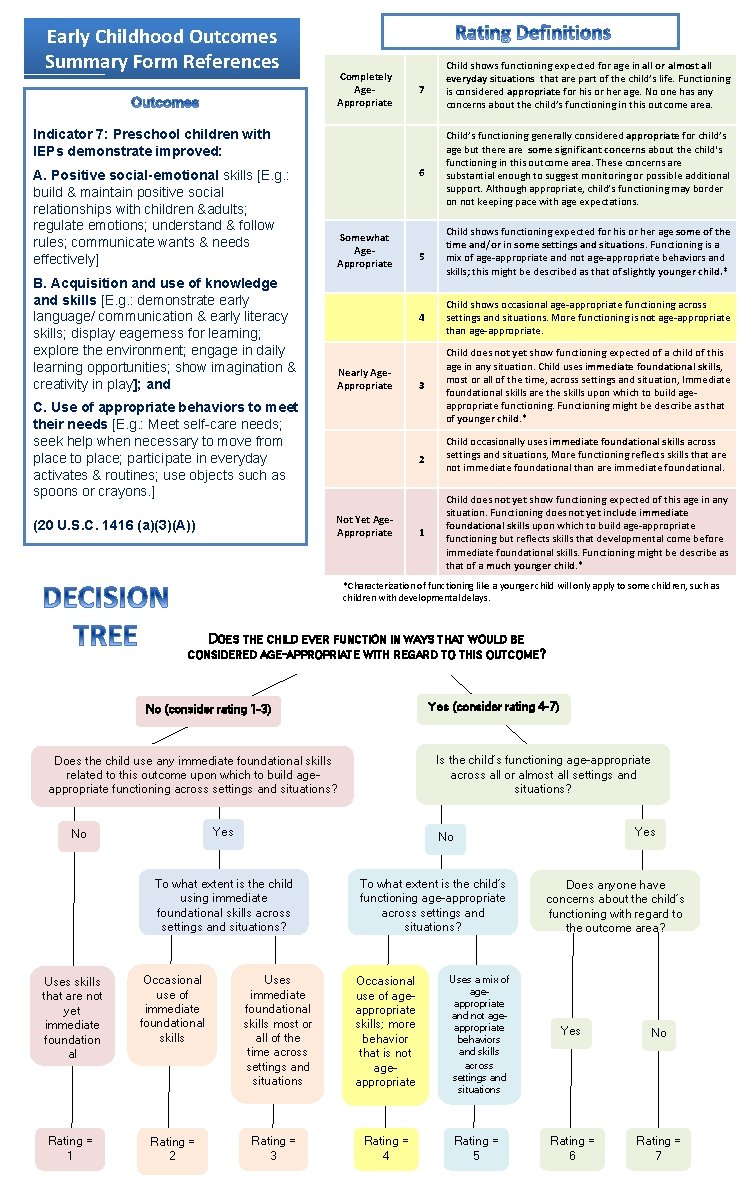
Early Childhood Outcomes Summary Form References Completely Age. Appropriate 7 Child shows functioning expected for age in all or almost all everyday situations that are part of the child’s life. Functioning is considered appropriate for his or her age. No one has any concerns about the child’s functioning in this outcome area. 6 Child’s functioning generally considered appropriate for child’s age but there are some significant concerns about the child's functioning in this outcome area. These concerns are substantial enough to suggest monitoring or possible additional support. Although appropriate, child’s functioning may border on not keeping pace with age expectations. Indicator 7: Preschool children with IEPs demonstrate improved: A. Positive social-emotional skills [E. g. : build & maintain positive social relationships with children &adults; regulate emotions; understand & follow rules; communicate wants & needs effectively] B. Acquisition and use of knowledge and skills [E. g. : demonstrate early language/ communication & early literacy skills; display eagerness for learning; explore the environment; engage in daily learning opportunities; show imagination & creativity in play]; and Somewhat Age. Appropriate Nearly Age. Appropriate C. Use of appropriate behaviors to meet their needs [E. g. : Meet self-care needs; seek help when necessary to move from place to place; participate in everyday activates & routines; use objects such as spoons or crayons. ] Not Yet Age. Appropriate (20 U. S. C. 1416 (a)(3)(A)) 5 Child shows functioning expected for his or her age some of the time and/or in some settings and situations. Functioning is a mix of age-appropriate and not age-appropriate behaviors and skills; this might be described as that of slightly younger child. * 4 Child shows occasional age-appropriate functioning across settings and situations. More functioning is not age-appropriate than age-appropriate. 3 Child does not yet show functioning expected of a child of this age in any situation. Child uses immediate foundational skills, most or all of the time, across settings and situation, Immediate foundational skills are the skills upon which to build ageappropriate functioning. Functioning might be describe as that of younger child. * 2 Child occasionally uses immediate foundational skills across settings and situations, More functioning reflects skills that are not immediate foundational than are immediate foundational. 1 Child does not yet show functioning expected of this age in any situation. Functioning does not yet include immediate foundational skills upon which to build age-appropriate functioning but reflects skills that developmental come before immediate foundational skills. Functioning might be describe as that of a much younger child. * *Characterization of functioning like a younger child will only apply to some children, such as children with developmental delays. DOES THE CHILD EVER FUNCTION IN WAYS THAT WOULD BE CONSIDERED AGE-APPROPRIATE WITH REGARD TO THIS OUTCOME? Yes (consider rating 4 -7) No (consider rating 1 -3) Is the child’s functioning age-appropriate across all or almost all settings and situations? Does the child use any immediate foundational skills related to this outcome upon which to build ageappropriate functioning across settings and situations? Yes No To what extent is the child using immediate foundational skills across settings and situations? Uses skills that are not yet immediate foundation al Occasional use of immediate foundational skills Rating = 1 Rating = 2 Yes No Uses immediate foundational skills most or all of the time across settings and situations Rating = 3 To what extent is the child’s functioning age-appropriate across settings and situations? Occasional use of ageappropriate skills; more behavior that is not ageappropriate Rating = 4 Uses a mix of ageappropriate and not ageappropriate behaviors and skills across settings and situations Rating = 5 Does anyone have concerns about the child’s functioning with regard to the outcome area? Yes No Rating = 6 Rating = 7
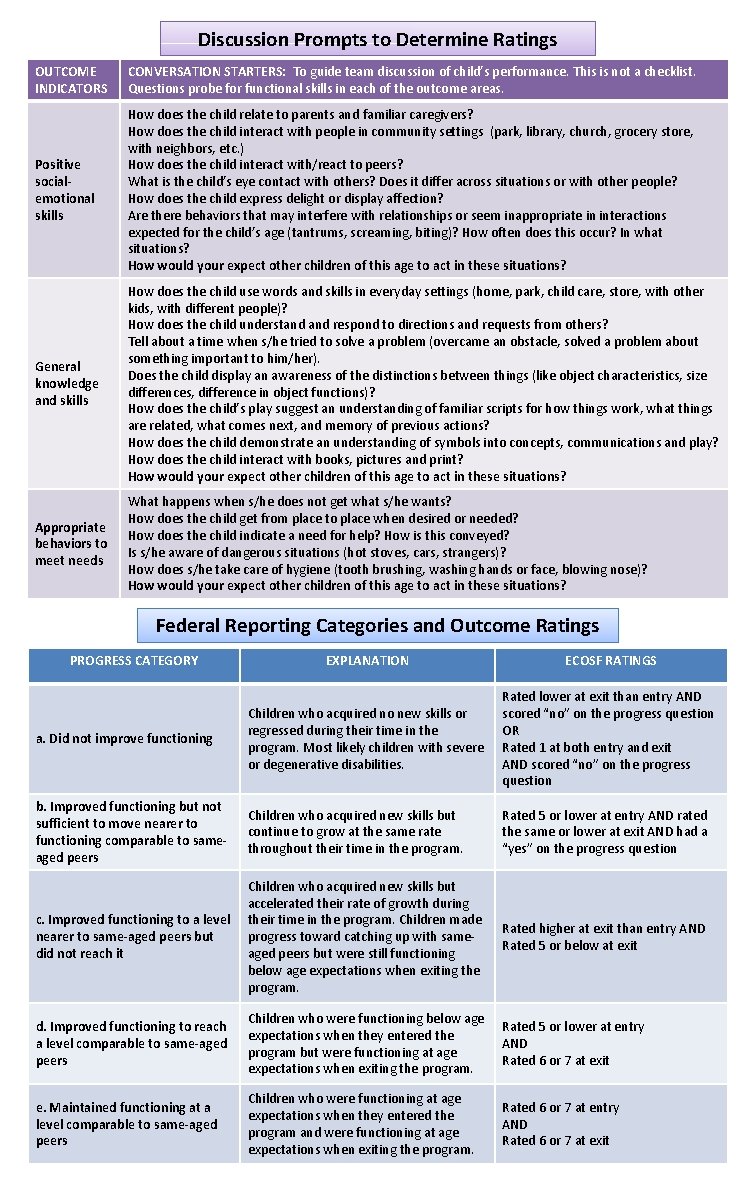
Discussion Prompts to Determine Ratings OUTCOME INDICATORS CONVERSATION STARTERS: To guide team discussion of child’s performance. This is not a checklist. Questions probe for functional skills in each of the outcome areas. Positive socialemotional skills How does the child relate to parents and familiar caregivers? How does the child interact with people in community settings (park, library, church, grocery store, with neighbors, etc. ) How does the child interact with/react to peers? What is the child’s eye contact with others? Does it differ across situations or with other people? How does the child express delight or display affection? Are there behaviors that may interfere with relationships or seem inappropriate in interactions expected for the child’s age (tantrums, screaming, biting)? How often does this occur? In what situations? How would your expect other children of this age to act in these situations? General knowledge and skills How does the child use words and skills in everyday settings (home, park, child care, store, with other kids, with different people)? How does the child understand respond to directions and requests from others? Tell about a time when s/he tried to solve a problem (overcame an obstacle, solved a problem about something important to him/her). Does the child display an awareness of the distinctions between things (like object characteristics, size differences, difference in object functions)? How does the child’s play suggest an understanding of familiar scripts for how things work, what things are related, what comes next, and memory of previous actions? How does the child demonstrate an understanding of symbols into concepts, communications and play? How does the child interact with books, pictures and print? How would your expect other children of this age to act in these situations? Appropriate behaviors to meet needs What happens when s/he does not get what s/he wants? How does the child get from place to place when desired or needed? How does the child indicate a need for help? How is this conveyed? Is s/he aware of dangerous situations (hot stoves, cars, strangers)? How does s/he take care of hygiene (tooth brushing, washing hands or face, blowing nose)? How would your expect other children of this age to act in these situations? Federal Reporting Categories and Outcome Ratings PROGRESS CATEGORY EXPLANATION ECOSF RATINGS a. Did not improve functioning Children who acquired no new skills or regressed during their time in the program. Most likely children with severe or degenerative disabilities. Rated lower at exit than entry AND scored “no” on the progress question OR Rated 1 at both entry and exit AND scored “no” on the progress question b. Improved functioning but not sufficient to move nearer to functioning comparable to sameaged peers Children who acquired new skills but continue to grow at the same rate throughout their time in the program. Rated 5 or lower at entry AND rated the same or lower at exit AND had a “yes” on the progress question c. Improved functioning to a level nearer to same-aged peers but did not reach it Children who acquired new skills but accelerated their rate of growth during their time in the program. Children made progress toward catching up with sameaged peers but were still functioning below age expectations when exiting the program. Rated higher at exit than entry AND Rated 5 or below at exit d. Improved functioning to reach a level comparable to same-aged peers Children who were functioning below age expectations when they entered the program but were functioning at age expectations when exiting the program. Rated 5 or lower at entry AND Rated 6 or 7 at exit e. Maintained functioning at a level comparable to same-aged peers Children who were functioning at age expectations when they entered the program and were functioning at age expectations when exiting the program. Rated 6 or 7 at entry AND Rated 6 or 7 at exit