
Early Childhood Outcomes Data Indicator C 3 and
- Slides: 25
Early Childhood Outcomes Data (Indicator C 3 and B 7)
Why are state early intervention and preschool special education agencies collecting data on child and family outcomes? 2
Why? • Accountability – Federal government (Office of Special Education Programs, U. S. Department of Education) requires that states submit data on outcomes – In some states, policy-makers are asking for outcome data • Program Improvement – State agencies (and local programs) want to use data on outcomes to improve services for children and families 3
Federal Forces Proving Impetus for Data on Child Outcomes • Government Performance and Results Act (GPRA) • Program Assessment Rating Tool (PART) • Individuals with Disabilities Education Act (IDEA) 4
Individuals with Disabilities Education Act SEC. 616. <<NOTE: 20 USC 1416. >> MONITORING, TECHNICAL ASSISTANCE, AND ENFORCEMENT. ``(a) Federal and State Monitoring. -…. . ``(2) Focused monitoring. --The primary focus of Federal and State monitoring activities described in paragraph (1) shall be on-- ``(A) improving educational results and functional outcomes for all children with disabilities; 5
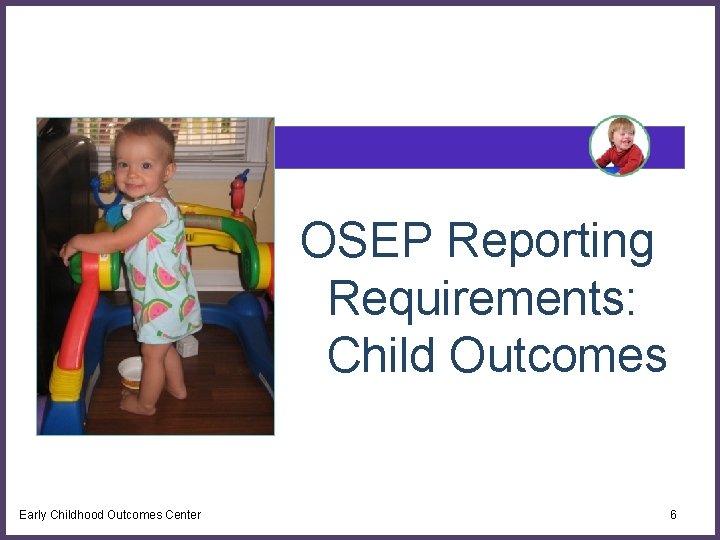
OSEP Reporting Requirements: Child Outcomes Early Childhood Outcomes Center 6
Overarching goal for EI and ECSE “…To enable young children to be active and successful participants during the early childhood years and in the future in a variety of settings – in their homes with their families, in child care, in preschool or school programs, and in the community. ” (from Early Childhood Outcomes Center, http: //www. fpg. unc. edu/~eco/pdfs/eco_outcomes_4 -13 -05. pdf) Early Childhood Outcomes Center 7
Three Child Outcomes – Positive social emotional skills (including positive social relationships) – Acquisition and use of knowledge and skills (including early language/ communication) – Use of appropriate behaviors to meet their needs Early Childhood Outcomes Center 8
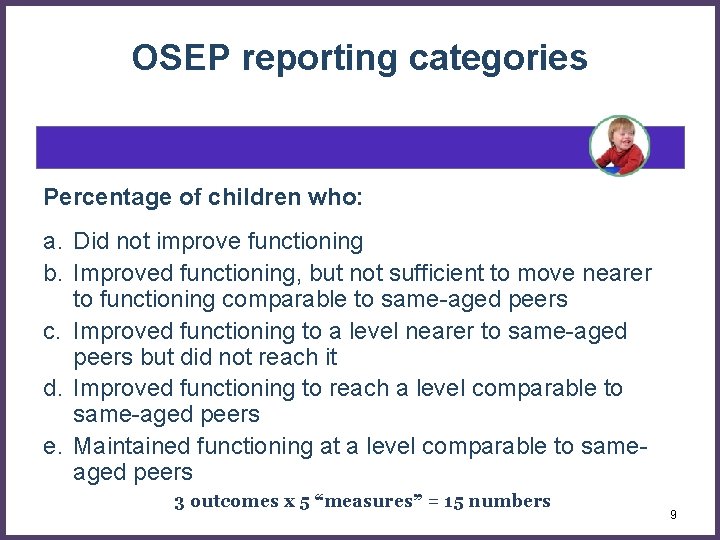
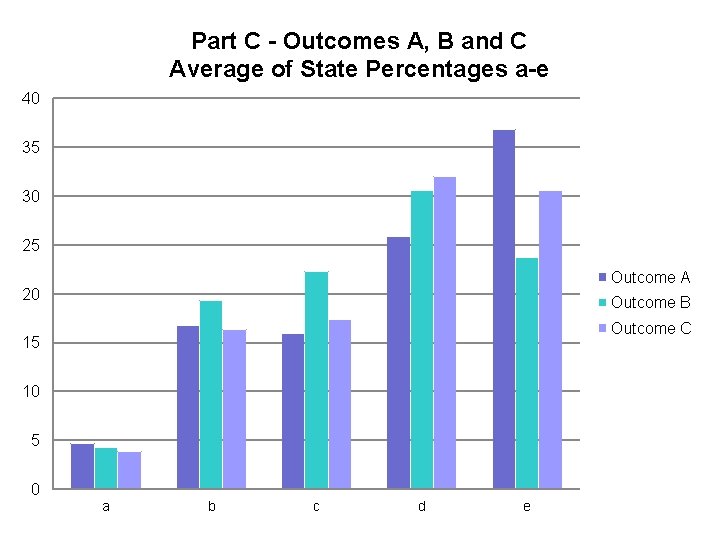
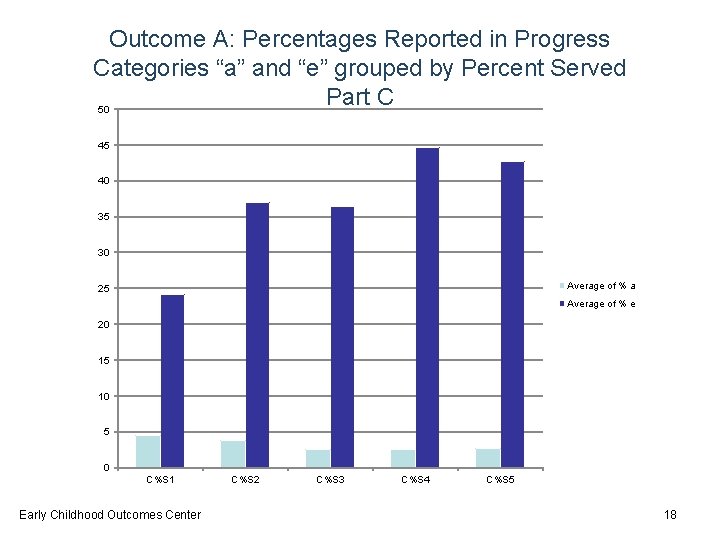
OSEP reporting categories Percentage of children who: a. Did not improve functioning b. Improved functioning, but not sufficient to move nearer to functioning comparable to same-aged peers c. Improved functioning to a level nearer to same-aged peers but did not reach it d. Improved functioning to reach a level comparable to same-aged peers e. Maintained functioning at a level comparable to sameaged peers 3 outcomes x 5 “measures” = 15 numbers 9
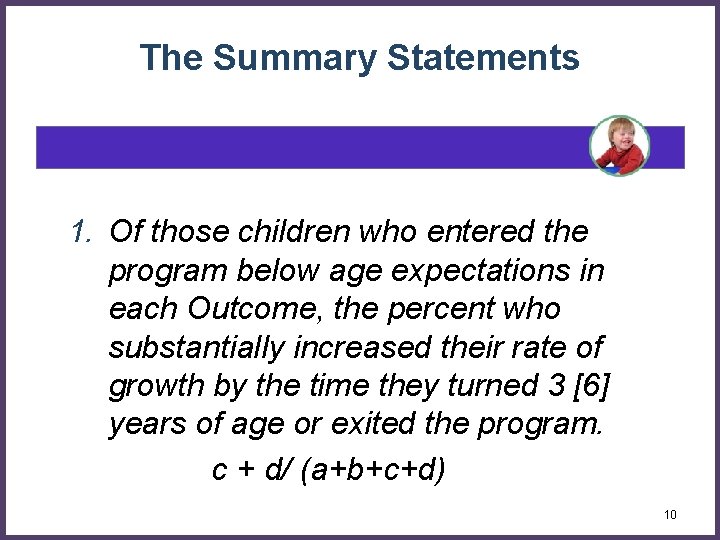
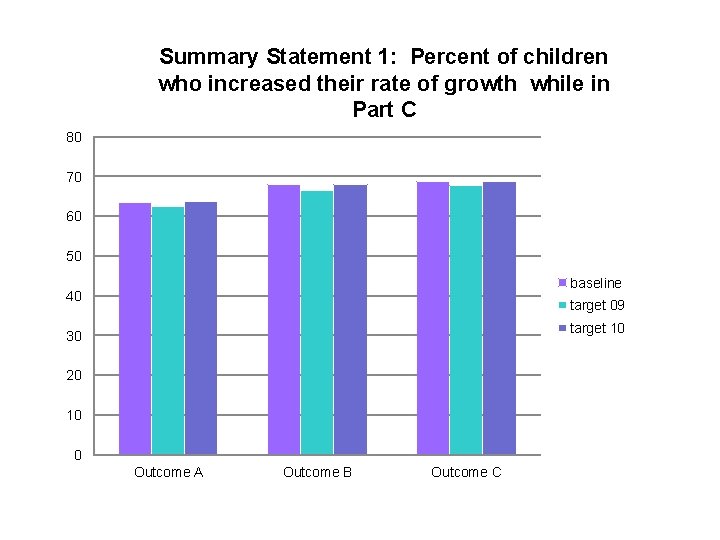
The Summary Statements 1. Of those children who entered the program below age expectations in each Outcome, the percent who substantially increased their rate of growth by the time they turned 3 [6] years of age or exited the program. c + d/ (a+b+c+d) 10
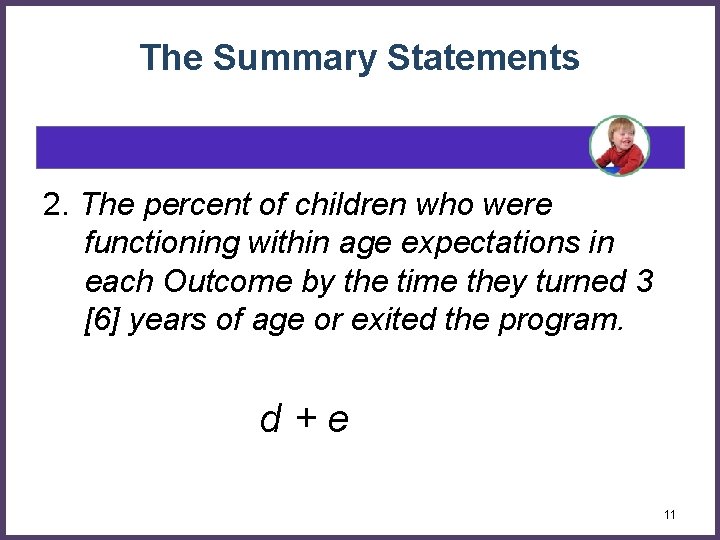
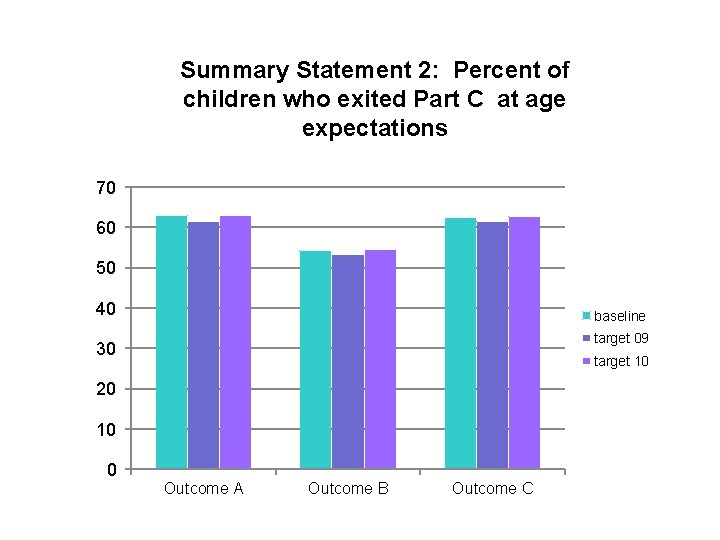
The Summary Statements 2. The percent of children who were functioning within age expectations in each Outcome by the time they turned 3 [6] years of age or exited the program. d+e 11
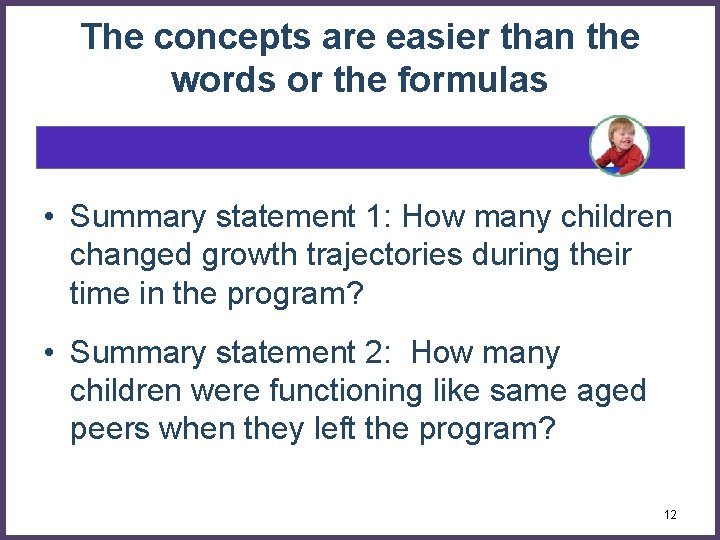
The concepts are easier than the words or the formulas • Summary statement 1: How many children changed growth trajectories during their time in the program? • Summary statement 2: How many children were functioning like same aged peers when they left the program? 12
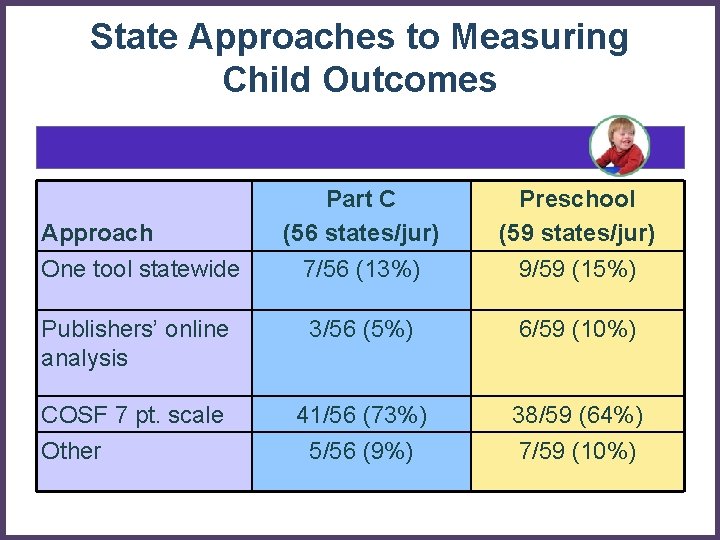
State Approaches to Measuring Child Outcomes Part C (56 states/jur) 7/56 (13%) Preschool (59 states/jur) 9/59 (15%) Publishers’ online analysis 3/56 (5%) 6/59 (10%) COSF 7 pt. scale Other 41/56 (73%) 5/56 (9%) 38/59 (64%) 7/59 (10%) Approach One tool statewide
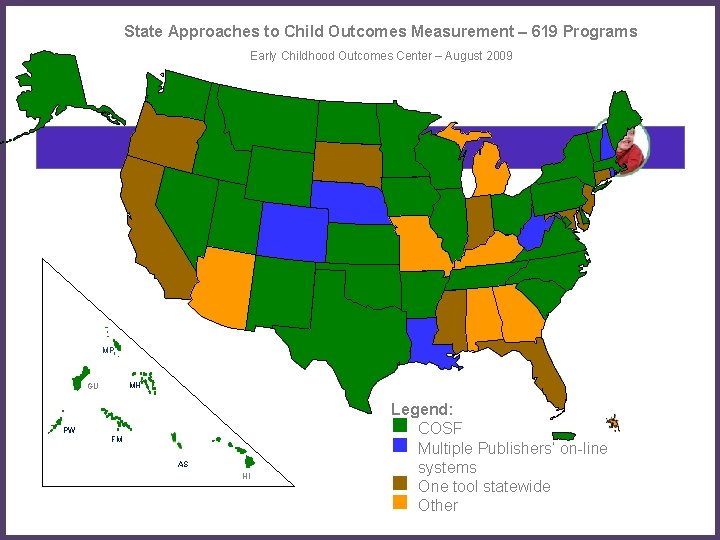
State Approaches to Child Outcomes Measurement – 619 Programs Early Childhood Outcomes Center – August 2009 MP MH GU PW FM AS HI Legend: n COSF n Multiple Publishers’ on-line systems n One tool statewide n Other
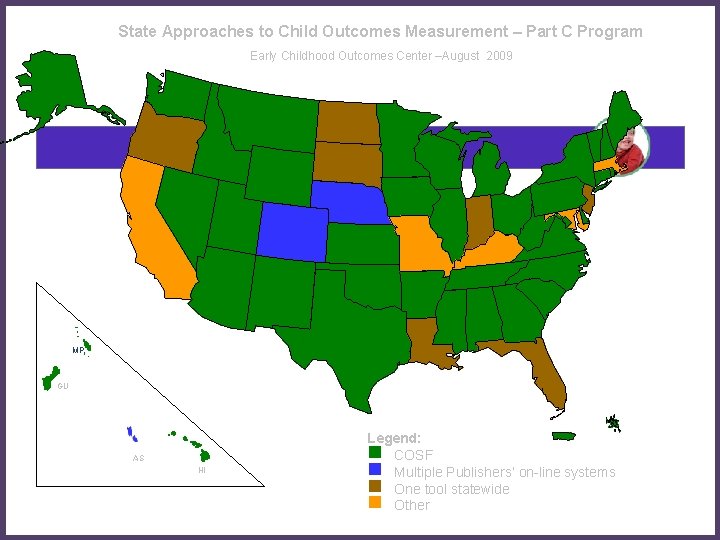
State Approaches to Child Outcomes Measurement – Part C Program Early Childhood Outcomes Center –August 2009 MP GU AS HI Legend: n COSF n Multiple Publishers’ on-line systems n One tool statewide n Other
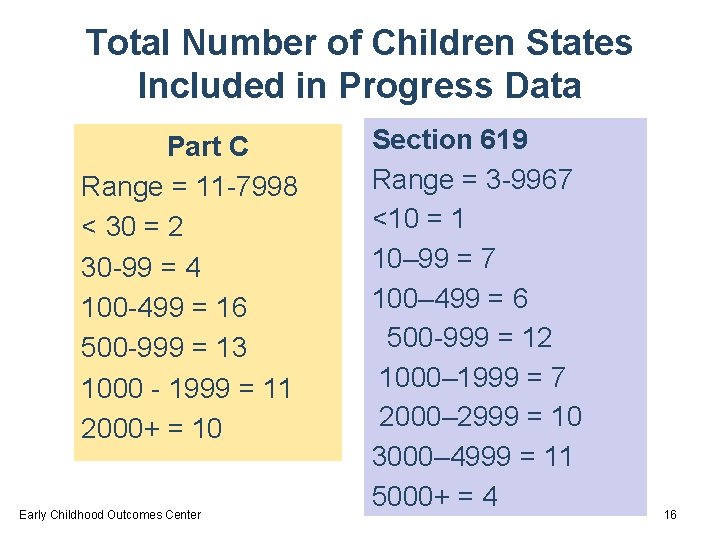
Total Number of Children States Included in Progress Data Part C Range = 11 -7998 < 30 = 2 30 -99 = 4 100 -499 = 16 500 -999 = 13 1000 - 1999 = 11 2000+ = 10 Early Childhood Outcomes Center Section 619 Range = 3 -9967 <10 = 1 10– 99 = 7 100– 499 = 6 500 -999 = 12 1000– 1999 = 7 2000– 2999 = 10 3000– 4999 = 11 5000+ = 4 16
Part C - Outcomes A, B and C Average of State Percentages a-e 40 35 30 25 Outcome A 20 Outcome B Outcome C 15 10 5 0 a b c d e
Outcome A: Percentages Reported in Progress Categories “a” and “e” grouped by Percent Served Part C 50 45 40 35 30 Average of % a 25 Average of % e 20 15 10 5 0 C%S 1 Early Childhood Outcomes Center C%S 2 C%S 3 C%S 4 C%S 5 18
Summary Statement 1: Percent of children who increased their rate of growth while in Part C 80 70 60 50 baseline 40 target 09 target 10 30 20 10 0 Outcome A Outcome B Outcome C
Summary Statement 2: Percent of children who exited Part C at age expectations 70 60 50 40 baseline target 09 30 target 10 20 10 0 Outcome A Outcome B Outcome C
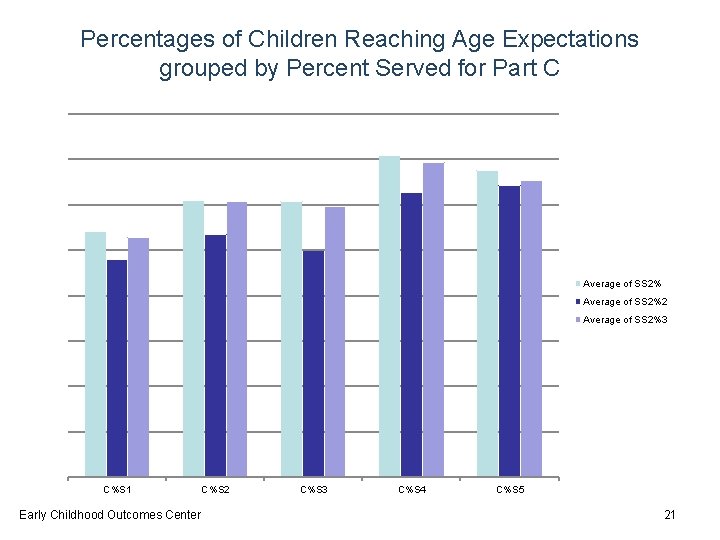
Percentages of Children Reaching Age Expectations grouped by Percent Served for Part C Average of SS 2%2 Average of SS 2%3 C%S 1 Early Childhood Outcomes Center C%S 2 C%S 3 C%S 4 C%S 5 21
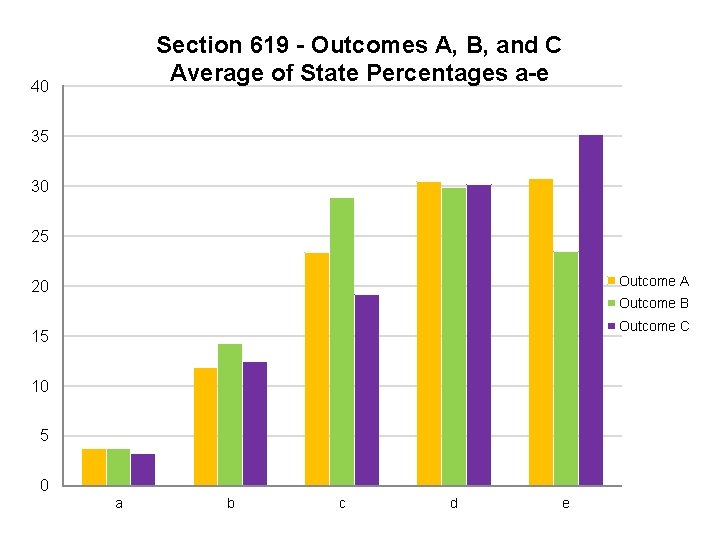
Section 619 - Outcomes A, B, and C Average of State Percentages a-e 40 35 30 25 Outcome A 20 Outcome B Outcome C 15 10 5 0 a b c d e
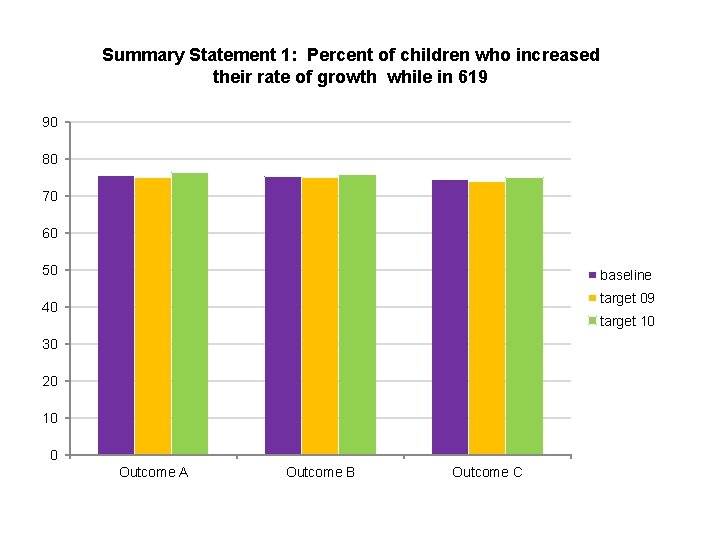
Summary Statement 1: Percent of children who increased their rate of growth while in 619 90 80 70 60 50 baseline target 09 40 target 10 30 20 10 0 Outcome A Outcome B Outcome C
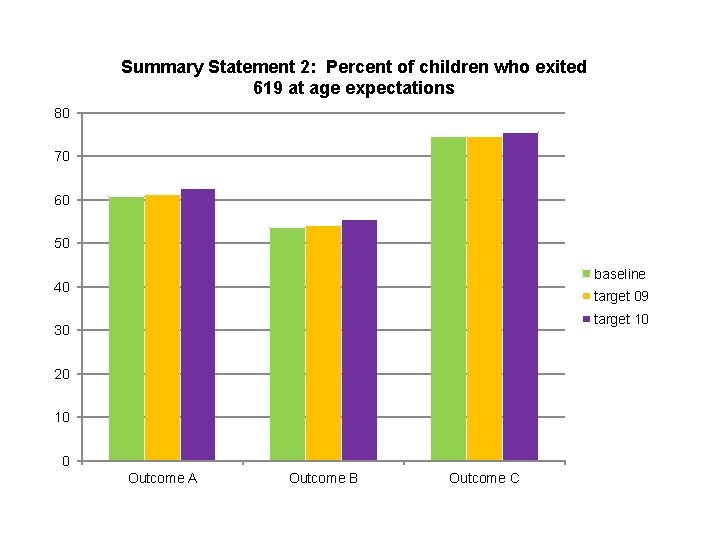
Summary Statement 2: Percent of children who exited 619 at age expectations 80 70 60 50 baseline 40 target 09 target 10 30 20 10 0 Outcome A Outcome B Outcome C
Early Childhood Outcomes Center 25