
EARLY BILINGUAL EDUCATION BY IMMERSION METHOD Edita Kriinien
EARLY BILINGUAL EDUCATION BY IMMERSION METHOD Edita Kriščiūnienė, 28 April 2018
IMMERSION METHOD
IMMERSION METHOD This method: • Attempts to recreate an environment close to that of bilingual family • Teaches language by using it in everyday activities • Is regarded by some researchers as the strongest method of foreign language teaching in strong native language environments • Is not suitable or may even be harmful in strong foreign language environments as it may drive assimilation.
IMMERSION METHOD The main results of Canadian research on immersion programs (Wesche 2002): • No negative influence on understanding of subject matter • No negative effect on the development of the native language • Much better foreign language skills compared to students of traditional teaching methods • Method suitable to students of varying capability levels.
FEATURES OF STRONG BILINGUAL PROGRAMS Linguistic criteria
SEPARATION OF LANGUAGES • Various ways to separate languages are possible – by alternating days, periods of a day, subjects. • Time must be allocated for activities in foreign language alone • The best strategy is to use one person one language method.
SEPARATION OF LANGUAGES Foreign language teacher: • Speaks in foreign language only • Speaks a lot (combines speech and actions, acting) • Avoids simplifying the language, uses rich vocabulary and variety of structures • If necessary, speaks slower, paraphrases • Does not translate or switch languages, but… • Repeats child’s sayings in foreign language • Changes, expands, paraphrases child’s sayings in foreign language • Rephrases using proper grammar in foreign language • Encourages children to use language, but uses no force. Source: Burmeister, P. ir Ania Steinlen. Early Immersion: Teaching Principles.
RATIO OF NATIVE AND FOREIGN LANGUAGE USE • Two language programs – approximately 50%-50%; • Immersion programs – approaching 80 -100%; • The more foreign language, the better results without negative influence on the native language • Opportunities to use the foreign language outside the kindergarten need to be considered.
GROUP COMPOSITION • Research on the appropriate group composition is quite scarce; however: • Ideally, the ratio of native and foreign language speakers that is at 2: 1 or lower encourages and creates opportunities for children to use the foreign language • Opportunities should be created for children to use the foreign language in an information environment; • Some researchers recommend grouping children by level of their foreign language for certain activities.
FEATURES OF STRONG BILINGUAL PROGRAMS Educational criteria
EDUCATIONAL CRITERIA These are criteria that speak of: • Qualities of instruction (teaching) plans • Teacher commitment to bilingualism and their readiness. Examples provided further in the presentation are from presentation by Petra Burmeister and Ania Steinlen Early Immersion: Teaching Principles (Ankstyvasis panardinimas: mokymo principai), ELIAS project.
RICH LEARNING ENVIRONMENT Multi-sensory learning: Explore content, composition, texture Get acquainted with terminology Practical application • These same categories are ‘recycled’ in foreign language various different ways in activities, songs, fairy tales. • Children are given positive feedback, are encouraged to express their understanding non-verbally too!
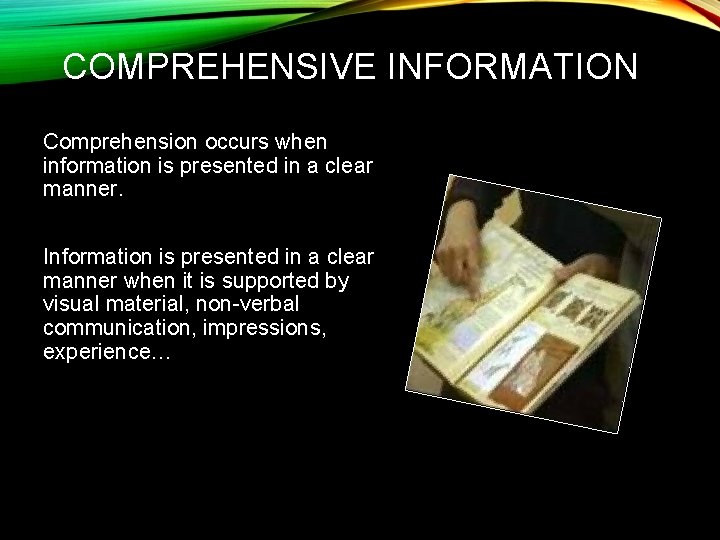
COMPREHENSIVE INFORMATION Comprehension occurs when information is presented in a clear manner. Information is presented in a clear manner when it is supported by visual material, non-verbal communication, impressions, experience…
COMPREHENSIVE INFORMATION Teacher contextualizes the foreign language: • Non-verbally: gestures, body language, pantomime • Verbally: references, directions ‘Look!’, ‘Here’, ‘There’, by accenting and selecting appropriate intonation • Visual materials: 3 D models, pictures, filmed material. • Other activities: • Stories with omitted words; • Performances, improvisation with children; • Finding differences / similarities in pictures • Problem solving together. The connection between what is being said and the situation must be obvious. “Silent movie” method
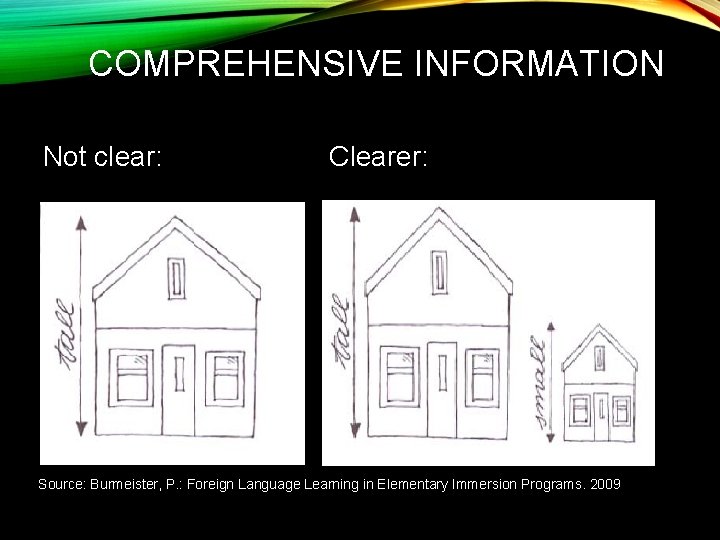
COMPREHENSIVE INFORMATION Not clear: Clearer: Source: Burmeister, P. : Foreign Language Learning in Elementary Immersion Programs. 2009
STRUCTURE THAT SUPPORTS LEARNING Appropriate structure to support learning: • Organizational structure: • Clear and anounced schedule • Sounds, pictures and other signaling for various activities. • Linguistic structure: • A set of standard names and expressions, a naming convention • Songs and poems used as signals.
FEATURES OF STRONG BILINGUAL PROGRAMS Sociocultural criteria
GOLDEN RULES OF A SUCCESSFUL PROGRAM Parents (family): • Trust the immersion method, support its application • Take interest in child’s activities and stories • Participate in kindergarten activities • Regularly read to child in native language • Engage in verbal communication with the child • Encourage the child to use the foreign language, but do not force to demonstrate his/her skills in front of friends, family, etc. • Cooperate with the teachers.
WHAT DID WE LOOK AT? • Immersion method • Features of strong bilingual programs: • Linguistic criteria • Educational criteria • Sociocultural criteria

I WISH YOU THE BEST OF LUCK AND PATIENCE IN YOUR DIFFICULT, BUT MEANINGFULL WORK!
USEFUL INFORMATION http: //www. elias. bilikita. org/
SOURCES Baker, Colin. Foundations of Bilingual Education and Bilingualism. 4 th ed. Tonawanda, NY: Multilingual Matters Ltd, 2006. Bulajeva, Tatjana, Lilija Duoblienė ir Nida Burneikaitė Ankstyvasis užsienio kalbų mokymas pradinėse klasėse. 2006 m. rugsėjis. 2008 m. sausio 31 d. http: //www. smm. lt/svietimo_bukle/docs/tyrimai/AUKM_prad_kl_atask 1. pdf. Burmeister, Petra ir Anja Steinlen. Early Immersion: Teaching Principles. Early Language and Intercultural Acquisition Studies, Comenius projektas finansuojamas Europos sąjungos. 2010 m. balandžio 15 d. http: //www. elias. bilikita. org/ Burmeister, Petra. Foreign Language Learning in Elementary Immersion Programs. 2010 m. balandžio 15 d. http: //www. elias. bilikita. org/docs/08_Burmeister_2009_Elementary_Immersion_Programs. pdf Čepulėnienė, Ona, Danutė Kolesnikova ir Irma Neseckienė, sudarytojos. Dvikalbis ugdymas: teorijos ir praktikos sąveika (2) Projekto medžiaga. Vilnius: LR švietimo ir mokslo ministerijos Švietimo aprūpinimo centras, 2003. Clarke, Priscilla. Investigating Second Language Acquisition in Preschools: A Longitudinal Study of Four Vietnamese-Speaking Children's Acquisition of English in a Bilingual Preschool. 1999. 2008 m. sausio 31 d. http: //www. eric. ed. gov. Cummins, Jim. Language, Power and Pedagogy: Bilingual Children in the Crossfire. Clevedon: Multilingual Matters Ltd, 2000. Filipovič, Natalia. Interviu. 2008 m. sausio 23 -24 d. Hakuta, Kenji. “Language and Cognition in Bilingual Children. ” Bilingual Education: Issues and Strategies. Eds. Amado M. Padilla, Halford H. Fairchild, and Concepcion M. Valadez. Newbury park, CA: Sage Publications, 1990. 47 -59. Howard Gardner. 2006. 2008 m. sausio 31 d. http: //www. howardgardner. com/MI/mi. html.
SOURCES Jonhnstone, Richard. Addressing ‘The Age Factor’: Some Implications for Languages Policy. Guide for the Development of Language Education Policies in Europe. From Linguistic Diversity to Plurilingual Education. 2002. 2008 m. sausio 31 d. http: //www. coe. int/t/dg 4/linguistic/Source/Johnstone. EN. pdf. Johnstone, Richard. “Characteristics of Immersion Programmes”. Bilingual Education: An Introductory Reader. Eds. Ofelia Garcia ir Colin Baker. Tonawanda, NY: Multilingual Matters Ltd, 2007. 19 -30. Jonhnstone, Richard. “Processes of Immersion Education”. Bilingual Education: An Introductory Reader. Eds. Ofelia Garcia ir Colin Baker. Tonawanda, NY: Multilingual Matters Ltd, 2007. 165 -176. King, Kendall ir Lyn Fogle. Raising Bilingual Children: Common Parental Concerns and Current Research. Apr 2006. 2008 m. sausio 31 d. http: //www. cal. org/resources/digest/Raise. Biling. Child. html. Lietuvos Respublikos švietimo ir mokslo ministerija and Europos Taryba. Language Education Policy Profile. 2003 -04. 2008 m. sausio 31 d. http: //www. coe. int/t/dg 4/linguistic/Profils 1_EN. asp. Lietuvos Respublikos švietimo ir mokslo ministerija. Language Education Policy Profile. Country Report. 2004 -06. 2008 m. sausio 31 d. http: //www. coe. int/t/dg 4/linguistic/Source/Country_Report_Lithuania_EN. pdf. Lindholm-Leary, Kathryn J. Review of Research and Best Practices on Effective Features of Dual Language Education Programs. 2005. 2008 m. sausio 31 d. http: //www. lindholmleary. com/resources/review_research. pdf. Lindholm-Leary, Kathryn J. Biliteracy for a Global Society: An Idea Book for Dual Language Education. 2000. 31 January 2008. http: //www. ncela. gwu. edu/pubs/ideabook/dual/. Lindholm, Kathryn J. “Bilingual Immersion Education: Criteria for Program Development. ” Bilingual Education: Issues and Strategies. Red. Amado M. Padilla, Halford H. Fairchild ir Concepcion M. Valadez. Newbury park, CA: Sage Publications, 1990. 91 -105. Mazolevskienė, Aldona. Priešmokyklinio amžiaus dvikalbių vaikų lietuvių kalbos gebėjimų ugdymas. Disertacija. Vilnius: Vilniaus pedagoginis universitetas, 2006.
SOURCES Mazolevskienė, Aldona. Priešmokyklinio amžiaus dvikalbių vaikų lietuvių kalbos gebėjimų ugdymas. Disertacija. Vilnius: Vilniaus pedagoginis universitetas, 2006. Mc. Laughlin, Barry. Myths and Misconceptions about Second Language Learning: What Every Teacher Needs to Unlearn. 1992. 2008 m. sausio 31 d. http: //www. ncela. gwu. edu/pubs/ncrcdsll/epr 5. htm. Mc. Laughlin, Barry, Antoinnette Gesi Blanchard ir Yuka Osanai. Assessing Language Development in Bilingual Preschool Children. Jun 1995. 2008 m. sausio 31 d. http: //www. eric. ed. gov. Milne, Rosemary ir Priscilla Clarke. “Bilingual Early Childhood Education in Child Care and Preschool Centres”. Melbourne: FKA Multicultural Resource Centre, 1993. 2008 m. sausio 31 d. http: //www. eric. ed. gov. Paurienė, Laima ir Antanas Valantinas. Ikimokyklinio ugdymo plėtra: ar keisime finansavimo modelį? Vilnius: LR švietimo ir mokslo ministerijos Švietimo aprūpinimo centras, 2006. Pearce, Marni. Kindergarten Guide to Implementation: Sharing Visions, Sharing Voices. Edmonton: Alberta Learning and Teaching Resources Branch, 2000. 2008 m. sausio 31 d. http: //www. eric. ed. gov. Piller, Ingrid. “Private Language Planning: The Best of Both Worlds? ” Estudios de Sociolingüística. Volume 2, 1 (2001): 61 -80. 2008 m. sausio 31 d. www. sociolinguistica. uvigo. es/descarga_gratis. asp? id=42. Progress Report. Public part. ELIAS (Early Language and Intercultural Acquisition Studies). Red. Kristin Kersten, Eva Frey ir Alexandra Hahnert. 2010 m. balandžio 15 d. http: //www. elias. bilikita. org/ Roberts, Cheryl A. “Bilingual Education Program Models: A Framework for Understanding”. The Bilingual Research Journal 19 (1995): 369 -378. 2008 m. sausio 31 d. http: //www. ncela. gwu. edu/pubs/nabe/brj/v 19/19_34_roberts. pdf. Rosberg, Merilee. Teaching English as a Second Language: How Young Children Learn. 1995. 2008 m. sausio 31 d. http: //www. eric. ed. gov.
SOURCES Skripkienė, Ramutė. Ankstyvasis užsienio kalbų mokymas: būtinybė ar mada? Vilnius: LR švietimo ir mokslo ministerijos Švietimo aprūpinimo centras, 2006. Snow, Catherine E. “Rationales for Native Language Instruction: Evidence from Research. ” Bilingual Education: Issues and Strategies. Red. Amado M. Padilla, Halford H. Fairchild ir Concepcion M. Valadez. Newbury park, CA: Sage Publications, 1990. 61 -74. Torres-Guzman, Maria E. “Dual Language Programs: Key Features and Results”. Bilingual Education: An Introductory Reader. Eds. Ofelia Garcia ir Colin Baker. Tonawanda, NY: Multilingual Matters Ltd, 2007. 50 -63.
- Slides: 25