
EARLY AND CLASSICAL CRIMINOLOGICAL THEORIES Dr Alberto Pimentel
EARLY AND CLASSICAL CRIMINOLOGICAL THEORIES Dr. Alberto Pimentel Jr
Theory ■ In the field of criminology, theory refers to efforts to explain or understand crime causation. – At times, skeptics of theory may wrongfully accuse criminologists of attempting to justify or excuse crime. – As students of criminology, we should avoid confusing the ability to explain why and how things happen with attempting to justify or defend crime.
Demonological Theory ■ Demonological Theory: assumes that supernatural forces cause and control crimes commission. ■ Supernatural explanations of criminality dominated thinking from early history until the 18 th century. ■ The criminal was viewed as a sinner who was possessed by demons or damned by otherworldly forces. ■ Humankind was viewed as at the mercy of the supernatural: fates, ghosts, furies, or spirits. ■ Those who committed crimes against humanity were viewed as being representations of the evil (within human nature) and pledging their allegiance to Satan.
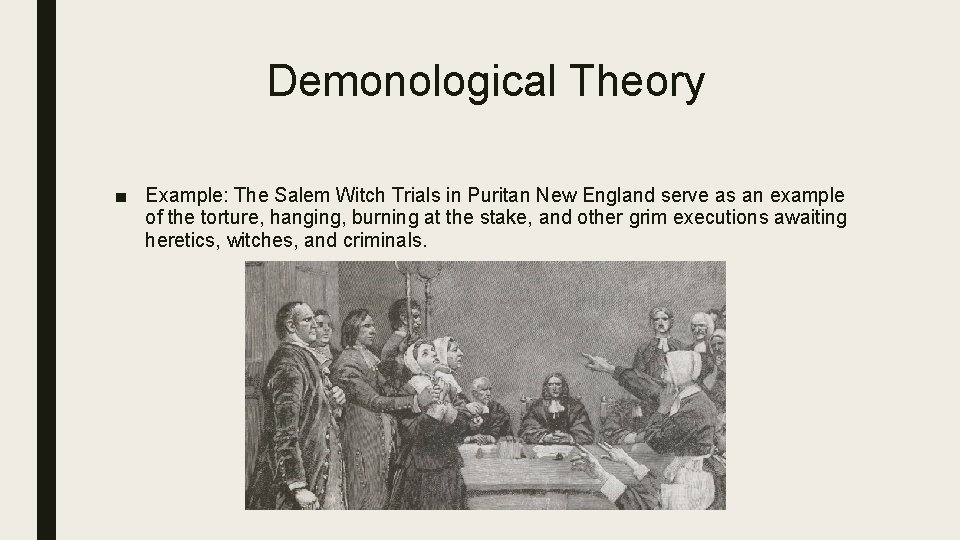
Demonological Theory ■ Example: The Salem Witch Trials in Puritan New England serve as an example of the torture, hanging, burning at the stake, and other grim executions awaiting heretics, witches, and criminals.
Classical Theory ■ Classical Theory (in criminology) refers to an approach that emphasizes free will and rationality on the part of the criminal actor. ■ Prior to the formulation and acceptance of classical theory, the administration of criminal justice in Europe was cruel, uncertain, and unpredictable. ■ In the 19 th century, England had more than 100 crimes punishable by death. ■ Penal policy was designed to control the “dangerous classes”. ■ As more liberal philosophies emerged, a greater emphasis on the natural rights of man and the influence of reason as a guide to regulating human conduct were promoted.
Classical Theory: Crime in Relation to Punishment ■ In the essay, ”On Crimes and Punishments”, Cesare Beccaria (1764) criticized the European judicial and penal systems because they were unpredictably harsh, exacted confessions by means of torture, and were completely subject to the whims of authorities. – – Believed that it made little sense to punish lawbreakers with unjust laws. Responsible for the abolition of torture as a legitimate means of exacting confessions. ■ Beccaria (1764) argued that potential criminals had no way of anticipating the nature of the criminal law and its accompanying penalty if violated, therefore, punishment had little deterrent value. ■ “Let the punishment fit the crime”…summation of Beccaria’s argument.

Classical Theory: Crime in Relation to Punishment ■ Beccaria’s thoughts on crime and punishment were considered radical in the 1700’s and his essay, “On Crimes and Punishment” was condemned by the Catholic Church. – The essay was placed on the Catholic Church’s “Index of Forbidden Books” for more than 200 years. ■ Beccaria proposed the following principles for the criminal justice system: – Laws should be made by legislatures, and they should be specific. – The role of judges is only to determine guilt and to follow strictly to the letter of the law in determining punishment. Judges should not interpret the laws. – The seriousness of crime should be determined by the harm it inflicts on society and be based on the pleasure/pain principle.
Classical Theory: Crime in Relation to Punishment – Punishment should be based on the seriousness of the crime and its ability to deter. – Punishment should not exceed that which is necessary for deterrence. – Excessive severity in punishment often increases crime that is then committed in order to avoid punishment. – Punishment should be sure, swift, and certain. – Capital punishment should be abolished as should the use of torture in order to gain confessions. – Laws should be structured so as to prevent crime in the first place. It is better to prevent crimes than to punish them. – All should be treated equally before the law.
Classical Theory: Hedonism and Crime ■ Jeremy Bentham saw the purpose of punishment to be deterrence rather than vengeance and was interested in the certainty of punishment than its severity. ■ Bentham is considered an advocate for “utilitarian hedonism”. ■ Utilitarianism is a practical philosophical view that claims “we should always act so as to produce the greatest possible ratio of good to evil for all concerned”. ■ Hedonism is a pleasure-seeking philosophy, the assumption that the main purpose of life is to maximize pleasure while minimizing pain. ■ According to the philosophy of “utilitarian hedonism”, individuals are viewed as entirely rational in their decision-making process in which they will attempt to increase the experience of pleasure, even from illicit desires, until the anticipated pain to be derived from a particular activity appears to outweigh the expected enjoyment.
Classical Theory: Hedonism and Crime ■ According to recent studies of career criminals, the pleasure or thrill of evil outweighs the fear of punishment. ■ Image, danger, glamour, and the excitement of crime overshadow any desire for a successful life in straight society.
Neoclassical Theory ■ Neoclassical Theory views crime as influenced by criminal opportunities to commit crime. ■ According to Becker (1968), individuals freely choose crime based on their estimate of their likelihood of being caught. ■ There is a cost-benefit analysis associated with the analysis of crime.
Neoclassical Theory: Rational Choice Theory ■ According to Cornish and Clarke (1986), offenders weigh the opportunities, costs, and benefits of particular crimes (rational choice theory). ■ Rational choice theorists do not argue that individuals are purely rational in their decision making but rather that they do consider the costs and benefits. ■ Rational choice theorists admit that much behavior is only partly rational but that most offenders know quite well what they are doing. ■ Crime is viewed as a situational choice, a combination of costs, benefits, and opportunities associated with a particular crime. – Increasing prevention or decreasing the opportunity to commit crime is viewed as an important means of deterring crime. ■ The criminal justice system must make crime less rewarding by increasing the certainty and severity of punishment.
Neoclassical Theory: Deterrence Theory ■ Deterrence Policy assumes rationality on the part of the actor, wherein specific deterrence serves to discourage a particular individual from repeating a crime and general deterrence targets others. ■ Mandatory sentencing policies reflect the assumption that the criminal is a rational actor and will be deterred by more sever and certain punishment. – “Just Deserts”: individuals must pay for their wrongdoing and that they deserve the punishment that is coming to them…an eye for an eye. – “Three strikes and you’re out”: third-time offenders receive very severe punishment for their crimes. (Evidence to suggest that this policy does not work).

Ecological Theory ■ Ecological Theory (Ecological School) is the school of thought that posits that crime is caused by environmental or geographic forces. ■ Deals with the interrelationship between human organisms and their environment. ■ The Ecological School was the first to attempt to apply official data and statistics to the problem of explaining criminality.
Ecological Theory: Using Crime Statistics ■ Andre Guerry is considered to be the founder of the ecological school of criminology. ■ In 1833, Andre Guerry published his first book on scientific criminology titled, “An Essay on Moral Statistics”. ■ Guerry used shaded areas on maps to describe and analyze variations in official crime statistics (in France). ■ Based on his study of crime statistics in France, Guerry concluded that property crime was higher in the wealthier areas on France because there were greater opportunities…burglary and theft occurred where more goods were available.
Ecological Theory: Using Crime Statistics ■ Lambert Quetelet is considered the father of modern sociological and psychological statistics. ■ According to Lambert Quetelet, group factors and characteristics influence an individual’s decision to engage in criminal activities. ■ In his book titled, “Treatise on Man and the Development of His Faculties” (1842), Quetelet argued that there was a remarkable consistency with which crimes appeared annually and varied with respect to age, sex, economic conditions, and other sociological variables. ■ The consistency of crime was described as the “annual budget of crime”…in other words, the stage and script (for engaging in crime) are provided by society, and only the faces playing the individual characters change.
Ecological Theory: Using Crime Statistics ■ In the book titled, “Research on the Propensity of Crime at Different Ages” (1831), Quetelet concluded that age was the greatest predictor of crime, with crime peaking at age 25. ■ According to Quetelet (1831), crime increases when an individual passes in an abrupt way from a state of ease to misery and to insufficiency in satisfying all the need which he has created. ■ Quetelet (1831) argued that the propensity for crime among younger adults and males and the tendency of crimes against persons increase during the summer and property crimes increase during the winter…. Thermic Law of Crime.
Economic Theory: Class, Crime, and Capitalism ■ Karl Marx was considered an economic determinist because he was an inspirational figure behind the economic theory of crime. ■ Economic Theory of Crime: views inequality and capitalism as the causes of crime. ■ Economic substructure determines the nature of all other institutions and social relationships in society. ■ The emergence of capitalism produces economic inequality in which the proletariat (workers) are exploited by the bourgeoisie (owners/capitalist class). ■ This exploitation creates poverty and is the root of social problems. ■ The history of all existing societies is one of class struggle.
Economic Theory: Criminal Law and Class ■ In the book titled, “Criminality and Economic Conditions”, Bonger (1916) argued that criminal law protected the interests of the elites aka the capitalist class. ■ Capitalist societies emphasized “egoism” (selfishness) rather than a sense of community and consensus (which exist in pre-capitalist societies). ■ Capitalism was viewed as precipitating crime by creating unequal access to the necessities of life as well as by viewing success in economic competition as a sign of status.
Economic Theory: Criminal Law and Class ■ Based on the writings of Bonger, Turk (1969) highlighted some of Bonger’s claims on criminality: – Notions of what constitutes crime vary among societies and reflect existing notions of morality. – Criminal law serves the interest of the ruling class in capitalist systems and is enforced by force rather than consensus. – Hedonism (pleasure seeking) is natural among people, but capitalism encourages egoism (selfish individualism) to an extreme and to the disadvantage of the society and the poor. – All groups are prone to crime in capitalist society, but seldom are the crimes of the wealthy punished. – – Poverty resulting from capitalism encourages crime. Most crimes would be eliminated in a socialist system in which the goods and wealth of a society would be equally distributed.
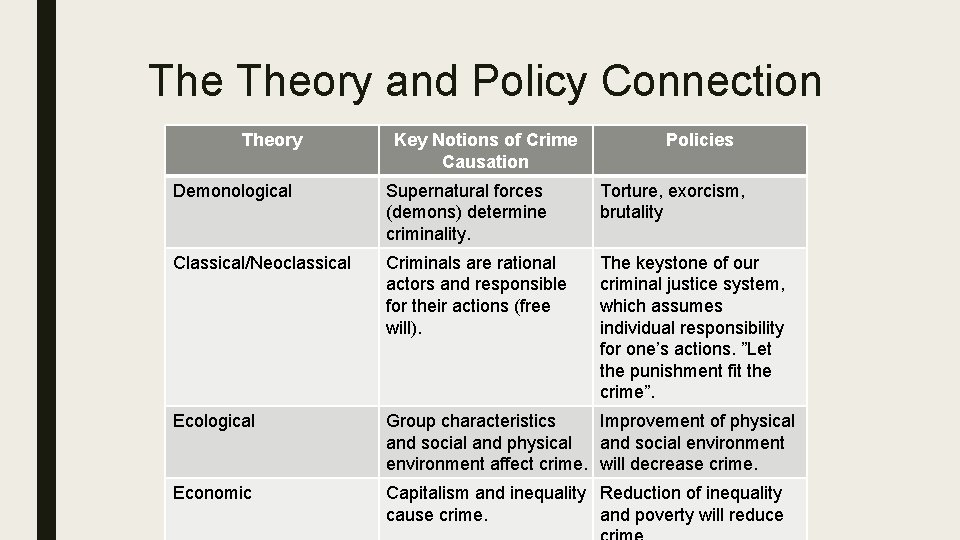
The Theory and Policy Connection Theory Key Notions of Crime Causation Policies Demonological Supernatural forces (demons) determine criminality. Torture, exorcism, brutality Classical/Neoclassical Criminals are rational actors and responsible for their actions (free will). The keystone of our criminal justice system, which assumes individual responsibility for one’s actions. ”Let the punishment fit the crime”. Ecological Group characteristics Improvement of physical and social and physical and social environment affect crime. will decrease crime. Economic Capitalism and inequality Reduction of inequality cause crime. and poverty will reduce
- Slides: 21