
Early African Civilizations 2000 B C E to
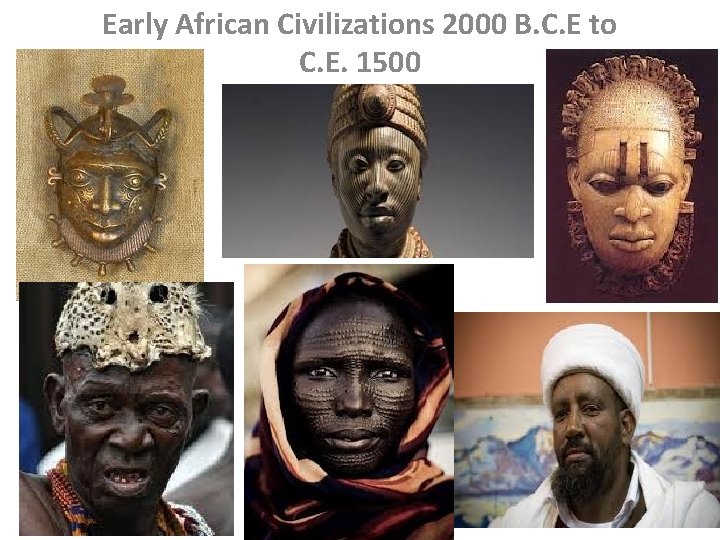
Early African Civilizations 2000 B. C. E to C. E. 1500 Ancient Africa
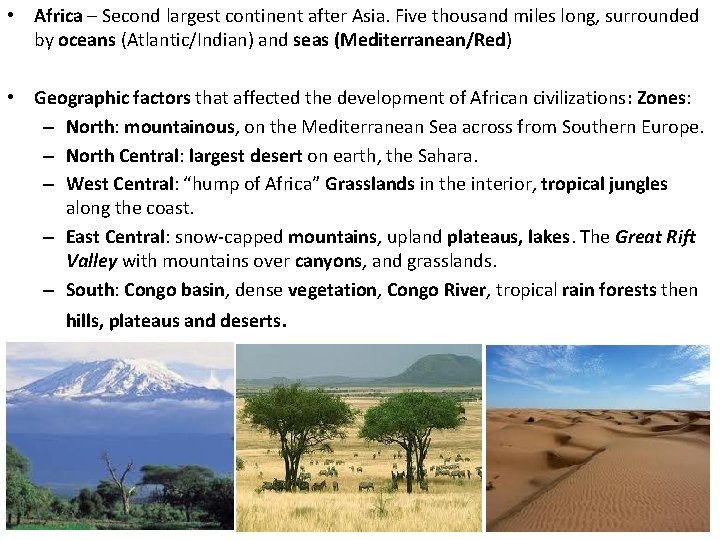
• Africa – Second largest continent after Asia. Five thousand miles long, surrounded by oceans (Atlantic/Indian) and seas (Mediterranean/Red) • Geographic factors that affected the development of African civilizations: Zones: – North: mountainous, on the Mediterranean Sea across from Southern Europe. – North Central: largest desert on earth, the Sahara. – West Central: “hump of Africa” Grasslands in the interior, tropical jungles along the coast. – East Central: snow-capped mountains, upland plateaus, lakes. The Great Rift Valley with mountains over canyons, and grasslands. – South: Congo basin, dense vegetation, Congo River, tropical rain forests then hills, plateaus and deserts.
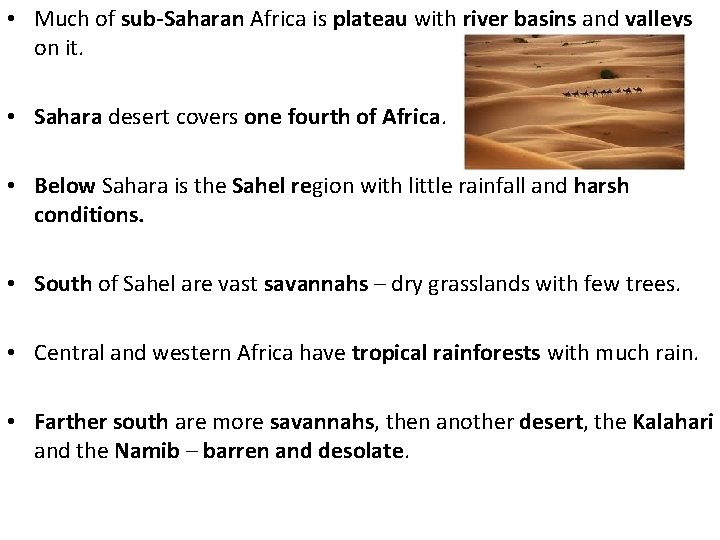
• Much of sub-Saharan Africa is plateau with river basins and valleys on it. • Sahara desert covers one fourth of Africa. • Below Sahara is the Sahel region with little rainfall and harsh conditions. • South of Sahel are vast savannahs – dry grasslands with few trees. • Central and western Africa have tropical rainforests with much rain. • Farther south are more savannahs, then another desert, the Kalahari and the Namib – barren and desolate.
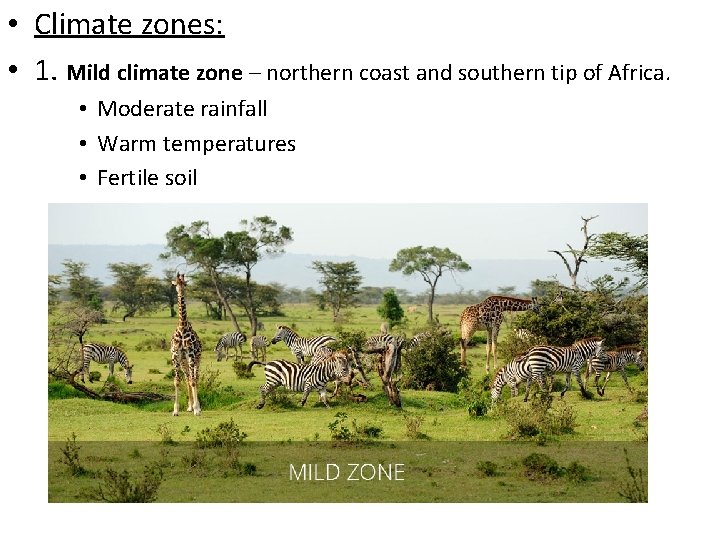
• Climate zones: • 1. Mild climate zone – northern coast and southern tip of Africa. • Moderate rainfall • Warm temperatures • Fertile soil
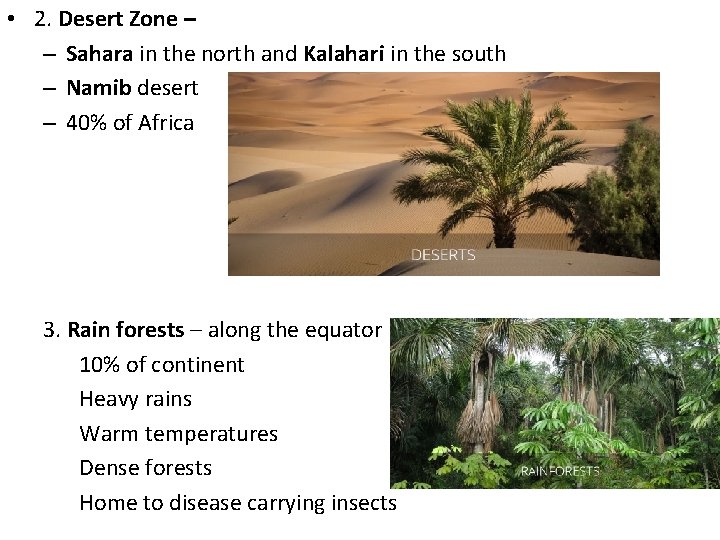
• 2. Desert Zone – – Sahara in the north and Kalahari in the south – Namib desert – 40% of Africa 3. Rain forests – along the equator 10% of continent Heavy rains Warm temperatures Dense forests Home to disease carrying insects
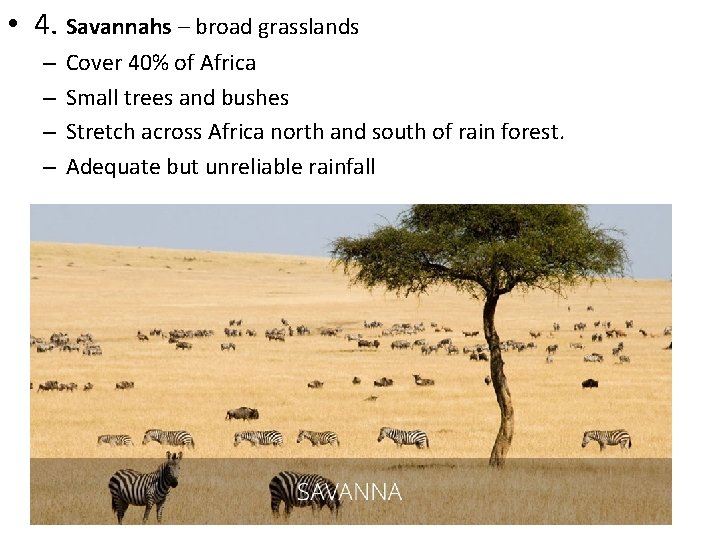
• 4. Savannahs – broad grasslands – – Cover 40% of Africa Small trees and bushes Stretch across Africa north and south of rain forest. Adequate but unreliable rainfall
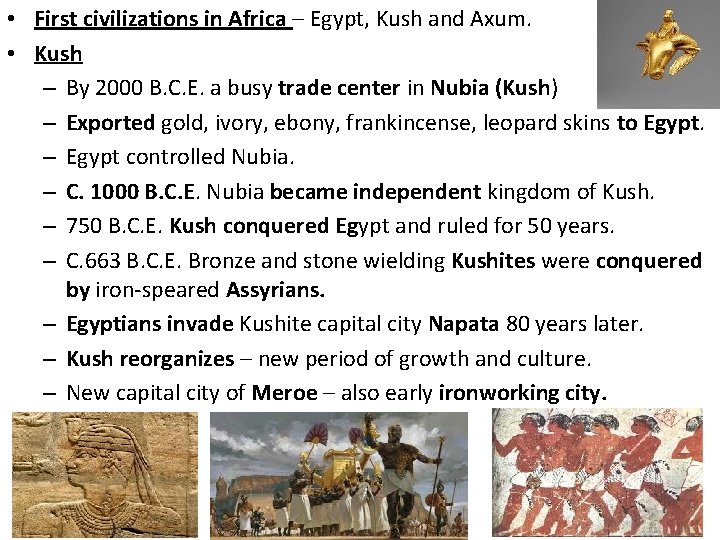
• First civilizations in Africa – Egypt, Kush and Axum. • Kush – By 2000 B. C. E. a busy trade center in Nubia (Kush) – Exported gold, ivory, ebony, frankincense, leopard skins to Egypt. – Egypt controlled Nubia. – C. 1000 B. C. E. Nubia became independent kingdom of Kush. – 750 B. C. E. Kush conquered Egypt and ruled for 50 years. – C. 663 B. C. E. Bronze and stone wielding Kushites were conquered by iron-speared Assyrians. – Egyptians invade Kushite capital city Napata 80 years later. – Kush reorganizes – new period of growth and culture. – New capital city of Meroe – also early ironworking city.
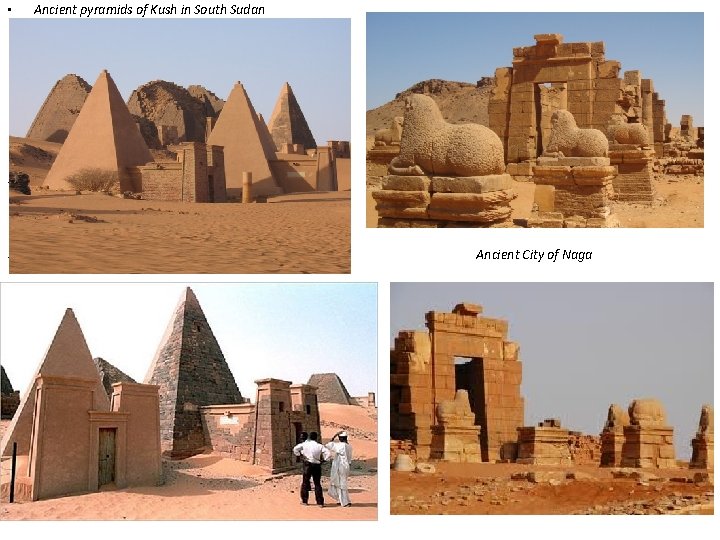
• Ancient pyramids of Kush in South Sudan • Ancient City of Naga • • • Ancient Kushite city of Naga
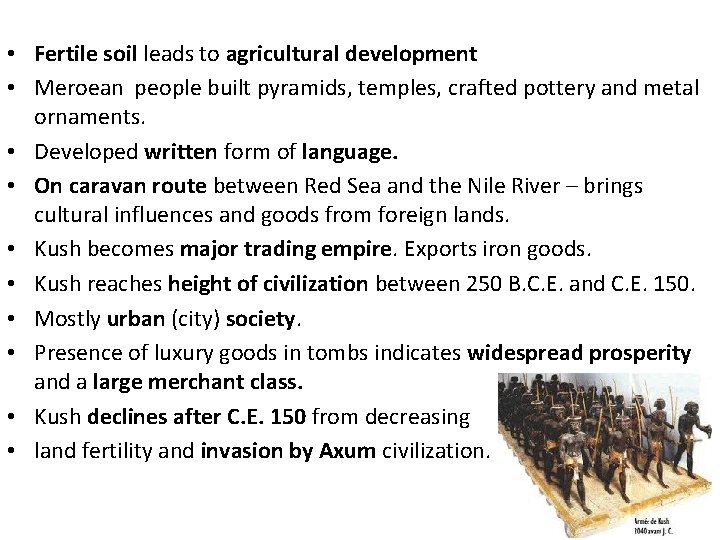
• Fertile soil leads to agricultural development • Meroean people built pyramids, temples, crafted pottery and metal ornaments. • Developed written form of language. • On caravan route between Red Sea and the Nile River – brings cultural influences and goods from foreign lands. • Kush becomes major trading empire. Exports iron goods. • Kush reaches height of civilization between 250 B. C. E. and C. E. 150. • Mostly urban (city) society. • Presence of luxury goods in tombs indicates widespread prosperity and a large merchant class. • Kush declines after C. E. 150 from decreasing • land fertility and invasion by Axum civilization.
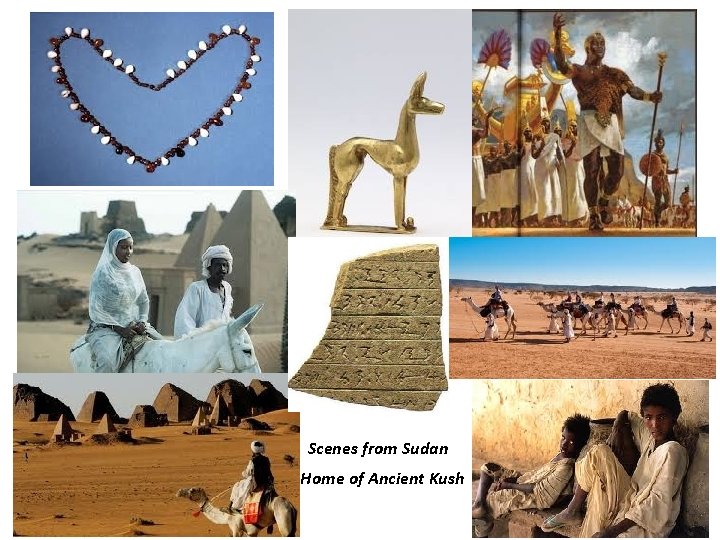
• Scenes from Sudan • Home of Ancient Kush

• Axum – founded as an Arab colony it lay south of Kush in the Ethiopian Highlands. – On trade route from Red Sea into Egypt and the African interior. – Develop trade in ivory, gold, rhinoceros horns, incense, decorative obsidian stone. – Imported glass, metal ornaments, pottery, wine and olive oil. – Minted its own coins.
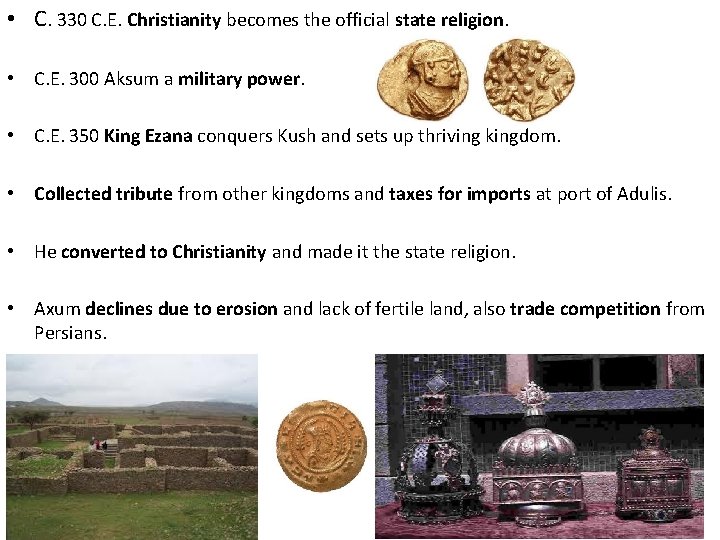
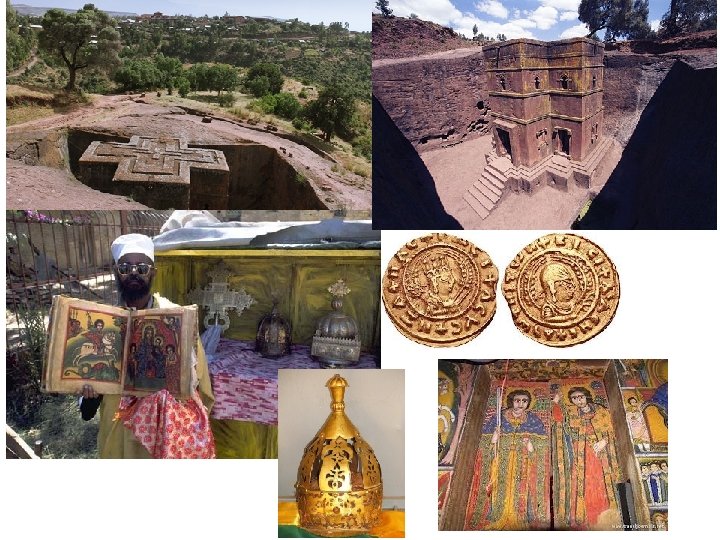
• C. 330 C. E. Christianity becomes the official state religion. • C. E. 300 Aksum a military power. • C. E. 350 King Ezana conquers Kush and sets up thriving kingdom. • Collected tribute from other kingdoms and taxes for imports at port of Adulis. • He converted to Christianity and made it the state religion. • Axum declines due to erosion and lack of fertile land, also trade competition from Persians.
West African Kingdoms Ghana, Mali, Songhai Wealth depended on control of trade routes across Sahara desert. Southern edge of Sahara – the Sahel – gold mines. Gold traded for salt from desert salt mines. Where gold-for-salt trade happened, cities grew up. Gold produced here until C. E. 1500. Then, exchanged ivory and slaves for jewels, copper, textiles. • Monarchs ruled kingdoms. Below the royal family were government officials. • Below officials came merchants, then farmers, fisher and cattle breeders. Slaves were the bottom of the social scale. • •
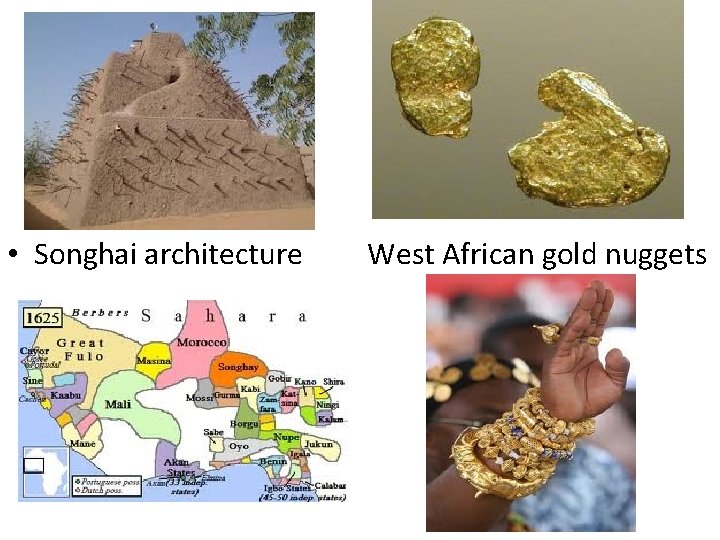
• Songhai architecture West African gold nuggets
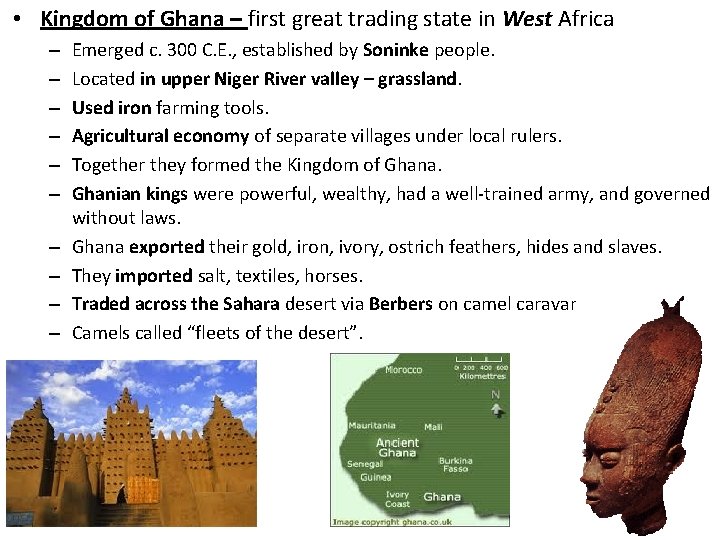
• Kingdom of Ghana – first great trading state in West Africa – – – – – Emerged c. 300 C. E. , established by Soninke people. Located in upper Niger River valley – grassland. Used iron farming tools. Agricultural economy of separate villages under local rulers. Together they formed the Kingdom of Ghana. Ghanian kings were powerful, wealthy, had a well-trained army, and governed without laws. Ghana exported their gold, iron, ivory, ostrich feathers, hides and slaves. They imported salt, textiles, horses. Traded across the Sahara desert via Berbers on camel caravans. Camels called “fleets of the desert”.
• Ghanaian kings acted as war leaders and negotiated trade with foreigners. • Large armies, conquered territory. • Reached peak c. 1050 C. E. • Most powerful king, Tunka Manin – C. E. 1067. • He commanded an army of 200, 000 – used bows, arrows, iron spears. • C. E. 100’s began to decline. • C. E. 1076 Berbers invaded and destroyed city of Kumi Saleh. • Soninke lose control of salt trade to neighboring tribes. • C. E. 1235, Malinke overthrew Ghana and establish empire of Mali.
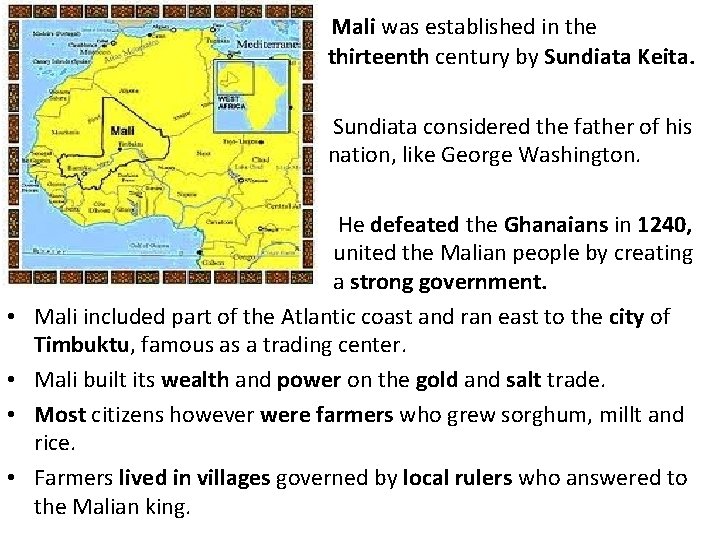
• Mali was established in the thirteenth century by Sundiata Keita. • Sundiata considered the father of his nation, like George Washington. • He defeated the Ghanaians in 1240, united the Malian people by creating a strong government. Mali included part of the Atlantic coast and ran east to the city of Timbuktu, famous as a trading center. Mali built its wealth and power on the gold and salt trade. Most citizens however were farmers who grew sorghum, millt and rice. Farmers lived in villages governed by local rulers who answered to the Malian king. • •
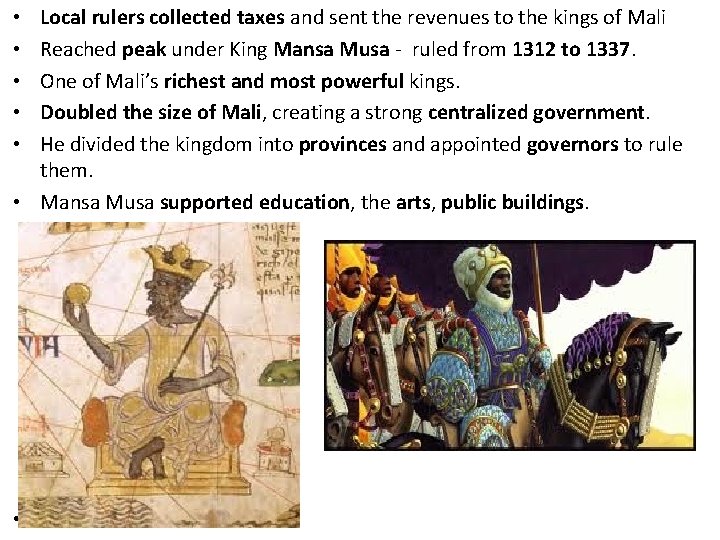
Local rulers collected taxes and sent the revenues to the kings of Mali Reached peak under King Mansa Musa - ruled from 1312 to 1337. One of Mali’s richest and most powerful kings. Doubled the size of Mali, creating a strong centralized government. He divided the kingdom into provinces and appointed governors to rule them. • Mansa Musa supported education, the arts, public buildings. • • • .
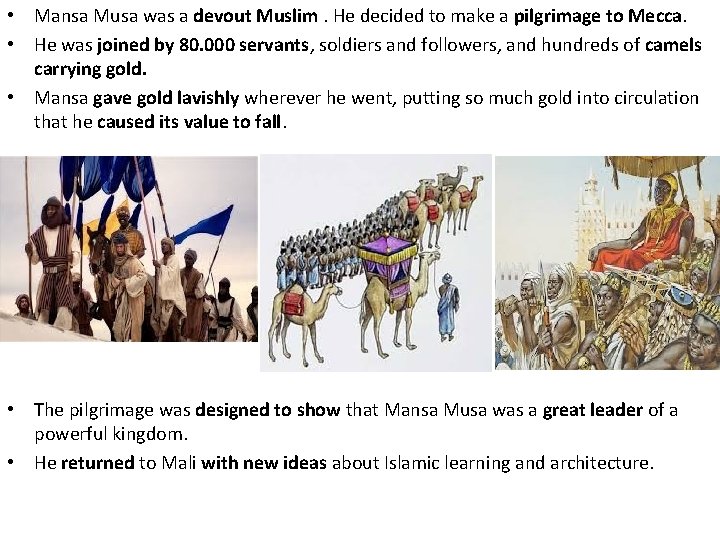
• Mansa Musa was a devout Muslim. He decided to make a pilgrimage to Mecca. • He was joined by 80. 000 servants, soldiers and followers, and hundreds of camels carrying gold. • Mansa gave gold lavishly wherever he went, putting so much gold into circulation that he caused its value to fall. • The pilgrimage was designed to show that Mansa Musa was a great leader of a powerful kingdom. • He returned to Mali with new ideas about Islamic learning and architecture.
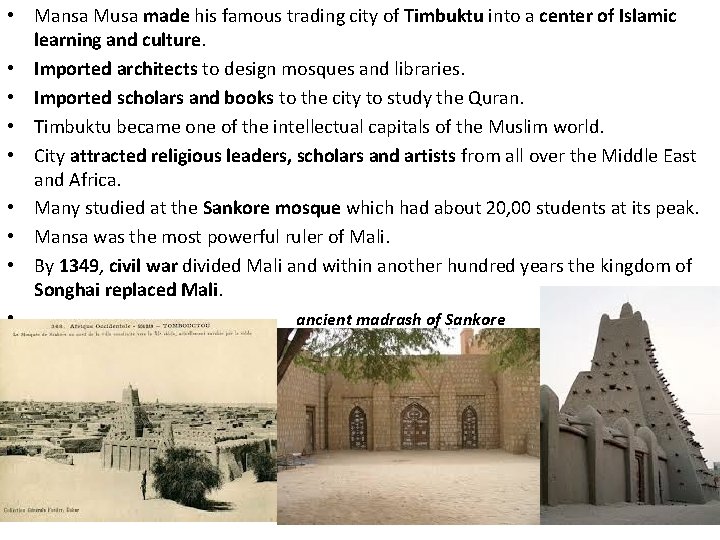
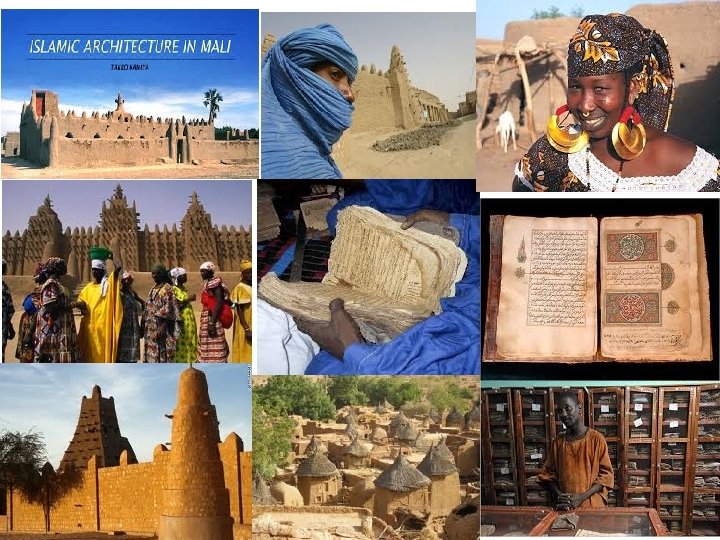
• Mansa Musa made his famous trading city of Timbuktu into a center of Islamic learning and culture. • Imported architects to design mosques and libraries. • Imported scholars and books to the city to study the Quran. • Timbuktu became one of the intellectual capitals of the Muslim world. • City attracted religious leaders, scholars and artists from all over the Middle East and Africa. • Many studied at the Sankore mosque which had about 20, 00 students at its peak. • Mansa was the most powerful ruler of Mali. • By 1349, civil war divided Mali and within another hundred years the kingdom of Songhai replaced Mali. • ancient madrash of Sankore
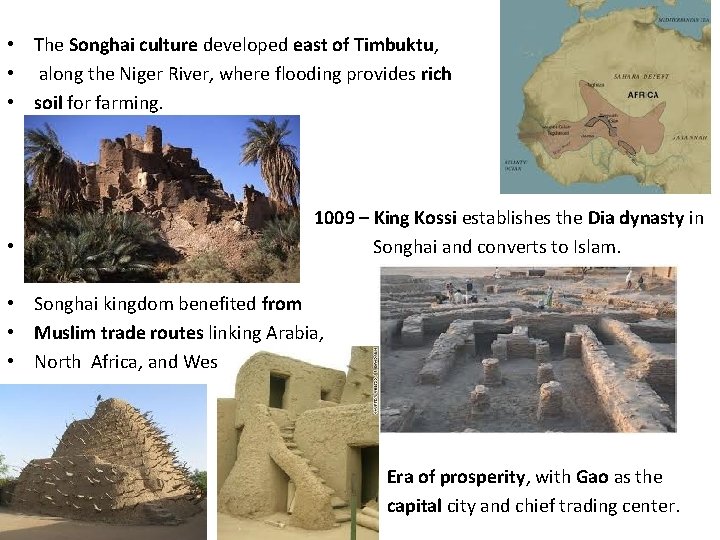
• The Songhai culture developed east of Timbuktu, • along the Niger River, where flooding provides rich • soil for farming. • 1009 – King Kossi establishes the Dia dynasty in Songhai and converts to Islam. • Songhai kingdom benefited from • Muslim trade routes linking Arabia, • North Africa, and West Africa. • • • Era of prosperity, with Gao as the capital city and chief trading center.
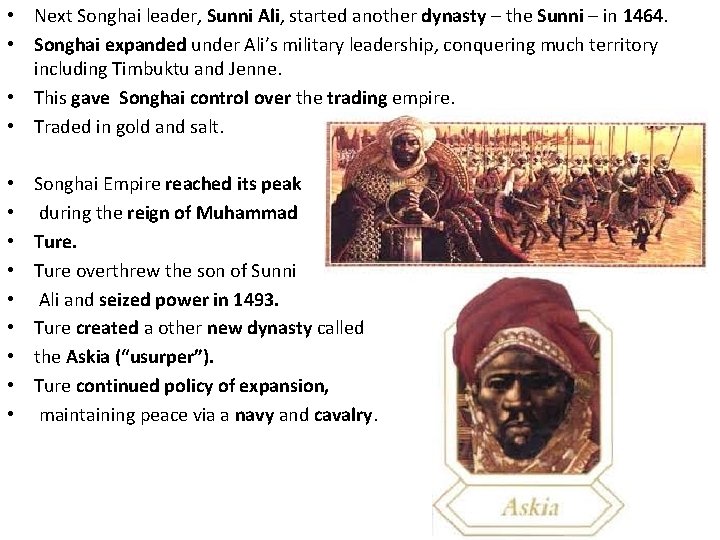
• Next Songhai leader, Sunni Ali, started another dynasty – the Sunni – in 1464. • Songhai expanded under Ali’s military leadership, conquering much territory including Timbuktu and Jenne. • This gave Songhai control over the trading empire. • Traded in gold and salt. • • • Songhai Empire reached its peak during the reign of Muhammad Ture overthrew the son of Sunni Ali and seized power in 1493. Ture created a other new dynasty called the Askia (“usurper”). Ture continued policy of expansion, maintaining peace via a navy and cavalry.
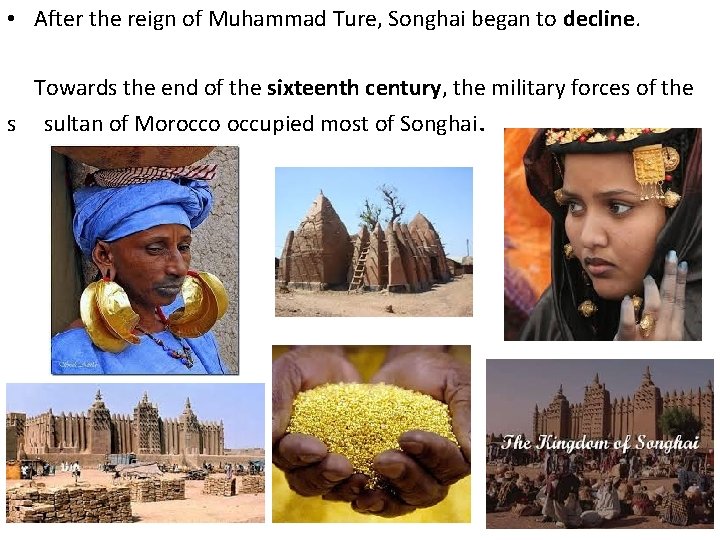
• After the reign of Muhammad Ture, Songhai began to decline. Towards the end of the sixteenth century, the military forces of the s sultan of Morocco occupied most of Songhai.
- Slides: 26