
Early Adulthood Transition to Adulthood Many milestones Achieved


- Slides: 45
Early Adulthood
Transition to Adulthood • Many milestones • Achieved more slowly now than in the past – Increased education – Later career entry – Delayed marriage • Prolonged identity development • Boomerang generation
Biological Theories on Aging • Cellular clock theory –cells can divide a maximum of about 70 -80 times – Telomeres, DNA sequences that cap chromosomes, become shorter each time a cell divides – Injecting telomerase in the lab extends the life of cells • Telomerase is common in cancer cells which is being used to combat cancer
Biological Theories on Aging • Free radical theory – when people metabolize energy the by products include unstable oxygen molecules, free radicals, which ricochet around causing damage to the cell – Free radicals can cause arthritis and cancer – Overeating is associated with increases in free radicals • Calorie restriction in lab animals is associated with longevity
Biological Theories on Aging • Mitochondrial theory – aging may be due to decay of the mitochondria, tiny bodies within cells responsible for energy, growth, and repair – Related to free radicals – Exercise in older adults increases mitochondrial activity in the cells – Defects in mitochondria are associated with cardiovascular disease, neurodegenerative diseases, and decline in liver functioning
Biological Theories on Aging • Hormonal stress theory- aging in the body’s hormonal system can lower resistance to stress and disease – As people age hormones released due to stress remain at higher levels longer • These are associated with increased risk for cardiovascular disease, cancer, diabetes, and hypertension – Decline in immune system function may also play a role
Biological Theories on Aging • Cross Linkage theory – As People age connective tissue form bonds reducing elasticity – Loss of flexibility in skin and other organs, clouding of the lens, clogging arteries, kidney problems can result • In ALL theories exercise is associated with better health and less decline
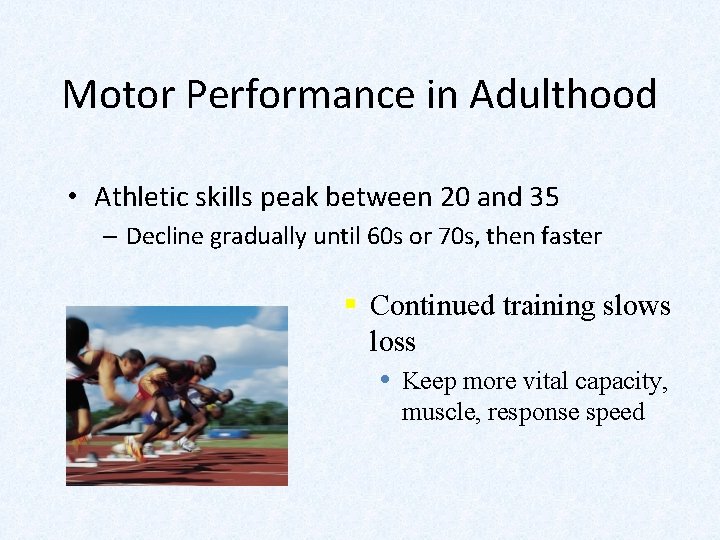
Motor Performance in Adulthood • Athletic skills peak between 20 and 35 – Decline gradually until 60 s or 70 s, then faster § Continued training slows loss Keep more vital capacity, muscle, response speed
Substance Abuse • Peaks from 19 -22 then declines • Binge drinking peaks in early adulthood • Some other substance abuse issues are also higher • Smoking, prescription drugs, “party drugs”, marijuana, and stimulants • 13% of men and 3% of women are heavy drinkers, 1/3 of these are alcoholics – Younger age at onset associated with increased risk of alcoholism
Heterosexual Sexual Activity in Early Adulthood • 90% have intercourse by age 22 • Most sex in the context of relationships – 70% only one partner in past year – Partners similar to each other • Sex infrequent – Only 1/3 twice a week or more – More often in 20 s, declines with age • Most are satisfied – Over 80% of those in relationships – Minority report problems
Sex Difference in Sexual Attitudes § Women more opposed to casual sex – More men looking for play and pleasure • Men more upset by sexual infidelity; women by emotional • Lifetime number of partners similar for men and women – Attitudes grow more similar with age
Homosexuality and Bisexuality in Early Adulthood § 2. 8% of men, 1. 4% of women Estimated 30% same-sex couples do not report § Similar behavior to heterosexuals • Public acceptance growing – Majority say it’s “OK, ” support civil liberties, job opportunities • Most well-educated; live in larger cities, college towns
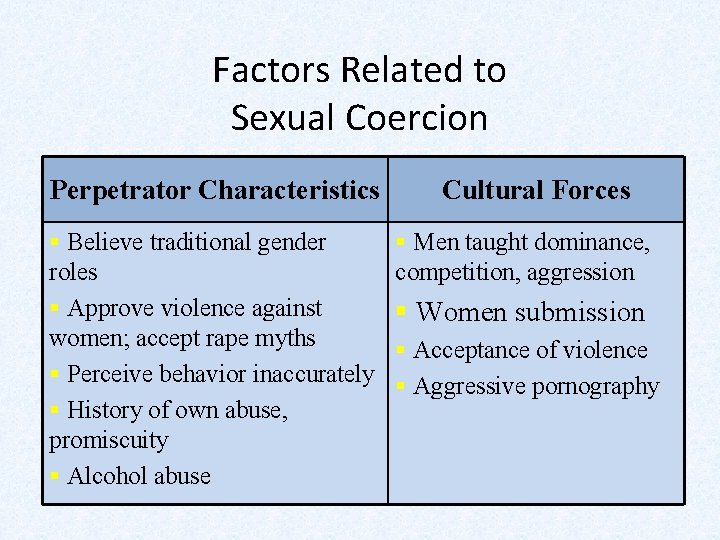
Factors Related to Sexual Coercion Perpetrator Characteristics § Believe traditional gender roles § Approve violence against women; accept rape myths § Perceive behavior inaccurately § History of own abuse, promiscuity § Alcohol abuse Cultural Forces § Men taught dominance, competition, aggression § Women submission § Acceptance of violence § Aggressive pornography
Development of Epistemic Cognition 1. Dualistic thinking 2. Relativistic thinking 3. Commitment within relativistic thinking § Challenges § Opportunities to reflect § Peers All help development
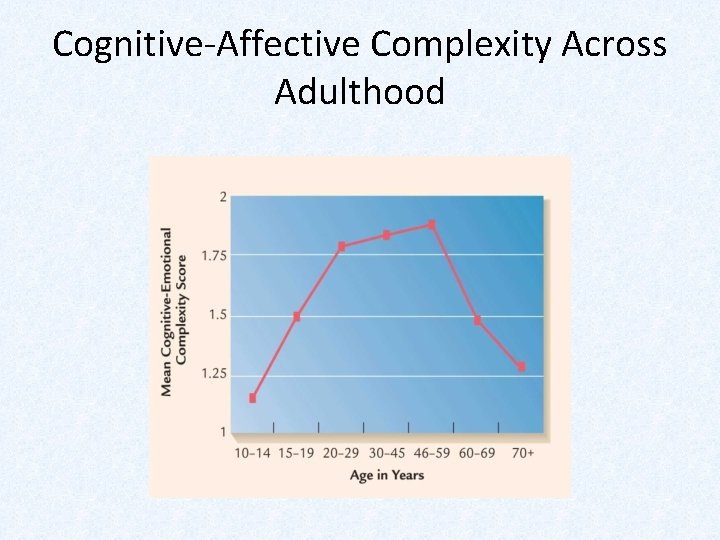
Cognitive-Affective Complexity Across Adulthood
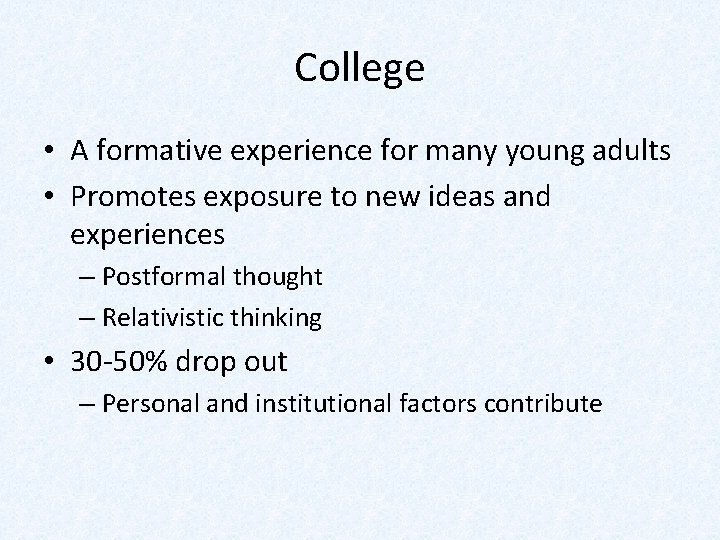
College • A formative experience for many young adults • Promotes exposure to new ideas and experiences – Postformal thought – Relativistic thinking • 30 -50% drop out – Personal and institutional factors contribute
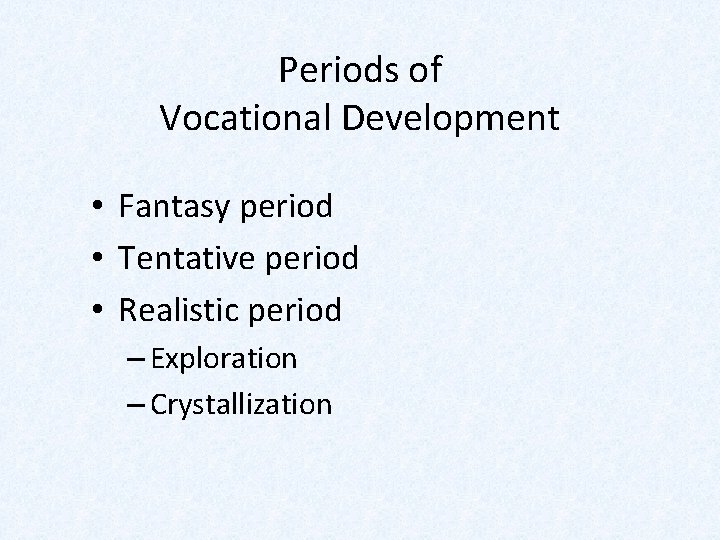
Periods of Vocational Development • Fantasy period • Tentative period • Realistic period – Exploration – Crystallization
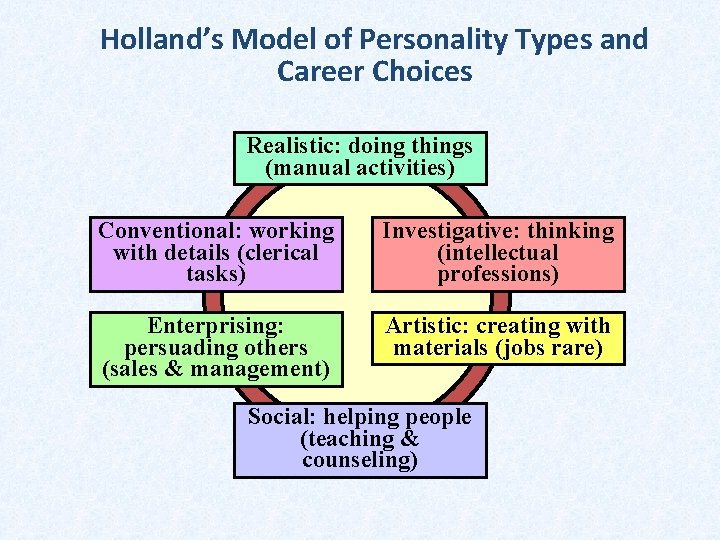
Holland’s Model of Personality Types and Career Choices Realistic: doing things (manual activities) Conventional: working with details (clerical tasks) Investigative: thinking (intellectual professions) Enterprising: persuading others (sales & management) Artistic: creating with materials (jobs rare) Social: helping people (teaching & counseling)
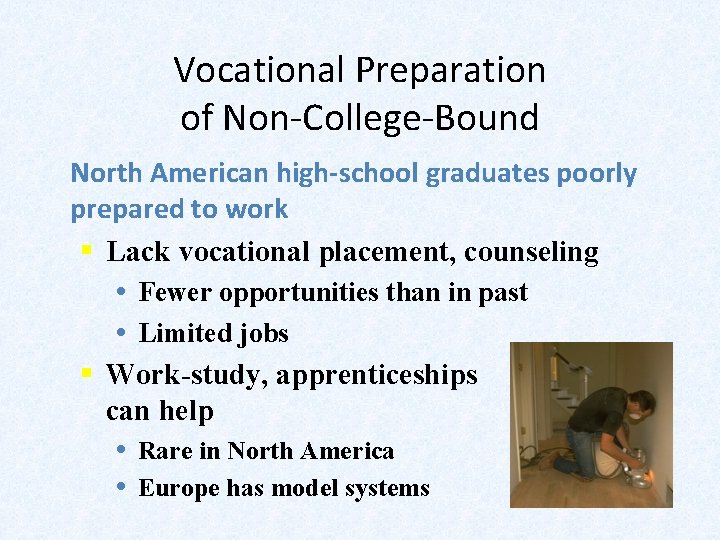
Vocational Preparation of Non-College-Bound North American high-school graduates poorly prepared to work § Lack vocational placement, counseling Fewer opportunities than in past Limited jobs § Work-study, apprenticeships can help Rare in North America Europe has model systems
Levinson’s Early Adult Season • Early adult transition – Dream – Mentor • Early adulthood life structure – Men: “settling down” – Women: continued instability, more roles • Age-30 transition – Reevaluate life structure – Often focus on underdeveloped aspects
Vaillant’s Adaptation to Life 20 s – intimacy concerns 30 s – career consolidation 40 s – generative 50 s– 60 s – “keepers of meaning” • 70 s – spiritual and reflective • •
Social Clock • Age-graded expectations for life events • Less rigid than in earlier generations • Following a social clock lends confidence, contributes to social stability • Distress if not following or falling behind
Stability from Childhood • Adult personalities are malleable as one ages. • Temperament involves emotions and the ability to control them. • Temperament is linked to adjustment in adulthood, with some stability from early childhood to adulthood. • The connections between childhood temperament and adulthood adjustment are based on a small number of studies.
Stability of Temperament • Major life events increase the likelihood of change • Inhibited toddlers are more likely to shy and withdrawn as adults – Also higher risk for adjustment difficulties • Higher self-regulation as young children is associated with better adjustment and greater success as adults
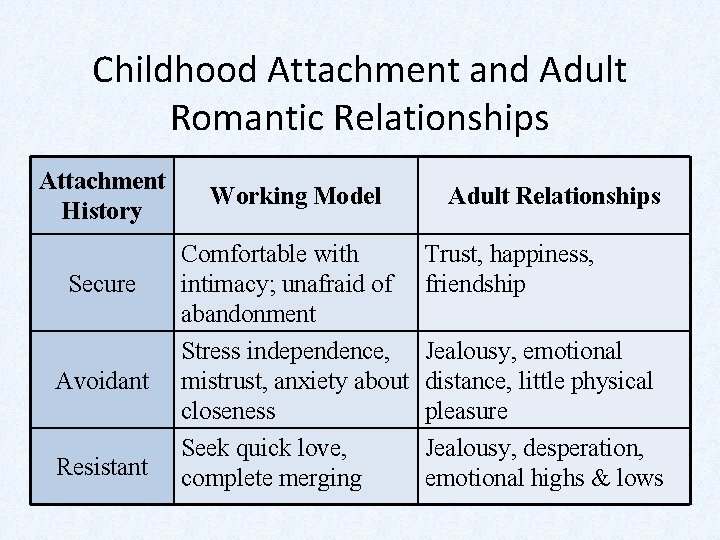
Stability of Attachment • Continuity is seen in the majority of securely attached children who enjoy secure relationships in adulthood. • The quality of childhood attachment relationships is linked to the quality of adult romantic relationships. • Other links exist between childhood attachment and relationship patterns in adulthood. • Not cast in stone, some individuals do revise their attachment styles as they experience relationships in their adult years.
• Attachment-related anxiety – degree to which individuals feel secure or insecure that a partner will be available, responsive, and available • Attachment-related avoidance – degree to which individuals feel comfortable relying on others, opening up to them, and being intimate with them
Childhood Attachment and Adult Romantic Relationships Attachment History Secure Avoidant Resistant Working Model Comfortable with intimacy; unafraid of abandonment Stress independence, mistrust, anxiety about closeness Seek quick love, complete merging Adult Relationships Trust, happiness, friendship Jealousy, emotional distance, little physical pleasure Jealousy, desperation, emotional highs & lows
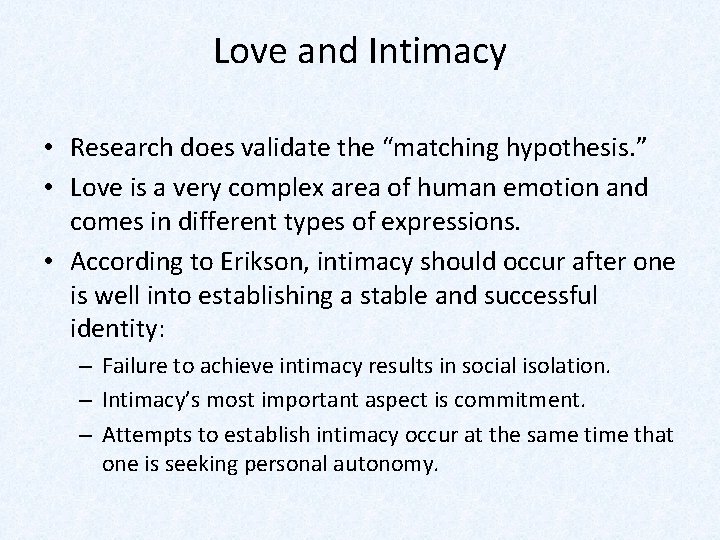
Love and Intimacy • Research does validate the “matching hypothesis. ” • Love is a very complex area of human emotion and comes in different types of expressions. • According to Erikson, intimacy should occur after one is well into establishing a stable and successful identity: – Failure to achieve intimacy results in social isolation. – Intimacy’s most important aspect is commitment. – Attempts to establish intimacy occur at the same time that one is seeking personal autonomy.
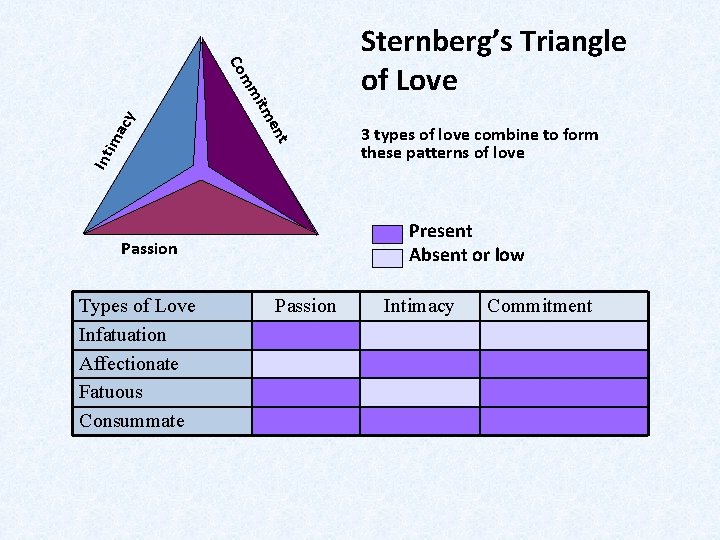
Co Sternberg’s Triangle of Love acy Int t en im itm mm Present Absent or low Passion Types of Love Infatuation Affectionate Fatuous Consummate 3 types of love combine to form these patterns of love Passion Intimacy Commitment
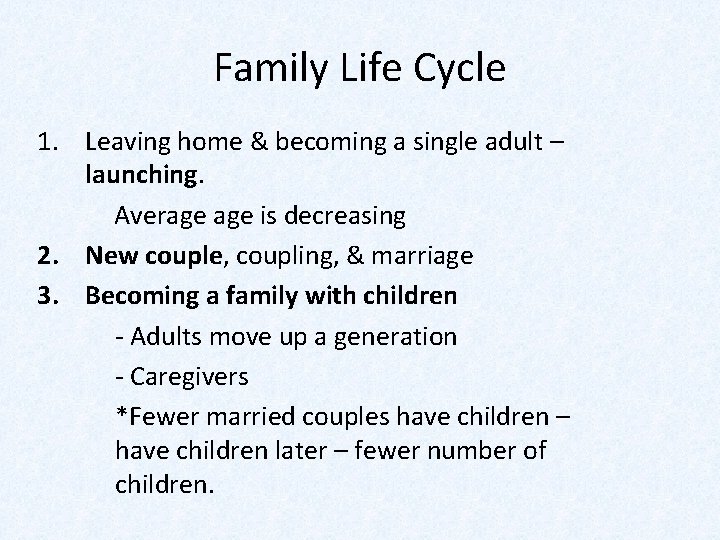
Family Life Cycle 1. Leaving home & becoming a single adult – launching. Average is decreasing 2. New couple, coupling, & marriage 3. Becoming a family with children - Adults move up a generation - Caregivers *Fewer married couples have children – have children later – fewer number of children.
Transition to Parenthood • Many profound changes • Roles often become more traditional – Roles get less traditional with second birth • Marriage can be strained – Problems before children predict problems after – Sharing care predicts happiness • Later parenthood eases transition – Couple’s groups, paid leave help
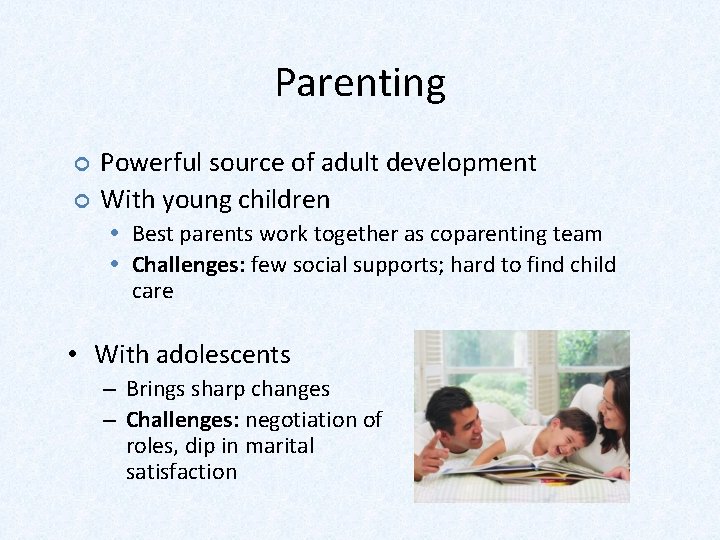
Parenting Powerful source of adult development With young children Best parents work together as coparenting team Challenges: few social supports; hard to find child care • With adolescents – Brings sharp changes – Challenges: negotiation of roles, dip in marital satisfaction
Parenting Trends – As birth control is common practice, many consciously choose when they will have children, and how many. – The number of one-child families is increasing. – Women are having fewer children, working outside the home more. – Fathers are spending more time in fathering. – There is widespread institutional childcare. – Women are becoming mothers later life, a large number after they are 35 years of age.
Friendship • Friendship is important throughout the life span • Friendship is a form of close relationship providing people with: – Enjoyment and spontaneity – Acceptance – Trust, respect, and mutual assistance – Confidences shared and a sense of understanding. • There are many functions of friendship • Siblings often become friends
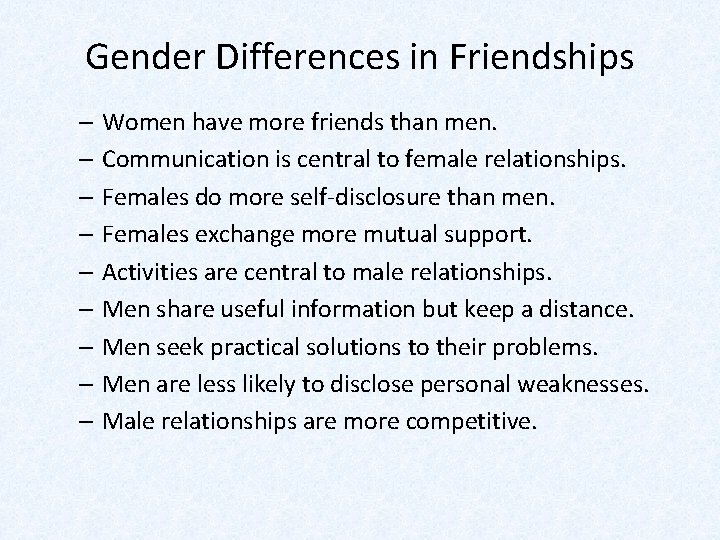
Gender Differences in Friendships – Women have more friends than men. – Communication is central to female relationships. – Females do more self-disclosure than men. – Females exchange more mutual support. – Activities are central to male relationships. – Men share useful information but keep a distance. – Men seek practical solutions to their problems. – Men are less likely to disclose personal weaknesses. – Male relationships are more competitive.
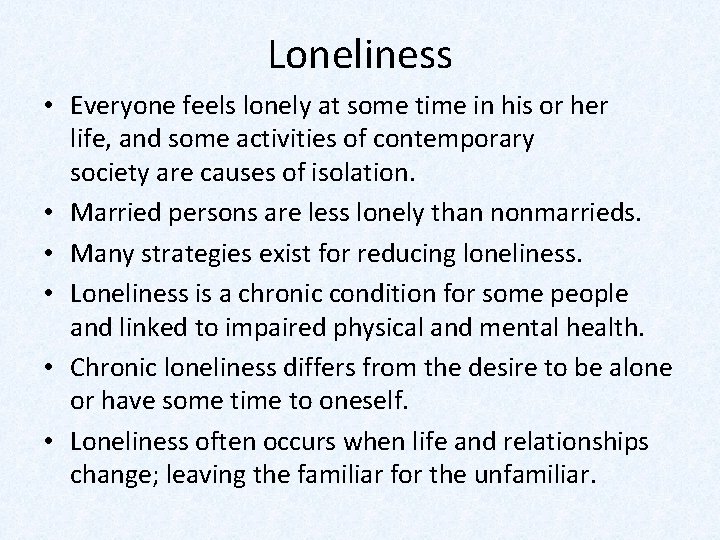
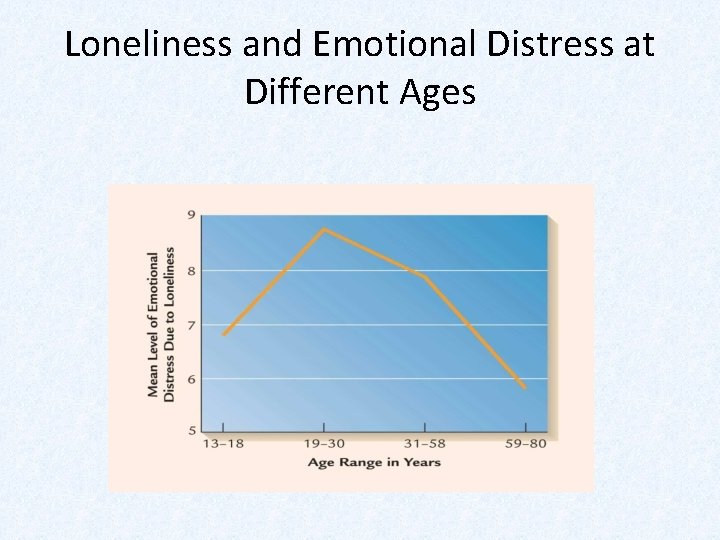
Loneliness • Everyone feels lonely at some time in his or her life, and some activities of contemporary society are causes of isolation. • Married persons are less lonely than nonmarrieds. • Many strategies exist for reducing loneliness. • Loneliness is a chronic condition for some people and linked to impaired physical and mental health. • Chronic loneliness differs from the desire to be alone or have some time to oneself. • Loneliness often occurs when life and relationships change; leaving the familiar for the unfamiliar.
Loneliness and Emotional Distress at Different Ages
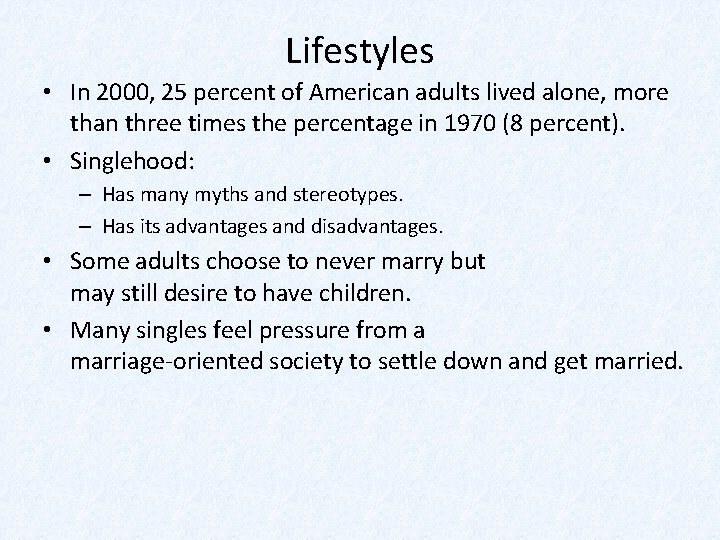
Lifestyles • In 2000, 25 percent of American adults lived alone, more than three times the percentage in 1970 (8 percent). • Singlehood: – Has many myths and stereotypes. – Has its advantages and disadvantages. • Some adults choose to never marry but may still desire to have children. • Many singles feel pressure from a marriage-oriented society to settle down and get married.
Cohabiting • Cohabiting has increased form 11% in 1970 to 50% in 2005 • Cohabiting relationships tend to be more equal than marriage relationships • Domestic violence rates are higher among cohabiting adults • May face disapproval • Legal issues can be complicated • Couples who marry after cohabiting are more likely to experience marital distress or divorce
Married adults • Average duration of a marriage is just over 9 years • Percentage of adults who rate their marriage as very happy declined 1970 -1990 but has since increased – Men are happier in their marriage than women • Happily married individuals live longer healthier lives than those who are divorced or unhappily married
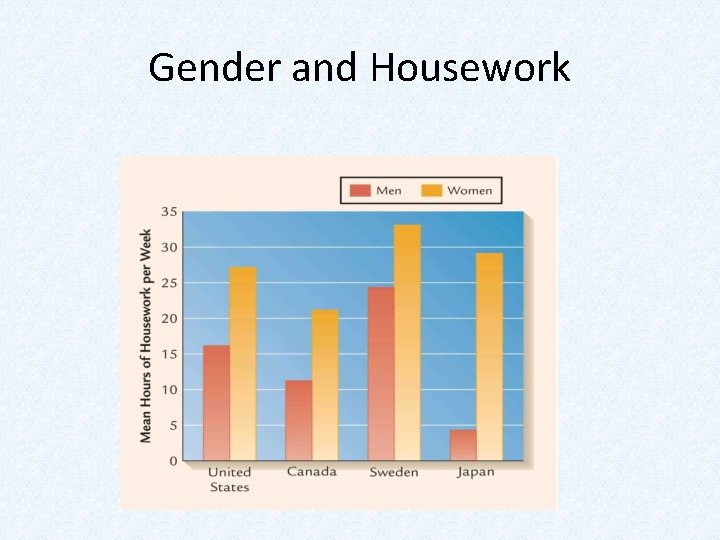
Gender and Housework
Divorce • Divorce is most likely within the first 10 years of marriage, most during 5 th to 10 th years • Youthful marriage, low SES, not religious, divorced parents, and having a baby prior to marriage increase the chance of divorce • Separation and divorce increase risk for psychological disorders, even among those initiating it
Women’s Development – Women place high value on relationships and focus on nurturing connections with others. – A large part of women’s lives are involved in actively participating in the development of others. – Women need to balance concern for relations with their own self-motivation.
Men’s Develeopment • According to Pleck’s role-strain view, male roles are contradictory and inconsistent. • Men experience stress when they violate men’s roles and when they act in accord with men’s roles. • Men experience considerable stress in: – Health. – Male-female relationships. – Male-male relationships.
Men’s Development • Men can reconstruct masculinity in more positive ways by: – Reexamining beliefs about manhood. – Separating out the valuable aspects of the male role. – Getting rid of masculine roles that are destructive. • This can be done through being more emotionally self-aware and being motivated to improve close relationships.