
EAP Task Force FEASIBLE tool prospects for further
EAP Task Force FEASIBLE tool: prospects for further developments Alexander Martoussevitch Paris, 23 February, 2007
Outline of the presentation n Objective of the presentation n FEASIBLE in progress n Ways forward EAP Task Force 2
Objective of the presentation n n Update you about the latest developments of FEASIBLE tool Present the remaining difficulties with the tool with regards to: – Data requirements – Functionalities – Dissemination n EAP Task Force Discuss ways forward 3
FEASIBLE in progress: Why a decision-support tool n n n Provide robust calculations to support policy dialogue Organise data collection and treatment Simulate alternative scenarios for sectoral policies – – EAP Task Force Targets Time frames Tariffs and subsidies, loans and grants «what-if» simulations quick and easy 4
FEASIBLE in progress: Key aspects of the tool n A tool: the FEASIBLE model, to – Assess the costs of alternative scenarios on the level of service – Measure available financial resources – Calculate a financial gap – Simulate the impact of various policy packages to close the financial gap n The model EAP Task Force – uses generic cost functions, adjusted for local conditions and prices – uses aggregated figures for territory under consideration, i. e. regional or national, but not local – calculates cash flow gap as key output 5
FEASIBLE in progress: Recent developments n 2000: FEASIBLE-1 – EXCEL-based – Urban WSS – Financing n 2002: Stand alone Module on MW – ACCESS-based n 2004: FEASIBLE-2 – Delphi-based – Integrate Modules on MW and WSS n 2006: new Module on Rural WSS – is being pilot tested in Armenia and Moldova, in co-operation with the EUWI EAP Task Force 6
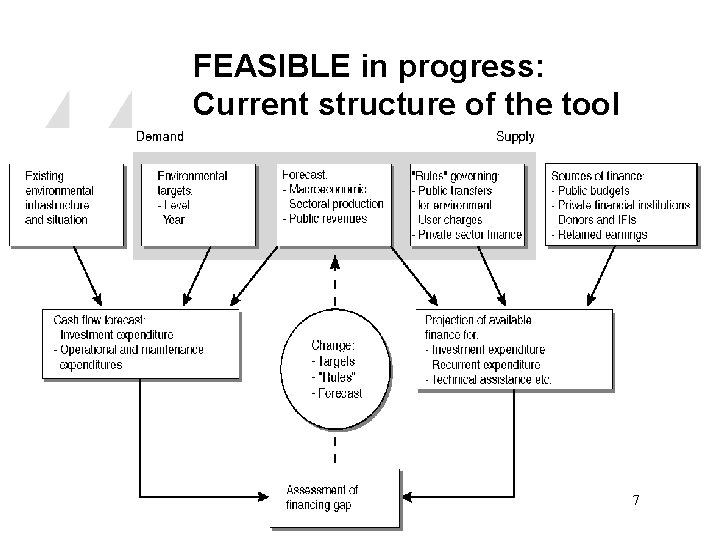
FEASIBLE in progress: Current structure of the tool 7
Ways forward: Adaptation of the tool n FEASIBLE – better ensure integrity of data – Refine the finance module (the module presents aggregated data, assuming crosssubsidisation between service providers) – generate additional output charts – improve scenario management (e. g. capacity to model non-regular water supply) – consider integrating marginal cost functions n EAP Task Force Documentation – the User manual (three years old) – the Guidelines on methodology – alternative methods to collect data in rural areas 8
Ways forward: Further dissemination n Working with consultancies: – COWI AS (Denmark, developer), JACOBS (UK), TME (Netherlands), the Institute for Urban Economics (Russia), other candidates (PWC, etc. ) n n n Requests for the tool from 66 individuals Working in other regions may require adaptation of the tool to the local context Comparison with similar tools – e. g. SWIFT for WSS n EAP Task Force Lower the “entry barrier” – Still remains relatively high: require 1 -2 day 9 training + a hotline
- Slides: 9