
EAP Tabletop Exercise Welcome GLASS CLUB DAM TX

EAP Tabletop Exercise Welcome… GLASS CLUB DAM (TX 04004) May 7, 2016
Tabletop Exercise Agenda �Introductions. �EAP and Dam Overview (Page 9). �Inundation Map Overview (Page 20). �Describe and Discuss Scenario. �Describe And Discuss Actions And Procedures, Especially As They Pertain To Specific Personnel. �Discuss Strengths, Weaknesses, Improvements, Etc. With The EAP.
GCL - Emergency Action Plan What, Why, Who, When, Where, How
GCL Emergency Action Plan What An EAP is a formal, dynamic document that identifies potential emergency conditions at a dam and specifies preplanned actions and communications to be followed to minimize property damage and loss of life.
GCL Emergency Action Plan Why �Required by TCEQ Regulations (TAC § 299). �Expedite effective responses to prevent a dam failure. �Prevent property damage and save lives. �Reduce dam owner’s potential liability.
GCL Emergency Action Plan Who All high and significant hazard dams are required to have an EAP.
GCL Emergency Action Plan When �Recurring requirements after EAP is accepted: – Annual Updates. �Send in pages that were updated. OR �Send in a letter stating no changes were necessary. –Tabletop Exercises • Required at least once every 5 years.
GCL Emergency Action Plan Where �A copy of EAP should be kept in an easily accessible location so it may be found quickly during an emergency. �Electronic copy on club website. �Copies at TCEQ, Morris County Sheriff, EMC, DPS, TXDOT, Engineer.
GCL Emergency Action Plan How �Prepared by Gayland Moreland in June 2013. �Guidelines for Developing Emergency Action Plans for Dams in Texas (GI-394). –PDF and Word copies on TCEQ website.
EAP Responsibilities Dam Owner – Glass Club Lake, Inc. �Write EAP. �Operation and Maintenance of Dam. �Detect a Problem/Emergency Situation at the Dam. �Decision Making/Notification of Emergency Response Agencies.
EAP Responsibilities TCEQ �Review and Accept EAP. �Provide Aide as Needed/Able. �Follow-Up.
EAP Responsibilities Emergency Management Coordinator (EMC) �Sign EAP/Acknowledge Roles and Responsibilities. �Issue Warnings to Affected Area(s). �Evacuations, as Necessary. �Coordination With Additional Emergency Response Agencies, as Necessary.
EAP Components � Title Page � Notification Flowcharts � Approval and Implementation Page � Purpose � General Description � Responsibilities � Emergency Detection, Evaluation, and Classification � Preventive Actions � Supplies and Resources � Training � Inundation Maps

Tabletop Exercise
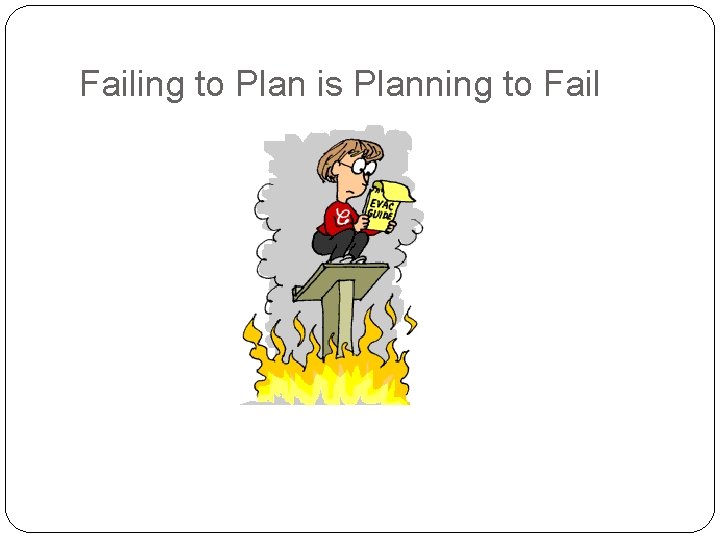
Failing to Plan is Planning to Fail
Tabletop Exercise Requirement �TAC § 299. 61(h) indicates that “The owner shall perform a table top exercise of the emergency action plan on the frequency provided in the owner’s emergency action plan, or at least every five years. A table top exercise is a meeting of the owner and the state and local emergency management personnel in a conference room setting. ”
Why Are Exercises Important? �Comply with States Rules and Guidelines. �Reduce owner’s potential liability. �Meet key players. �Confirm names, positions, contact information. �Establish clear lines of communication. �Identify unforeseeable problems. �Reduces false alarms.
Emergency Action Plan “An EAP is not worth the paper it’s printed on unless it works”.
What is a Tabletop Exercise �Informal meeting of key players involved with the EAP. �A hypothetical (but possible) scenario is provided and emergency actions/procedures are then discussed. �Focused more on problem-solving than decision making.
Benefits of a Tabletop Exercise �All responsible parties are together. �Informal meeting with low stress. �EMC can determine best available evacuation routes. –Will flooding block important access roads or evacuation routes? �Problems/issues with EAP are found and fixed that day. �Required by TCEQ.
After the Tabletop Exercise �Board should implement any changes found and discussed during the exercise. �Any changes/modifications should be submitted to the distribution list in the EAP. �Remember to schedule the next exercise in at least 5 years.
Purpose of Today’s Table Top Exercise �Provide a situation that could happen with the GCL dam and discuss actions that need to be taken as the situation changes. �Desired outcome is that we all learn to Identify life threatening situations and react to save lives and protect property. �Reduce property damage without overreacting and possibly compromising our credibility. �Improve the emergency action plan as needed.
Let’s start the Exercise. Scenario #1 Last night when you went to bed (10: 00 PM) it was raining real hard. It is still raining hard when you leave for work. You check your rain gauge or hear in the weather report that parts of Morris and surrounding counties have received 4” of rain in this storm and there is a flood watch in effect. Do we have any required EAP responsibilities? What should we do?
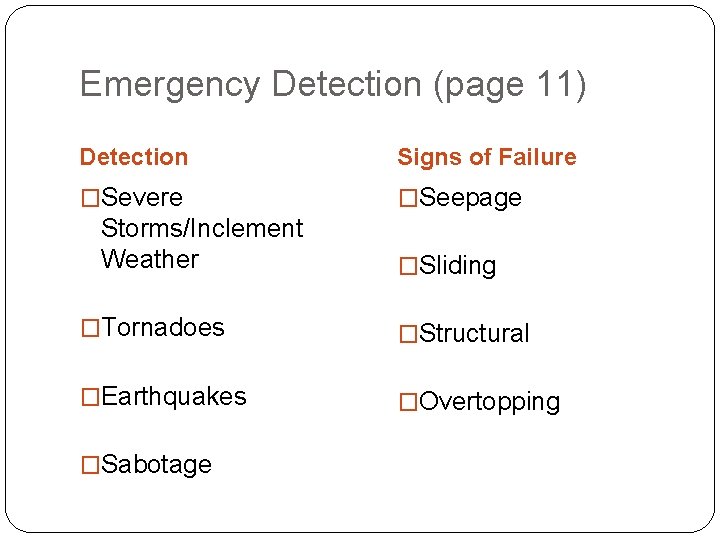
Emergency Detection (page 11) Detection Signs of Failure �Severe �Seepage Storms/Inclement Weather �Sliding �Tornadoes �Structural �Earthquakes �Overtopping �Sabotage
Scenario #1 (continued a) Assuming about 8 hours has gone by, 4” of rain is not enough to justify going to a “Watch Condition”. See page 12 of the emergency action plan. Remember a flood watch just means that the conditions are right for flooding to occur but that it has not necessarily happened yet. The condition that initiates the EAP process is the flood watch but a warning indicates that flooding is occurring. Perhaps the bigger issue here is who is responsible for starting the EAP process? Someone at the Lake (or maybe 2 people) should be aware that 4” of rain is a lot and bells and whistles should go off in their heads. Who do we need to alert? What do we need to do?
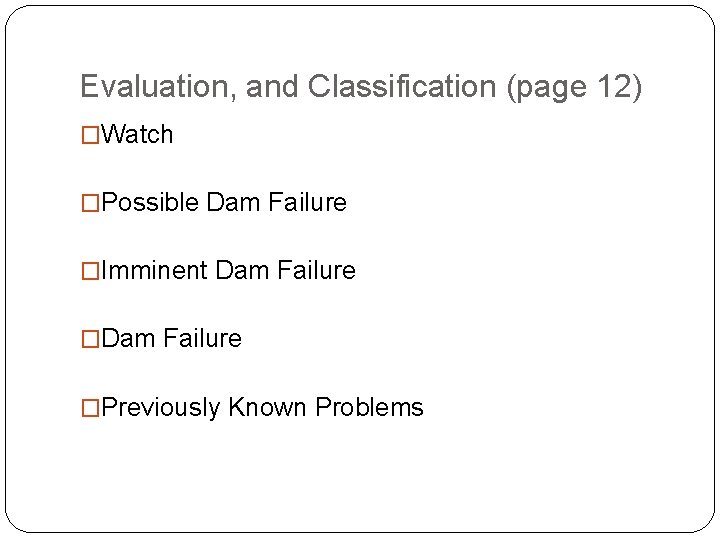
Evaluation, and Classification (page 12) �Watch �Possible Dam Failure �Imminent Dam Failure �Previously Known Problems
Scenario #1 (continued) Four inches of rain is certainly enough to justify reviewing our EAP process for the Dam. When you get to work, you turn on a radio, television or Internet to monitor the progress of the storm.
Scenario #1 (continued) As bulletins (in Blue) are received, discuss the situation with the group, decide what is required and act out the necessary steps. This gives us the opportunity to practice what we will say. Assume communications are working unless the person you are trying to reach says they can’t be reached. Also assume the Dam is accessible without putting anyone in danger. What are some sources for rainfall data: National Weather Service Other?
Scenario #1 (continued) Rain continues. At noon the local weather channel reports a flood warning has been declared with flooding in some areas of a 4 county wide area. Rainfall not reported. Required Actions?
Scenario #1 (continued) On page 10 of the Emergency Action Plan it states that the Dam Owner will initiate surveillance and notify the Morris County Emergency Management Coordinator in the event of a “possible dam failure” or more serious condition. At this time, under a “Watch” the distress condition is manageable by Board personnel. So at 4: 00 pm only ½ foot of water is flowing though the spillway, no notification to the County is required. However, as a “Watch” condition gets worse creating a developing situation that could cause the Dam to fail then appropriate authorities would be contacted.
Scenario #1 (continued) In our exercise the observer could not be contacted. Now what? Simple right? Contact the alternate dam observer. If they are unavailable, discuss how to proceed.
Scenario #1 (continued) Rain is slowing down but has not stopped: It is now 4: 00 PM. The observer returns home from work and gets the message left on his/her voicemail, went out to the dam and is reporting that it sounds like a freight train is running through the spillway. Water depth is about ½ ft. going over the spillway and the water just downstream is a cloudy chocolate brown with what appears to be bubbling and increased flow. The observer can’t tell if the water is rising or not. The observer has an evening commitment and will be out until late that night and must get home to change. Actions?
Watch Condition (p. 12) �Issue first detected. �Repair issue, if possible. �Monitor the dam. �Downstream residents notified on flowchart.
Scenario #1 (continued) Watch Condition: A problem has been detected at the dam which requires constant monitoring or immediate action to repair or correct. At this time, the distress condition is manageable by Board personnel. At Watch Condition a designated person should go to the dam site once a day. Someone from the Board should contact this person as a backup to make sure they are doing their job. We are all working together on this so you will not be insulting them if you call.
Scenario #1 (continued) Discussion: At Watch Condition, the County was not alerted. No alert needs to be made until the next stage “Possible Dam Failure Condition” is realized. The watershed is large covering over 800 acres so all the runoff may not have gotten to the Dam yet. The work is not over, however. Should the observer go out again tonight? Getting to the spillway is more difficult at night but if there is concern that the water will continue to rise then by all means make arrangements for your safety and go look again. Reflectors mounted on the gauge will help reflect light from a flashlight so depth can be seen.
Possible Dam Failure Condition (p. 12) �The ‘Watch’ condition continues to worsen. �Save the dam. �Consider notifying downstream residents, depending on how much the condition worsens.
Scenario #1 (continued) You wake up at my regular time, after sunrise. The sun is shining the birds are singing and the air is fresh from the recent rains. Time to enjoy life after your recent ordeal, right? Any other required duties from the EAP?
Scenario #1 (continued) The EAP requires that we continue the inspections until the Dam breaks or the water level starts to recede. So at least 1 more site visit is required? So you go down to the spillway observation point at 8: 00 AM on your way to work and the gauge reads 1. 2 feet over the spillway. You notice large boils of muddy water, increasing in size and increased flow rate, Are actions required?
Scenario #1 (continued) Has the trigger been satisfied to alert County Emergency Management Coordinator to initiate the EAP process? Who will make the notification? Think about what you will say and contact them, now if you haven’t already. Discussion: The “Possible Dam Failure” condition alerts the County time to mobilize its evacuation team so it is a critical step in the emergency action plan. In some watersheds the water level rises and recedes very quickly. In others there may be hours where the water level continues rise. Knowing how our watershed reacts is important information to know.
Scenario #1 (continued) Page 12, describes the “Possible Dam Failure Condition”. The correct step is to contact the County 24 hour dispatch center or Emergency Services Coordinator and declare a possible dam failure condition exists. See page 23 for the recommended message. So, a possible dam failure is eminent. How many trips to the dam should be done per day?
Scenario #1 (continued) Different television and radio stations are reporting different rainfall totals. Most are over 6”. Does this matter to us? At 2: 00 PM our alternate gauge observer reports the water level at 1. 0’, and muddy chocolate brown water flowing immediately downstream from the spillway section. Action required?
Scenario #1 (continued) The water has dropped from 1. 2’ to 1. 0’. Should we stop inspecting the dam? Discussion: We have met our good stewardship threshold but the erosion occurring in below the spillway could continue. Continue to inspect the Dam. The issue here is that if the erosion connects to the normal pool water then the Dam may fail through the spillway releasing a destructive wave downstream. That is what we are trying to warn people to get to safety from. One-foot of flow is certainly enough to continue the erosion process once it is started. Do we need to change the EAP to reflect a low water level at which to stop the EAP process?
Scenario #1 (continued) Remember you have the County as a partner in this operation, too. They have geared up to evacuate so you need to let them know the status of the flows so they can stand down also. We were lucky, no evacuation & no failure.
End of First Exercise BREAK
Let’s Begin - Senario #2 Let’s change the situation slightly to make another point. Go back to the 4: 00 PM report. At 4: 00 pm with only 0. 5’ flowing through the emergency spillway no notification was required. This time the observer reports that the muddy chocolate brown area is working its way back toward the spillway section and the Lake. A whirlpool is also seen on the lake side of the spillway. Does this change the situation?
Scenario # 2 (continued) You bet it changes things. We know that the sudden release of stored water in the impoundment is what causes the damage downstream. If the spillway is compromised by erosion the Dam could fail through the spillway. The proper action would be to decide if a breach is imminent. If the spillway is eroding rapidly then move to the “Possible Dam Failure Condition” and call the County and set the evacuation procedures into motion. At this point the roads behind the dam should be closed too. �Questions/Discussion:
Imminent Dam Failure Condition (p. 13) �Someone has determined that conditions will continue to progress and there will be an uncontrollable release of water from the reservoir. �Save lives. �Notify/evacuate downstream residents.
Scenario # 3 Go back to the 8: 00 AM report except now the situation has changed as follows: Rain is not slowing down. We have already declared “Possible Dam Failure Condition” and notified the County properly in accordance with the EAP based on our observers report. The water rose 1. 2’ in the 1 st 34 hours. At noon you call the observer and get no answer. No response from the alternate observer either. Wide spread power outages and telephone system breakdowns are being reported. Should we be concerned?
Scenario # 3 (continued) Remember, failure by erosion after overtopping is our biggest concern and at 8: 00 AM this morning we had some safety margin but remember the erosion rill downstream of the spillway caused by the increasing flowing muddy water. That may still cause us to go to the “Imminent Dam Failure Condition”. With the rain still coming down and the wind blowing another safety issue arises. Wind can cause waves across the Lake and the wave may overtop your dam. As the water level rises wave action should also be checked as it may be cause for early evacuation.
Scenario # 3 (continued) We never were able to reach our gauge observer, but a Deputy did go to the dam at 5: 00 PM. The water level was up to 2. 1’ on the gauge. It is still raining but the rain is not as hard as it had been. Board members and observers should be familiar with the gauge and observation locations at the Dam. Read Page 13. Evacuation conditions have now been exceeded to initiate warning of residents downstream. Time does exist between now and eminent dam failure. So there is still time to move to get people to higher ground. The question is always how much time do we have? Make sure that the County and TXDOT is contacted to close the roads. Are We Done Now?
Scenario # 3 (continued) It is the dam owner’s responsibility to monitor the dam continuously after the dam failure or until the water level starts to recede. Notification of the actual dam break is important to let evacuation staff get to higher ground. Our situation is that no EAP person is available and the Morris County has other critical duties at this time. Discussion on this problem?
Scenario # 3 (continued) Before notifying people to evacuate, the gauge observer(s) should be located or alternate observers should live close to the dam. Get them out to the dam so they can provide advance warning of the actual dam break. That will give evacuation staff enough warning (usually only minutes) to get up the hill. If they can’t be found, putting someone there to report is important. When the dam overtops failure may follow. Well maintained dams when overtopped can survive for a long time. The gauge observer should be able to see how quickly the dam is eroding and give the Emergency Management Coordinator advice on whether or not to get their evacuation team out of harms way.
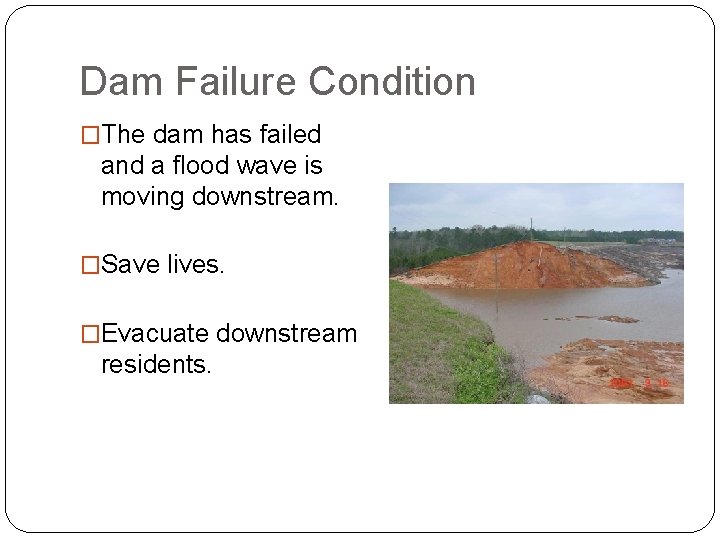
Dam Failure Condition �The dam has failed and a flood wave is moving downstream. �Save lives. �Evacuate downstream residents.
Scenario # 3 (continued) We are done when the dam breaks or the water level starts to recede. Should we continue to inspect periodically until the water level reaches a non-erosive velocity? Discussion, Questions, Comments.
Preventive Actions � Include a routine inspection schedule and identify the person responsible for conducting inspections. –Important to inspect after significant rain events. � Specify actions to be taken before and after development of emergency conditions to prepare for an emergency (alternate routes, surveillance, dark ). � Evidence of Distress. � Indicate procedures and measures for timely: –Emergency Detection. –Emergency Evaluation. –Emergency Classification.

EAP Tabletop Exercise End of Exercise Thanks for coming… GLASS CLUB DAM (TX 04004) May 7, 2016
- Slides: 56