
EAP 1 2 Induction Academic English and Skills

- Slides: 12
EAP 1 & 2 Induction Academic English and Skills for International Undergraduate Students
Outline • • • Basic information about the courses Aims and Assessment Brief overview of course materials Q & As Contact details
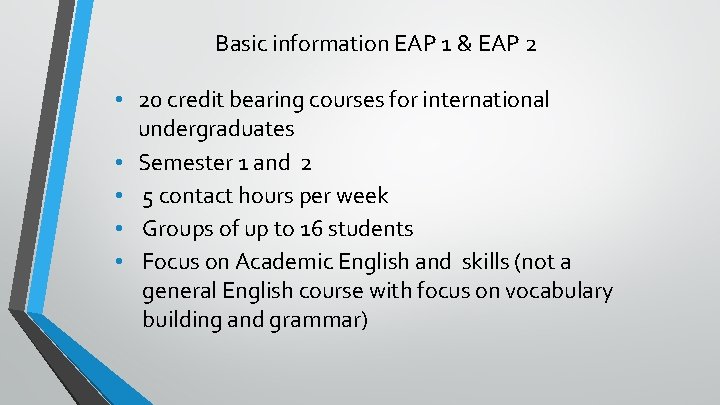
Basic information EAP 1 & EAP 2 • 20 credit bearing courses for international undergraduates • Semester 1 and 2 • 5 contact hours per week • Groups of up to 16 students • Focus on Academic English and skills (not a general English course with focus on vocabulary building and grammar)
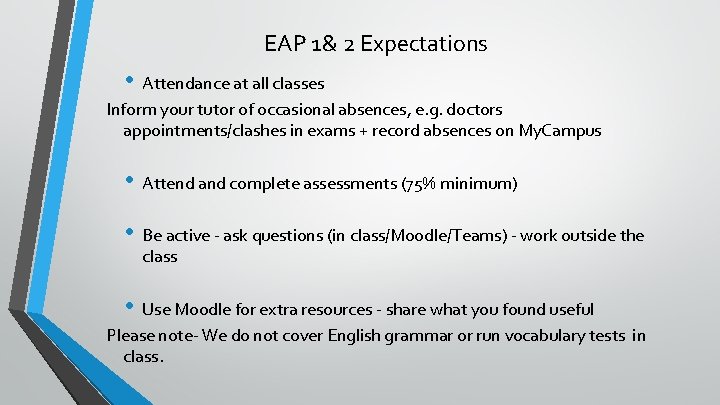
EAP 1& 2 Expectations • Attendance at all classes Inform your tutor of occasional absences, e. g. doctors appointments/clashes in exams + record absences on My. Campus • Attend and complete assessments (75% minimum) • Be active - ask questions (in class/Moodle/Teams) - work outside the class • Use Moodle for extra resources - share what you found useful Please note- We do not cover English grammar or run vocabulary tests in class.
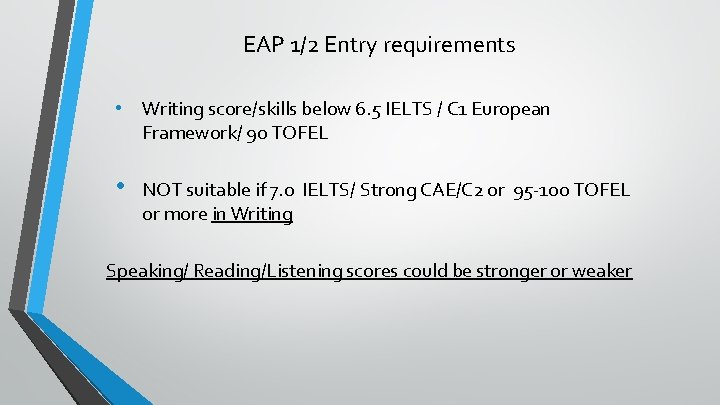
EAP 1/2 Entry requirements • Writing score/skills below 6. 5 IELTS / C 1 European Framework/ 90 TOFEL • NOT suitable if 7. 0 IELTS/ Strong CAE/C 2 or 95 -100 TOFEL or more in Writing Speaking/ Reading/Listening scores could be stronger or weaker
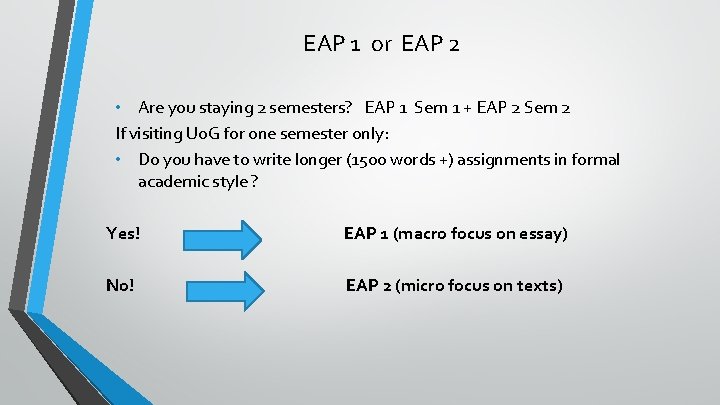
EAP 1 or EAP 2 • Are you staying 2 semesters? EAP 1 Sem 1 + EAP 2 Sem 2 If visiting Uo. G for one semester only: • Do you have to write longer (1500 words +) assignments in formal academic style ? Yes! EAP 1 (macro focus on essay) No! EAP 2 (micro focus on texts)
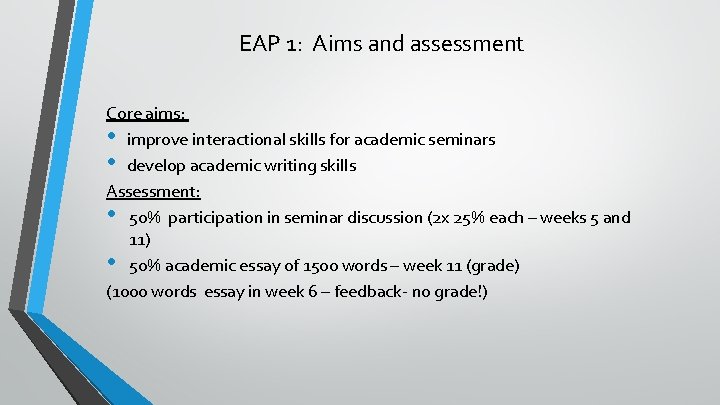
EAP 1: Aims and assessment Core aims: • improve interactional skills for academic seminars • develop academic writing skills Assessment: • 50% participation in seminar discussion (2 x 25% each – weeks 5 and 11) • 50% academic essay of 1500 words – week 11 (grade) (1000 words essay in week 6 – feedback- no grade!)
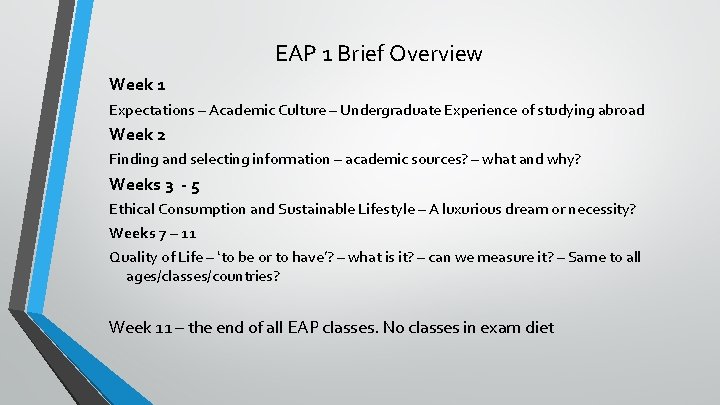
EAP 1 Brief Overview Week 1 Expectations – Academic Culture – Undergraduate Experience of studying abroad Week 2 Finding and selecting information – academic sources? – what and why? Weeks 3 - 5 Ethical Consumption and Sustainable Lifestyle – A luxurious dream or necessity? Weeks 7 – 11 Quality of Life – ‘to be or to have’? – what is it? – can we measure it? – Same to all ages/classes/countries? Week 11 – the end of all EAP classes. No classes in exam diet
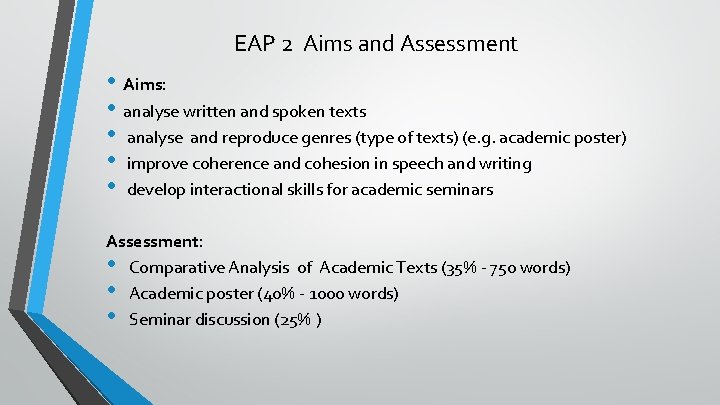
EAP 2 Aims and Assessment • Aims: • analyse written and spoken texts • analyse and reproduce genres (type of texts) (e. g. academic poster) • improve coherence and cohesion in speech and writing • develop interactional skills for academic seminars Assessment: • Comparative Analysis of Academic Texts (35% - 750 words) • Academic poster (40% - 1000 words) • Seminar discussion (25% )
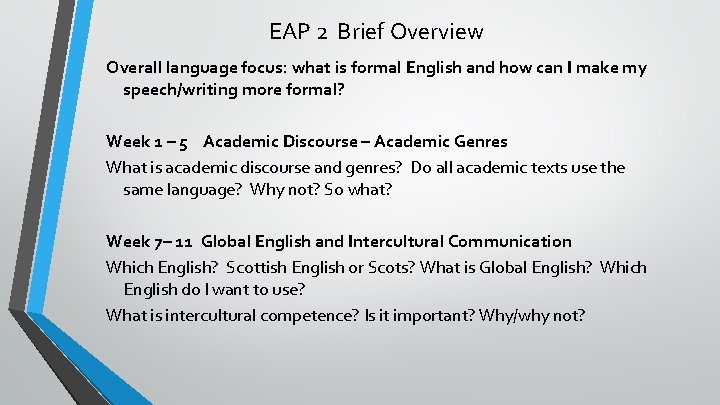
EAP 2 Brief Overview Overall language focus: what is formal English and how can I make my speech/writing more formal? Week 1 – 5 Academic Discourse – Academic Genres What is academic discourse and genres? Do all academic texts use the same language? Why not? So what? Week 7– 11 Global English and Intercultural Communication Which English? Scottish English or Scots? What is Global English? Which English do I want to use? What is intercultural competence? Is it important? Why/why not?
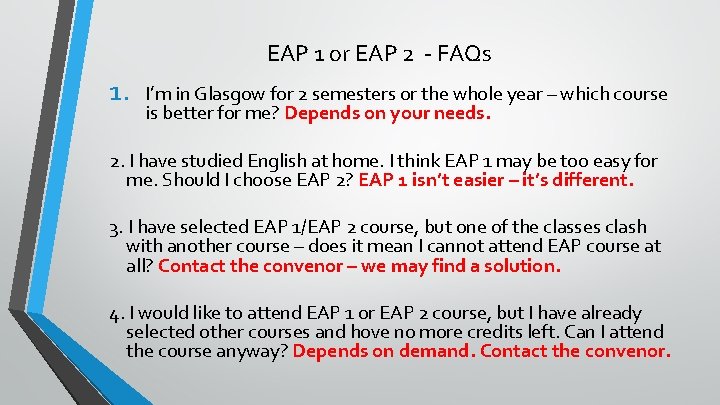
EAP 1 or EAP 2 - FAQs 1. I’m in Glasgow for 2 semesters or the whole year – which course is better for me? Depends on your needs. 2. I have studied English at home. I think EAP 1 may be too easy for me. Should I choose EAP 2? EAP 1 isn’t easier – it’s different. 3. I have selected EAP 1/EAP 2 course, but one of the classes clash with another course – does it mean I cannot attend EAP course at all? Contact the convenor – we may find a solution. 4. I would like to attend EAP 1 or EAP 2 course, but I have already selected other courses and hove no more credits left. Can I attend the course anyway? Depends on demand. Contact the convenor.
Contact details for EAP Convenors EAP 1 - Jolanta Hudson Jolanta. Hudson@glasgow. ac. uk EAP 2 Iwona Winiarska-Pringle iwona. winiarska-pringle@glasgow. ac. uk OR email our joined account for general/administrative questions: arts-eapconvenor@glasgow. ac. uk English for Academic Study School of Modern Languages and Cultures Tel: + 44 141 330 6082 Hetherington Building