
Eagle Sat1 Flight Operations Madison Padilla EmbryRiddle Aeronautical
Eagle. Sat-1: Flight Operations Madison Padilla Embry-Riddle Aeronautical University Aerospace Engineering, Senior AZ/NASA Space Grant Symposium April 13 -14, 2018 1
Overview • • • Ground system overview Ground system breakdown Graphic user interface (GUI) layout Flight dynamics overview Flight dynamics analysis Questions 2
Ground System Overview • A ground system to provide a Graphical User Interface (GUI) that is able to connect to Eagle. Sat-I through a serial connection to the Terminal Node Controller (TNC) • View, save, observe and process data from Eagle. Sat-I • Matrix Laboratories (MATLAB) chosen for all ground station software 3
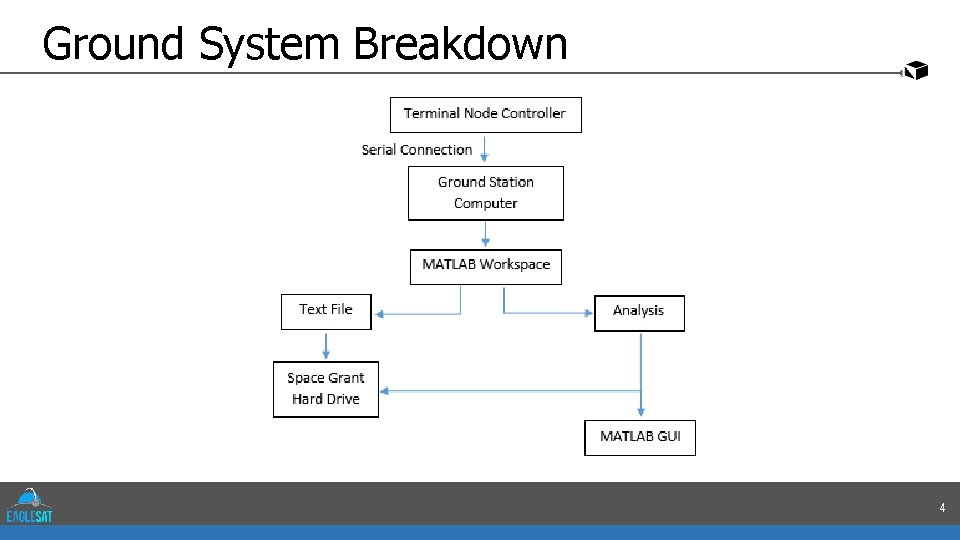
Ground System Breakdown 4
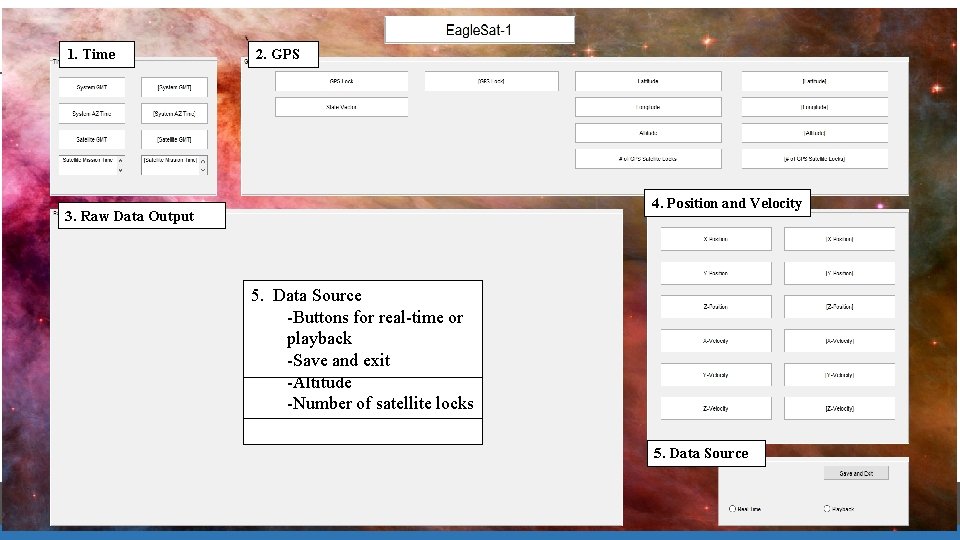
1. Time 2. GPS 4. Position and Velocity 3. Raw Data Output 4. Position Velocity 5. 2. GPSSource 3. Raw Dataand Output 1. Data Time X, Y, Lock Z Greenwich position -Buttons for real-time or GPS System Mean -Time X, Y, (GMT) Z velocity playback State Vector -Save and. AZ exit Latitude and Longitude System Time -Altitude Satellite GMT -Number of satellite locks Satellite Mission Time 5. Data Source
Flight Dynamics Overview • Main objective: To calculate and incorporate drag in order to predict the deorbit time on the Eagle. Sat-I • Orbital Predictions: • • Altitude at apogee: 818. 0 km Altitude at perigee: 453. 0 km Inclination: 97. 7° Launch date: November 18, 2017 • All flight dynamics analysis was done in Systems Tool Kit 11 (STK) • Two-Line Element sets for Eagle. Sat-I were obtained from Space-Track. org 6
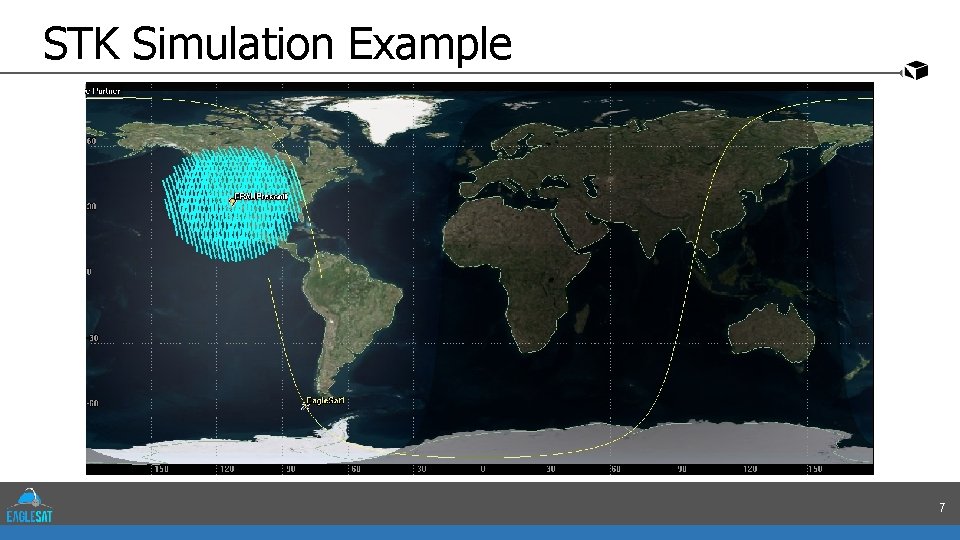
STK Simulation Example 7
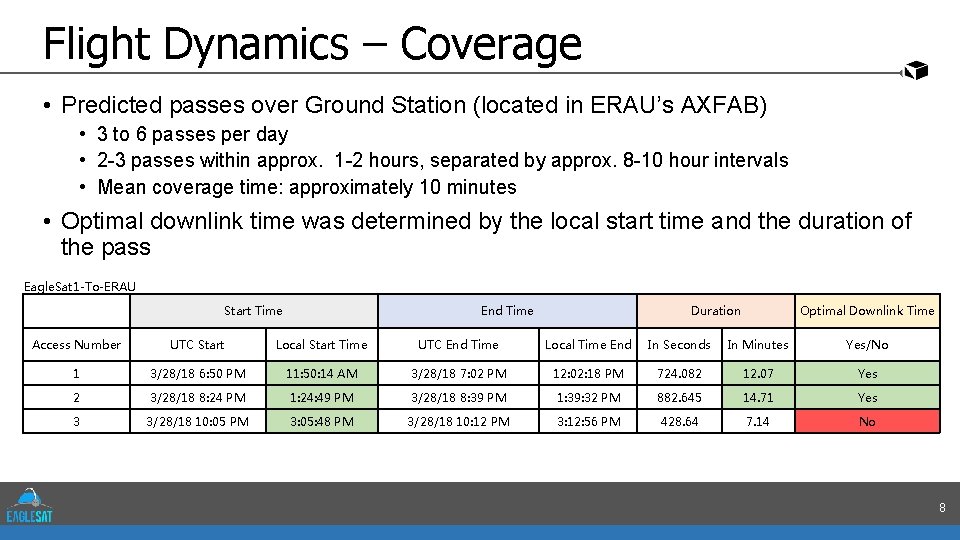
Flight Dynamics – Coverage • Predicted passes over Ground Station (located in ERAU’s AXFAB) • 3 to 6 passes per day • 2 -3 passes within approx. 1 -2 hours, separated by approx. 8 -10 hour intervals • Mean coverage time: approximately 10 minutes • Optimal downlink time was determined by the local start time and the duration of the pass Eagle. Sat 1 -To-ERAU Start Time End Time Duration Optimal Downlink Time Access Number UTC Start Local Start Time UTC End Time Local Time End In Seconds In Minutes Yes/No 1 3/28/18 6: 50 PM 11: 50: 14 AM 3/28/18 7: 02 PM 12: 02: 18 PM 724. 082 12. 07 Yes 2 3/28/18 8: 24 PM 1: 24: 49 PM 3/28/18 8: 39 PM 1: 39: 32 PM 882. 645 14. 71 Yes 3 3/28/18 10: 05 PM 3: 05: 48 PM 3/28/18 10: 12 PM 3: 12: 56 PM 428. 64 7. 14 No 8
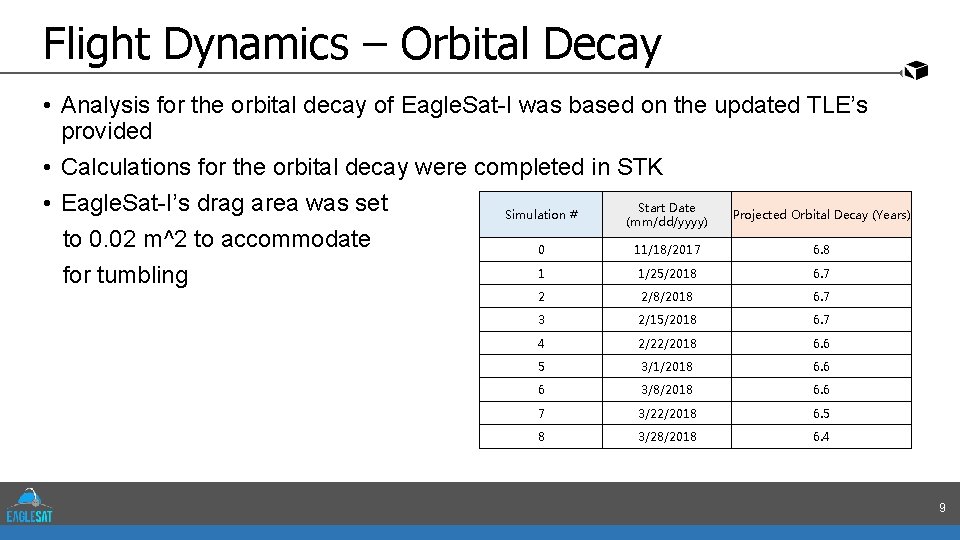
Flight Dynamics – Orbital Decay • Analysis for the orbital decay of Eagle. Sat-I was based on the updated TLE’s provided • Calculations for the orbital decay were completed in STK • Eagle. Sat-I’s drag area was set Start Date Simulation # Projected Orbital Decay (Years) (mm/dd/yyyy) to 0. 02 m^2 to accommodate 0 11/18/2017 6. 8 1 1/25/2018 6. 7 for tumbling 2 2/8/2018 6. 7 3 2/15/2018 6. 7 4 2/22/2018 6. 6 5 3/1/2018 6. 6 6 3/8/2018 6. 6 7 3/22/2018 6. 5 8 3/28/2018 6. 4 9
Acknowledgements • Dr. Gary Yale • Dr. Kaela Martin • Dr. Julio Benavides • Flight Operations team members Kyle Noland, Tyler Noland Yashica Khatri 10
Questions? Madison Padilla padillm 3@my. erau. edu 11
- Slides: 11