
e Study us Business Statistics Inference About Population
e. Study. us Business Statistics Inference About Population Variances This lecture flows well with Statistics for Business and Economics, Anderson, Sweeney, and Williams, 13 th edition, chapter 11. copyright © michael. roberson@e. Study. us 2017, All rights reserved
e. Study. us Inferences About Population Variances • • Inference about a Population Variance Inferences about Two Populations Variances copyright © michael. roberson@e. Study. us 2017, All rights reserved
e. Study. us Inferences About a Population Variance • A variance can provide important decision-making information. • Consider the production process of filling containers with a liquid detergent product. • The mean filling weight is important, but also is the variance of the filling weights. • By selecting a sample of containers, we can compute a sample variance for the amount of detergent placed in a container. • If the sample variance is excessive, overfilling and underfilling may be occurring even though the mean is correct. copyright © michael. roberson@e. Study. us 2017, All rights reserved
e. Study. us Inferences About a Population Variance • • • Chi-Square Distribution Interval Estimation of 2 Hypothesis Testing copyright © michael. roberson@e. Study. us 2017, All rights reserved
e. Study. us Chi-Square Distribution • The chi-square distribution is based on sampling from a normal population. • The sampling distribution of (n - 1)s 2/ 2 has a chi-square distribution with n-1 degrees of freedom whenever a simple random sample of size n is selected from a normal population. • We can use the chi-square distribution to develop interval estimates and conduct hypothesis tests about a population variance. copyright © michael. roberson@e. Study. us 2017, All rights reserved
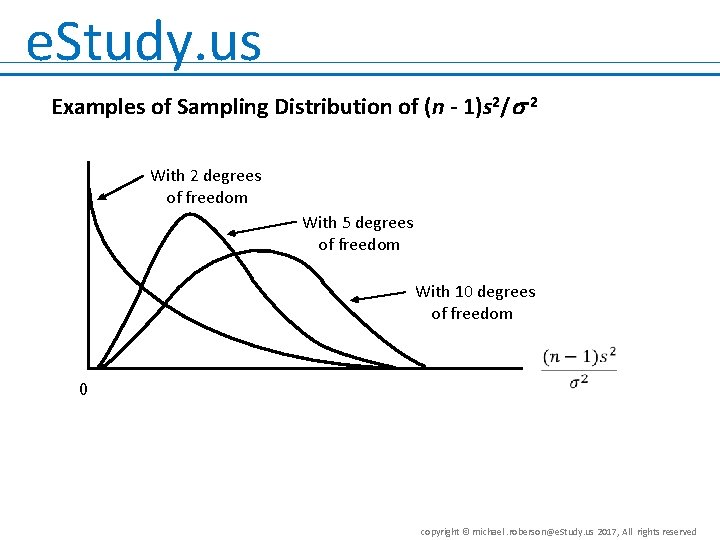
e. Study. us Examples of Sampling Distribution of (n - 1)s 2/ 2 With 2 degrees of freedom With 5 degrees of freedom With 10 degrees of freedom 0 copyright © michael. roberson@e. Study. us 2017, All rights reserved
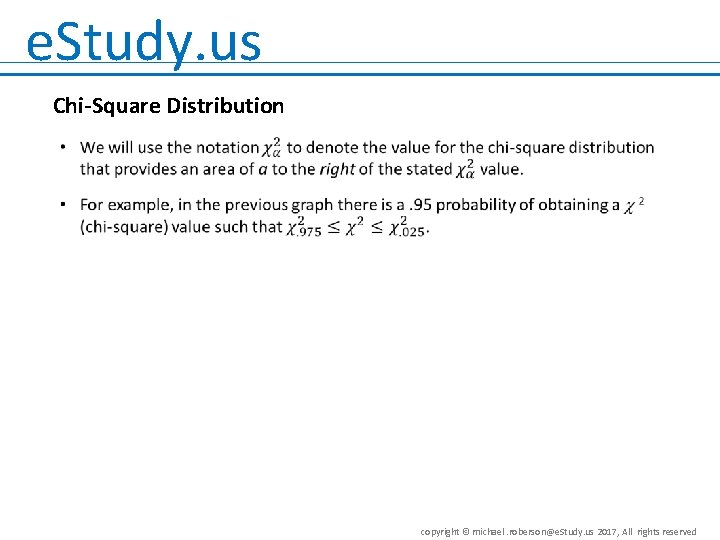
e. Study. us Chi-Square Distribution copyright © michael. roberson@e. Study. us 2017, All rights reserved
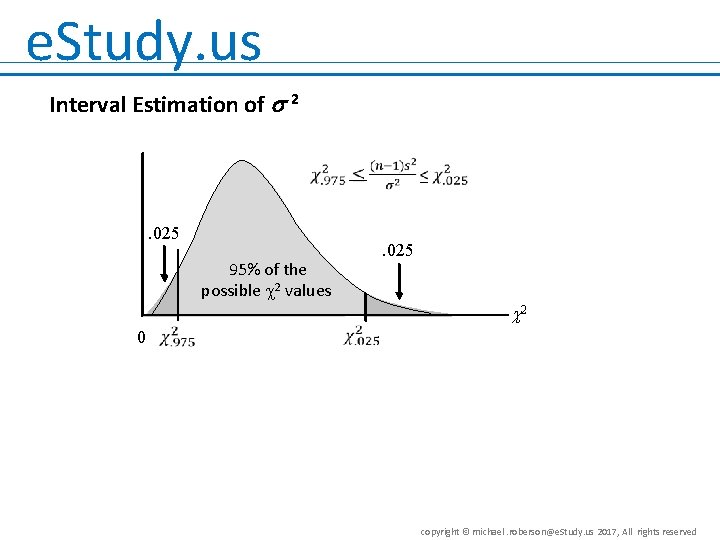
e. Study. us Interval Estimation of 2 . 025 95% of the possible 2 values . 025 2 0 copyright © michael. roberson@e. Study. us 2017, All rights reserved
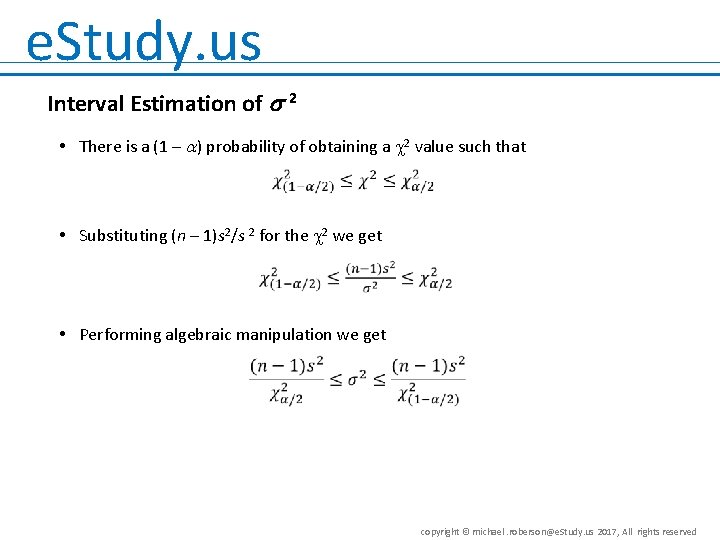
e. Study. us Interval Estimation of 2 • There is a (1 – ) probability of obtaining a 2 value such that • Substituting (n – 1)s 2/s 2 for the 2 we get • Performing algebraic manipulation we get copyright © michael. roberson@e. Study. us 2017, All rights reserved
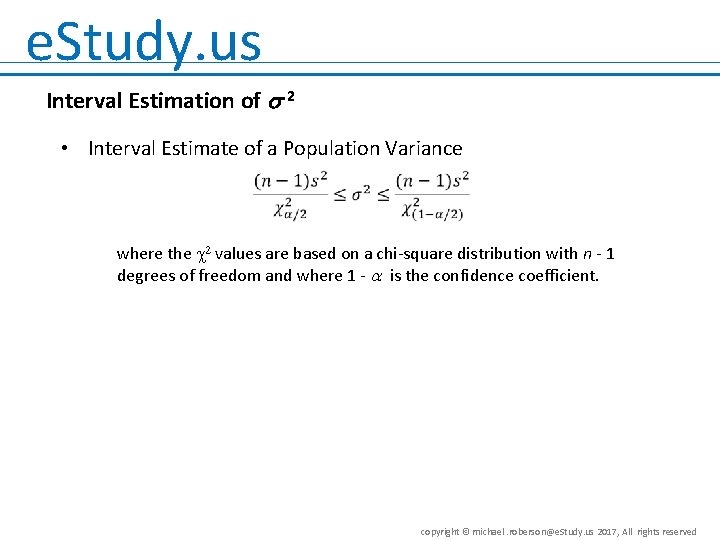
e. Study. us Interval Estimation of 2 • Interval Estimate of a Population Variance where the values are based on a chi-square distribution with n - 1 degrees of freedom and where 1 - is the confidence coefficient. copyright © michael. roberson@e. Study. us 2017, All rights reserved

e. Study. us Interval Estimation of • Interval Estimate of a Population Standard Deviation Taking the square root of the upper and lower limits of the variance interval provides the confidence interval for the population standard deviation. copyright © michael. roberson@e. Study. us 2017, All rights reserved
e. Study. us Interval Estimation of 2 • Example: Buyer’s Digest (A) Buyer’s Digest rates thermostats manufactured for home temperature control. In a recent test, 10 thermostats manufactured by Thermo. Rite were selected and placed in a test room that was maintained at a temperature of 68 o. F. The temperature readings of the ten thermostats are shown on the next slide. copyright © michael. roberson@e. Study. us 2017, All rights reserved
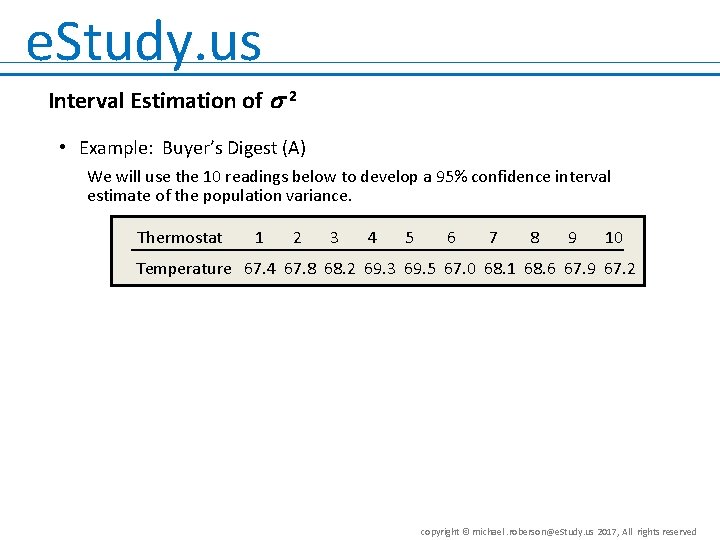
e. Study. us Interval Estimation of 2 • Example: Buyer’s Digest (A) We will use the 10 readings below to develop a 95% confidence interval estimate of the population variance. Thermostat 1 2 3 4 5 6 7 8 9 10 Temperature 67. 4 67. 8 68. 2 69. 3 69. 5 67. 0 68. 1 68. 6 67. 9 67. 2 copyright © michael. roberson@e. Study. us 2017, All rights reserved
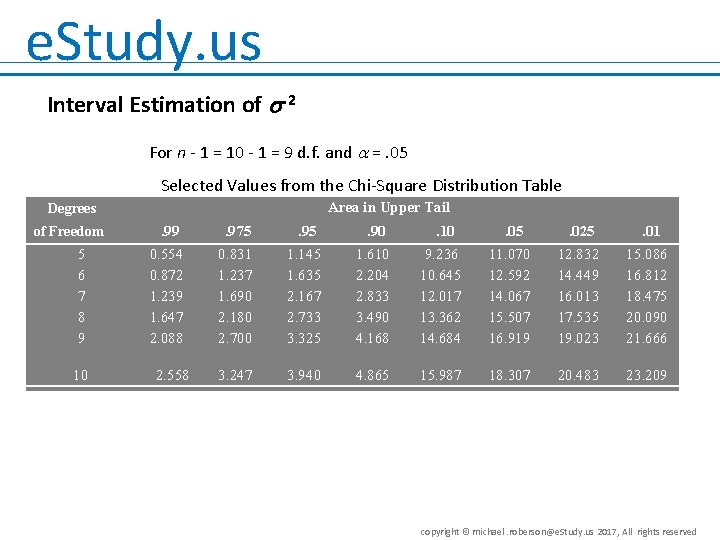
e. Study. us Interval Estimation of 2 For n - 1 = 10 - 1 = 9 d. f. and =. 05 Selected Values from the Chi-Square Distribution Table Area in Upper Tail Degrees of Freedom 5 6 7 8 9 10 . 99 . 975 . 90 . 10 . 05 . 025 . 01 0. 554 0. 872 1. 239 1. 647 2. 088 0. 831 1. 237 1. 690 2. 180 2. 700 1. 145 1. 635 2. 167 2. 733 3. 325 1. 610 2. 204 2. 833 3. 490 4. 168 9. 236 10. 645 12. 017 13. 362 14. 684 11. 070 12. 592 14. 067 15. 507 16. 919 12. 832 14. 449 16. 013 17. 535 19. 023 15. 086 16. 812 18. 475 20. 090 21. 666 3. 247 3. 940 4. 865 15. 987 18. 307 20. 483 23. 209 2. 558 copyright © michael. roberson@e. Study. us 2017, All rights reserved
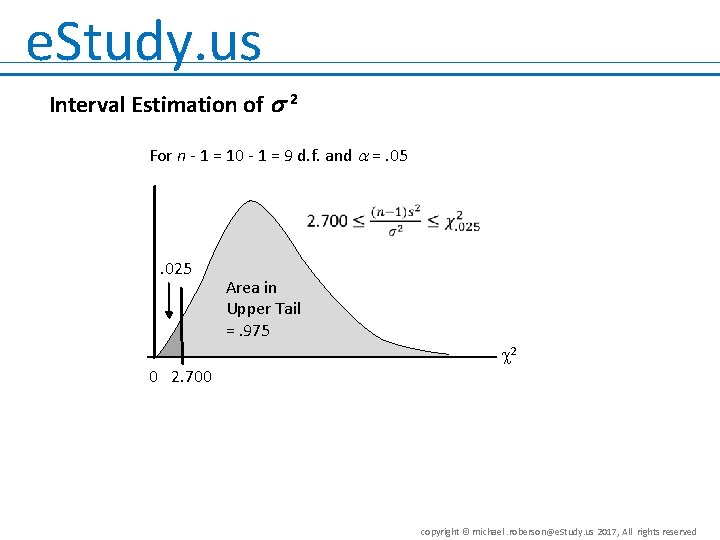
e. Study. us Interval Estimation of 2 For n - 1 = 10 - 1 = 9 d. f. and =. 05 . 025 Area in Upper Tail =. 975 2 0 2. 700 copyright © michael. roberson@e. Study. us 2017, All rights reserved
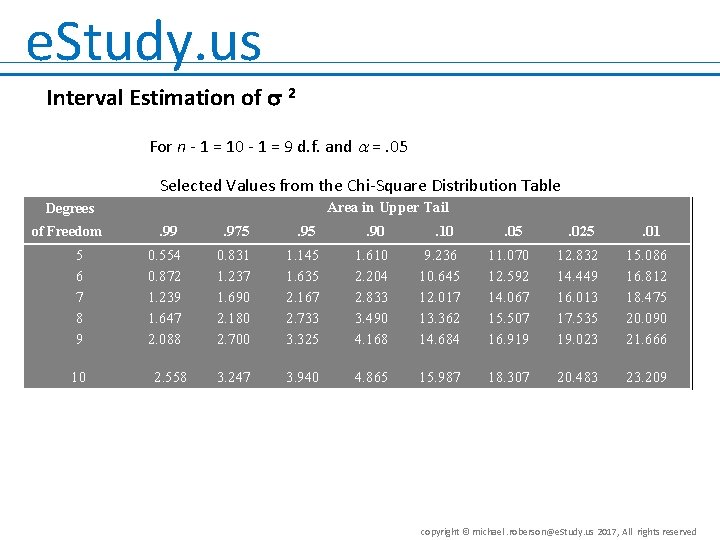
e. Study. us Interval Estimation of 2 For n - 1 = 10 - 1 = 9 d. f. and =. 05 Selected Values from the Chi-Square Distribution Table Area in Upper Tail Degrees of Freedom 5 6 7 8 9 10 . 99 . 975 . 90 . 10 . 05 . 025 . 01 0. 554 0. 872 1. 239 1. 647 2. 088 0. 831 1. 237 1. 690 2. 180 2. 700 1. 145 1. 635 2. 167 2. 733 3. 325 1. 610 2. 204 2. 833 3. 490 4. 168 9. 236 10. 645 12. 017 13. 362 14. 684 11. 070 12. 592 14. 067 15. 507 16. 919 12. 832 14. 449 16. 013 17. 535 19. 023 15. 086 16. 812 18. 475 20. 090 21. 666 3. 247 3. 940 4. 865 15. 987 18. 307 20. 483 23. 209 2. 558 copyright © michael. roberson@e. Study. us 2017, All rights reserved
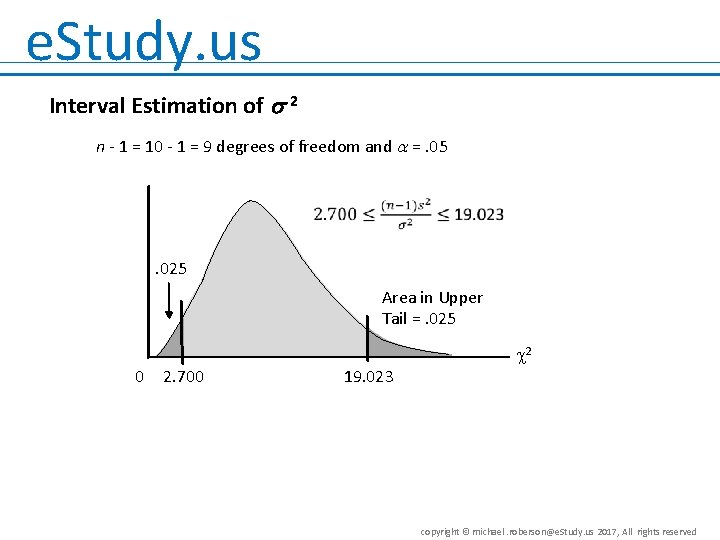
e. Study. us Interval Estimation of 2 n - 1 = 10 - 1 = 9 degrees of freedom and =. 05 . 025 Area in Upper Tail =. 025 2 0 2. 700 19. 023 copyright © michael. roberson@e. Study. us 2017, All rights reserved
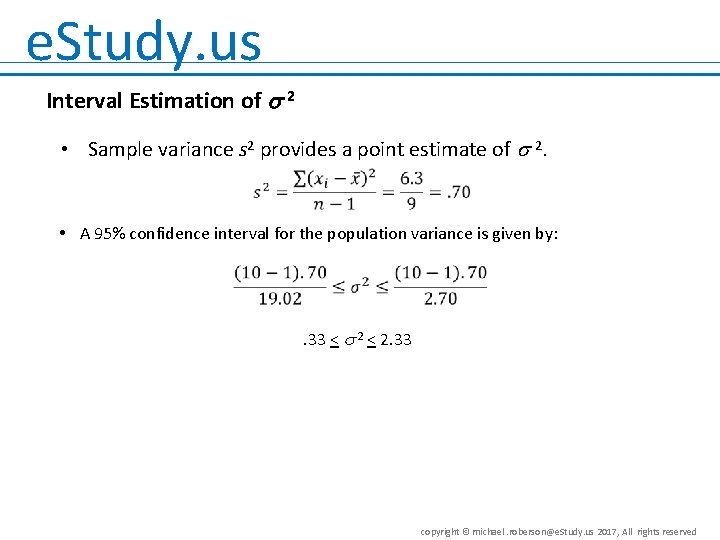
e. Study. us Interval Estimation of 2 • Sample variance s 2 provides a point estimate of 2. • A 95% confidence interval for the population variance is given by: . 33 < 2 < 2. 33 copyright © michael. roberson@e. Study. us 2017, All rights reserved
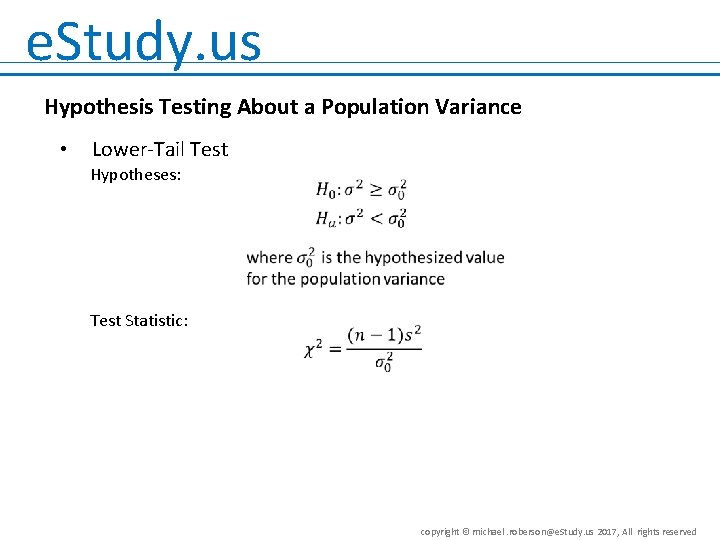
e. Study. us Hypothesis Testing About a Population Variance • Lower-Tail Test Hypotheses: Test Statistic: copyright © michael. roberson@e. Study. us 2017, All rights reserved
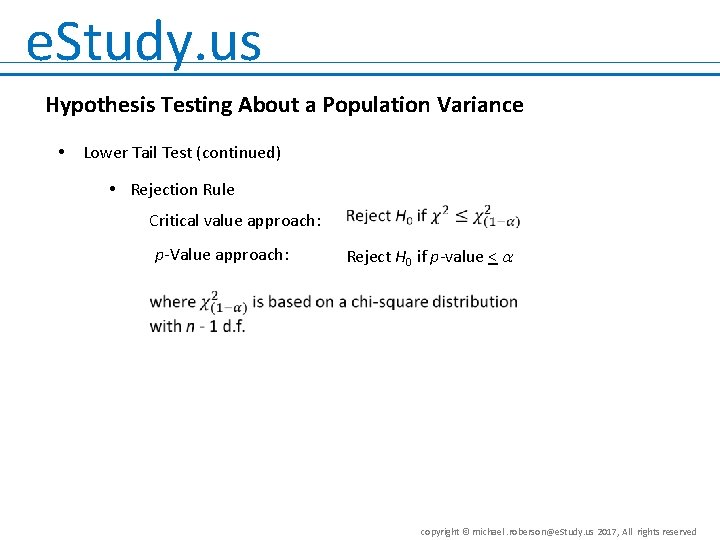
e. Study. us Hypothesis Testing About a Population Variance • Lower Tail Test (continued) • Rejection Rule Critical value approach: p-Value approach: Reject H 0 if p-value < copyright © michael. roberson@e. Study. us 2017, All rights reserved
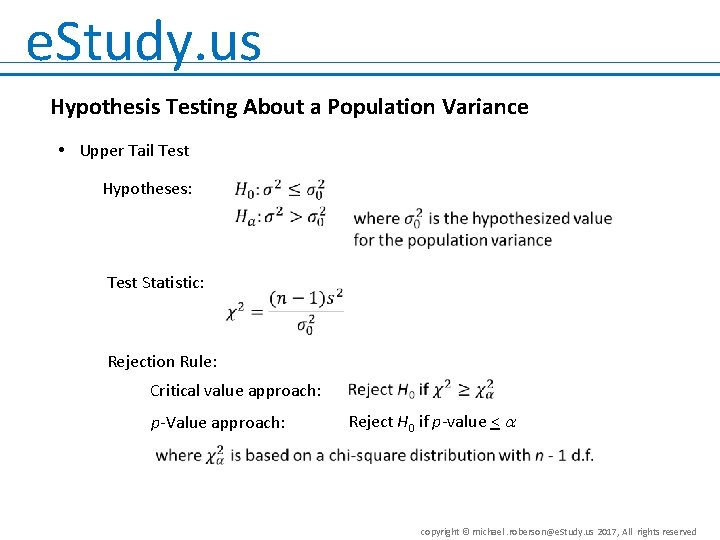
e. Study. us Hypothesis Testing About a Population Variance • Upper Tail Test Hypotheses: Test Statistic: Rejection Rule: Critical value approach: p-Value approach: Reject H 0 if p-value < copyright © michael. roberson@e. Study. us 2017, All rights reserved
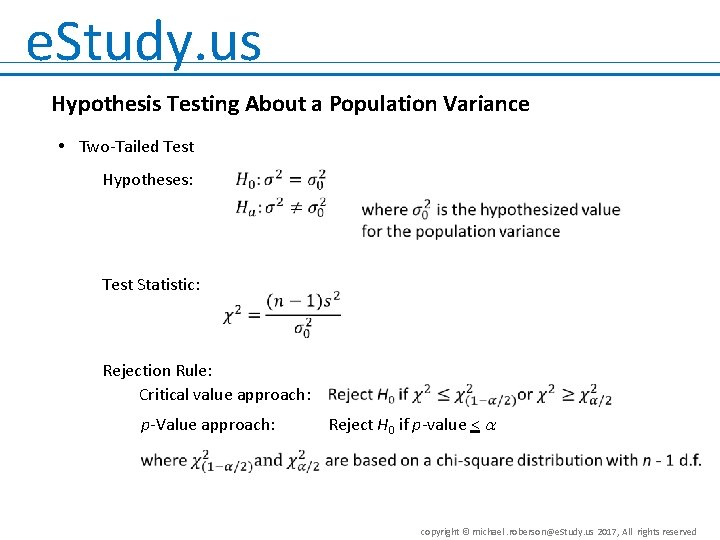
e. Study. us Hypothesis Testing About a Population Variance • Two-Tailed Test Hypotheses: Test Statistic: Rejection Rule: Critical value approach: p-Value approach: Reject H 0 if p-value < copyright © michael. roberson@e. Study. us 2017, All rights reserved
e. Study. us Hypothesis Testing About a Population Variance • Example: Buyer’s Digest (B) Recall that Buyer’s Digest is rating Thermo. Rite thermostats. Buyer’s Digest gives an “acceptable” rating to a thermostat with a temperature variance of 0. 5 or less. We will conduct a hypothesis test (with =. 10) to determine whether the Thermo. Rite thermostat’s temperature variance is “acceptable”. copyright © michael. roberson@e. Study. us 2017, All rights reserved
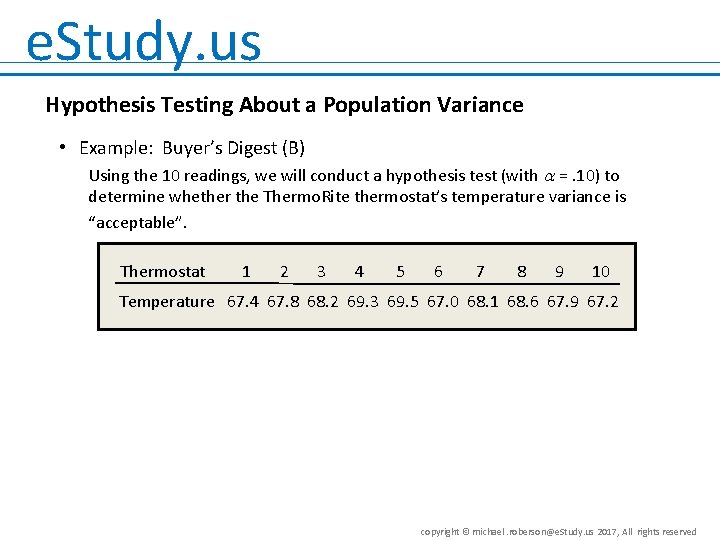
e. Study. us Hypothesis Testing About a Population Variance • Example: Buyer’s Digest (B) Using the 10 readings, we will conduct a hypothesis test (with =. 10) to determine whether the Thermo. Rite thermostat’s temperature variance is “acceptable”. Thermostat 1 2 3 4 5 6 7 8 9 10 Temperature 67. 4 67. 8 68. 2 69. 3 69. 5 67. 0 68. 1 68. 6 67. 9 67. 2 copyright © michael. roberson@e. Study. us 2017, All rights reserved
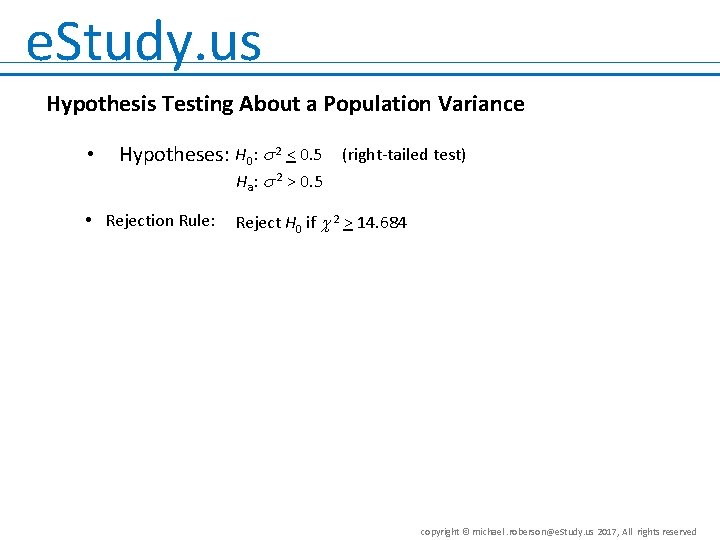
e. Study. us Hypothesis Testing About a Population Variance • Hypotheses: H 0: 2 < 0. 5 (right-tailed test) Ha: 2 > 0. 5 • Rejection Rule: Reject H 0 if 2 > 14. 684 copyright © michael. roberson@e. Study. us 2017, All rights reserved
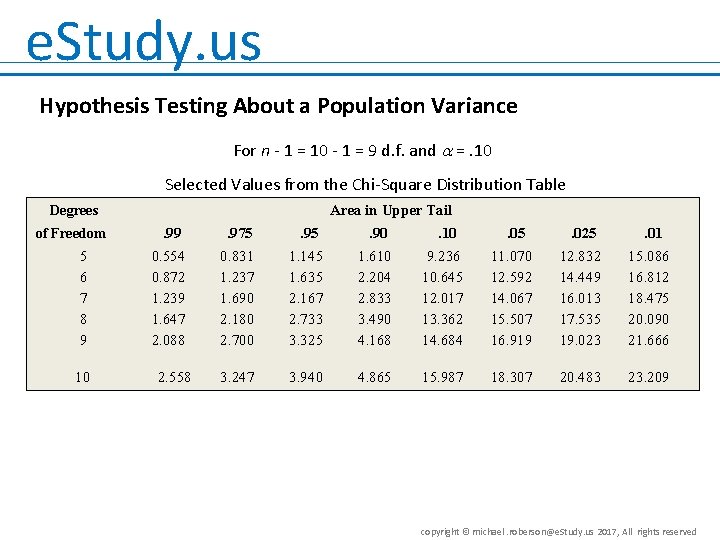
e. Study. us Hypothesis Testing About a Population Variance For n - 1 = 10 - 1 = 9 d. f. and =. 10 Selected Values from the Chi-Square Distribution Table Area in Upper Tail Degrees of Freedom 5 6 7 8 9 10 . 99 . 975 . 90 . 10 . 05 . 025 . 01 0. 554 0. 872 1. 239 1. 647 2. 088 0. 831 1. 237 1. 690 2. 180 2. 700 1. 145 1. 635 2. 167 2. 733 3. 325 1. 610 2. 204 2. 833 3. 490 4. 168 9. 236 10. 645 12. 017 13. 362 14. 684 11. 070 12. 592 14. 067 15. 507 16. 919 12. 832 14. 449 16. 013 17. 535 19. 023 15. 086 16. 812 18. 475 20. 090 21. 666 3. 247 3. 940 4. 865 15. 987 18. 307 20. 483 23. 209 2. 558 copyright © michael. roberson@e. Study. us 2017, All rights reserved
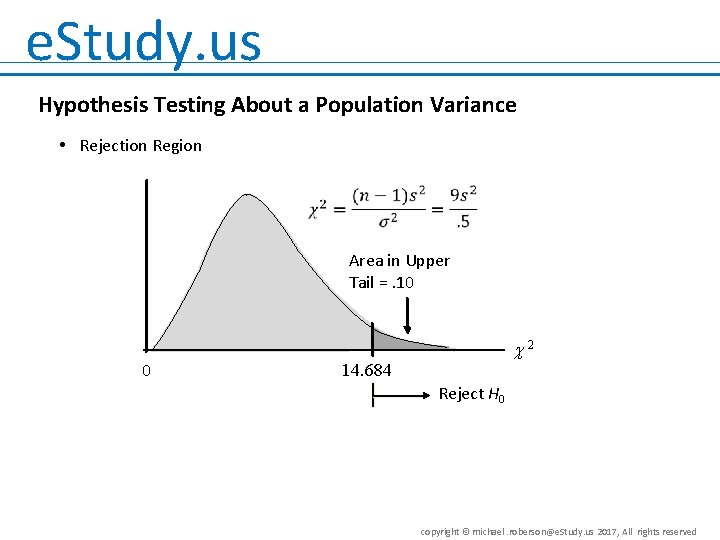
e. Study. us Hypothesis Testing About a Population Variance • Rejection Region Area in Upper Tail =. 10 2 0 14. 684 Reject H 0 copyright © michael. roberson@e. Study. us 2017, All rights reserved
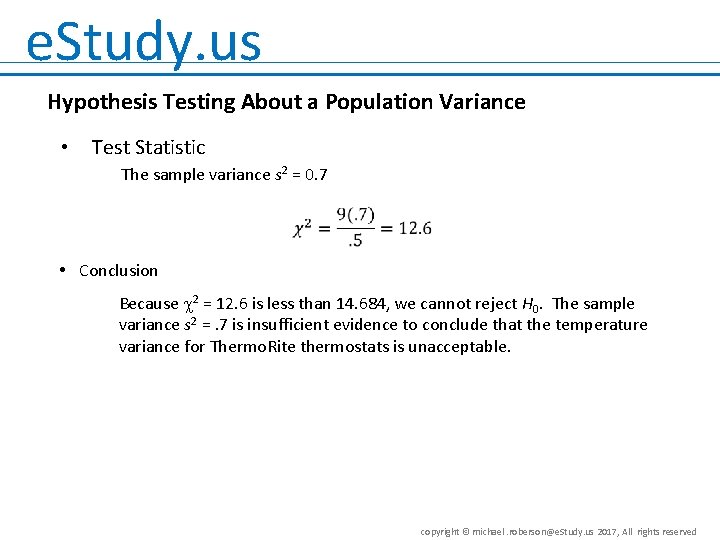
e. Study. us Hypothesis Testing About a Population Variance • Test Statistic The sample variance s 2 = 0. 7 • Conclusion Because 2 = 12. 6 is less than 14. 684, we cannot reject H 0. The sample variance s 2 =. 7 is insufficient evidence to conclude that the temperature variance for Thermo. Rite thermostats is unacceptable. copyright © michael. roberson@e. Study. us 2017, All rights reserved
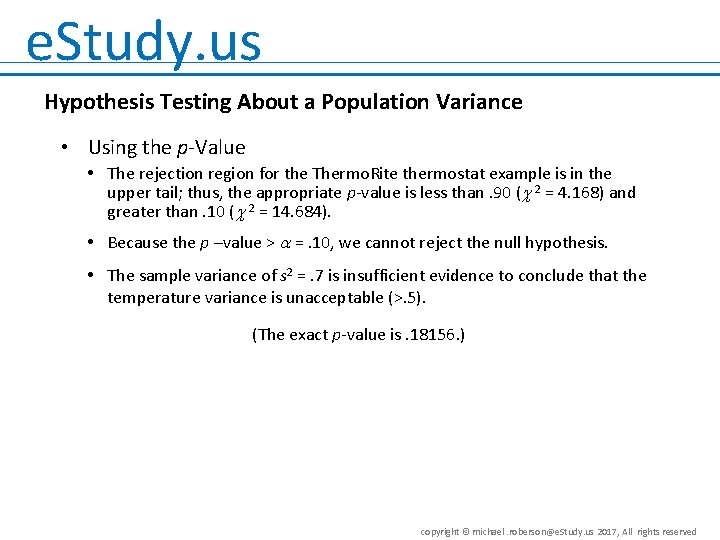
e. Study. us Hypothesis Testing About a Population Variance • Using the p-Value • The rejection region for the Thermo. Rite thermostat example is in the upper tail; thus, the appropriate p-value is less than. 90 ( 2 = 4. 168) and greater than. 10 ( 2 = 14. 684). • Because the p –value > =. 10, we cannot reject the null hypothesis. • The sample variance of s 2 =. 7 is insufficient evidence to conclude that the temperature variance is unacceptable (>. 5). (The exact p-value is. 18156. ) copyright © michael. roberson@e. Study. us 2017, All rights reserved
e. Study. us Inferences About Two Population Variances • We may want to compare the variances in: • product quality resulting from two different production processes, • temperatures for two heating devices, or • assembly times for two assembly methods. • We use data collected from two independent random samples, one from population 1 and another from population 2. • The two sample variances will be the basis for making inferences about the two population variances. copyright © michael. roberson@e. Study. us 2017, All rights reserved
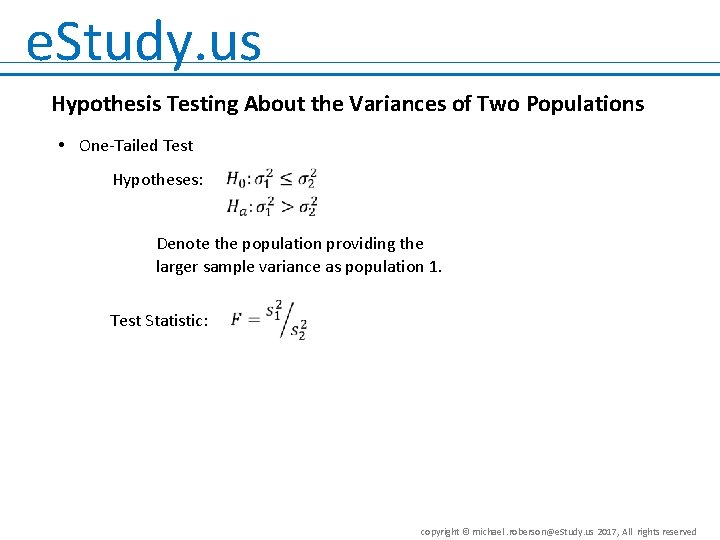
e. Study. us Hypothesis Testing About the Variances of Two Populations • One-Tailed Test Hypotheses: Denote the population providing the larger sample variance as population 1. Test Statistic: copyright © michael. roberson@e. Study. us 2017, All rights reserved
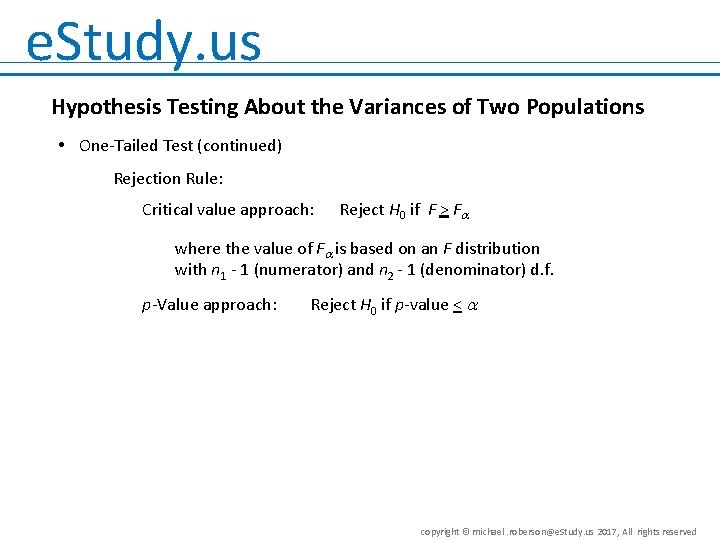
e. Study. us Hypothesis Testing About the Variances of Two Populations • One-Tailed Test (continued) Rejection Rule: Critical value approach: Reject H 0 if F > F where the value of F is based on an F distribution with n 1 - 1 (numerator) and n 2 - 1 (denominator) d. f. p-Value approach: Reject H 0 if p-value < copyright © michael. roberson@e. Study. us 2017, All rights reserved
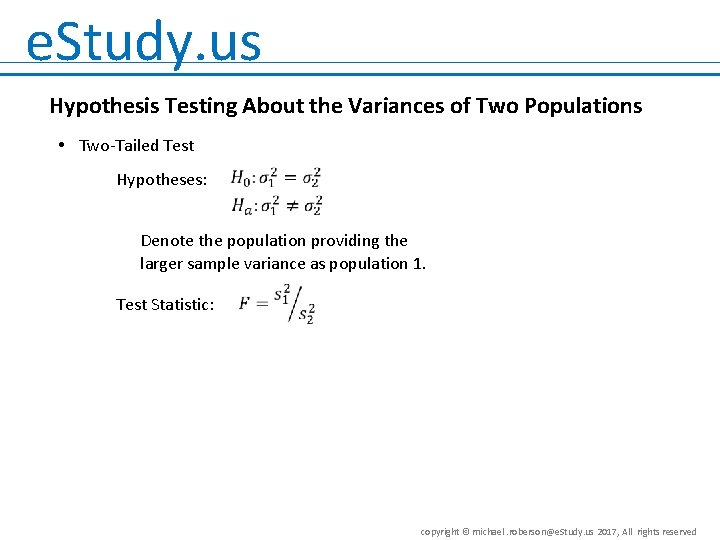
e. Study. us Hypothesis Testing About the Variances of Two Populations • Two-Tailed Test Hypotheses: Denote the population providing the larger sample variance as population 1. Test Statistic: copyright © michael. roberson@e. Study. us 2017, All rights reserved
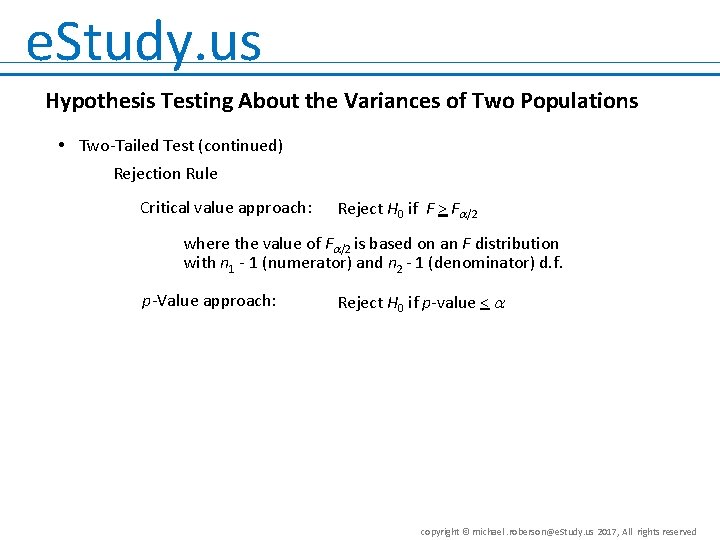
e. Study. us Hypothesis Testing About the Variances of Two Populations • Two-Tailed Test (continued) Rejection Rule Critical value approach: Reject H 0 if F > F /2 where the value of F /2 is based on an F distribution with n 1 - 1 (numerator) and n 2 - 1 (denominator) d. f. p-Value approach: Reject H 0 if p-value < copyright © michael. roberson@e. Study. us 2017, All rights reserved
e. Study. us Hypothesis Testing About the Variances of Two Populations • Example: Buyer’s Digest (C) Buyer’s Digest has conducted the same test, as was described earlier, on another 10 thermostats, this time manufactured by Temp. King. The temperature readings of the ten thermostats are listed on the next slide. We will conduct a hypothesis test with �=. 10 to see if the variances are equal for Thermo. Rite’s thermostats and Temp. King’s thermostats. copyright © michael. roberson@e. Study. us 2017, All rights reserved
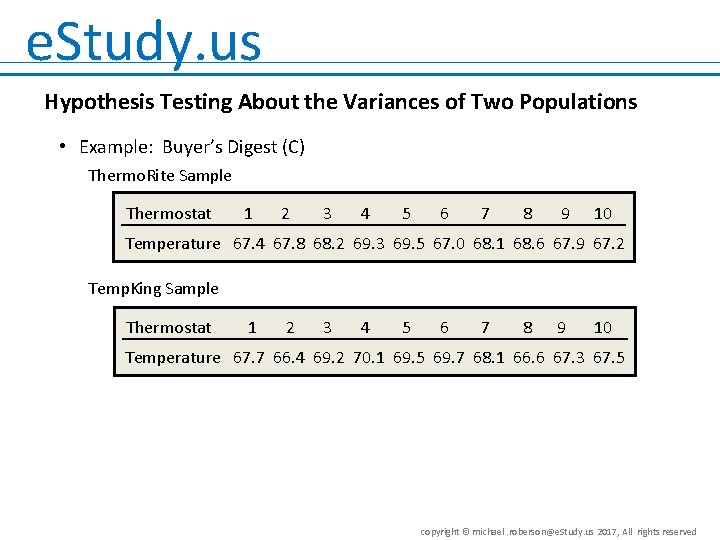
e. Study. us Hypothesis Testing About the Variances of Two Populations • Example: Buyer’s Digest (C) Thermo. Rite Sample Thermostat 1 2 3 4 5 6 7 8 9 10 Temperature 67. 4 67. 8 68. 2 69. 3 69. 5 67. 0 68. 1 68. 6 67. 9 67. 2 Temp. King Sample Thermostat 1 2 3 4 5 6 7 8 9 10 Temperature 67. 7 66. 4 69. 2 70. 1 69. 5 69. 7 68. 1 66. 6 67. 3 67. 5 copyright © michael. roberson@e. Study. us 2017, All rights reserved
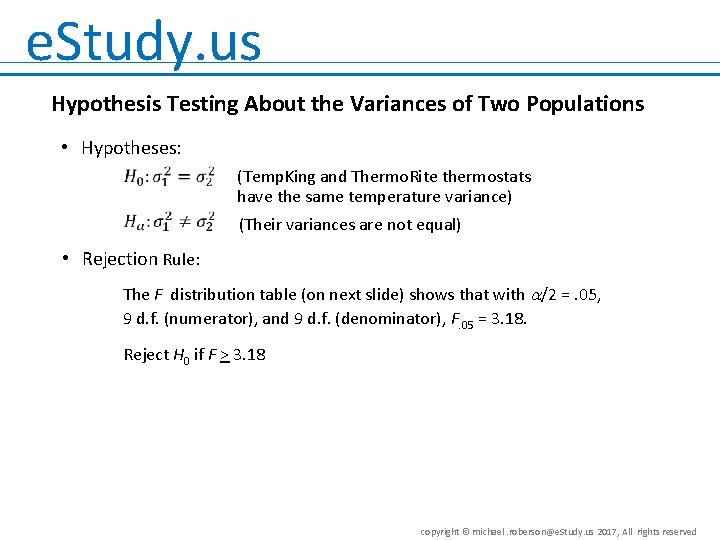
e. Study. us Hypothesis Testing About the Variances of Two Populations • Hypotheses: (Temp. King and Thermo. Rite thermostats have the same temperature variance) (Their variances are not equal) • Rejection Rule: The F distribution table (on next slide) shows that with /2 =. 05, 9 d. f. (numerator), and 9 d. f. (denominator), F. 05 = 3. 18. Reject H 0 if F > 3. 18 copyright © michael. roberson@e. Study. us 2017, All rights reserved
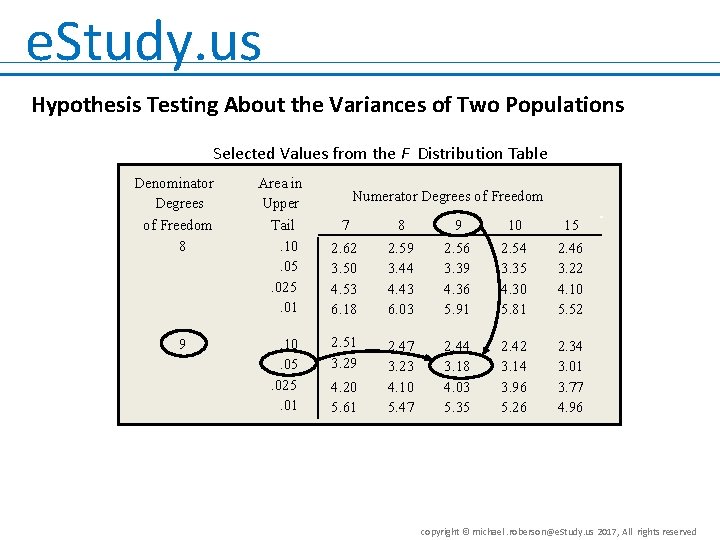
e. Study. us Hypothesis Testing About the Variances of Two Populations Selected Values from the F Distribution Table Denominator Degrees of Freedom 8 9 Area in Upper Tail. 10. 05. 025. 01 Numerator Degrees of Freedom 7 8 9 10 15 2. 62 3. 50 4. 53 6. 18 2. 59 3. 44 4. 43 6. 03 2. 56 3. 39 4. 36 5. 91 2. 54 3. 35 4. 30 5. 81 2. 46 3. 22 4. 10 5. 52 2. 51 3. 29 2. 47 3. 23 4. 10 5. 47 2. 44 3. 18 4. 03 5. 35 2. 42 3. 14 3. 96 5. 26 2. 34 3. 01 3. 77 4. 96 4. 20 5. 61 copyright © michael. roberson@e. Study. us 2017, All rights reserved
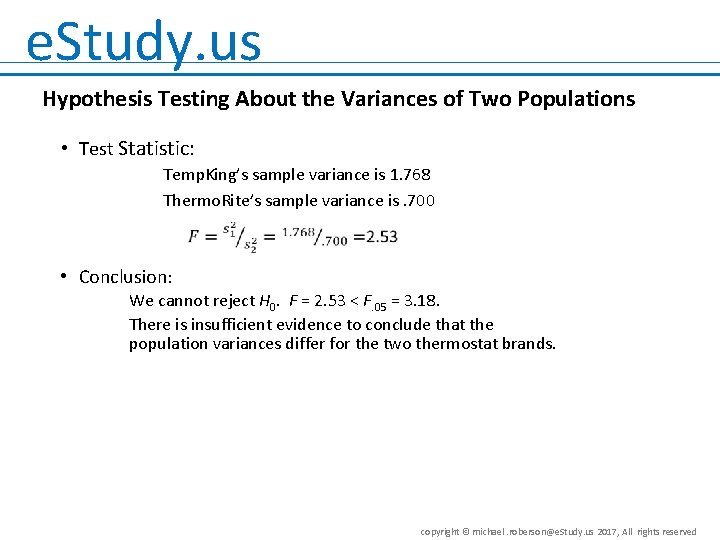
e. Study. us Hypothesis Testing About the Variances of Two Populations • Test Statistic: Temp. King’s sample variance is 1. 768 Thermo. Rite’s sample variance is. 700 • Conclusion: We cannot reject H 0. F = 2. 53 < F. 05 = 3. 18. There is insufficient evidence to conclude that the population variances differ for the two thermostat brands. copyright © michael. roberson@e. Study. us 2017, All rights reserved
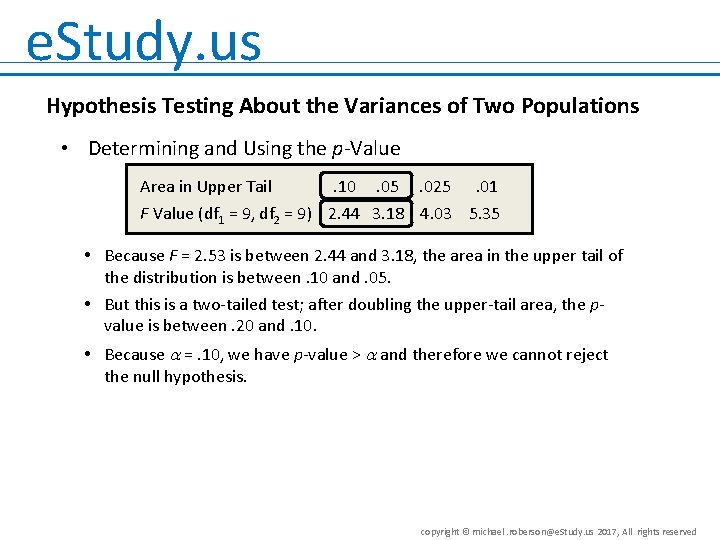
e. Study. us Hypothesis Testing About the Variances of Two Populations • Determining and Using the p-Value Area in Upper Tail . 10 . 05 . 025 . 01 F Value (df 1 = 9, df 2 = 9) 2. 44 3. 18 4. 03 5. 35 • Because F = 2. 53 is between 2. 44 and 3. 18, the area in the upper tail of the distribution is between. 10 and. 05. • But this is a two-tailed test; after doubling the upper-tail area, the pvalue is between. 20 and. 10. • Because =. 10, we have p-value > and therefore we cannot reject the null hypothesis. copyright © michael. roberson@e. Study. us 2017, All rights reserved
- Slides: 40