
E Selection 1 Measuring fitness differential reproductive success

- Slides: 72
E. Selection 1. Measuring “fitness” – differential reproductive success 2. Relationships with Energy Budgets 3. Modeling Selection 4. Types of Selection
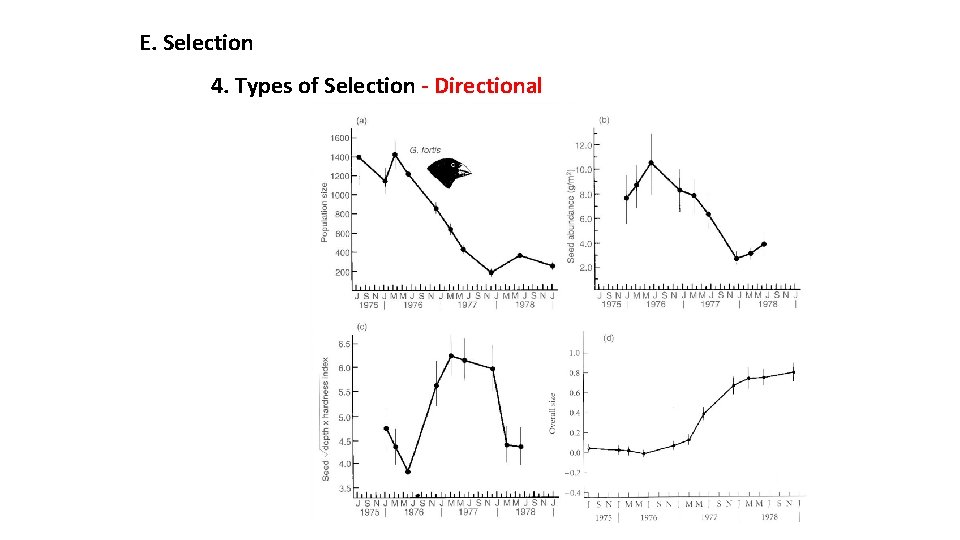
E. Selection 4. Types of Selection - Directional
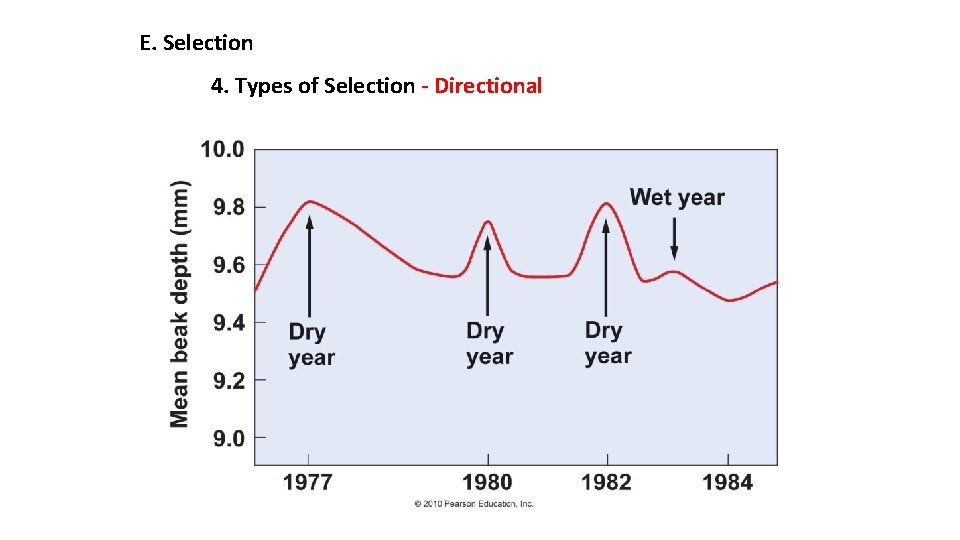
E. Selection 4. Types of Selection - Directional
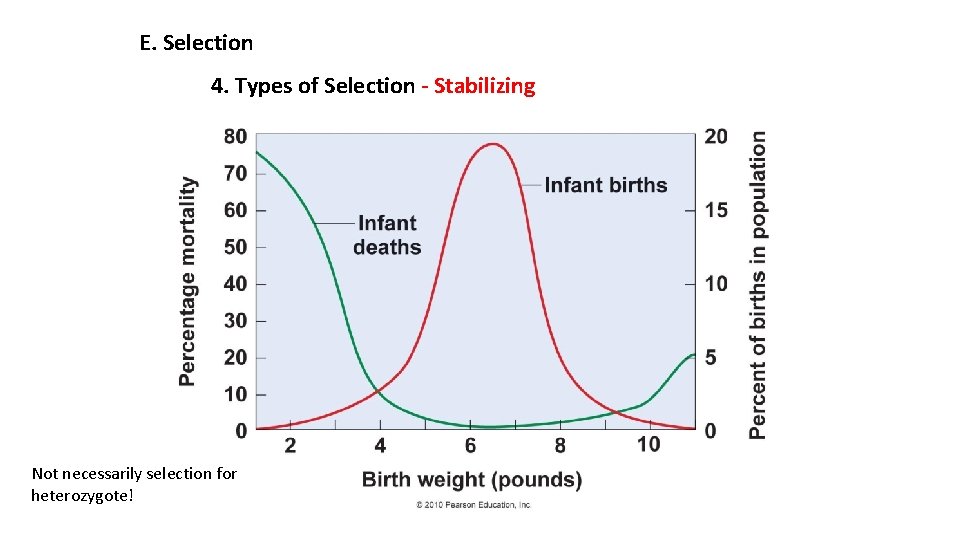
E. Selection 4. Types of Selection - Stabilizing Not necessarily selection for heterozygote!
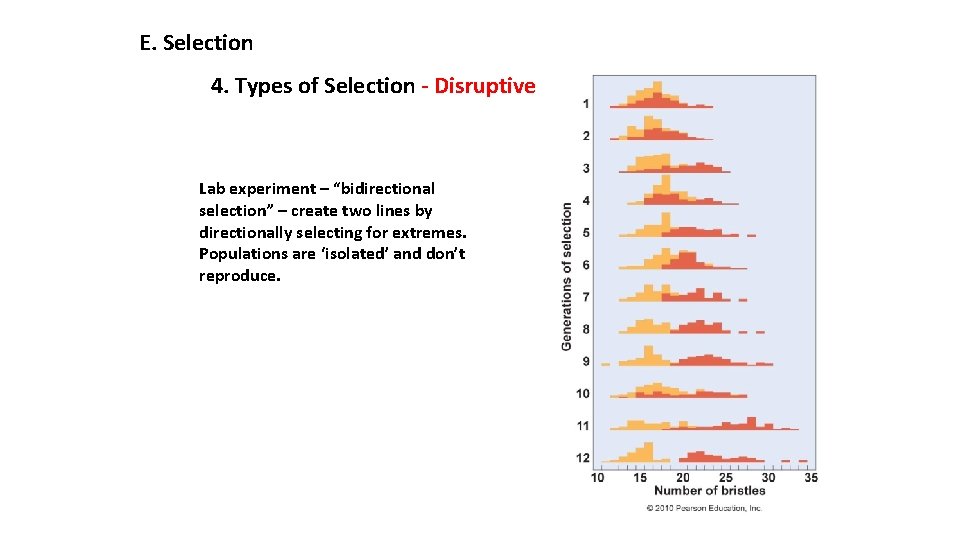
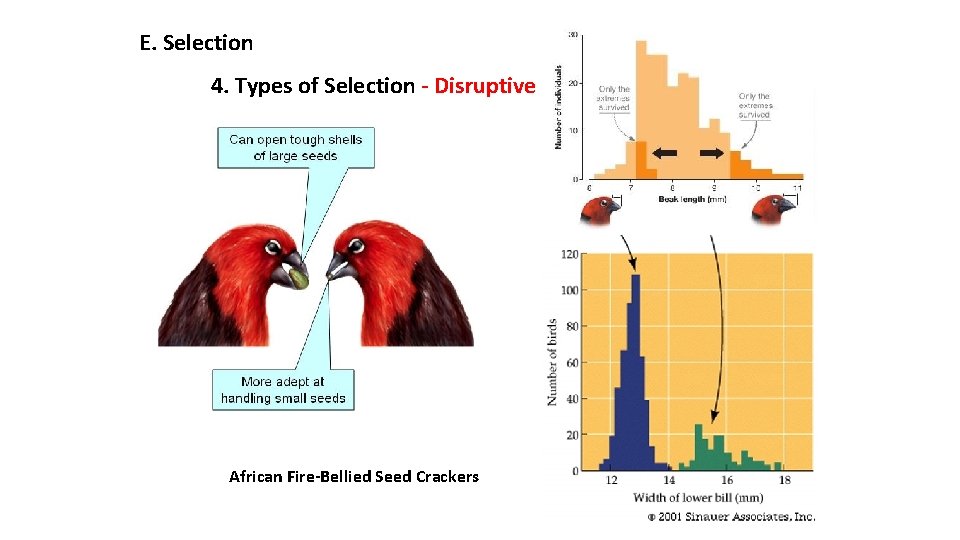
E. Selection 4. Types of Selection - Disruptive Lab experiment – “bidirectional selection” – create two lines by directionally selecting for extremes. Populations are ‘isolated’ and don’t reproduce.
E. Selection 4. Types of Selection - Disruptive African Fire-Bellied Seed Crackers
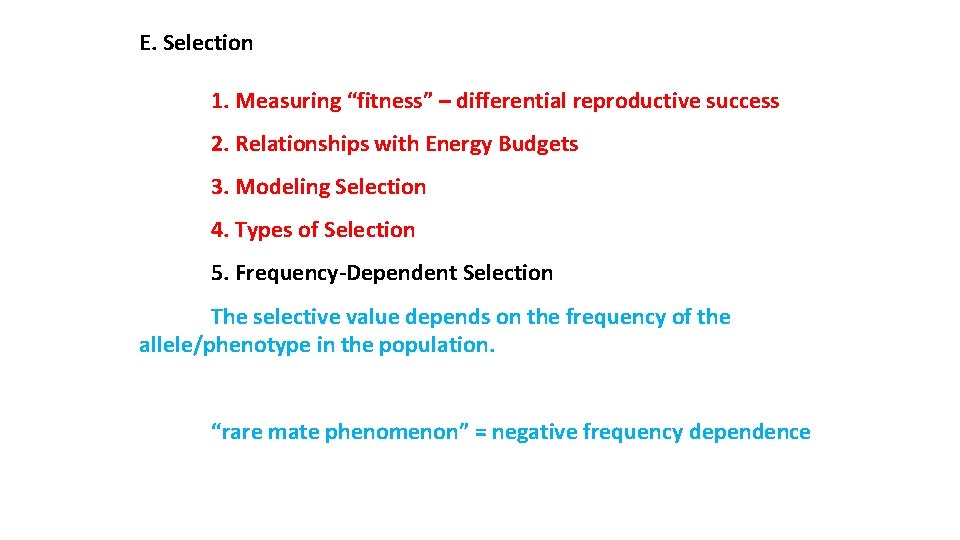
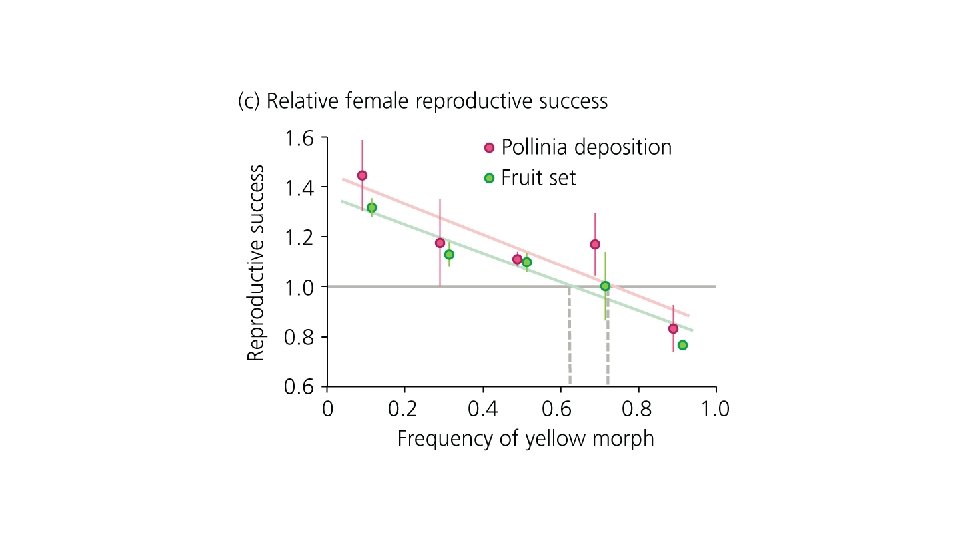
E. Selection 1. Measuring “fitness” – differential reproductive success 2. Relationships with Energy Budgets 3. Modeling Selection 4. Types of Selection 5. Frequency-Dependent Selection The selective value depends on the frequency of the allele/phenotype in the population. “rare mate phenomenon” = negative frequency dependence
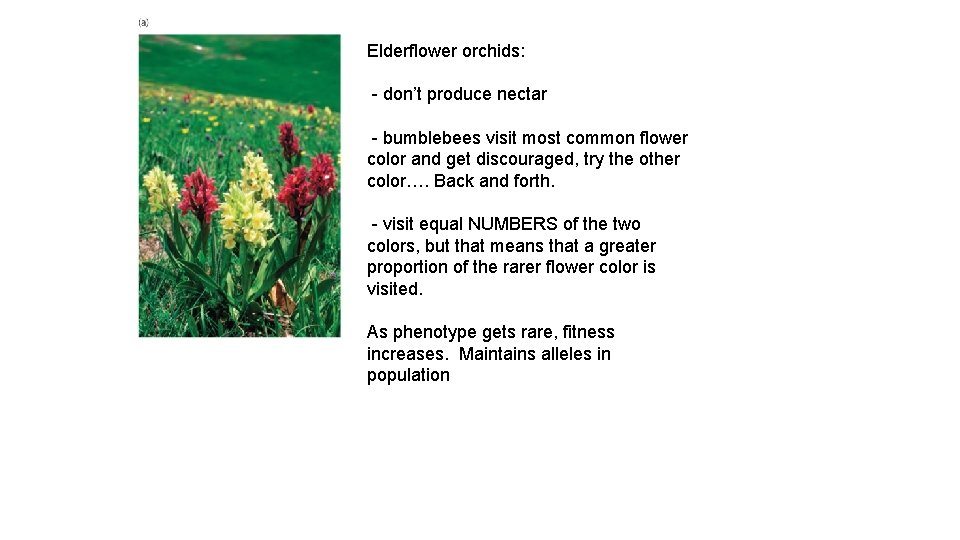
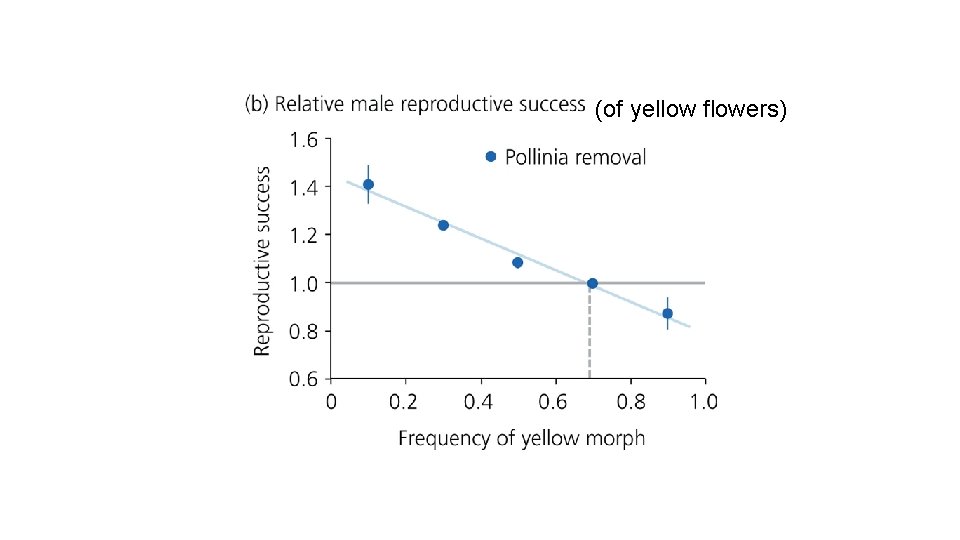
Elderflower orchids: - don’t produce nectar - bumblebees visit most common flower color and get discouraged, try the other color…. Back and forth. - visit equal NUMBERS of the two colors, but that means that a greater proportion of the rarer flower color is visited. As phenotype gets rare, fitness increases. Maintains alleles in population
(of yellow flowers)
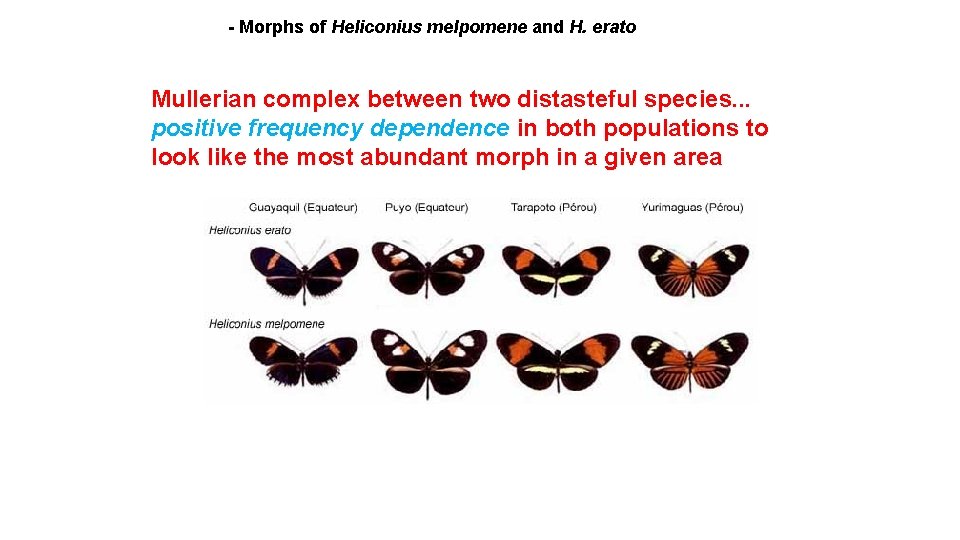
- Morphs of Heliconius melpomene and H. erato Mullerian complex between two distasteful species. . . positive frequency dependence in both populations to look like the most abundant morph in a given area
E. Selection 1. Measuring “fitness” – differential reproductive success 2. Relationships with Energy Budgets 3. Modeling Selection 4. Types of Selection 5. Interactive Effects
E. Selection 1. Measuring “fitness” – differential reproductive success 2. Relationships with Energy Budgets 3. Modeling Selection 4. Types of Selection 5. Interactive Effects - antagonistic pleiotropy
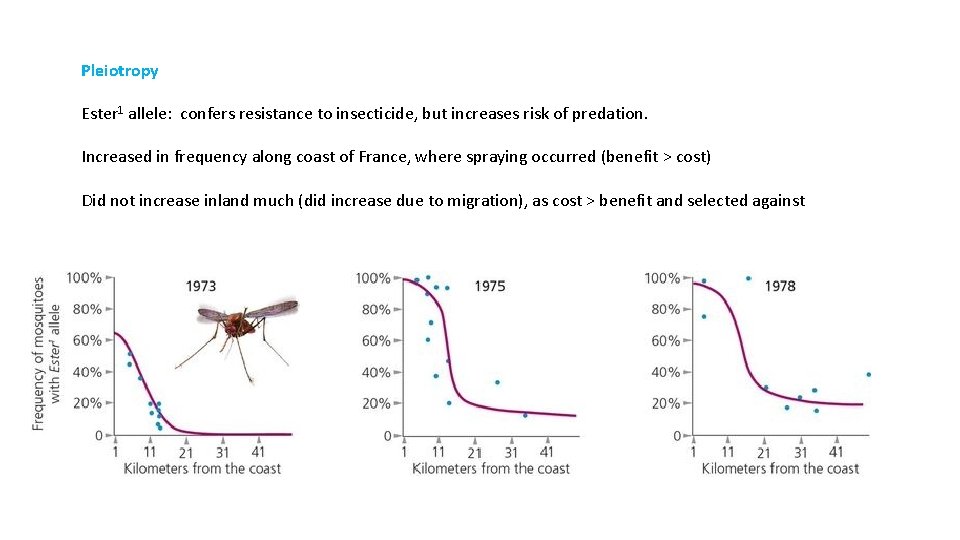
Pleiotropy Ester 1 allele: confers resistance to insecticide, but increases risk of predation. Increased in frequency along coast of France, where spraying occurred (benefit > cost) Did not increase inland much (did increase due to migration), as cost > benefit and selected against
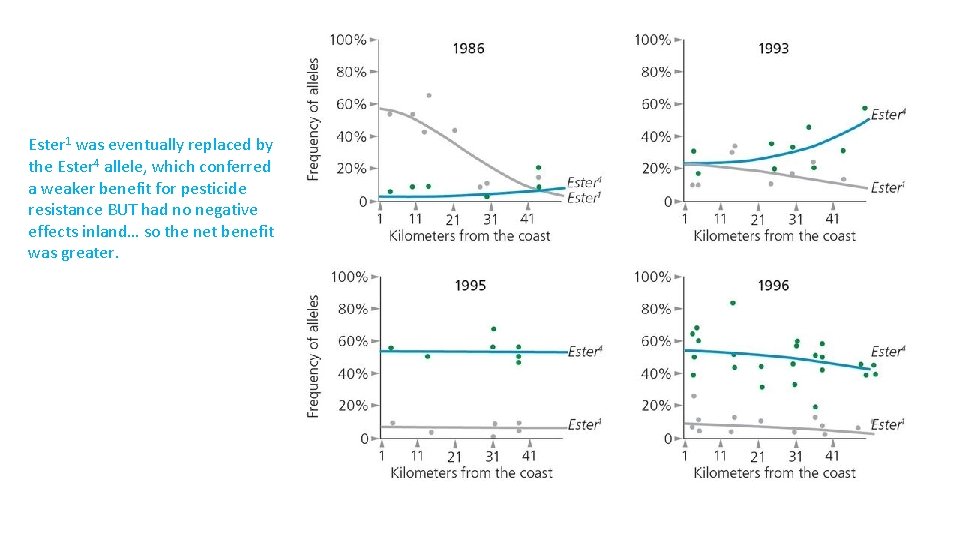
Ester 1 was eventually replaced by the Ester 4 allele, which conferred a weaker benefit for pesticide resistance BUT had no negative effects inland… so the net benefit was greater.
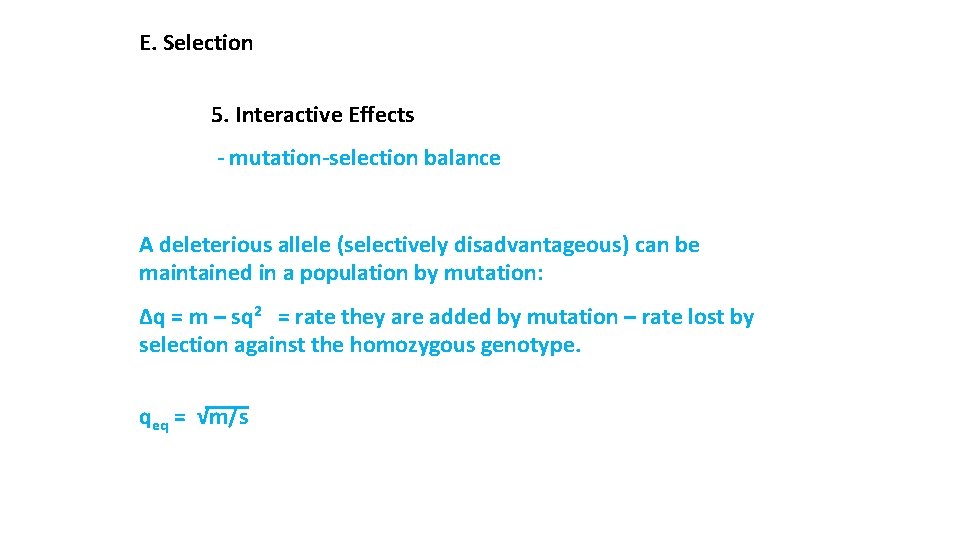
E. Selection 5. Interactive Effects - mutation-selection balance A deleterious allele (selectively disadvantageous) can be maintained in a population by mutation: Δq = m – sq 2 = rate they are added by mutation – rate lost by selection against the homozygous genotype. qeq = √m/s
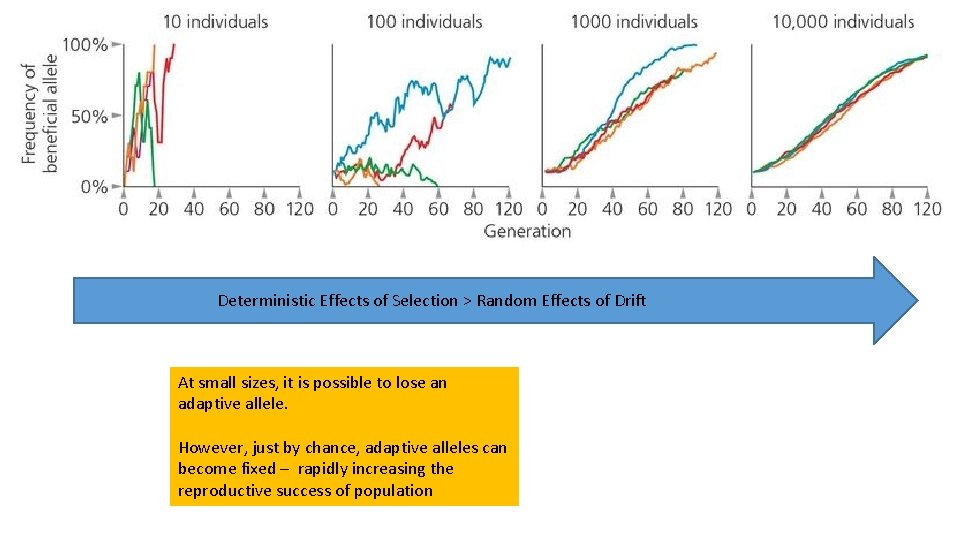
E. Selection 5. Interactive Effects - mutation-selection balance - selection and drift
Deterministic Effects of Selection > Random Effects of Drift At small sizes, it is possible to lose an adaptive allele. However, just by chance, adaptive alleles can become fixed – rapidly increasing the reproductive success of population
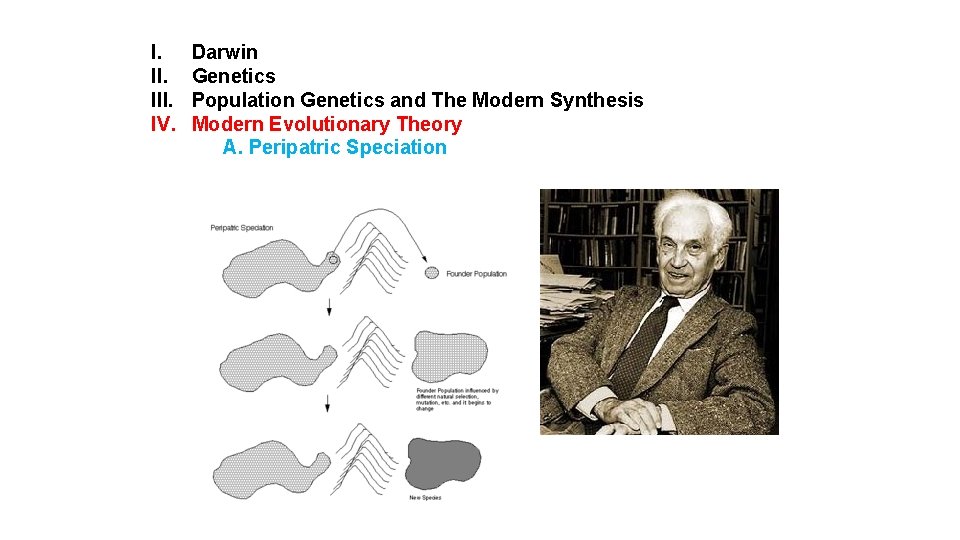
I. III. IV. Darwin Genetics Population Genetics and The Modern Synthesis Modern Evolutionary Theory A. Peripatric Speciation
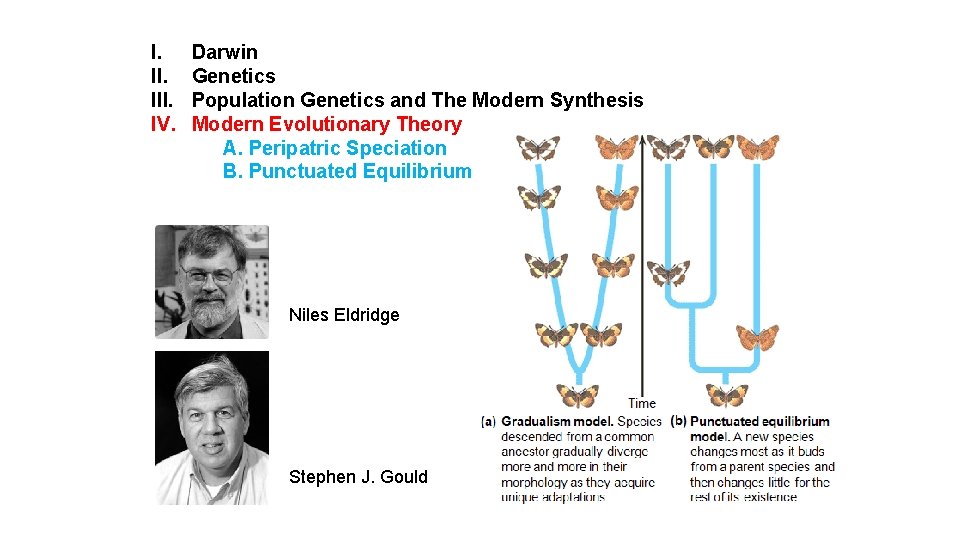
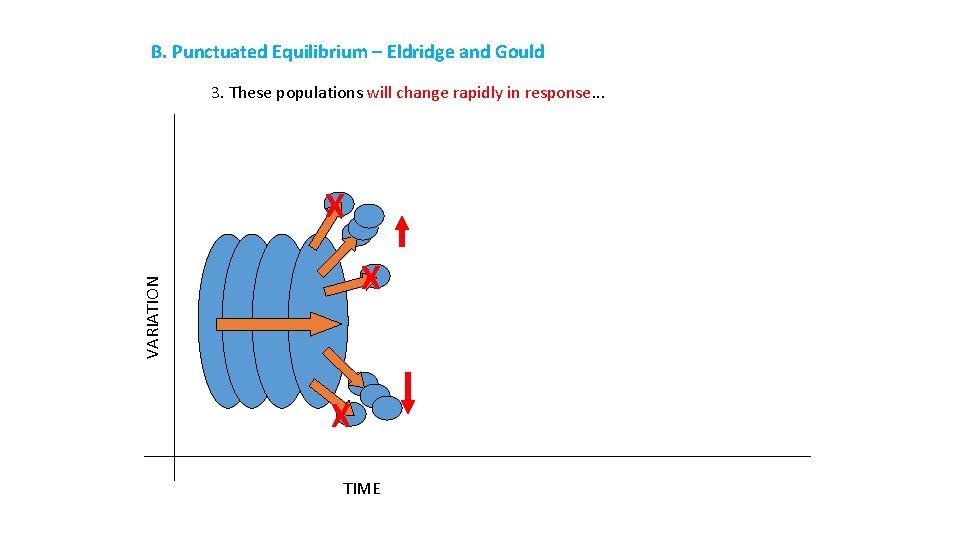
I. III. IV. Darwin Genetics Population Genetics and The Modern Synthesis Modern Evolutionary Theory A. Peripatric Speciation B. Punctuated Equilibrium Niles Eldridge Stephen J. Gould
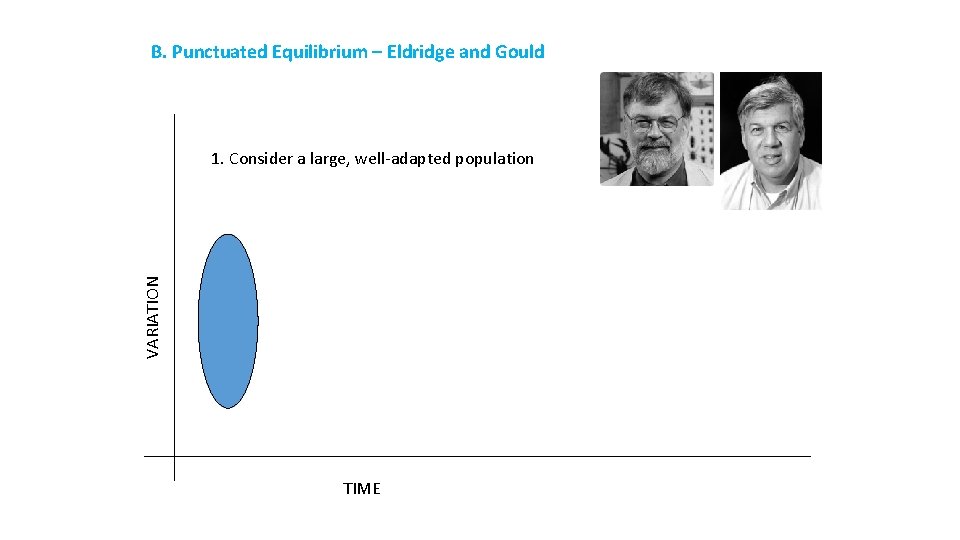
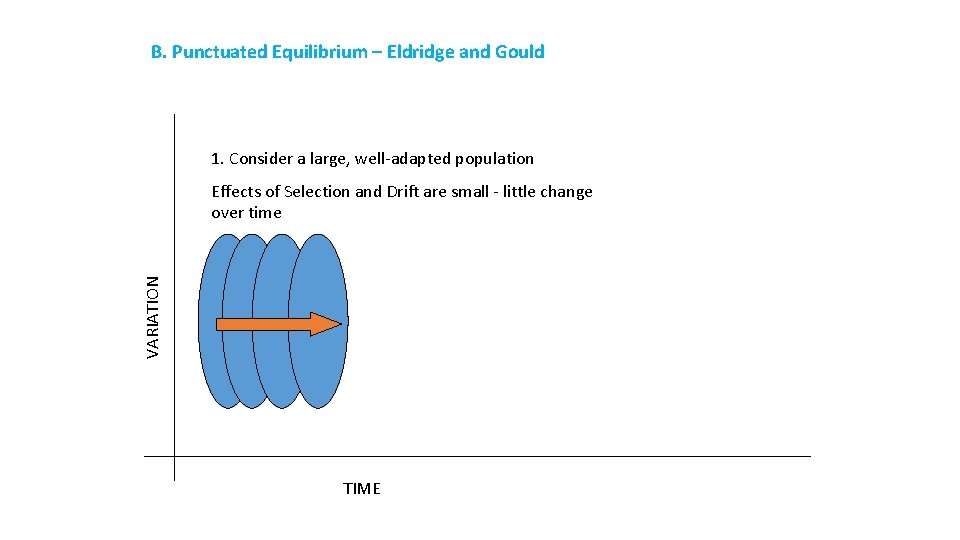
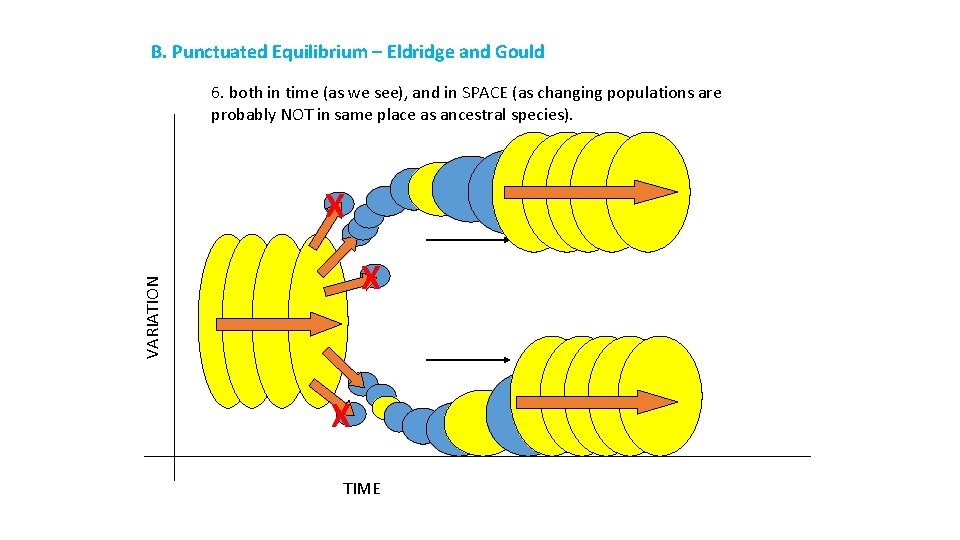
B. Punctuated Equilibrium – Eldridge and Gould VARIATION 1. Consider a large, well-adapted population TIME
B. Punctuated Equilibrium – Eldridge and Gould 1. Consider a large, well-adapted population VARIATION Effects of Selection and Drift are small - little change over time TIME
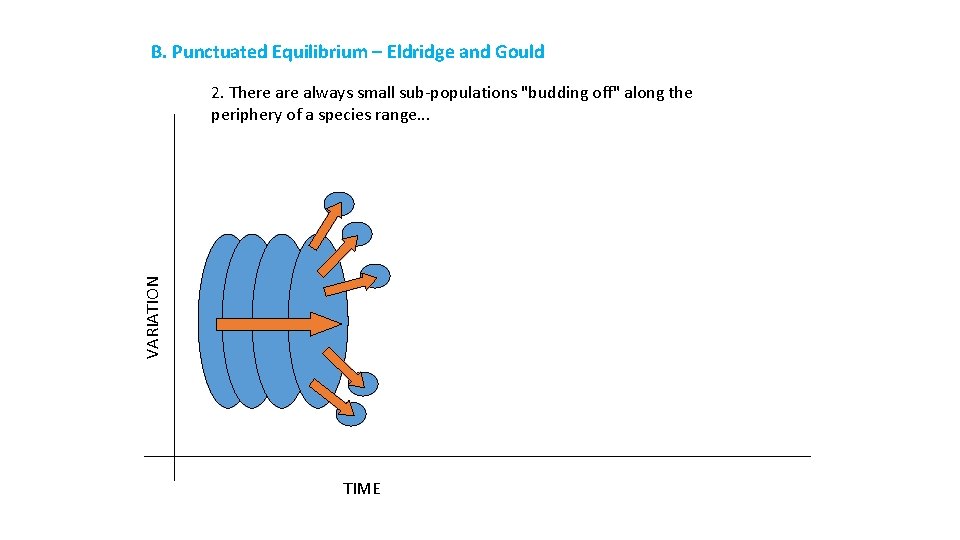
B. Punctuated Equilibrium – Eldridge and Gould VARIATION 2. There always small sub-populations "budding off" along the periphery of a species range. . . TIME
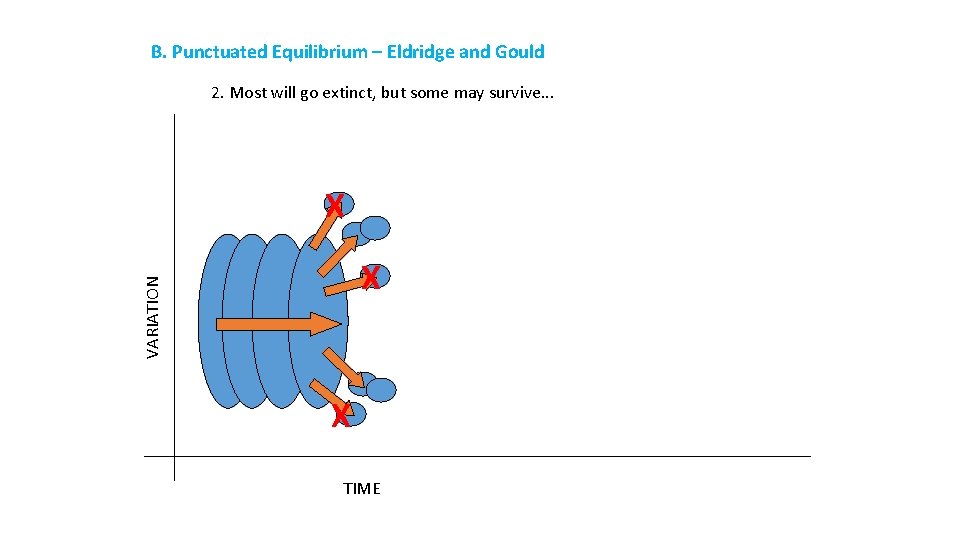
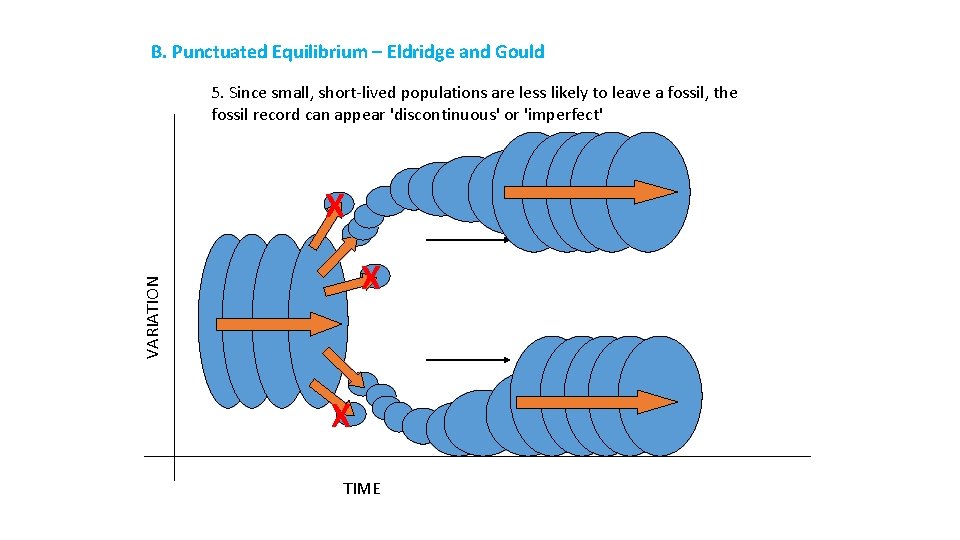
B. Punctuated Equilibrium – Eldridge and Gould 2. Most will go extinct, but some may survive. . . X VARIATION X X TIME
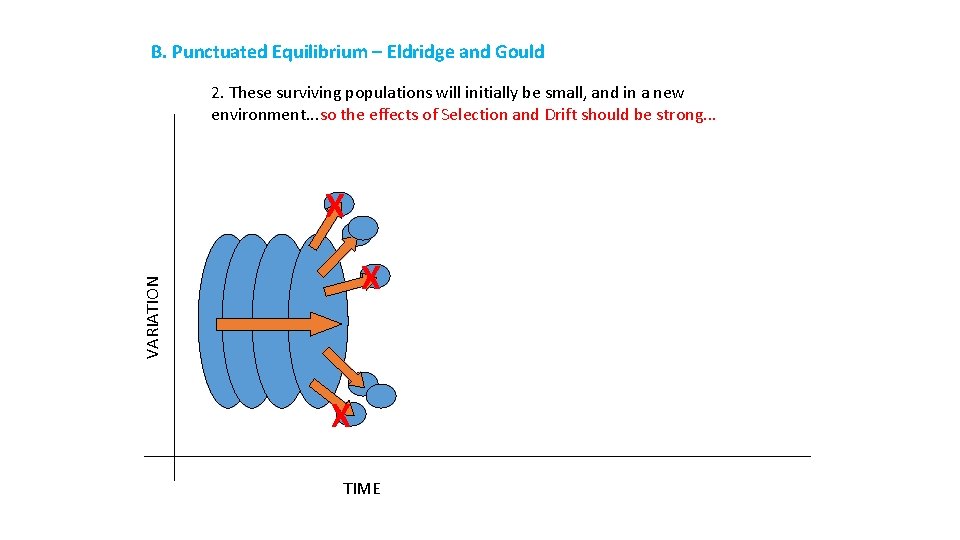
B. Punctuated Equilibrium – Eldridge and Gould 2. These surviving populations will initially be small, and in a new environment. . . so the effects of Selection and Drift should be strong. . . X VARIATION X X TIME
B. Punctuated Equilibrium – Eldridge and Gould 3. These populations will change rapidly in response. . . X VARIATION X X TIME
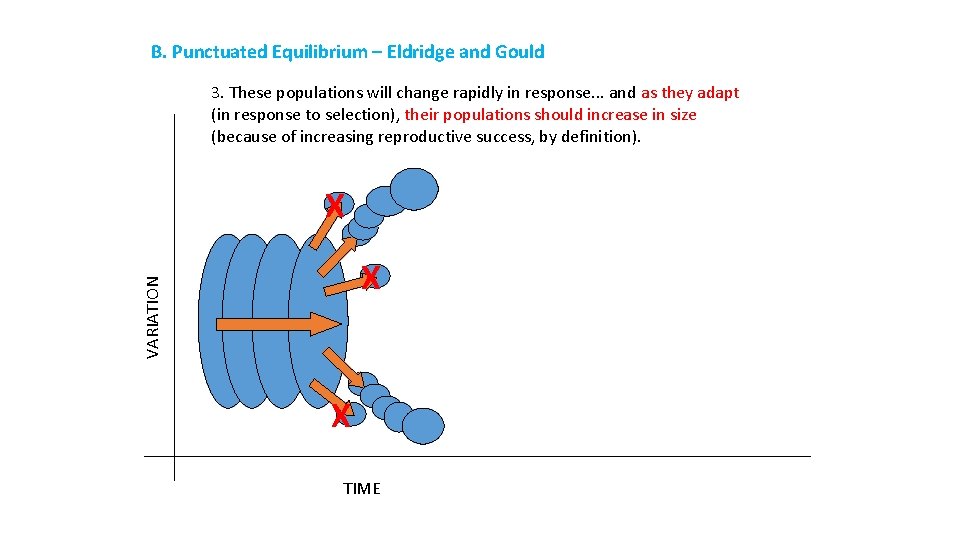
B. Punctuated Equilibrium – Eldridge and Gould 3. These populations will change rapidly in response. . . and as they adapt (in response to selection), their populations should increase in size (because of increasing reproductive success, by definition). X VARIATION X X TIME
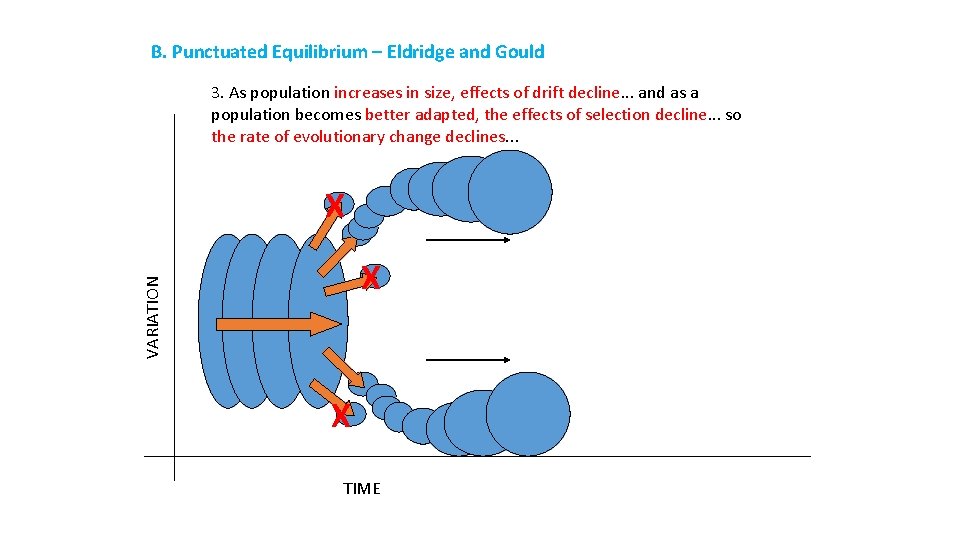
B. Punctuated Equilibrium – Eldridge and Gould 3. As population increases in size, effects of drift decline. . . and as a population becomes better adapted, the effects of selection decline. . . so the rate of evolutionary change declines. . . X VARIATION X X TIME
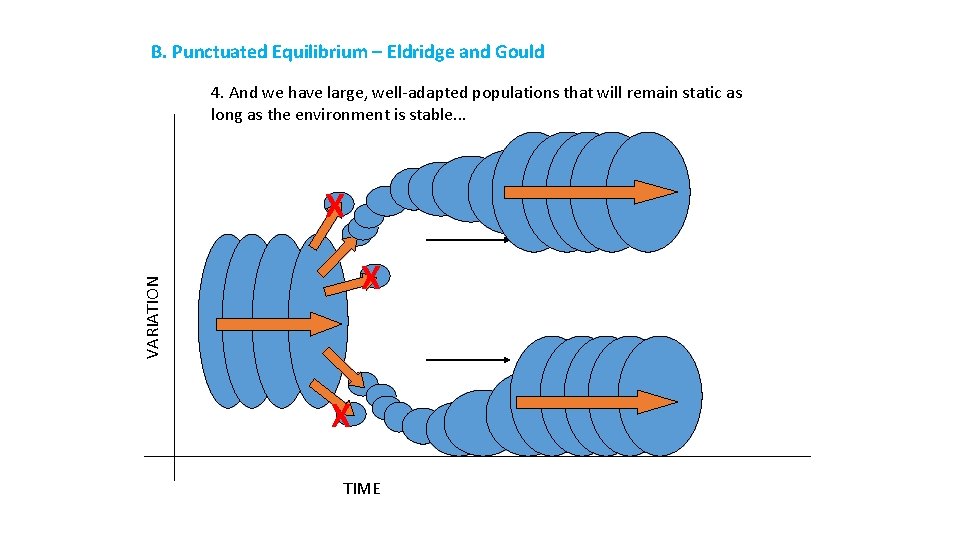
B. Punctuated Equilibrium – Eldridge and Gould 4. And we have large, well-adapted populations that will remain static as long as the environment is stable. . . X VARIATION X X TIME
B. Punctuated Equilibrium – Eldridge and Gould 5. Since small, short-lived populations are less likely to leave a fossil, the fossil record can appear 'discontinuous' or 'imperfect' X VARIATION X X TIME
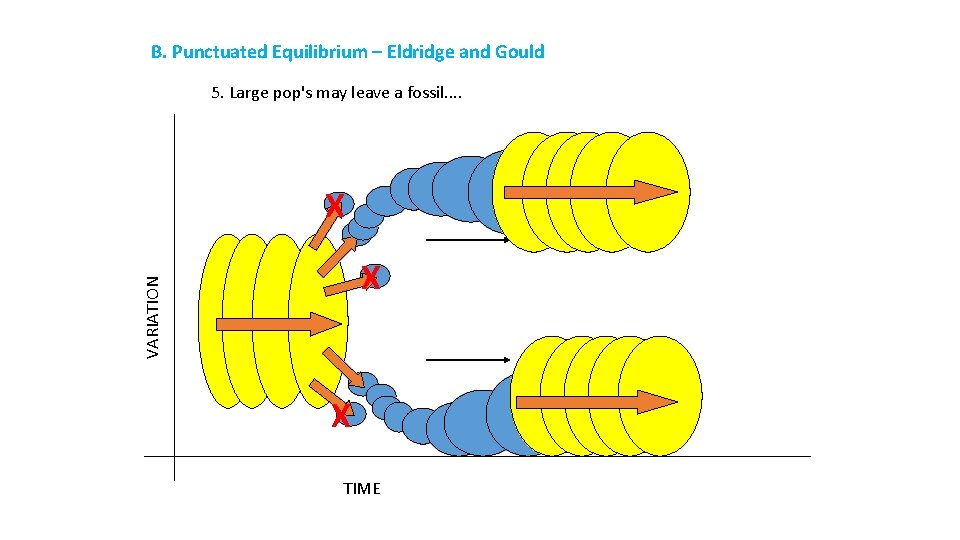
B. Punctuated Equilibrium – Eldridge and Gould 5. Large pop's may leave a fossil. . X VARIATION X X TIME
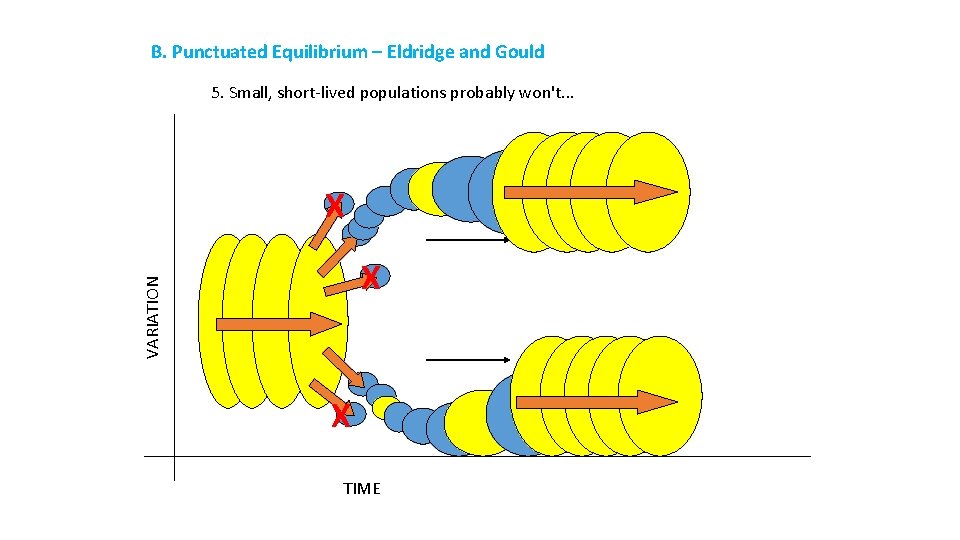
B. Punctuated Equilibrium – Eldridge and Gould 5. Small, short-lived populations probably won't. . . X VARIATION X X TIME
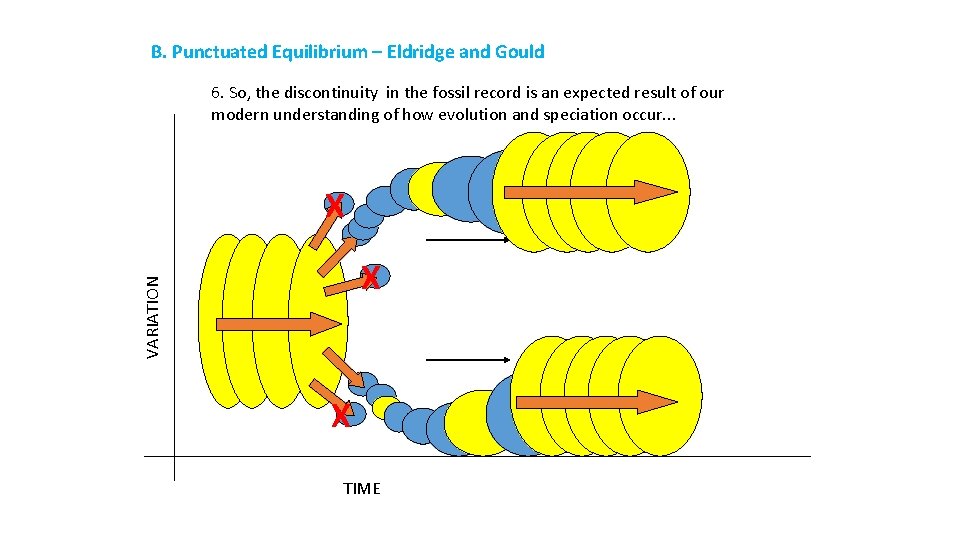
B. Punctuated Equilibrium – Eldridge and Gould 6. So, the discontinuity in the fossil record is an expected result of our modern understanding of how evolution and speciation occur. . . X VARIATION X X TIME
B. Punctuated Equilibrium – Eldridge and Gould 6. both in time (as we see), and in SPACE (as changing populations are probably NOT in same place as ancestral species). X VARIATION X X TIME
I. III. IV. Darwin Genetics Population Genetics and The Modern Synthesis Modern Evolutionary Theory A. Peripatric Speciation B. Punctuated Equilibrium C. The Molecular Revolution and The Neutral Theory Motoo Kimura 1924 -1994
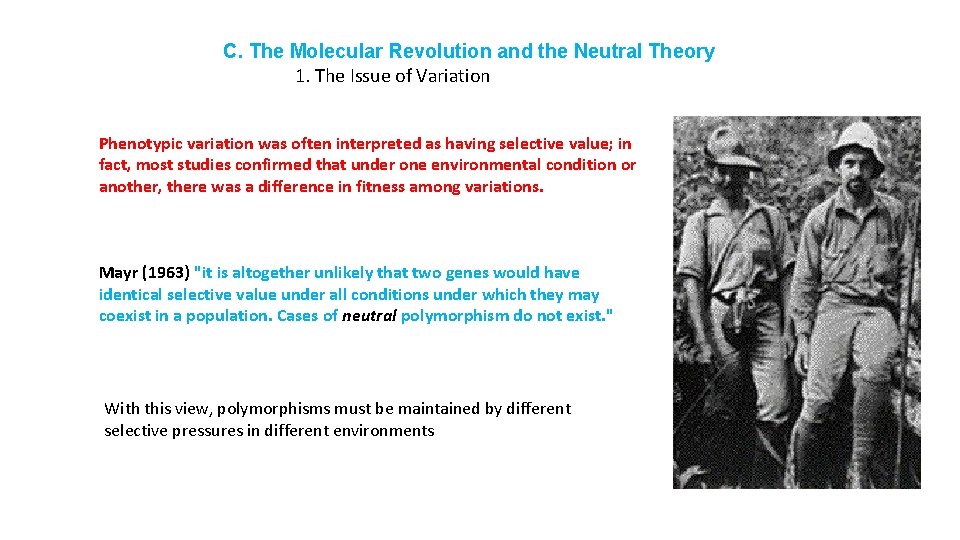
C. The Molecular Revolution and the Neutral Theory 1. The Issue of Variation Phenotypic variation was often interpreted as having selective value; in fact, most studies confirmed that under one environmental condition or another, there was a difference in fitness among variations. Mayr (1963) "it is altogether unlikely that two genes would have identical selective value under all conditions under which they may coexist in a population. Cases of neutral polymorphism do not exist. " With this view, polymorphisms must be maintained by different selective pressures in different environments
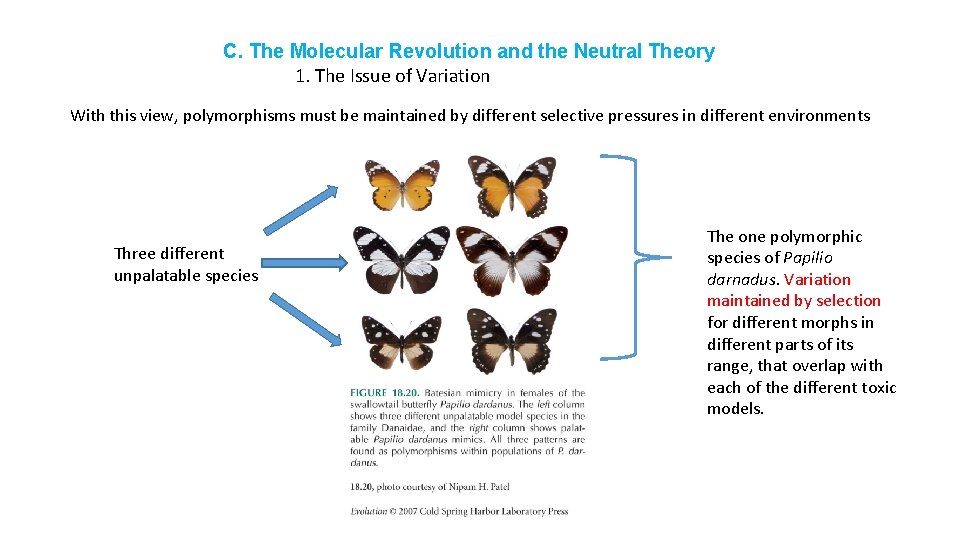
C. The Molecular Revolution and the Neutral Theory 1. The Issue of Variation With this view, polymorphisms must be maintained by different selective pressures in different environments Three different unpalatable species The one polymorphic species of Papilio darnadus. Variation maintained by selection for different morphs in different parts of its range, that overlap with each of the different toxic models.
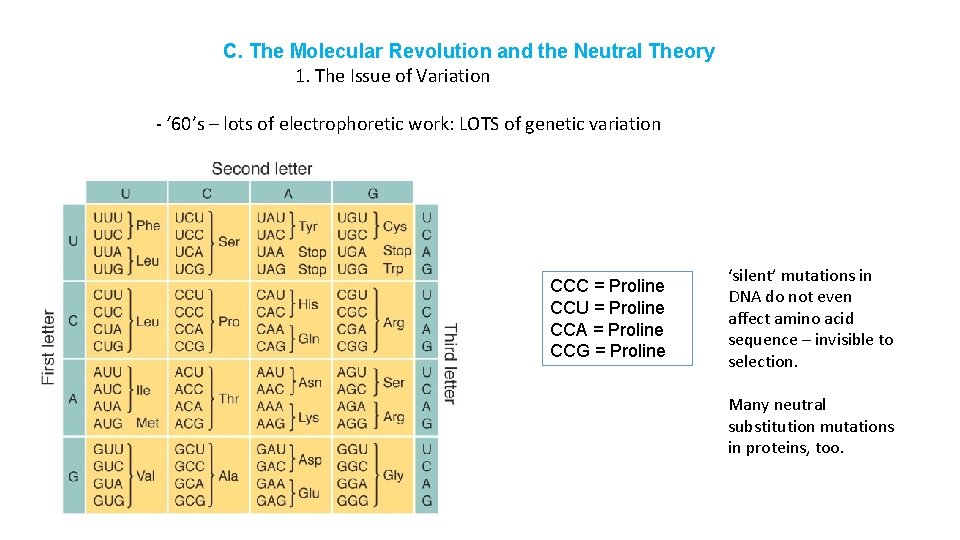
C. The Molecular Revolution and the Neutral Theory 1. The Issue of Variation - ‘ 60’s – lots of electrophoretic work: LOTS of genetic variation CCC = Proline CCU = Proline CCA = Proline CCG = Proline ‘silent’ mutations in DNA do not even affect amino acid sequence – invisible to selection. Many neutral substitution mutations in proteins, too.
C. The Molecular Revolution and the Neutral Theory 1. The Issue of Variation Most populations showed mean heterozygosities across ALL loci of about 10%. - And, about 20 -30% of all loci are polymorphic (have at least 2 alleles with frequencies over 1%). Drosophila has 10, 000 loci, so 3000 are polymorphic. At these polymorphic loci, H =. 33 Conclusion - lots of variation at a genetic level. . . is this ALL maintained by selection?
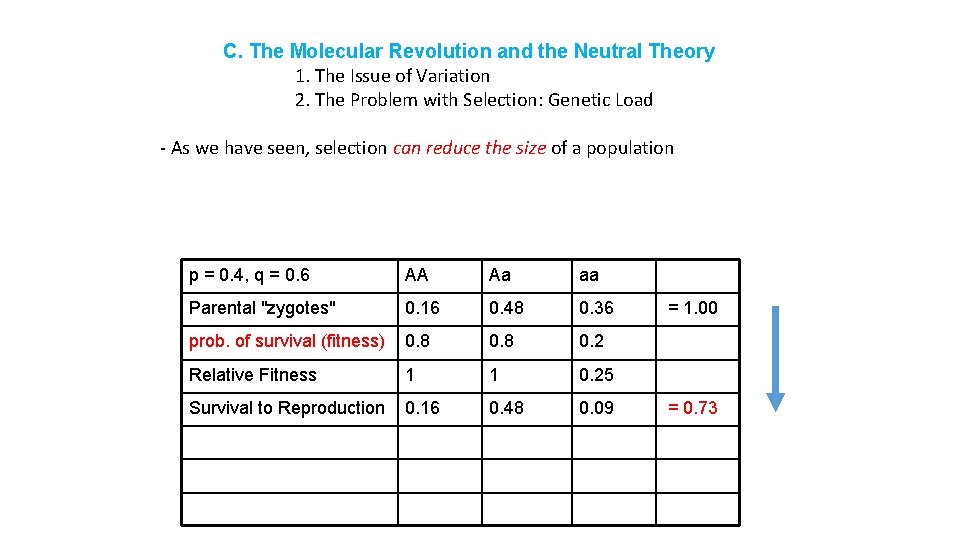
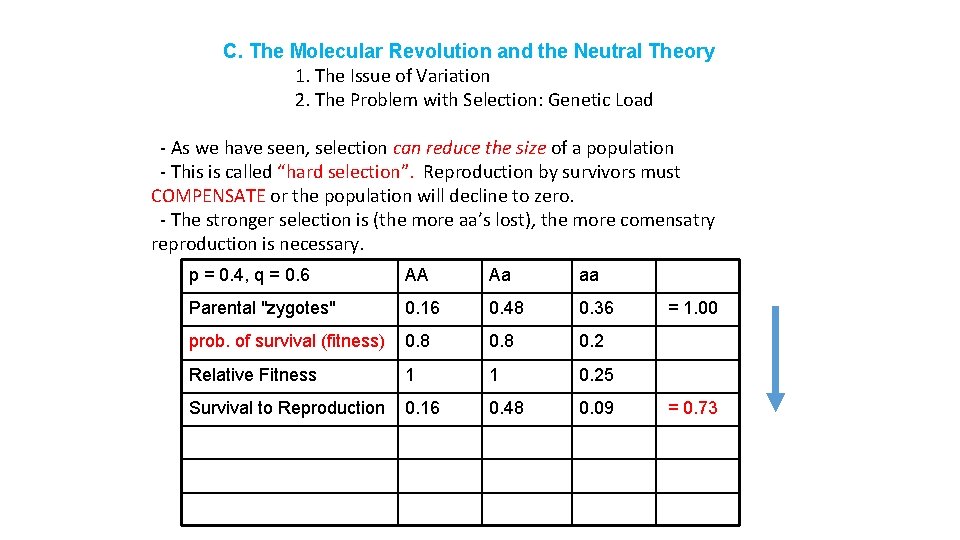
C. The Molecular Revolution and the Neutral Theory 1. The Issue of Variation 2. The Problem with Selection: Genetic Load - As we have seen, selection can reduce the size of a population p = 0. 4, q = 0. 6 AA Aa aa Parental "zygotes" 0. 16 0. 48 0. 36 prob. of survival (fitness) 0. 8 0. 2 Relative Fitness 1 1 0. 25 Survival to Reproduction 0. 16 0. 48 0. 09 = 1. 00 = 0. 73
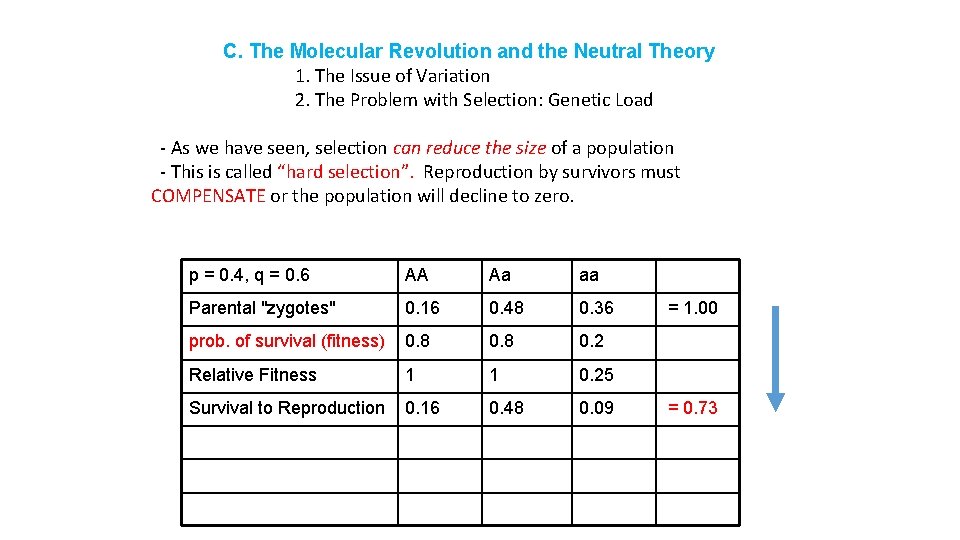
C. The Molecular Revolution and the Neutral Theory 1. The Issue of Variation 2. The Problem with Selection: Genetic Load - As we have seen, selection can reduce the size of a population - This is called “hard selection”. Reproduction by survivors must COMPENSATE or the population will decline to zero. p = 0. 4, q = 0. 6 AA Aa aa Parental "zygotes" 0. 16 0. 48 0. 36 prob. of survival (fitness) 0. 8 0. 2 Relative Fitness 1 1 0. 25 Survival to Reproduction 0. 16 0. 48 0. 09 = 1. 00 = 0. 73
C. The Molecular Revolution and the Neutral Theory 1. The Issue of Variation 2. The Problem with Selection: Genetic Load - As we have seen, selection can reduce the size of a population - This is called “hard selection”. Reproduction by survivors must COMPENSATE or the population will decline to zero. - The stronger selection is (the more aa’s lost), the more comensatry reproduction is necessary. p = 0. 4, q = 0. 6 AA Aa aa Parental "zygotes" 0. 16 0. 48 0. 36 prob. of survival (fitness) 0. 8 0. 2 Relative Fitness 1 1 0. 25 Survival to Reproduction 0. 16 0. 48 0. 09 = 1. 00 = 0. 73
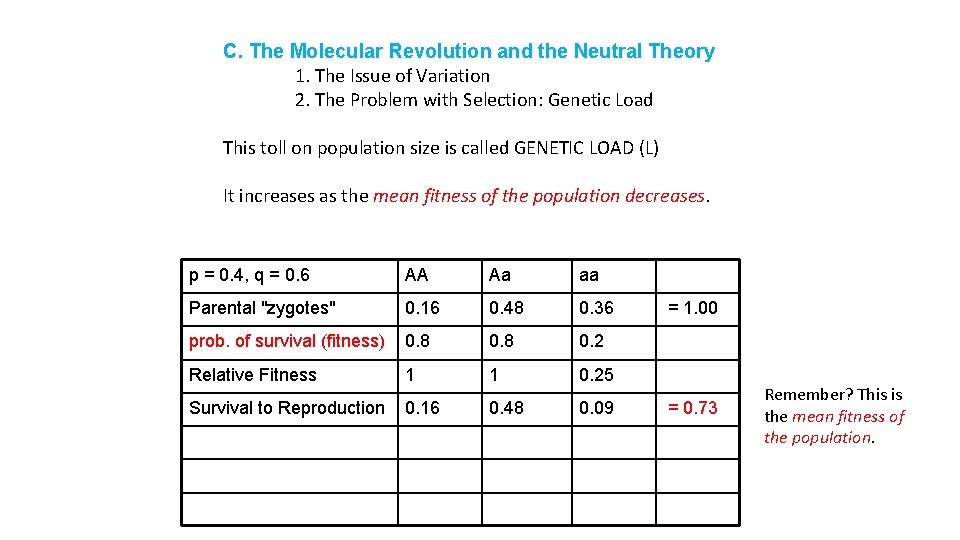
C. The Molecular Revolution and the Neutral Theory 1. The Issue of Variation 2. The Problem with Selection: Genetic Load This toll on population size is called GENETIC LOAD (L) It increases as the mean fitness of the population decreases. p = 0. 4, q = 0. 6 AA Aa aa Parental "zygotes" 0. 16 0. 48 0. 36 prob. of survival (fitness) 0. 8 0. 2 Relative Fitness 1 1 0. 25 Survival to Reproduction 0. 16 0. 48 0. 09 = 1. 00 = 0. 73 Remember? This is the mean fitness of the population.
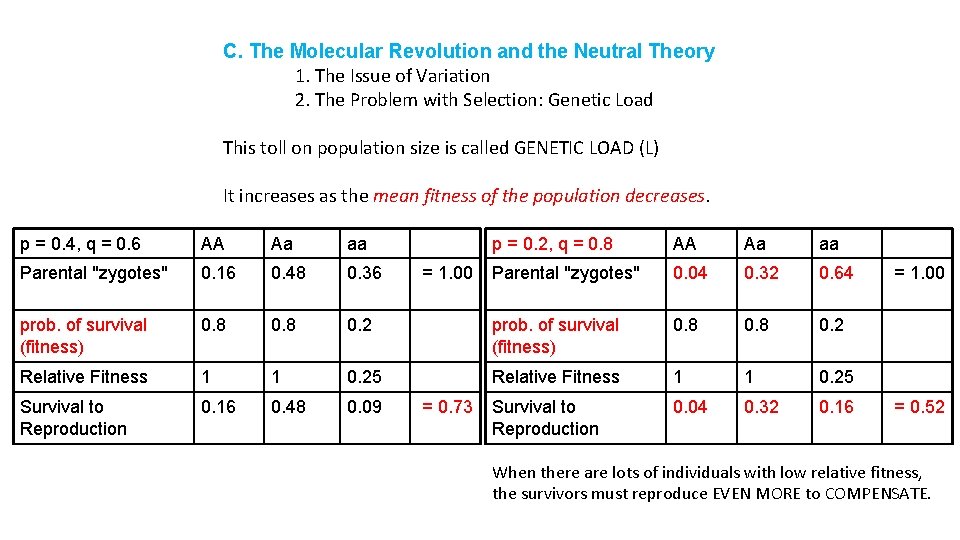
C. The Molecular Revolution and the Neutral Theory 1. The Issue of Variation 2. The Problem with Selection: Genetic Load This toll on population size is called GENETIC LOAD (L) It increases as the mean fitness of the population decreases. p = 0. 4, q = 0. 6 AA Aa aa p = 0. 2, q = 0. 8 AA Aa aa Parental "zygotes" 0. 16 0. 48 0. 36 Parental "zygotes" 0. 04 0. 32 0. 64 prob. of survival (fitness) 0. 8 0. 2 Relative Fitness 1 1 0. 25 Survival to Reproduction 0. 16 0. 48 0. 09 Survival to Reproduction 0. 04 0. 32 0. 16 = 1. 00 = 0. 73 = 1. 00 = 0. 52 When there are lots of individuals with low relative fitness, the survivors must reproduce EVEN MORE to COMPENSATE.
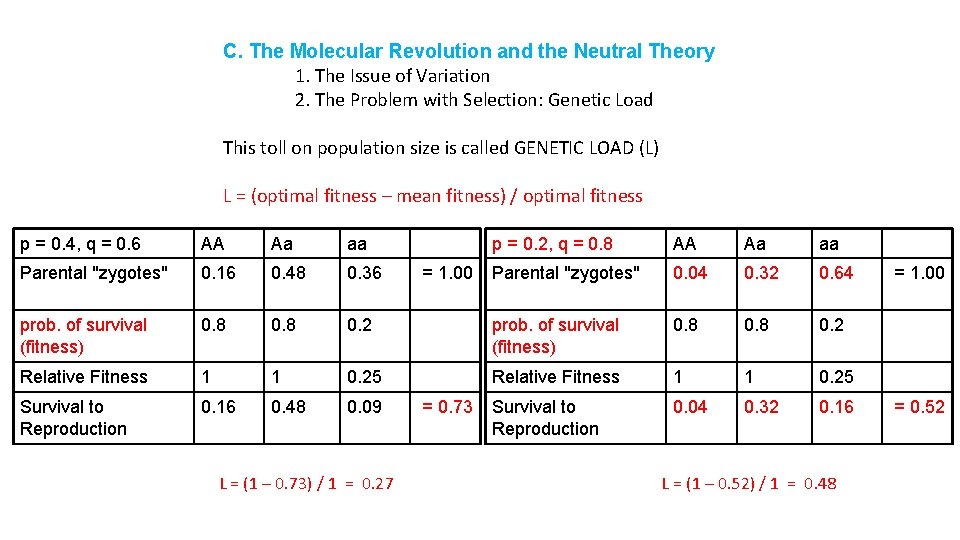
C. The Molecular Revolution and the Neutral Theory 1. The Issue of Variation 2. The Problem with Selection: Genetic Load This toll on population size is called GENETIC LOAD (L) L = (optimal fitness – mean fitness) / optimal fitness p = 0. 4, q = 0. 6 AA Aa aa p = 0. 2, q = 0. 8 AA Aa aa Parental "zygotes" 0. 16 0. 48 0. 36 Parental "zygotes" 0. 04 0. 32 0. 64 prob. of survival (fitness) 0. 8 0. 2 Relative Fitness 1 1 0. 25 Survival to Reproduction 0. 16 0. 48 0. 09 Survival to Reproduction 0. 04 0. 32 0. 16 L = (1 – 0. 73) / 1 = 0. 27 = 1. 00 = 0. 73 L = (1 – 0. 52) / 1 = 0. 48 = 1. 00 = 0. 52
C. The Molecular Revolution and the Neutral Theory 1. The Issue of Variation 2. The Problem with Selection: Genetic Load Why is this a problem? - The easiest way for selection to maintain variation is through heterosis: selection for the heterozygote (Aa). - But in this situation, lots of homozygotes (AA and aa) die.
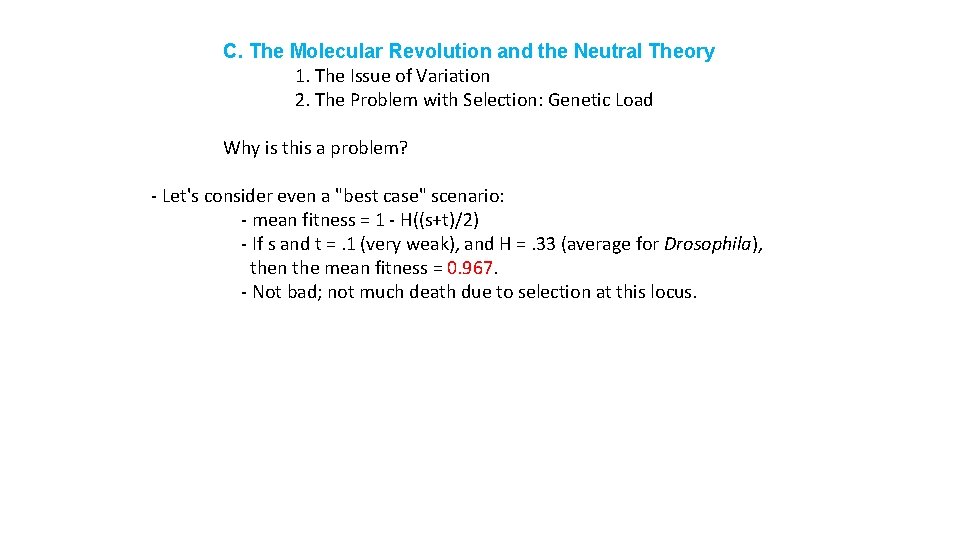
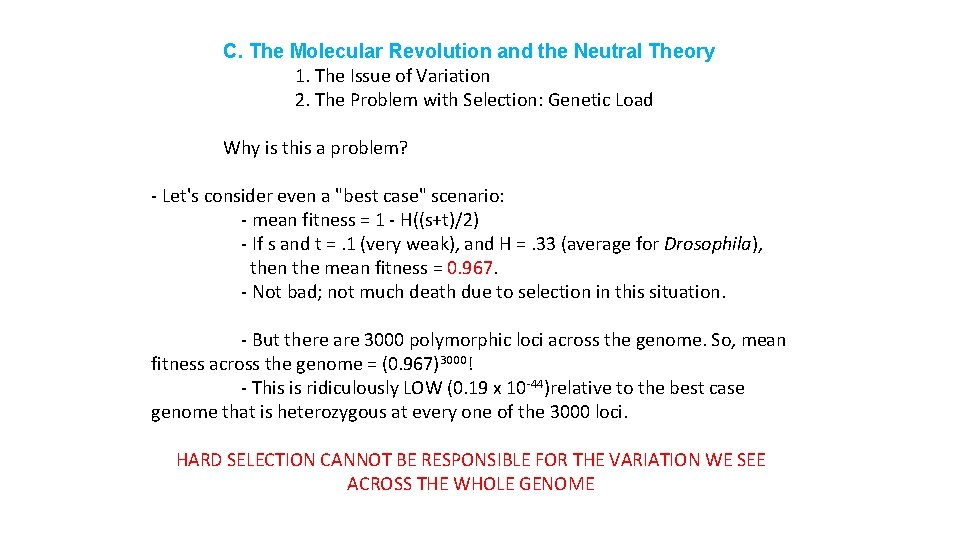
C. The Molecular Revolution and the Neutral Theory 1. The Issue of Variation 2. The Problem with Selection: Genetic Load Why is this a problem? - Let's consider even a "best case" scenario: - mean fitness = 1 - H((s+t)/2) - If s and t =. 1 (very weak), and H =. 33 (average for Drosophila), then the mean fitness = 0. 967. - Not bad; not much death due to selection at this locus.
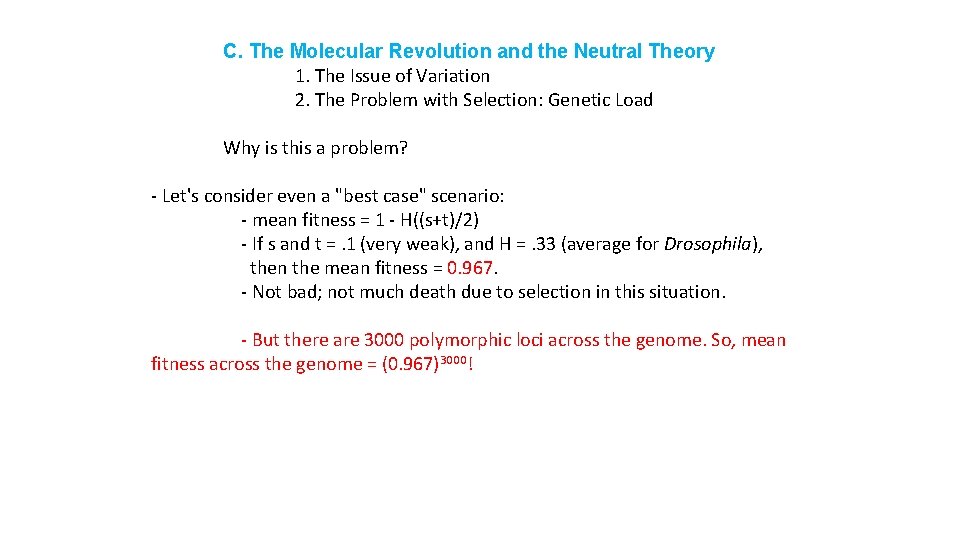
C. The Molecular Revolution and the Neutral Theory 1. The Issue of Variation 2. The Problem with Selection: Genetic Load Why is this a problem? - Let's consider even a "best case" scenario: - mean fitness = 1 - H((s+t)/2) - If s and t =. 1 (very weak), and H =. 33 (average for Drosophila), then the mean fitness = 0. 967. - Not bad; not much death due to selection in this situation. - But there are 3000 polymorphic loci across the genome. So, mean fitness across the genome = (0. 967)3000!
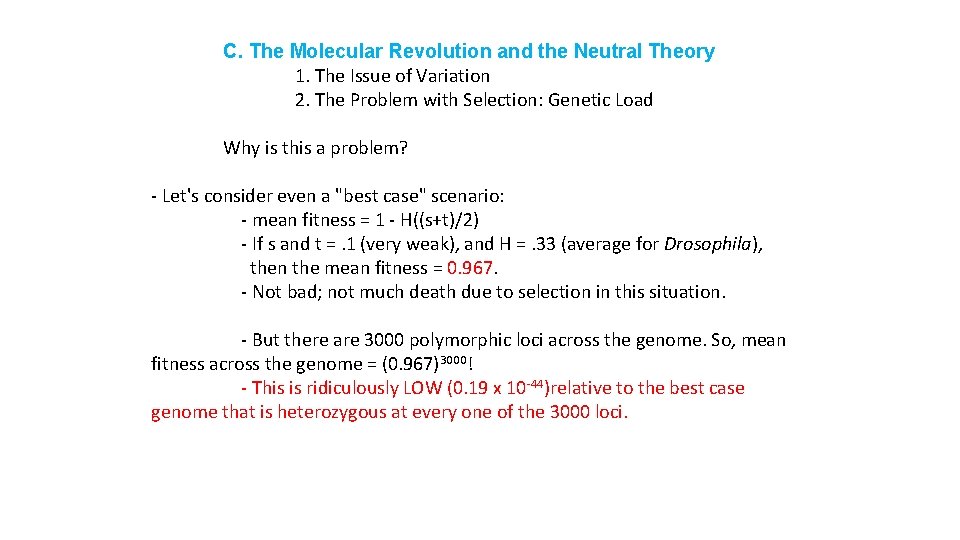
C. The Molecular Revolution and the Neutral Theory 1. The Issue of Variation 2. The Problem with Selection: Genetic Load Why is this a problem? - Let's consider even a "best case" scenario: - mean fitness = 1 - H((s+t)/2) - If s and t =. 1 (very weak), and H =. 33 (average for Drosophila), then the mean fitness = 0. 967. - Not bad; not much death due to selection in this situation. - But there are 3000 polymorphic loci across the genome. So, mean fitness across the genome = (0. 967)3000! - This is ridiculously LOW (0. 19 x 10 -44)relative to the best case genome that is heterozygous at every one of the 3000 loci.
C. The Molecular Revolution and the Neutral Theory 1. The Issue of Variation 2. The Problem with Selection: Genetic Load Why is this a problem? - Let's consider even a "best case" scenario: - mean fitness = 1 - H((s+t)/2) - If s and t =. 1 (very weak), and H =. 33 (average for Drosophila), then the mean fitness = 0. 967. - Not bad; not much death due to selection in this situation. - But there are 3000 polymorphic loci across the genome. So, mean fitness across the genome = (0. 967)3000! - This is ridiculously LOW (0. 19 x 10 -44)relative to the best case genome that is heterozygous at every one of the 3000 loci. HARD SELECTION CANNOT BE RESPONSIBLE FOR THE VARIATION WE SEE ACROSS THE WHOLE GENOME
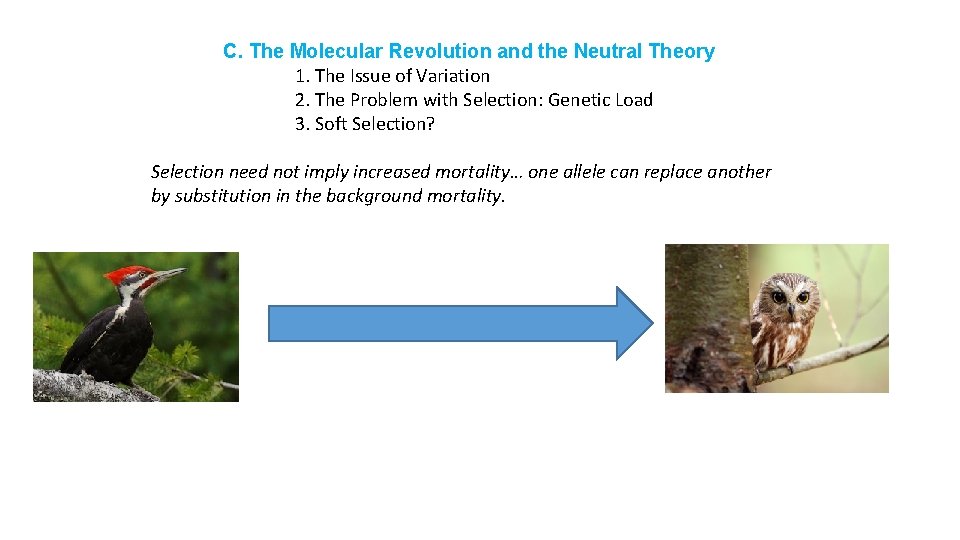
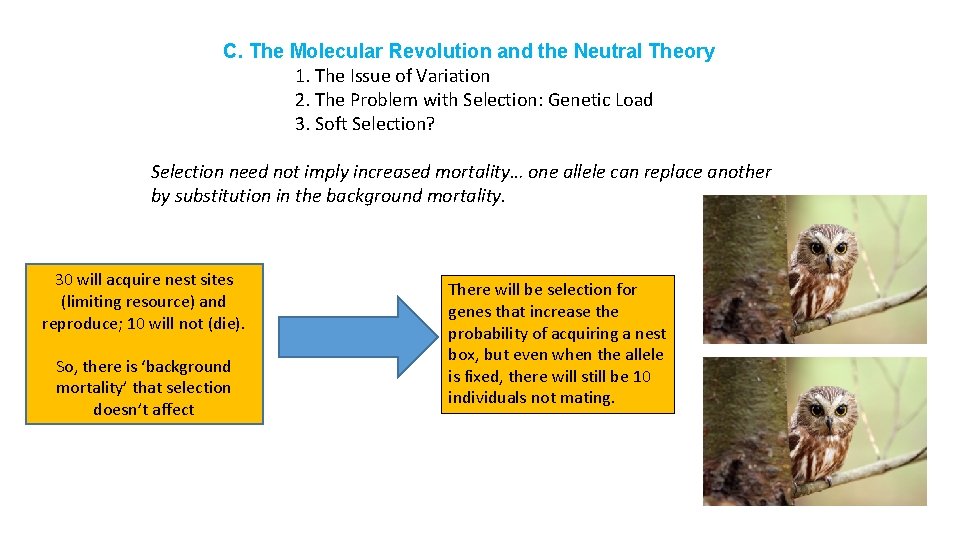
C. The Molecular Revolution and the Neutral Theory 1. The Issue of Variation 2. The Problem with Selection: Genetic Load 3. Soft Selection? Selection need not imply increased mortality… one allele can replace another by substitution in the background mortality.
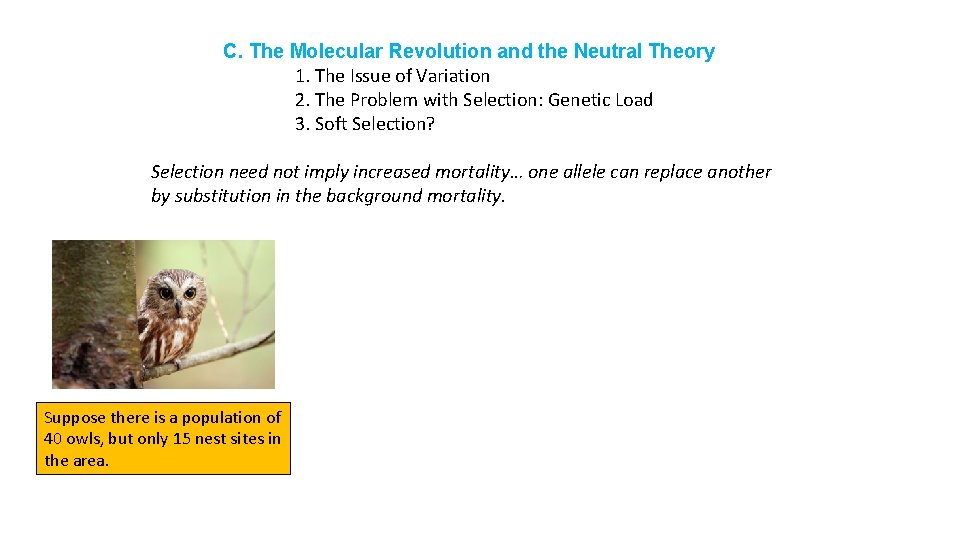
C. The Molecular Revolution and the Neutral Theory 1. The Issue of Variation 2. The Problem with Selection: Genetic Load 3. Soft Selection? Selection need not imply increased mortality… one allele can replace another by substitution in the background mortality. Suppose there is a population of 40 owls, but only 15 nest sites in the area.
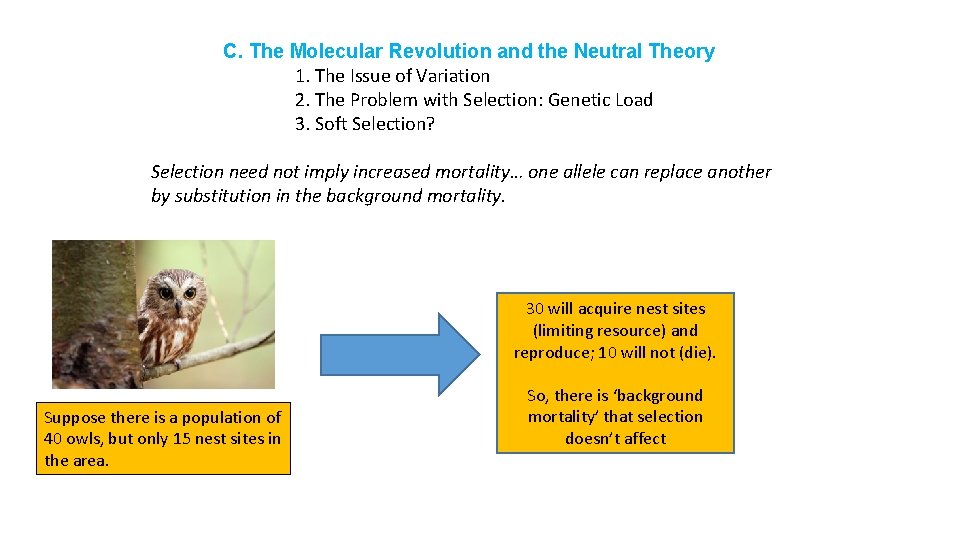
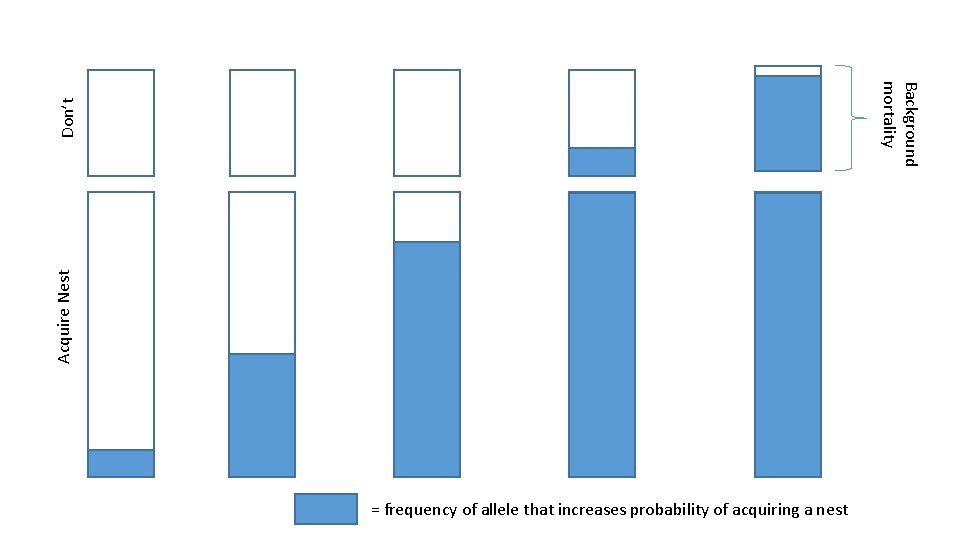
C. The Molecular Revolution and the Neutral Theory 1. The Issue of Variation 2. The Problem with Selection: Genetic Load 3. Soft Selection? Selection need not imply increased mortality… one allele can replace another by substitution in the background mortality. 30 will acquire nest sites (limiting resource) and reproduce; 10 will not (die). Suppose there is a population of 40 owls, but only 15 nest sites in the area. So, there is ‘background mortality’ that selection doesn’t affect
C. The Molecular Revolution and the Neutral Theory 1. The Issue of Variation 2. The Problem with Selection: Genetic Load 3. Soft Selection? Selection need not imply increased mortality… one allele can replace another by substitution in the background mortality. 30 will acquire nest sites (limiting resource) and reproduce; 10 will not (die). So, there is ‘background mortality’ that selection doesn’t affect There will be selection for genes that increase the probability of acquiring a nest box, but even when the allele is fixed, there will still be 10 individuals not mating.
Acquire Nest Don’t Background mortality = frequency of allele that increases probability of acquiring a nest
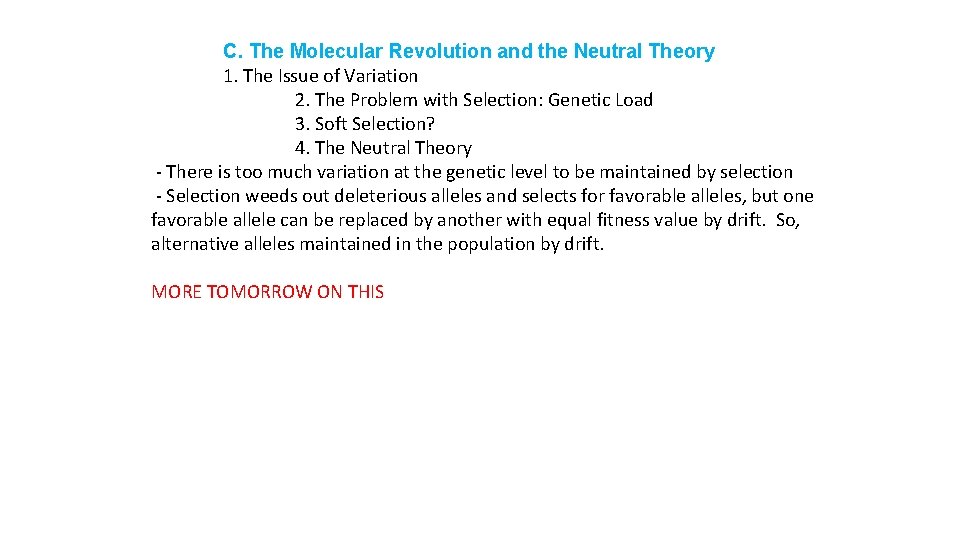
C. The Molecular Revolution and the Neutral Theory 1. The Issue of Variation 2. The Problem with Selection: Genetic Load 3. Soft Selection? 4. The Neutral Theory - There is too much variation at the genetic level to be maintained by selection - Selection weeds out deleterious alleles and selects for favorable alleles, but one favorable allele can be replaced by another with equal fitness value by drift. So, alternative alleles maintained in the population by drift. MORE TOMORROW ON THIS
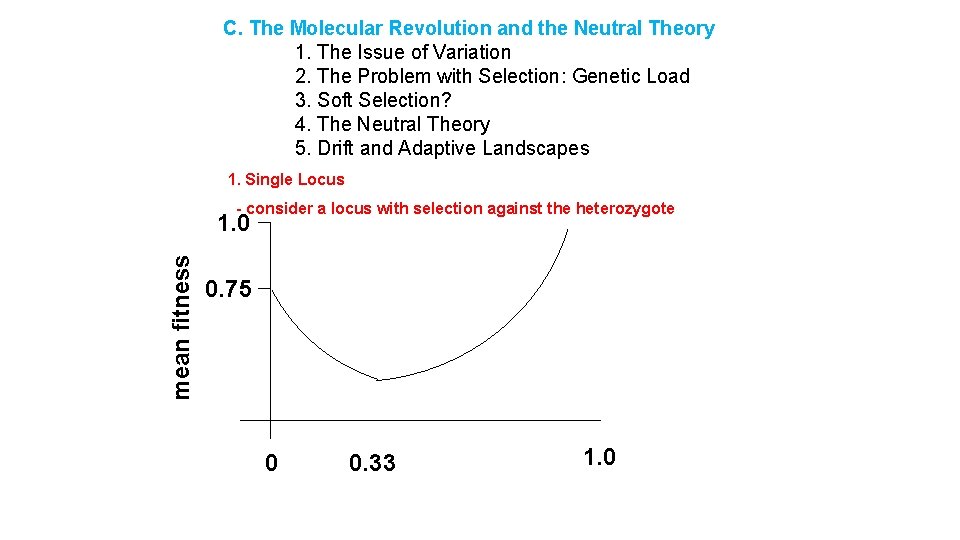
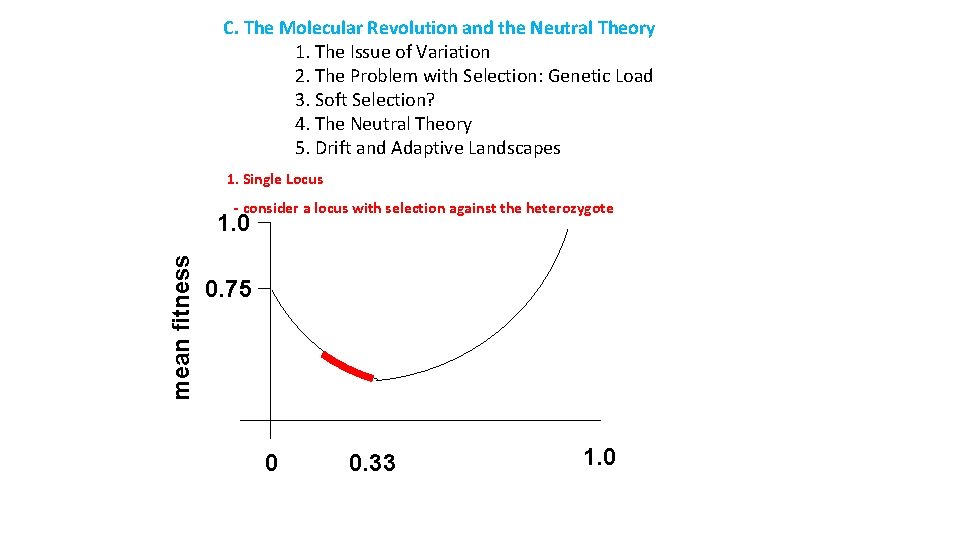
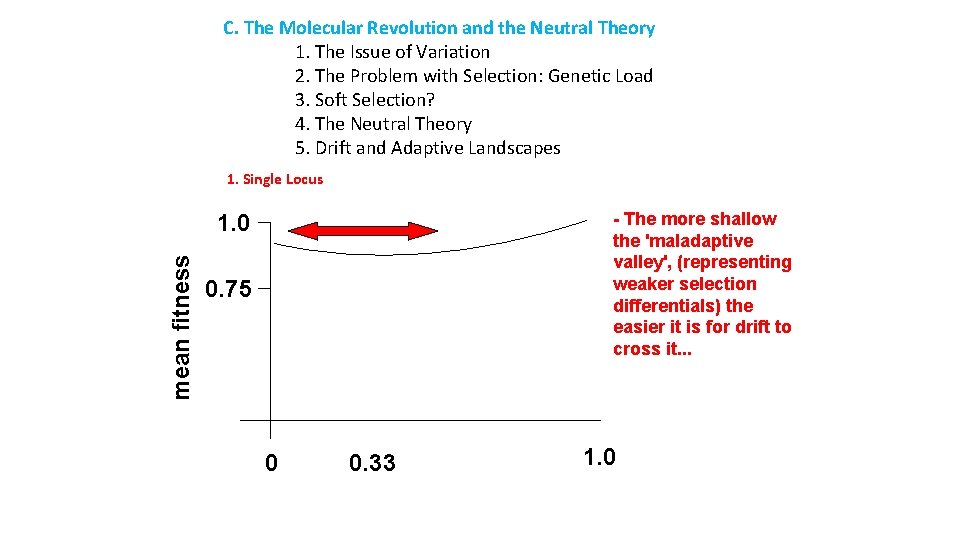
C. The Molecular Revolution and the Neutral Theory 1. The Issue of Variation 2. The Problem with Selection: Genetic Load 3. Soft Selection? 4. The Neutral Theory 5. Drift and Adaptive Landscapes 1. Single Locus - consider a locus with selection against the heterozygote mean fitness 1. 0 0. 75 0 0. 33 1. 0
C. The Molecular Revolution and the Neutral Theory 1. The Issue of Variation 2. The Problem with Selection: Genetic Load 3. Soft Selection? 4. The Neutral Theory 5. Drift and Adaptive Landscapes 1. Single Locus - consider a locus with selection against the heterozygote mean fitness 1. 0 0. 75 0 0. 33 1. 0
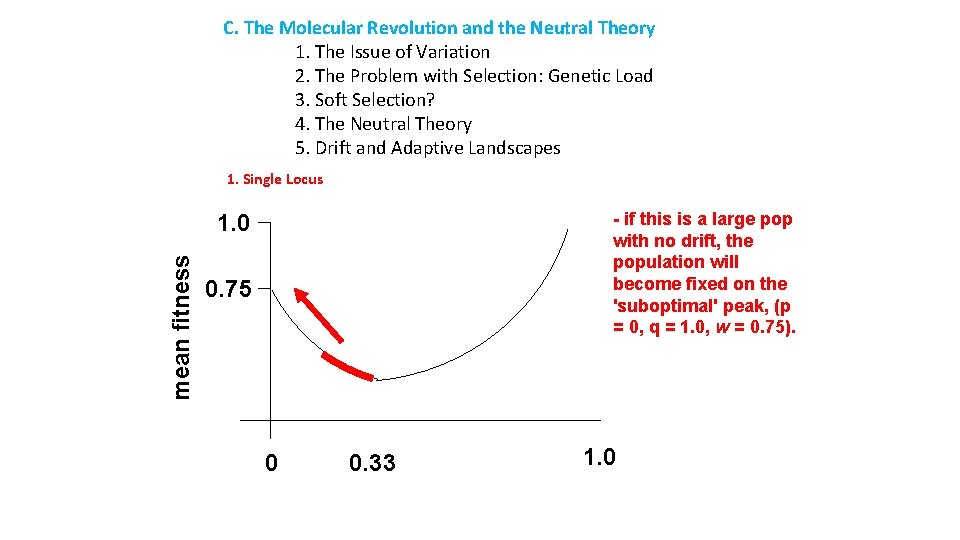
C. The Molecular Revolution and the Neutral Theory 1. The Issue of Variation 2. The Problem with Selection: Genetic Load 3. Soft Selection? 4. The Neutral Theory 5. Drift and Adaptive Landscapes 1. Single Locus - if this is a large pop with no drift, the population will become fixed on the 'suboptimal' peak, (p = 0, q = 1. 0, w = 0. 75). mean fitness 1. 0 0. 75 0 0. 33 1. 0
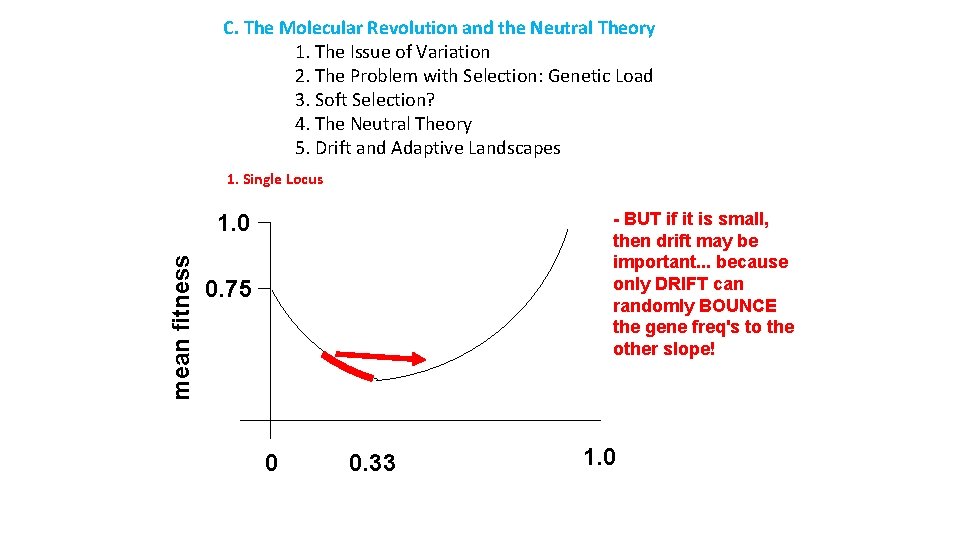
C. The Molecular Revolution and the Neutral Theory 1. The Issue of Variation 2. The Problem with Selection: Genetic Load 3. Soft Selection? 4. The Neutral Theory 5. Drift and Adaptive Landscapes 1. Single Locus - BUT if it is small, then drift may be important. . . because only DRIFT can randomly BOUNCE the gene freq's to the other slope! mean fitness 1. 0 0. 75 0 0. 33 1. 0
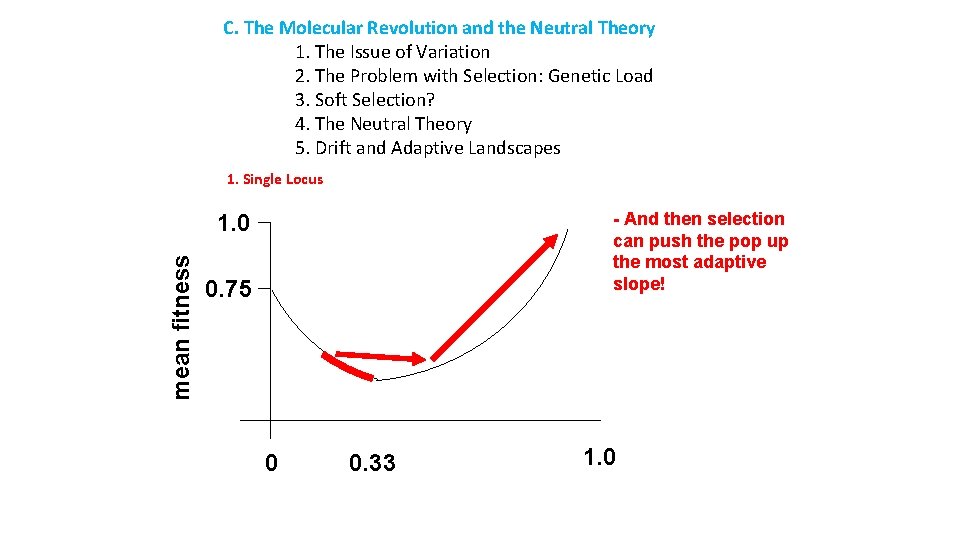
C. The Molecular Revolution and the Neutral Theory 1. The Issue of Variation 2. The Problem with Selection: Genetic Load 3. Soft Selection? 4. The Neutral Theory 5. Drift and Adaptive Landscapes 1. Single Locus - And then selection can push the pop up the most adaptive slope! mean fitness 1. 0 0. 75 0 0. 33 1. 0
C. The Molecular Revolution and the Neutral Theory 1. The Issue of Variation 2. The Problem with Selection: Genetic Load 3. Soft Selection? 4. The Neutral Theory 5. Drift and Adaptive Landscapes 1. Single Locus - The more shallow the 'maladaptive valley', (representing weaker selection differentials) the easier it is for drift to cross it. . . mean fitness 1. 0 0. 75 0 0. 33 1. 0
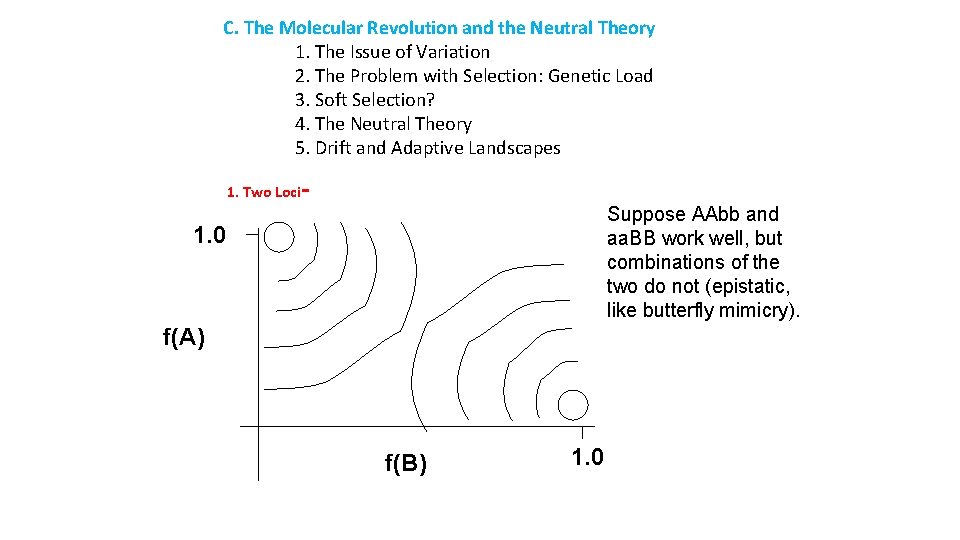
C. The Molecular Revolution and the Neutral Theory 1. The Issue of Variation 2. The Problem with Selection: Genetic Load 3. Soft Selection? 4. The Neutral Theory 5. Drift and Adaptive Landscapes 1. Two Loci- Suppose AAbb and aa. BB work well, but combinations of the two do not (epistatic, like butterfly mimicry). 1. 0 f(A) f(B) 1. 0
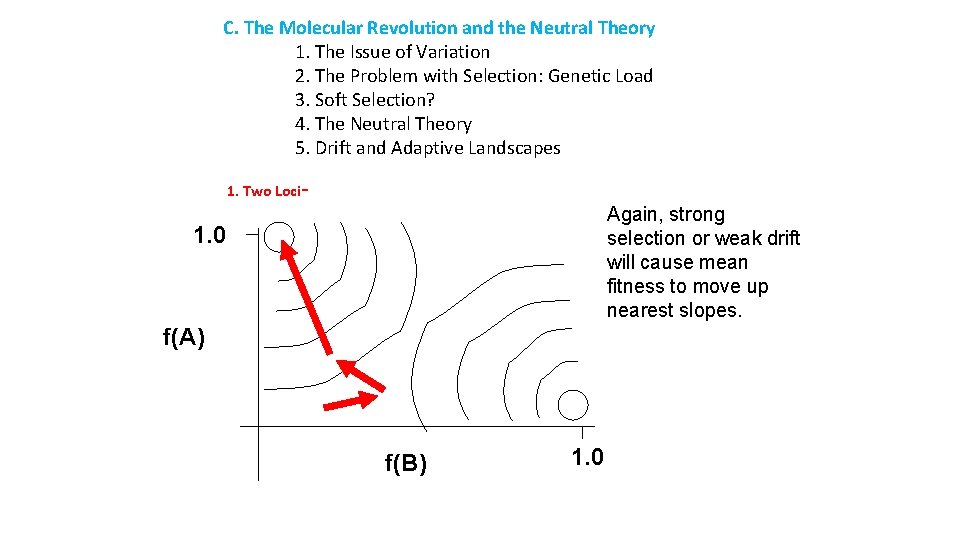
C. The Molecular Revolution and the Neutral Theory 1. The Issue of Variation 2. The Problem with Selection: Genetic Load 3. Soft Selection? 4. The Neutral Theory 5. Drift and Adaptive Landscapes 1. Two Loci- Again, strong selection or weak drift will cause mean fitness to move up nearest slopes. 1. 0 f(A) f(B) 1. 0
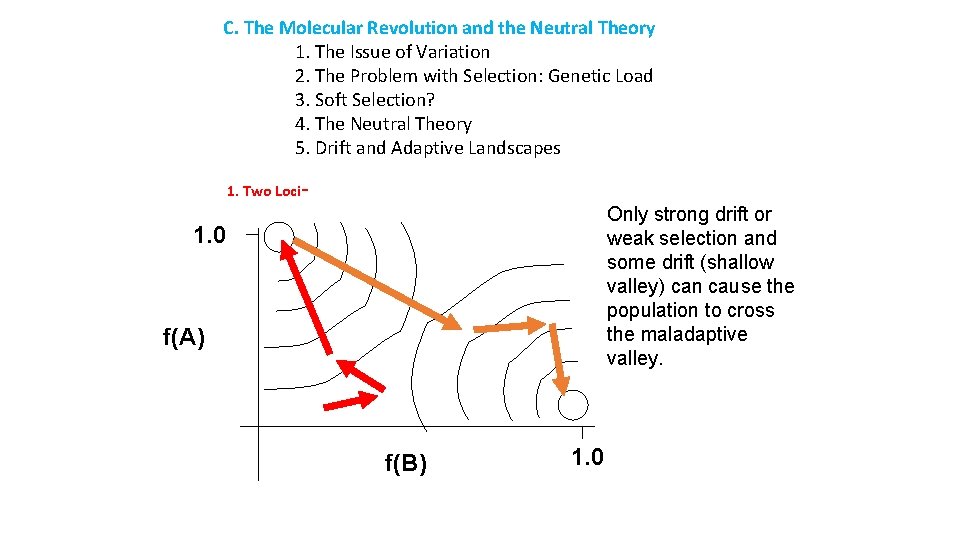
C. The Molecular Revolution and the Neutral Theory 1. The Issue of Variation 2. The Problem with Selection: Genetic Load 3. Soft Selection? 4. The Neutral Theory 5. Drift and Adaptive Landscapes 1. Two Loci- Only strong drift or weak selection and some drift (shallow valley) can cause the population to cross the maladaptive valley. 1. 0 f(A) f(B) 1. 0
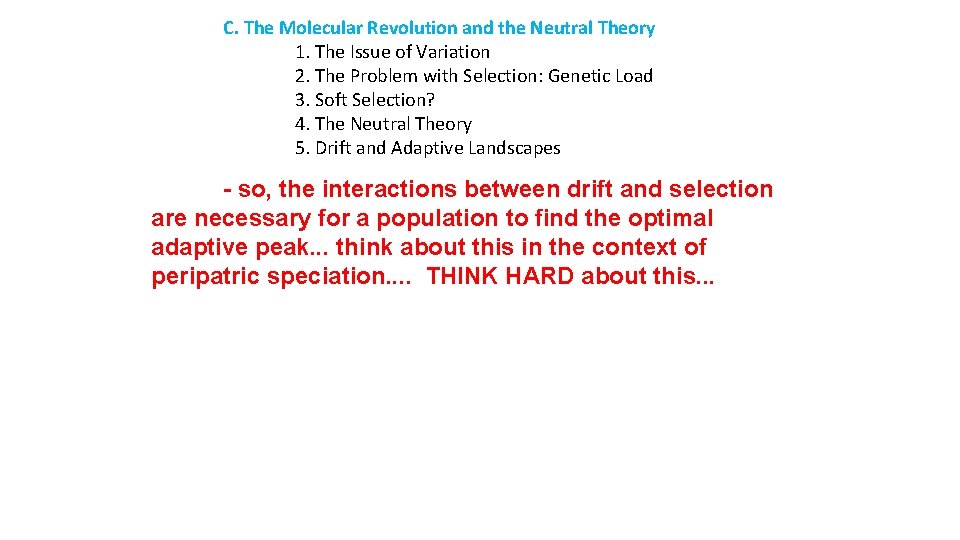
C. The Molecular Revolution and the Neutral Theory 1. The Issue of Variation 2. The Problem with Selection: Genetic Load 3. Soft Selection? 4. The Neutral Theory 5. Drift and Adaptive Landscapes - so, the interactions between drift and selection are necessary for a population to find the optimal adaptive peak. . . think about this in the context of peripatric speciation. . THINK HARD about this. . .
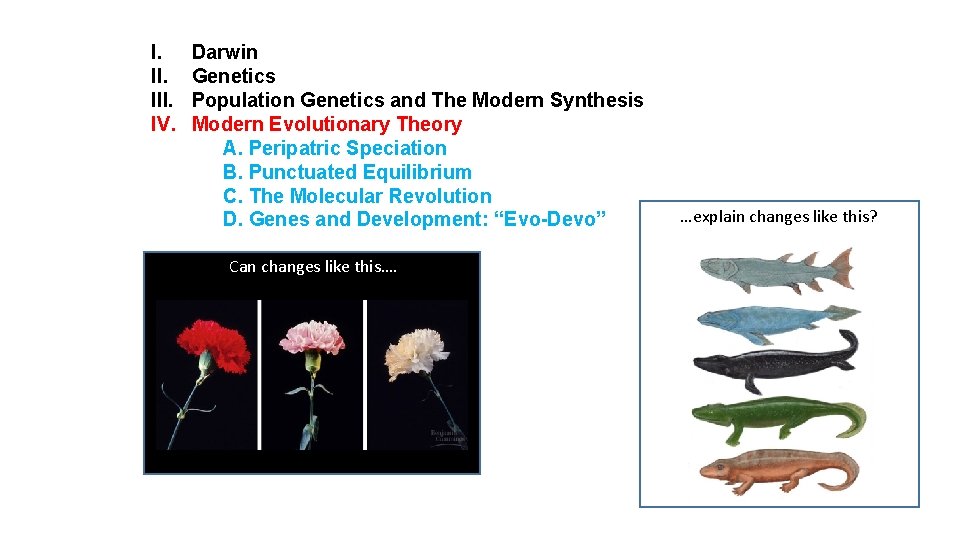
I. III. IV. Darwin Genetics Population Genetics and The Modern Synthesis Modern Evolutionary Theory A. Peripatric Speciation B. Punctuated Equilibrium C. The Molecular Revolution D. Genes and Development: “Evo-Devo” Can changes like this…. …explain changes like this?
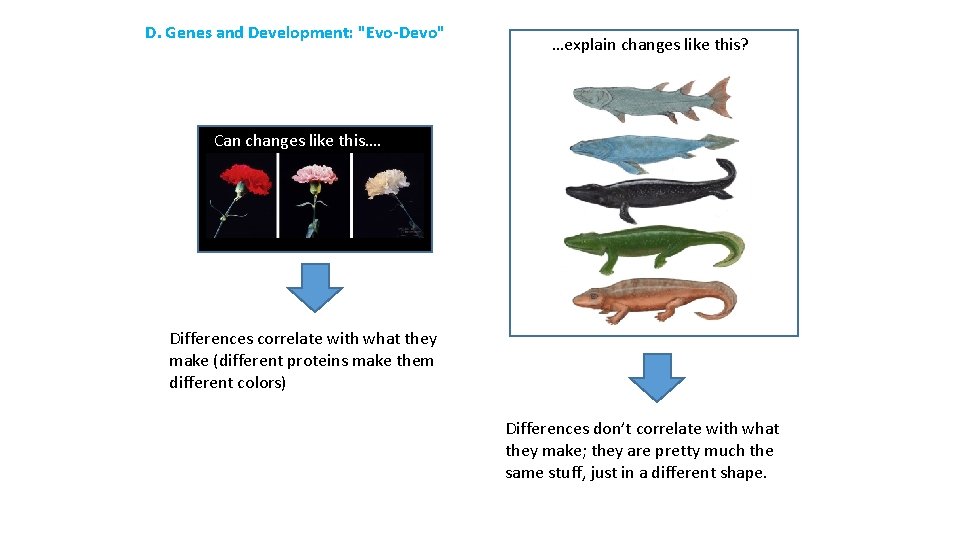
D. Genes and Development: "Evo-Devo" …explain changes like this? Can changes like this…. Differences correlate with what they make (different proteins make them different colors) Differences don’t correlate with what they make; they are pretty much the same stuff, just in a different shape.
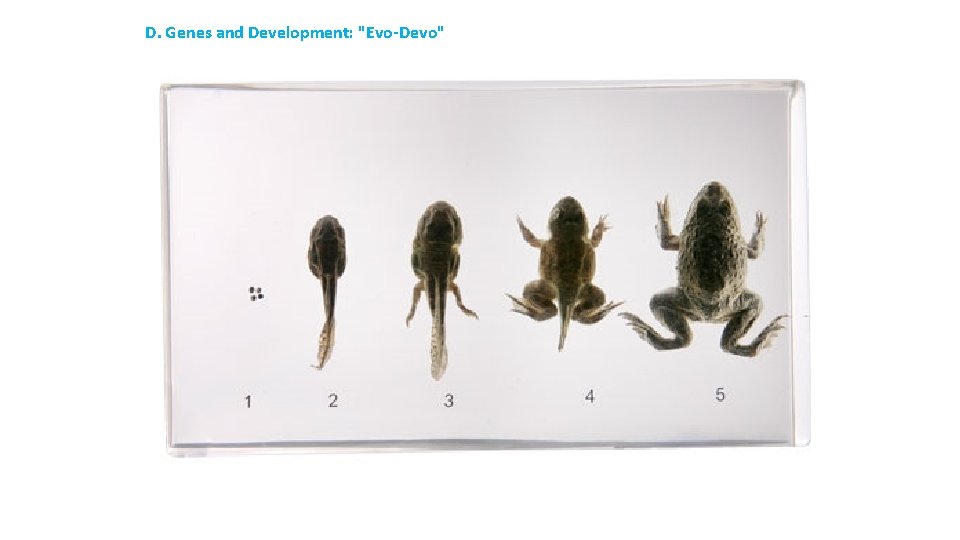
D. Genes and Development: "Evo-Devo"
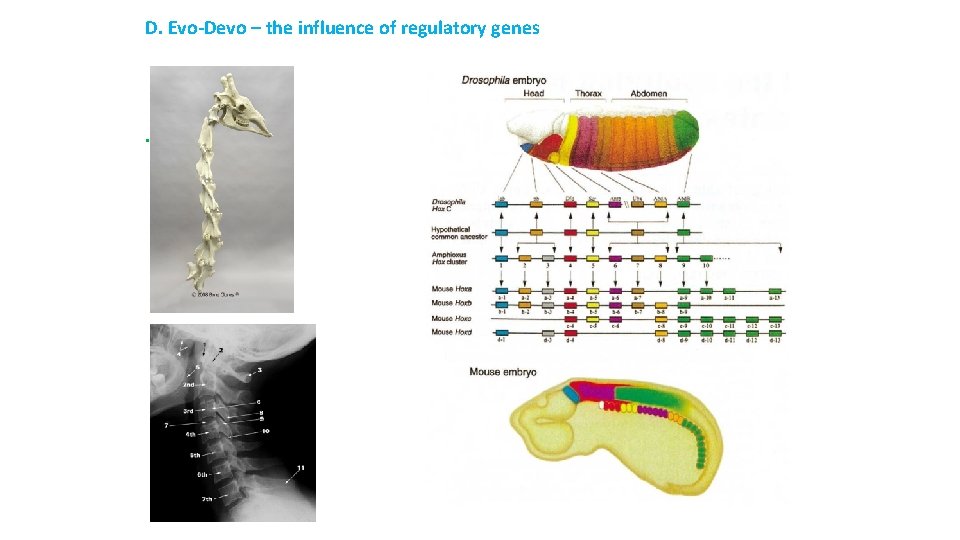
D. Evo-Devo – the influence of regulatory genes .
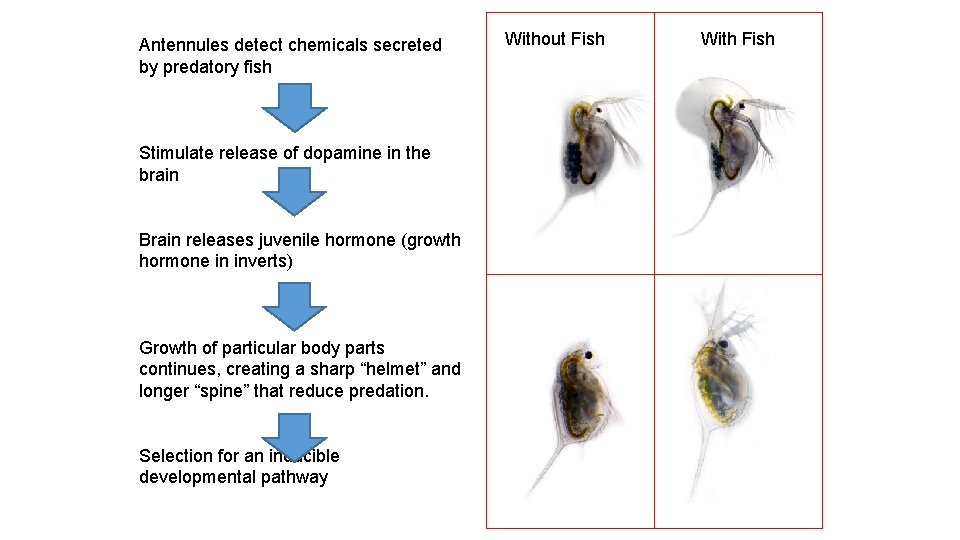
Antennules detect chemicals secreted by predatory fish Stimulate release of dopamine in the brain Brain releases juvenile hormone (growth hormone in inverts) Growth of particular body parts continues, creating a sharp “helmet” and longer “spine” that reduce predation. Selection for an inducible developmental pathway Without Fish With Fish
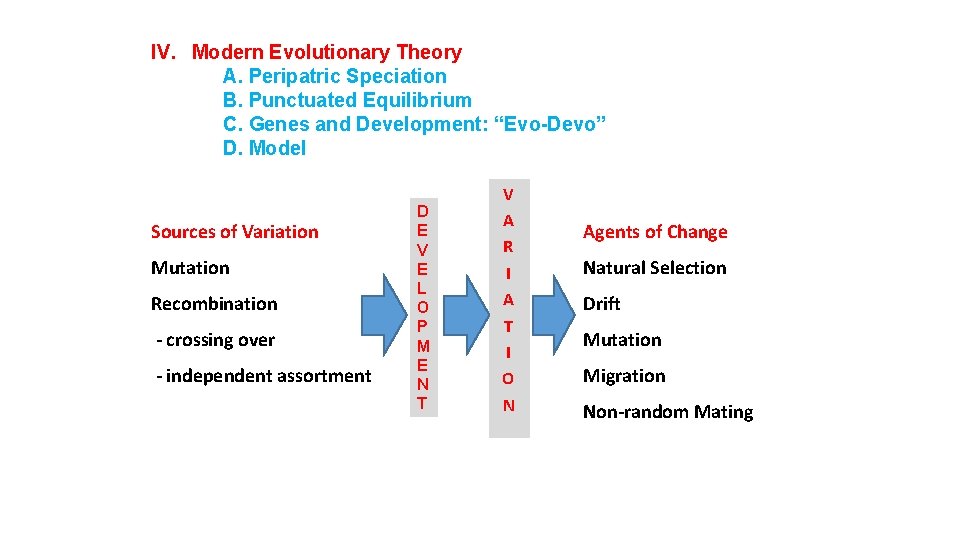
IV. Modern Evolutionary Theory A. Peripatric Speciation B. Punctuated Equilibrium C. Genes and Development: “Evo-Devo” D. Model Sources of Variation Mutation Recombination - crossing over - independent assortment D E V E L O P M E N T V A R I A T I O N Agents of Change Natural Selection Drift Mutation Migration Non-random Mating