
e MOLST Digital Transformation of NY MOLST an
- Slides: 37
e. MOLST: Digital Transformation of NY MOLST an End-of-life Care Transition Program Patricia Bomba, MD, FACP Vice President and Medical Director, Geriatrics Chair, MOLST Statewide Implementation Team & e. MOLST Program Director Chair, National Healthcare Decisions Day New York State Coalition Leader, Community-wide End-of-life/Palliative Care Initiative Katie Orem, MPH Geriatrics and Palliative Care Program Manager & e. MOLST Administrator Member, Executive Committee, MOLST Statewide Implementation Team Patricia. Bomba@lifethc. com Katie. Orem@excellus. com Compassion. And. Support. org
Objectives § Examine why there are failures in following MOLST orders and review recommendations for improvement, including e. MOLST § Define e. MOLST, a tool to assist patients and providers with end of life decisions § Discuss how e. MOLST improves quality and patient safety, ensures accessibility, and achieves the triple aim § Demonstrate e. MOLST 2
Key Recommendations Policies and Payment Systems § Provide financial incentives to patients and clinicians to discuss EOL issues, document preferences, provide appropriate services & care § Require EHRs incorporate advance care planning to improve communication of individuals’ wishes across time, settings, and providers § NY’s e. MOLST highlighted in IOM Report § Encourage states to develop & implement a POLST Paradigm Program
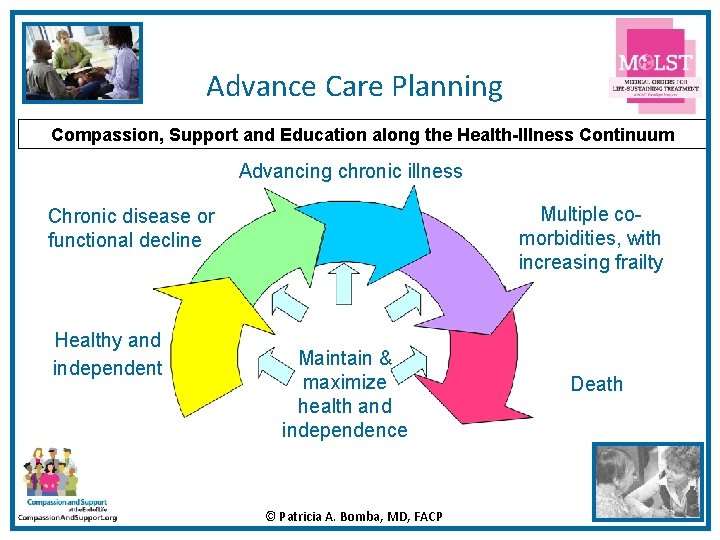
Advance Care Planning Compassion, Support and Education along the Health-Illness Continuum Advancing chronic illness Multiple comorbidities, with increasing frailty Chronic disease or functional decline Healthy and independent 4 Maintain & maximize health and independence © Patricia A. Bomba, MD, FACP Death
Advance Care Planning § Whole process of discussion of end-of-life care, clarification of related values and goals, and embodiment of preferences through written documents and medical orders § Start at any time § Revisit periodically § Becomes more focused as health status changes 5 2014 IOM Report Dying in America Report available: www. nap. edu
Advance Care Planning Ideal Conversations § Occur with a person’s health care agent and primary clinician, along with other members of the clinical team § Are recorded and updated as needed § Allow for flexible decision making in the context of the patient’s current medical situation. 6 2014 IOM Report Dying in America Report available: www. nap. edu
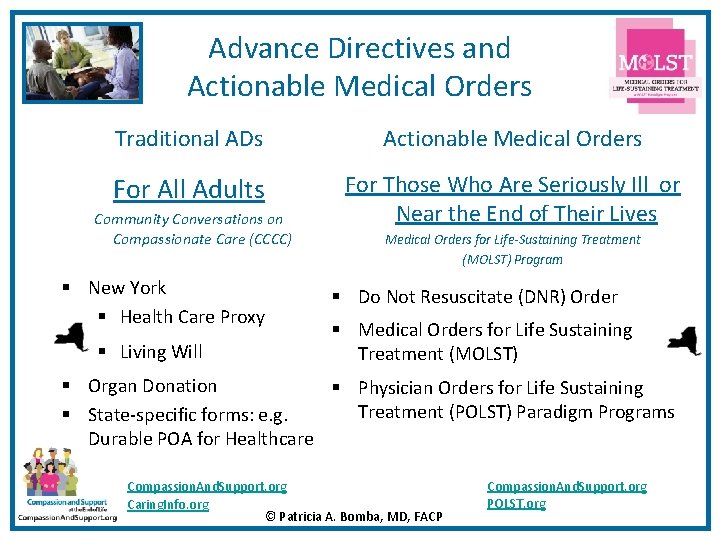
Advance Directives and Actionable Medical Orders Traditional ADs Actionable Medical Orders For All Adults For Those Who Are Seriously Ill or Near the End of Their Lives Community Conversations on Compassionate Care (CCCC) § New York § Health Care Proxy § Living Will Medical Orders for Life-Sustaining Treatment (MOLST) Program § Do Not Resuscitate (DNR) Order § Medical Orders for Life Sustaining Treatment (MOLST) § Organ Donation § Physician Orders for Life Sustaining Treatment (POLST) Paradigm Programs § State-specific forms: e. g. Durable POA for Healthcare 7 Compassion. And. Support. org Caring. Info. org © Patricia A. Bomba, MD, FACP Compassion. And. Support. org POLST. org
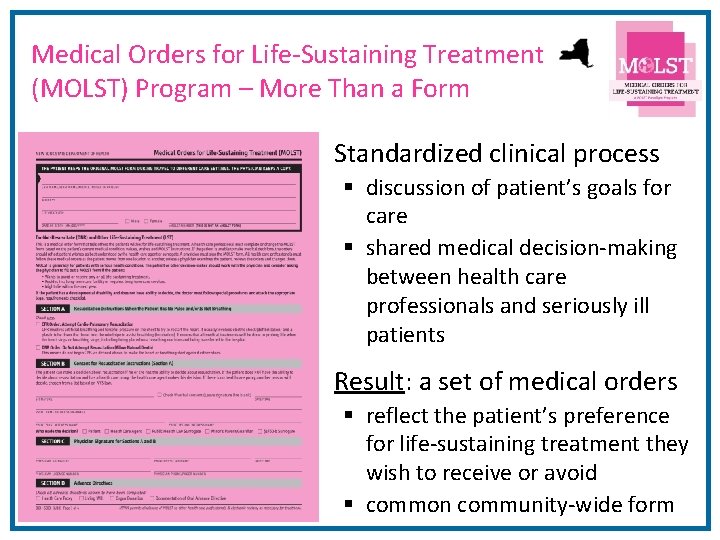
Medical Orders for Life-Sustaining Treatment (MOLST) Program – More Than a Form § Standardized clinical process § discussion of patient’s goals for care § shared medical decision-making between health care professionals and seriously ill patients § Result: a set of medical orders 8 § reflect the patient’s preference for life-sustaining treatment they wish to receive or avoid § common community-wide form
MOLST: Who Should Have One? § Generally for patients with serious health conditions § Wants to avoid or receive any or all life-sustaining treatment § Resides in a long-term care facility or requires long-term care services 9 § Might die within the next year
Medicare Wellness Visit § Does my patient have a health care proxy? § Do I have a copy of the health care proxy? § Has the patient shared their values, beliefs and goals for their care? § Has the person spoken with their family? § Is my patient appropriate for MOLST? 10
MOLST Screening Questions § Does the person express a desire to avoid or receive any or all life-sustaining treatment? § Does the person live in a nursing home or receive long term care services at home or in an ALF? § Would you be surprised if the person dies in the next year? § Does this person have one or more advanced chronic condition or a serious new illness with a poor prognosis? § Does this patient have decreased function, frailty, progressive weight loss, >= 2 unplanned admissions in last 12 months, have inadequate social supports, or need more help at home?
Why There Are Failure in Following MOLST Orders § Clinicians, patients, families are unaware of their obligations to follow MOLST and implications of failure to follow MOLST § Advance care planning is not recognized as a dynamic process, including MOLST § Emphasis should be on communication § Forms are the end of the process 12 Bomba, Karmel. NYSBA Health Law Journal. 2015; 20(2): 28 -33.
Why There Are Failure in Following MOLST Orders § Attention is given to the discussion, but ADs or MOLST are not completed or done incorrectly (incompatible orders) § Avoiding early discussions or focusing on interventions, rather that personal values, beliefs and goals for care - #What. Matters. Most § Wrong Health Care Agent is chosen 13 Bomba, Karmel. NYSBA Health Law Journal. 2015; 20(2): 28 -33.
Why There Are Failure in Following MOLST Orders § Lack of understanding of the differences between advance directives (HCP, LW) and medical orders (MOLST) § Failure to assess and document capacity & other legal requirements § Lack of accessibility to MOLST and documentation of the discussion 14 Bomba, Karmel. NYSBA Health Law Journal. 2015; 20(2): 28 -33.
Recommendations § Strengthen clinician training § Encourage public education and engagement in advance care planning § Expand use of e. MOLST 2014 IOM Report Dying in America 15 Bomba, Karmel. NYSBA Health Law Journal. 2015; 20(2): 28 -33.
New York e. MOLST: Definitions § Form: Refers to MOLST form and the Chart Documentation Form (CDF) that documents the key elements of the discussion and process § Users: persons with different clinical and administrative roles with regards to creating, updating, or accessing MOLST forms or other registry content § EMR: Electronic Medical Record § EHR: Electronic Health Record • Registry: Electronic database centrally housing MOLST forms and CDFs to allow 24/7 access in an emergency § e. MOLST: electronic form completion system for MOLST & NYe. MOLST Registry
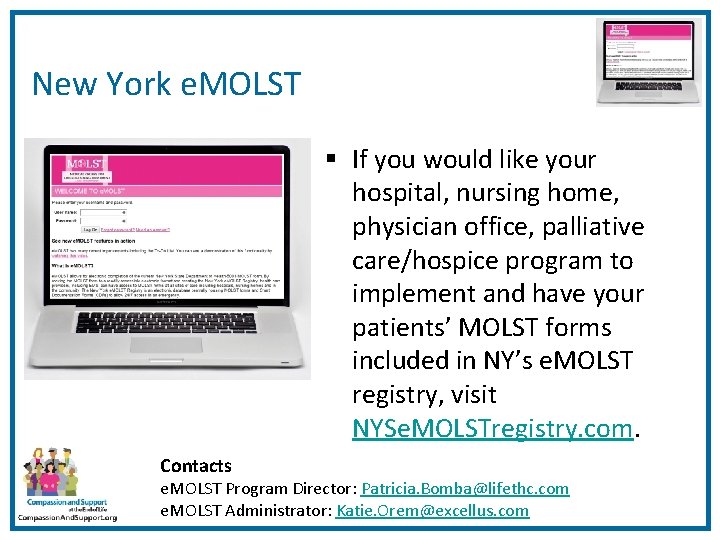
New York e. MOLST § An electronic system that guides clinicians and patients through a thoughtful discussion and MOLST process. § e. MOLST makes sure MOLST is completed correctly and ensures it is accessible. § Allows the clinician to print a copy of the e. MOLST form on bright pink paper for the patient. § Serves as the registry of NY e. MOLST forms to make sure a copy of the medical orders and the discussion are available in an emergency. § e. MOLST is web-based, available statewide and accessed at NYSe. MOLSTregistry. com.
8 -Step MOLST Protocol 1. Prepare for discussion • Understand patient’s health status, prognosis & ability to consent • Retrieve completed Advance Directives • Determine decision-maker and NYSPHL legal requirements, based on who makes decision and setting 2. Determine what the patient and family know • re: condition, prognosis 3. Explore goals, hopes and expectations 4. Suggest realistic goals 5. Respond empathetically 6. Use MOLST to guide choices and finalize patient wishes • Shared, informed medical decision-making • Conflict resolution 7. Complete and sign MOLST § Follow NYSPHL and document conversation 8. Review and revise periodically Developed for NYS MOLST, Bomba, 2005; revised 2011
AFTER FHCDA: MOLST Instructions and Checklists Ethical Framework/Legal Requirements § § Checklist #1 - Adult patients with medical decision-making capacity (any setting) § Checklist #3 - Adult hospital or nursing home patients without medical decision-making capacity who do not have a health care proxy, and decision-maker is a Public Health Law Surrogate (surrogate selected from the surrogate list) § Checklist #4 - Adult hospital or nursing home patients without medical decision-making capacity who do not have a health care proxy or a Public Health Law Surrogate § Checklist #5 - Adult patients without medical decision-making capacity who do not have a health care proxy, and the MOLST form is being completed in the community. § § Checklist for Minor Patients - (any setting) Checklist #2 - Adult patients without medical decision-making capacity who have a health care proxy (any setting) Checklist for Developmentally Disabled who lack capacity – (any setting) must travel with the patient’s MOLST http: //www. nyhealth. gov/professionals/patient_rights/molst/
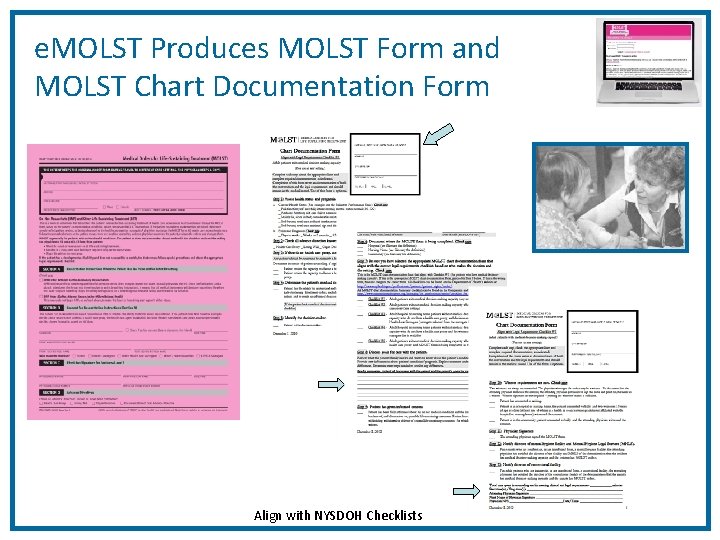
e. MOLST Produces MOLST Form and MOLST Chart Documentation Form Align with NYSDOH Checklists
Why NYe. MOLST? e. MOLST Improves Quality & Patient Safety, Reduces Harm and Achieves the Triple Aim
Research: Oregon POLST Registry Site of Death vs. Treatment Requested § Death records: 58, 000 people who died of natural causes in 2010 and 2011 in OR § Nearly 31% of people who died: POLST forms entered in OR's POLST Registry § Compared location of death with treatment requested § 6. 4% of people with POLST forms who selected "comfort measures only" died in hospital § 34. 2% of people without POLST forms in the registry died in the hospital 22 Fromme, Erik et al (2014). JAGS, on-line June 9, 2014
e. MOLST Feedback: NYSDOH Attorney
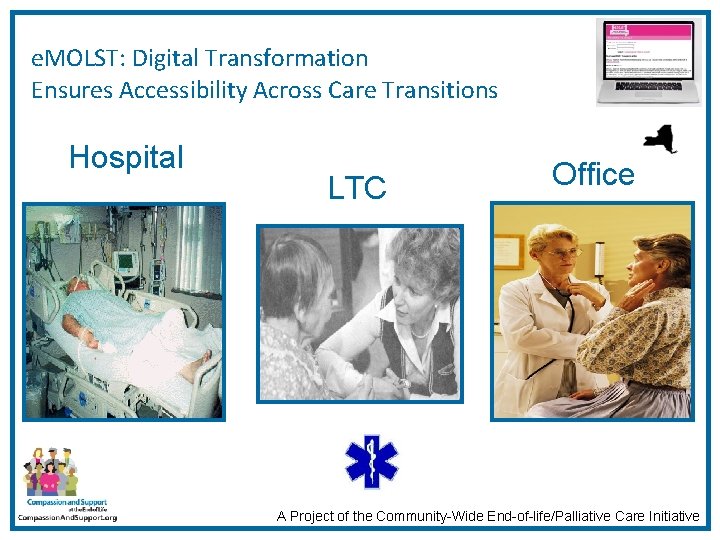
Why e. MOLST? Accessibility
e. MOLST: Digital Transformation Ensures Accessibility Across Care Transitions Hospital 25 LTC Office A Project of the Community-Wide End-of-life/Palliative Care Initiative
e. MOLST Feedback: Physician
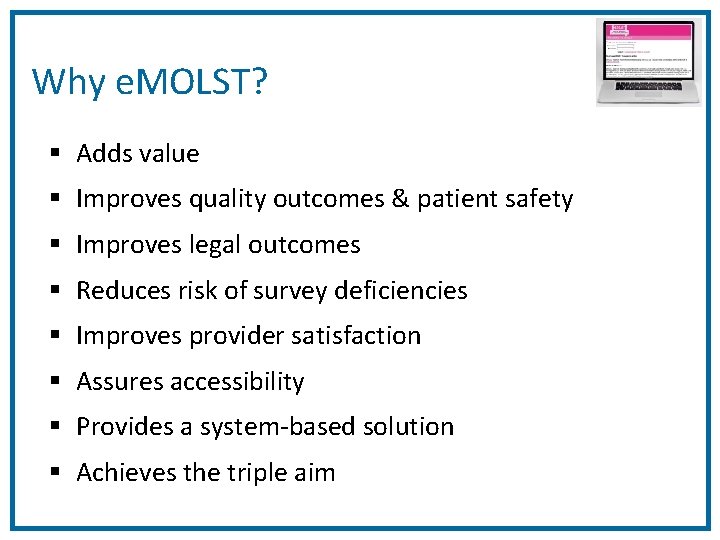
Why e. MOLST? § Adds value § Improves quality outcomes & patient safety § Improves legal outcomes § Reduces risk of survey deficiencies § Improves provider satisfaction § Assures accessibility § Provides a system-based solution § Achieves the triple aim
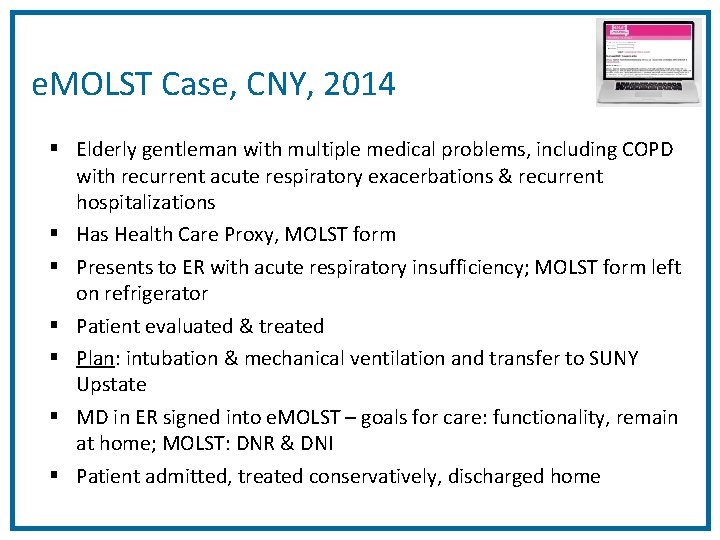
e. MOLST Case, CNY, 2014 § Elderly gentleman with multiple medical problems, including COPD with recurrent acute respiratory exacerbations & recurrent hospitalizations § Has Health Care Proxy, MOLST form § Presents to ER with acute respiratory insufficiency; MOLST form left on refrigerator § Patient evaluated & treated § Plan: intubation & mechanical ventilation and transfer to SUNY Upstate § MD in ER signed into e. MOLST – goals for care: functionality, remain at home; MOLST: DNR & DNI § Patient admitted, treated conservatively, discharged home
e. MOLST Aligns with New Value-Based, Accountable Care Models § Improves quality: discussion of personalcentered values, beliefs and goals for care drives choice of life-sustaining treatment § Honors individual preferences: provides MOLST orders and copy of discussion across care transitions § Reduce unnecessary and unwanted hospitalizations, ED use, service utilization and expense
Where e. MOLST Aligns With NYS Health System Priorities § § § Palliative Care Advance Care Planning Quality, Patient Safety & Risk Management Compliance with NYSPHL Care Transitions Reducing Readmissions Accountable Care Organizations Innovative Payment Models Medicaid Redesign: DSRIP, FIDA, Health Homes NY State Health Innovation Plan IOM Dying in America Recommendations
Potential Barrier to e. MOLST and Thoughtful MOLST Discussions MOLST Takes Time • Person-centered goals for care discussion § • • Shared, informed medical decision making process Ethical framework/legal requirements Completion of form Family awareness of person’s decision § § Face-to-face Non face-to-face Care Plan to support MOLST Goals and preferences may change § • • May require more than 1 session to complete Discussion and MOLST form change ACP CPT Codes Overcomes Barrier: Inadequate reimbursement for time spent Consider office workflow transformation
CMS Approves Advance Care Planning CPT Codes § Two new codes: 99497 and 99498 § Reimbursement to health care professionals for providing advance care planning services to Medicare and Medicaid members § Advance care planning is an integral component of the practice of medicine § Overcomes a key barrier § Effective January 1, 2016
e. MOLST Demo e. MOLST Training Site: https: //training. nysemolstregistry. com/Login
New York e. MOLST § If you would like your hospital, nursing home, physician office, palliative care/hospice program to implement and have your patients’ MOLST forms included in NY’s e. MOLST registry, visit NYSe. MOLSTregistry. com. Contacts 34 e. MOLST Program Director: Patricia. Bomba@lifethc. com e. MOLST Administrator: Katie. Orem@excellus. com
Additional MOLST/e. MOLST Resources § e. MOLST Overview (5: 37) https: //youtu. be/Mj. L 8 Qz 944 IU? list=PLCSvow. XDKV 5 IEJX 39 GHvbs 8 ekkf. NXec 55 § NYSDOH Attorney's Perspective on e. MOLST (1: 38) https: //youtu. be/r_JUky. PY 6 tc? list=PLCSvow. XDKV 5 IEJX 39 GHvbs 8 ekkf. NXec 55 § Advantages of e. MOLST: A Nursing Home Physician's Perspective (7: 24) https: //youtu. be/jn 47 Fl. Ysxss? list=PLCSvow. XDKV 5 IEJX 39 GHvbs 8 ekkf. NXec 55 § MOLST Video Revised 2013! (28: 14) https: //youtu. be/Cl. TAG 19 RX 8 w § This video, "Writing Your Final Chapter: Know Your Choices. Share Your Wishes" has 5 real patient stories (2 before, 3 after MOLST); was originally released in 2007 & revised to comply with FHCDA. § It is an excellent resource for staff, patient, family caregiver education; it can be used as a staff "lunch and learn. "
Additional MOLST/e. MOLST Resources § "New CPT Codes for Advance Care Planning and MOLST Discussions" (1: 00) webinar posted on You. Tube https: //youtu. be/VCV 26 Zy. Ggw. Y § e. MOLST webinar sponsored by IPRO and includes Q & A (2: 00) https: //qualitynet. webex. com/qualitynet/ldr. php? RCID=f 2 c 519 e 2 4280 cba 7863 dab 9 ad 1 bf 68 ea § Link to a MMLIC Dateline Special Edition, includes NYSBA Health Law Journal article co-authored by Jonathan Karmel, JD, NYSDOH, and Pat Bomba, MD, FACP; three additional cases are included: here.
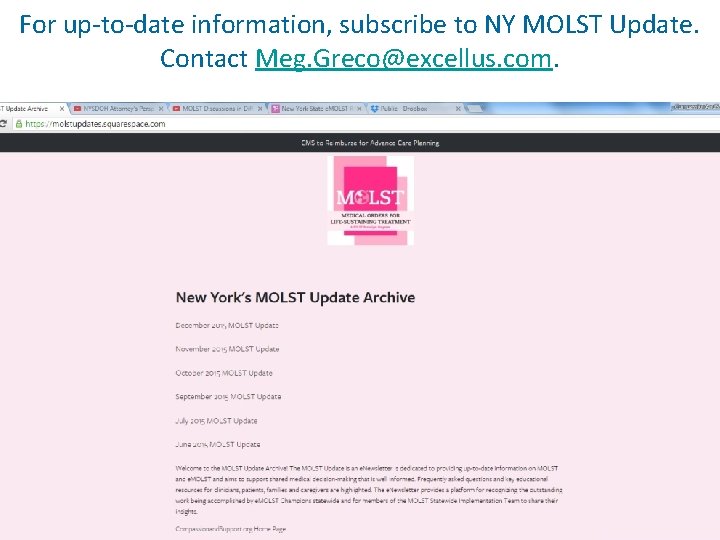
For up-to-date information, subscribe to NY MOLST Update. Contact Meg. Greco@excellus. com.