
E Learning System Based on Semantic Web Technology
E- Learning System Based on Semantic Web Technology Dr. Walid Qassim Qwaider Majmaah University wqwaider 74@yahoo. com Dr. Walid Qwaider Majmaah University
1. Introduction • E-learning courses have to serve very different learner groups and can be presented in many different forms. • E-Learning aims at replacing old-fashioned time/place/content predetermined learning with a just-in time/at-workplace/customized/on-demand process of learning. 2 Dr. Walid Qwaider Majmaah University 9/19/2021
Introduction… • The Semantic Web offers new technologies to the developers of Web-based applications aiming at providing more intelligent access and management of the Web in-formation and semantically richer modeling of the applications and their users. • The aim of the semantic web is to provide this extra layer, to add structure or meaning to what is on the Web thus allowing intelligent navigation, personalization and retrieval. 3 Dr. Walid Qwaider Majmaah University 9/19/2021
Introduction… • This paper is an attempt to close the gap by documenting our experiences from building e-learning applications using Semantic Web technology. • And introduce requirements for e-Learning, and analysis the representational structures that are offered by the Semantic Web portals. • And introduce advantages of using ontologies for describing e-Learning materials are presented. • And possible roles of the semantic web in blended elearning; we then describe our proposed architecture for e-learning services (annotations, ontologies and services) including an e-learning scenario. 4 Dr. Walid Qwaider Majmaah University 9/19/2021
2. Semantic Web Portals • semantic portal can be seen as an entry point to knowledge resources that may be distributed across several locations, as the web sites led to the need for web portals, sites providing access to collections of interesting URLs and “dumb” (i. e. keyword -based) search for information. 5 Dr. Walid Qwaider Majmaah University 9/19/2021
3 -Layers of the Semantic Web Architecture • XML layer, which represents the structure of data. • RDF layer, which represents the meaning of data. • Ontology layer, which represents the formal common agreement about meaning of data. • Logic layer, which enables intelligent reasoning with meaningful data 6 Dr. Walid Qwaider Majmaah University 9/19/2021

Layers of the Semantic Web architecture… (Layers of the Semantic Web architecture (Berners-Lee, 2003) 7 Dr. Walid Qwaider Majmaah University 9/19/2021
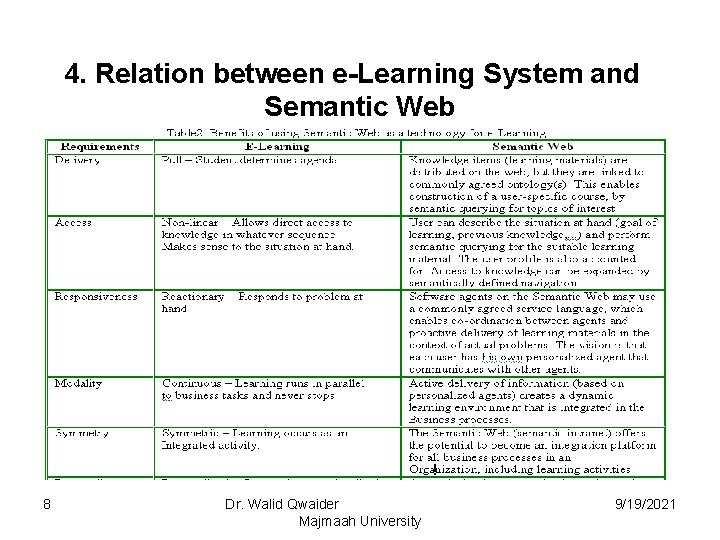
4. Relation between e-Learning System and Semantic Web 8 Dr. Walid Qwaider Majmaah University 9/19/2021
5 - Annotation • Annotation is the activity of annotating text documents written in plain HTML with a set of tags that are the names of slots of the selected class in ontology. • Figure 2 represent Blended e-learning Ontology: Educational-Organization. 9 Dr. Walid Qwaider Majmaah University 9/19/2021
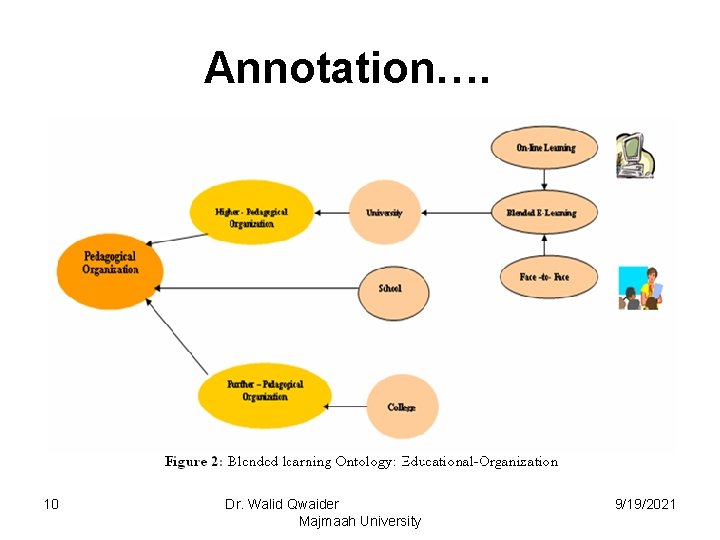
Annotation…. 10 Dr. Walid Qwaider Majmaah University 9/19/2021
6 - Ontologies • The term ontology has been widely used in recent years in the field of Artificial Intelligence, computer and information science especially in domains such as, cooperative information systems, intelligent information integration, information retrieval and extraction, knowledge representation, and database management systems. • Figur 3 represent E-Learning Ontologies Ph. D course (MIS, CIS) in Arab University for Banking & Financial Sciences Faculty of Information Systems & Technology. 11 Dr. Walid Qwaider Majmaah University 9/19/2021
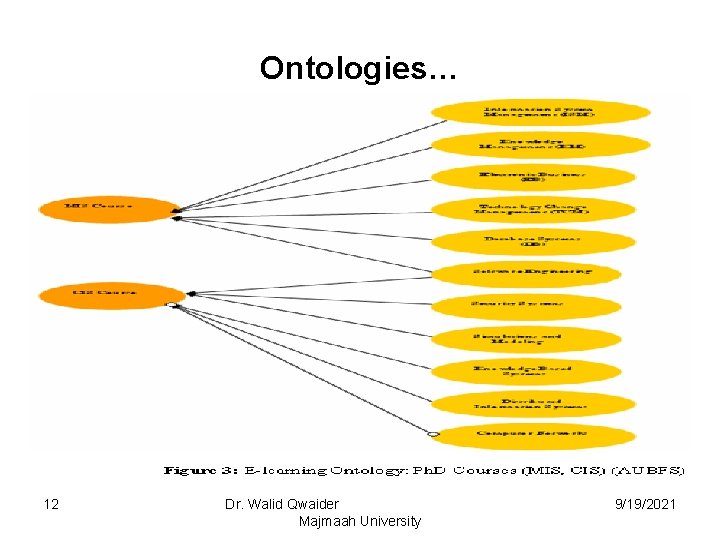
Ontologies… 12 Dr. Walid Qwaider Majmaah University 9/19/2021
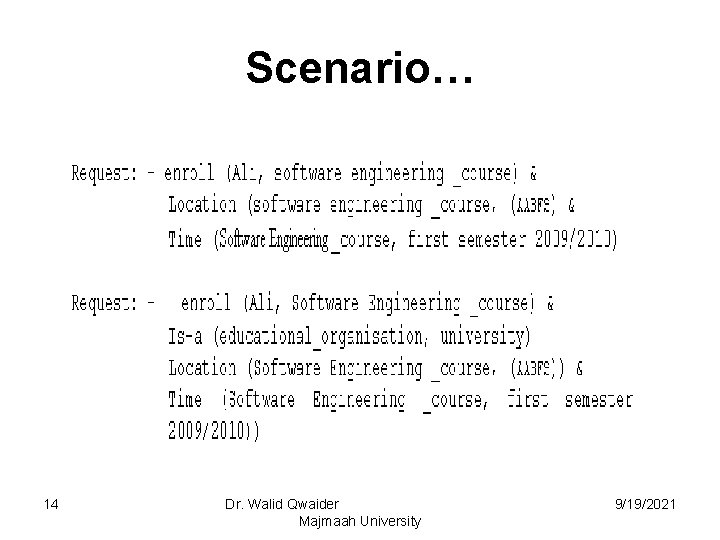
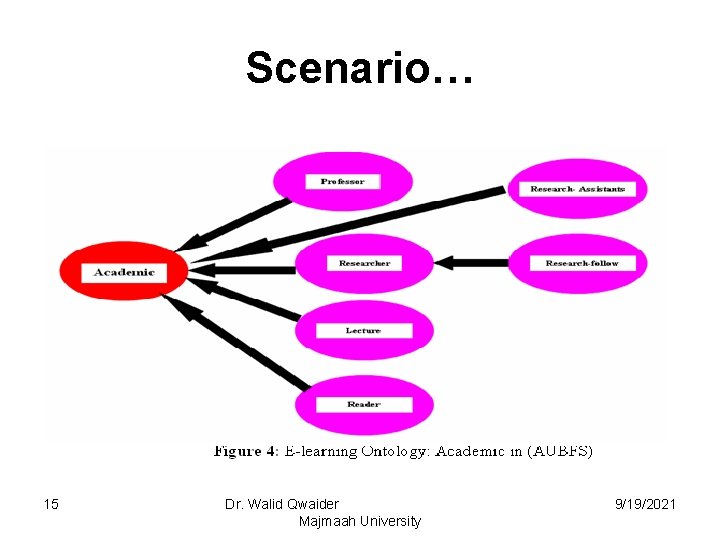
7 - Scenario • Let us consider Ali scenario. Ali wants to enroll in an Software Engineering course in Arab Universities for Banking & Financial Sciences Faculty of Information Systems & Technology (AUBFS) in first semester 2009/2010. • A smart search service could analyze Ali current location, locate Software Engineering courses run by (AUBFS) and book a ticket for Ali to reach her destination from start location. This is a simple scenario, which the broker can split into several simple semantic services such as enroll-in-a-course, payment, accommodation, arrangetransport and so on. • A formal specification for Ali request is shown Figure 4. It is written in First Order Logic using Prolog notation 13 Dr. Walid Qwaider Majmaah University 9/19/2021
Scenario… 14 Dr. Walid Qwaider Majmaah University 9/19/2021
Scenario… 15 Dr. Walid Qwaider Majmaah University 9/19/2021
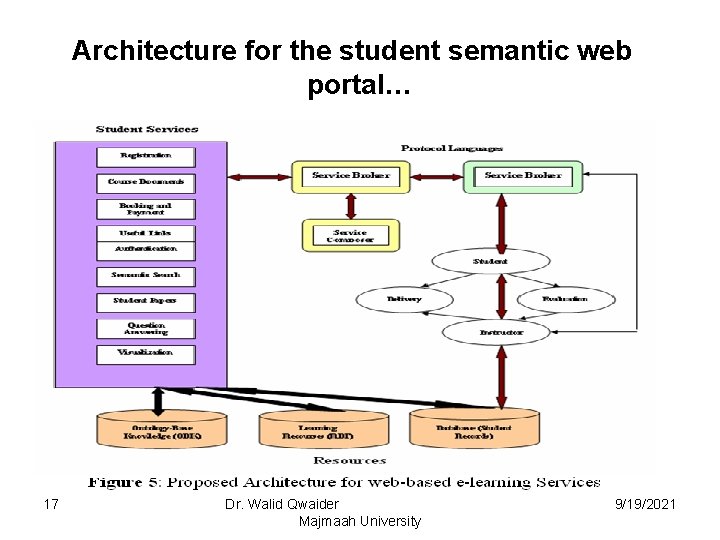
8. Architecture for the student semantic web portal • semantic portal consists of a user who has access to services, repositories and databases through an interface. Figure 5 gives a represent of the overall architecture in the e-learning scenario and specifies details of services in the e -learning domain. • Otherwise this architecture, the first step would be recording each service with a registry. • The broker is a central component in this distributed architecture: it allows communication between service providers and requesters. 16 Dr. Walid Qwaider Majmaah University 9/19/2021
Architecture for the student semantic web portal… 17 Dr. Walid Qwaider Majmaah University 9/19/2021
9. Conclusion • our outline architecture for e-learning services in the context of a semantic portal, the description of various scenarios within this architecture, including recoding in a course and annotation of a student essay. We have used ontologies to describe learning materials, annotation schemas and ontology of services. 18 Dr. Walid Qwaider Majmaah University 9/19/2021
Conclusion… • The architecture moves away from the traditional teacher-student model ( face –to-face interaction) in which the teacher determines the learning material to be absorbed by students and towards a new, more flexible learning structure in which students take responsibility for their own learning, determine their learning agenda, including what is to be included and in what order. • Otherwise having more choice, students also have wider access to semantic technologies such as annotation tools. 19 Dr. Walid Qwaider Majmaah University 9/19/2021
Conclusion… • This paper is an attempt to close the gap by documenting our experiences from building e-learning applications using Semantic Web technology. • As presented a proposal for a distributed e -learning architecture comprising several e -learning services. 20 Dr. Walid Qwaider Majmaah University 9/19/2021
Thank you 21 Dr. Walid Qwaider Majmaah University 9/19/2021
- Slides: 21