
e gen le alle Genetics Vocabulary Genetics is
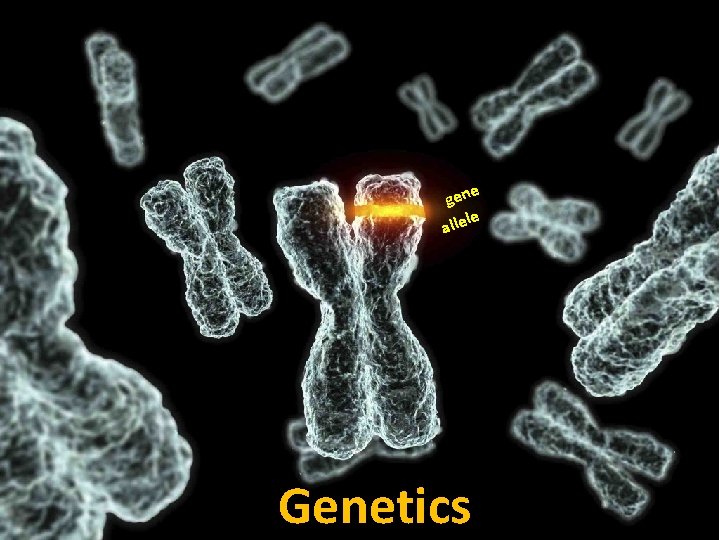
e gen le alle Genetics
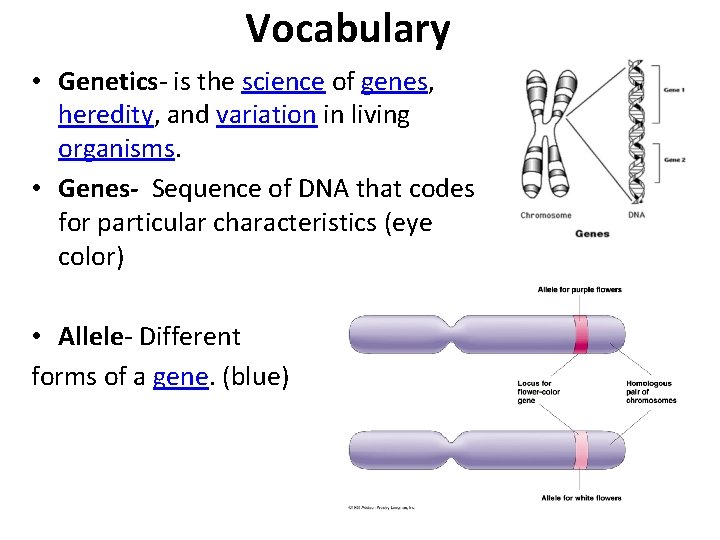
Vocabulary • Genetics- is the science of genes, heredity, and variation in living organisms. • Genes- Sequence of DNA that codes for particular characteristics (eye color) • Allele- Different forms of a gene. (blue)
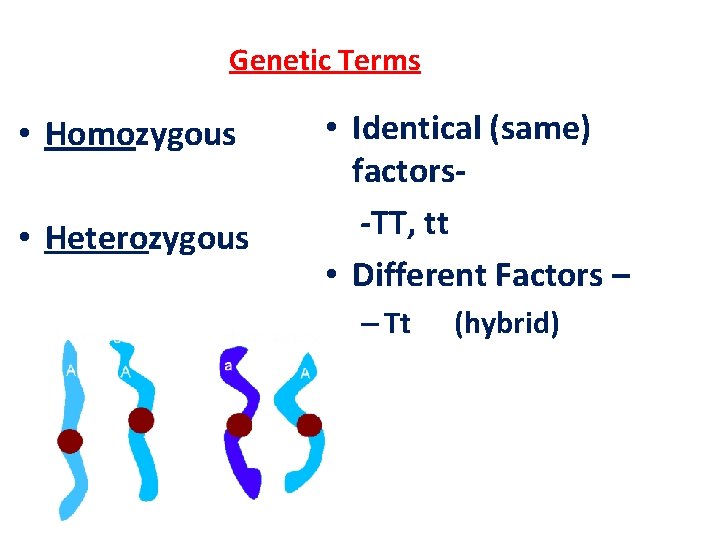
Genetic Terms • Homozygous • Heterozygous • Identical (same) factors-TT, tt • Different Factors – – Tt (hybrid)
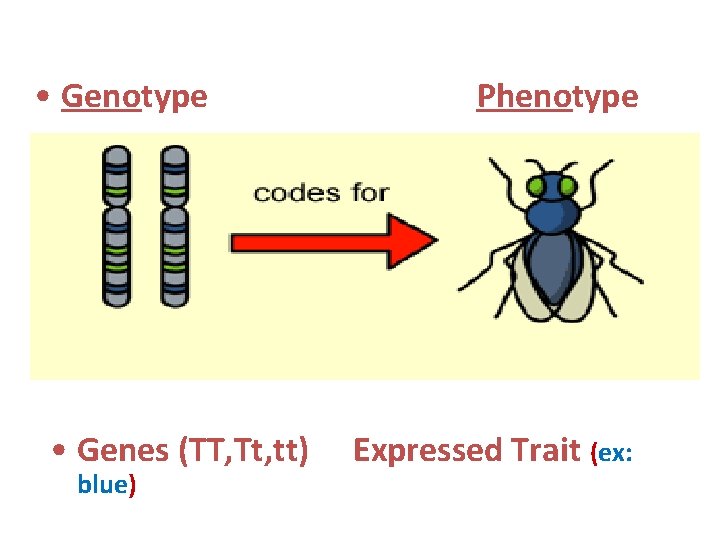
• Genotype • Genes (TT, Tt, tt) blue) Phenotype Expressed Trait (ex:
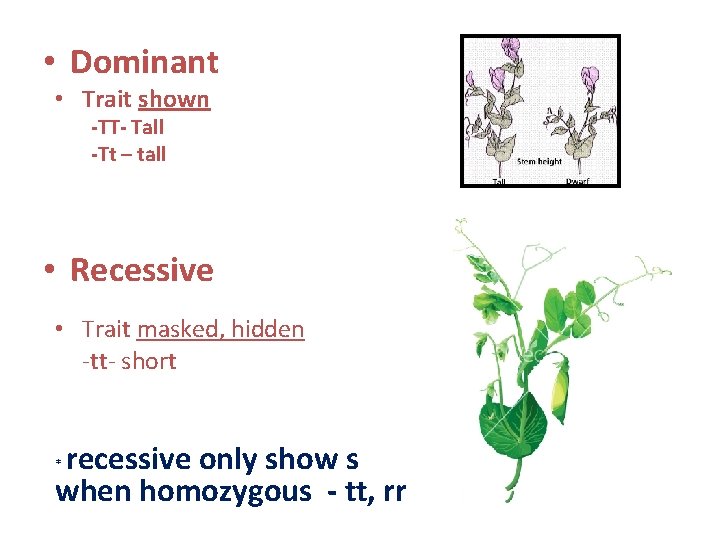
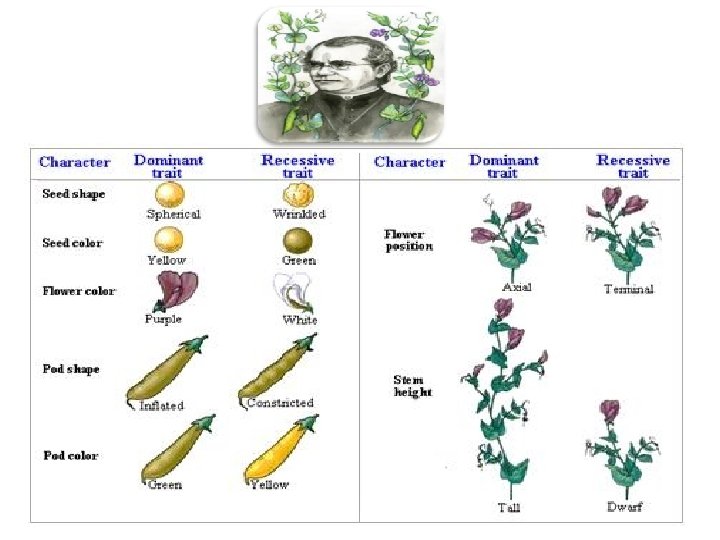
• Dominant • Trait shown -TT- Tall -Tt – tall • Recessive • Trait masked, hidden -tt- short recessive only show s when homozygous - tt, rr *
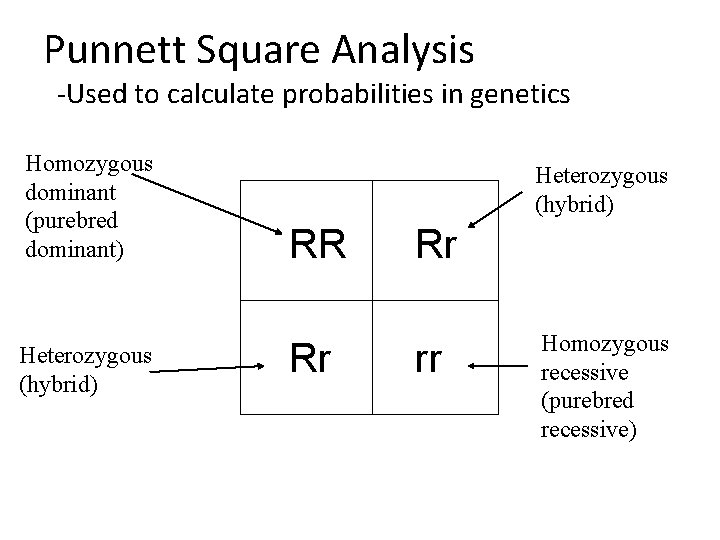
Punnett Square Analysis -Used to calculate probabilities in genetics Homozygous dominant (purebred dominant) Heterozygous (hybrid) R r RR Rr Rr rr Heterozygous (hybrid) Homozygous recessive (purebred recessive)
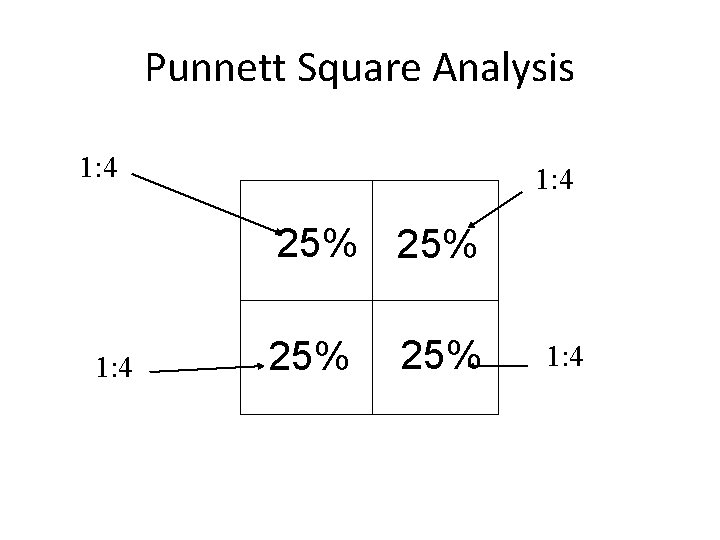
Punnett Square Analysis R r R 25% r 25% 1: 4
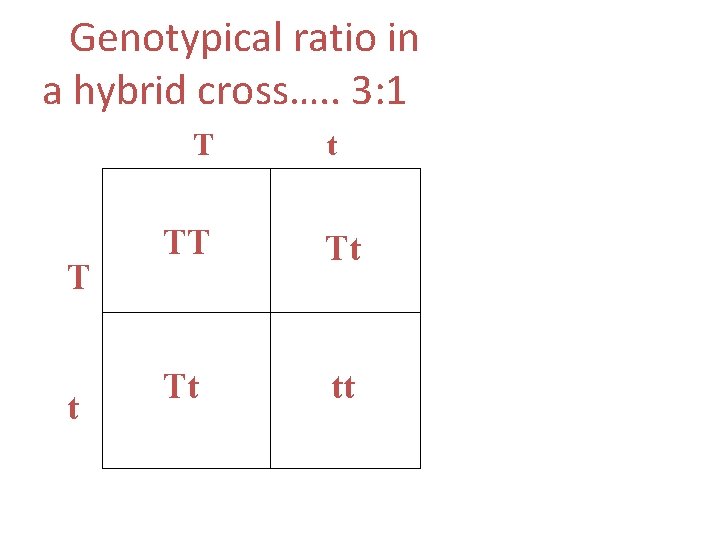
Genotypical ratio in a hybrid cross…. . 3: 1 T T t t TT Tt Tt tt
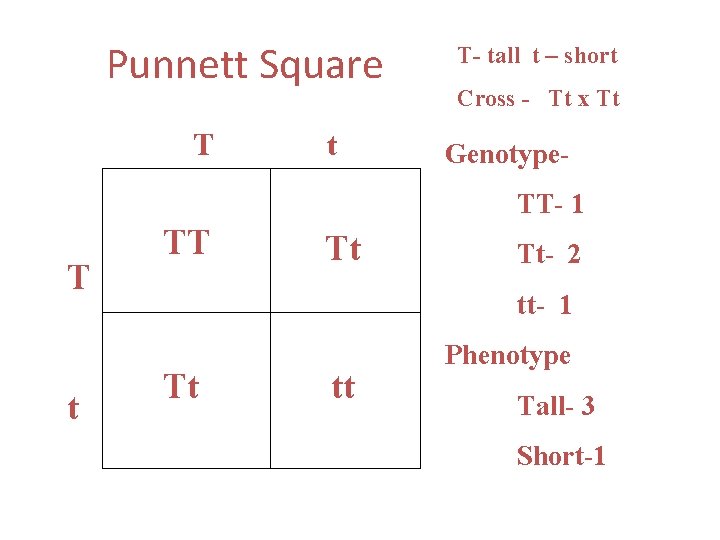
Punnett Square T t T- tall t – short Cross - Tt x Tt Genotype. TT- 1 T t TT Tt Tt- 2 tt- 1 Tt tt Phenotype Tall- 3 Short-1
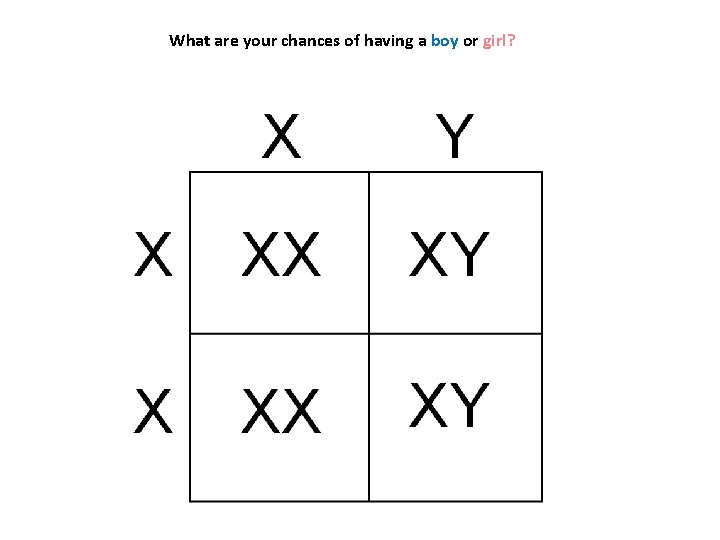
What are your chances of having a boy or girl?
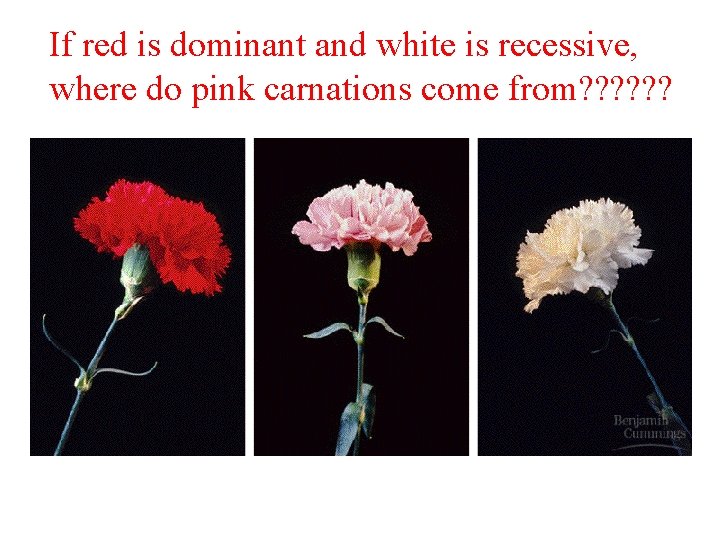
If red is dominant and white is recessive, where do pink carnations come from? ? ?
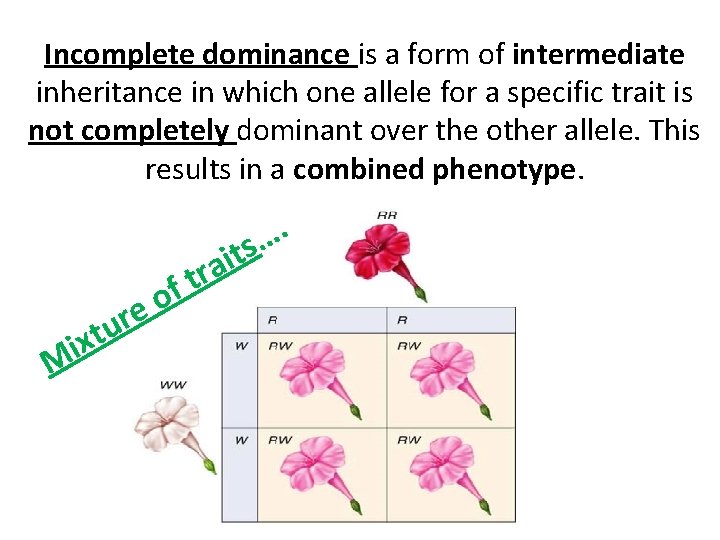
Incomplete dominance is a form of intermediate inheritance in which one allele for a specific trait is not completely dominant over the other allele. This results in a combined phenotype. a r t f xt i M o e ur . … its
• 1. The trait that is expressed is known as the ______ trait. • A. recessive • B. dominant • C. hybrid • D. heterozygous
Robert and Susan are married and have two children, one son and one daughter. The children have different hair color and eye color. Which of the following statements explains these differences in the children? – A. The environment affects these characteristics after birth. – B. There is a lack of variation in the genes of parent sex cells. – C. Sexual reproduction produces a fertilized egg that has a unique genetic makeup. – D. Hormone changes in a pregnant woman’s body cause traits to develop differently in a fertilized egg.
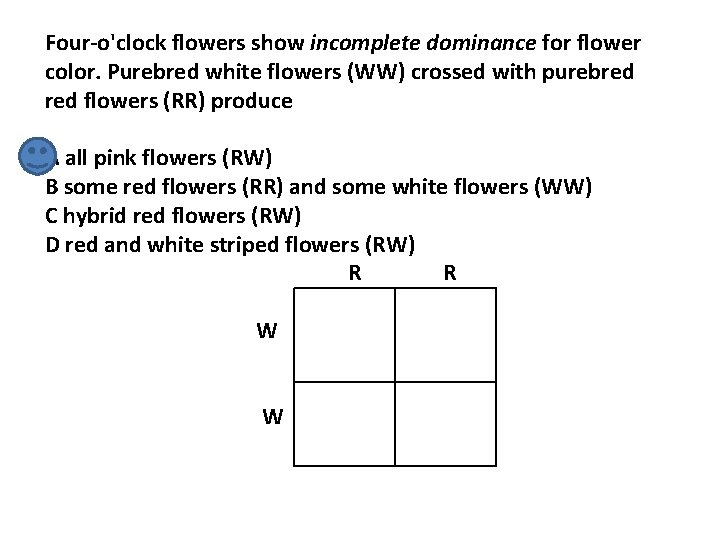
Four-o'clock flowers show incomplete dominance for flower color. Purebred white flowers (WW) crossed with purebred flowers (RR) produce A all pink flowers (RW) B some red flowers (RR) and some white flowers (WW) C hybrid red flowers (RW) D red and white striped flowers (RW) R R W W
A gardener crossed a plant with red flowers with a plant that had white flowers. The offspring plants had pink flowers. What is the most likely genetic reason for these differences in color? • A. codominance. • B. recessive pink genes. • C. polygenic inheritance. • D. incomplete dominance…
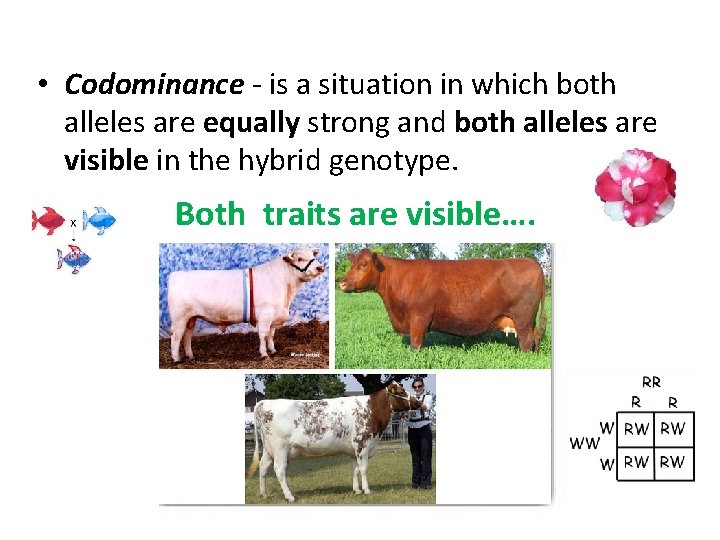
• Codominance - is a situation in which both alleles are equally strong and both alleles are visible in the hybrid genotype. Both traits are visible….
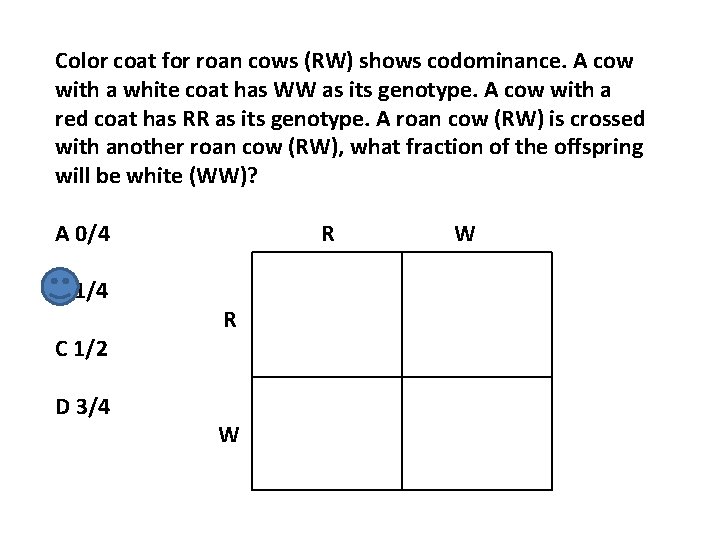
Color coat for roan cows (RW) shows codominance. A cow with a white coat has WW as its genotype. A cow with a red coat has RR as its genotype. A roan cow (RW) is crossed with another roan cow (RW), what fraction of the offspring will be white (WW)? A 0/4 B 1/4 C 1/2 D 3/4 R R W W
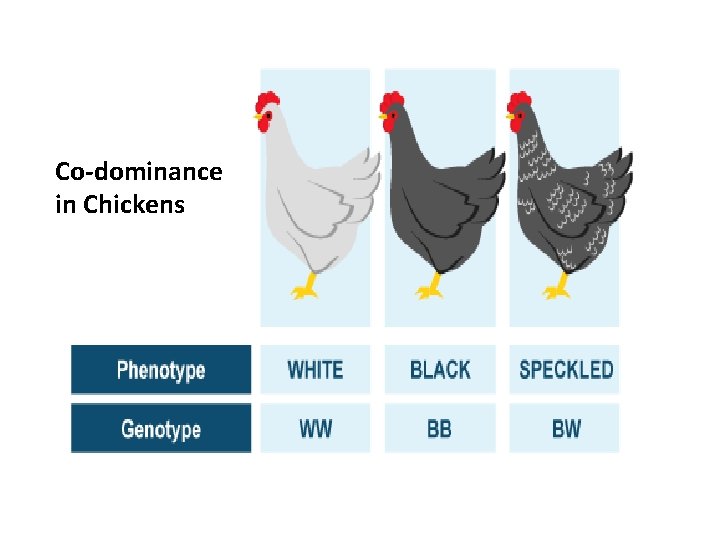
Co-dominance in Chickens
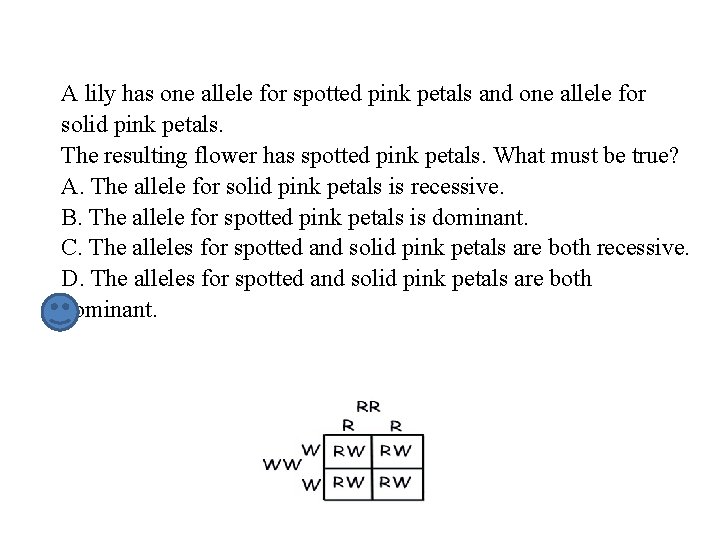
A lily has one allele for spotted pink petals and one allele for solid pink petals. The resulting flower has spotted pink petals. What must be true? A. The allele for solid pink petals is recessive. B. The allele for spotted pink petals is dominant. C. The alleles for spotted and solid pink petals are both recessive. D. The alleles for spotted and solid pink petals are both dominant.
• In some chickens, the gene for feather is controlled by codominance. The allele for black is B and the allele for white is W. The heterozygous phenotype is known as erminette. • 1. What is the genotype for white chickens? • 2. What is the genotype for erminette chickens?
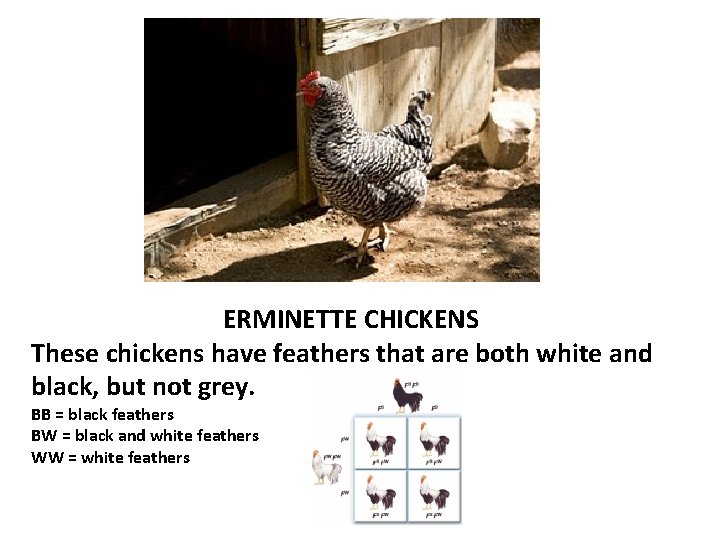
ERMINETTE CHICKENS These chickens have feathers that are both white and black, but not grey. BB = black feathers BW = black and white feathers WW = white feathers
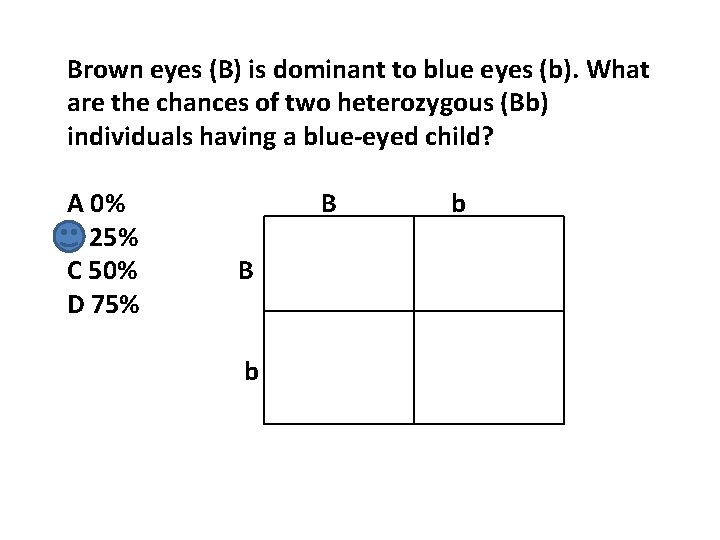
Brown eyes (B) is dominant to blue eyes (b). What are the chances of two heterozygous (Bb) individuals having a blue-eyed child? A 0% B 25% C 50% D 75% B B b b
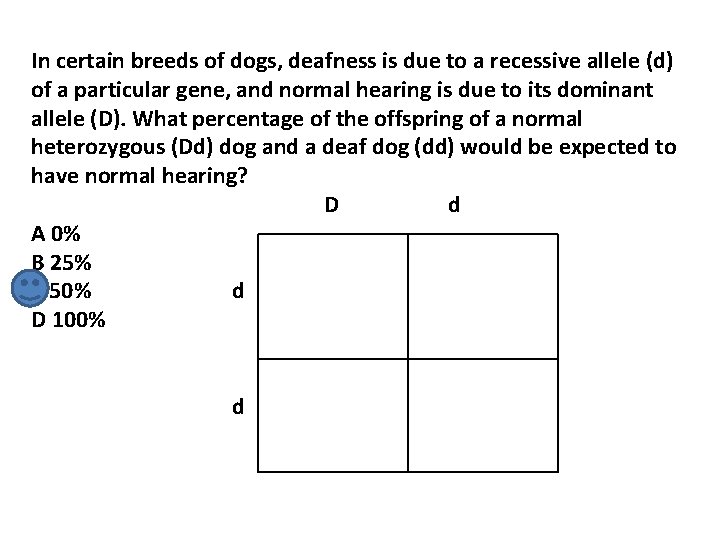
In certain breeds of dogs, deafness is due to a recessive allele (d) of a particular gene, and normal hearing is due to its dominant allele (D). What percentage of the offspring of a normal heterozygous (Dd) dog and a deaf dog (dd) would be expected to have normal hearing? D d A 0% B 25% C 50% d D 100% d
h s a l F k c a B Slows the Flow Increases BP Atherosclerosis
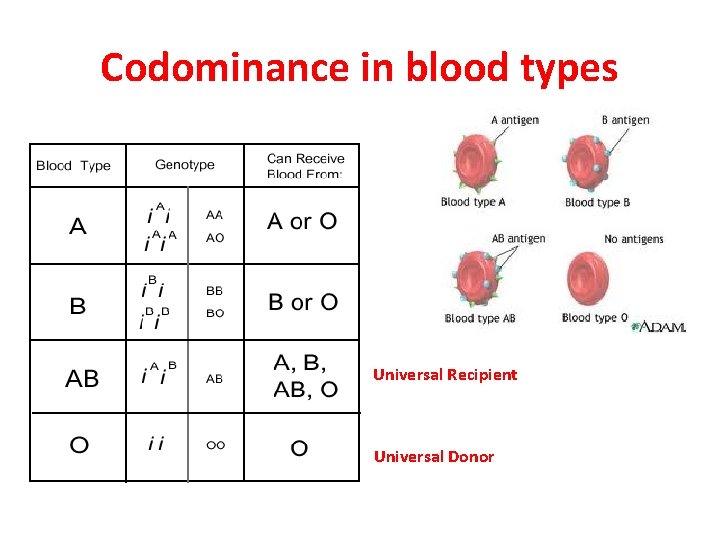
Codominance in blood types Universal Recipient Universal Donor
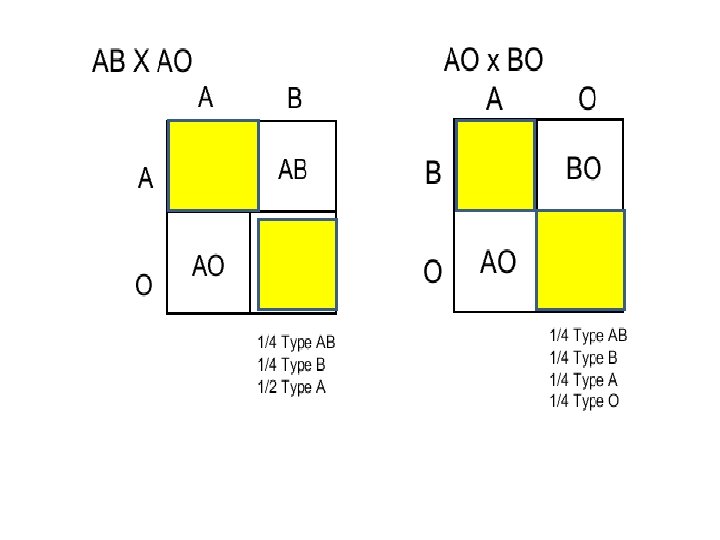
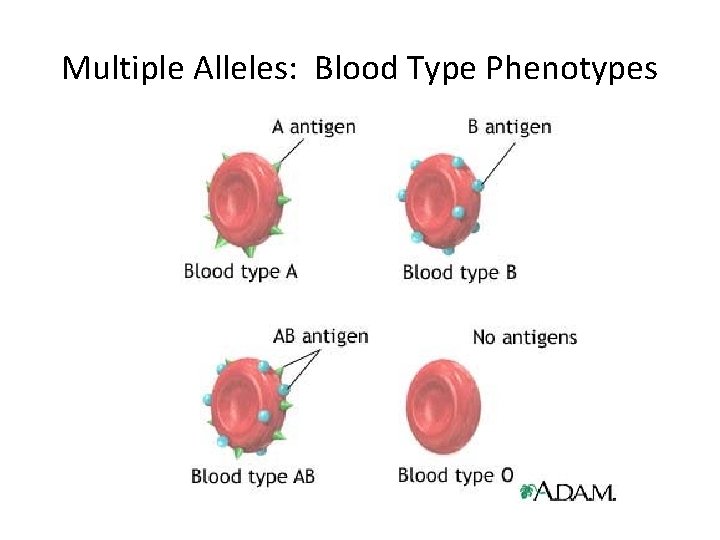
Multiple Alleles: Blood Type Phenotypes
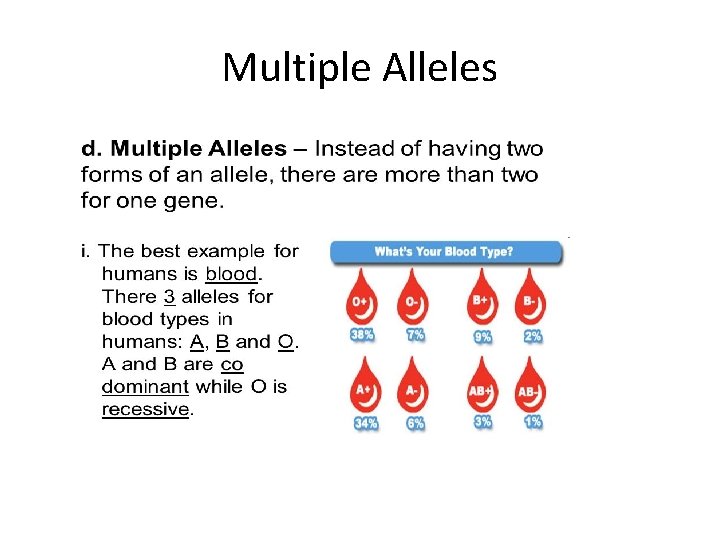
Multiple Alleles
Genetic Laws Law of Segregation Law of Independent Assortment
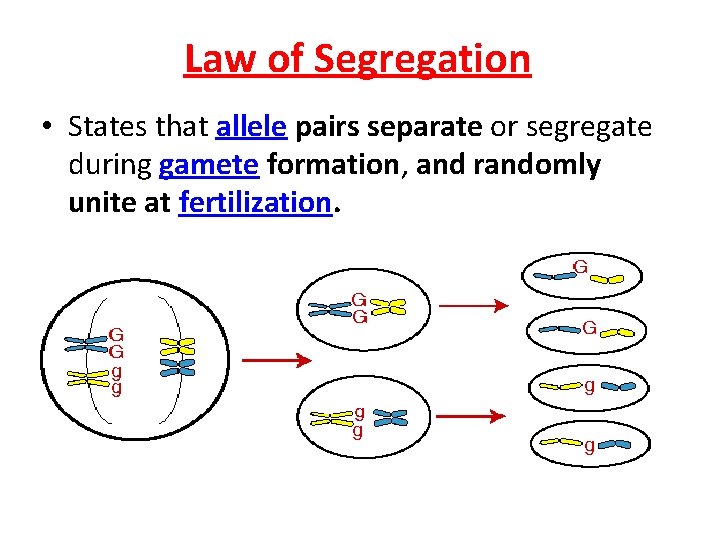
Law of Segregation • States that allele pairs separate or segregate during gamete formation, and randomly unite at fertilization.
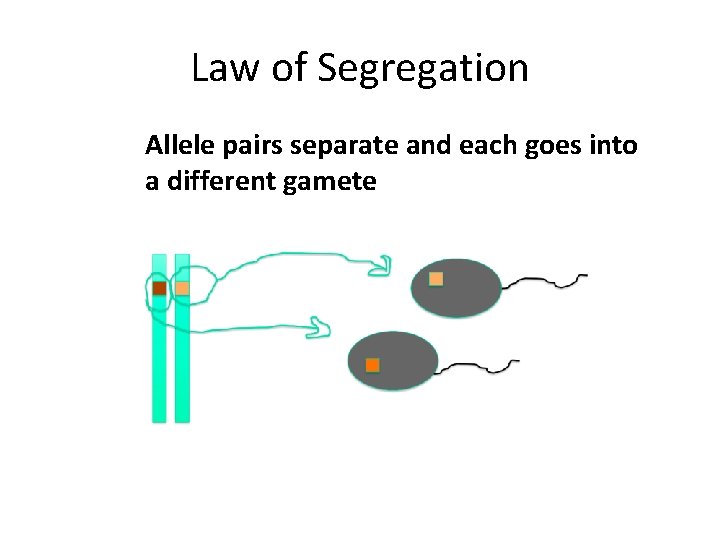
Law of Segregation Allele pairs separate and each goes into a different gamete
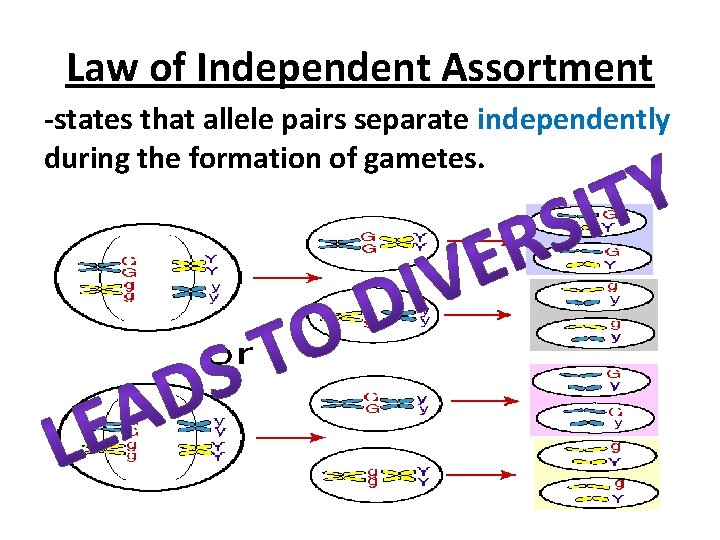
Law of Independent Assortment -states that allele pairs separate independently during the formation of gametes.
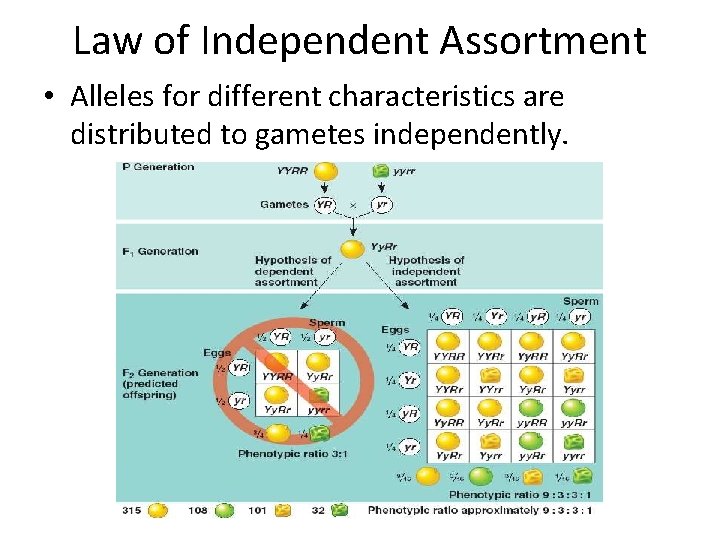
Law of Independent Assortment • Alleles for different characteristics are distributed to gametes independently.
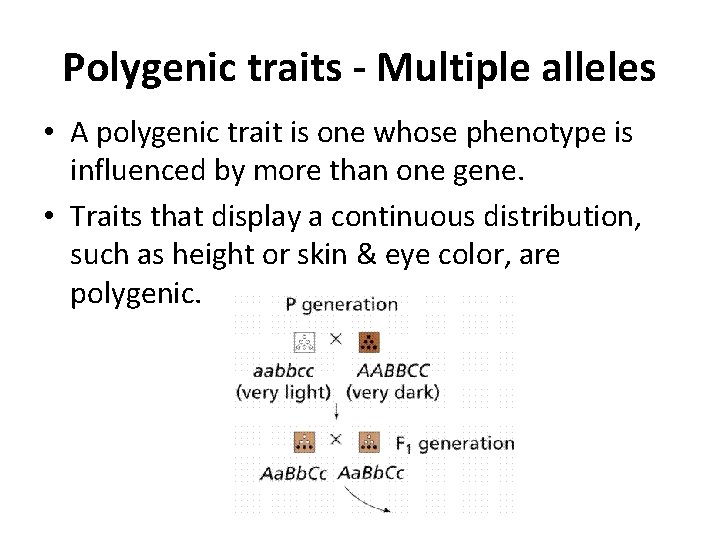
Polygenic traits - Multiple alleles • A polygenic trait is one whose phenotype is influenced by more than one gene. • Traits that display a continuous distribution, such as height or skin & eye color, are polygenic.
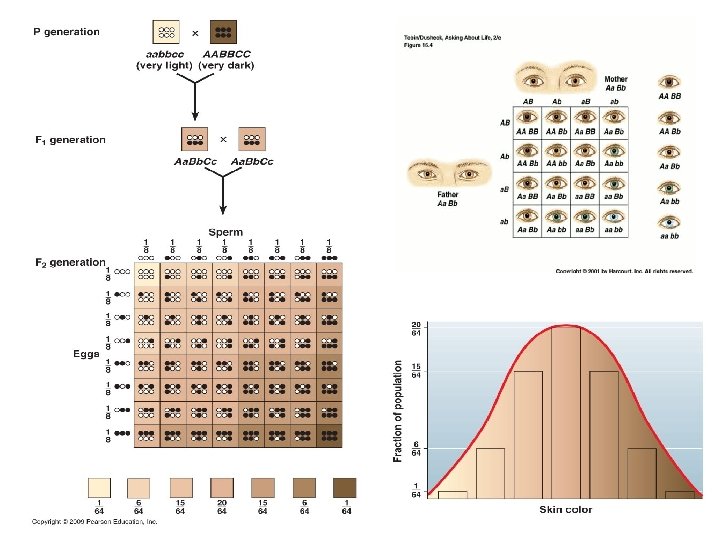
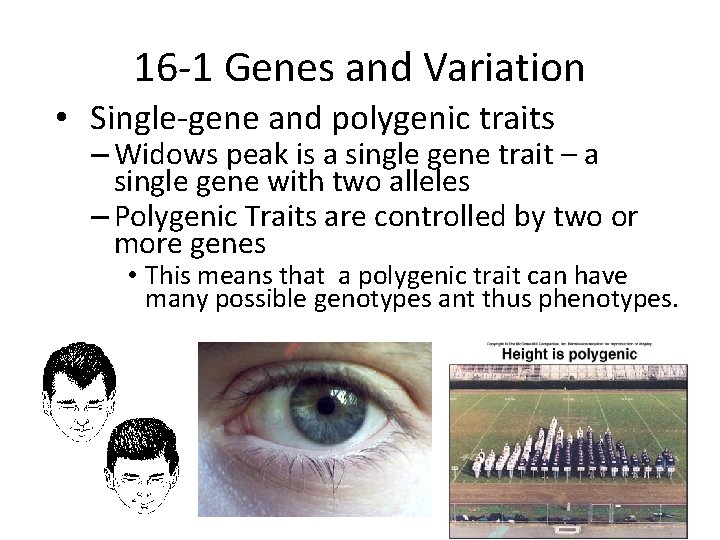
16 -1 Genes and Variation • Single-gene and polygenic traits – Widows peak is a single gene trait – a single gene with two alleles – Polygenic Traits are controlled by two or more genes • This means that a polygenic trait can have many possible genotypes ant thus phenotypes.
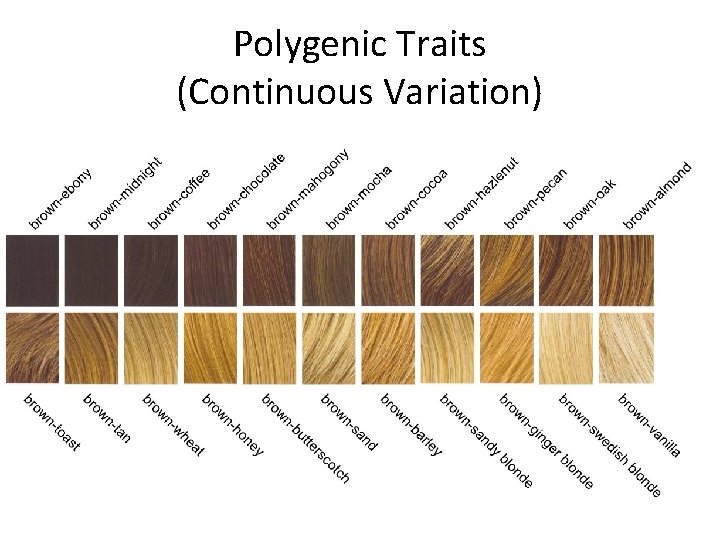
Polygenic Traits (Continuous Variation)
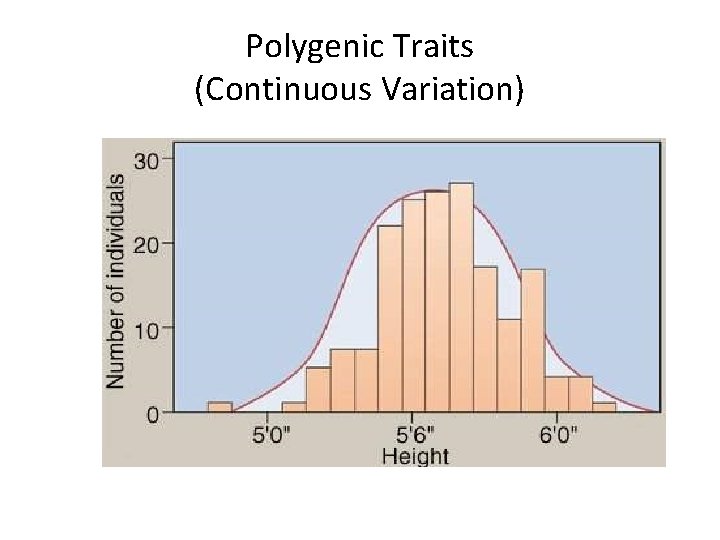
Polygenic Traits (Continuous Variation)
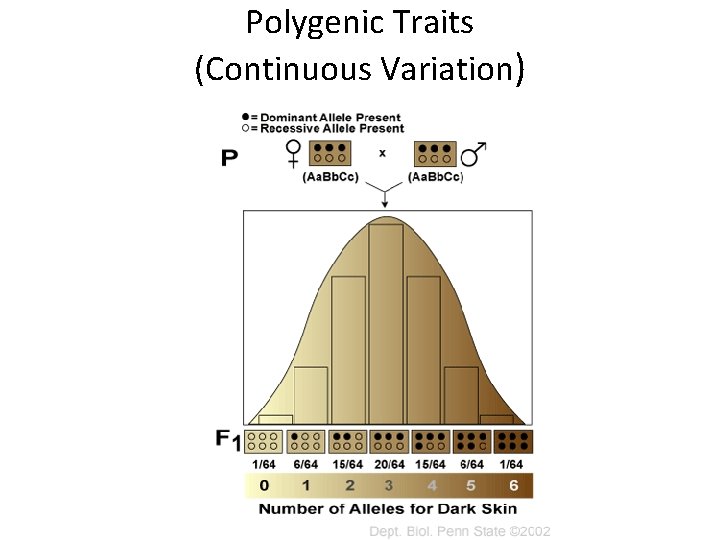
Polygenic Traits (Continuous Variation)
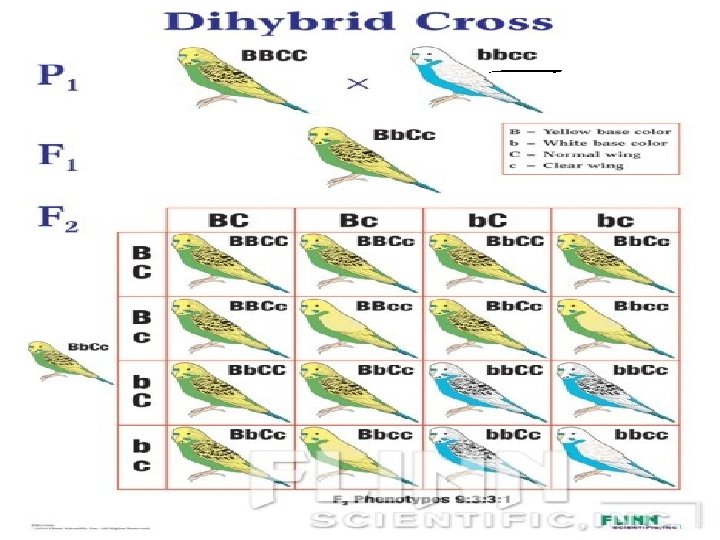
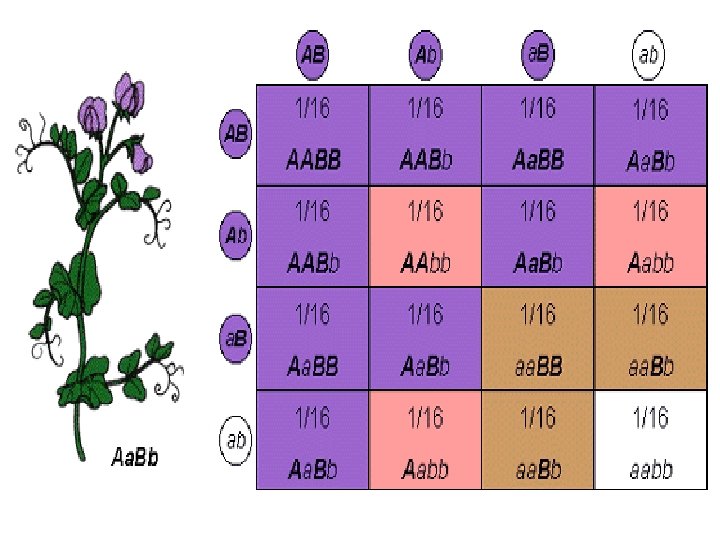
Dihybrid Cross • Cross that involve two traits • Comparing to traits at the same time. – Ex: hair color and eye color • Both parents have to be heterozygous • Genotypical ratio will always be 9: 3: 3: 1
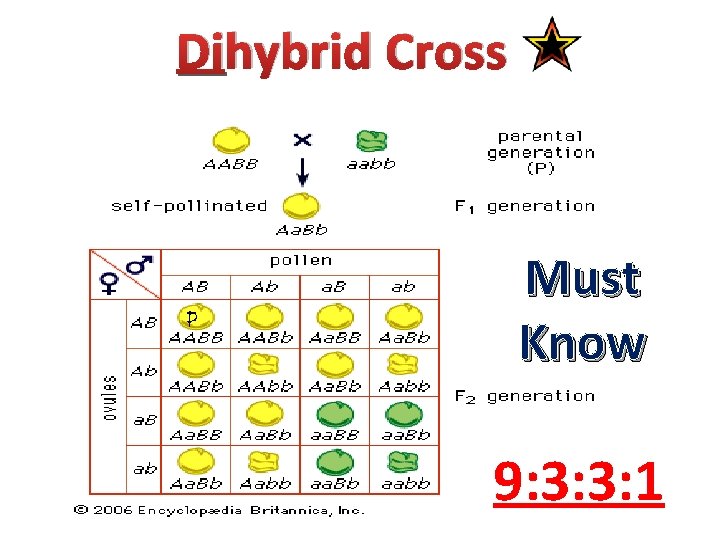
Dihybrid Cross Must Know 9: 3: 3: 1
F. O. I. L FOIL RRHh. What gametes are produced? FOIL Bb. Tt. Possible gametes?
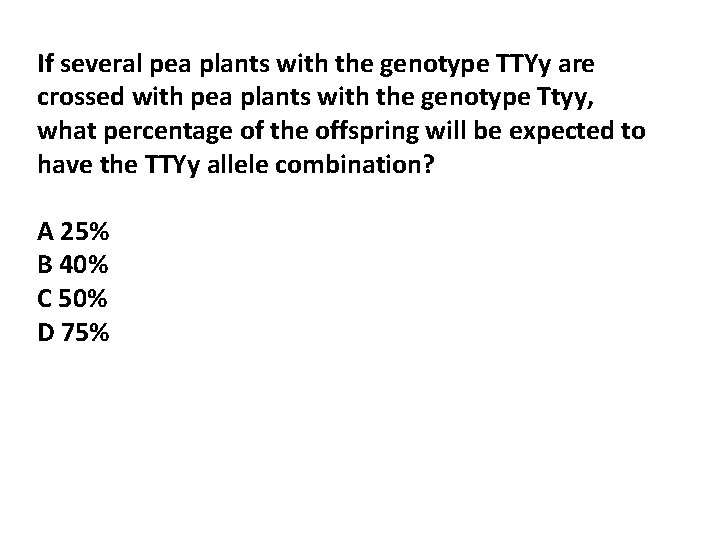
If several pea plants with the genotype TTYy are crossed with pea plants with the genotype Ttyy, what percentage of the offspring will be expected to have the TTYy allele combination? A 25% B 40% C 50% D 75%
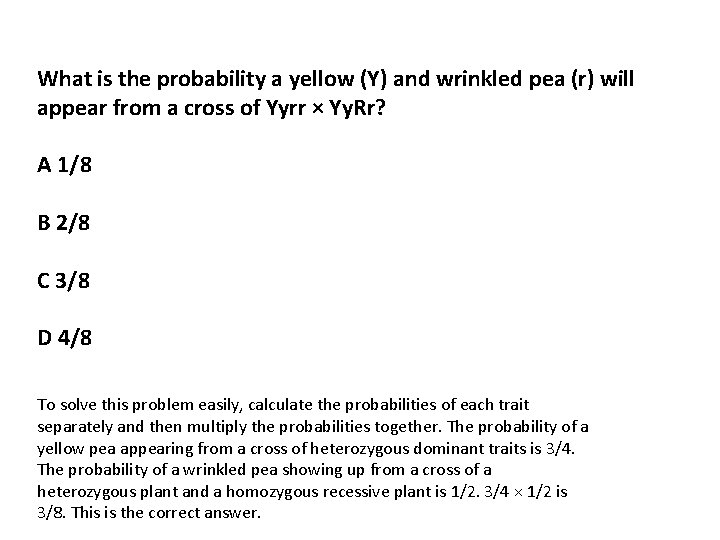
What is the probability a yellow (Y) and wrinkled pea (r) will appear from a cross of Yyrr × Yy. Rr? A 1/8 B 2/8 C 3/8 D 4/8 To solve this problem easily, calculate the probabilities of each trait separately and then multiply the probabilities together. The probability of a yellow pea appearing from a cross of heterozygous dominant traits is 3/4. The probability of a wrinkled pea showing up from a cross of a heterozygous plant and a homozygous recessive plant is 1/2. 3/4 × 1/2 is 3/8. This is the correct answer.
• A dihybrid cross (Aa. Bb x Aa. Bb) will result in what offspring ratio? • A. 4: 4: 2: 2 • B. 1: 3: 1 • C. 3: 1 • D. 9: 3: 3: 1
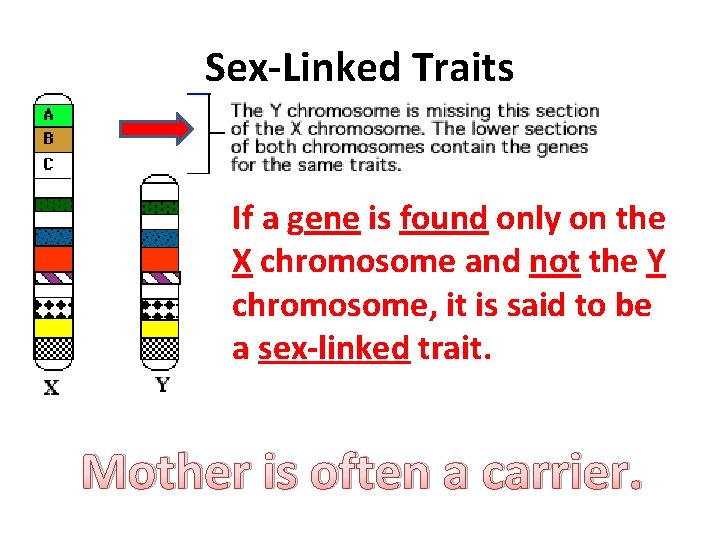
Sex-Linked Traits If a gene is found only on the X chromosome and not the Y chromosome, it is said to be a sex-linked trait. Mother is often a carrier.
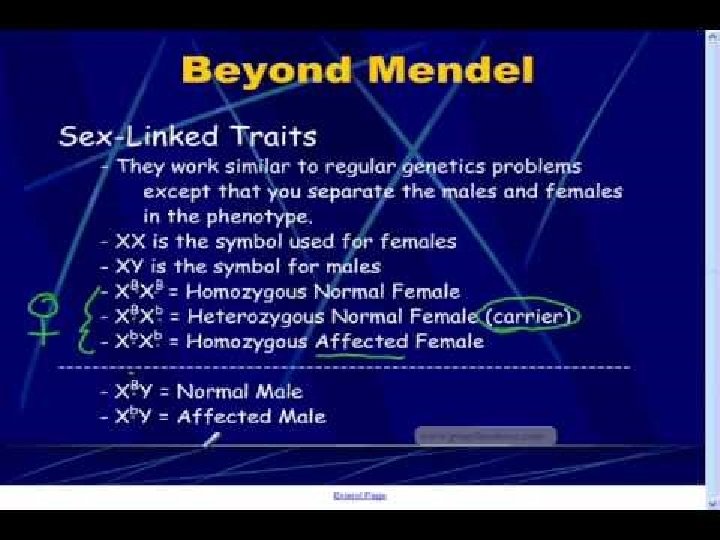
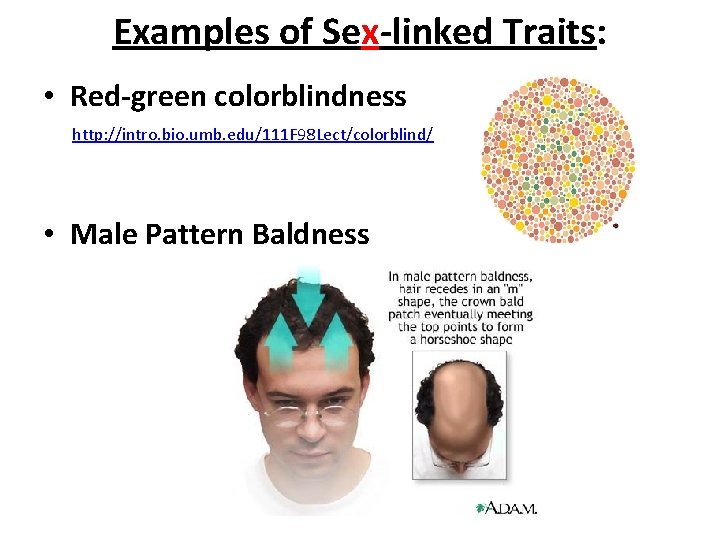
Examples of Sex-linked Traits: • Red-green colorblindness http: //intro. bio. umb. edu/111 F 98 Lect/colorblind/ • Male Pattern Baldness
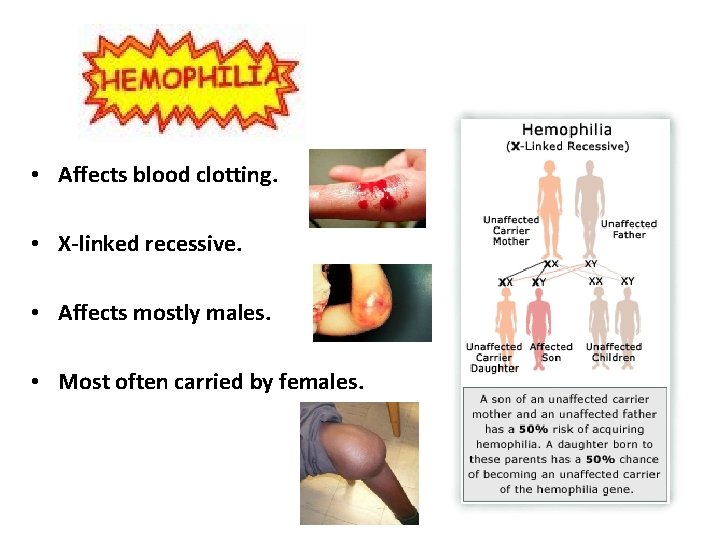
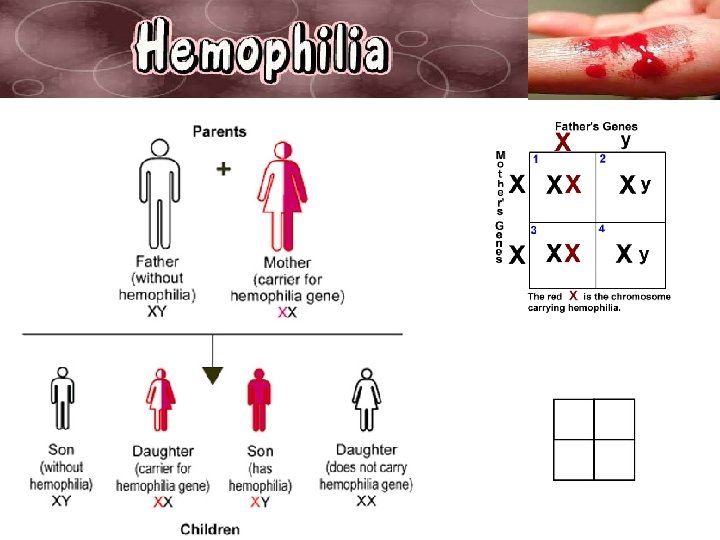
• Affects blood clotting. • X-linked recessive. • Affects mostly males. • Most often carried by females.
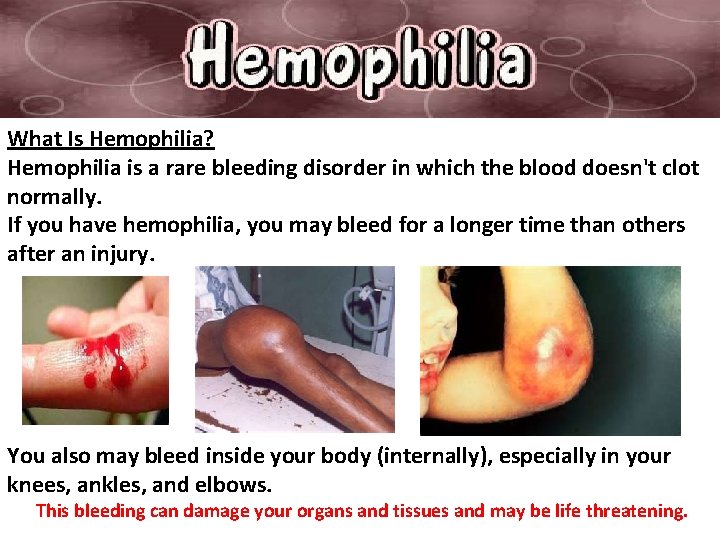
What Is Hemophilia? Hemophilia is a rare bleeding disorder in which the blood doesn't clot normally. If you have hemophilia, you may bleed for a longer time than others after an injury. You also may bleed inside your body (internally), especially in your knees, ankles, and elbows. This bleeding can damage your organs and tissues and may be life threatening.
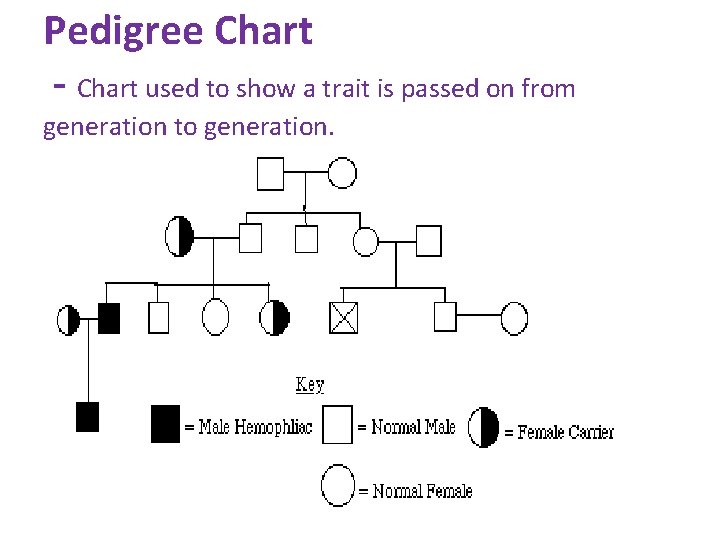
Pedigree Chart - Chart used to show a trait is passed on from generation to generation.
• 1. A human baby boy inherits a recessive allele from his mother. In which circumstance would he most likely show the trait coded for by the recessive allele? • A. The baby inherits the dominant allele from his father. • B. The allele is on an autosomal chromosome and the baby is a twin. • C. The allele is on the X chromosome. • D. The allele is on the Y chromosome.
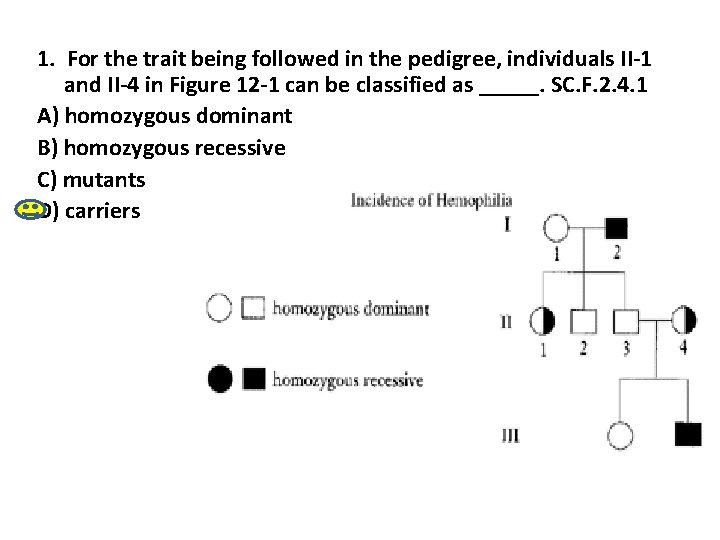
1. For the trait being followed in the pedigree, individuals II-1 and II-4 in Figure 12 -1 can be classified as _____. SC. F. 2. 4. 1 A) homozygous dominant B) homozygous recessive C) mutants D) carriers
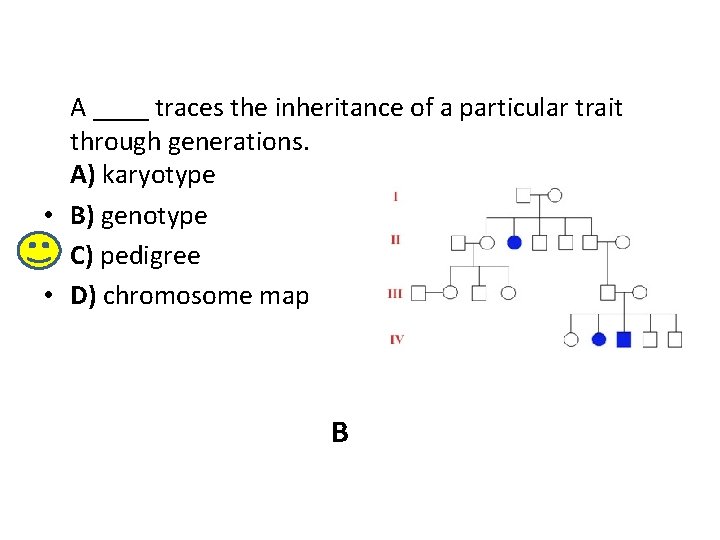
A ____ traces the inheritance of a particular trait through generations. A) karyotype • B) genotype • C) pedigree • D) chromosome map B
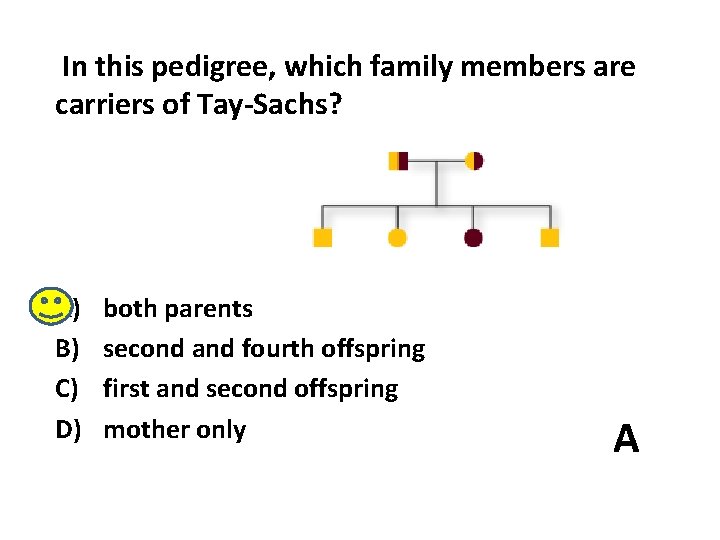
In this pedigree, which family members are carriers of Tay-Sachs? A) B) C) D) both parents second and fourth offspring first and second offspring mother only A
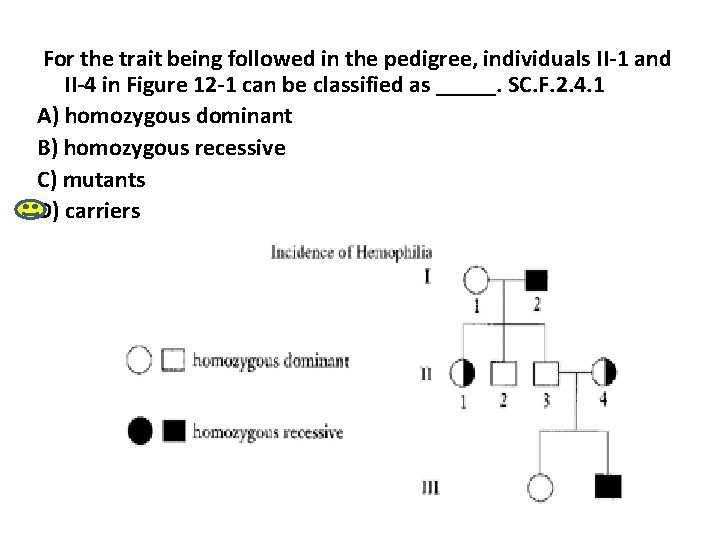
For the trait being followed in the pedigree, individuals II-1 and II-4 in Figure 12 -1 can be classified as _____. SC. F. 2. 4. 1 A) homozygous dominant B) homozygous recessive C) mutants D) carriers
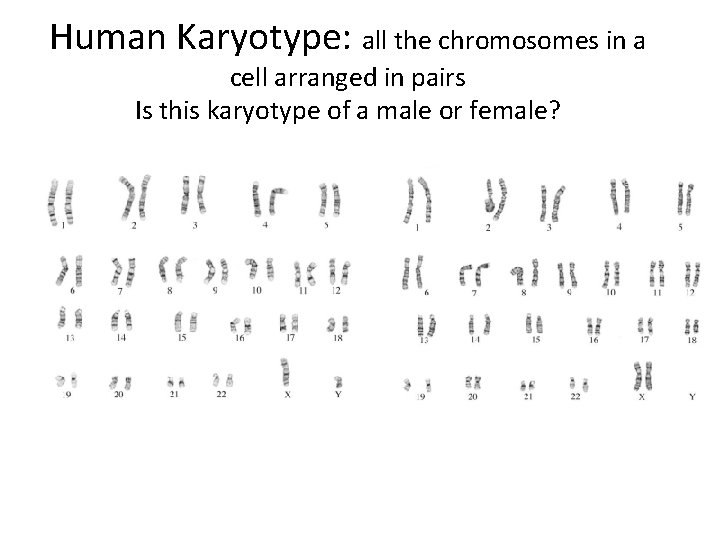
Human Karyotype: all the chromosomes in a cell arranged in pairs Is this karyotype of a male or female?
Autosomal Disorders • Found in any chromosome that is not a sex chromosomes. – Sickle Anemia – Down Syndrome
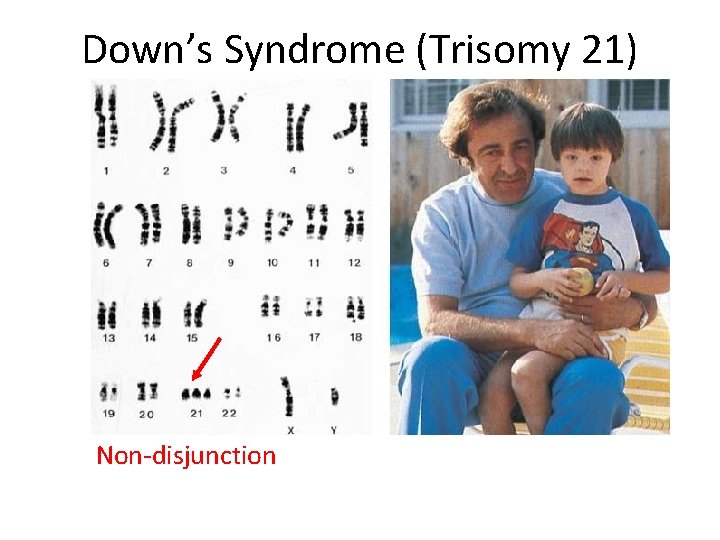
Down’s Syndrome (Trisomy 21) Non-disjunction
Sickle Cell Anemia • A genetic disorder that causes abnormal hemoglobin , resulting in some red blood cells assuming an abnormal. • Autosomal recessive
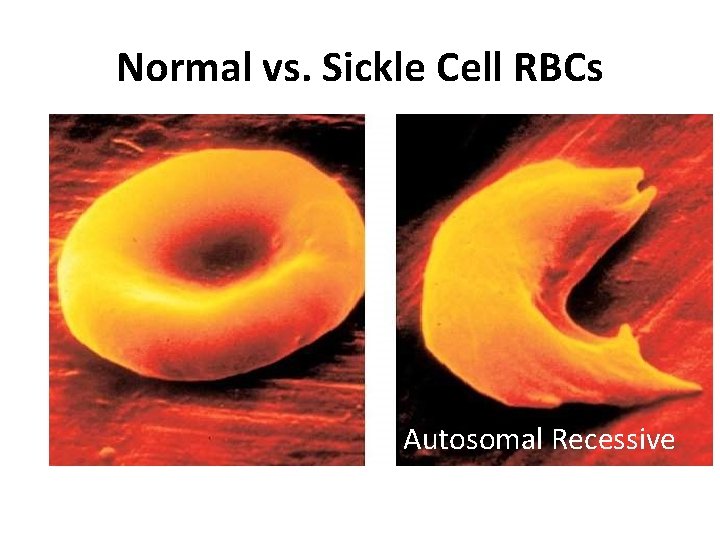
Normal vs. Sickle Cell RBCs Autosomal Recessive
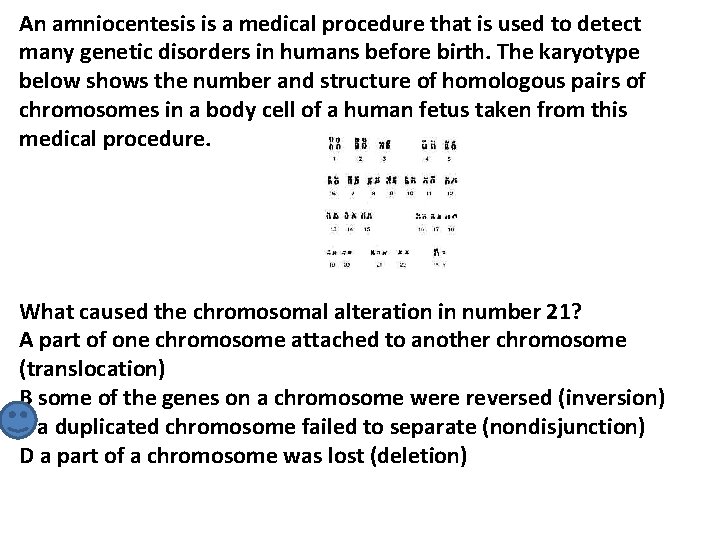
An amniocentesis is a medical procedure that is used to detect many genetic disorders in humans before birth. The karyotype below shows the number and structure of homologous pairs of chromosomes in a body cell of a human fetus taken from this medical procedure. What caused the chromosomal alteration in number 21? A part of one chromosome attached to another chromosome (translocation) B some of the genes on a chromosome were reversed (inversion) C a duplicated chromosome failed to separate (nondisjunction) D a part of a chromosome was lost (deletion)
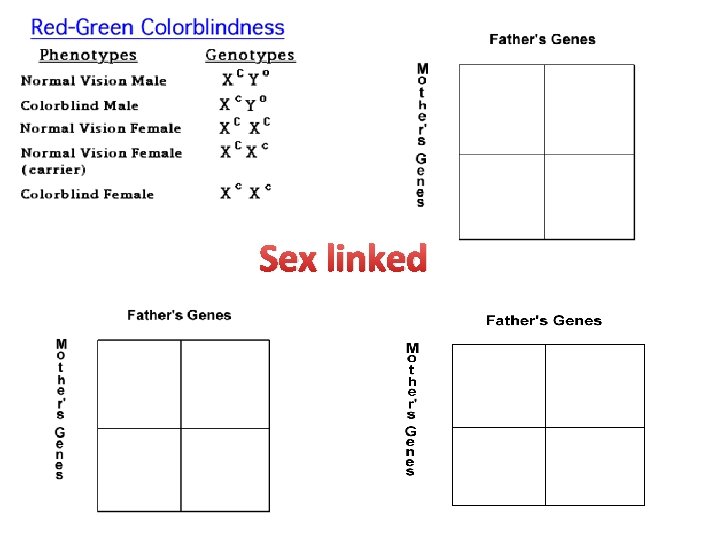
Sex linked
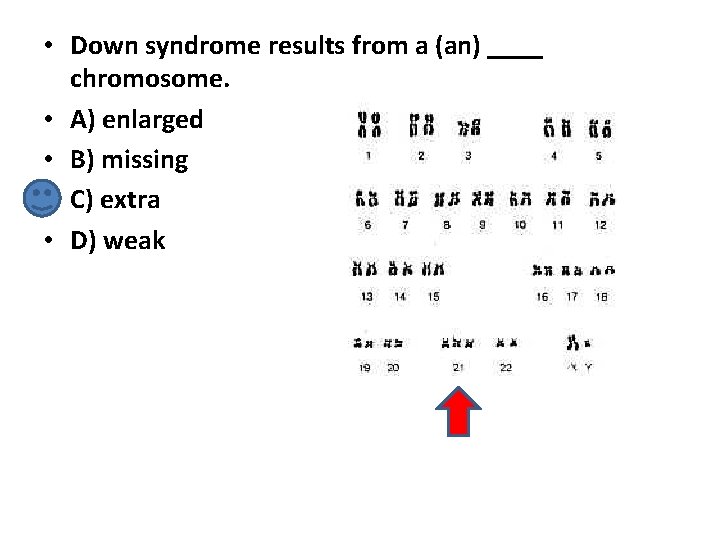
• Down syndrome results from a (an) ____ chromosome. • A) enlarged • B) missing • C) extra • D) weak
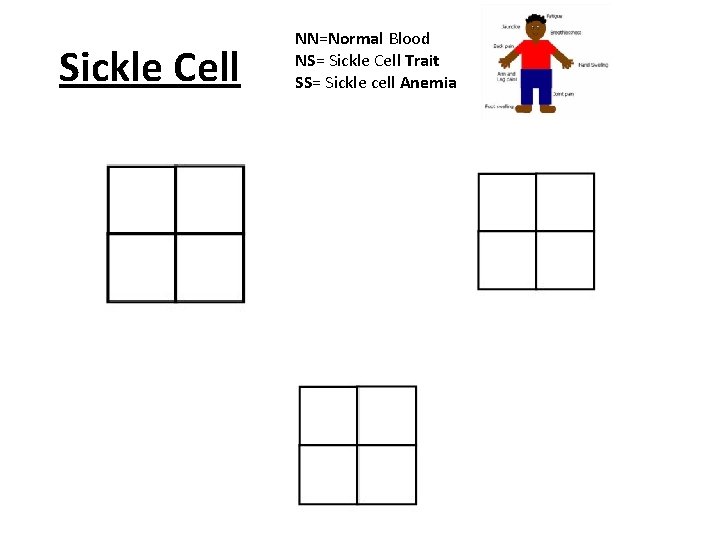
Sickle Cell NN=Normal Blood NS= Sickle Cell Trait SS= Sickle cell Anemia
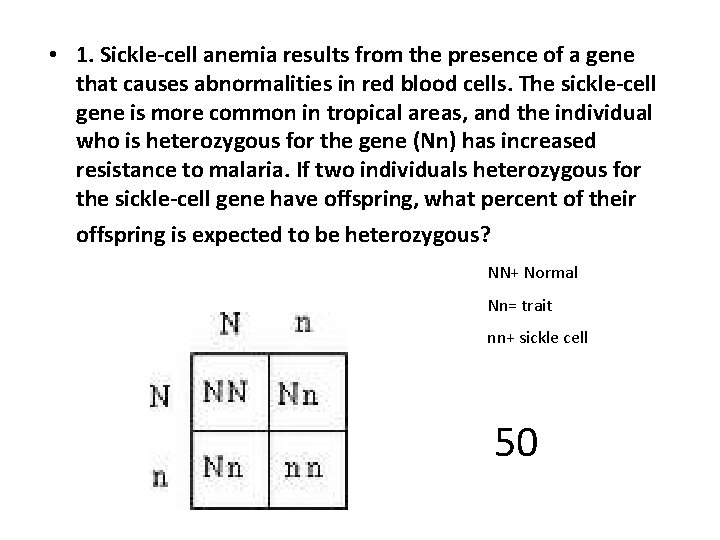
• 1. Sickle-cell anemia results from the presence of a gene that causes abnormalities in red blood cells. The sickle-cell gene is more common in tropical areas, and the individual who is heterozygous for the gene (Nn) has increased resistance to malaria. If two individuals heterozygous for the sickle-cell gene have offspring, what percent of their offspring is expected to be heterozygous? NN+ Normal Nn= trait nn+ sickle cell 50
• Sponge. Bob Square. Pants recently met Sponge. Susie Roundpants at a dance. Sponge. Bob is heterozygous for his square shape, but Sponge. Susie is round. Create a Punnett square to show the possibilities that would result if Sponge. Bob and Sponge. Susie had children. HINT: Read question #2! • A. List the possible genotypes and phenotypes for their children. • B. What are the chances of a child with a square shape? ____ out of ____ or ____% • C. What are the chances of a child with a round shape? ____ out of ____ or ____%
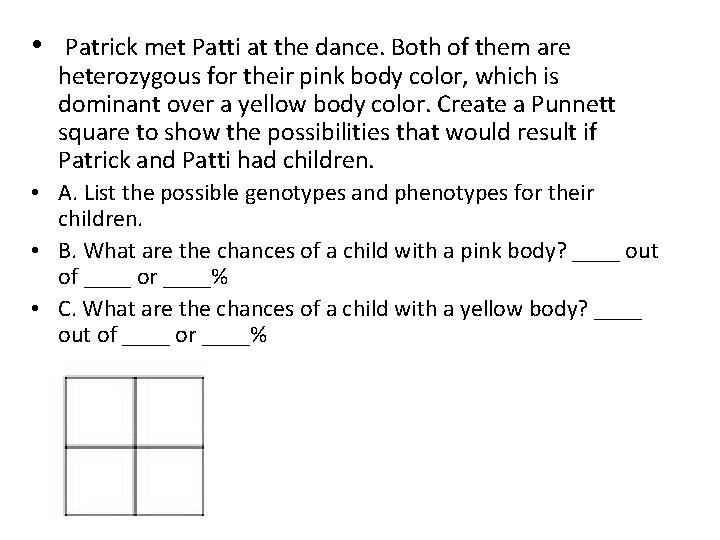
• Patrick met Patti at the dance. Both of them are heterozygous for their pink body color, which is dominant over a yellow body color. Create a Punnett square to show the possibilities that would result if Patrick and Patti had children. • A. List the possible genotypes and phenotypes for their children. • B. What are the chances of a child with a pink body? ____ out of ____ or ____% • C. What are the chances of a child with a yellow body? ____ out of ____ or ____%
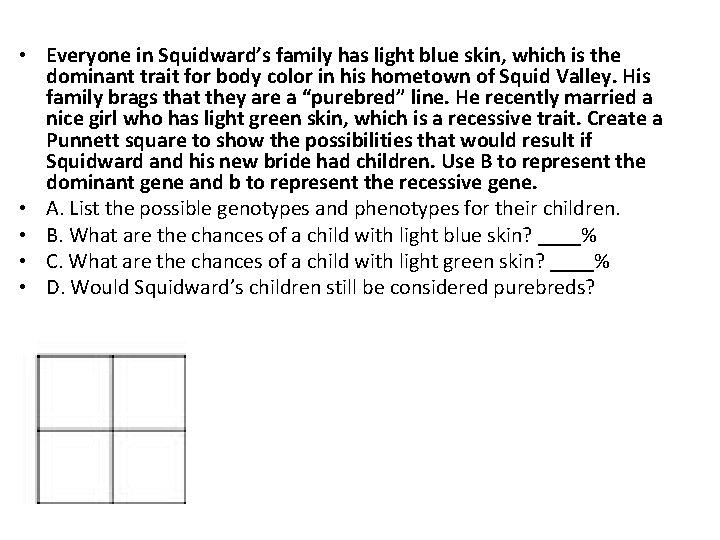
• Everyone in Squidward’s family has light blue skin, which is the dominant trait for body color in his hometown of Squid Valley. His family brags that they are a “purebred” line. He recently married a nice girl who has light green skin, which is a recessive trait. Create a Punnett square to show the possibilities that would result if Squidward and his new bride had children. Use B to represent the dominant gene and b to represent the recessive gene. • A. List the possible genotypes and phenotypes for their children. • B. What are the chances of a child with light blue skin? ____% • C. What are the chances of a child with light green skin? ____% • D. Would Squidward’s children still be considered purebreds?
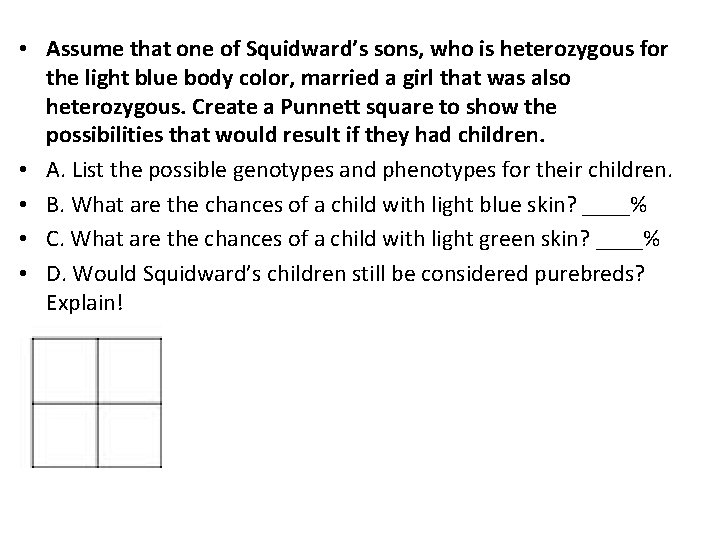
• Assume that one of Squidward’s sons, who is heterozygous for the light blue body color, married a girl that was also heterozygous. Create a Punnett square to show the possibilities that would result if they had children. • A. List the possible genotypes and phenotypes for their children. • B. What are the chances of a child with light blue skin? ____% • C. What are the chances of a child with light green skin? ____% • D. Would Squidward’s children still be considered purebreds? Explain!
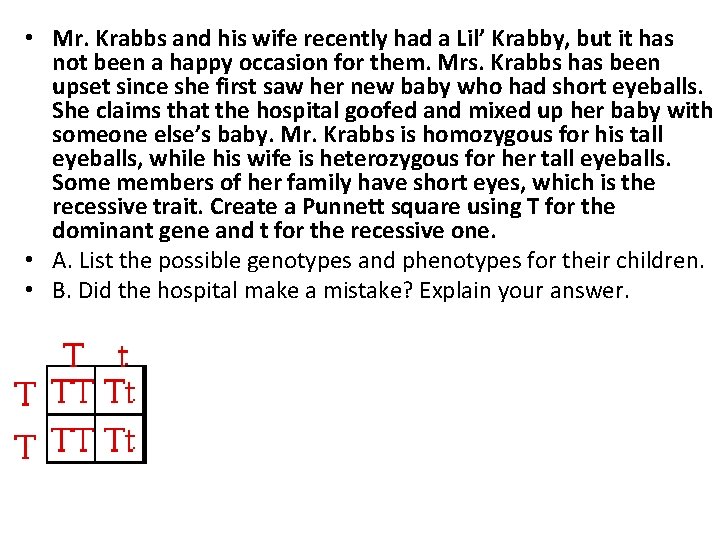
• Mr. Krabbs and his wife recently had a Lil’ Krabby, but it has not been a happy occasion for them. Mrs. Krabbs has been upset since she first saw her new baby who had short eyeballs. She claims that the hospital goofed and mixed up her baby with someone else’s baby. Mr. Krabbs is homozygous for his tall eyeballs, while his wife is heterozygous for her tall eyeballs. Some members of her family have short eyes, which is the recessive trait. Create a Punnett square using T for the dominant gene and t for the recessive one. • A. List the possible genotypes and phenotypes for their children. • B. Did the hospital make a mistake? Explain your answer.
- Slides: 76