
e Bus Simulator Presentation Overview 1 About New

e. Bus Simulator
Presentation Overview 1. About New Flyer Industries and Xcelsior 2. Project Goals 3. Data Requirements 4. Development Environment and Risks 5. Validation Method 6. Milestones and Presentation Venue Confidential 2

About New Flyer
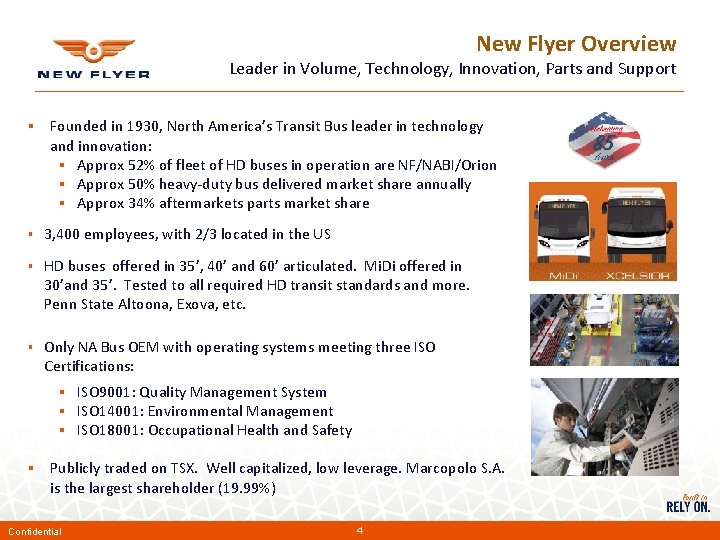
New Flyer Overview Leader in Volume, Technology, Innovation, Parts and Support § Founded in 1930, North America’s Transit Bus leader in technology and innovation: § Approx 52% of fleet of HD buses in operation are NF/NABI/Orion § Approx 50% heavy-duty bus delivered market share annually § Approx 34% aftermarkets parts market share § 3, 400 employees, with 2/3 located in the US § HD buses offered in 35’, 40’ and 60’ articulated. Mi. Di offered in 30’and 35’. Tested to all required HD transit standards and more. Penn State Altoona, Exova, etc. § Only NA Bus OEM with operating systems meeting three ISO Certifications: § § ISO 9001: Quality Management System ISO 14001: Environmental Management ISO 18001: Occupational Health and Safety Publicly traded on TSX. Well capitalized, low leverage. Marcopolo S. A. is the largest shareholder (19. 99%) Confidential 4
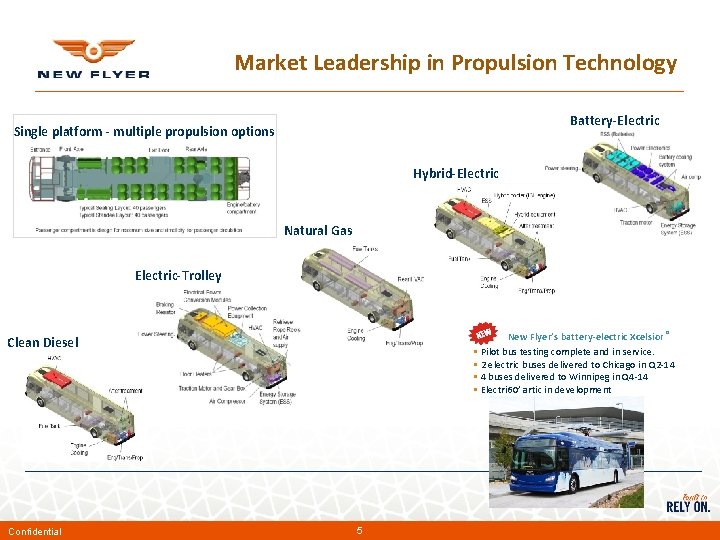
Market Leadership in Propulsion Technology Battery-Electric Single platform - multiple propulsion options Hybrid-Electric Natural Gas Electric-Trolley New Flyer’s battery-electric Xcelsior ® § Pilot bus testing complete and in service. § 2 electric buses delivered to Chicago in Q 2 -14 § 4 buses delivered to Winnipeg in Q 4 -14 § Electri 60’ artic in development Clean Diesel Confidential 5
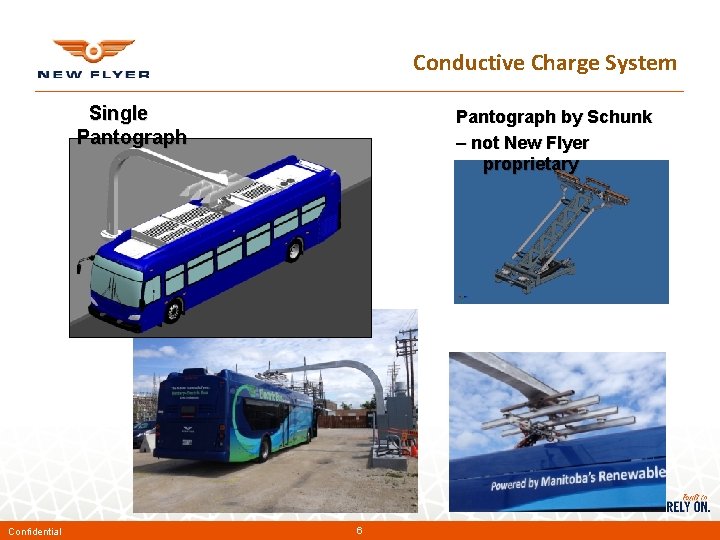
Conductive Charge System Single Pantograph Confidential Pantograph by Schunk – not New Flyer proprietary 6

Project Goals
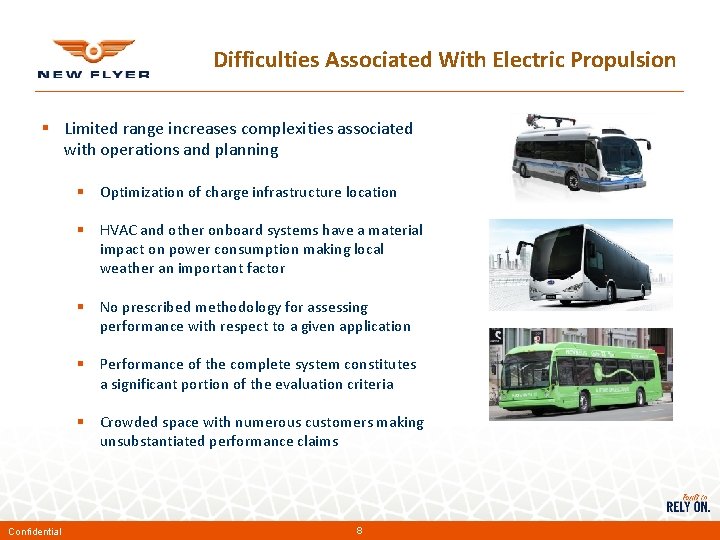
Difficulties Associated With Electric Propulsion § Limited range increases complexities associated with operations and planning § Optimization of charge infrastructure location § HVAC and other onboard systems have a material impact on power consumption making local weather an important factor § No prescribed methodology for assessing performance with respect to a given application § Performance of the complete system constitutes a significant portion of the evaluation criteria § Crowded space with numerous customers making unsubstantiated performance claims Confidential 8
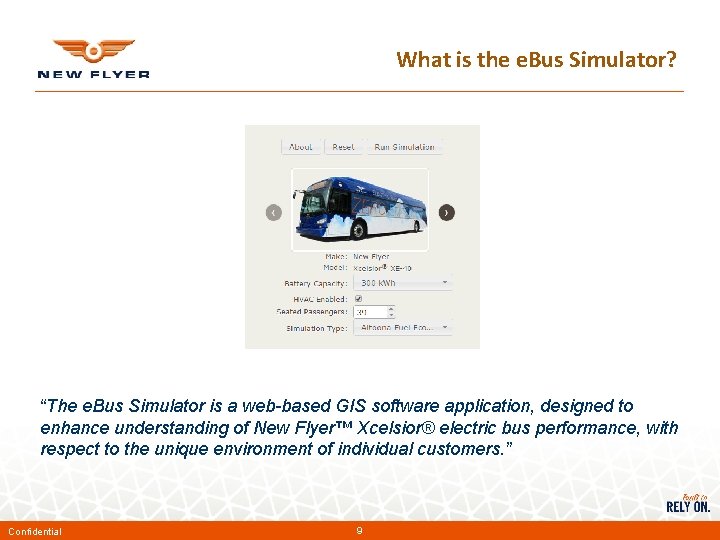
What is the e. Bus Simulator? “The e. Bus Simulator is a web-based GIS software application, designed to enhance understanding of New Flyer™ Xcelsior® electric bus performance, with respect to the unique environment of individual customers. ” Confidential 9
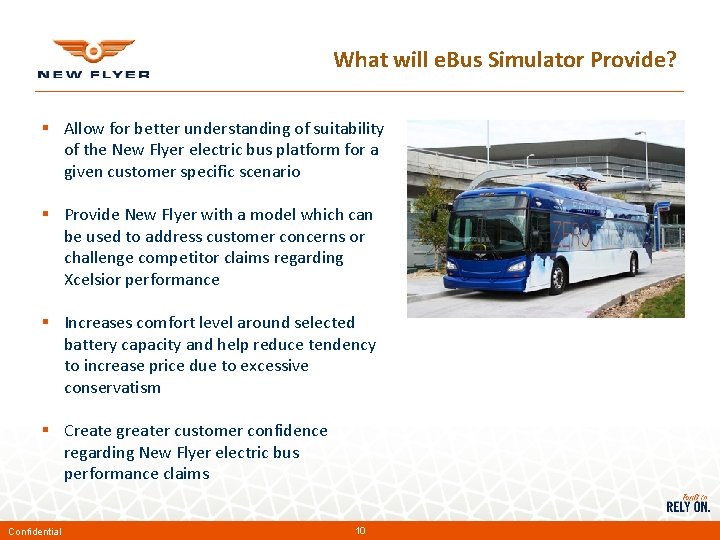
What will e. Bus Simulator Provide? § Allow for better understanding of suitability of the New Flyer electric bus platform for a given customer specific scenario § Provide New Flyer with a model which can be used to address customer concerns or challenge competitor claims regarding Xcelsior performance § Increases comfort level around selected battery capacity and help reduce tendency to increase price due to excessive conservatism § Create greater customer confidence regarding New Flyer electric bus performance claims Confidential 10
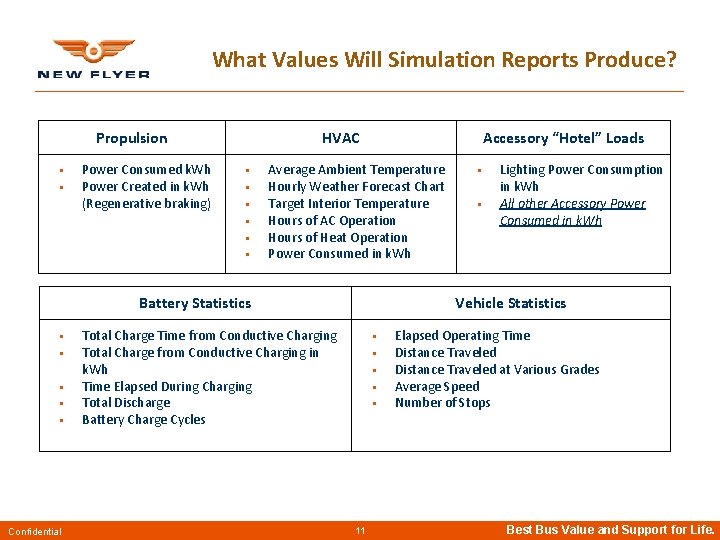
What Values Will Simulation Reports Produce? Propulsion § § Power Consumed k. Wh Power Created in k. Wh (Regenerative braking) HVAC § § § Accessory “Hotel” Loads Average Ambient Temperature Hourly Weather Forecast Chart Target Interior Temperature Hours of AC Operation Hours of Heat Operation Power Consumed in k. Wh Battery Statistics § § § Confidential § § Lighting Power Consumption in k. Wh All other Accessory Power Consumed in k. Wh Vehicle Statistics Total Charge Time from Conductive Charging Total Charge from Conductive Charging in k. Wh Time Elapsed During Charging Total Discharge Battery Charge Cycles § § § 11 Elapsed Operating Time Distance Traveled at Various Grades Average Speed Number of Stops Best Bus Value and Support for Life.
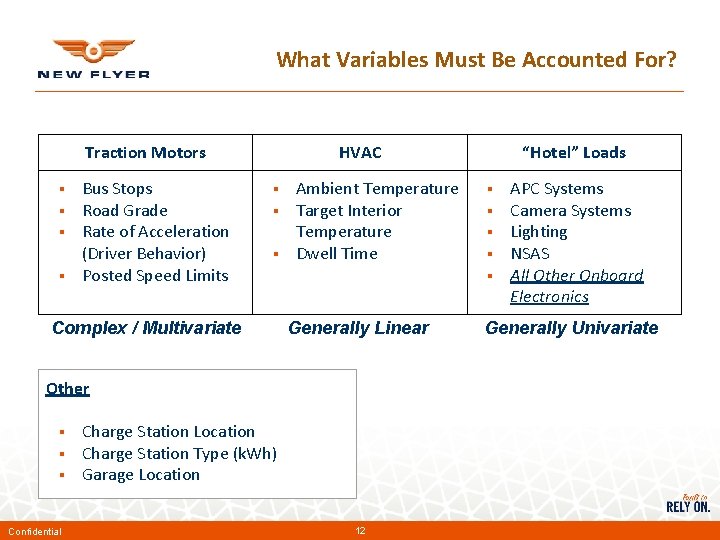
What Variables Must Be Accounted For? Traction Motors § § Bus Stops Road Grade Rate of Acceleration (Driver Behavior) Posted Speed Limits HVAC § § § Complex / Multivariate Ambient Temperature Target Interior Temperature Dwell Time § § Confidential § § § Generally Linear Other § “Hotel” Loads Charge Station Location Charge Station Type (k. Wh) Garage Location 12 APC Systems Camera Systems Lighting NSAS All Other Onboard Electronics Generally Univariate
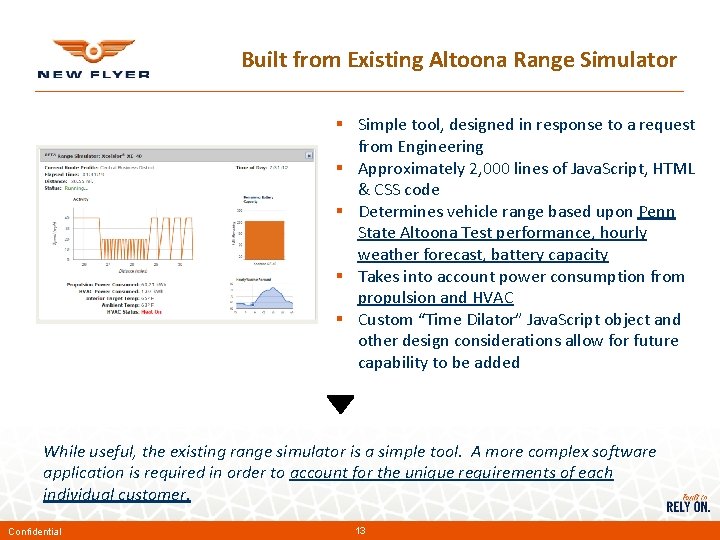
Built from Existing Altoona Range Simulator § Simple tool, designed in response to a request from Engineering § Approximately 2, 000 lines of Java. Script, HTML & CSS code § Determines vehicle range based upon Penn State Altoona Test performance, hourly weather forecast, battery capacity § Takes into account power consumption from propulsion and HVAC § Custom “Time Dilator” Java. Script object and other design considerations allow for future capability to be added While useful, the existing range simulator is a simple tool. A more complex software application is required in order to account for the unique requirements of each individual customer. Confidential 13
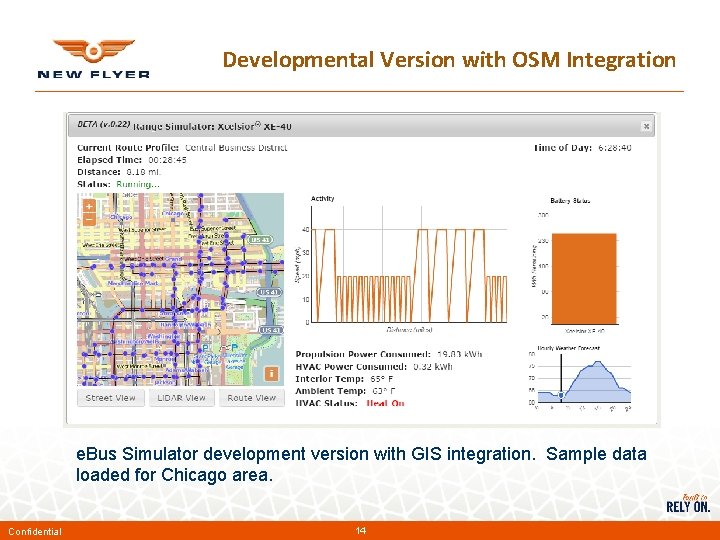
Developmental Version with OSM Integration e. Bus Simulator development version with GIS integration. Sample data loaded for Chicago area. Confidential 14
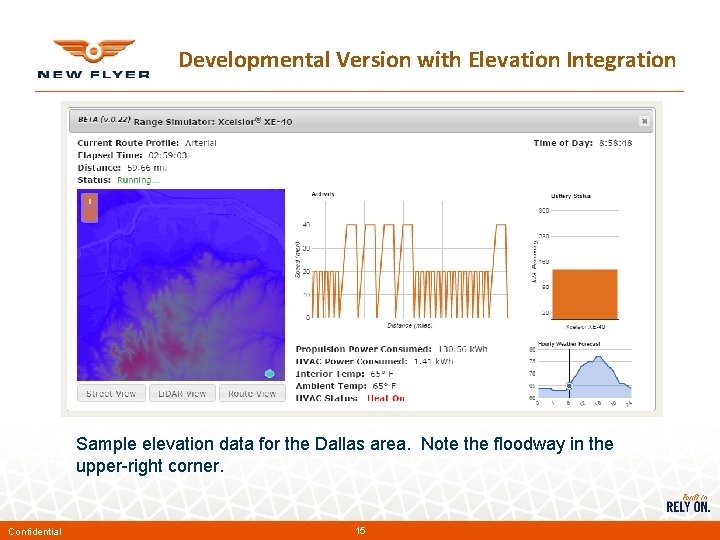
Developmental Version with Elevation Integration Sample elevation data for the Dallas area. Note the floodway in the upper-right corner. Confidential 15
Project Data Requirements
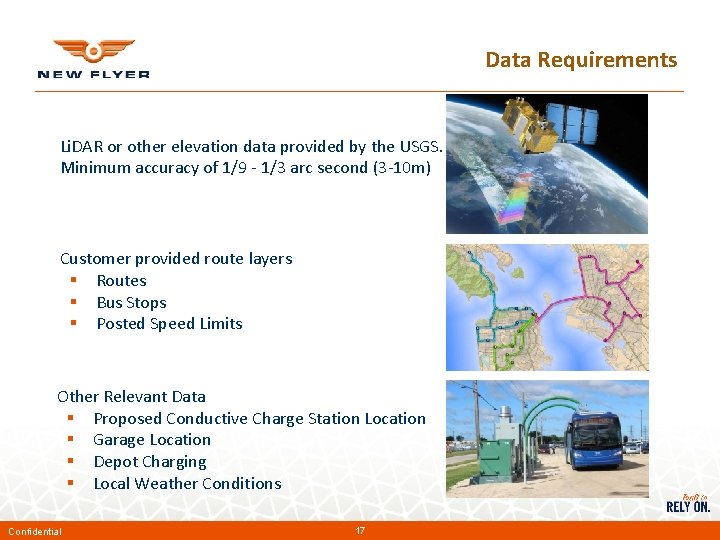
Data Requirements Li. DAR or other elevation data provided by the USGS. Minimum accuracy of 1/9 - 1/3 arc second (3 -10 m) Customer provided route layers § Routes § Bus Stops § Posted Speed Limits Other Relevant Data § Proposed Conductive Charge Station Location § Garage Location § Depot Charging § Local Weather Conditions Confidential 17
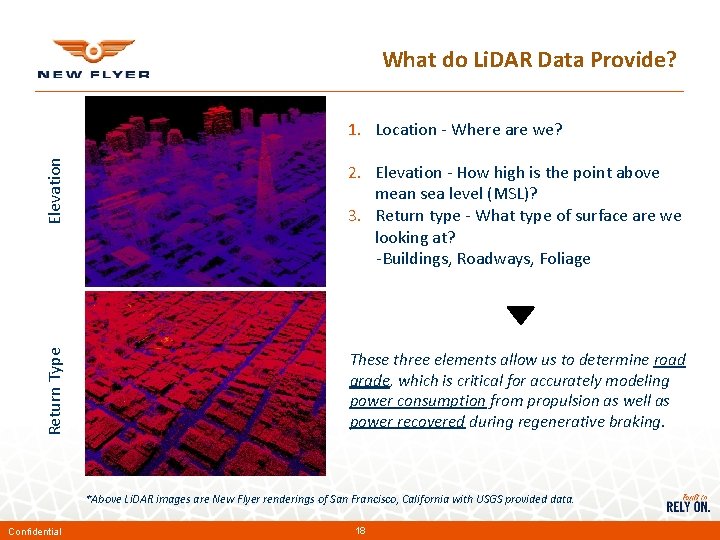
What do Li. DAR Data Provide? Elevation 2. Elevation - How high is the point above mean sea level (MSL)? 3. Return type - What type of surface are we looking at? -Buildings, Roadways, Foliage Return Type 1. Location - Where are we? These three elements allow us to determine road grade, which is critical for accurately modeling power consumption from propulsion as well as power recovered during regenerative braking. *Above Li. DAR images are New Flyer renderings of San Francisco, California with USGS provided data. Confidential 18
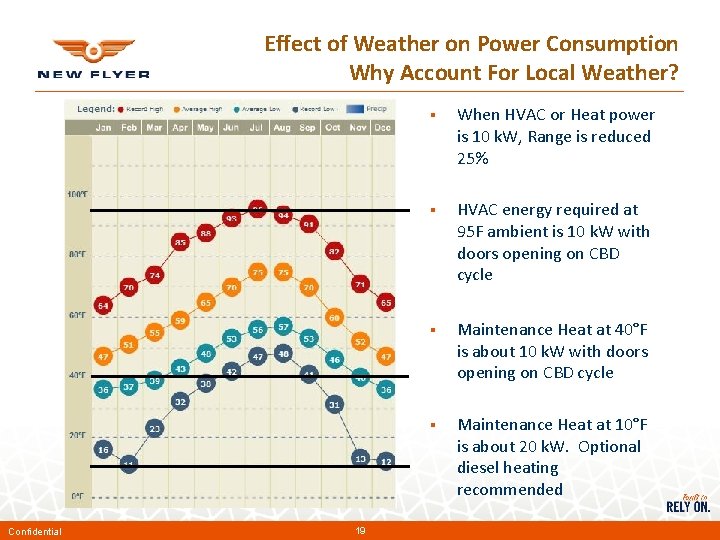
Effect of Weather on Power Consumption Why Account For Local Weather? Confidential 19 § When HVAC or Heat power is 10 k. W, Range is reduced 25% § HVAC energy required at 95 F ambient is 10 k. W with doors opening on CBD cycle § Maintenance Heat at 40°F is about 10 k. W with doors opening on CBD cycle § Maintenance Heat at 10°F is about 20 k. W. Optional diesel heating recommended

Project Platform & Risks
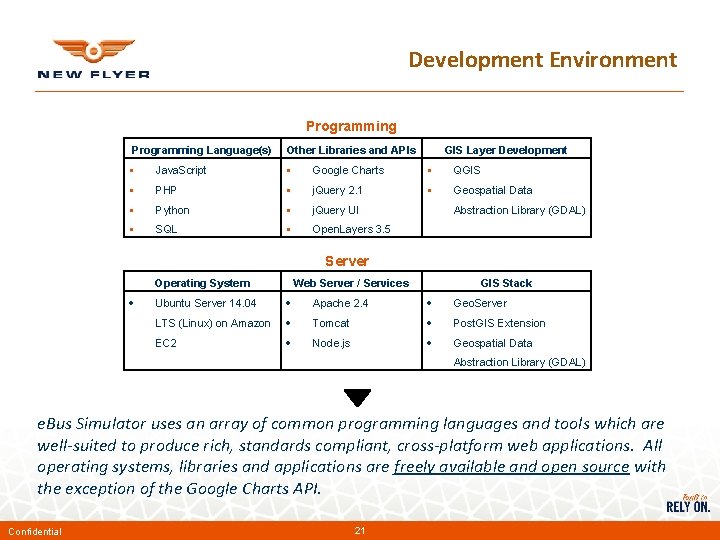
Development Environment Programming Language(s) Other Libraries and APIs GIS Layer Development § Java. Script § Google Charts § QGIS § PHP § j. Query 2. 1 § Geospatial Data § Python § j. Query UI § SQL § Open. Layers 3. 5 Abstraction Library (GDAL) Server Operating System Web Server / Services GIS Stack Ubuntu Server 14. 04 Apache 2. 4 Geo. Server LTS (Linux) on Amazon Tomcat Post. GIS Extension EC 2 Node. js Geospatial Data Abstraction Library (GDAL) e. Bus Simulator uses an array of common programming languages and tools which are well-suited to produce rich, standards compliant, cross-platform web applications. All operating systems, libraries and applications are freely available and open source with the exception of the Google Charts API. Confidential 21
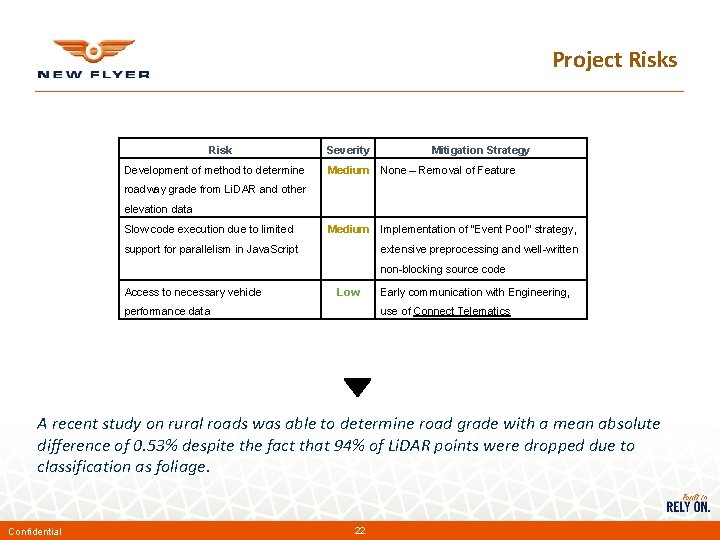
Project Risks Risk Development of method to determine Severity Mitigation Strategy Medium None – Removal of Feature Medium Implementation of “Event Pool” strategy, roadway grade from Li. DAR and other elevation data Slow code execution due to limited support for parallelism in Java. Script extensive preprocessing and well-written non-blocking source code Access to necessary vehicle Low performance data Early communication with Engineering, use of Connect Telematics A recent study on rural roads was able to determine road grade with a mean absolute difference of 0. 53% despite the fact that 94% of Li. DAR points were dropped due to classification as foliage. Confidential 22

Validation Method
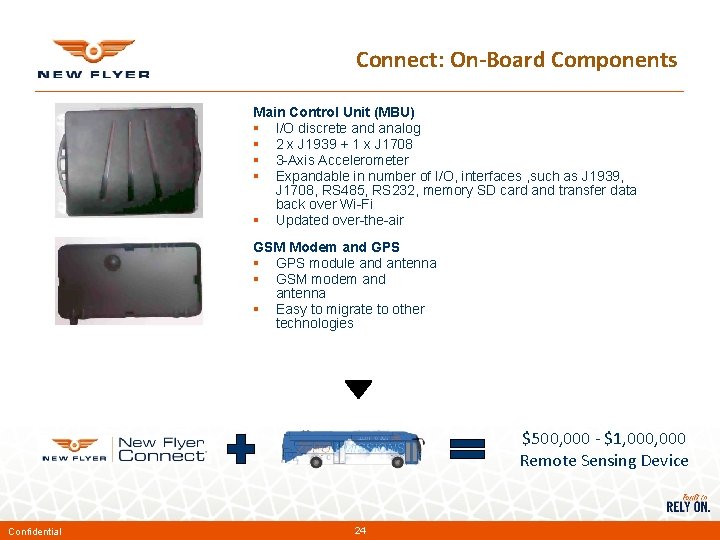
Connect: On-Board Components Main Control Unit (MBU) § I/O discrete and analog § 2 x J 1939 + 1 x J 1708 § 3 -Axis Accelerometer § Expandable in number of I/O, interfaces , such as J 1939, J 1708, RS 485, RS 232, memory SD card and transfer data back over Wi-Fi § Updated over-the-air GSM Modem and GPS § GPS module and antenna § GSM modem and antenna § Easy to migrate to other technologies $500, 000 - $1, 000 Remote Sensing Device Confidential 24
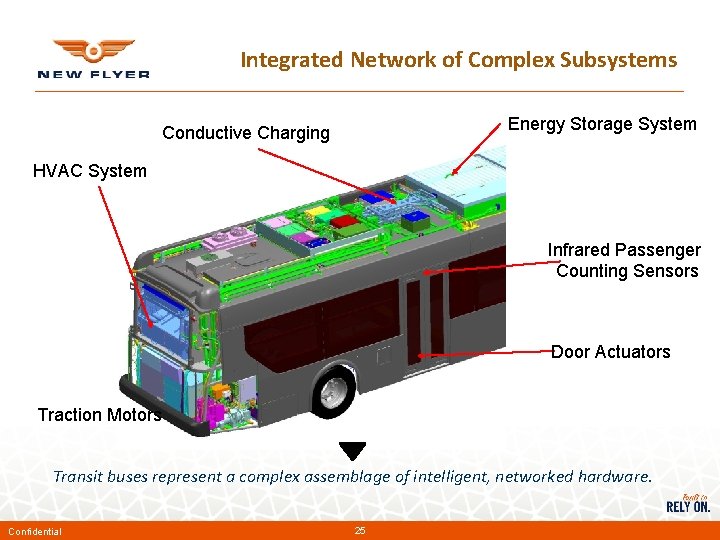
Integrated Network of Complex Subsystems Energy Storage System Conductive Charging HVAC System Infrared Passenger Counting Sensors Door Actuators Traction Motors Transit buses represent a complex assemblage of intelligent, networked hardware. Confidential 25
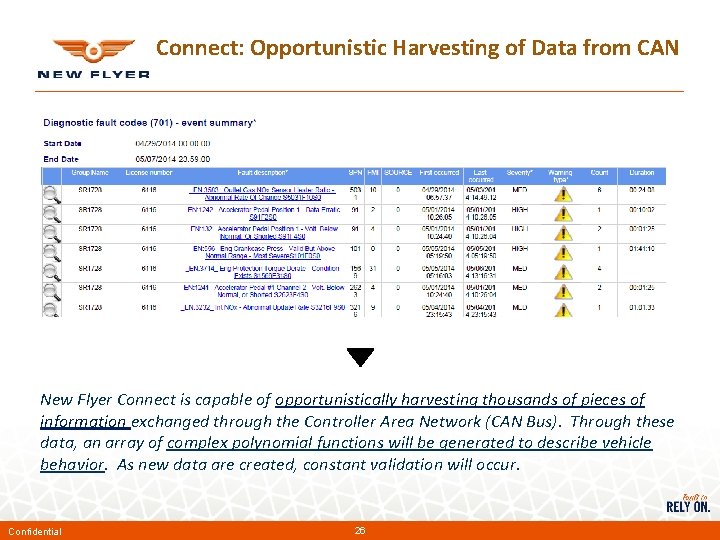
Connect: Opportunistic Harvesting of Data from CAN New Flyer Connect is capable of opportunistically harvesting thousands of pieces of information exchanged through the Controller Area Network (CAN Bus). Through these data, an array of complex polynomial functions will be generated to describe vehicle behavior. As new data are created, constant validation will occur. Confidential 26

Milestones and Presentation Venue
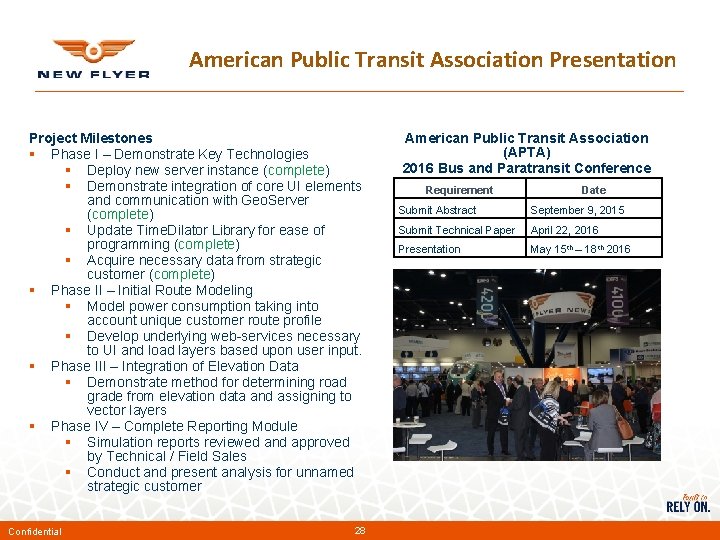
American Public Transit Association Presentation Project Milestones § Phase I – Demonstrate Key Technologies § Deploy new server instance (complete) § Demonstrate integration of core UI elements and communication with Geo. Server (complete) § Update Time. Dilator Library for ease of programming (complete) § Acquire necessary data from strategic customer (complete) § Phase II – Initial Route Modeling § Model power consumption taking into account unique customer route profile § Develop underlying web-services necessary to UI and load layers based upon user input. § Phase III – Integration of Elevation Data § Demonstrate method for determining road grade from elevation data and assigning to vector layers § Phase IV – Complete Reporting Module § Simulation reports reviewed and approved by Technical / Field Sales § Conduct and present analysis for unnamed strategic customer Confidential 28 American Public Transit Association (APTA) 2016 Bus and Paratransit Conference Requirement Date Submit Abstract September 9, 2015 Submit Technical Paper April 22, 2016 Presentation May 15 th – 18 th 2016

Thank you for attending our presentation
- Slides: 29