
E 1 Electrical Fundamentals 3 Meters Circuits Loads

- Slides: 53
E 1 – Electrical Fundamentals # 3 – Meters, Circuits, Loads and Switches © 2005 Refrigeration Training Services - E 1#3 Meters, Circuits, Loads & Switches v 1. 1
Meter Types • • Voltmeter – measures voltage Ohmmeter – measures resistance (ohms) Ammeter – measures current (amps) Multimeter – a combination meter that measures volts, ohms, & amps © 2005 Refrigeration Training Services - E 1#3 Meters, Circuits, Loads & Switches v 1. 1 2
Voltmeters • Measure electromotive force of a circuit in volts • Always set meter at the highest voltage scale to prevent meter damage • 1 Volt = 1, 000 millivolts (m. V) © 2005 Refrigeration Training Services - E 1#3 Meters, Circuits, Loads & Switches v 1. 1 3
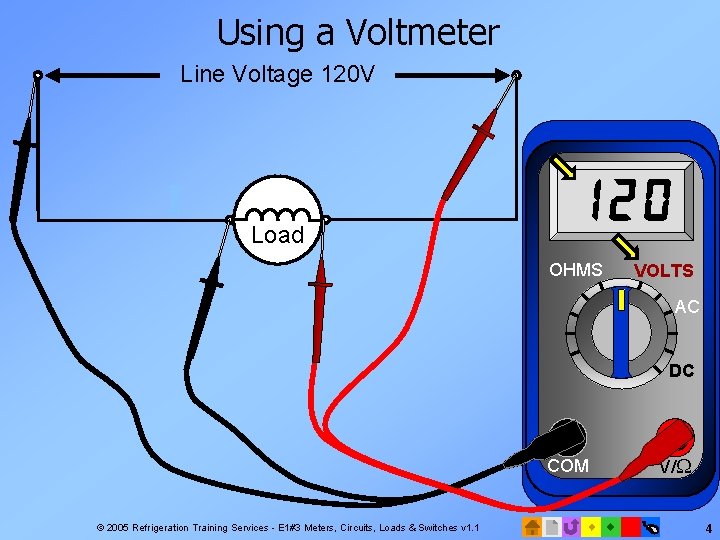
Using a Voltmeter Line Voltage 120 V Load OHMS VOLTS AC DC V/ COM © 2005 Refrigeration Training Services - E 1#3 Meters, Circuits, Loads & Switches v 1. 1 4
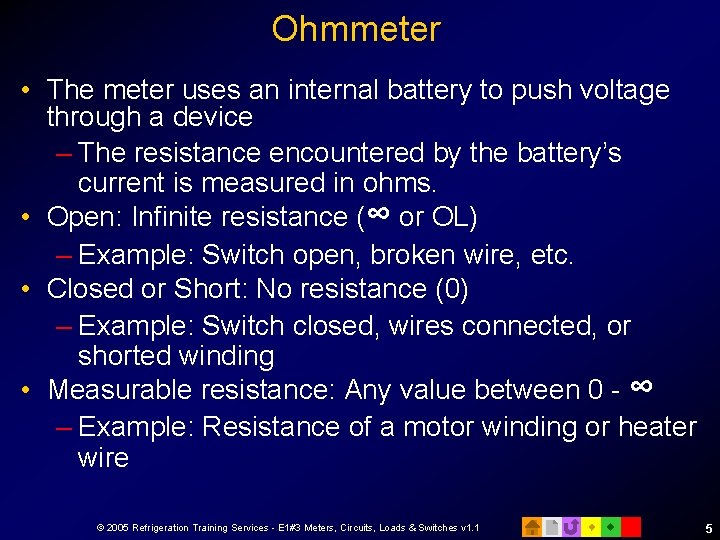
Ohmmeter • The meter uses an internal battery to push voltage through a device – The resistance encountered by the battery’s current is measured in ohms. • Open: Infinite resistance (∞ or OL) – Example: Switch open, broken wire, etc. • Closed or Short: No resistance (0) – Example: Switch closed, wires connected, or shorted winding • Measurable resistance: Any value between 0 - ∞ – Example: Resistance of a motor winding or heater wire © 2005 Refrigeration Training Services - E 1#3 Meters, Circuits, Loads & Switches v 1. 1 5
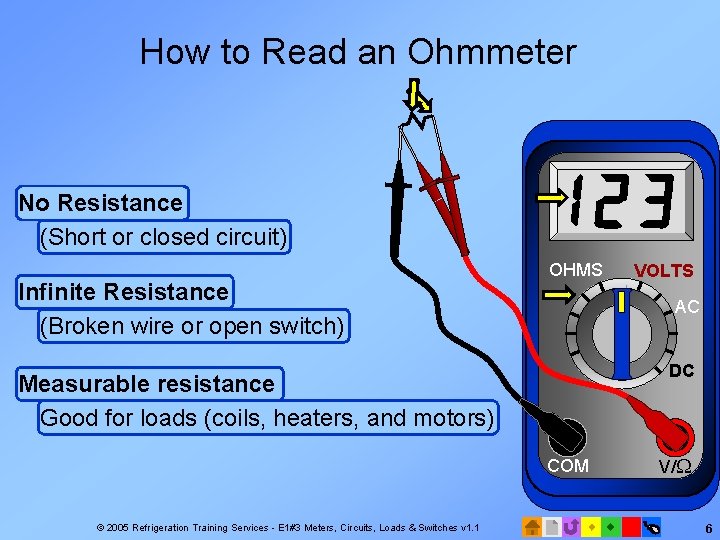
How to Read an Ohmmeter No Resistance (Short or closed circuit) Infinite Resistance (Broken wire or open switch) OHMS VOLTS AC DC Measurable resistance Good for loads (coils, heaters, and motors) V/ COM © 2005 Refrigeration Training Services - E 1#3 Meters, Circuits, Loads & Switches v 1. 1 6
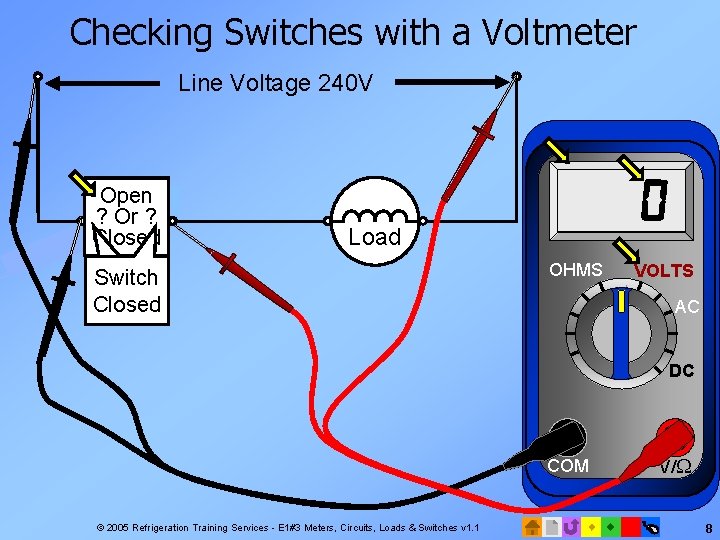
Using a voltmeter to check switch contacts • Checking switches with power on the circuit • The voltmeter can show whether they are open or closed © 2005 Refrigeration Training Services - E 1#3 Meters, Circuits, Loads & Switches v 1. 1 7
Checking Switches with a Voltmeter Line Voltage 240 V h witc SOpen Switch ? Or ? Closed Load Switch Closed Open OHMS VOLTS AC DC V/ COM © 2005 Refrigeration Training Services - E 1#3 Meters, Circuits, Loads & Switches v 1. 1 8 Swi tch
Checking for “Continuity” • Determine if the wiring within a load is continuous – Example: Checking a resistance heater © 2005 Refrigeration Training Services - E 1#3 Meters, Circuits, Loads & Switches v 1. 1 9
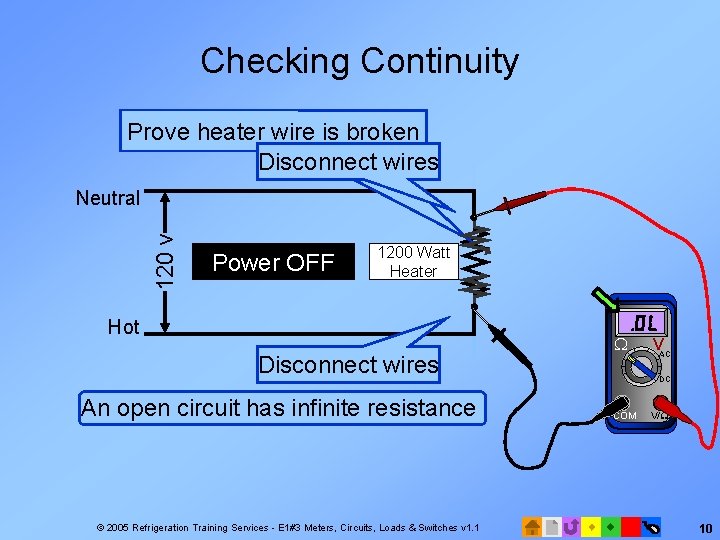
Checking Continuity Prove heater wire is broken Disconnect wires 120 v Neutral Power OFF 1200 Watt Heater Hot Disconnect wires DC An open circuit has infinite resistance © 2005 Refrigeration Training Services - E 1#3 Meters, Circuits, Loads & Switches v 1. 1 VAC COM V/ 10
Ammeters (Amp Meters) • Current flow creates a magnetic field • Ammeters measure the intensity of the field © 2005 Refrigeration Training Services - E 1#3 Meters, Circuits, Loads & Switches v 1. 1 11
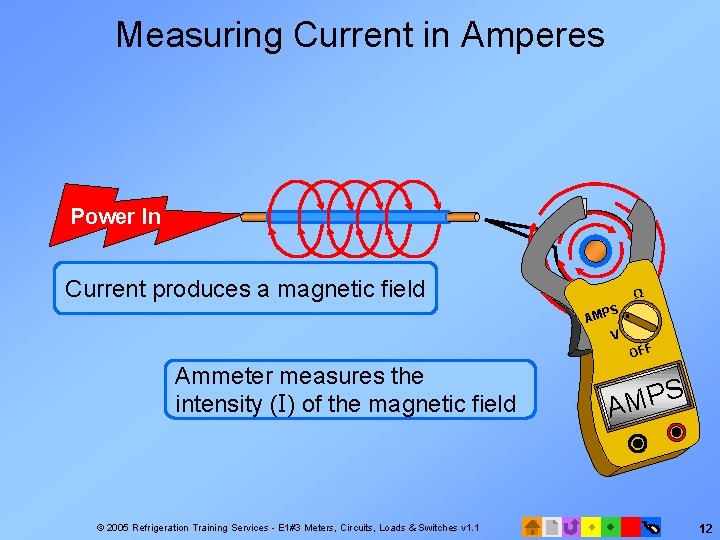
Measuring Current in Amperes Power In Current produces a magnetic field Ω S AMP V Ammeter measures the intensity (I) of the magnetic field © 2005 Refrigeration Training Services - E 1#3 Meters, Circuits, Loads & Switches v 1. 1 OFF S P M A 12
Using an Ammeter • Current intensity is measured in amperes – 1 Amp = 1, 000 milliamps (m. A) • Most common ammeter is a “Clamp-on” type – Meter jaws must encircle only one wire © 2005 Refrigeration Training Services - E 1#3 Meters, Circuits, Loads & Switches v 1. 1 13
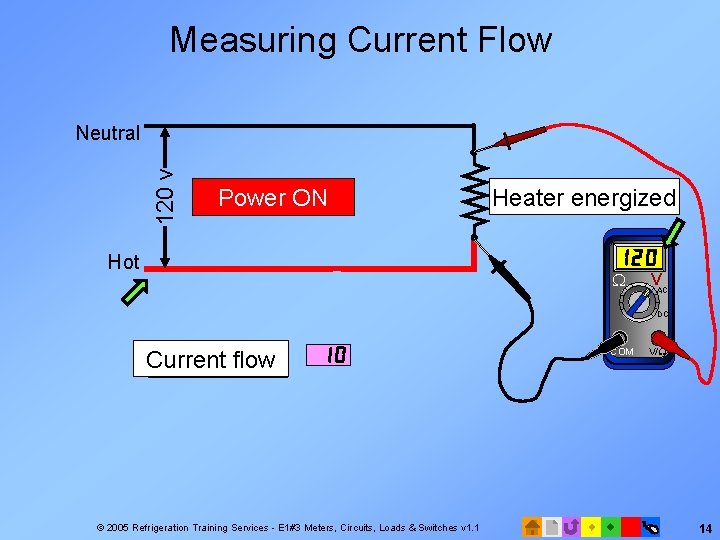
Measuring Current Flow 120 v Neutral Power. OFF ON Heater energized Hot VAC DC COM Current flow No current © 2005 Refrigeration Training Services - E 1#3 Meters, Circuits, Loads & Switches v 1. 1 V/ 14
Determining Circuit Resistance • An ohmmeter measures resistance • Ohm’s law calculates resistance • Measuring and calculating work together © 2005 Refrigeration Training Services - E 1#3 Meters, Circuits, Loads & Switches v 1. 1 15
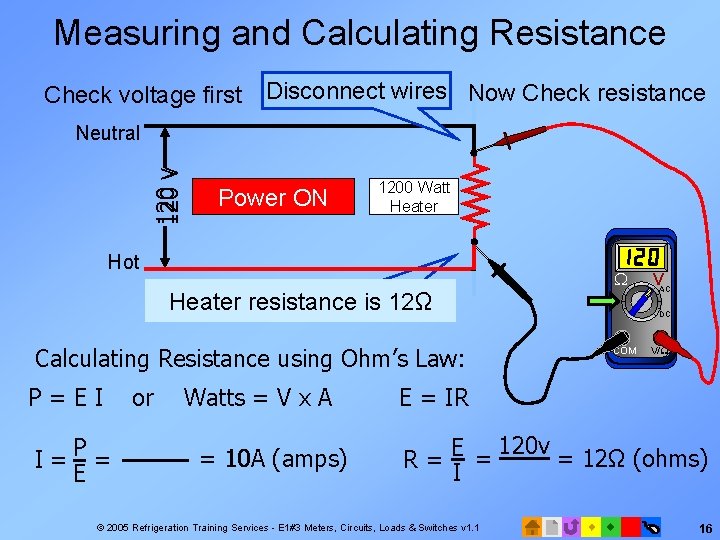
Measuring and Calculating Resistance Check voltage first Disconnect wires Now Check resistance 120 v Neutral Power. OFF ON 1200 Watt 1200 W Heater Hot Heater resistance is 12Ω Disconnect wires DC Calculating Resistance using Ohm’s Law: P=EI I=P = E or Watts = V x A = 10 A (amps) VAC COM V/ E = IR 120 v = 12Ω (ohms) R=E = I © 2005 Refrigeration Training Services - E 1#3 Meters, Circuits, Loads & Switches v 1. 1 16
Series Circuit • Only one path for electrons to flow. • Current must be able to go through one device before it can go to the next device. © 2005 Refrigeration Training Services - E 1#3 Meters, Circuits, Loads & Switches v 1. 1 17
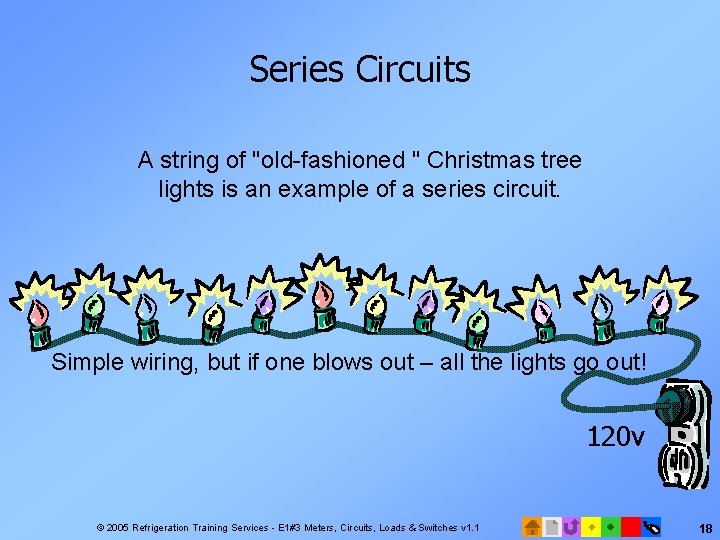
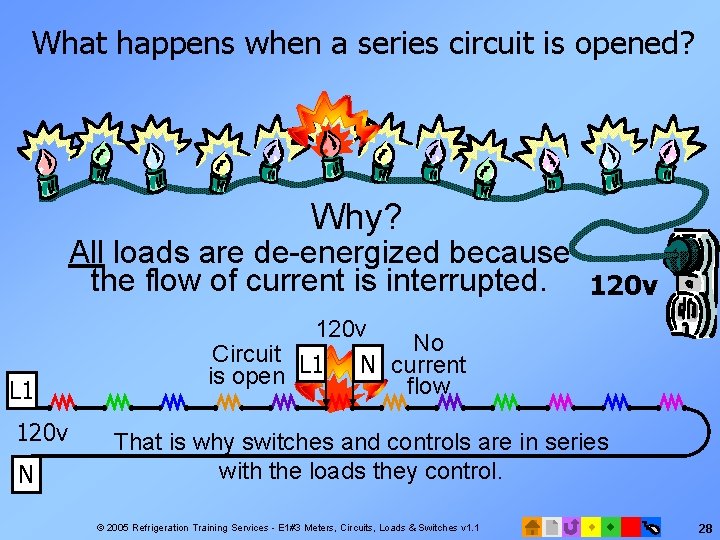
Series Circuits A string of "old-fashioned " Christmas tree lights is an example of a series circuit. Simple wiring, but if one blows out – all the lights go out! 120 v © 2005 Refrigeration Training Services - E 1#3 Meters, Circuits, Loads & Switches v 1. 1 18
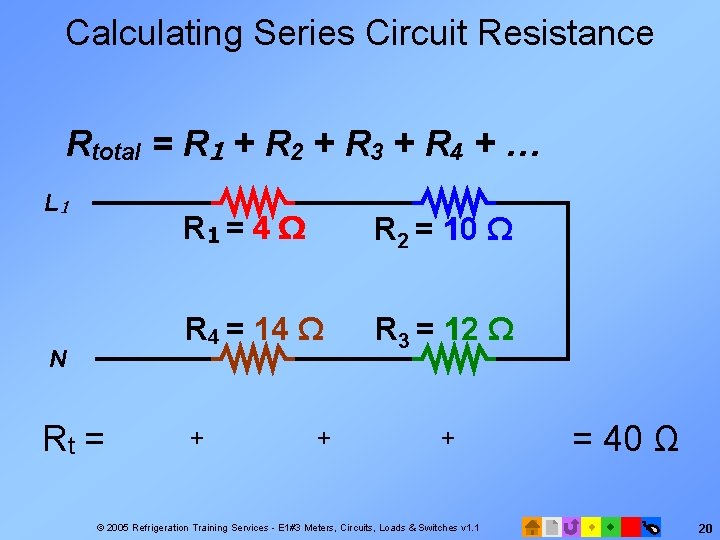
Resistance in Series Circuits • The more loads in a series circuit, the more resistance in the circuit • Total resistance is the sum of all the resistances in the circuit © 2005 Refrigeration Training Services - E 1#3 Meters, Circuits, Loads & Switches v 1. 1 19
Calculating Series Circuit Resistance Rtotal = R 1 + R 2 + R 3 + R 4 + … L 1 N Rt = R 1 = 4 Ω R 2 = 10 Ω R 4 = 14 Ω R 3 = 12 Ω + + + © 2005 Refrigeration Training Services - E 1#3 Meters, Circuits, Loads & Switches v 1. 1 = 40 Ω 20
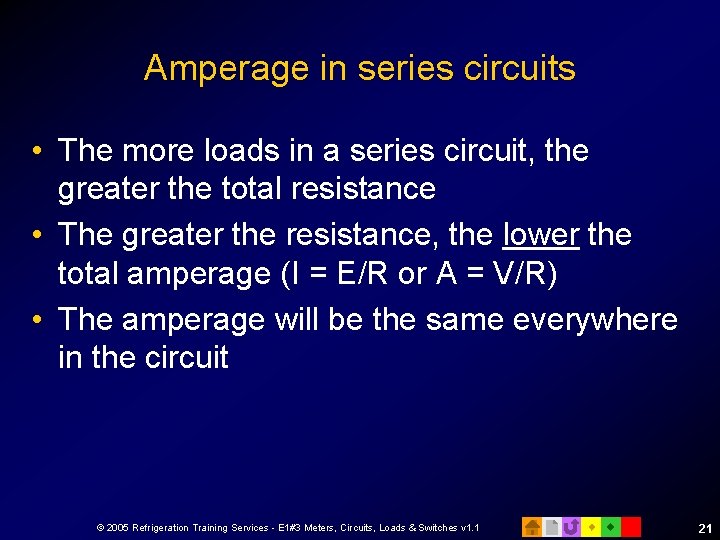
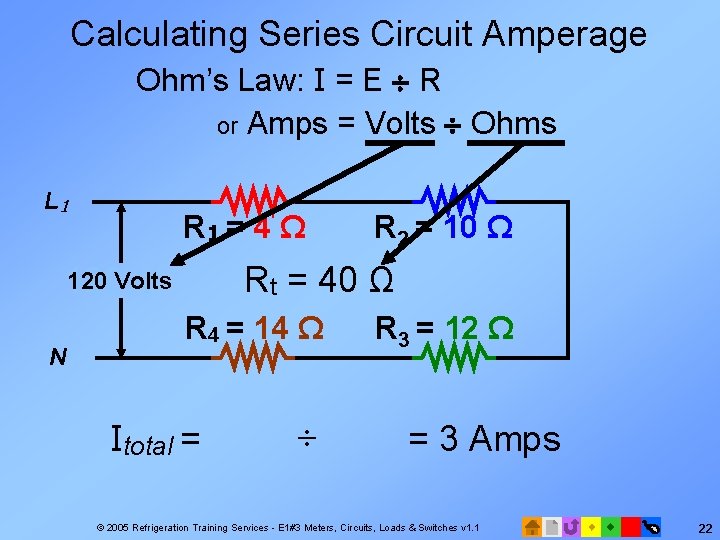
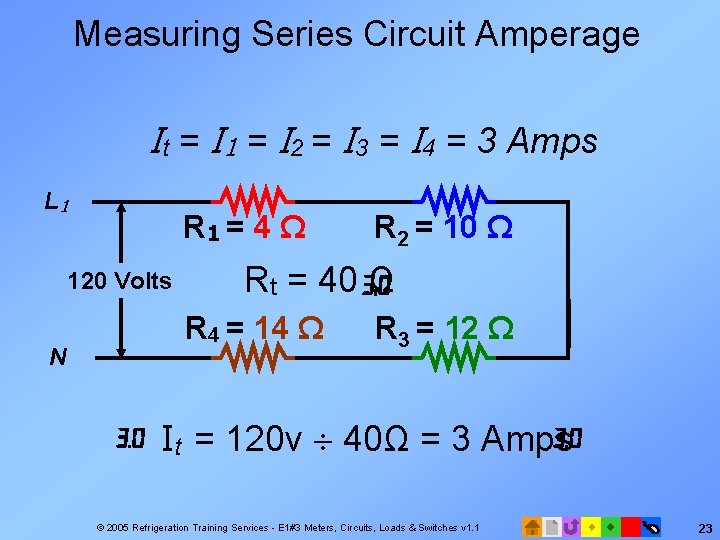
Amperage in series circuits • The more loads in a series circuit, the greater the total resistance • The greater the resistance, the lower the total amperage (I = E/R or A = V/R) • The amperage will be the same everywhere in the circuit © 2005 Refrigeration Training Services - E 1#3 Meters, Circuits, Loads & Switches v 1. 1 21
Calculating Series Circuit Amperage Ohm’s Law: I = E R or Amps = Volts Ohms L 1 R 1 = 4 Ω Rt = 40 Ω 120 Volts 120 V N R 2 = 10 Ω R 4 = 14 Ω Itotal = R 3 = 12 Ω = 3 Amps © 2005 Refrigeration Training Services - E 1#3 Meters, Circuits, Loads & Switches v 1. 1 22
Measuring Series Circuit Amperage It = I 1 = I 2 = I 3 = I 4 = 3 Amps L 1 R 1 = 4 Ω 120 Volts N R 2 = 10 Ω Rt = 40 Ω R 4 = 14 Ω R 3 = 12 Ω It = 120 v 40Ω = 3 Amps © 2005 Refrigeration Training Services - E 1#3 Meters, Circuits, Loads & Switches v 1. 1 23
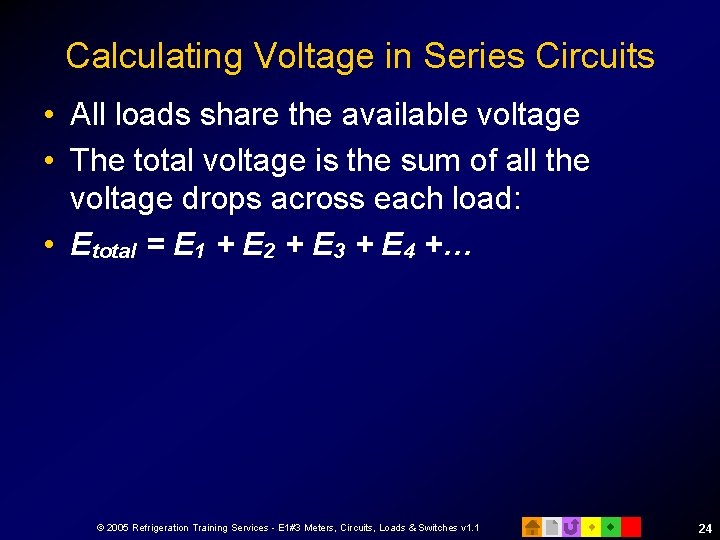
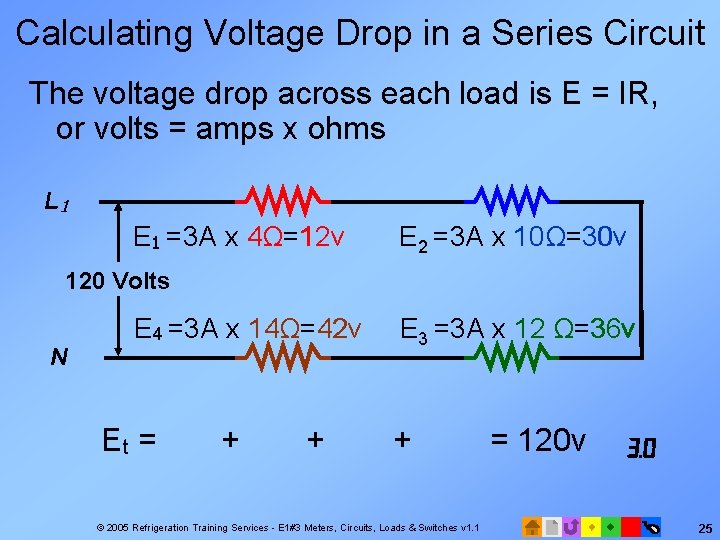
Calculating Voltage in Series Circuits • All loads share the available voltage • The total voltage is the sum of all the voltage drops across each load: • Etotal = E 1 + E 2 + E 3 + E 4 +… © 2005 Refrigeration Training Services - E 1#3 Meters, Circuits, Loads & Switches v 1. 1 24
Calculating Voltage Drop in a Series Circuit The voltage drop across each load is E = IR, or volts = amps x ohms L 1 E 1 =3 A x 4Ω=12 v E 2 =3 A x 10Ω=30 v 120 Volts N E 4 =3 A x 14Ω=42 v Et = + + E 3 =3 A x 12 Ω=36 v + © 2005 Refrigeration Training Services - E 1#3 Meters, Circuits, Loads & Switches v 1. 1 = 120 v 25
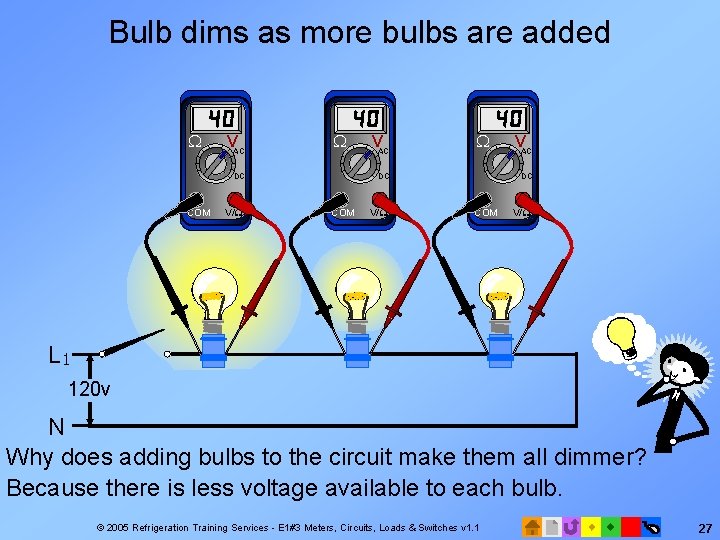
Measuring Voltage in Series Circuits • All loads share the available voltage • The voltage of each load drops as more loads are added © 2005 Refrigeration Training Services - E 1#3 Meters, Circuits, Loads & Switches v 1. 1 26
Bulb dims as more bulbs are added VAC DC COM V/ L 1 120 v N Why does adding bulbs to the circuit make them all dimmer? Because there is less voltage available to each bulb. © 2005 Refrigeration Training Services - E 1#3 Meters, Circuits, Loads & Switches v 1. 1 27
What happens when a series circuit is opened? Why? All loads are de-energized because the flow of current is interrupted. 120 v L 1 120 v No Circuit L 1 N current is open flow That is why switches and controls are in series with the loads they control. © 2005 Refrigeration Training Services - E 1#3 Meters, Circuits, Loads & Switches v 1. 1 28
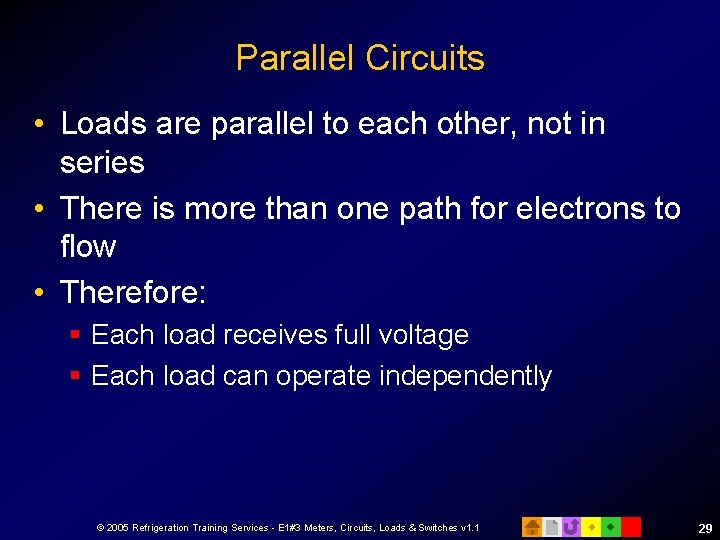
Parallel Circuits • Loads are parallel to each other, not in series • There is more than one path for electrons to flow • Therefore: § Each load receives full voltage § Each load can operate independently © 2005 Refrigeration Training Services - E 1#3 Meters, Circuits, Loads & Switches v 1. 1 29
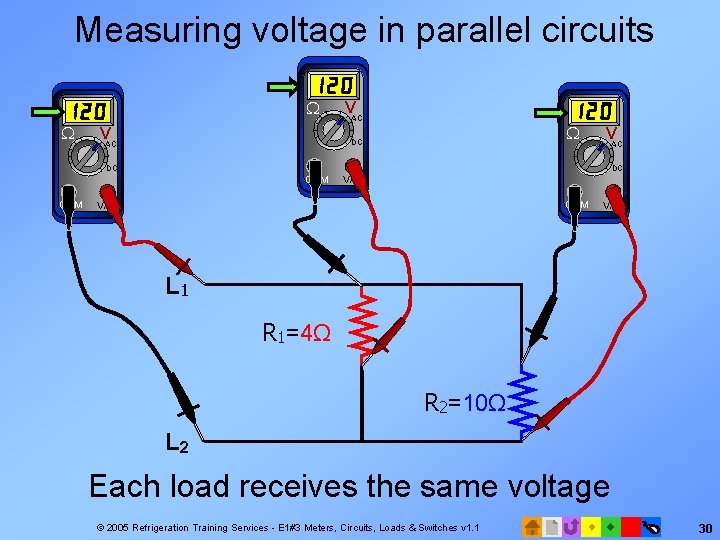
Measuring voltage in parallel circuits VAC DC DC COM V/ L 1 R 1=4Ω R 2=10Ω L 2 Each load receives the same voltage © 2005 Refrigeration Training Services - E 1#3 Meters, Circuits, Loads & Switches v 1. 1 30
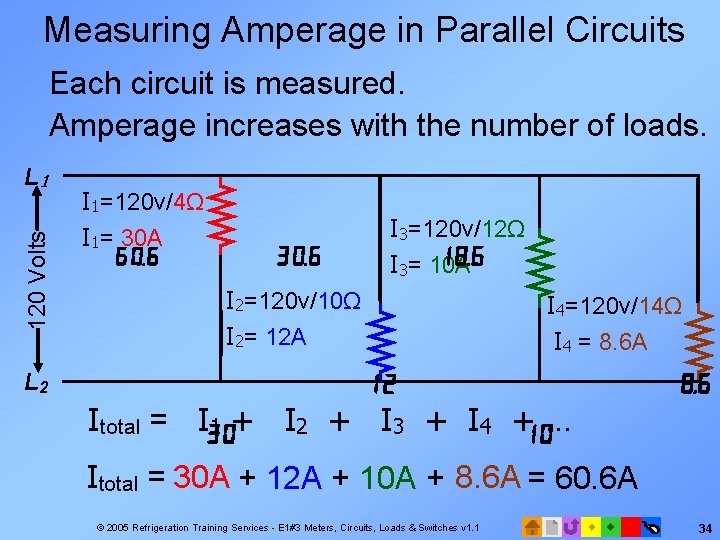
Amperage in Parallel Circuits • The resistance of each load determines the amperage of each circuit • Additional loads increase total amperage © 2005 Refrigeration Training Services - E 1#3 Meters, Circuits, Loads & Switches v 1. 1 31
Calculating Amperage in Parallel Circuits E = IR I =E R Amps = Volts Ohms 120 Volts L 1 I 1=120 v/4Ω I 1= 30 A I 3=120 v/12Ω I 3= 10 A I 2=120 v/10Ω I 2= 12 A I 4=120 v/14Ω I 4 = 8. 6 A L 2 Itotal = I 1 + I 2 + I 3 + I 4 + … Itotal = + + + © 2005 Refrigeration Training Services - E 1#3 Meters, Circuits, Loads & Switches v 1. 1 = 60. 6 A 32
Measuring Amperage in Parallel Circuits • An ammeter Þ Measures each circuit Þ Also verifies total amperage © 2005 Refrigeration Training Services - E 1#3 Meters, Circuits, Loads & Switches v 1. 1 33
Measuring Amperage in Parallel Circuits Each circuit is measured. Amperage increases with the number of loads. 120 Volts L 1 I 1=120 v/4Ω I 1= 30 A I 3=120 v/12Ω I 3= 10 A I 2=120 v/10Ω I 2= 12 A I 4=120 v/14Ω I 4 = 8. 6 A L 2 Itotal = I 1 + I 2 + I 3 + I 4 + … Itotal = 30 A + 12 A + 10 A + 8. 6 A = 60. 6 A © 2005 Refrigeration Training Services - E 1#3 Meters, Circuits, Loads & Switches v 1. 1 34
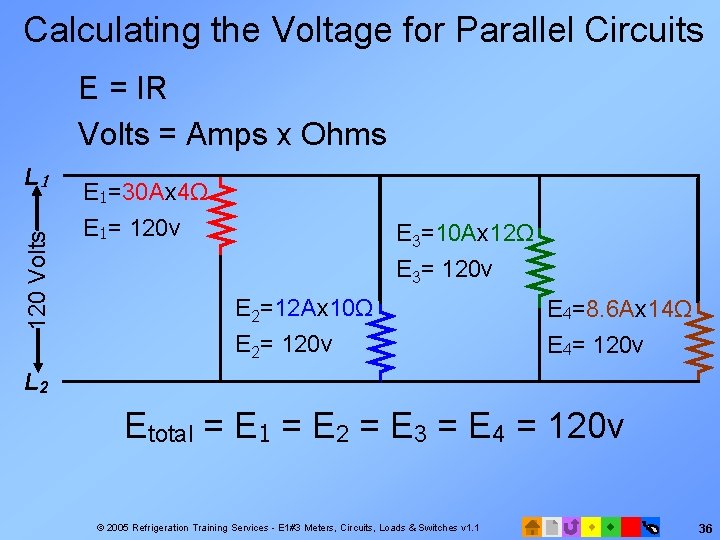
Calculating Voltage in Parallel Circuits • The voltage can be calculated, if the amperage and resistance are known • In parallel circuits the voltage is the same throughout the circuits © 2005 Refrigeration Training Services - E 1#3 Meters, Circuits, Loads & Switches v 1. 1 35
Calculating the Voltage for Parallel Circuits E = IR Volts = Amps x Ohms 120 Volts L 1 E 1=30 Ax 4Ω E 1= 120 v E 3=10 Ax 12Ω E 3= 120 v E 2=12 Ax 10Ω E 2= 120 v E 4=8. 6 Ax 14Ω E 4= 120 v L 2 Etotal = E 1 = E 2 = E 3 = E 4 = 120 v © 2005 Refrigeration Training Services - E 1#3 Meters, Circuits, Loads & Switches v 1. 1 36
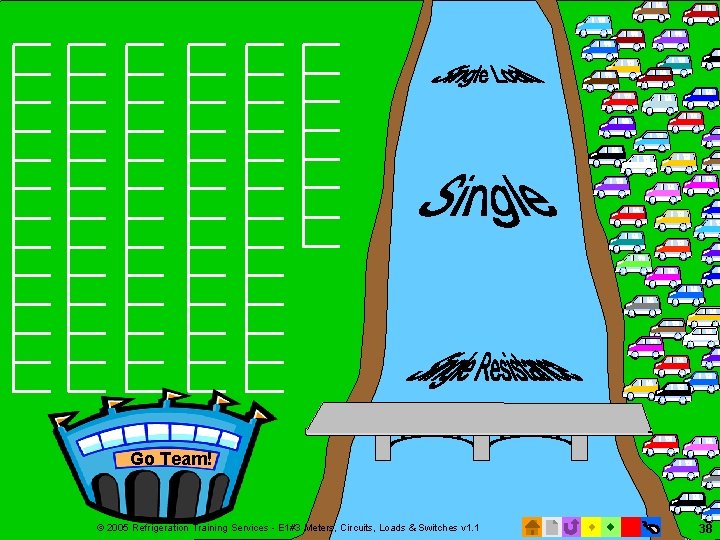
Single Load Resistance in a Parallel Circuit • One load provides the only path for current flow • Its resistance is the total circuit resistance • The following slide compares resistance to crossing a river: – Resistance is the open space between the shores – Cars represent electrons – Bridges represent loads © 2005 Refrigeration Training Services - E 1#3 Meters, Circuits, Loads & Switches v 1. 1 37
Single Load Go Team! © 2005 Refrigeration Training Services - E 1#3 Meters, Circuits, Loads & Switches v 1. 1 38
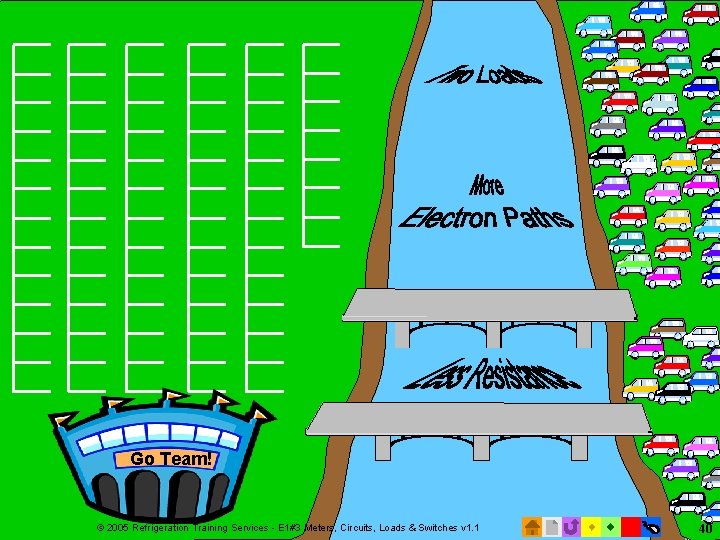
Two Loads in a Parallel Circuit • Two loads provide two paths for electrons • More total current flow than a single circuit • The total resistance is less than that for a single load © 2005 Refrigeration Training Services - E 1#3 Meters, Circuits, Loads & Switches v 1. 1 39
Two Loads Go Team! © 2005 Refrigeration Training Services - E 1#3 Meters, Circuits, Loads & Switches v 1. 1 40
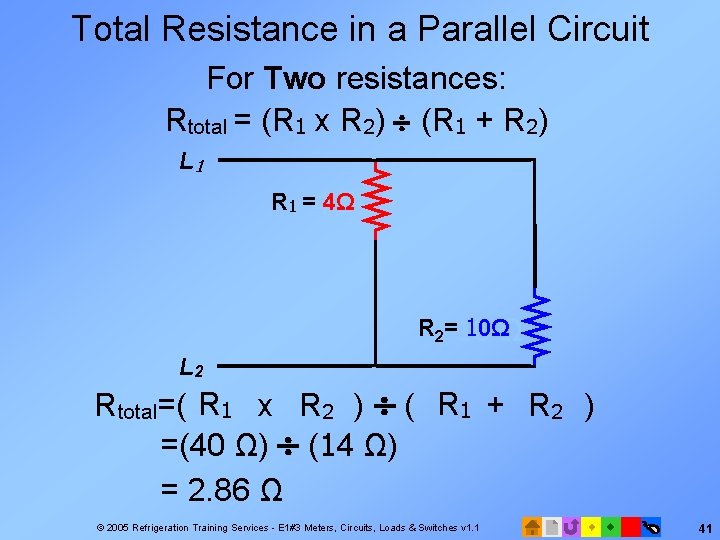
Total Resistance in a Parallel Circuit For Two resistances: Rtotal = (R 1 x R 2) (R 1 + R 2) L 1 R 1 =44Ω Ω R 2=10 10ΩΩ L 2 Rtotal=( R 1 x R 2 ) ( R 1 + R 2 ) =(40 Ω) (14 Ω) = 2. 86 Ω © 2005 Refrigeration Training Services - E 1#3 Meters, Circuits, Loads & Switches v 1. 1 41
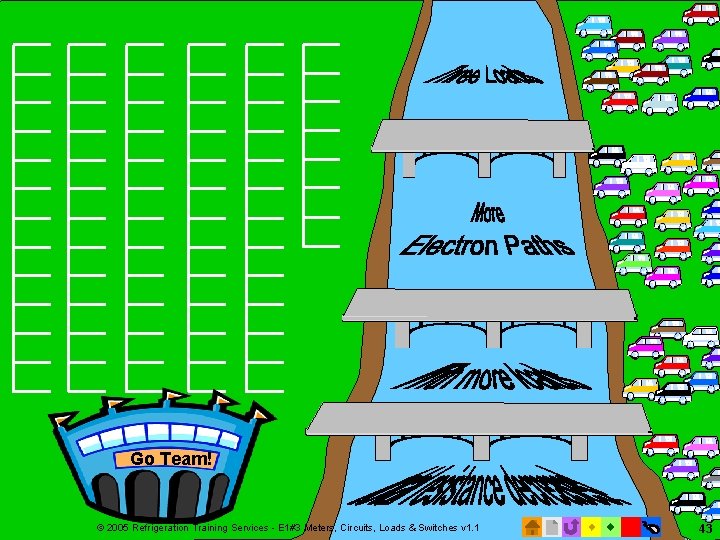
Three Loads in a Parallel Circuit • Three loads provide three paths for electrons • More total current flow than with one or two circuits • Because the total resistance is less than with only one or two loads – The total resistance decreases as the number of loads increase © 2005 Refrigeration Training Services - E 1#3 Meters, Circuits, Loads & Switches v 1. 1 42
Three Loads Go Team! © 2005 Refrigeration Training Services - E 1#3 Meters, Circuits, Loads & Switches v 1. 1 43
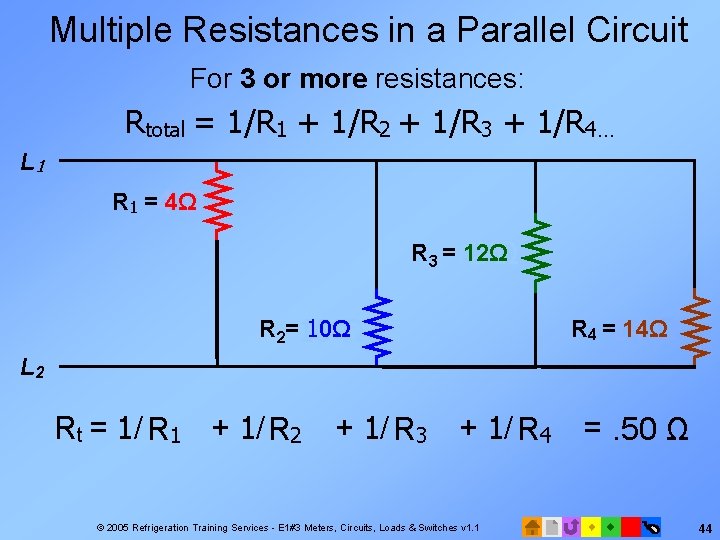
Multiple Resistances in a Parallel Circuit For 3 or more resistances: Rtotal = 1/R 1 + 1/R 2 + 1/R 3 + 1/R 4… L 1 R 1 =44Ω Ω R 3 =12 12Ω Ω R 2=10 10ΩΩ R 4 =14 14Ω Ω L 2 Rt = 1/ R 1 + 1/ R 2 + 1/ R 3 + 1/ R 4 =. 50 Ω © 2005 Refrigeration Training Services - E 1#3 Meters, Circuits, Loads & Switches v 1. 1 44
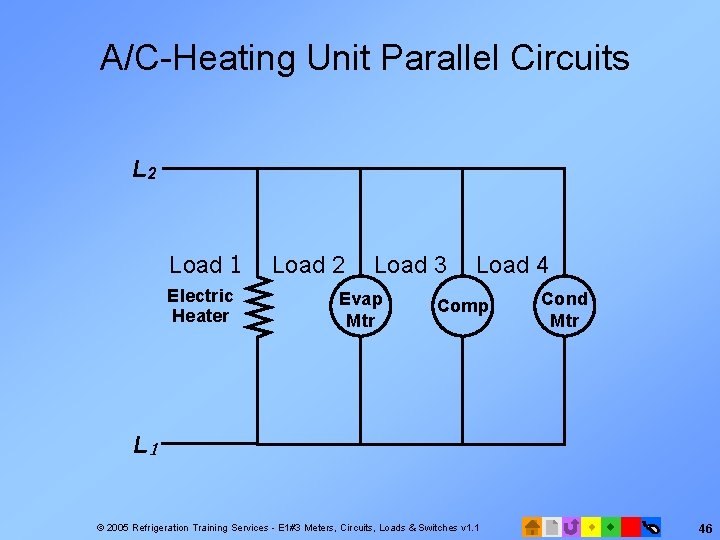
Simple Diagram of Parallel Circuits • The following slide shows how the loads in an air conditioning unit with electric heat might be sketched into a simple diagram © 2005 Refrigeration Training Services - E 1#3 Meters, Circuits, Loads & Switches v 1. 1 45
A/C-Heating Unit Parallel Circuits L 2 Load 1 Electric Heater Load 2 Load 3 Evap Mtr Load 4 Comp Cond Mtr L 1 © 2005 Refrigeration Training Services - E 1#3 Meters, Circuits, Loads & Switches v 1. 1 46
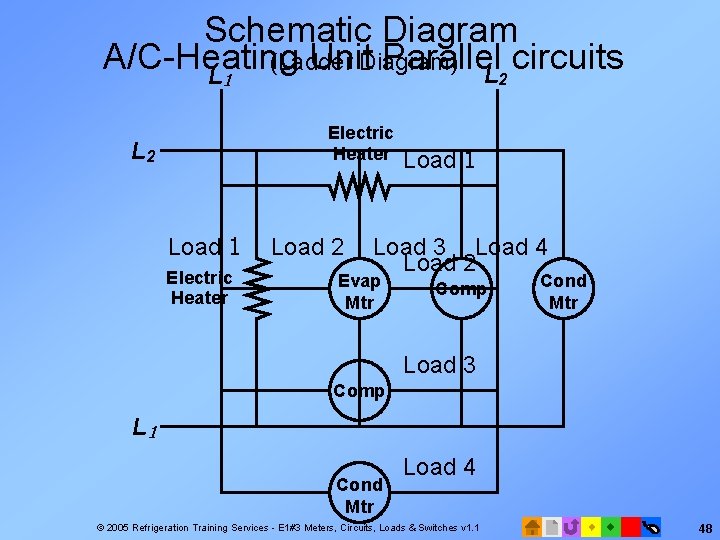
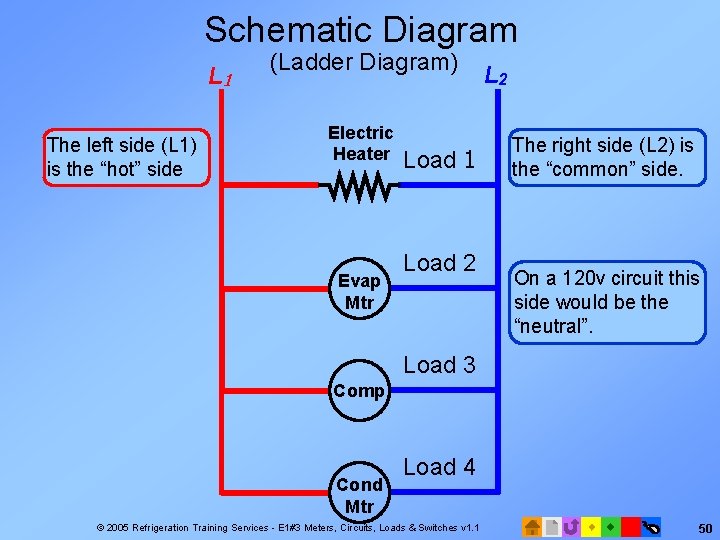
Diagram Development • A schematic diagram is also called a “ladder diagram” • The rungs of the ladder are parallel circuits © 2005 Refrigeration Training Services - E 1#3 Meters, Circuits, Loads & Switches v 1. 1 47
Schematic Diagram A/C-Heating Unit. Diagram) Parallel circuits (Ladder L 2 L 1 Electric Heater L 2 Load 1 Electric Heater Load 2 Load 1 Load 3 Load 4 Load 2 Evap Mtr Comp Cond Mtr Load 3 Comp L 1 Cond Mtr Load 4 © 2005 Refrigeration Training Services - E 1#3 Meters, Circuits, Loads & Switches v 1. 1 48
Diagram Set-Up • The left side is usually considered the main power • The right side is usually considered common © 2005 Refrigeration Training Services - E 1#3 Meters, Circuits, Loads & Switches v 1. 1 49
Schematic Diagram L 1 The left side (L 1) is the “hot” side (Ladder Diagram) Electric Heater Evap Mtr Load 1 Load 2 L 2 The right side (L 2) is the “common” side. On a 120 v circuit this side would be the “neutral”. Load 3 Comp Cond Mtr Load 4 © 2005 Refrigeration Training Services - E 1#3 Meters, Circuits, Loads & Switches v 1. 1 50
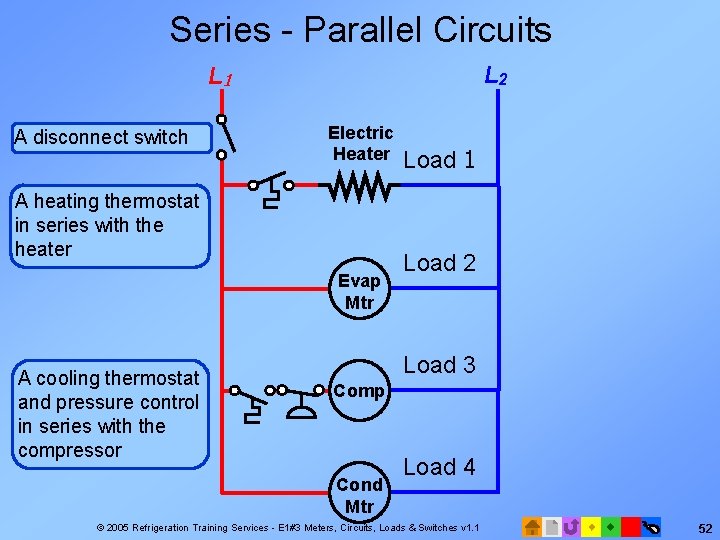
Series – Parallel Circuits • Controls and switches are in series with loads • An open switch stops current to any load in that one circuit • A disconnect switch in the main power line stops current to all circuits after it © 2005 Refrigeration Training Services - E 1#3 Meters, Circuits, Loads & Switches v 1. 1 51
Series - Parallel Circuits L 2 L 1 A disconnect switch Electric Heater A heating thermostat in series with the heater Evap Mtr A cooling thermostat and pressure control in series with the compressor Load 1 Load 2 Load 3 Comp Cond Mtr Load 4 © 2005 Refrigeration Training Services - E 1#3 Meters, Circuits, Loads & Switches v 1. 1 52
© 2005 Refrigeration Training Services - E 1#3 Meters, Circuits, Loads & Switches v 1. 1 53