
Dystopian Inspiration 1 Question Research Task In 1898
- Slides: 6
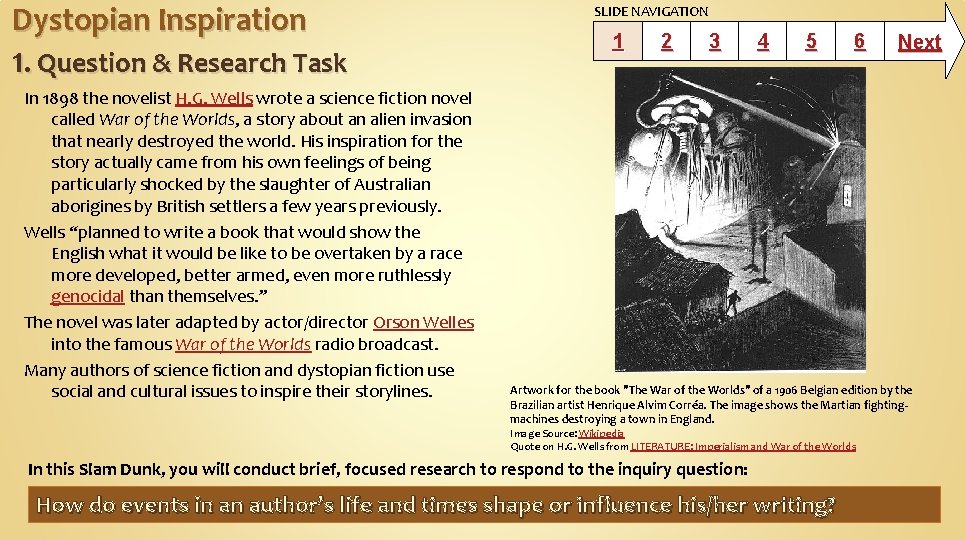
Dystopian Inspiration 1. Question & Research Task In 1898 the novelist H. G. Wells wrote a science fiction novel called War of the Worlds, a story about an alien invasion that nearly destroyed the world. His inspiration for the story actually came from his own feelings of being particularly shocked by the slaughter of Australian aborigines by British settlers a few years previously. Wells “planned to write a book that would show the English what it would be like to be overtaken by a race more developed, better armed, even more ruthlessly genocidal than themselves. ” The novel was later adapted by actor/director Orson Welles into the famous War of the Worlds radio broadcast. Many authors of science fiction and dystopian fiction use social and cultural issues to inspire their storylines. SLIDE NAVIGATION 1 2 3 4 5 6 Next Artwork for the book "The War of the Worlds" of a 1906 Belgian edition by the Brazilian artist Henrique Alvim Corréa. The image shows the Martian fightingmachines destroying a town in England. Image Source: Wikipedia Quote on H. G. Wells from LITERATURE: Imperialism and War of the Worlds In this Slam Dunk, you will conduct brief, focused research to respond to the inquiry question: How do events in an author’s life and times shape or influence his/her writing?
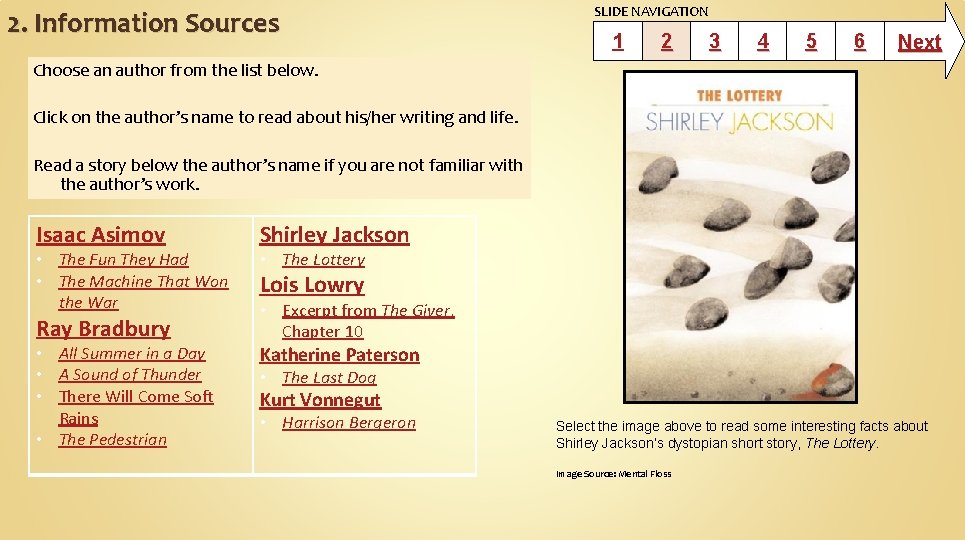
2. Information Sources SLIDE NAVIGATION 1 2 3 4 5 6 Next Choose an author from the list below. Click on the author’s name to read about his/her writing and life. Read a story below the author’s name if you are not familiar with the author’s work. Isaac Asimov • The Fun They Had • The Machine That Won the War Ray Bradbury • All Summer in a Day • A Sound of Thunder • There Will Come Soft Rains • The Pedestrian Shirley Jackson • The Lottery Lois Lowry • Excerpt from The Giver, Chapter 10 Katherine Paterson • The Last Dog Kurt Vonnegut • Harrison Bergeron Select the image above to read some interesting facts about Shirley Jackson’s dystopian short story, The Lottery. Image Source: Mental Floss
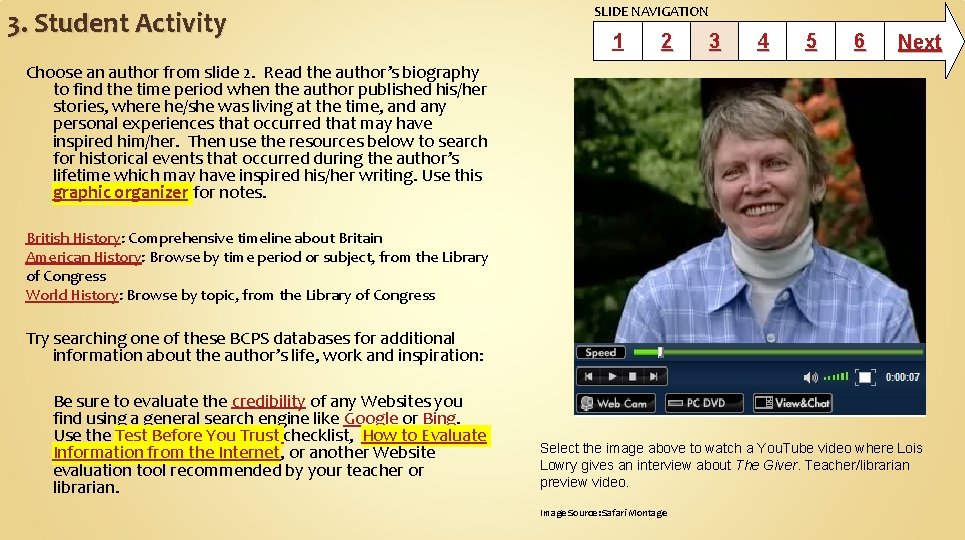
3. Student Activity SLIDE NAVIGATION 1 2 3 4 5 6 Next Choose an author from slide 2. Read the author’s biography to find the time period when the author published his/her stories, where he/she was living at the time, and any personal experiences that occurred that may have inspired him/her. Then use the resources below to search for historical events that occurred during the author’s lifetime which may have inspired his/her writing. Use this graphic organizer for notes. British History: Comprehensive timeline about Britain American History: Browse by time period or subject, from the Library of Congress World History: Browse by topic, from the Library of Congress Try searching one of these BCPS databases for additional information about the author’s life, work and inspiration: Be sure to evaluate the credibility of any Websites you find using a general search engine like Google or Bing. Use the Test Before You Trust checklist, How to Evaluate Information from the Internet, or another Website evaluation tool recommended by your teacher or librarian. Select the image above to watch a You. Tube video where Lois Lowry gives an interview about The Giver. Teacher/librarian preview video. Image Source: Safari Montage
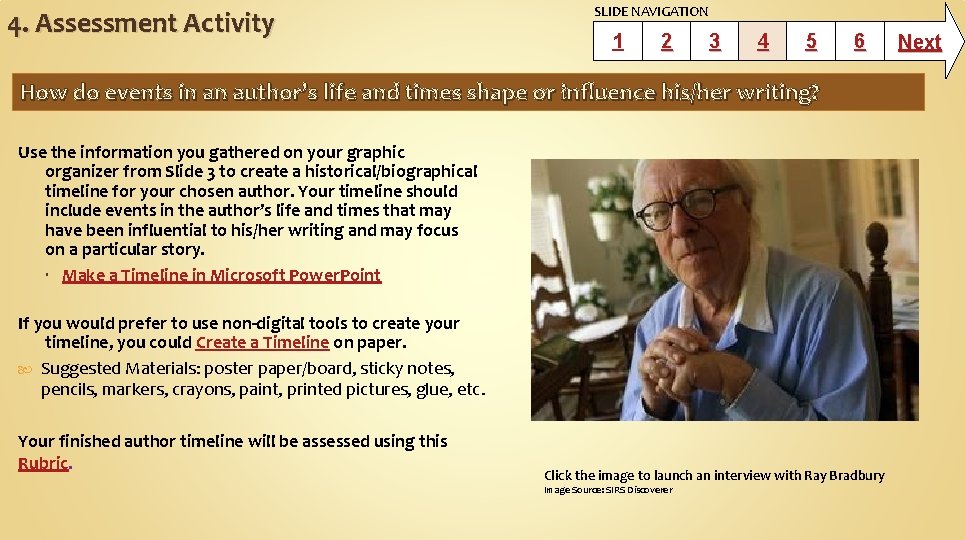
4. Assessment Activity SLIDE NAVIGATION 1 2 3 4 5 6 How do events in an author’s life and times shape or influence his/her writing? Use the information you gathered on your graphic organizer from Slide 3 to create a historical/biographical timeline for your chosen author. Your timeline should include events in the author’s life and times that may have been influential to his/her writing and may focus on a particular story. Make a Timeline in Microsoft Power. Point If you would prefer to use non-digital tools to create your timeline, you could Create a Timeline on paper. Suggested Materials: poster paper/board, sticky notes, pencils, markers, crayons, paint, printed pictures, glue, etc. Your finished author timeline will be assessed using this Rubric. Click the image to launch an interview with Ray Bradbury Image Source: SIRS Discoverer Next
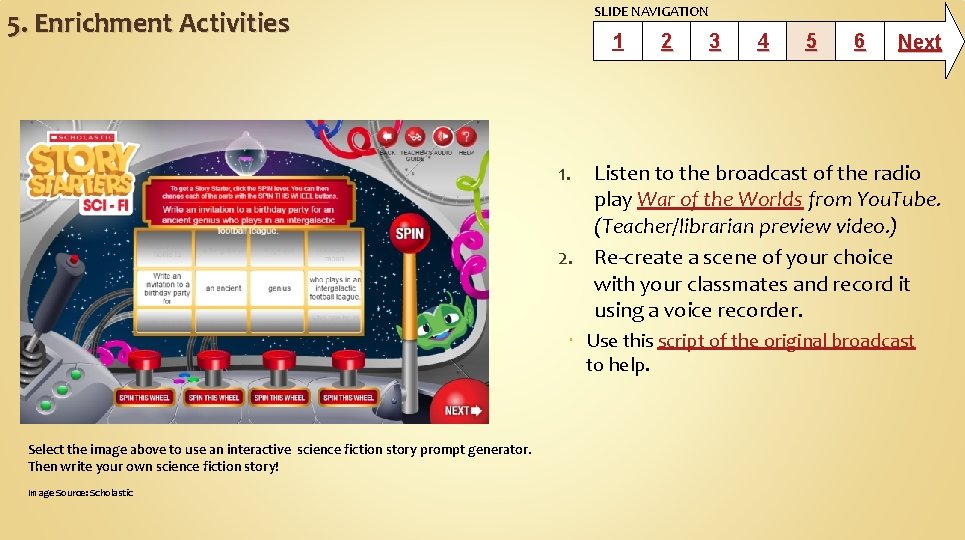
SLIDE NAVIGATION 5. Enrichment Activities 1 2 3 4 5 6 Next 1. Listen to the broadcast of the radio play War of the Worlds from You. Tube. (Teacher/librarian preview video. ) 2. Re-create a scene of your choice with your classmates and record it using a voice recorder. Use this script of the original broadcast to help. Select the image above to use an interactive science fiction story prompt generator. Then write your own science fiction story! Image Source: Scholastic
6. Teacher Resources Content Specific Standards RI 6. 2 Determine a central idea of a text and how it is conveyed through particular details; provide a summary of the text distinct from personal opinions or judgments. RI 6. 7 Integrate information presented in different media or formats (e. g. , visually, quantitatively) as well as in words to develop a coherent understanding of a topic or issue. RL 6. 2 Determine a theme or central idea of a text and how it is conveyed through particular details; provide a summary of the text distinct from personal opinions or judgments. RL 6. 5 Analyze how a particular sentence, chapter, scene, or stanza fits into the overall structure of a text and contributes to the development of theme, setting, or plot. W 6. 2 Write informative/explanatory texts to examine a topic and convey ideas, concepts, and information through the selection, organization, and analysis of relevant content. Learning Standards Alignment Common Core State Standards for English Language Arts & Literacy Reading: 1. Read closely to determine what the text says explicitly and to make logical inferences from it; cite specific textual evidence when writing or speaking to support conclusions drawn from the text. Writing: 7. Conduct short as well as more sustained research projects based on focused questions, demonstrating understanding of the subject under investigation. AASL Standards Framework for Learners Inquire: Build new knowledge by inquiring, thinking critically, identifying problems, and developing strategies for solving problems. Think: Learners display curiosity and initiative by: I. A. 2 Recalling prior and background knowledge as context for new meaning. Create: Learners engage with new knowledge by following a process that includes: I. B. 1 Using evidence to investigate questions. I. B. 3 Generating products that illustrate learning. Share: Learners adapt, communicate, and exchange learning products with others in a cycle that includes: I. C. 1 Interacting with content presented by others. Grow: Learners participate in an ongoing inquiry-based process by: I. D. 2 Engaging in sustained inquiry. P 21 Framework: 21 st Century Student Outcomes 3. Information, Media & Technology Skills: Information Literacy: Access information efficiently and effectively; Use information accurately and creatively for the issue or problem at hand. ICT Literacy: Use technology as a tool to research, organize, evaluate and communicate information. SLIDE NAVIGATION 1 2 3 4 5 6 Grade 6 ELA – Advanced Academics Objective: Students will conduct brief, focused research in order to explain how events in an author’s life and time shaped or influenced his/her dystopian writing. Time Frame: Two or three 50 -minute class periods Differentiation strategies for this lesson: Have students use learning supports provided in any BCPSlicensed Digital Content included in this lesson. Refer to Digital Content Snapshots & Support resources for as needed. This Slam Dunk Lesson includes links to You. Tube videos. Teacher/librarian may screen videos for the class, or can provide student access via Safari or Voice. Thread. See: Safari Montage and You Tube Integration | Sharing You. Tube Videos with Safari Mont age | Voice. Thread and You. Tube Notes to the teacher: Collaborate with your school library media specialist to plan and implement this lesson. Last updated: August 2020 Report broken links to BCPS Library Media Programs & Digital Resources 443 -809 -4035 BCPS Slam Dunk Research Model, Copyright 2018, Baltimore County Public Schools, MD, all rights reserved. This lesson may be used for educational, non-profit school use only.