
Dystonia INTRODUCTION Julie Rope Objectives To have an
Dystonia INTRODUCTION – Julie Rope
Objectives • To have an understanding of the pathology of the origin of Dystonia • To understand the various classification/locations and potential causes of dystonia
• Symptom or diagnosis • Age location • "episodes" that last for minutes or hours, the terms paroxysmal dystonia and dyskinesias are used. • task-specific which means that the symptoms occur only when the person is performing a specific task or movement. These forms often involve the fingers and hands or the mouth. • Torsion refers to the twisting element of dystonia. It describes muscles contracting against each other.
Dystonia • Sustained muscle contractions that can cause involuntary twisting and repetitive movements resulting in abnormal postures that sometimes can be painful. The dystonia can be focal (involve only one area of the body) or may include many body parts. Treatments include oral medications, botulinum toxin injections and DBS. • A state of abnormal muscle tone resulting in muscular spasm and abnormal posture, typically due to neurological disease or a side effect of drug therapy. • The movements may resemble a tremor. • Dystonia is often initiated or worsened by voluntary movements, and symptoms may “overflow” into adjacent muscles.
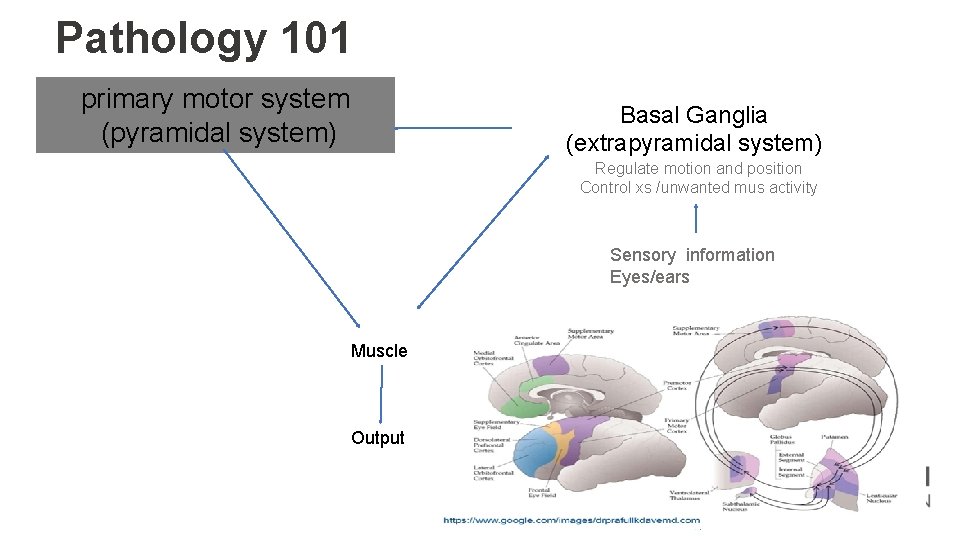
Pathology 101 primary motor system (pyramidal system) Basal Ganglia (extrapyramidal system) Regulate motion and position Control xs /unwanted mus activity Sensory information Eyes/ears Muscle Output
Dystonia is a brain circuit disorder • Basal Ganglia ORIGIN • Cerebellar function, sensory processing, motor inhibition, neuroplasticity and somatotopic cortical organisation but the pathology remain largely unclear • Cassidy A pathophysiology of idiopathic focal dystonia ACNR 2010 10 14 – 18 • Many parts of the BG • Many ways to arrive at dystonia • Distribution defines effect • Inherited dystonias come from changes in basic cell processes
‘PAM’ ‘Our muscles themselves are fine. They’re just receiving confusing instructions (“mis-transmissions”), like a mis-coached football team running around in senseless patterns, no offense or defence, as they fail to accomplish coordinated plays let alone score a touchdown! https: //dystoniamuse. com/
No inhibition… • No harmony. • deficient inhibition of the antagonist muscles. This can result in cocontraction, where the agonist and antagonist muscles contract together. • basal ganglia is to balance excitation and inhibition (just like a pair of scales). • It is not yet certain whether the problem is with the direct pathway, the indirect pathway or both - ultimately causes the co-contraction or overflow phenomena seen in dystonia. • ? shortage of the inhibitory neurotransmitter GABA. • At present this is a theory that remains unproven; however, one of the treatments for dystonia, which helps in some cases, is to prescribe medications that increase the quantity of GABA such as benzodiazepines, gabapentin or baclofen. • Courtesy of http: //www. dystonia. org. uk/
QOL • Mobility 53% • Daily activities 64% • Pain uncommon in early stages • cervical dystonia 75% • Mental Health 65% mod or s. anxiety or depression. • exacerbate symptoms. • Employment status. • • 69% reduced productivity, • 31% reduced hours or responsibilities • 19% reported unemployment as a result of their condition (Molho 2009) Gudex 1998 • Social life 75% • Self-conscious 80% (Dystonia Society 2011)
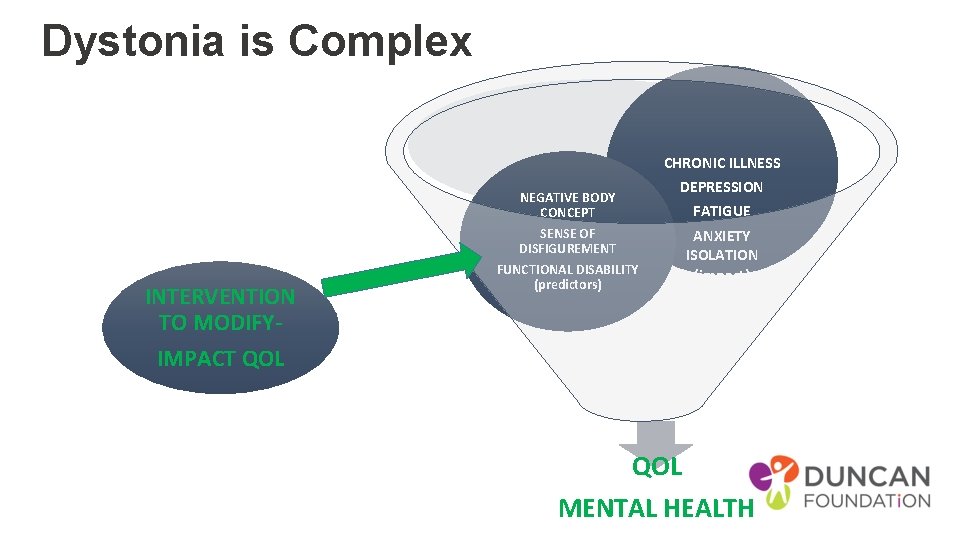
Dystonia is Complex CHRONIC ILLNESS DEPRESSION FATIGUE NEGATIVE BODY CONCEPT INTERVENTION TO MODIFY- SENSE OF DISFIGUREMENT FUNCTIONAL DISABILITY (predictors) ANXIETY ISOLATION (impact) IMPACT QOL MENTAL HEALTH
Classification • Areas affected • generalised, focal, multi focal, segmental, hemi-dystonia • Origin • primary idiopathic – out of the blue – 50%, inherited ? precise cause, further classified by the gene • Secondary acquired – disease, environmental, infection, drug, trauma – damage to BG • And location • Cervical = neck, blepharospasm = eyes, writers cramp = hand
Diagnosis • History – BI (anoxia, trauma, CVA) psychiatric (anti psychotic drugs) • No blood test or lab test as chemical/functional • Not visible on CT/MRI • Exclusion
Cervical Dystonia • Patterned, repetitive, and spasmodic or sustained muscle contractions resulting in abnormal movements and postures of the head and neck may affect any combination of neck muscles result in jerky head movements or periodic or sustained unnatural positioning of the head (dystonic posturing). • Extrapyramidal system fine tunes to maintain ‘set point’ • CD set point altered so overactive contraction of push pull balance into ‘new set point’ • Cervical Dystonia >Spasmodic Torticollis • as may not be spasmodic and may or may not consist of torticollis (head turning) • Ostrem J
Types • Blepharospasm • • • eye muscle, squinting (1 but usu. 2), affect vision, inc. sunlight, wind, stress, running/ decr. Humming singing, pinching neck F>M, 50 y + Artificial tears don’t help Botox to the orbicularis Oculi • Oromandibular dystonia • Jaw musc can’t open, clench, grinding • Pain, hard to eat, drink, speak • ? after dental procedure/trauma • Meige syndrome • facial mus (pharynx, throat, speech swallow) • Blepharospasm + Oromandibular dystonia • Inc. s. Tress/ decr. Sing/hum
Types • Spasmodic dysphoria • • Invol. movements of voice box – Add/Abduction Can’t talk loud, irregular choppy speech, silent at times CAN scream, laugh without spasm, whisper and sing high pitched Does affect airflow Can have mixed F>M, 30 – 50 yrs onset Diag. – local anaesthetic to vocal cord – speech normal Botox – alternating one cord at a time • Writers cramp • Focal – dominant hand, ache after a page – then onset earlier, may develop into complex and associated with CD/ oromandibular • Simple – writing only Complex – all dexterity tasks (buttons, utensils) • Usu. Person swaps hand – 50% dev in non dom also • Occupational dystonia • Job– musician – spasms/feel heavy and pain • Rest and Botox but then weakness and in coordination – balance but hard if $
Online resources • • www. dystoniasociety. com Dystonia Medical Research Foundation (DMRF) www. dystonia-foundation. org info@dystonia-foundation. org The Dystonia Society http: //www. dystonia. org. uk/ info@dystonia. org. uk National Spasmodic Dysphonia Association (NSDA) www. dysphonia. org nsda@dysphonia. org Benign Essential Blepharospasm Foundation (BEBRF) • http: //www. blepharospasm. org/ bebrf@sbcglobal. net • We. Move (Movement disorders) • http: //www. wemove. org
Measures • QUALITY OF LIFE • Cranio-cervical Dystonia Questionnaire (CDQ-24) and Short Form 36 (SF-36) • Disability • • Toronto Western Spasmodic Torticollis Rating Scale (TWSTRS) Functional Disability Questionnaire (FDQ). The FDQ is a 27 item scale to measures the impact of CD on daily functioning • RANGE OF MOVEMENT • ability to perform voluntary movements, with a cervical range of motion meter (CROM) [29]. The CROM is a frame that will be placed on the head with three separate inclinometers to measure AROM in the sagittal, coronal and horizontal planesthe psychometric properties of the CROM in patients with CD are unknown, in a healthy population the CROM is a reliable instrument to measure cervical ROM • PAIN • To determine the additional effects of PT on pain, patient are asked to rate their pain on a Numeric Rating Scale (NRS). • DEPRESSION • Beck’s Anxiety Index and Beck’s Depression Index • Severity • • • Tsui scale measures different aspects of abnormal posture and movements in CD patients Clinical Global Impressions-Severity of Illness Scale (CGI-S) and the Clinical Global Impression - Improvement scale (CGI-I ). ADDS – arm dystonia scale
References Bleton J-P, Spasmodic Torticololis. A physiotherapy handbook. 2014, Frison-Roche Cassidy A pathophysiology of idiopathic focal dystonia ACNR 2010 10 14 – 18 Chan, J. Brin, MF, Fahn, S: Idiopathic cervical dystonia: clinical characteristics. Movement disorders 1991; 6(2): 119 -26 Chronicles of a dystonia muse – https: //dystoniamuse. com/ Dashtipour K, Lew M. Handbook of Dystonia. 2007: 37 -154. Dystonia foundation organisation – living with dystonia physical therapy resource Joost van den Dool, et al; Effectiveness of a standardised physical therapy program: study design and protocol of a single blind randomised controlled trial. BMC Neurology December 2013, 13: 85 Mueller J, Wissel J Visual biofeedback treatment improves cervical dystonia Department of Neurology, Vivantes Hospital Berlin Spandau, Academic teaching Hospital of the Charité, Berlin Ostrem Jill L. , MD Diagnostic criteria for cervical dystonia: Can botulinum neurotoxin manage, as well as, cure the problem? Professor of Neurology UCSF Department of Neurology Movement Disorder and Neuromodulation Center Bachmann Strauss Dystonia and Parkinson’s Disease Center of Excellence Dec 2015 Thong, D, Mayank P and Frei K. Living Well with Dystonia. A patient guide. 2010. National Institute of Neurological Disorders and Stroke Wolfgang H. Jost et al: Rating scales for cervical dystonia: a critical evaluation of tools for outcome assessment of botulinum toxin therapy, J Neural Transm. 2013 Mar; 120(3): 487– 496.
THANK YOU Julie Rope on behalf of the Duncan Foundation
- Slides: 22