
Dysphagia Ent Objectives Normal physiology Dysphagia Definition Cause
Dysphagia ��. ���� Ent

Objectives Normal physiology � Dysphagia �Definition �Cause and classification �History taking, physical examination and investigation �Disease �
Normal physiology � 4 stage �Oral preparatory stage �Oral stage �Pharyngeal stage �Esophageal stage

Normal physiology Oral preparatory stage Prepare food for swallow ª Mechanism of action ª 1. lip closure to hold food in mouth anteriorly ª 2. tension in labial&buccal musculature to close Ant&Lat sulci ª 3. rotatory motion of jaw for chewing ª 4. lateral rolling motion of tongue position food on teeth during mastication – most important ª 5. bulging forward of soft palate to seal oral cavity posterior and widen nasal airway
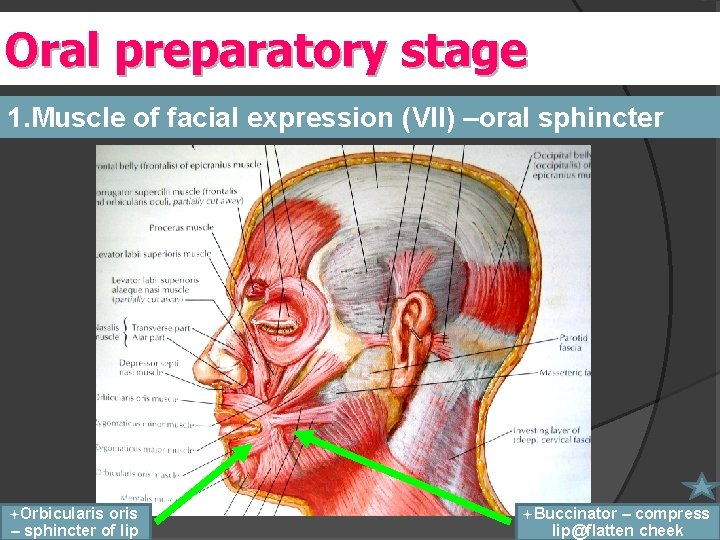
Oral preparatory stage 1. Muscle of facial expression (VII) –oral sphincter ªOrbicularis oris – sphincter of lip ªBuccinator – compress lip@flatten cheek
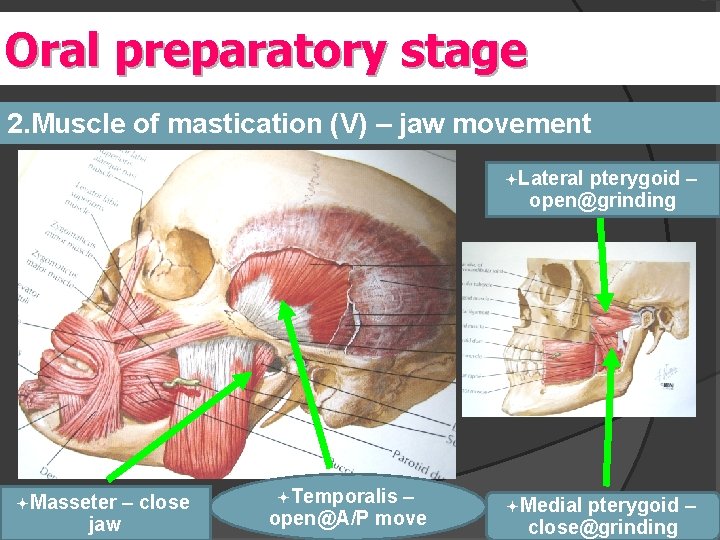
Oral preparatory stage 2. Muscle of mastication (V) – jaw movement ªLateral pterygoid – open@grinding ªMasseter jaw – close ªTemporalis – open@A/P move ªMedial pterygoid – close@grinding
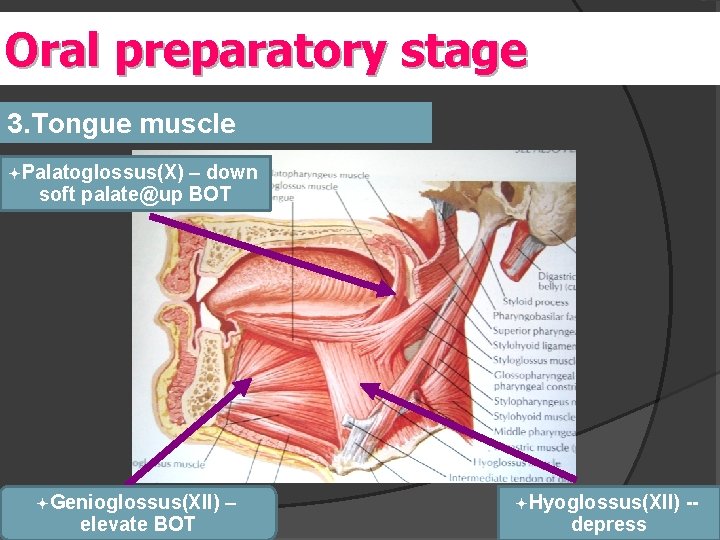
Oral y preparatory stage 3. Tongue muscle ªPalatoglossus(X) – down soft palate@up BOT ªGenioglossus(XII) elevate BOT – ªHyoglossus(XII) depress --
Oral er preparatory stage Time : depend on type of food
Normal physiology Oral stage �Move food from front oral cavity to pharynx �Mechanism of action ○ 1. Upward&backward by midline& Lat margin of tongue – most important ○ 2. Backward by tension in buccal musculature ○ 3. trigger swallowing reflex (locate at anterior pillar)
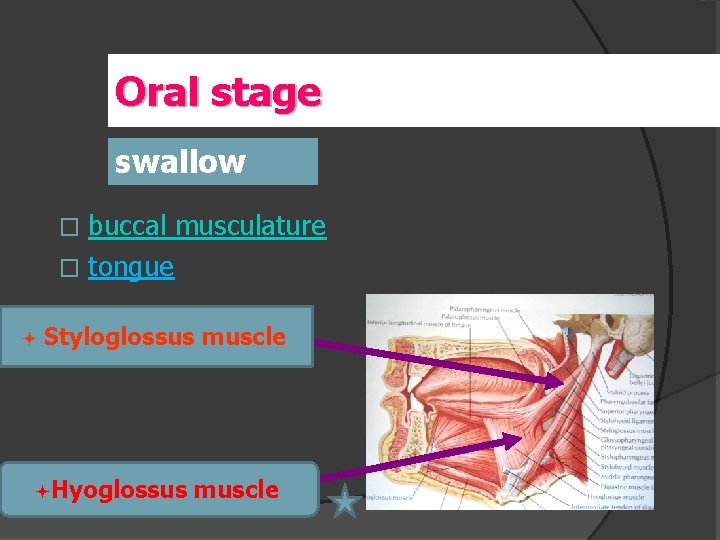
Oral stage swallow buccal musculature � tongue � ª Styloglossus muscle ªHyoglossus muscle
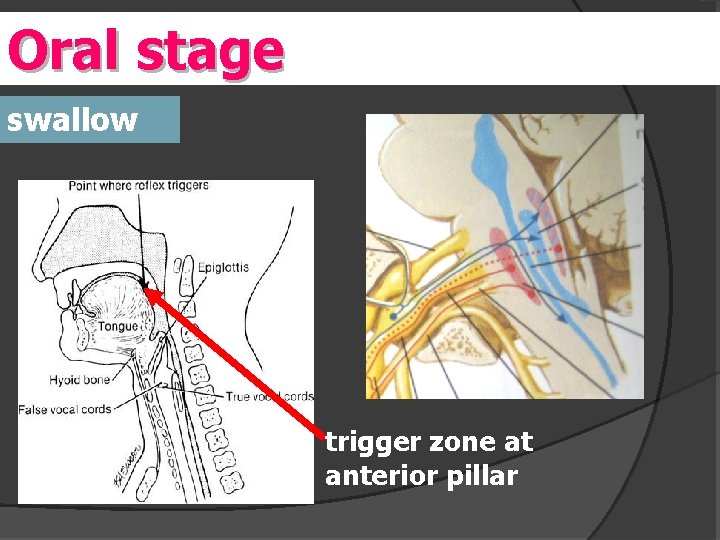
Oral stage swallow trigger zone at anterior pillar
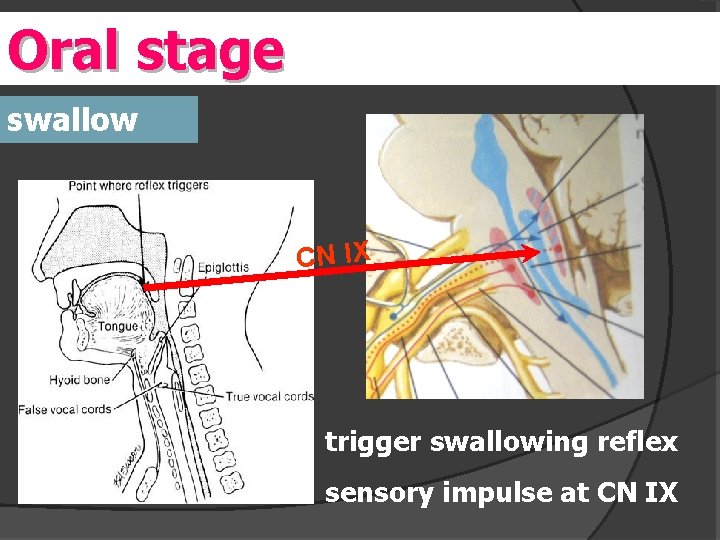
Oral stage ri swallow CN IX trigger swallowing reflex sensory impulse at CN IX
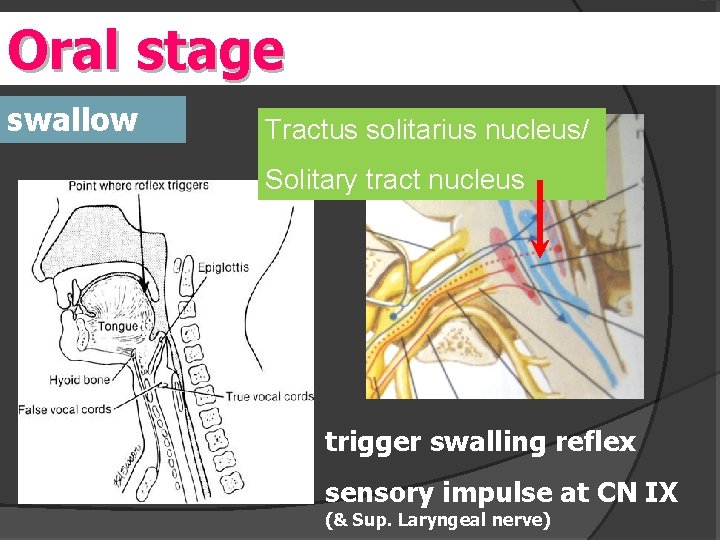
Oral stage swallow Tractus solitarius nucleus/ Solitary tract nucleus trigger swalling reflex sensory impulse at CN IX (& Sup. Laryngeal nerve)

Oral stage swallow nucleus ambiguus CN X nucleus ambiguus to motor neuron of CN X at pharynx
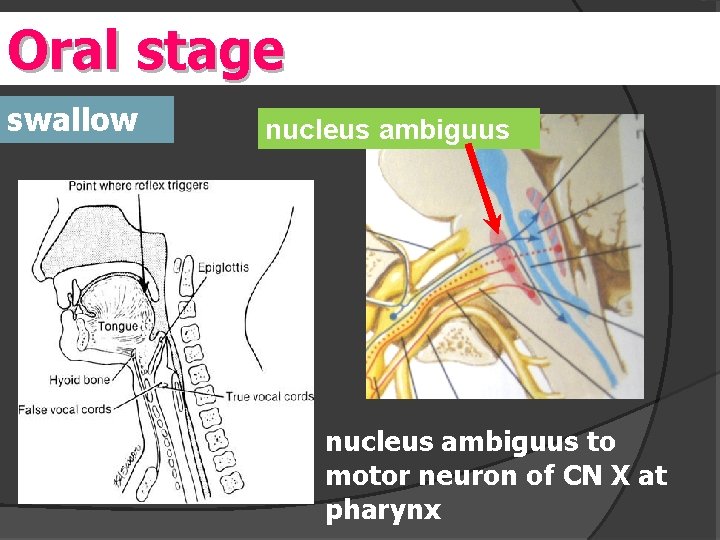
Oral stage swallow nucleus ambiguus to motor neuron of CN X at pharynx
Oral er stage Time : take 1 second
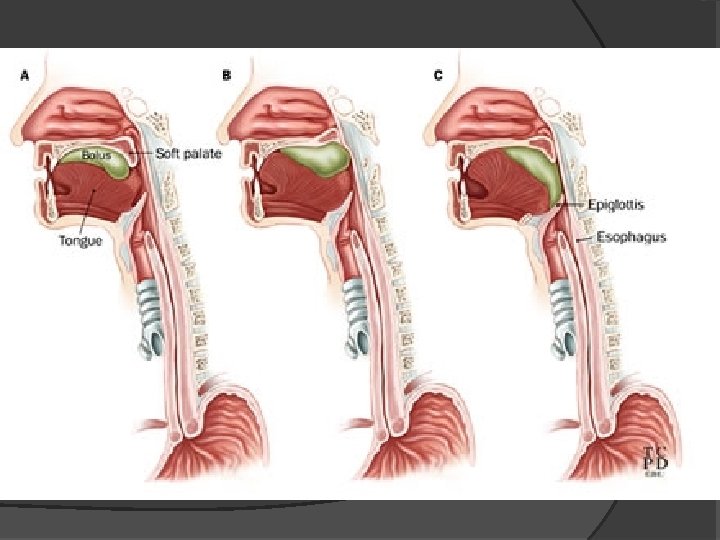
Pharyngeal stage � � Move food from pharynx to esophagus Mechanism of action � 1. velopharyngeal closure (prevent backflow of material up nose) � 2. tongue base retraction (propel bolus through pharynx) � 3. pharynx contraction (clear redisue through pharynx) � 4. larynx elevate and closure (airway protection) � 5. cricopharyngeal opening (allow bolus to pass into esophagus)
t
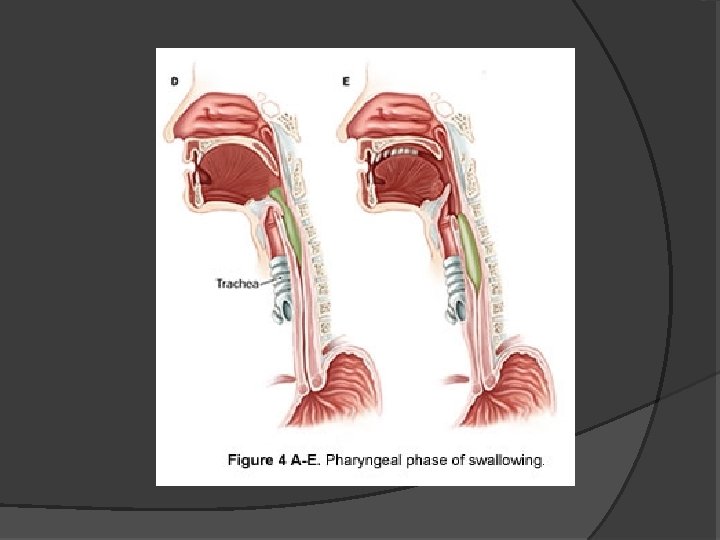
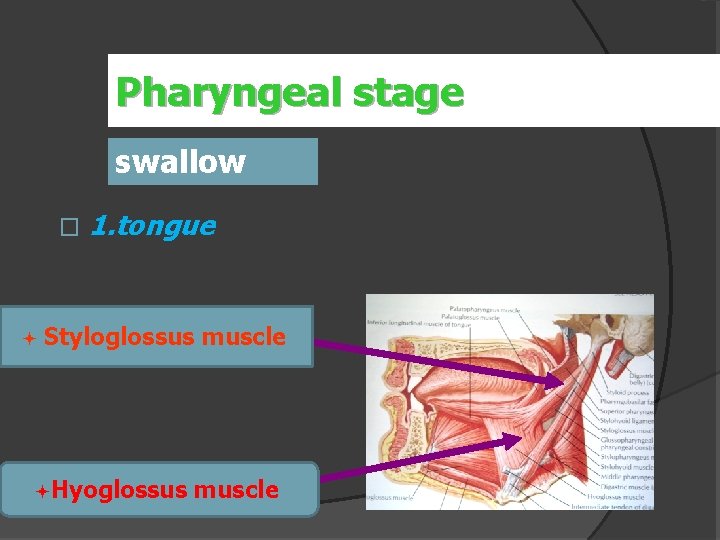
Pharyngeal stage swallow � ª 1. tongue Styloglossus muscle ªHyoglossus muscle
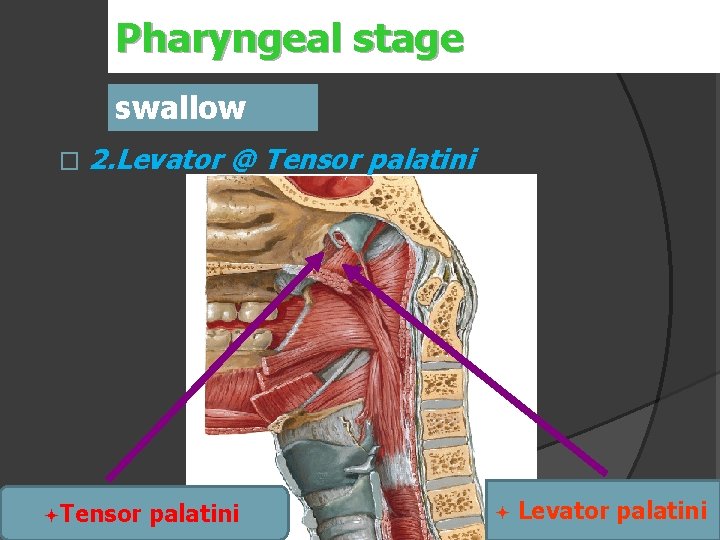
Pharyngeal stage swallow � 2. Levator @ Tensor palatini ª Levator palatini
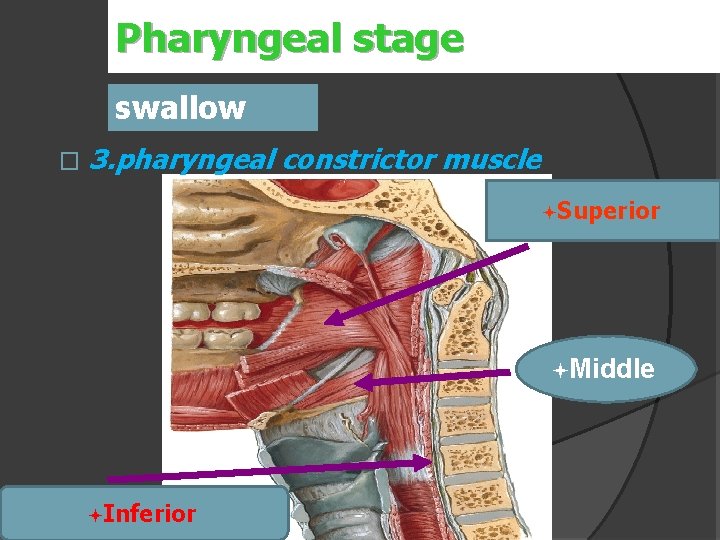
Pharyngeal stage swallow � 3. pharyngeal constrictor muscle ªSuperior ªMiddle ªInferior
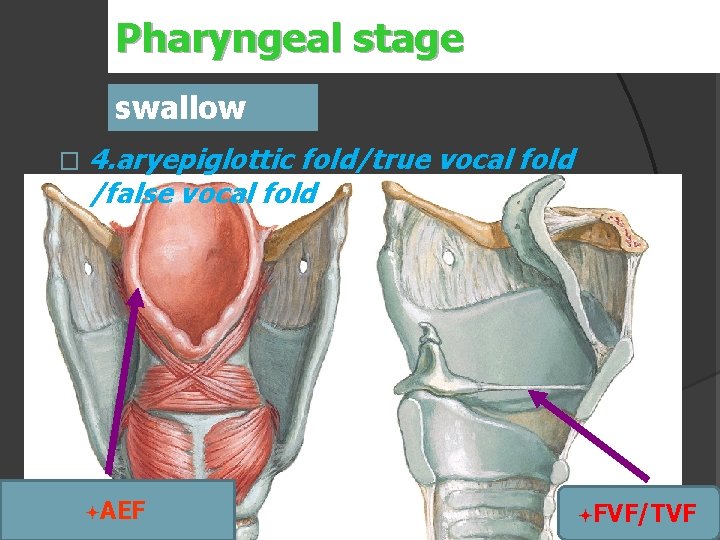
Pharyngeal stage swallow � 4. aryepiglottic fold/true vocal fold /false vocal fold ªAEF ªFVF/TVF
Pharyngeal stage er Time : take less than 1 second (not vary with age and gender)
Esophageal stage Close UES � Body of esophagus � � Outer -> longitudinal , Inner -> circular � Peristalsis �primary peristalsis : ○ upper 1/3 striated & transitional zone ○ mix voluntary & involuntary �secondary peristalsis : ○ lower 2/3 smooth ○ Involuntary � Open LES
Esophageal stage er Time : take 8 to 20 seconds (depend on food influence by peristalsis&gravity)
Dysphagia History Onset & Site � Cough or choke or food coming back through your nose � Liquid or solid or both �Liquid and solid motility disorder �Solid progress to liquid benign or malignant stricture � Progression �
Dysphagia History Other symptoms �Loss of appetite, weight loss , N/V regurgitation, heart burn, weakness, hematemesis, pain � Medical problems �DM, HT, cancer � Hx. Of surgery �
Dysphagia History Hx. Of radiation � Medications � In children �Feeding �Growth �Development �
Dysphagia Physical examination Complete examination � Head and neck �Mass �Thyroid �Lymph node �Salivary gland �Oral mucosa � � Gag reflex, Cough reflex
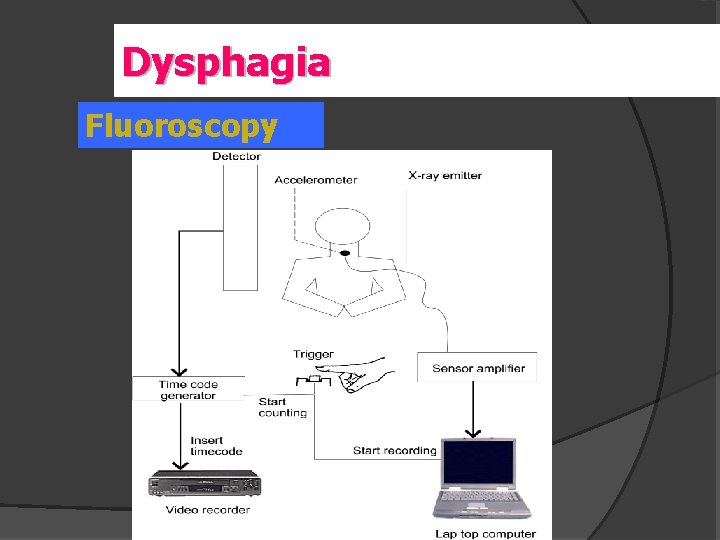
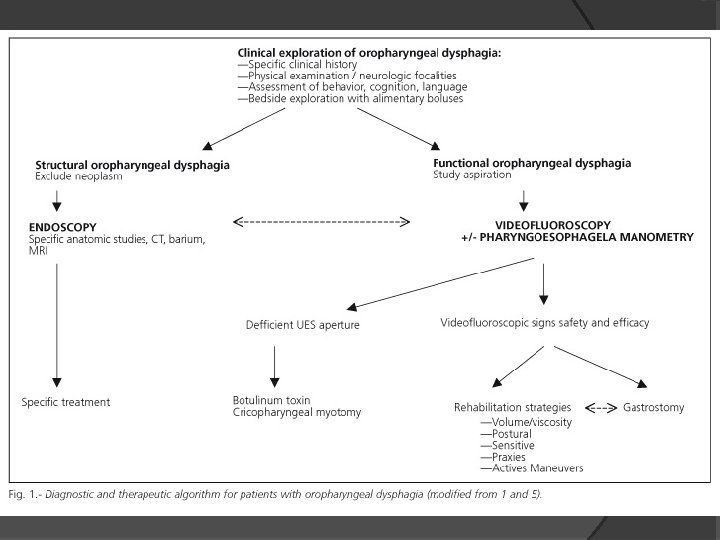
Dysphagia Investigation � Procedure to evaluate -- major � 1. Fluoroscopy � 2. Endoscopy � 3. Manometry � 4. Ultrasonography
Dysphagia Fluoroscopy � Barium swallow �conventional barium swallow �modified barium swallow
Dysphagia Fluoroscopy � Modified barium swallow �Gold standard �Examine oral cavity & pharyngeal swallowing �Ba(1/3 teaspoon per swallow) & vary food consistency �Seated upright in normal eating position
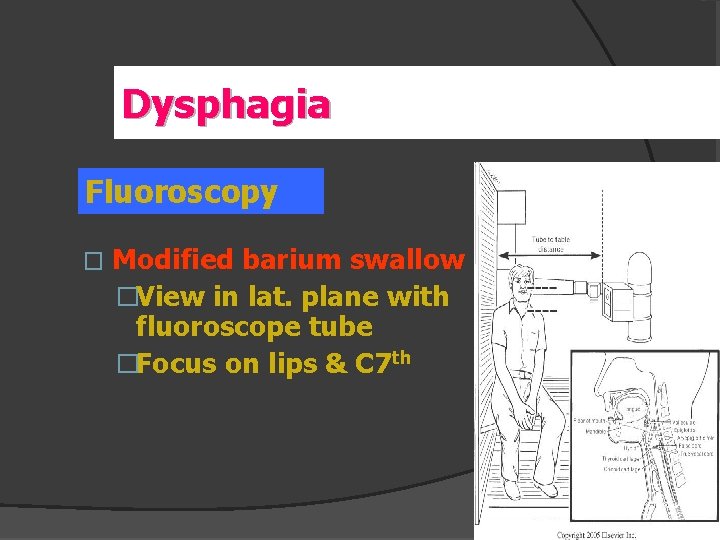
Dysphagia Fluoroscopy � Modified barium swallow �View in lat. plane with fluoroscope tube �Focus on lips & C 7 th
Dysphagia Fluoroscopy � Modified barium swallow �Purpose restore oral intake as quickly ○ 1. define oral&pharyngeal disorder during swallow ○ 2. identify aspiration of any food consistency ○ 3. assess speed of swallow to determine adequate nutrition ○ 4. assess effect of Tx eg. postural change , heightened sensory input , Tx procedure (swallowing maneuvers)
Dysphagia Fluoroscopy � convention barium swallow �Examine anatomy & motility esophagus �Ba(a cup of barium)(250 cc)swallow repeatedly �Lies in supine position �View in anteroposterior plane
Dysphagia Fluoroscopy
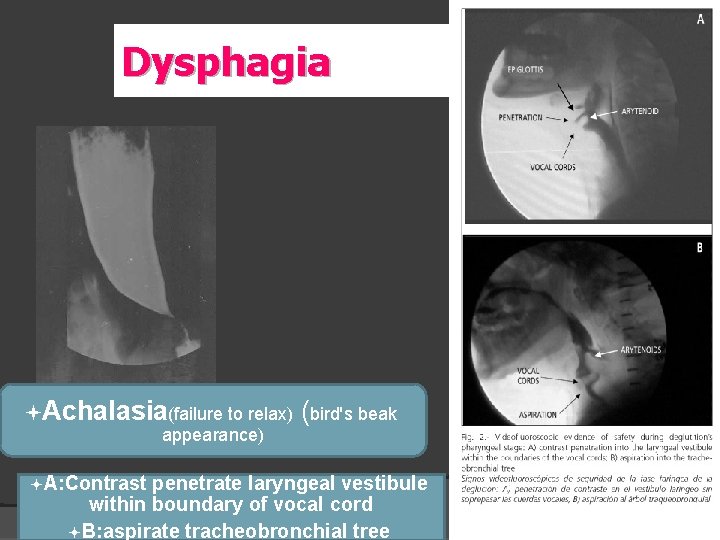
Dysphagia ªAchalasia(failure to relax) (bird's beak appearance) ªA: Contrast penetrate laryngeal vestibule within boundary of vocal cord ªB: aspirate tracheobronchial tree
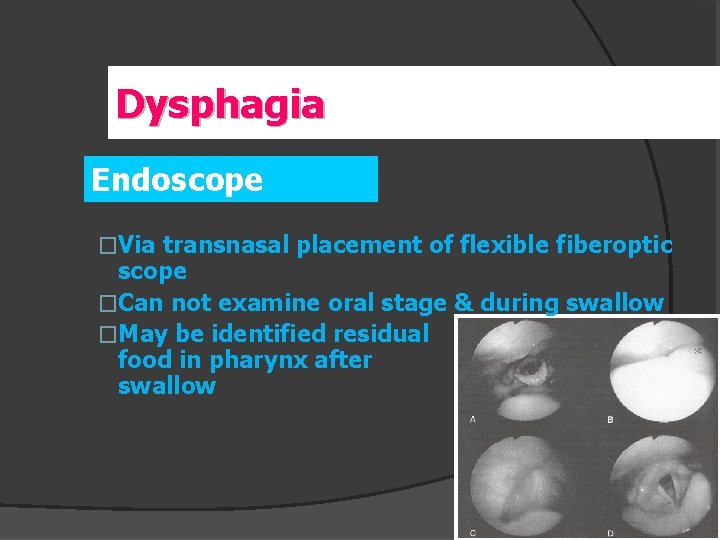
Dysphagia Endoscope �Via transnasal placement of flexible fiberoptic scope �Can not examine oral stage & during swallow �May be identified residual food in pharynx after swallow
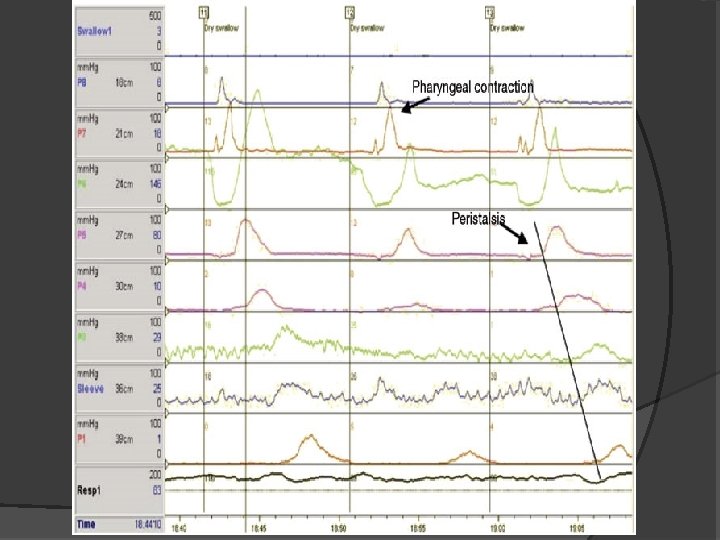
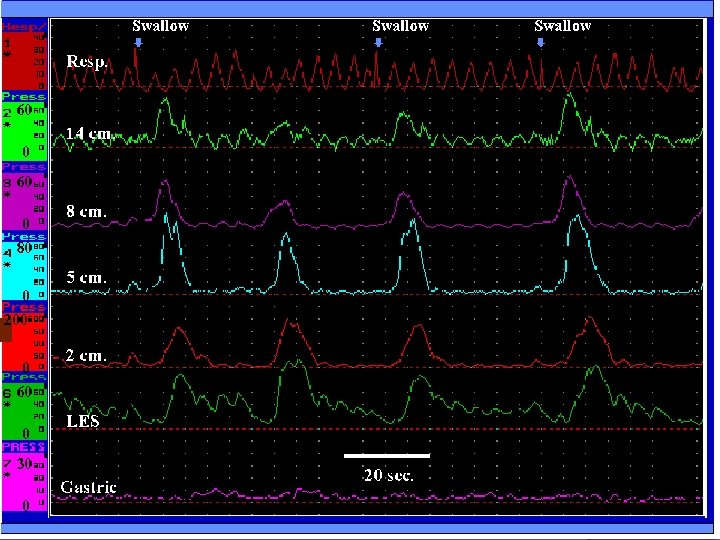
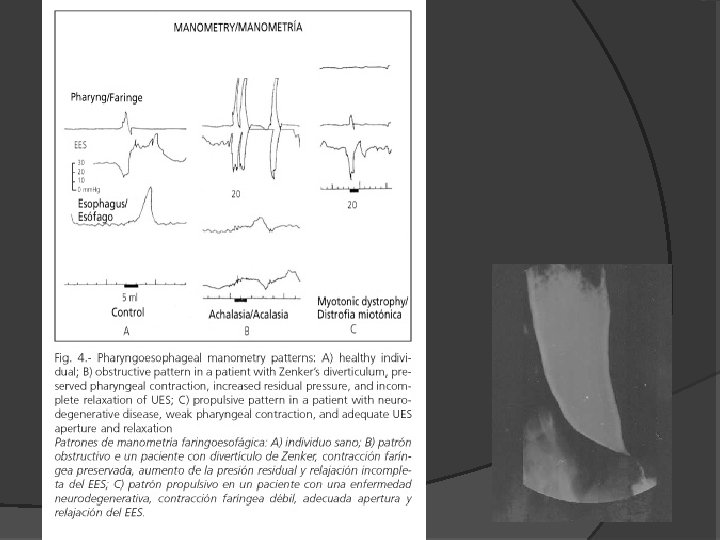
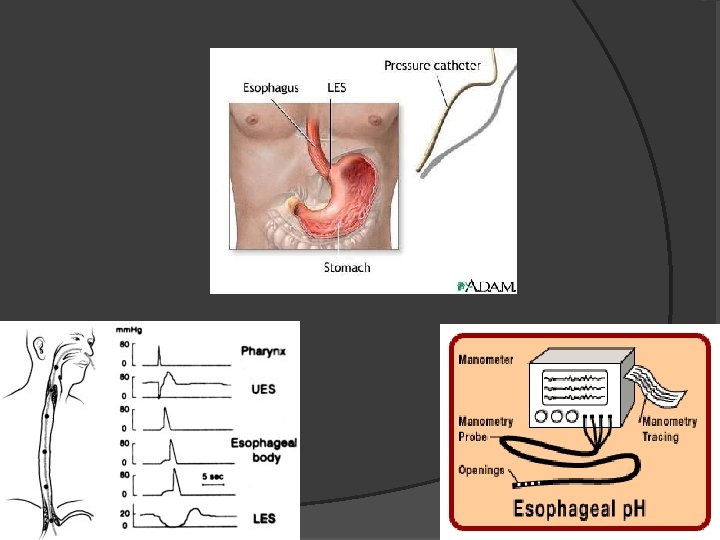
Dysphagia Manometry Used examine esophageal peristalsis & function of UES & LES � Swallow soft tube contain 3 pressure sensor � � First register --- UES � Second register – body of esophagus � Third register – pressure in LES � No information on aspirate or function in oral cavity or larynx
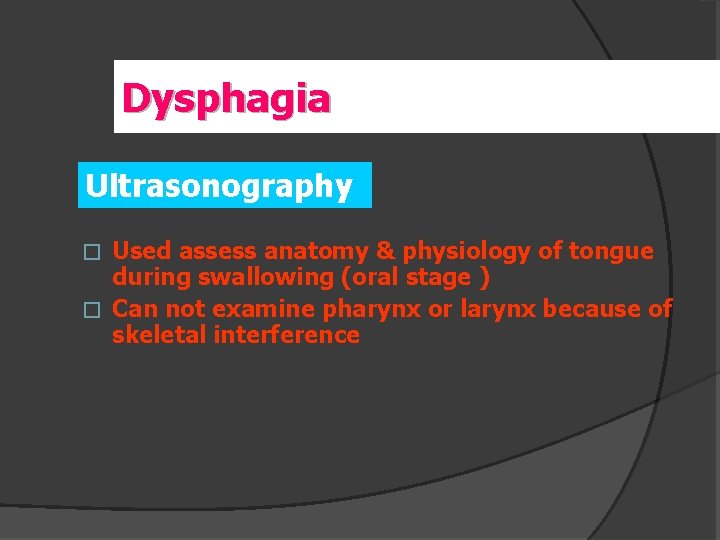
Dysphagia Ultrasonography Used assess anatomy & physiology of tongue during swallowing (oral stage ) � Can not examine pharynx or larynx because of skeletal interference �
Dysphagia Other investigate Plain film : film lateral neck(soft tissue technique) -- FB, Infection � CT/MRI � 24 hrs. p. H monitoring ����������� p. H<4 ���������� 5 cm ������� 1 hr. /��� �
Dysphagia Other investigate � Scintigraphy �Nuclear medicine test �Swallow several selected bolus of radioactive material �Gamma camera detect amount radiation passing �Oropharyngeal anatomy not visible �Aspiration – two trial material swallows ○ One to esophagus ○ Another to airway
The end…
- Slides: 49