
Dynein and motor protein Dynein protein v Dynein

- Slides: 32
Dynein and motor protein
Dynein protein v. Dynein is a family of cytoskeletal motor proteins that move along microtubules in cells v They convert the chemical energy stored in ATP to mechanical work v. Dynein transports various cellular cargos, provides forces and displacements important in mitosis, and drives the beat of eukaryotic cilia and flagella
v All of these functions rely on dynein's ability to move towards the minus-end of the microtubules, known as retrograde transport, thus, they are called "minusend directed motors". v In contrast, most kinesin motor proteins move toward the microtubules' plus end.
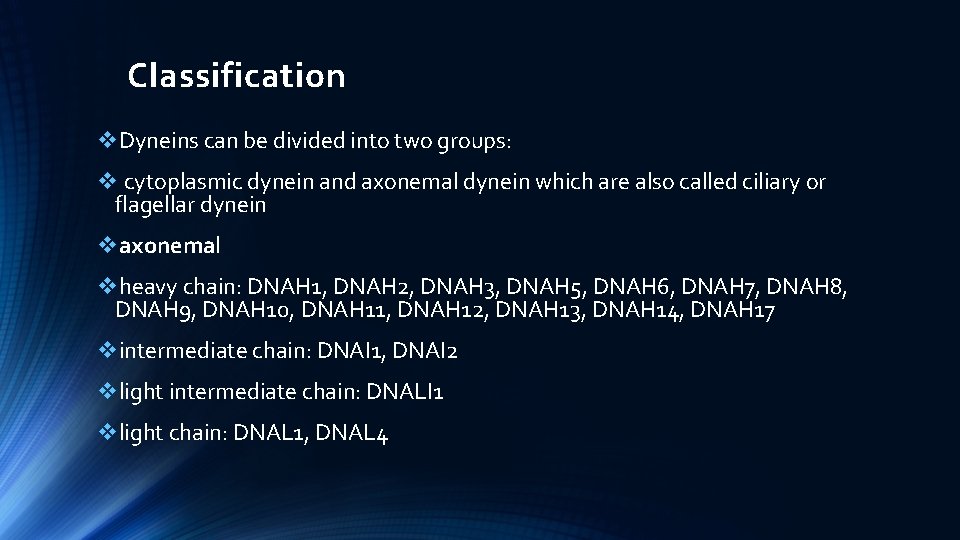
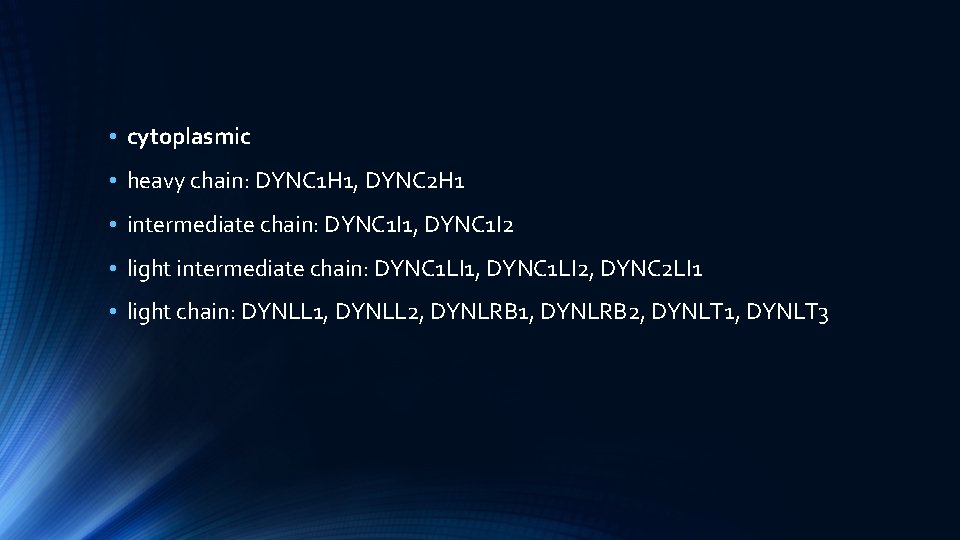
Classification v. Dyneins can be divided into two groups: v cytoplasmic dynein and axonemal dynein which are also called ciliary or flagellar dynein vaxonemal vheavy chain: DNAH 1, DNAH 2, DNAH 3, DNAH 5, DNAH 6, DNAH 7, DNAH 8, DNAH 9, DNAH 10, DNAH 11, DNAH 12, DNAH 13, DNAH 14, DNAH 17 vintermediate chain: DNAI 1, DNAI 2 vlight intermediate chain: DNALI 1 vlight chain: DNAL 1, DNAL 4
• cytoplasmic • heavy chain: DYNC 1 H 1, DYNC 2 H 1 • intermediate chain: DYNC 1 I 1, DYNC 1 I 2 • light intermediate chain: DYNC 1 LI 1, DYNC 1 LI 2, DYNC 2 LI 1 • light chain: DYNLL 1, DYNLL 2, DYNLRB 1, DYNLRB 2, DYNLT 1, DYNLT 3
Functions • Axonemal dynein causes sliding of microtubules in the axonemes of cilia and flagella and is found only in cells that have those structures • Cytoplasmic dynein, found in all animal cells and possibly plant cells as well, performs functions necessary for cell survival such as organelle transport and centrosome assembly
Functions • It also helps transport cargo needed for cell function such as vesicles made by the endoplasmic reticulum, endosomes, and lysosomes • Dynein is involved in the movement of chromosomes and positioning the mitotic spindles for cell division. [2][3] • Dynein carries organelles, vesicles and possibly microtubule fragments along the axons of neurons toward the cell body in a process called retrograde axoplasmic transport. [1]
v. Conti……. . v. Cytoplasmic dynein moves processively along the microtubule; that is, one or the other of its stalks is always attached to the microtubule so that the dynein can "walk" a considerable distance along a microtubule without detaching v. Cytoplasmic dynein helps to position the Golgi complex and other organelles in the cell
v. History v. The protein responsible for movement of cilia and flagella was first discovered and named dynein in 1963 v 20 years later, cytoplasmic dynein, which had been suspected to exist since the discovery of flagellar dynein, was isolated and identified
v. Structure v. Each molecule of the dynein motor is a complex protein assembly composed of many smaller polypeptide subunits v Cytoplasmic and axonemal dynein contain some of the same components, but they also contain some unique subunits
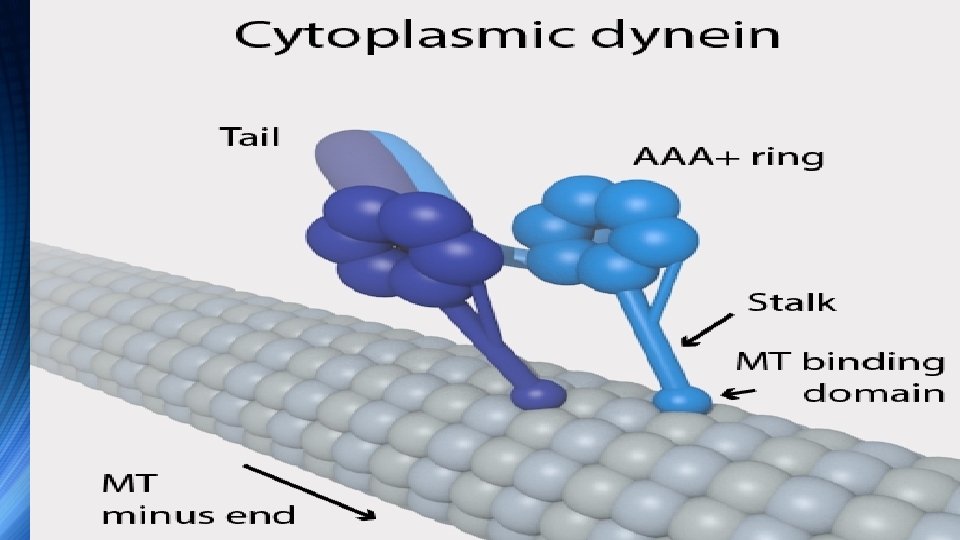
v. Cytoplasmic dynein, which has a molecular mass of about 1. 5 megadaltons (MDa), is a dimer of dimers, containing approximately twelve polypeptide subunits v. Two identical "heavy chains", 520 k. Da in mass, which contain the ATPase activity and are thus responsible for generating movement along the microtubule; two 74 k. Da intermediate chains which are believed to anchor the dynein to its cargo; two 53– 59 k. Da light intermediate chains; and several light chains
• The force-generating ATPase activity of each dynein heavy chain is located in its large doughnut-shaped "head", which is related to other AAA proteins, while two projections from the head connect it to other cytoplasmic structures • One projection, the coiled-coil stalk, binds to and "walks" along the surface of the microtubule via a repeated cycle of detachment and reattachment
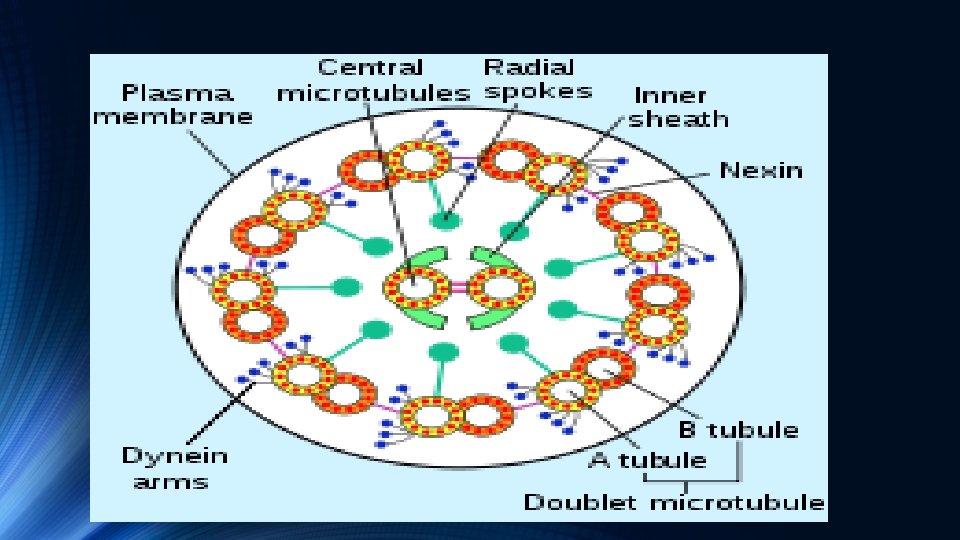
v. Axonemal dynein v. A cross-section of an axoneme, with axonemal dynein arms v. Axonemal Dyneins come in multiple forms that contain either one, two or three non-identical heavy chains (depending upon the organism and location in the cilium) v Each heavy chain has a globular motor domain with a doughnutshaped structure believed to resemble that of other AAA proteins, a coiled coil "stalk" that binds to the microtubule, and an extended tail that attaches to a neighboring microtubule of the same axoneme
v. Each dynein molecule thus forms a cross-bridge between two adjacent microtubules of the ciliary axoneme v During the "power stroke", which causes movement, the AAA ATPase motor domain undergoes a conformational change that causes the microtubule-binding stalk to pivot relative to the cargo-binding tail with the result that one microtubule slides relative to the other
v. The heavy chains of inner and outer arms of axonemal dynein are phosphorylated/dephosphorylated to control the rate of microtubule sliding v Thioredoxins associated with the other axonemal dynein arms are oxidized/reduced to regulate where dynein binds in the axoneme v. Center in and components of the outer axonemal dynein arms detect fluctuations in calcium concentration v Calcium fluctuations play an important role in altering cilia waveform and flagellar beat frequency
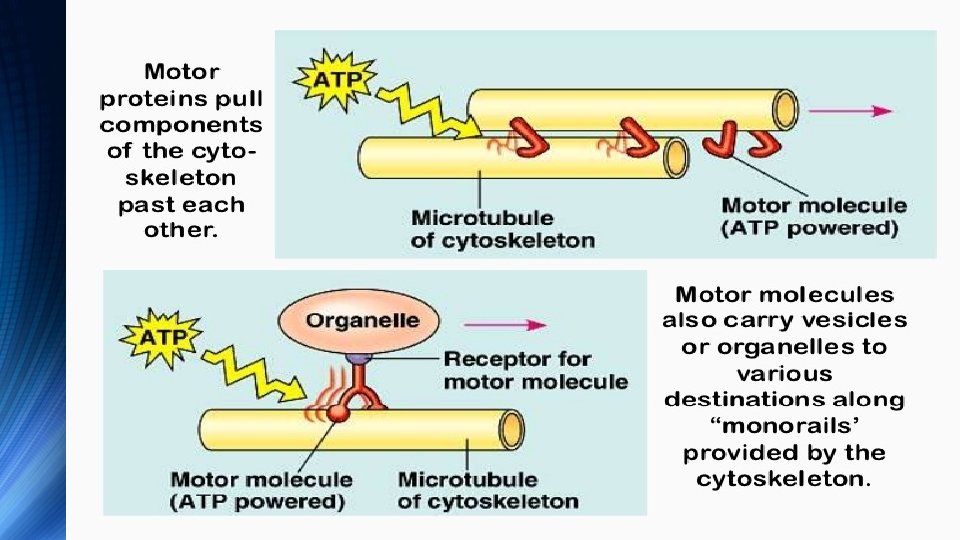
v Motor protein v. Motor proteins are a class of molecular motors that can move along the cytoplasm of animal cell v. They convert chemical energy into mechanical work by the hydrolysis of ATP v. Flagellar rotation, however, is powered by a proton pump
• Cellular functions • The best prominent example of a motor protein is the muscle protein myosin which "motors" the contraction of muscle fibers in animals • Motor proteins are the driving force behind most active transport of proteins and vesicles in the cytoplasm • Axonemal dynein, found in cilia and flagella, is crucial to cell motility
v. Microtubule motors v. Kinesins are a group of related motor proteins that use a microtubule track in anterograde movement v They are vital to spindle formation in mitotic and meiotic chromosome separation during cell division and are also responsible for shuttling mitochondria, Golgi bodies, and vesicles within eukaryotic cells v. Kinesins have two heavy chains and two light chains per active motor v The two globular head motor domains in heavy chains can convert the chemical energy of ATP hydrolysis into mechanical work to move along microtubules [6]
v. Kinesins and cytoplasmic dyneins play essential roles in intracellular transport such as axonal transport and in the formation of the spindle apparatus and the separation of the chromosomes during mitosis and meiosis v. Diseases associated with motor protein defects v. The importance of motor proteins in cells becomes evident when they fail to fulfill their function v For example, kinesin deficiencies have been identified as the cause for Charcot. Marie-Tooth disease and some kidney diseases
v. Dynein deficiencies can lead to chronic infections of the respiratory tract as cilia fail to function without dynein v Numerous myosin deficiencies are related to disease states and genetic syndromes
v. Cytoskeletal motor proteins v. Motor proteins utilizing the cytoskeleton for movement fall into two categories based on their substrate: v microfilaments or microtubules: v Actin motors such as myosin move along microfilaments through interaction with actin, and microtubule motors such as dynein and kinesin move along microtubules through interaction with tubulin
v. There are two basic types of microtubule motors: plus-end motors and minus-end motors, depending on the direction in which they "walk" along the microtubule cables within the cell v. Actin motors v. Myosin are a superfamily of actin motor proteins that convert chemical energy in the form of ATP to mechanical energy, thus generating force and movement v The first identified myosin, myosin II, is responsible for generating muscle contraction
v Myosin II is an elongated protein that is formed from two heavy chains with motor heads and two light chains v Each myosin head contains actin and ATP binding site v. The myosin heads bind and hydrolyze ATP, which provides the energy to walk toward the plus end of an actin filament
v. In addition to myosin II, many other myosin types are responsible for variety of movement of non-muscle cells v For example, myosin is involved in intracellular organization and the protrusion of actin-rich structures at the cell surface v Myosin V is involved in vesicle and organelle transport. [2] Myosin XI is involved in cytoplasmic streaming, wherein movement along microfilament networks in the cell allows organelles and cytoplasm to stream in a particular direction [3]
v. Dyneins are microtubule motors capable of a retrograde sliding movement v Dynein complexes are much larger and more complex than kinesin and myosin motors v. Dyneins are composed of two or three heavy chains and a large and variable number of associated light chains v. Dyneins drive intracellular transport toward the minus end of microtubules which lies in the microtubule organizing center near the nucleus. [8]
v. The direction in which cargo is transported can be towards the plus-end or the minus-end, depending on the type of kinesin v In general, kinesins with N-terminal motor domains move their cargo towards the plus ends of microtubules located at the cell periphery, while kinesins with C-terminal motor domains move cargo towards the minus ends of microtubules located at the nucleus
v References v Hirokawa N, R (2003). "Biochemical and molecular characterization of diseases linked to motor proteins". Trends in Biochemical Sciences. 28 (10): 558– 65. doi: 10. 1016/j. tibs. 2003. 08. 006. PMID 14559185. v Alberts, Bruce; Johnson, Alexander; Lewis, Julian; Raff, Martin; Roberts, Keith; Walter, Peter (2002 -01 -01). "Molecular Motors“ v Vale RD (2003). "The molecular motor toolbox for intracellular transport". Cell. 112 (4): 467– 80. doi: 10. 1016/S 0092 -8674(03)00111 -9. PMID 12600311
v. Vanstraelen M, Inze D, Geelen D (2006). "Mitosis-specific kinesins in Arabidopsis". Trends in Plant Science. 11 (4): 167– 175. doi: 10. 1016/j. tplants. 2006. 02. 004. hdl: 1854/LU-364298. PMID 16530461 vallos P, Fakler B (2002). "Prestin, a new type of motor protein". Nat. Rev. Mol. Cell Biol. 3 (2): 104– 11. doi: 10. 1038/nrm 730. PMID 11836512 v. Mallik R, Gross SP (2004). "Molecular motors: strategies to get along". Current Biology. 14 (22): R 971–R 982. doi: 10. 1016/j. cub. 2004. 10. 046. PMID 15556858