
Dynamics TYPES OF FORCES NEWTONS LAWS OF MOTION


![Example 2 A 750 kg car goes from 21 m/s [E] to 15 m/s](https://slidetodoc.com/presentation_image_h/19261e43e3f7828122457ea80fef6c7e/image-48.jpg "Example 2 A 750 kg car goes from 21 m/s [E] to 15 m/s")
- Slides: 49
Dynamics TYPES OF FORCES & NEWTON’S LAWS OF MOTION
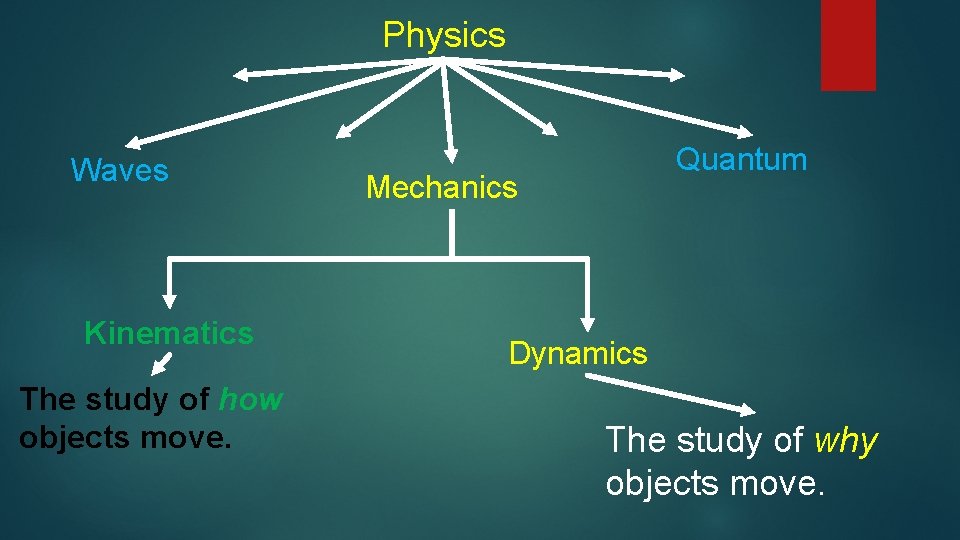
Physics Waves Kinematics The study of how objects move. Quantum Mechanics Dynamics The study of why objects move.
Force A push or a pull. Vector quantity. Usually results in an acceleration. Measured in Newtons, N. Many forces can act on an object all at once.
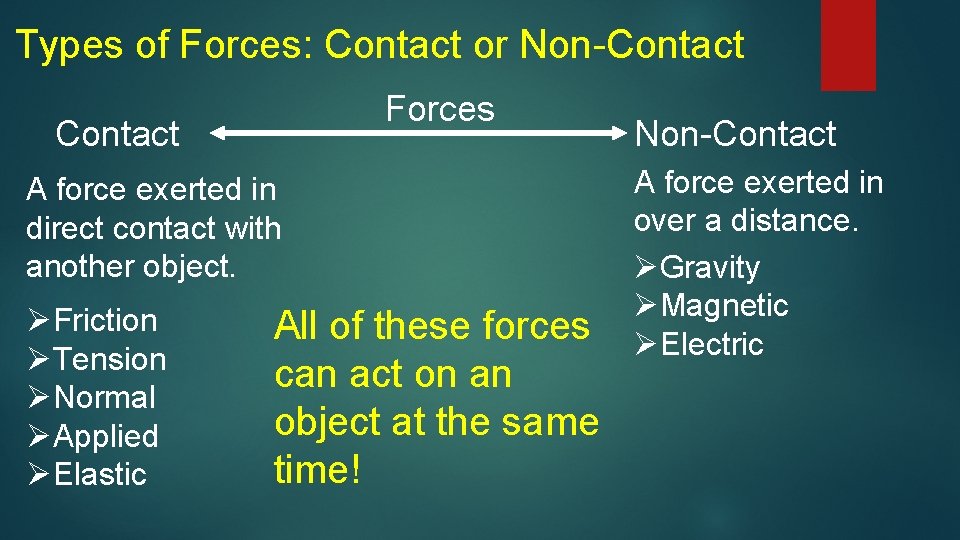
Types of Forces: Contact or Non-Contact Forces Contact A force exerted in direct contact with another object. ØFriction ØTension ØNormal ØApplied ØElastic All of these forces can act on an object at the same time! Non-Contact A force exerted in over a distance. ØGravity ØMagnetic ØElectric
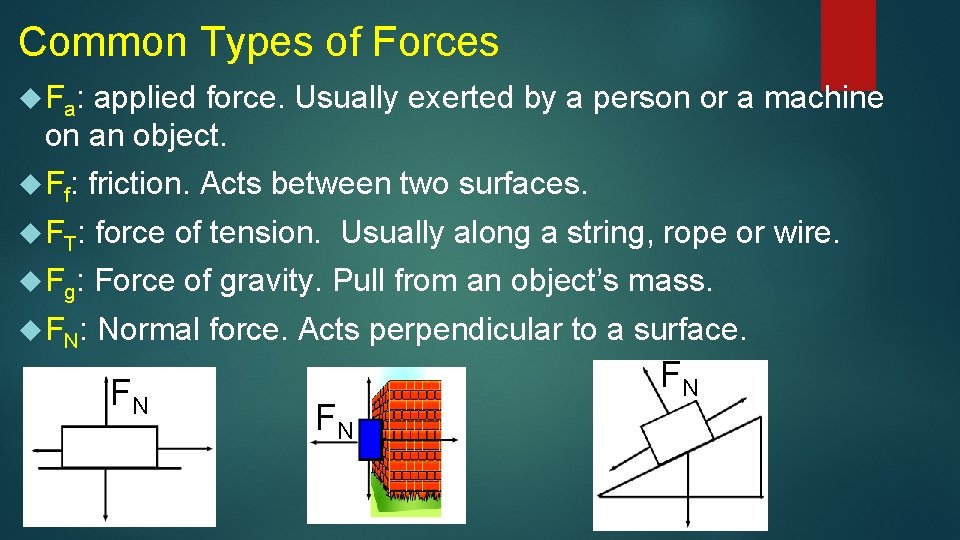
Common Types of Forces Fa: applied force. Usually exerted by a person or a machine on an object. Ff: friction. Acts between two surfaces. FT: force of tension. Usually along a string, rope or wire. Fg: Force of gravity. Pull from an object’s mass. FN: Normal force. Acts perpendicular to a surface. FN FN FN
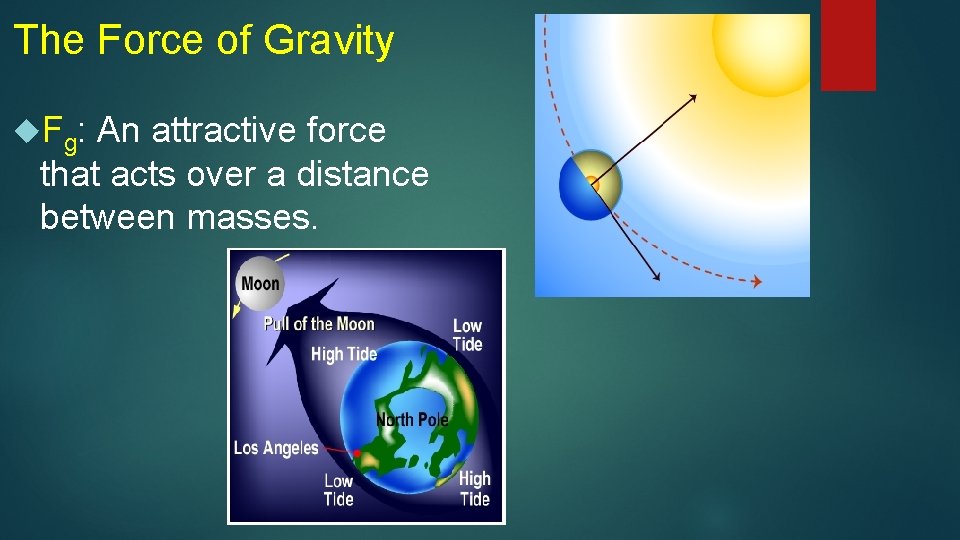
The Force of Gravity Fg: An attractive force that acts over a distance between masses.
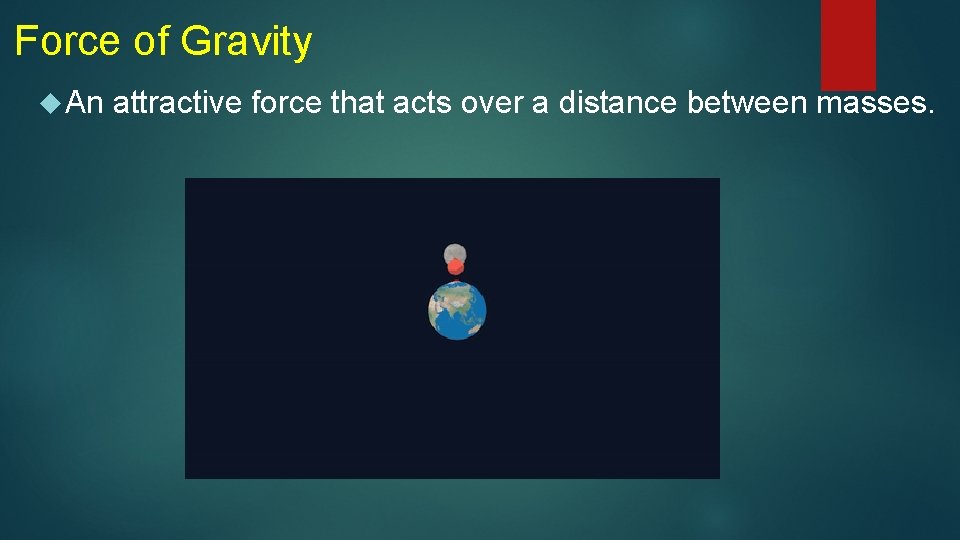
Force of Gravity An attractive force that acts over a distance between masses.
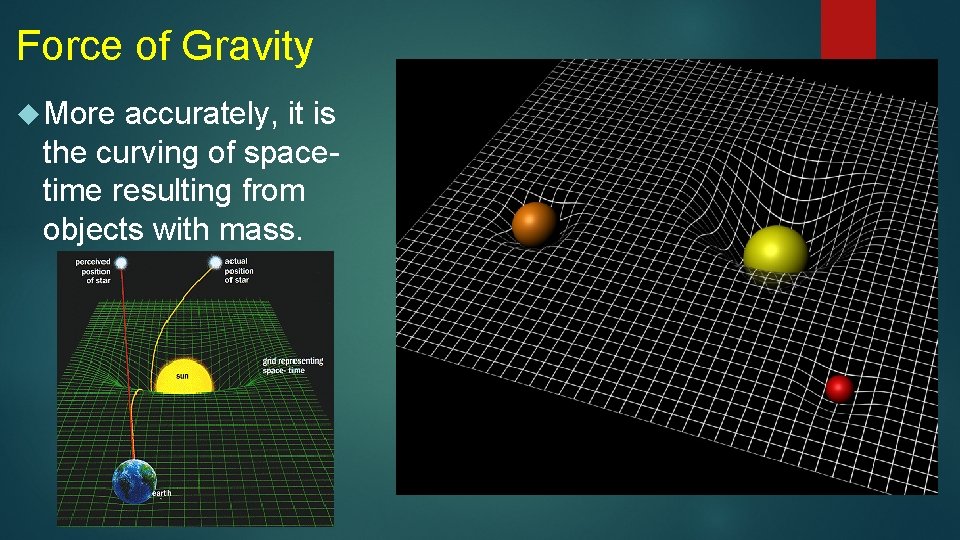
Force of Gravity More accurately, it is the curving of spacetime resulting from objects with mass.
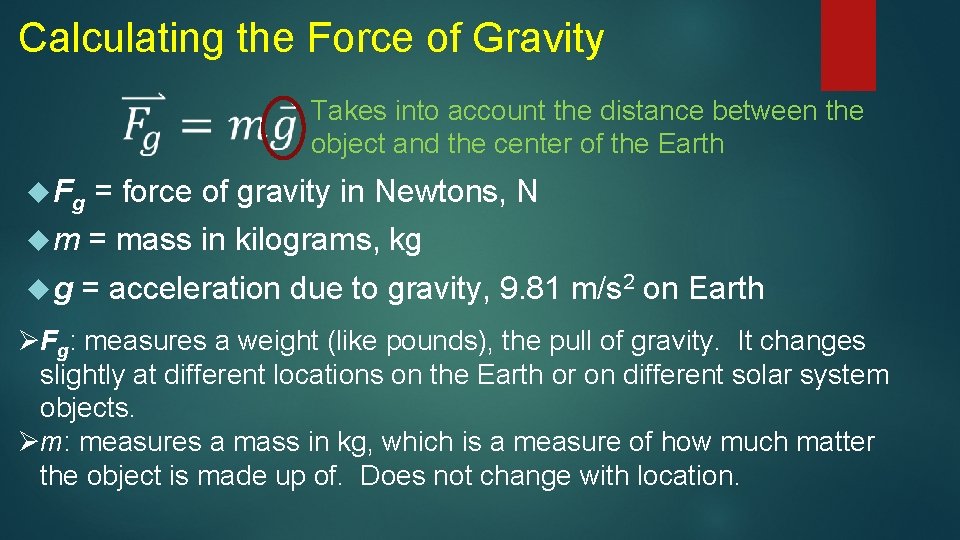
Calculating the Force of Gravity Takes into account the distance between the object and the center of the Earth Fg = force of gravity in Newtons, N m = mass in kilograms, kg g = acceleration due to gravity, 9. 81 m/s 2 on Earth ØFg: measures a weight (like pounds), the pull of gravity. It changes slightly at different locations on the Earth or on different solar system objects. Øm: measures a mass in kg, which is a measure of how much matter the object is made up of. Does not change with location.
Force of Gravity: Problems 1. Calculate the magnitude of the force of gravity on a 45 kg mass located at the peak of Mt. Everest. 2. Calculate the mass of a person that has a weight magnitude of 1075 N at the equator. Unless given a specific location, take the magnitude of the acceleration to be g = 9. 81 m/s 2.
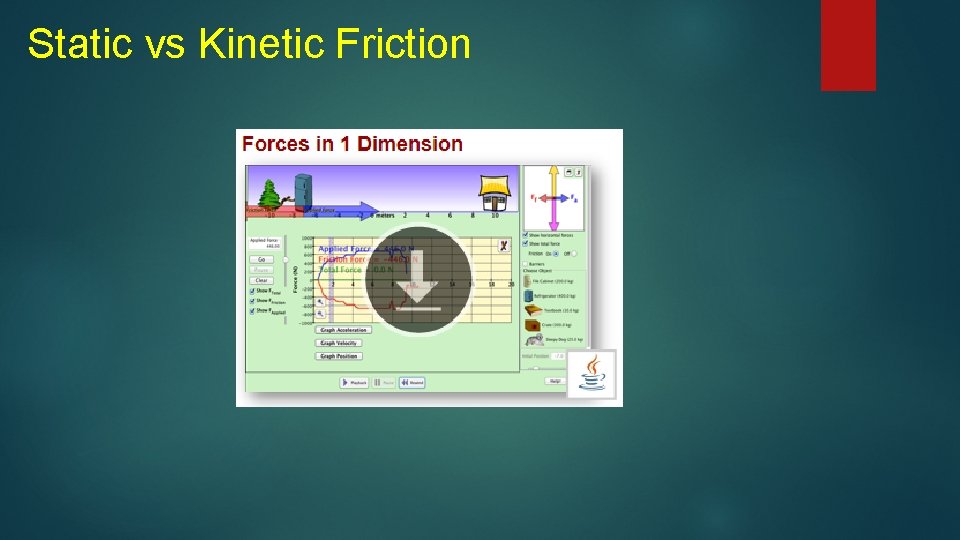
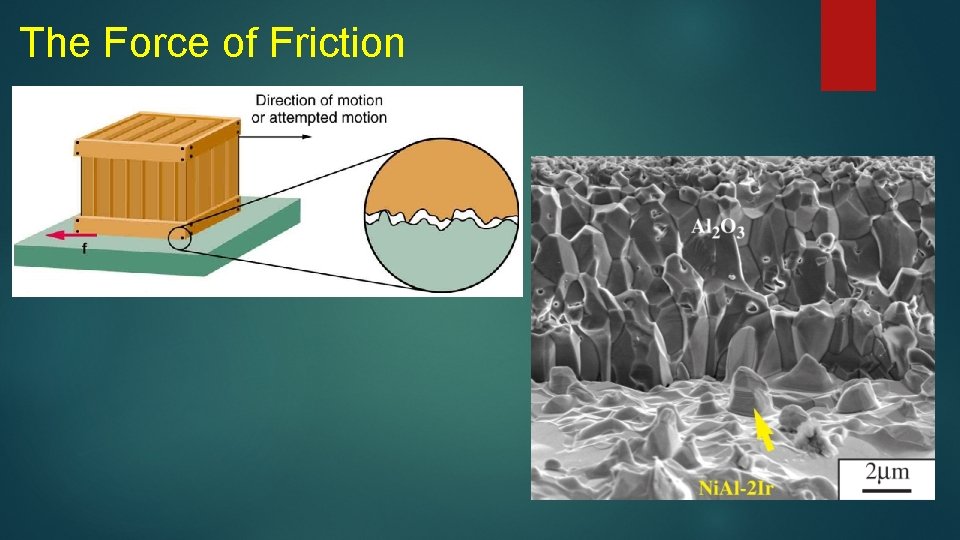
The Force of Friction When two surfaces come in contact, the surface atoms of each form relatively strong electromagnetic bonds (between the positive nucleus and motion of negative electrons). Static Friction: Exists when you start to move an object from rest. Kinetic Friction: Exists while an object is moving.
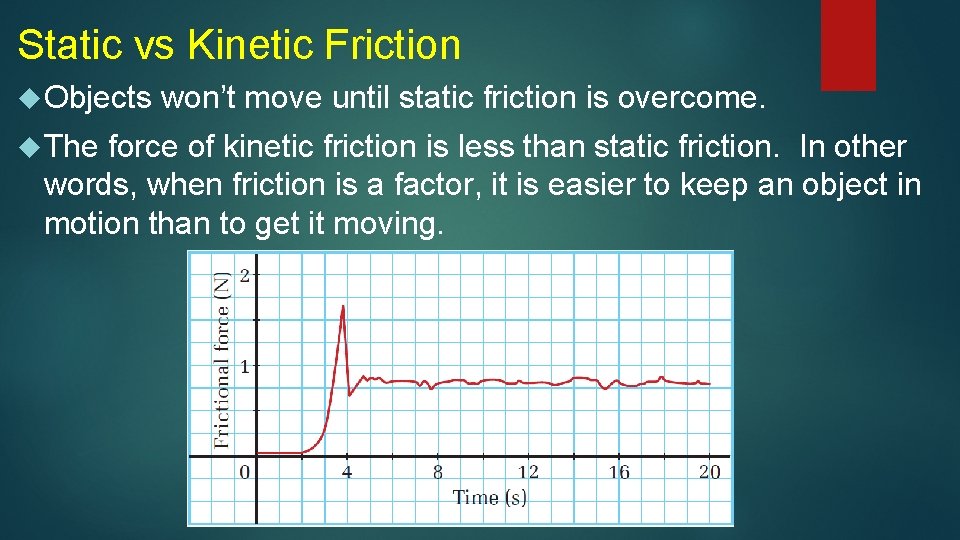
Static vs Kinetic Friction Objects won’t move until static friction is overcome. The force of kinetic friction is less than static friction. In other words, when friction is a factor, it is easier to keep an object in motion than to get it moving.
Static vs Kinetic Friction
Static vs Kinetic Friction Surfaces may feel smooth but are not so when you look with electron microscopes at the atomic level. Static friction arises from the electromagnetic bonds of surface atoms “pushing back” against an applied force. Once broken the object begins to move, but surface atoms are continually forming EM bonds, but they are weaker because of the motion. This process is responsible for the noise we hear when two objects are moved against each other. Heat is released when the bonds are broken.
The Force of Friction
Force of Friction: Conditions The interaction of atoms is complex and our formula is a good approximation of the forces involved if: The mass of the object is evenly distributed (not heavier at one end). No adhesives. No penetrating spikes.
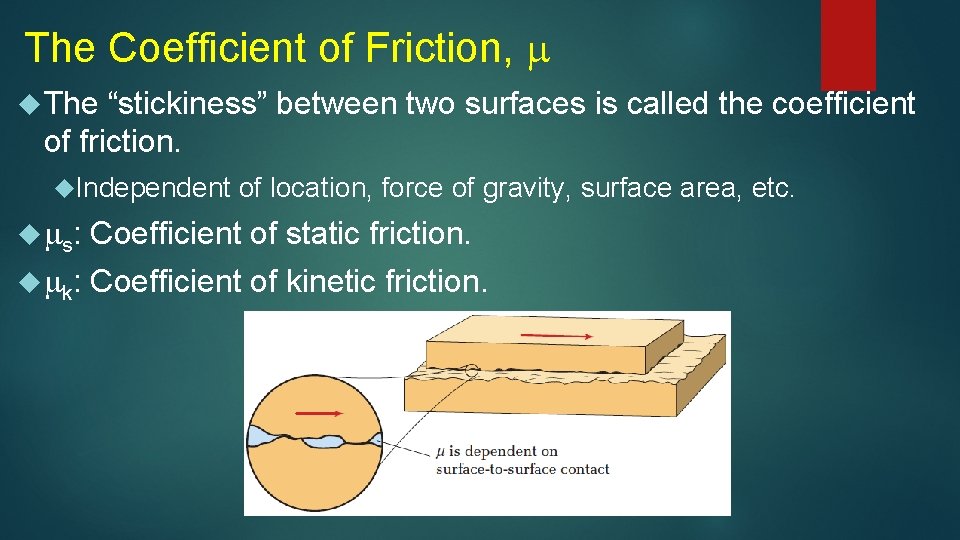
The Coefficient of Friction, The “stickiness” between two surfaces is called the coefficient of friction. Independent of location, force of gravity, surface area, etc. s: Coefficient of static friction. k: Coefficient of kinetic friction.
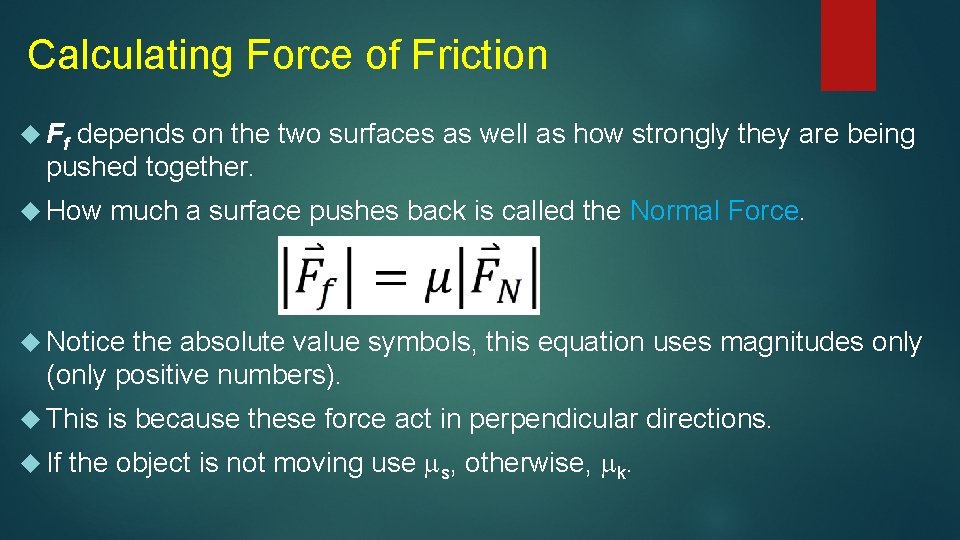
Calculating Force of Friction Ff depends on the two surfaces as well as how strongly they are being pushed together. How much a surface pushes back is called the Normal Force. Notice the absolute value symbols, this equation uses magnitudes only (only positive numbers). This is because these force act in perpendicular directions. If the object is not moving use s, otherwise, k.
Determining Normal Force Draw a diagram and identify the forces pushing against the surface. The magnitude of the normal force is the sum of all the forces pushing on the surface. An object on the floor or ground: same as the force of gravity plus any applied force (Fa could be positive or negative). An object pressed against a wall: same as the applied force.
Determining Normal Force Examples Ex 1. A 20 kg box sits on the ground. Calculate the normal force provided by the ground. Ex 2. A person applies a 340 N [down] force on the 20 kg box. Calculate the normal force. Ex 3. A 12 kg box is held up against a wall with an applied force of 100 N. Determine the normal force. Ex 4. A 50 kg box is pulled up by an applied force of 275 N. Calculate the normal force.
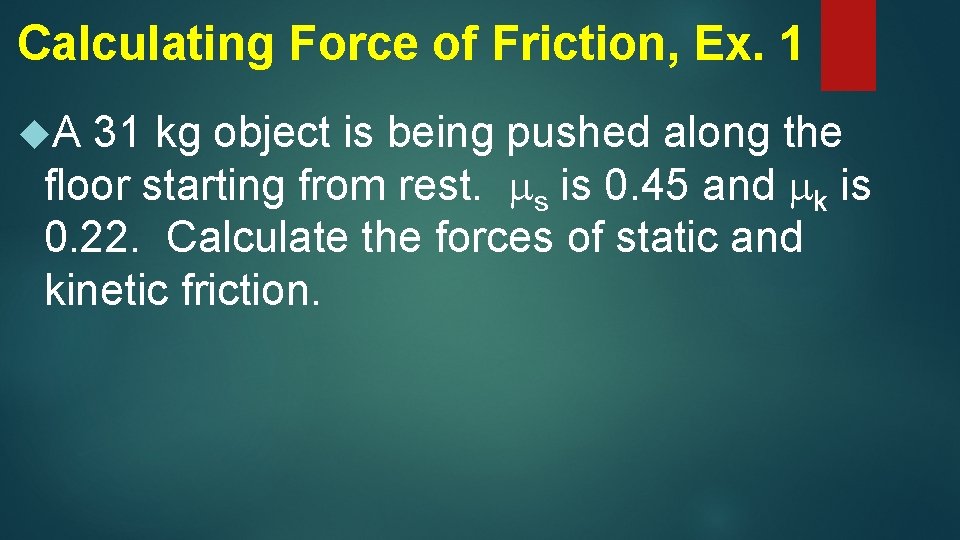
Calculating Force of Friction, Ex. 1 A 31 kg object is being pushed along the floor starting from rest. s is 0. 45 and k is 0. 22. Calculate the forces of static and kinetic friction.
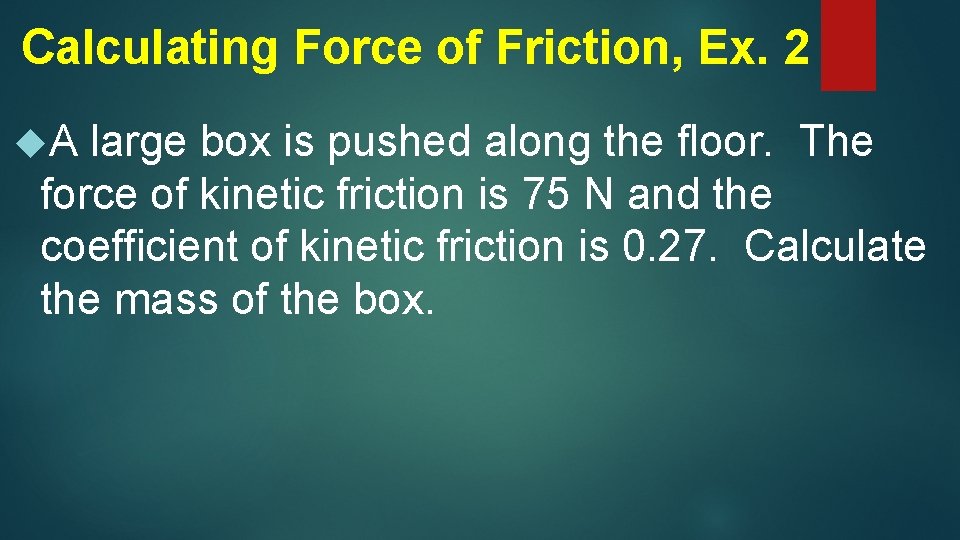
Calculating Force of Friction, Ex. 2 A large box is pushed along the floor. The force of kinetic friction is 75 N and the coefficient of kinetic friction is 0. 27. Calculate the mass of the box.
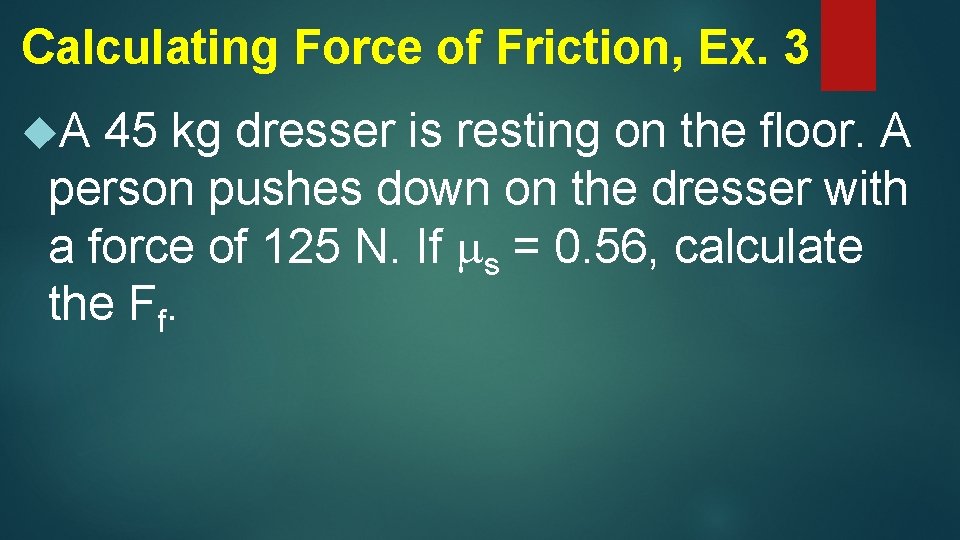
Calculating Force of Friction, Ex. 3 A 45 kg dresser is resting on the floor. A person pushes down on the dresser with a force of 125 N. If s = 0. 56, calculate the Ff.
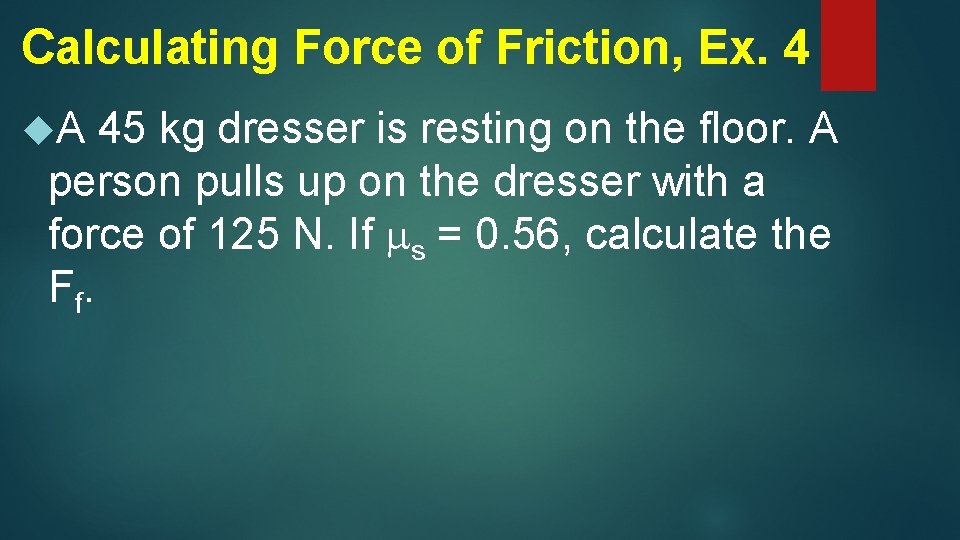
Calculating Force of Friction, Ex. 4 A 45 kg dresser is resting on the floor. A person pulls up on the dresser with a force of 125 N. If s = 0. 56, calculate the F f.
Calculating Force of Friction, Ex. 5 A 5. 8 kg book is pressed against the wall and held there with force of 75 N. Calculate the coefficient of static friction.
Force of Friction Practice Friction review from your worksheet.
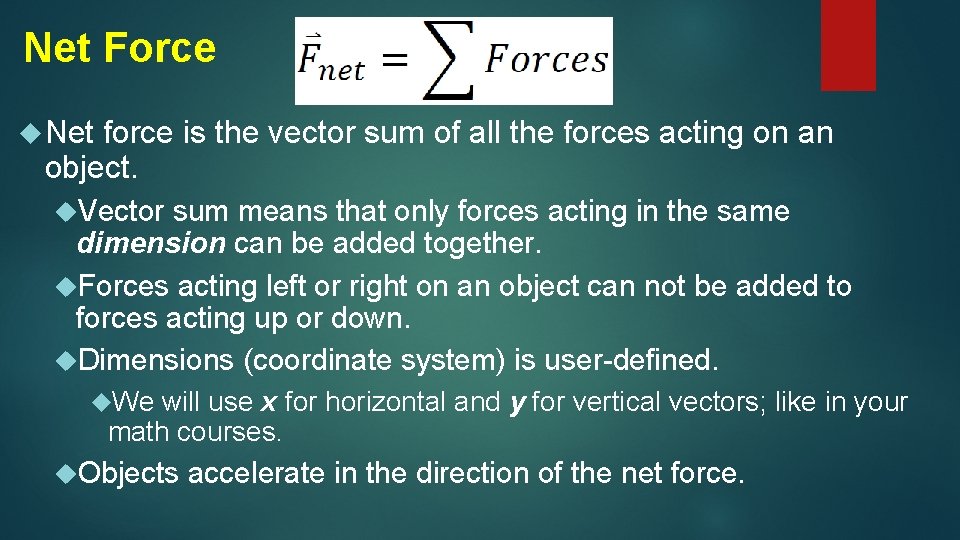
Net Force Net force is the vector sum of all the forces acting on an object. Vector sum means that only forces acting in the same dimension can be added together. Forces acting left or right on an object can not be added to forces acting up or down. Dimensions (coordinate system) is user-defined. We will use x for horizontal and y for vertical vectors; like in your math courses. Objects accelerate in the direction of the net force.
Net Force and Equilibrium If an object is said to be in equilibrium, that means the net force acting on it is zero. This happens when the acceleration on the object is zero. When the velocity is zero, there is zero acceleration. When the velocity is constant, there is zero acceleration. A car could be driving 125 km/h, but if there is no acceleration, the net force is zero!
Solving Net Force Problems Determine a coordinate system. Sketch a diagram and label all relevant forces using arrows pointing away from the object. Apply the concept of net force in each dimension separately, as needed. List the forces involved, taking direction into account using the coordinate system. Solve for the unknown variable(s).
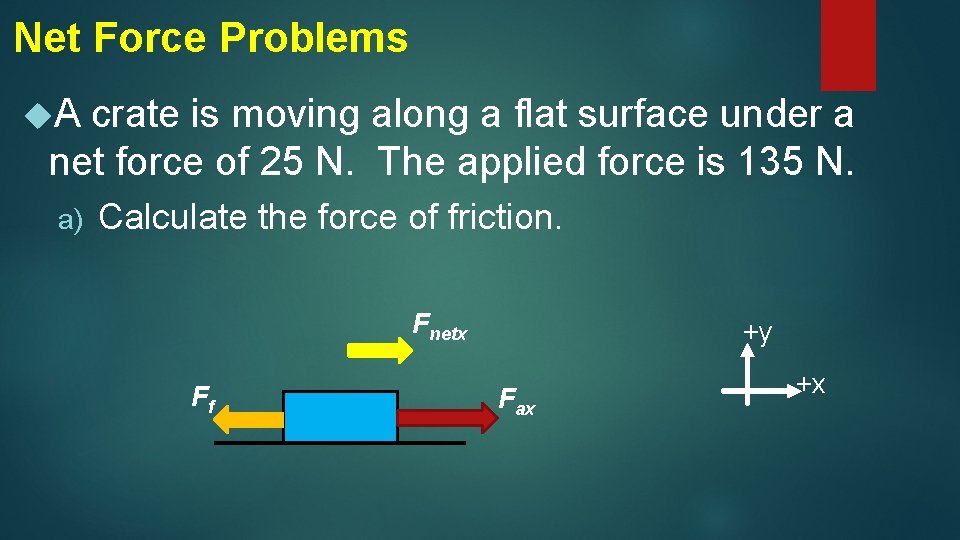
Net Force Problems A crate is moving along a flat surface under a net force of 25 N. The applied force is 135 N. a) Calculate the force of friction. Fnetx Ff +y Fax +x
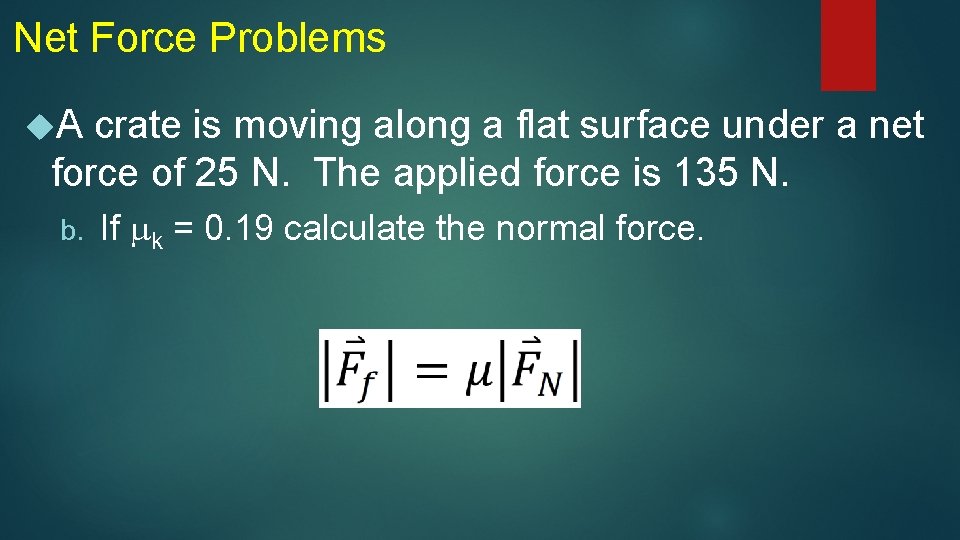
Net Force Problems A crate is moving along a flat surface under a net force of 25 N. The applied force is 135 N. b. If k = 0. 19 calculate the normal force.
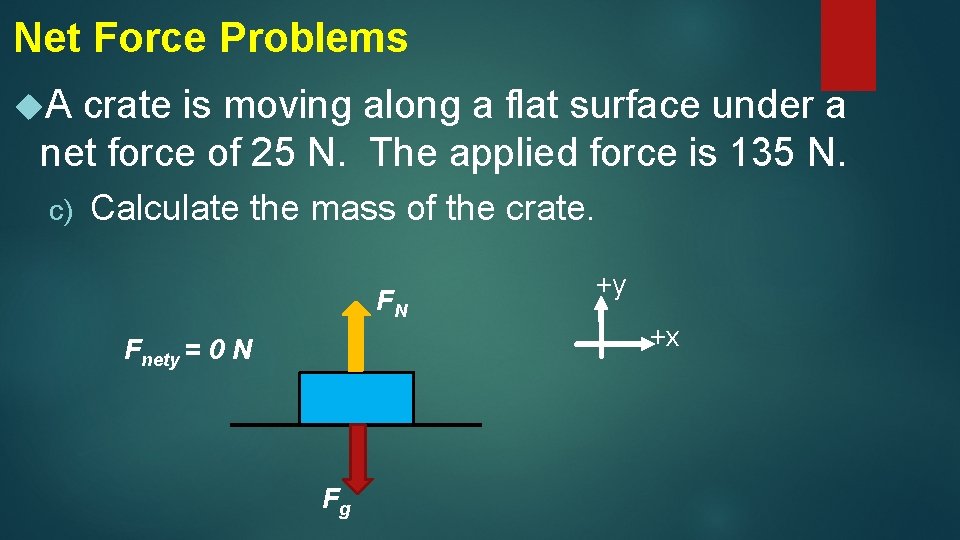
Net Force Problems A crate is moving along a flat surface under a net force of 25 N. The applied force is 135 N. c) Calculate the mass of the crate. FN Fnety = 0 N Fg +y +x
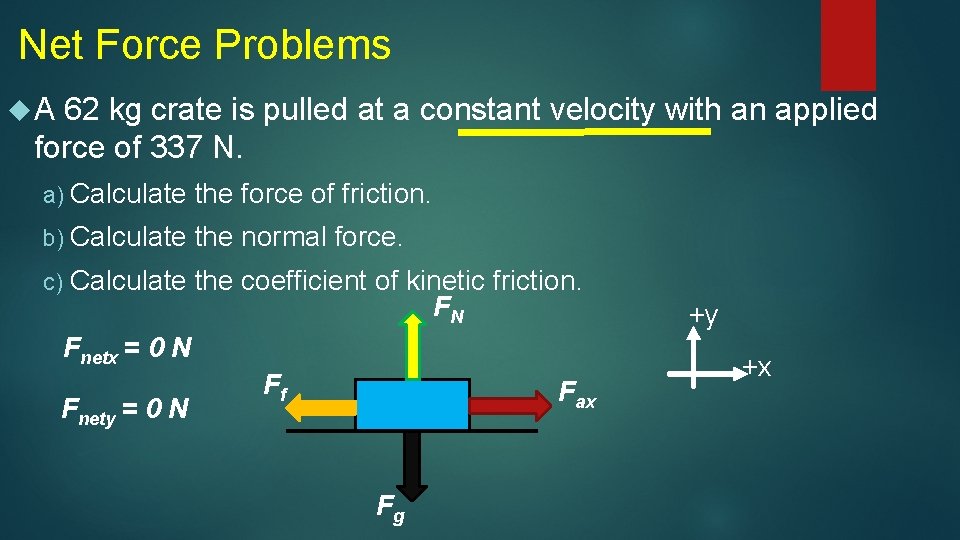
Net Force Problems A 62 kg crate is pulled at a constant velocity with an applied force of 337 N. a) Calculate the force of friction. b) Calculate the normal force. Calculate the coefficient of kinetic friction. FN Fnetx = 0 N Ff Fax Fnety = 0 N c) Fg +y +x
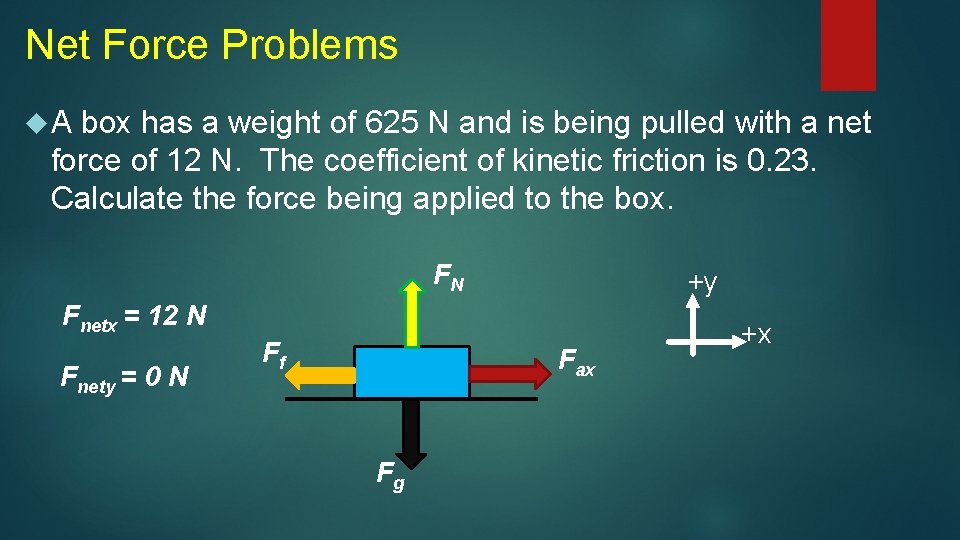
Net Force Problems A box has a weight of 625 N and is being pulled with a net force of 12 N. The coefficient of kinetic friction is 0. 23. Calculate the force being applied to the box. FN +y Fnetx = 12 N Fnety = 0 N Ff Fax Fg +x
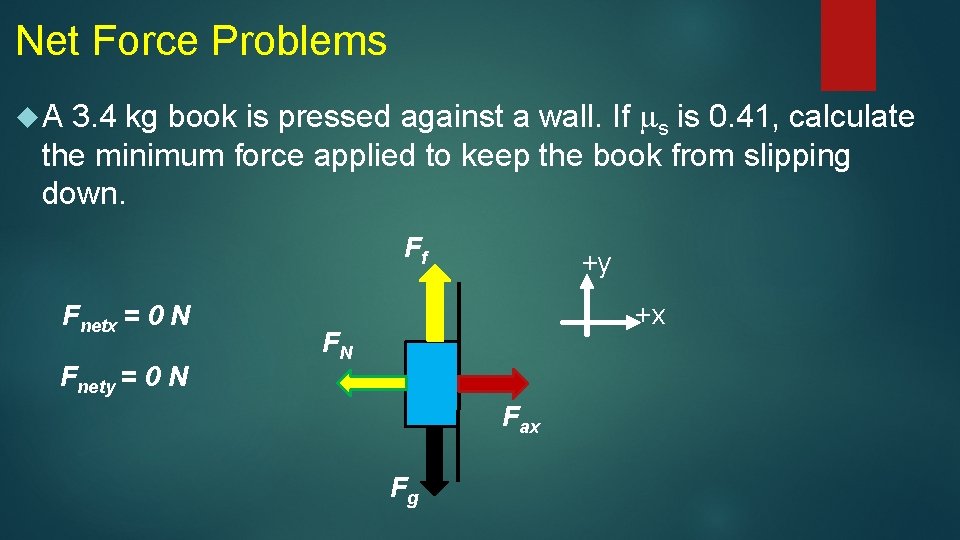
Net Force Problems A 3. 4 kg book is pressed against a wall. If s is 0. 41, calculate the minimum force applied to keep the book from slipping down. Ff Fnetx = 0 N Fnety = 0 N +y +x FN Fax Fg
Net Force Worksheet Continue through the worksheet questions. Test day is coming…
Newton’s Laws CLASSICAL MECHANICS
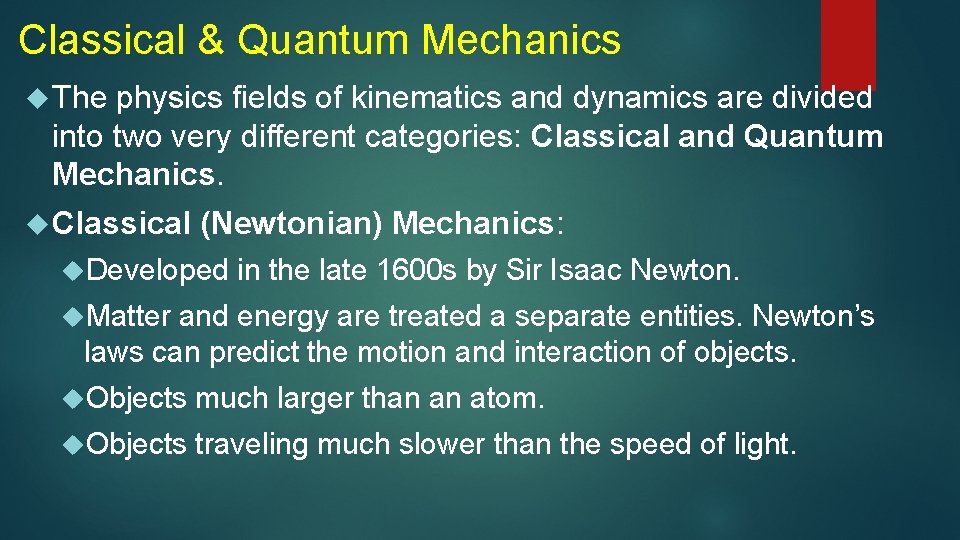
Classical & Quantum Mechanics The physics fields of kinematics and dynamics are divided into two very different categories: Classical and Quantum Mechanics. Classical (Newtonian) Mechanics: Developed in the late 1600 s by Sir Isaac Newton. Matter and energy are treated a separate entities. Newton’s laws can predict the motion and interaction of objects. Objects much larger than an atom. Objects traveling much slower than the speed of light.
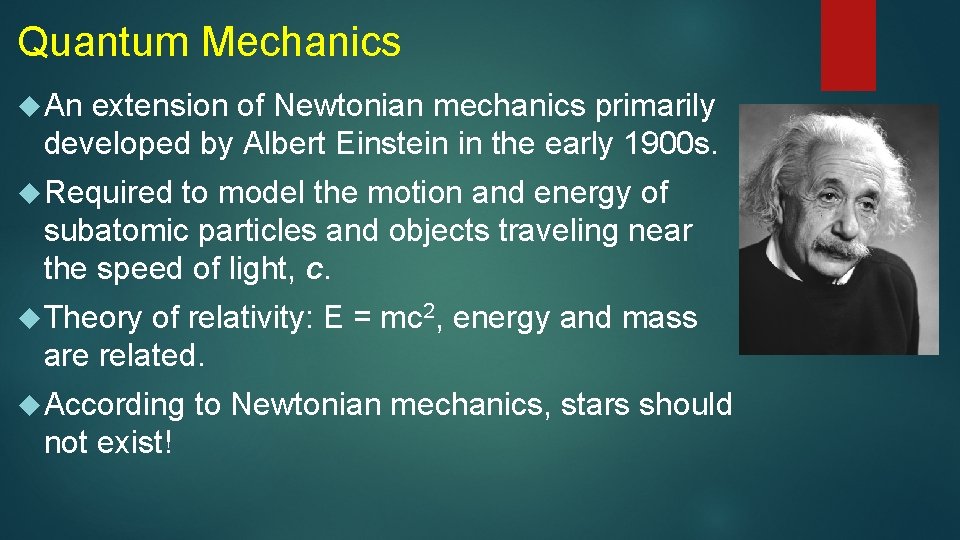
Quantum Mechanics An extension of Newtonian mechanics primarily developed by Albert Einstein in the early 1900 s. Required to model the motion and energy of subatomic particles and objects traveling near the speed of light, c. Theory of relativity: E = mc 2, energy and mass are related. According to Newtonian mechanics, stars should not exist!
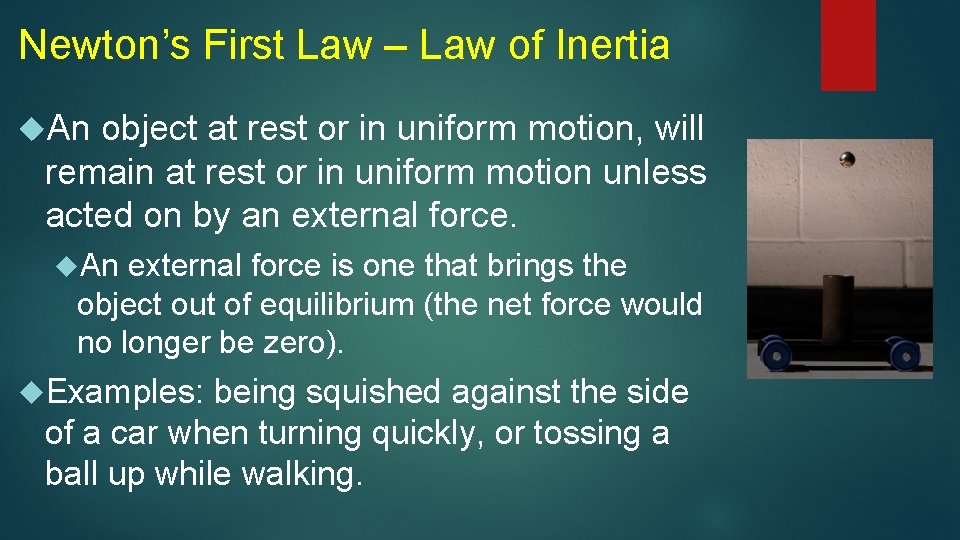
Newton’s First Law – Law of Inertia An object at rest or in uniform motion, will remain at rest or in uniform motion unless acted on by an external force. An external force is one that brings the object out of equilibrium (the net force would no longer be zero). Examples: being squished against the side of a car when turning quickly, or tossing a ball up while walking.
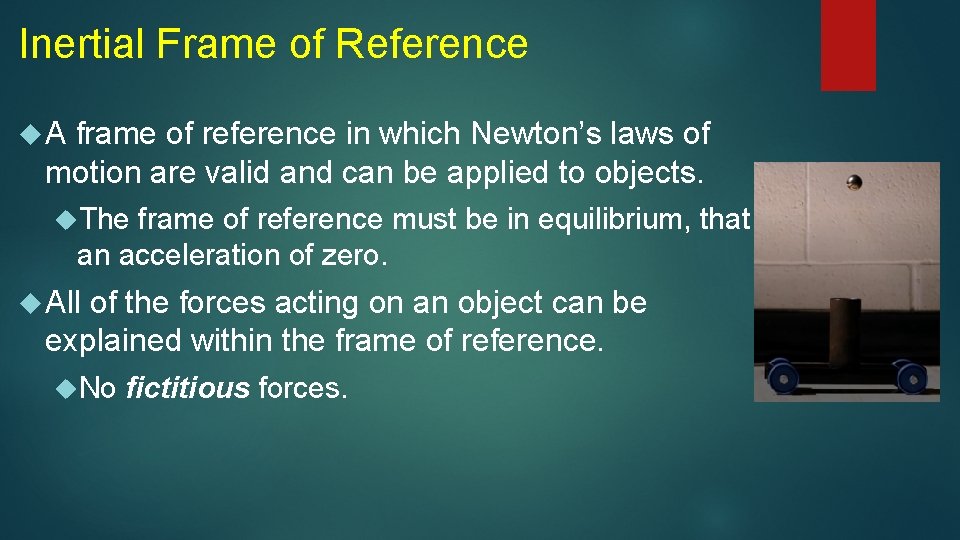
Inertial Frame of Reference A frame of reference in which Newton’s laws of motion are valid and can be applied to objects. The frame of reference must be in equilibrium, that is an acceleration of zero. All of the forces acting on an object can be explained within the frame of reference. No fictitious forces.
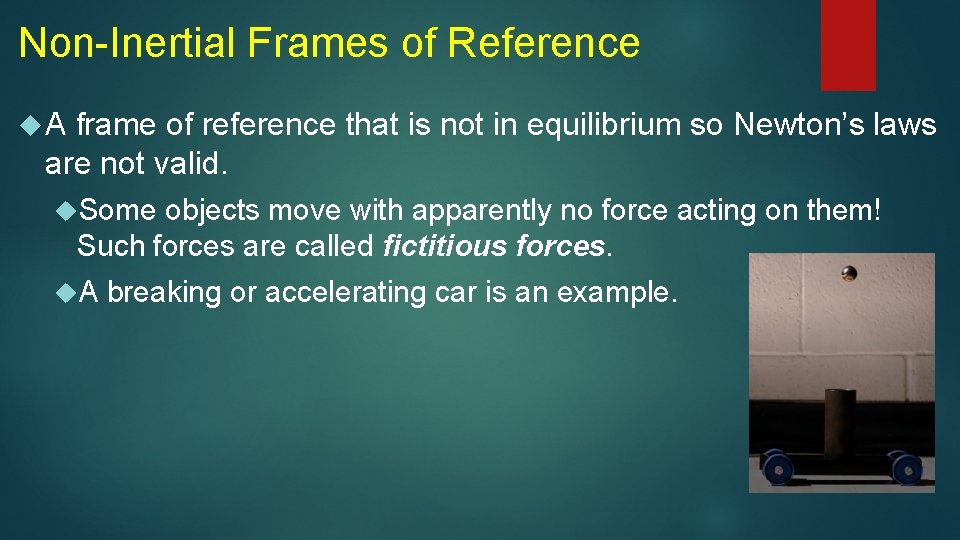
Non-Inertial Frames of Reference A frame of reference that is not in equilibrium so Newton’s laws are not valid. Some objects move with apparently no force acting on them! Such forces are called fictitious forces. A breaking or accelerating car is an example.
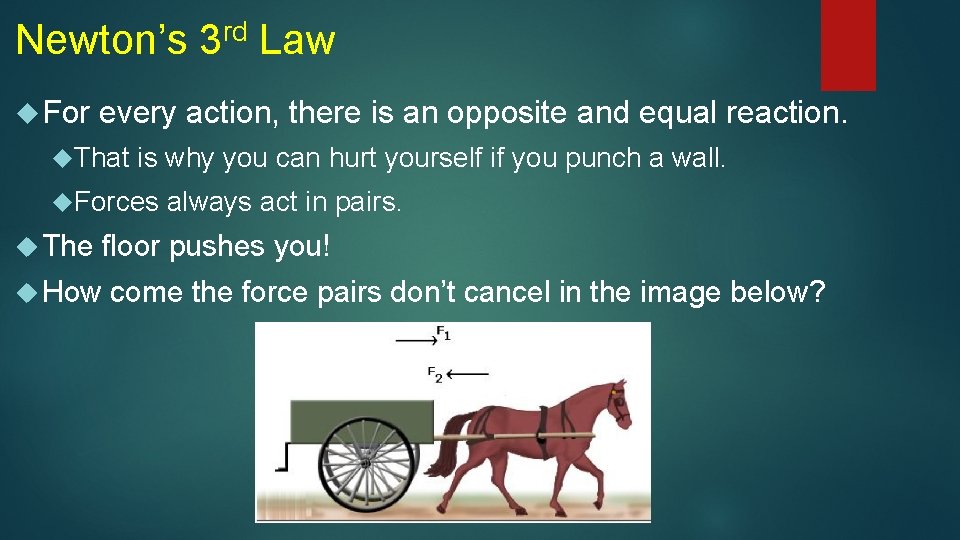
Newton’s 3 rd Law For every action, there is an opposite and equal reaction. That is why you can hurt yourself if you punch a wall. Forces always act in pairs. The floor pushes you! How come the force pairs don’t cancel in the image below?
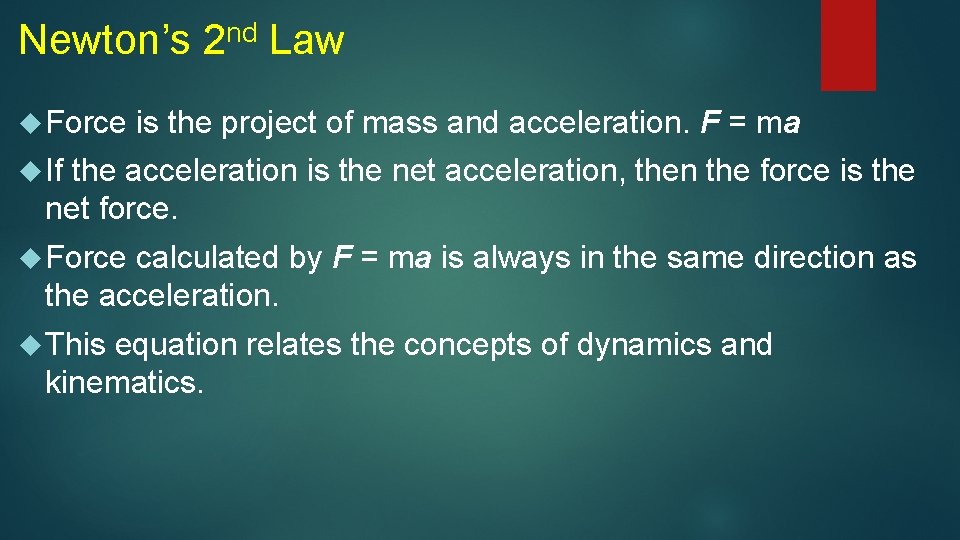
Newton’s 2 nd Law Force is the project of mass and acceleration. F = ma If the acceleration is the net acceleration, then the force is the net force. Force calculated by F = ma is always in the same direction as the acceleration. This equation relates the concepts of dynamics and kinematics.
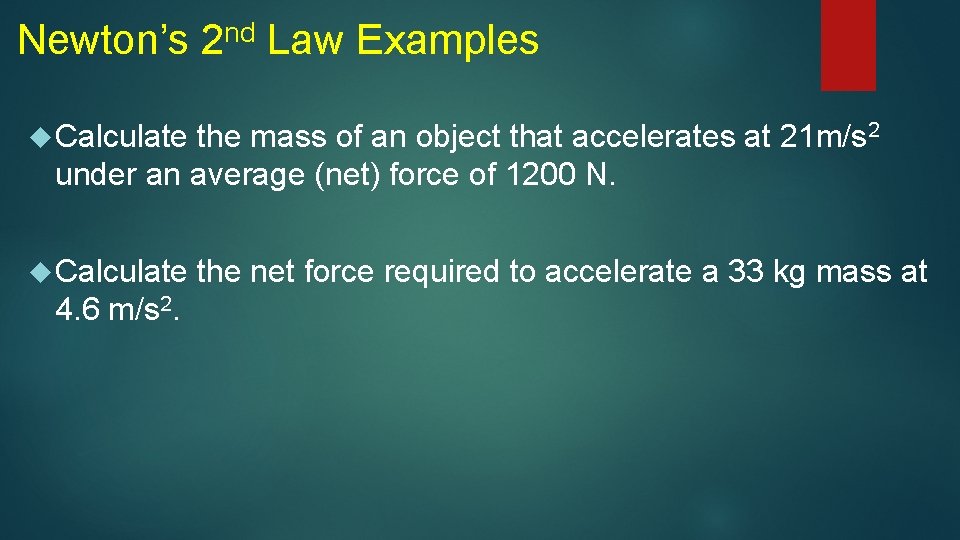
Newton’s 2 nd Law Examples Calculate the mass of an object that accelerates at 21 m/s 2 under an average (net) force of 1200 N. Calculate the net force required to accelerate a 33 kg mass at 4. 6 m/s 2.
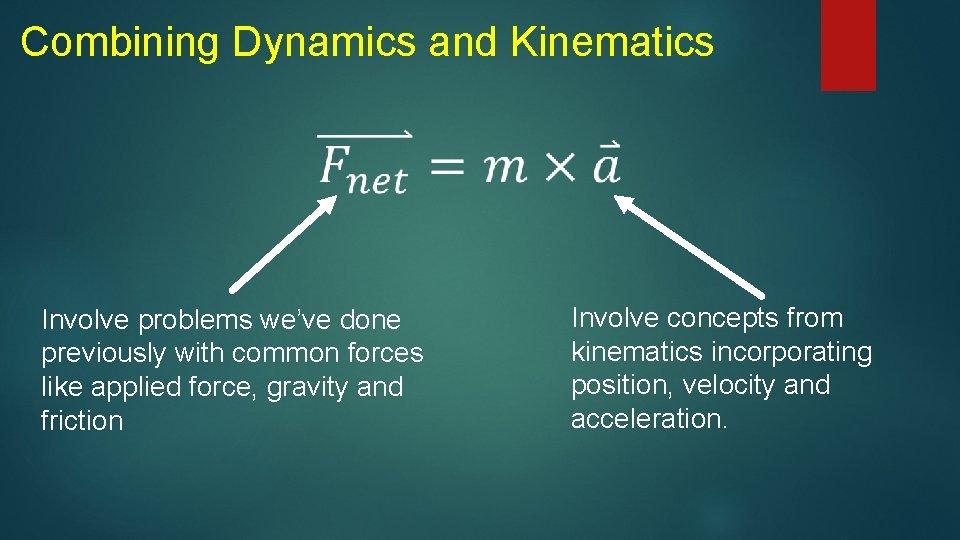
Combining Dynamics and Kinematics Involve problems we’ve done previously with common forces like applied force, gravity and friction Involve concepts from kinematics incorporating position, velocity and acceleration.
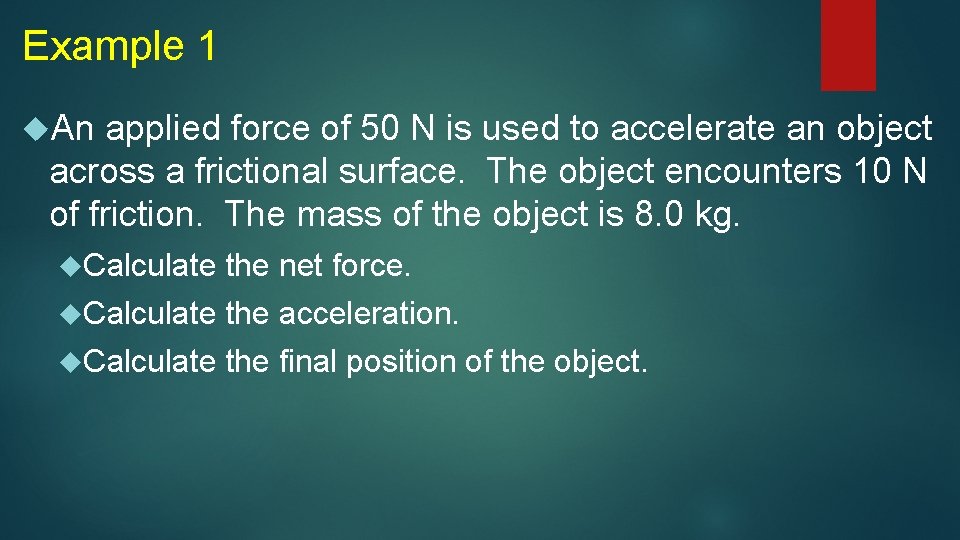
Example 1 An applied force of 50 N is used to accelerate an object across a frictional surface. The object encounters 10 N of friction. The mass of the object is 8. 0 kg. Calculate the net force. Calculate the acceleration. Calculate the final position of the object.
Example 2 A 750 kg car goes from 21 m/s [E] to 15 m/s [W] in 7. 5 seconds. Calculate the net force acting on the car.
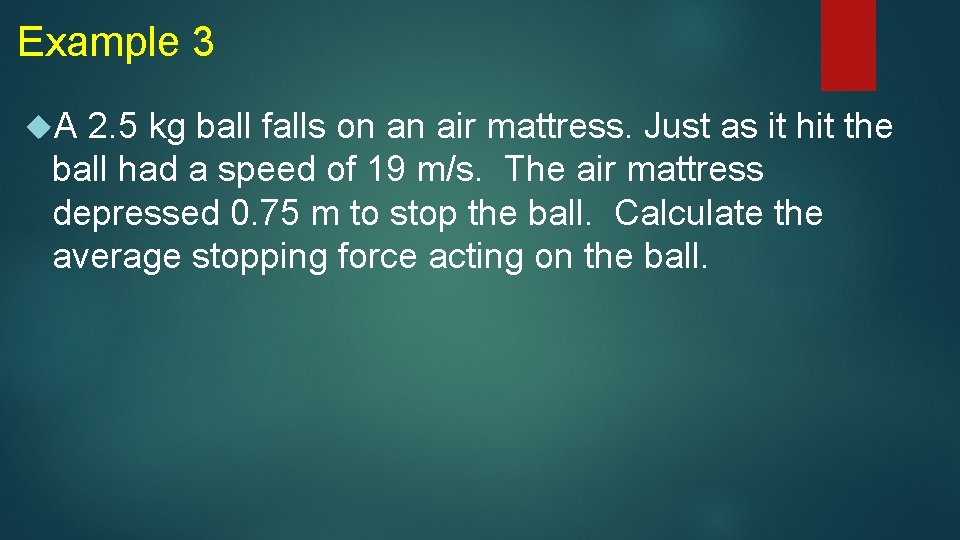
Example 3 A 2. 5 kg ball falls on an air mattress. Just as it hit the ball had a speed of 19 m/s. The air mattress depressed 0. 75 m to stop the ball. Calculate the average stopping force acting on the ball.