
Dynamics of the Benefits of Dual Class Voting
Dynamics of the Benefits of Dual -Class Voting by Kim and Michaeli Discussion by Kate Litvak
Research Question • Impact of Dual-Class Shares of Firm Valuation, Performance, etc. • Theory Reasons to Think: Older Firms Different • Tests Whether Older Dual-Class Firms Different • From younger dual-class firms • From older non-dual-class firms
This Paper • Lots of Data Collection Work • Including by hand • Lots and Lots of Tests • Feels too much • Almost hard to tell which are the core results • I understand the problem: there is a competing concurrent paper, must do something to differentiate • If not for that, I would have recommended splitting the paper into two
Voting Premium and Firm Maturity (I)
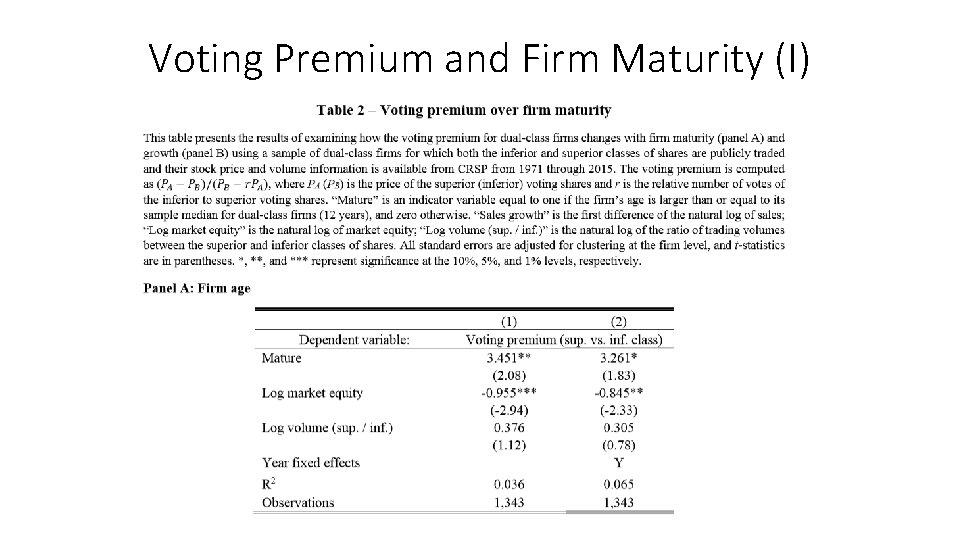
Voting Premium and Firm Maturity (II): Issues and Concerns • Sample – only dual-class firms with tradable superior class • And prob that’s only a minority of superior class • Because controller does not trade • But real problem with dual-class shares • in firms with non-tradable superior class • Or for controller in tradable class who does not trade • (at least it’s so for takeovers, the channel of the effect that authors propose): • Problem: No market value for non-traded blocks • so, cannot test that • So, this is as best we can do • But patterns prob are not the same as for tradable superior class • Esp if the main concern is hostile takeovers
Voting Premium and Firm Maturity (III): Issues and Concerns • Panel Data, but Does Not Use Panel Techniques • No firm fixed effects • No industry fixed effects • No year fixed effects • None in main results column • Yes year FE in second column, but result barely there • Clustering standard errors on firm does not remove bias generated by not using fixed effects • Where We See Main Result on Maturity • When we treat each year in firm’s life as independent event • And compare them to each other as one giant cross-section • Ignoring year, industry, most other firm characteristic except couple of controls • Cannot Call that an “Effect” – No Identification
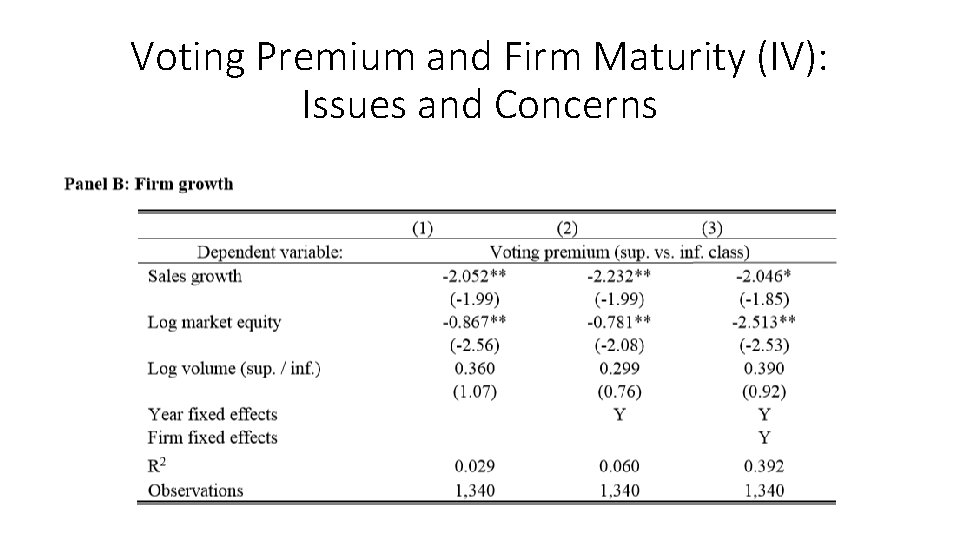
Voting Premium and Firm Maturity (IV): Issues and Concerns
Voting Premium and Firm Maturity (V): Issues and Concerns • Ask re Theory for Using Sales Growth as Proxy for Maturity • At least for this research question • Which has to do with behavior of founders, dependence on their unique skills, etc. • Notice: Uses Firm FE • And Panel A did not • Need to explain • Result with Very Weak for Firm FE • And for year FE or no FE – also week • Is this barely-there result – fruit of large sample, few controls? • Need more robustness checks to show it’s not so
Specification I Prefer Here: Diffs-in-Diffs • Treated shares – superior class • Control shares – inferior class • Event for before-and-after: • Firm switching from “not mature” to “mature” • Add panel techniques • • Firm FE Year FE Firm clusters for standard errors Controls for time-variant characteristics • More flexible measures of “firm maturity” • Not just above-below sample median • Still no identification! • Because no exogenous shock to treated • Firms become “mature” for same reasons that also affect their outcome variables • Esp if “mature” is defined not as years, but as sales growth and such • But at least something
Voting Premium and Firm Maturity (VI): Smaller Issues and Concerns • Maturity is measured very crudely • Yes-no; above sample median age (12 years) or not • But need to see more detailed breakdown • Where is most of the effect? • In the very tails? • In the middle? • More granular measures of maturity • • Age in years Quartile regressions Very tails separately (top-bottom 10%) Other age-based divisions of sample
Better Specification: Diffs-in-Diffs with Stronger Shock than “Maturity” • Treated firms – dual-class • Control firms – non-dual-class • Event for before-and-after: • Firm switching from dual-class to single-class or in reverse • And add the following panel techniques • • Firm FE Year FE Firm clusters for standard errors Controls for time-variant characteristics • Still not great identification! • Because firms choose to change class structure • In response to outcome variables, like share prices • Or in response to world conditions that affect share prices directly, like macro variables • Or can make existing dual class shares publicly tradable or not • Which adds or removes them from sample • But at least something

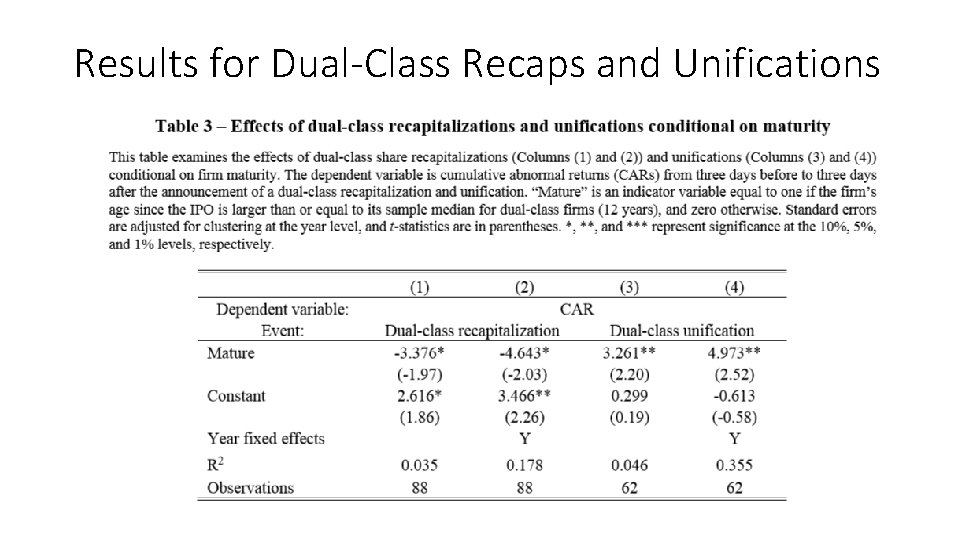
Results for Dual-Class Recaps and Unifications • What’s Good About These Tests • Identification is cleaner • Treated firms • Did recap or unification • Control firms • The rest of the market, via the event-study methodology • Shock • The event of recap or unification • So, we measure treated and controls before and after the shock • Shock is short reduces worries re intervening variables • What else happened on exactly those days? • Weakness: Shock is not exogenous • But ok
Results for Dual-Class Recaps and Unifications
Results for Dual-Class Recaps and Unifications • One Event Per Firm (I hope) • • So, not firm-level panel, like prior table Don’t need Firm FE Still need Year FE and clusters Good if can control for industry, at least roughly • Another possible test – flip the question: • Which pre-event firm characteristics predict which firm would do dual-class recap? • • • Or unification Better firms? More traded firms? Firms in declining industries? Etc. And ask whether that pattern differs for mature and not mature firms
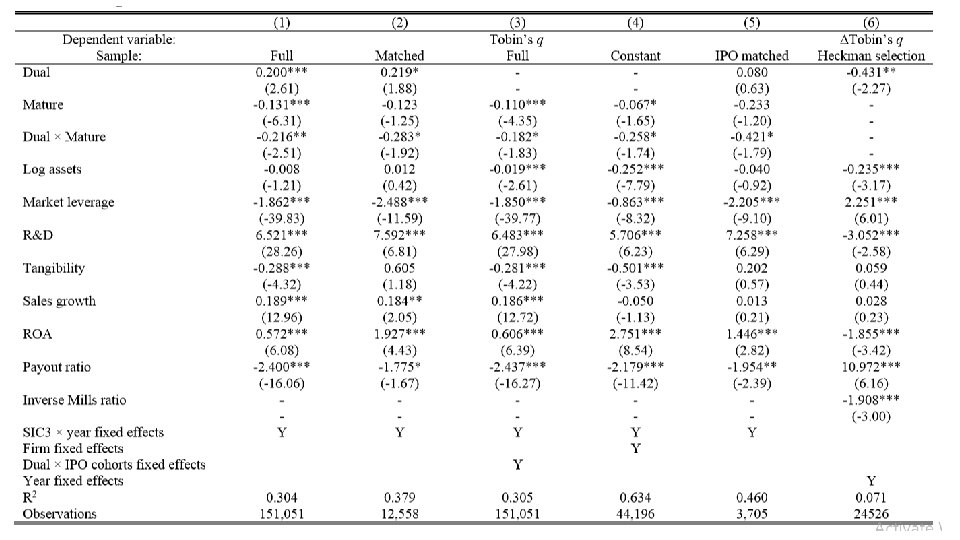
Table 4 – Effects on Firm Value (Tobin’s Q) • My preferred question • Standard spec: • • • Firm FE Year FE Firm Clusters Various standard controls Matched sample, so treated and control firms are similar • So, you don’t estimate on strange small areas of common support • Table 4 does not have a single column like that • No columns with Firm FE and Year FE • But that’s standard for panel regressions • In the one column with firm FE almost no result on coeff of interest • Mature * Dual-Class
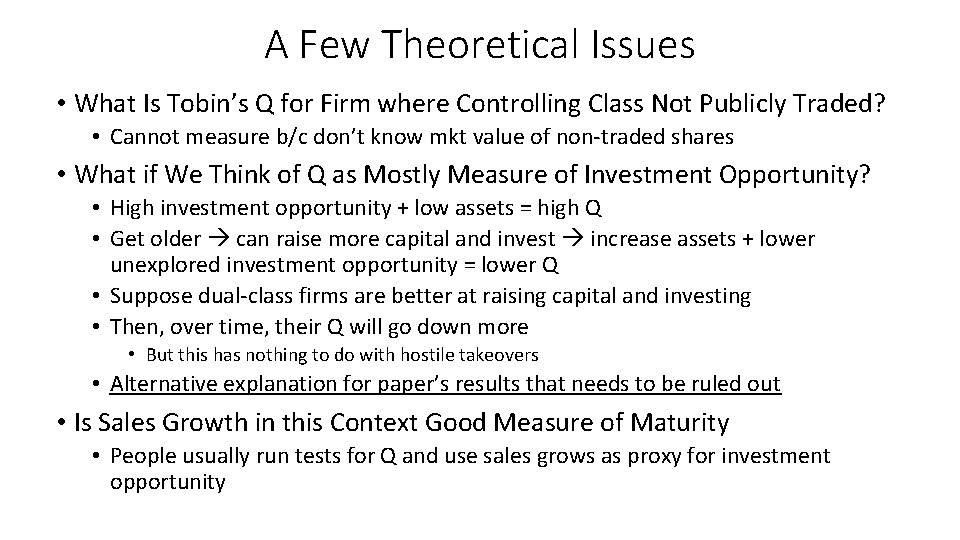
A Few Theoretical Issues • What Is Tobin’s Q for Firm where Controlling Class Not Publicly Traded? • Cannot measure b/c don’t know mkt value of non-traded shares • What if We Think of Q as Mostly Measure of Investment Opportunity? • High investment opportunity + low assets = high Q • Get older can raise more capital and invest increase assets + lower unexplored investment opportunity = lower Q • Suppose dual-class firms are better at raising capital and investing • Then, over time, their Q will go down more • But this has nothing to do with hostile takeovers • Alternative explanation for paper’s results that needs to be ruled out • Is Sales Growth in this Context Good Measure of Maturity • People usually run tests for Q and use sales grows as proxy for investment opportunity
Econometric Comment for All Subsequent Tables • I’d Do Firm FE and Year FE and Firm Clusters Everywhere • None of your panel regs have this spec • Not in operating performance table • Not in innovation table • Here, results especially weak, will likely disappear entirely with proper spec
Table 10 – Switches Due to Sunset • Very Nice Identification, Likely Best of All • For time-based sunsets • Exact Date of Sunset is Exogenous (Kind of) • Set up ahead • No good relationship to what’s going on much later • So, good sort-of exogenous shock for a Diffs-in-Diffs test • Possible problems: • Controllers might be able to control whether or when the unification actually happens by e. g. , amending charter, buying shares, issuing new classes, etc. • Maybe sample is too small? • Paper says only 6. 4% of dual-class firms have time-based sunset
Bottom Line • Very important research question • Great data collection work • Some interesting results • But I prefer different specifications and robustness checks
- Slides: 20