
Dynamics of spinor condensates dipolar interactions and more

- Slides: 52
Dynamics of spinor condensates: dipolar interactions and more Eugene Demler Harvard University Collaborators: Ehud Altman, Robert Cherng, Vladimir Gritsev, Mikhail Lukin, Anatoli Polkovnikov, Ana Maria Rey Experimental collaborators: Immanuel Bloch’s group and Dan Stamper-Kurn’s group Funded by NSF, DARPA, MURI, AFOSR, Harvard-MIT CUA
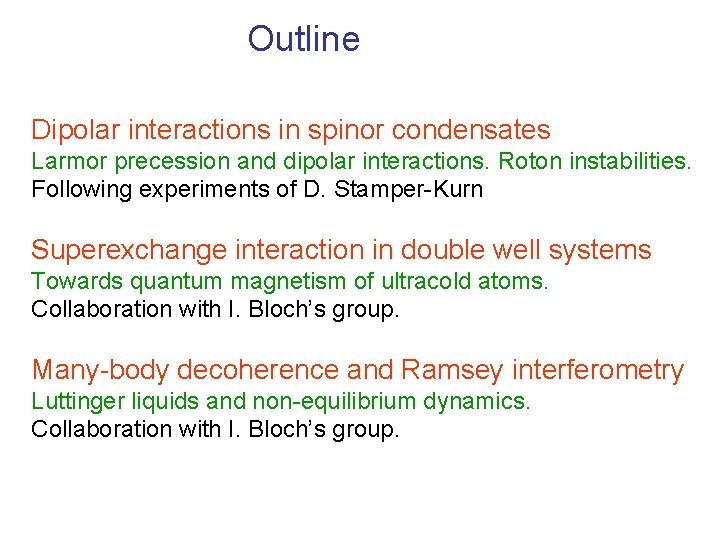
Outline Dipolar interactions in spinor condensates Larmor precession and dipolar interactions. Roton instabilities. Following experiments of D. Stamper-Kurn Superexchange interaction in double well systems Towards quantum magnetism of ultracold atoms. Collaboration with I. Bloch’s group. Many-body decoherence and Ramsey interferometry Luttinger liquids and non-equilibrium dynamics. Collaboration with I. Bloch’s group.
Dipolar interactions in spinor condensates. Introduction
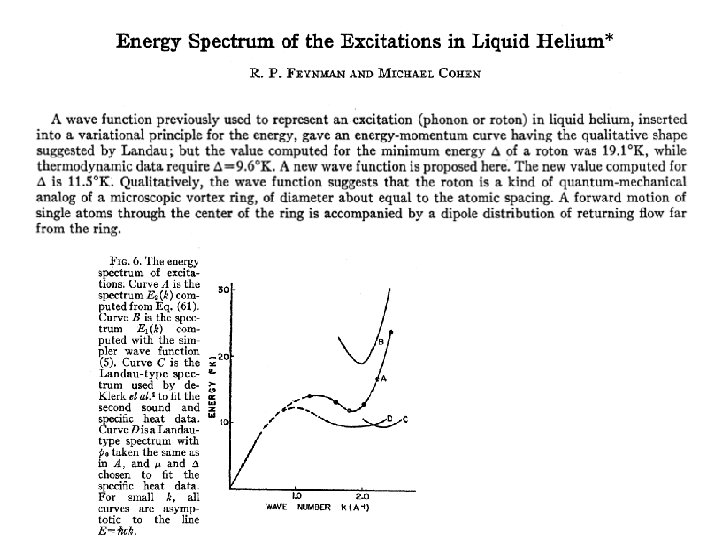
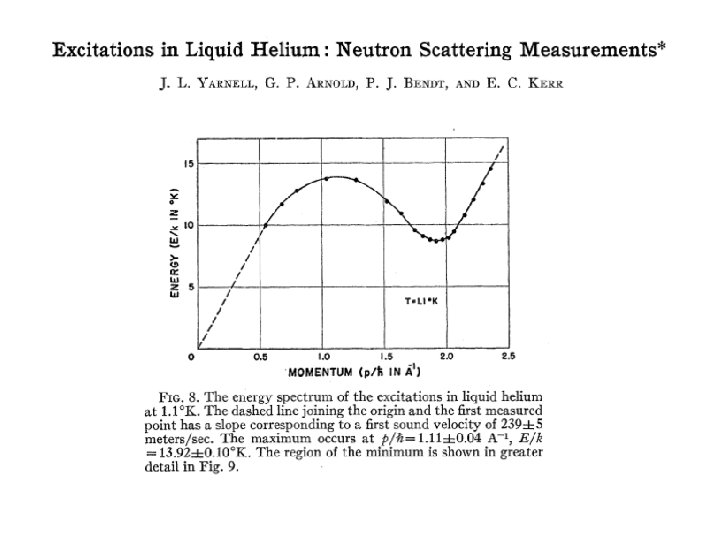
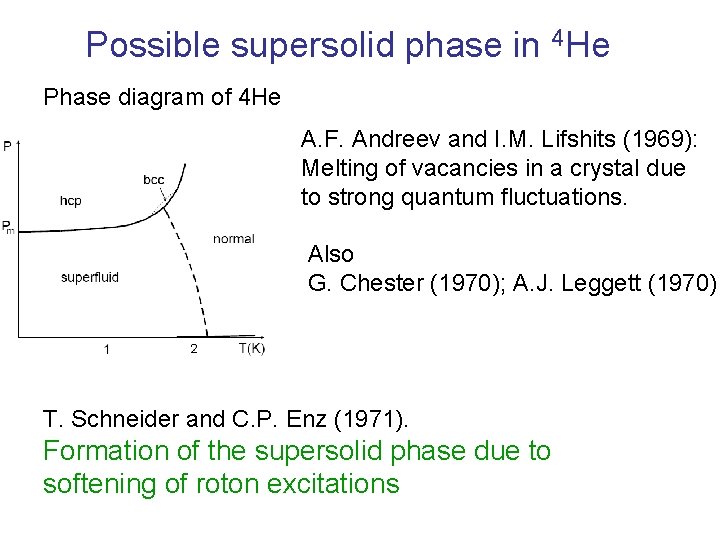
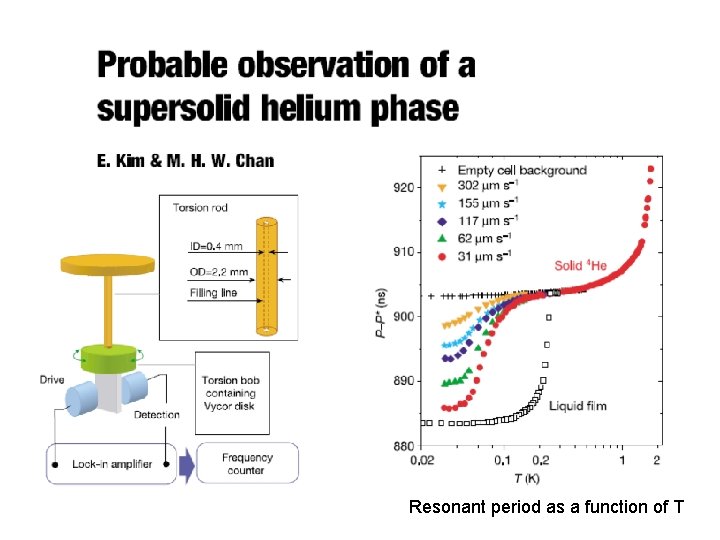
Possible supersolid phase in 4 He Phase diagram of 4 He A. F. Andreev and I. M. Lifshits (1969): Melting of vacancies in a crystal due to strong quantum fluctuations. Also G. Chester (1970); A. J. Leggett (1970) T. Schneider and C. P. Enz (1971). Formation of the supersolid phase due to softening of roton excitations
Resonant period as a function of T
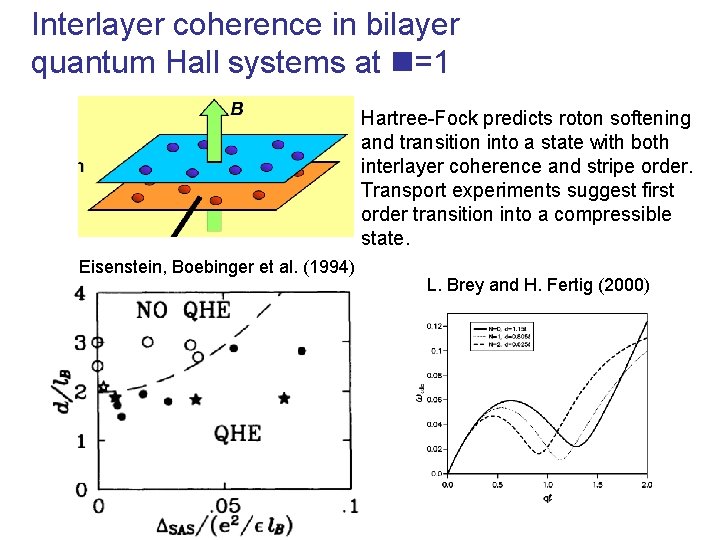
Interlayer coherence in bilayer quantum Hall systems at n=1 Hartree-Fock predicts roton softening and transition into a state with both interlayer coherence and stripe order. Transport experiments suggest first order transition into a compressible state. Eisenstein, Boebinger et al. (1994) L. Brey and H. Fertig (2000)
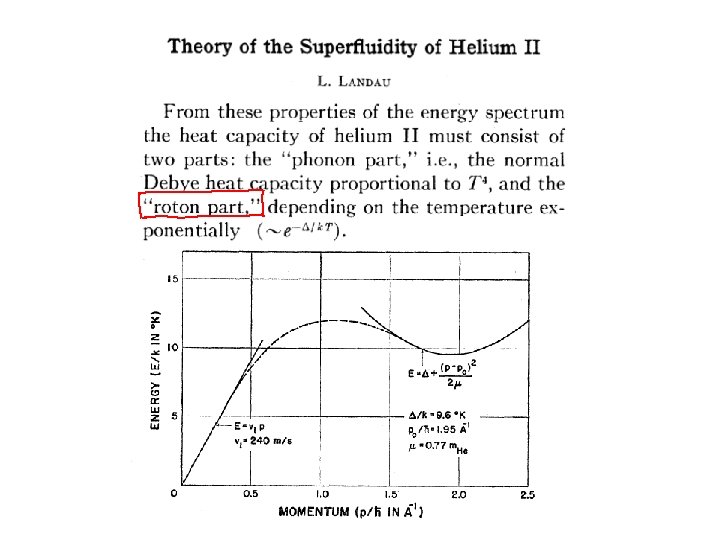
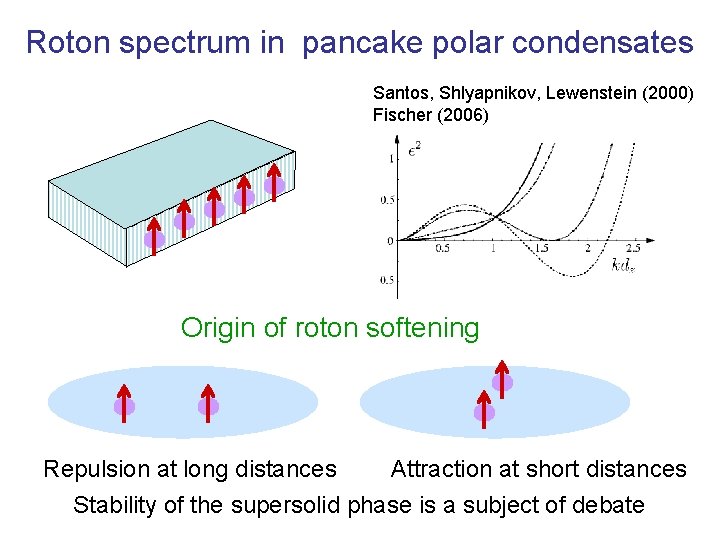
Roton spectrum in pancake polar condensates Santos, Shlyapnikov, Lewenstein (2000) Fischer (2006) Origin of roton softening Repulsion at long distances Attraction at short distances Stability of the supersolid phase is a subject of debate
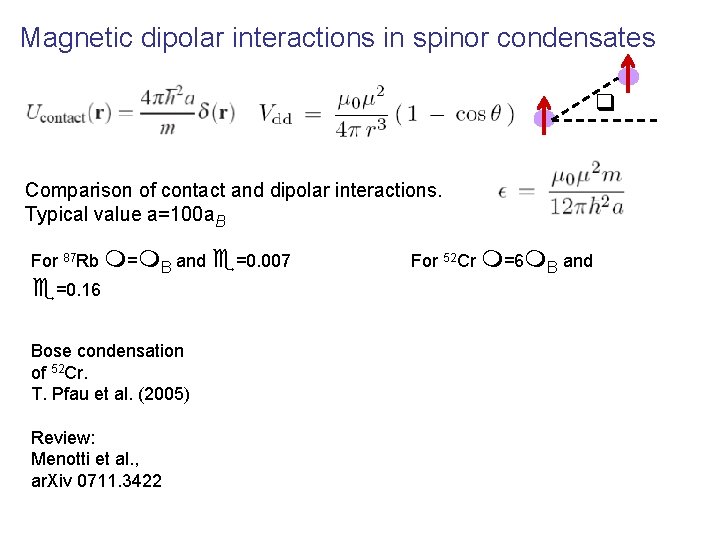
Magnetic dipolar interactions in spinor condensates q Comparison of contact and dipolar interactions. Typical value a=100 a. B For 87 Rb m=m. B and e=0. 007 e=0. 16 Bose condensation of 52 Cr. T. Pfau et al. (2005) Review: Menotti et al. , ar. Xiv 0711. 3422 For 52 Cr m=6 m. B and
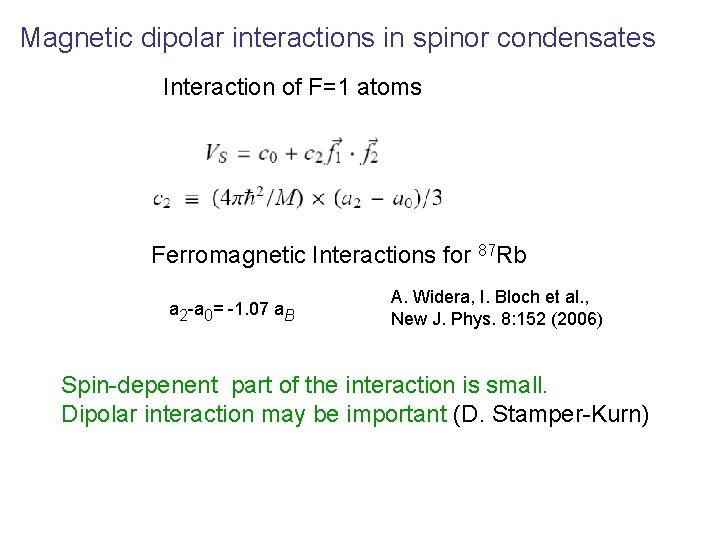
Magnetic dipolar interactions in spinor condensates Interaction of F=1 atoms Ferromagnetic Interactions for 87 Rb a 2 -a 0= -1. 07 a. B A. Widera, I. Bloch et al. , New J. Phys. 8: 152 (2006) Spin-depenent part of the interaction is small. Dipolar interaction may be important (D. Stamper-Kurn)
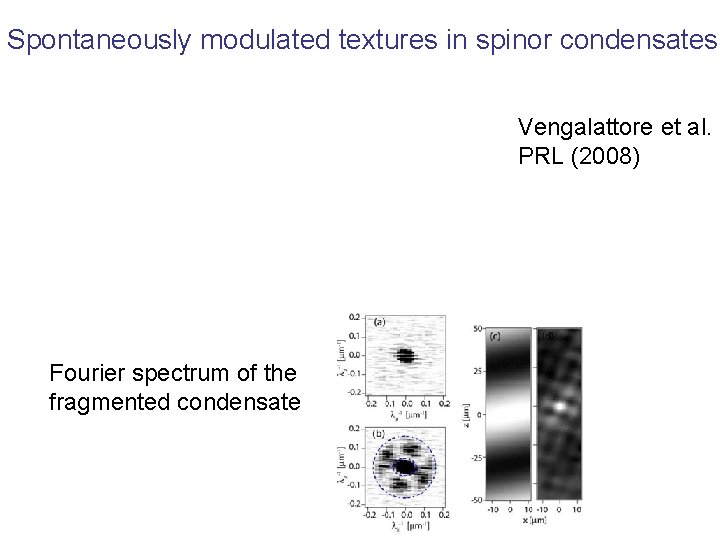
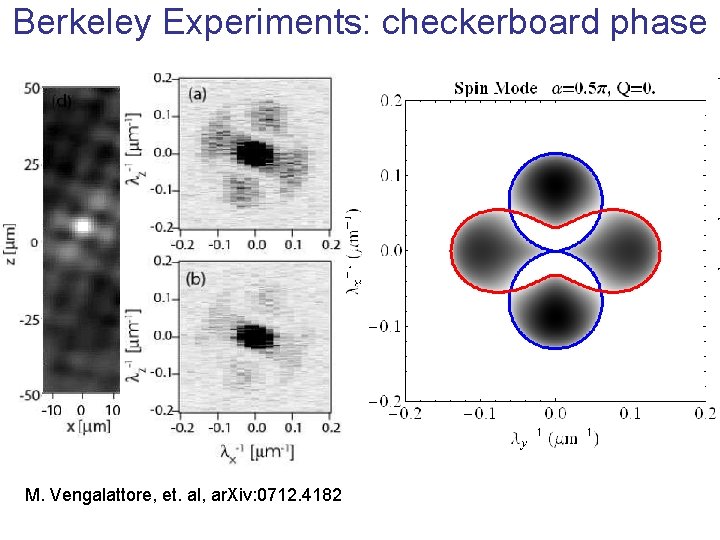
Spontaneously modulated textures in spinor condensates Vengalattore et al. PRL (2008) Fourier spectrum of the fragmented condensate
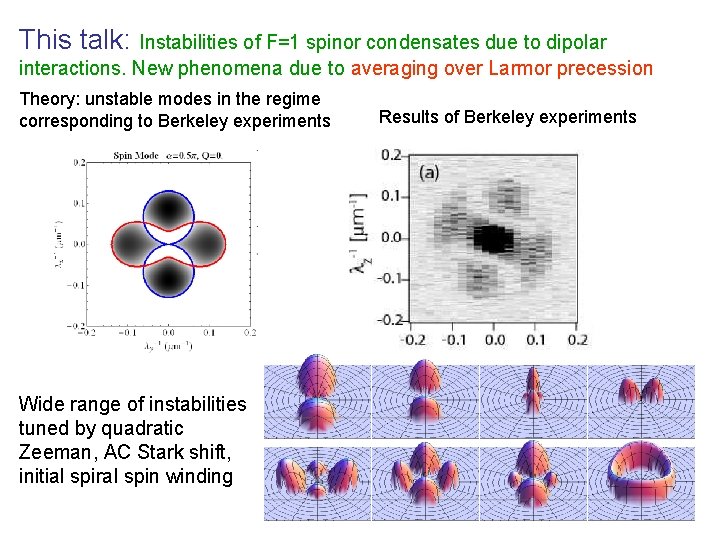
This talk: Instabilities of F=1 spinor condensates due to dipolar interactions. New phenomena due to averaging over Larmor precession Theory: unstable modes in the regime corresponding to Berkeley experiments Wide range of instabilities tuned by quadratic Zeeman, AC Stark shift, initial spiral spin winding Results of Berkeley experiments
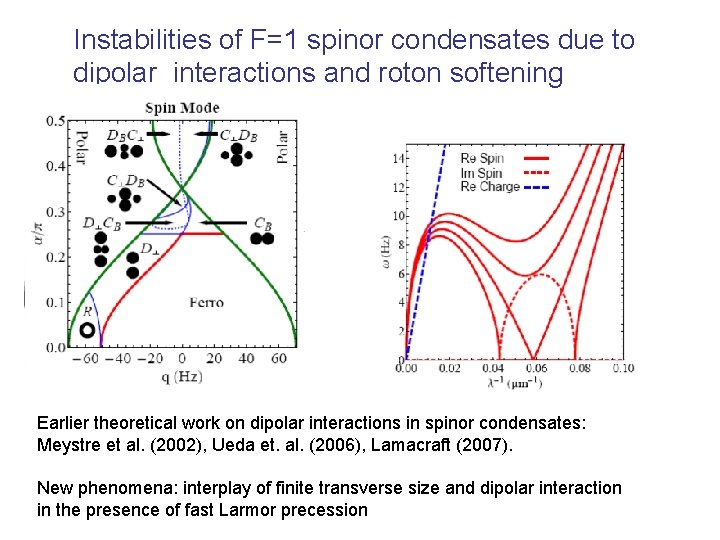
Instabilities of F=1 spinor condensates due to dipolar interactions and roton softening Earlier theoretical work on dipolar interactions in spinor condensates: Meystre et al. (2002), Ueda et. al. (2006), Lamacraft (2007). New phenomena: interplay of finite transverse size and dipolar interaction in the presence of fast Larmor precession
Dipolar interactions after averaging over Larmor precession
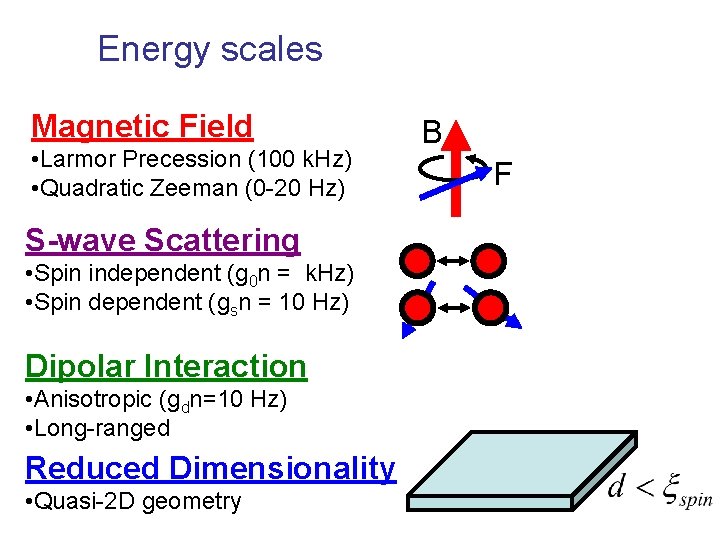
Energy scales Magnetic Field • Larmor Precession (100 k. Hz) • Quadratic Zeeman (0 -20 Hz) S-wave Scattering • Spin independent (g 0 n = k. Hz) • Spin dependent (gsn = 10 Hz) Dipolar Interaction • Anisotropic (gdn=10 Hz) • Long-ranged Reduced Dimensionality • Quasi-2 D geometry B F
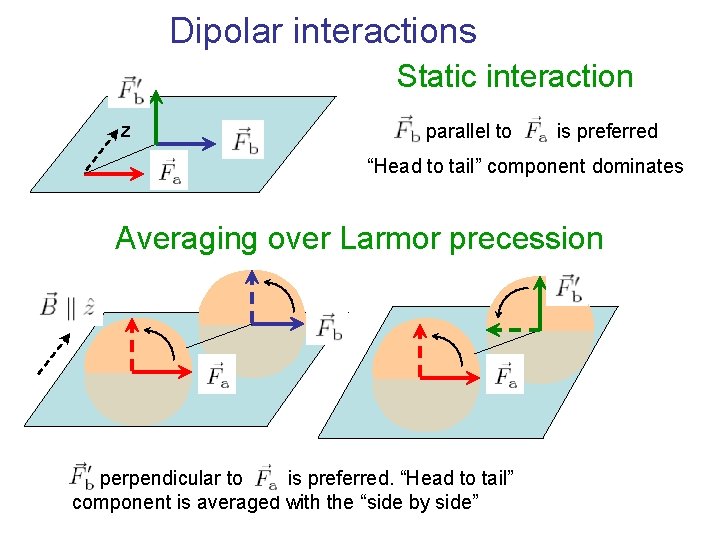
Dipolar interactions Static interaction z parallel to is preferred “Head to tail” component dominates Averaging over Larmor precession perpendicular to is preferred. “Head to tail” component is averaged with the “side by side”
Instabilities: qualitative picture
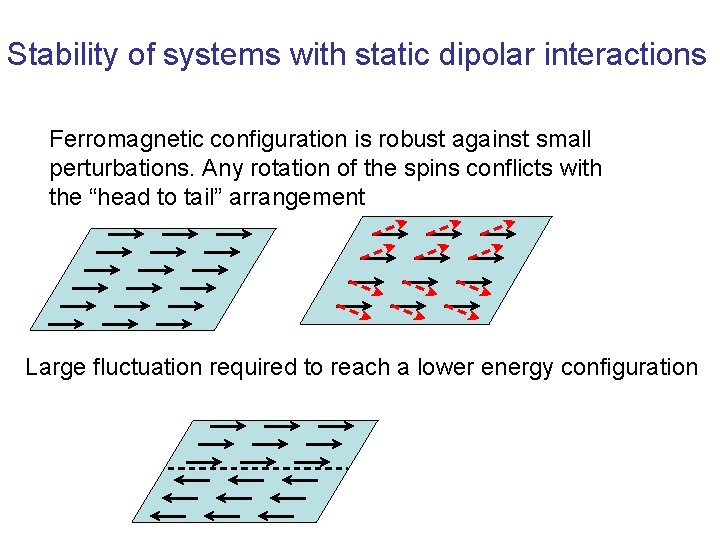
Stability of systems with static dipolar interactions Ferromagnetic configuration is robust against small perturbations. Any rotation of the spins conflicts with the “head to tail” arrangement Large fluctuation required to reach a lower energy configuration
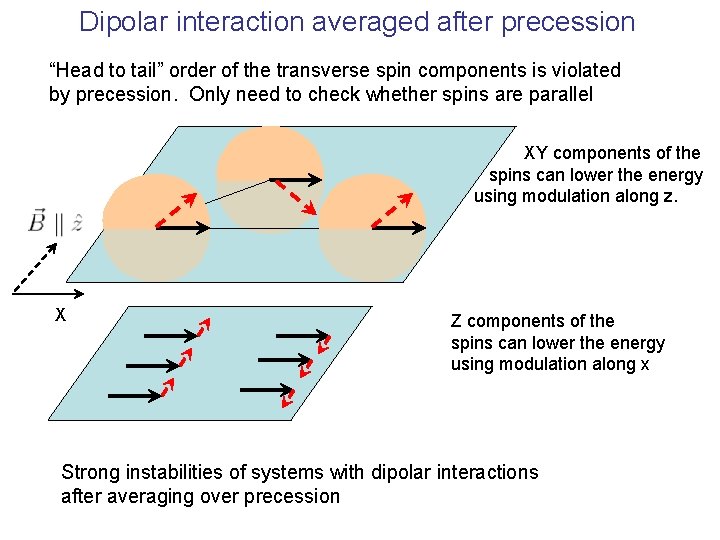
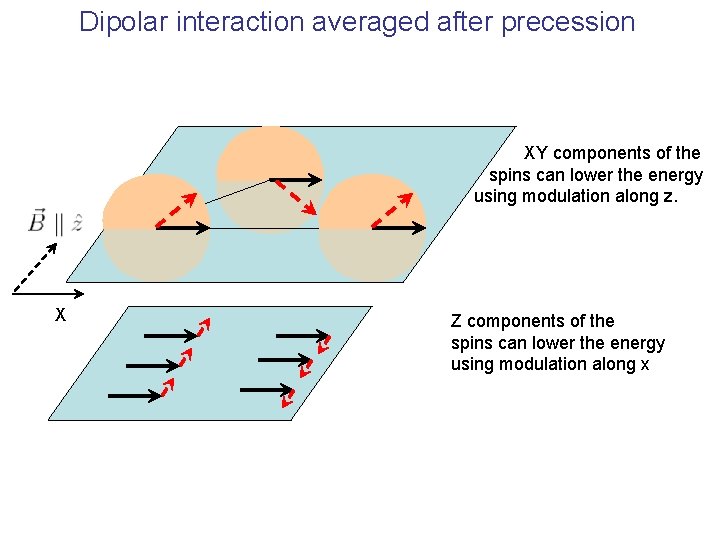
Dipolar interaction averaged after precession “Head to tail” order of the transverse spin components is violated by precession. Only need to check whether spins are parallel XY components of the spins can lower the energy using modulation along z. X X Z components of the spins can lower the energy using modulation along x Strong instabilities of systems with dipolar interactions after averaging over precession
Instabilities: technical details
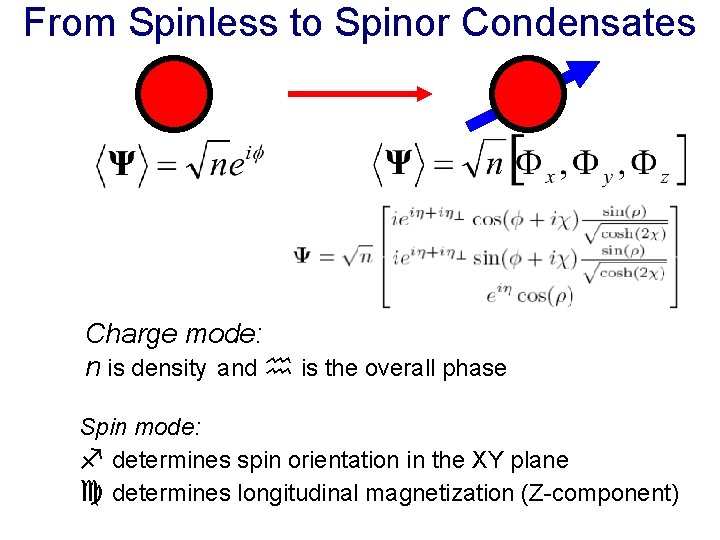
From Spinless to Spinor Condensates Charge mode: n is density and h is the overall phase Spin mode: f determines spin orientation in the XY plane c determines longitudinal magnetization (Z-component)
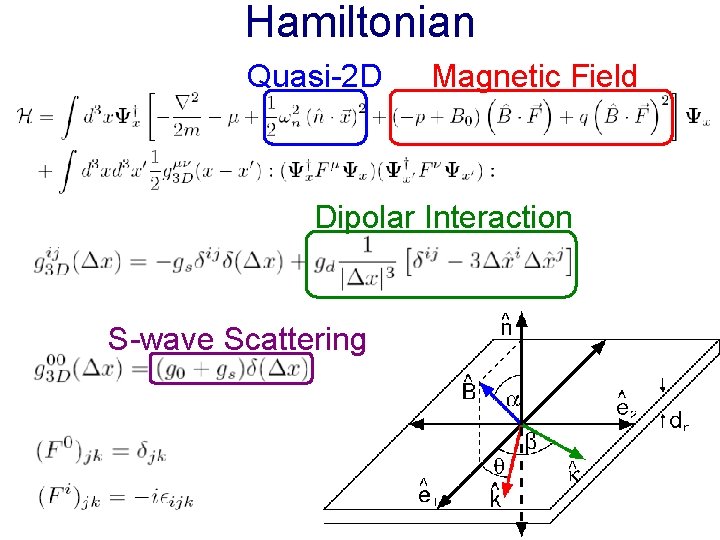
Hamiltonian Quasi-2 D Magnetic Field Dipolar Interaction S-wave Scattering
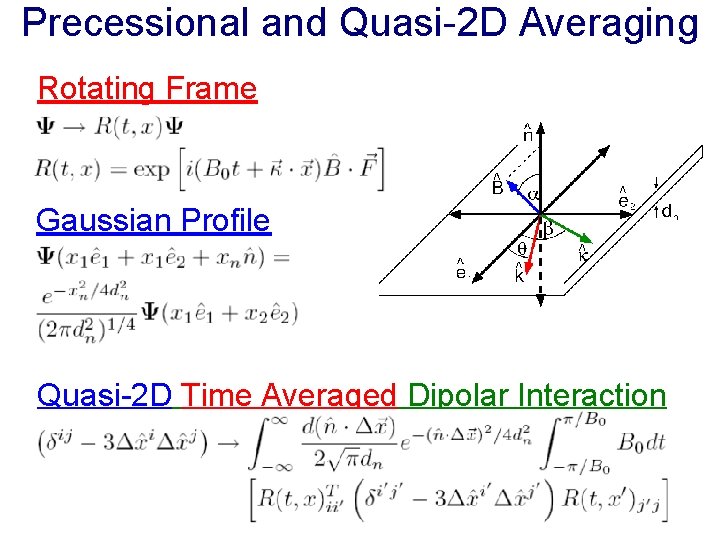
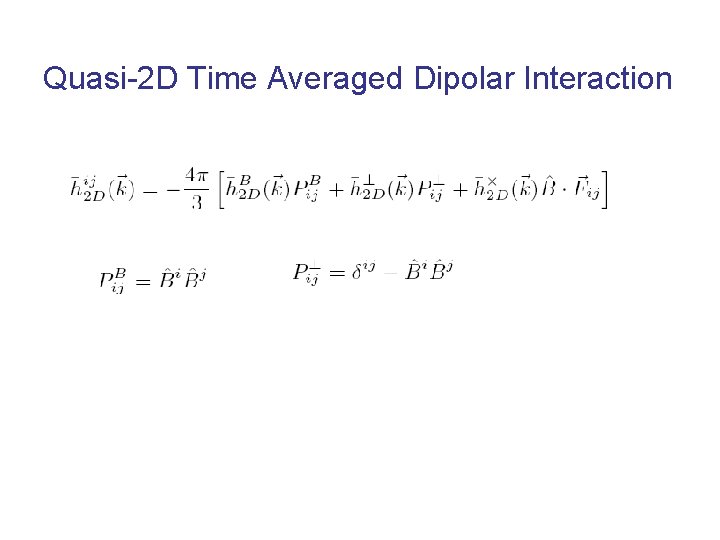
Precessional and Quasi-2 D Averaging Rotating Frame Gaussian Profile Quasi-2 D Time Averaged Dipolar Interaction
Quasi-2 D Time Averaged Dipolar Interaction
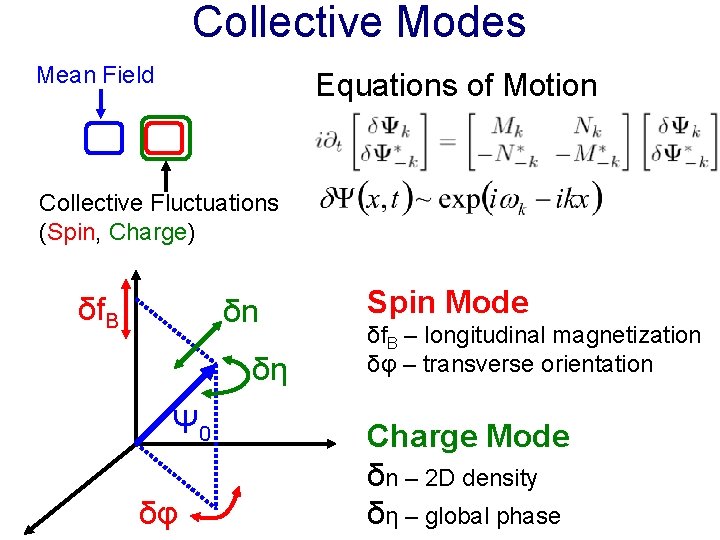
Collective Modes Mean Field Equations of Motion Collective Fluctuations (Spin, Charge) δf. B δn δη Ψ 0 δφ Spin Mode δf. B – longitudinal magnetization δφ – transverse orientation Charge Mode δn – 2 D density δη – global phase
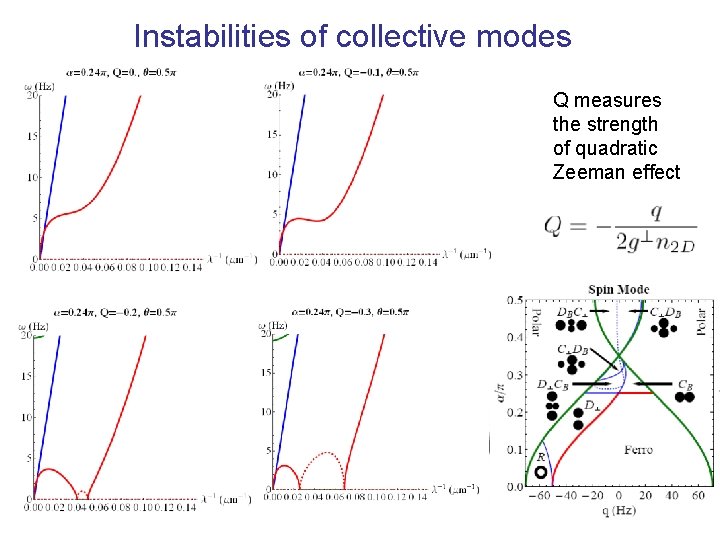
Instabilities of collective modes Q measures the strength of quadratic Zeeman effect
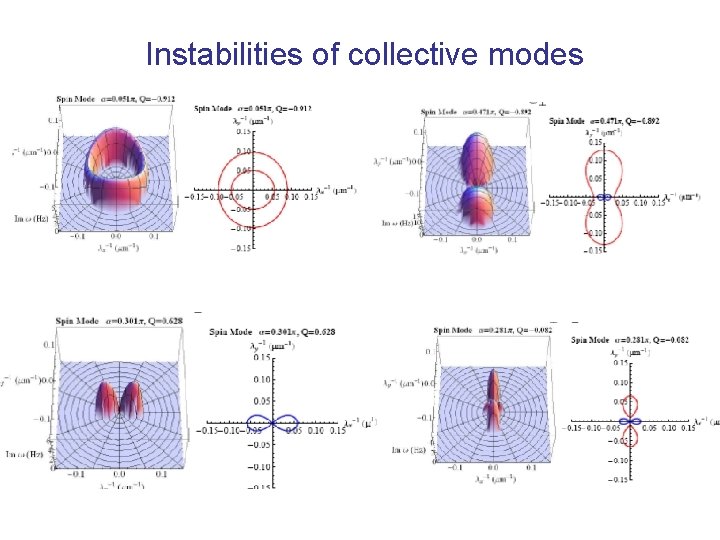
Instabilities of collective modes
Berkeley Experiments: checkerboard phase M. Vengalattore, et. al, ar. Xiv: 0712. 4182
Dipolar interaction averaged after precession XY components of the spins can lower the energy using modulation along z. X X Z components of the spins can lower the energy using modulation along x
Instabilities of collective modes
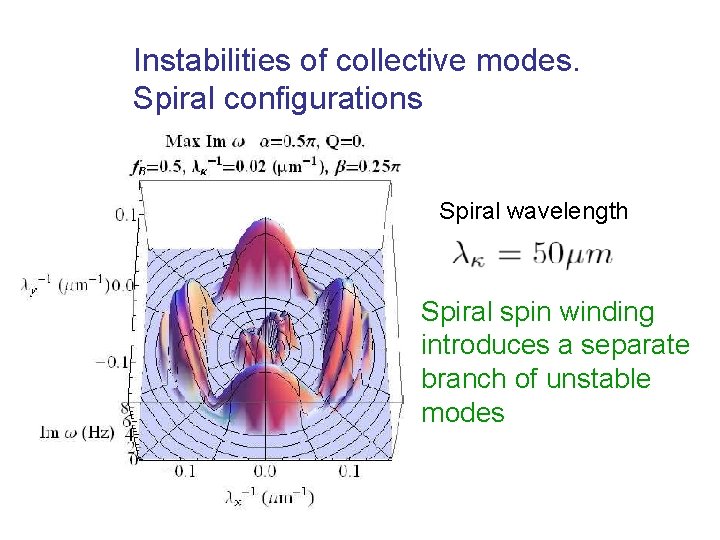
Instabilities of collective modes. Spiral configurations Spiral wavelength Spiral spin winding introduces a separate branch of unstable modes
Superexchange interaction in experiments with double wells Refs: Theory: A. M. Rey et al. , Phys. Rev. Lett. 99: 140601 (2007) Experiment: S. Trotzky et al. , Science 319: 295 (2008)
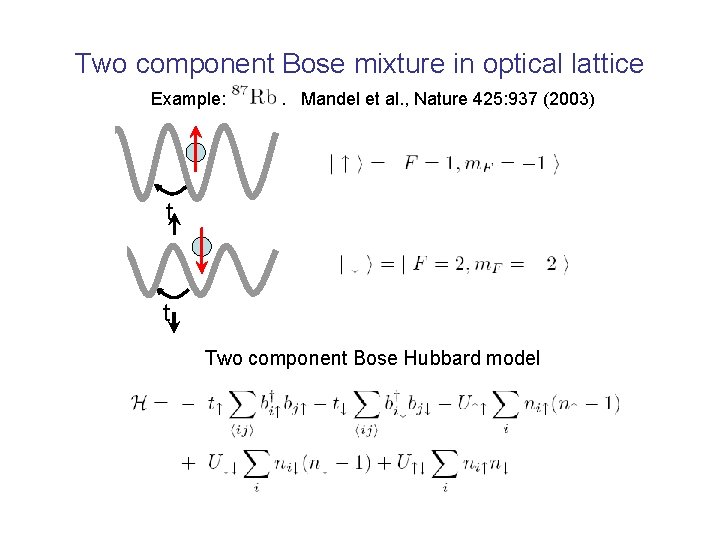
Two component Bose mixture in optical lattice Example: . Mandel et al. , Nature 425: 937 (2003) t t Two component Bose Hubbard model
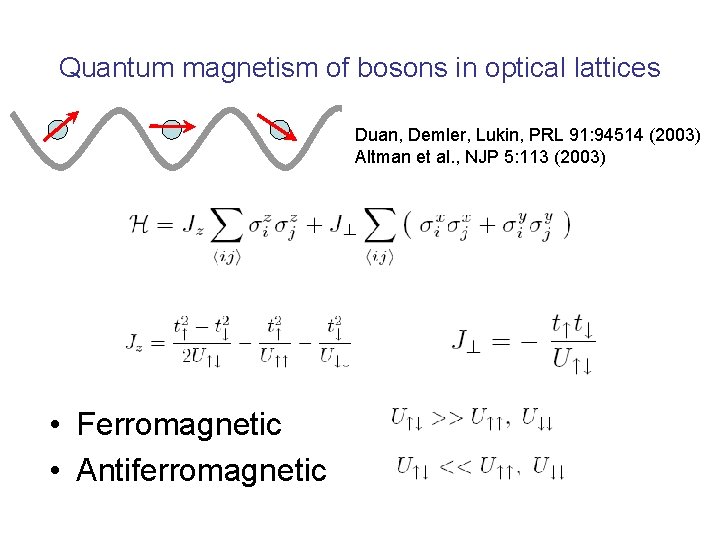
Quantum magnetism of bosons in optical lattices Duan, Demler, Lukin, PRL 91: 94514 (2003) Altman et al. , NJP 5: 113 (2003) • Ferromagnetic • Antiferromagnetic
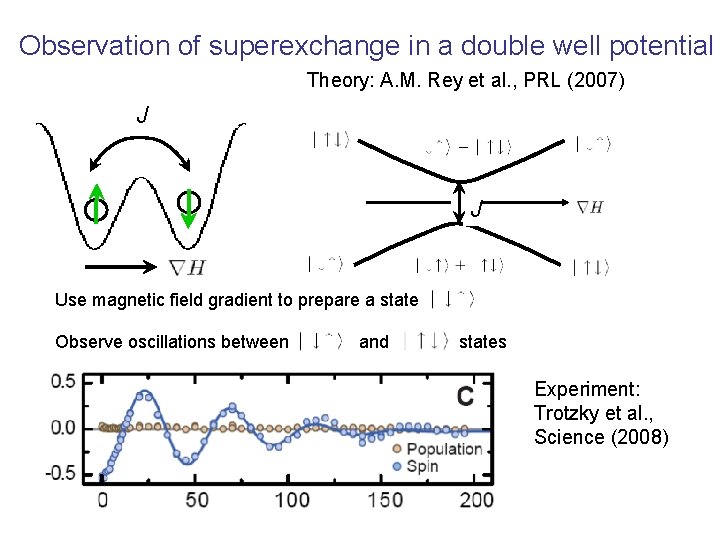
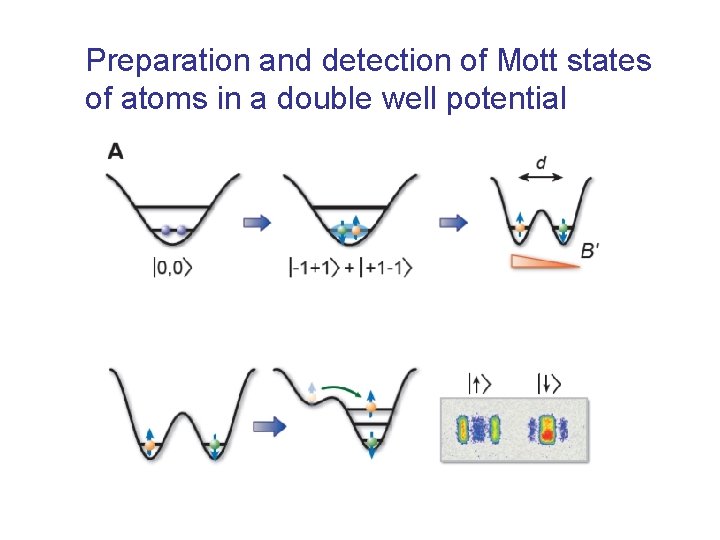
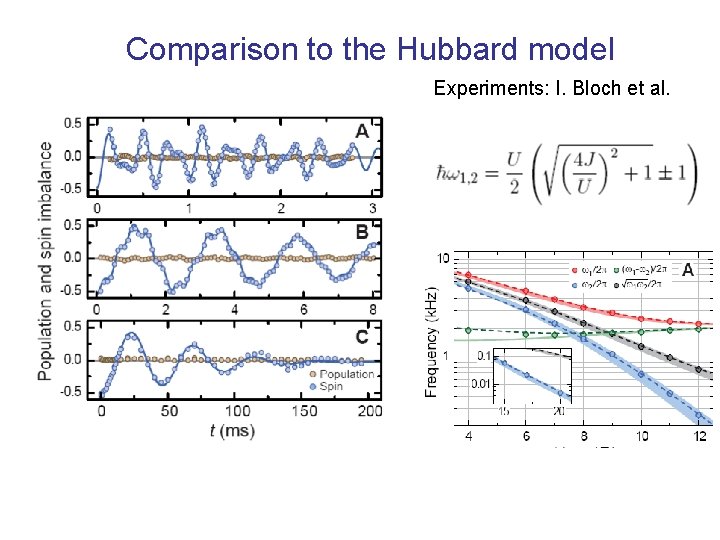
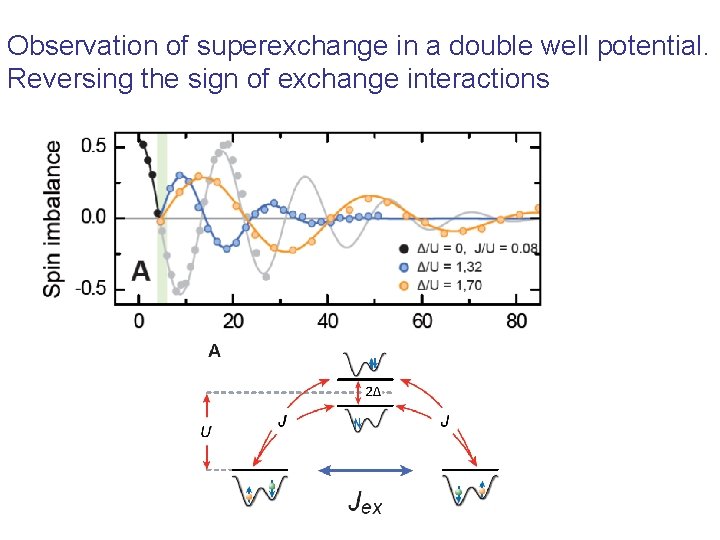
Observation of superexchange in a double well potential Theory: A. M. Rey et al. , PRL (2007) J J Use magnetic field gradient to prepare a state Observe oscillations between and states Experiment: Trotzky et al. , Science (2008)
Preparation and detection of Mott states of atoms in a double well potential
Comparison to the Hubbard model Experiments: I. Bloch et al.
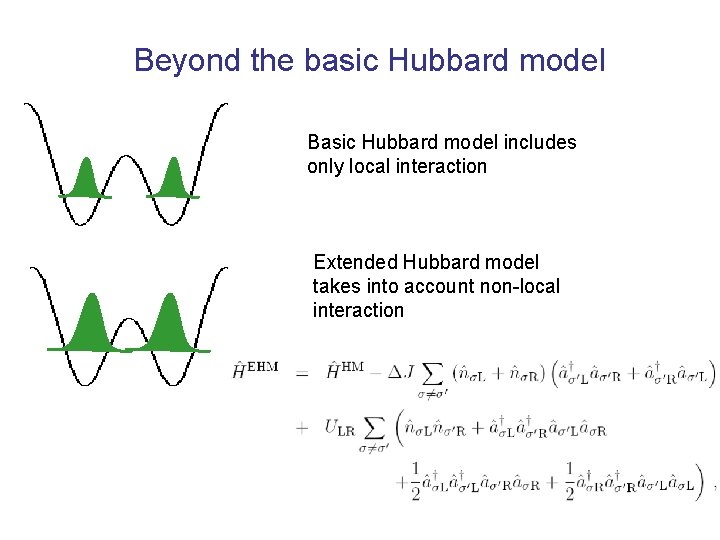
Beyond the basic Hubbard model Basic Hubbard model includes only local interaction Extended Hubbard model takes into account non-local interaction
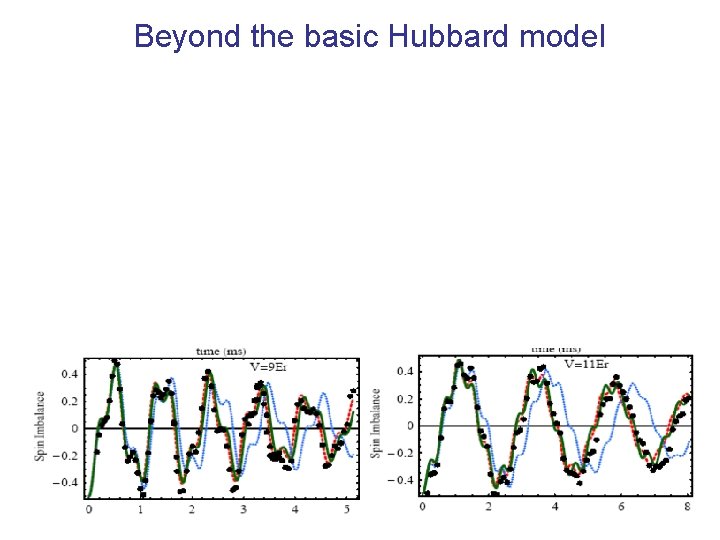
Beyond the basic Hubbard model
Observation of superexchange in a double well potential. Reversing the sign of exchange interactions
Many-body decoherence and Ramsey interferometry Collaboration with A. Widera, S. Trotzky, P. Cheinet, S. Fölling, F. Gerbier, I. Bloch, V. Gritsev, M. Lukin Phys. Rev. Lett. (2008)
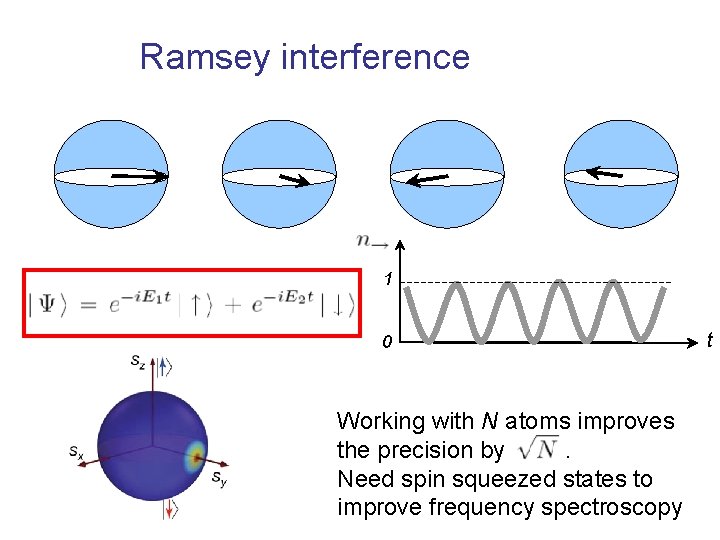
Ramsey interference 1 0 Working with N atoms improves the precision by. Need spin squeezed states to improve frequency spectroscopy t
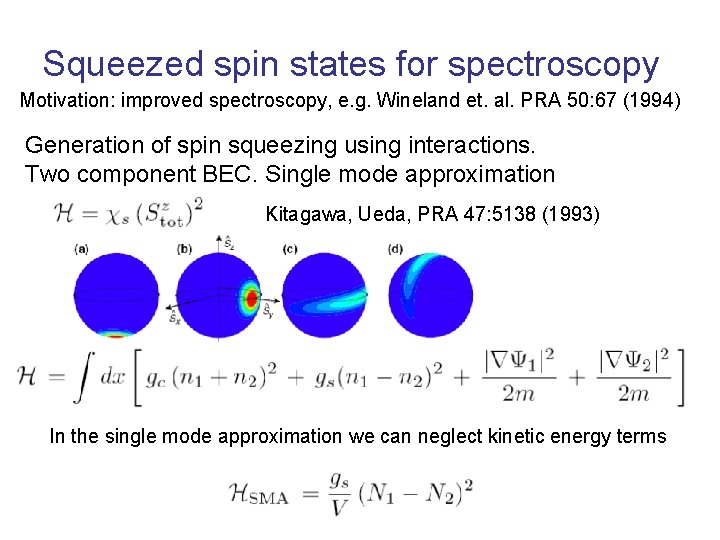
Squeezed spin states for spectroscopy Motivation: improved spectroscopy, e. g. Wineland et. al. PRA 50: 67 (1994) Generation of spin squeezing using interactions. Two component BEC. Single mode approximation Kitagawa, Ueda, PRA 47: 5138 (1993) In the single mode approximation we can neglect kinetic energy terms
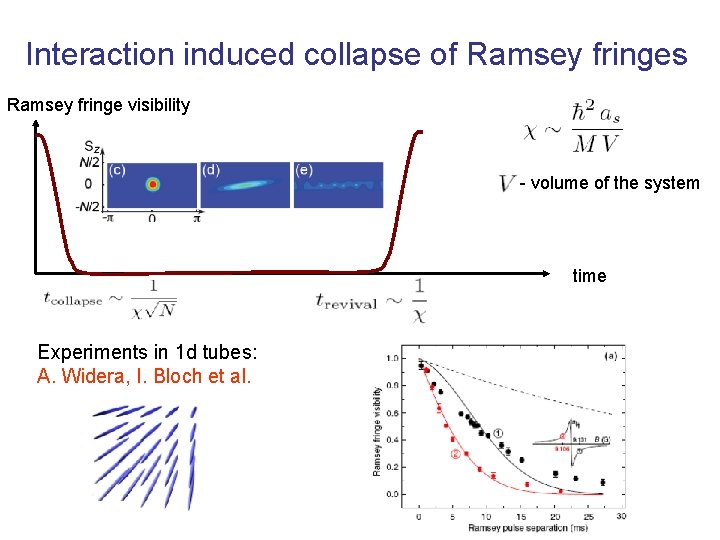
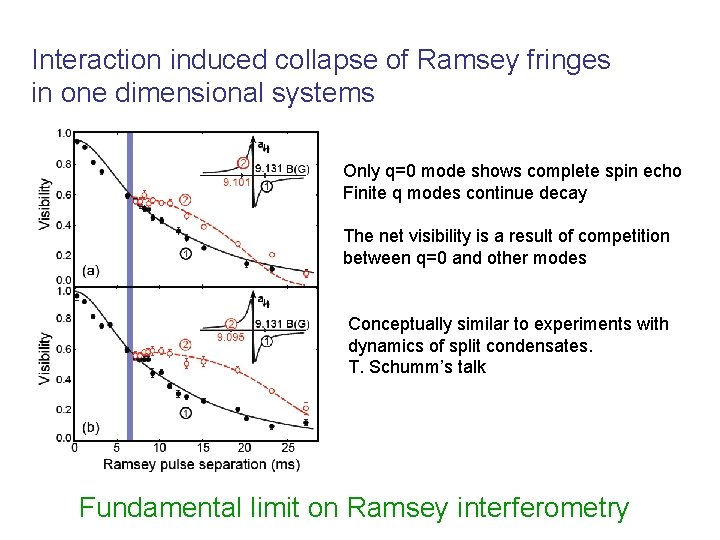
Interaction induced collapse of Ramsey fringes Ramsey fringe visibility - volume of the system time Experiments in 1 d tubes: A. Widera, I. Bloch et al.
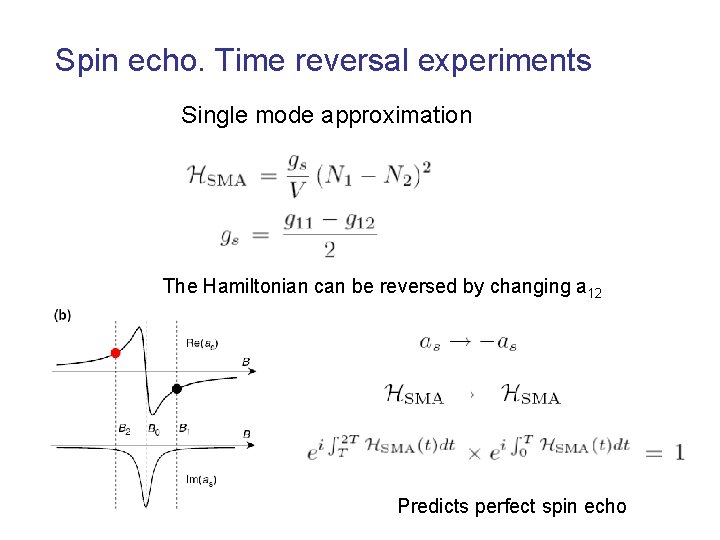
Spin echo. Time reversal experiments Single mode approximation The Hamiltonian can be reversed by changing a 12 Predicts perfect spin echo
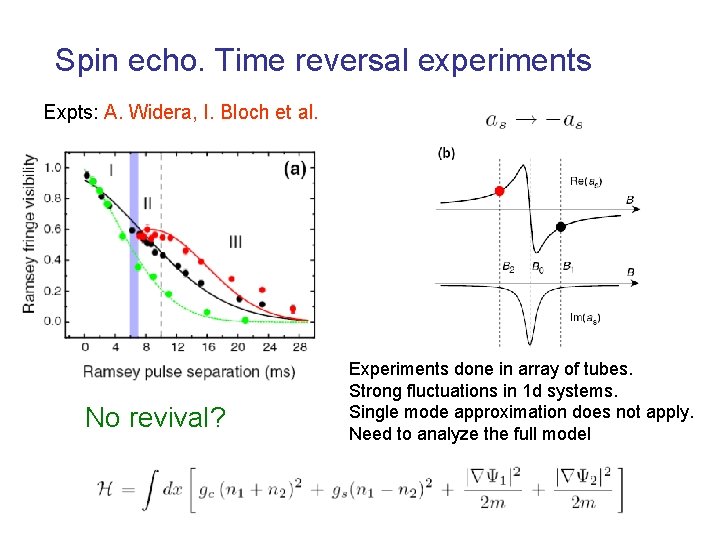
Spin echo. Time reversal experiments Expts: A. Widera, I. Bloch et al. No revival? Experiments done in array of tubes. Strong fluctuations in 1 d systems. Single mode approximation does not apply. Need to analyze the full model
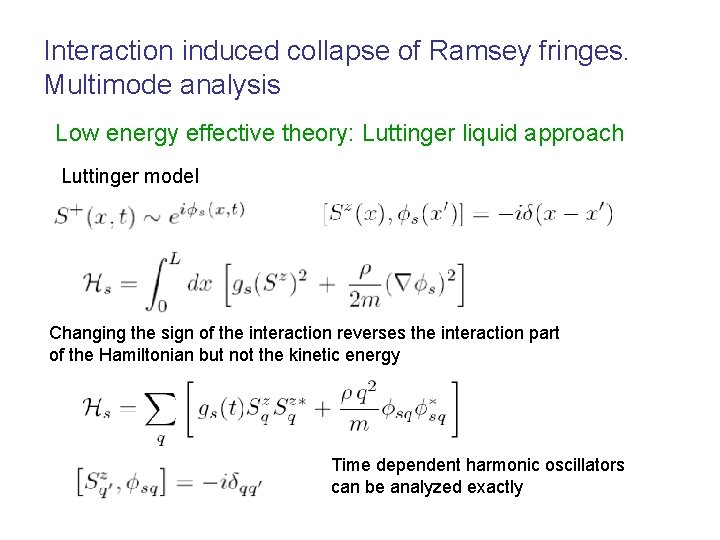
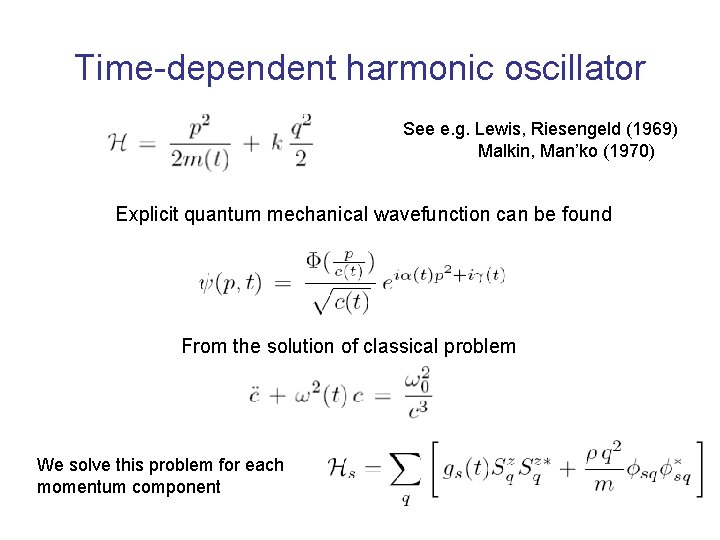
Interaction induced collapse of Ramsey fringes. Multimode analysis Low energy effective theory: Luttinger liquid approach Luttinger model Changing the sign of the interaction reverses the interaction part of the Hamiltonian but not the kinetic energy Time dependent harmonic oscillators can be analyzed exactly
Time-dependent harmonic oscillator See e. g. Lewis, Riesengeld (1969) Malkin, Man’ko (1970) Explicit quantum mechanical wavefunction can be found From the solution of classical problem We solve this problem for each momentum component
Interaction induced collapse of Ramsey fringes in one dimensional systems Only q=0 mode shows complete spin echo Finite q modes continue decay The net visibility is a result of competition between q=0 and other modes Conceptually similar to experiments with dynamics of split condensates. T. Schumm’s talk Fundamental limit on Ramsey interferometry
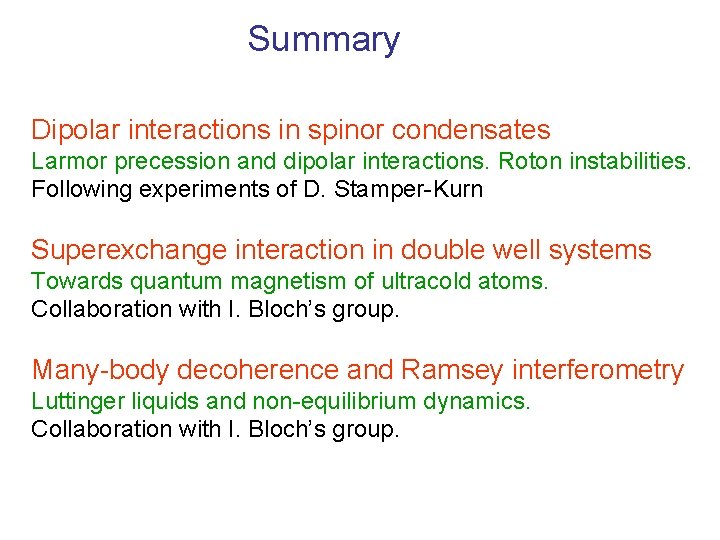
Summary Dipolar interactions in spinor condensates Larmor precession and dipolar interactions. Roton instabilities. Following experiments of D. Stamper-Kurn Superexchange interaction in double well systems Towards quantum magnetism of ultracold atoms. Collaboration with I. Bloch’s group. Many-body decoherence and Ramsey interferometry Luttinger liquids and non-equilibrium dynamics. Collaboration with I. Bloch’s group.