
Dynamics of shallow cumulus and stratocumulus clouds in
- Slides: 14
Dynamics of shallow cumulus and stratocumulus clouds in the presence of black carbon aerosol Eric Wilcox, Desert Research Institute, Eric. Wilcox@dri. edu, 775 -673 -7686 Jun Wang, University of Iowa CARDEX Team: Rick Thomas, University of Birmingham P. S. Praveen, International Centre for Integrated Mountain Development, Kathmandu Kristina Pistone, NASA Ames Research Center Frida Bender, Stockholm University V. Ramanathan, Scripps/UCSD SEAC 4 RS e. MAS analysis: Lan Gao, University of Oklahoma Rob Levy and Sasha Marshak NASA GSFC New MEa. SUREs Deep cloud database: Tianle Yuan, UMBC/NASA GSFC Derek Posselt NASA JPL
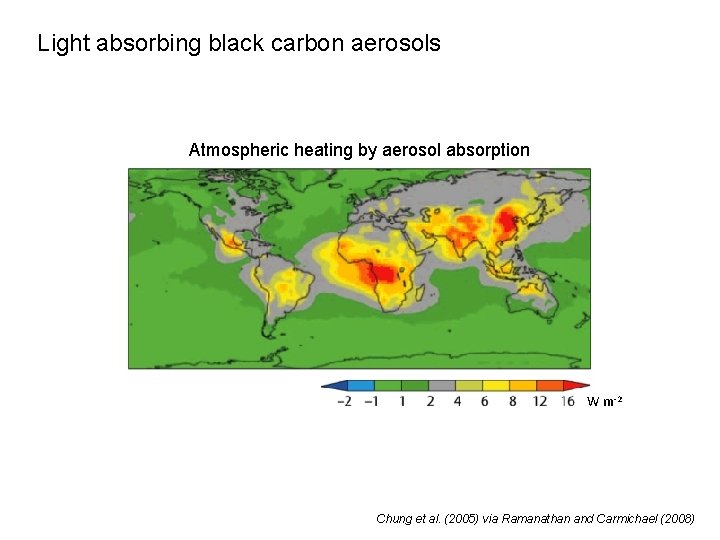
Light absorbing black carbon aerosols Atmospheric heating by aerosol absorption W m-2 Chung et al. (2005) via Ramanathan and Carmichael (2008)
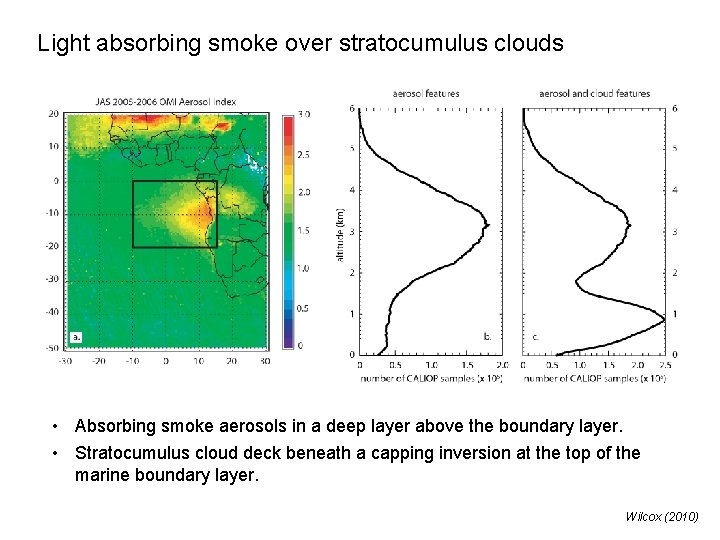
Light absorbing smoke over stratocumulus clouds • Absorbing smoke aerosols in a deep layer above the boundary layer. • Stratocumulus cloud deck beneath a capping inversion at the top of the marine boundary layer. Wilcox (2010)
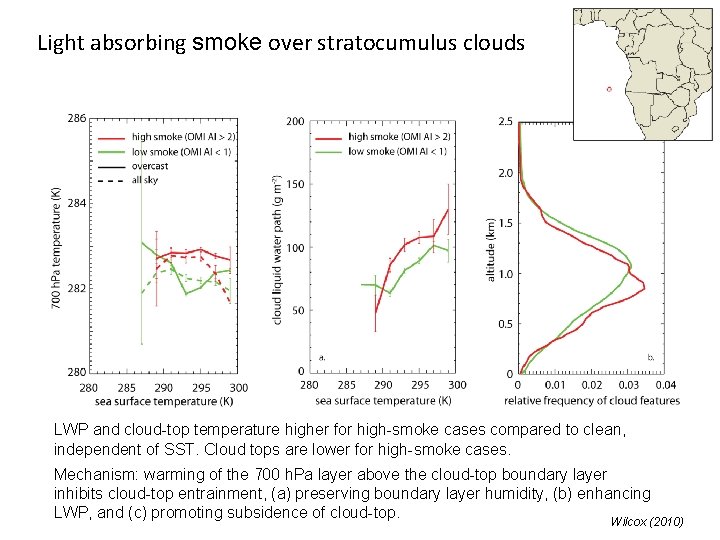
Light absorbing smoke over stratocumulus clouds LWP and cloud-top temperature higher for high-smoke cases compared to clean, independent of SST. Cloud tops are lower for high-smoke cases. Mechanism: warming of the 700 h. Pa layer above the cloud-top boundary layer inhibits cloud-top entrainment, (a) preserving boundary layer humidity, (b) enhancing LWP, and (c) promoting subsidence of cloud-top. Wilcox (2010)
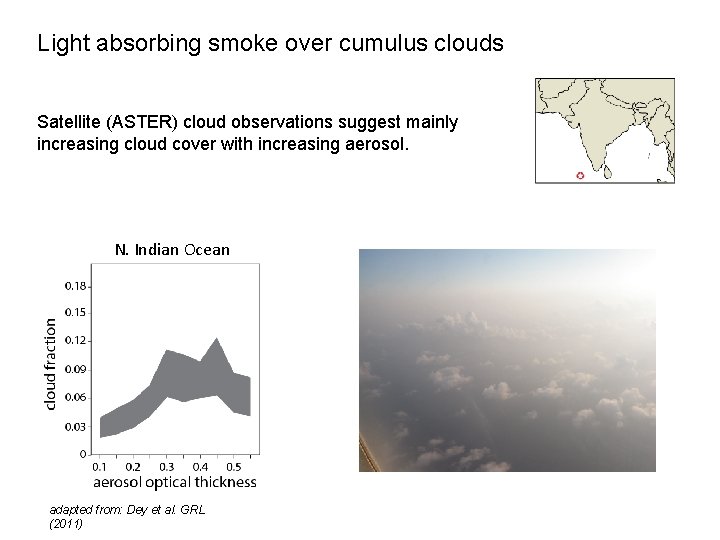
Light absorbing smoke over cumulus clouds Satellite (ASTER) cloud observations suggest mainly increasing cloud cover with increasing aerosol. N. Indian Ocean adapted from: Dey et al. GRL (2011)
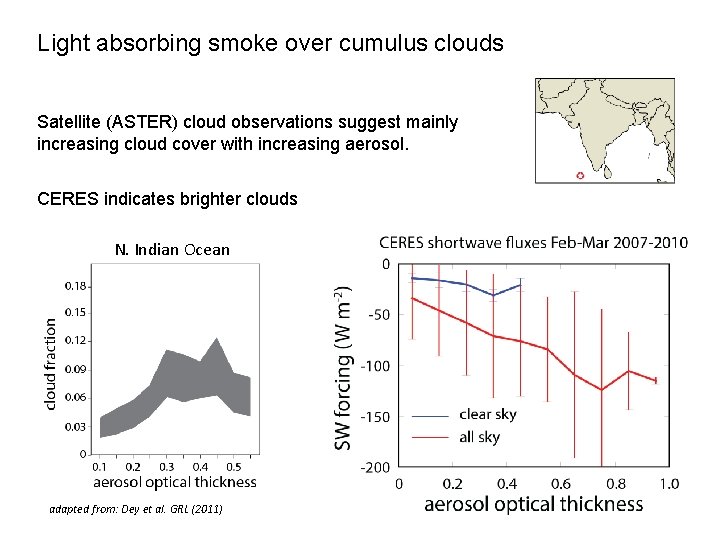
Light absorbing smoke over cumulus clouds Satellite (ASTER) cloud observations suggest mainly increasing cloud cover with increasing aerosol. CERES indicates brighter clouds N. Indian Ocean adapted from: Dey et al. GRL (2011)
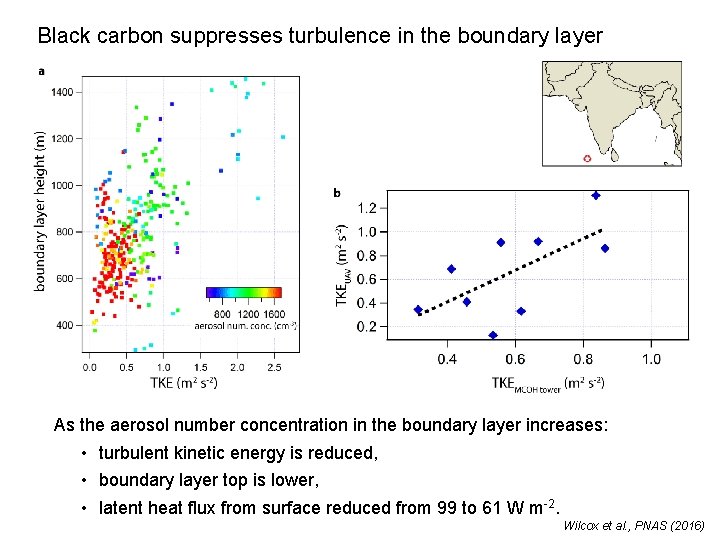
Black carbon suppresses turbulence in the boundary layer As the aerosol number concentration in the boundary layer increases: • turbulent kinetic energy is reduced, • boundary layer top is lower, • latent heat flux from surface reduced from 99 to 61 W m-2. Wilcox et al. , PNAS (2016)
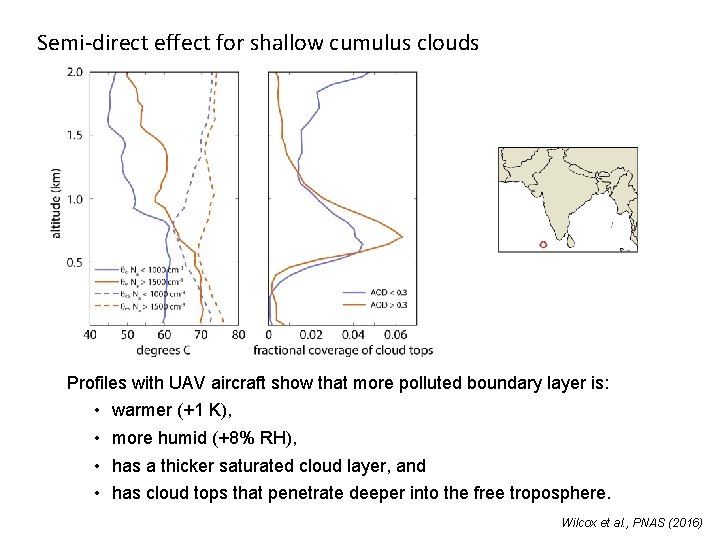
Semi-direct effect for shallow cumulus clouds Profiles with UAV aircraft show that more polluted boundary layer is: • • warmer (+1 K), more humid (+8% RH), has a thicker saturated cloud layer, and has cloud tops that penetrate deeper into the free troposphere. Wilcox et al. , PNAS (2016)
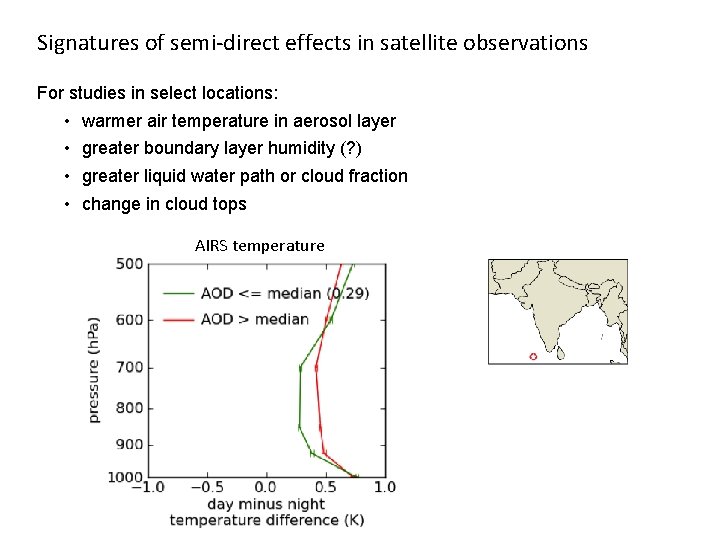
Signatures of semi-direct effects in satellite observations For studies in select locations: • • warmer air temperature in aerosol layer greater boundary layer humidity (? ) greater liquid water path or cloud fraction change in cloud tops AIRS temperature
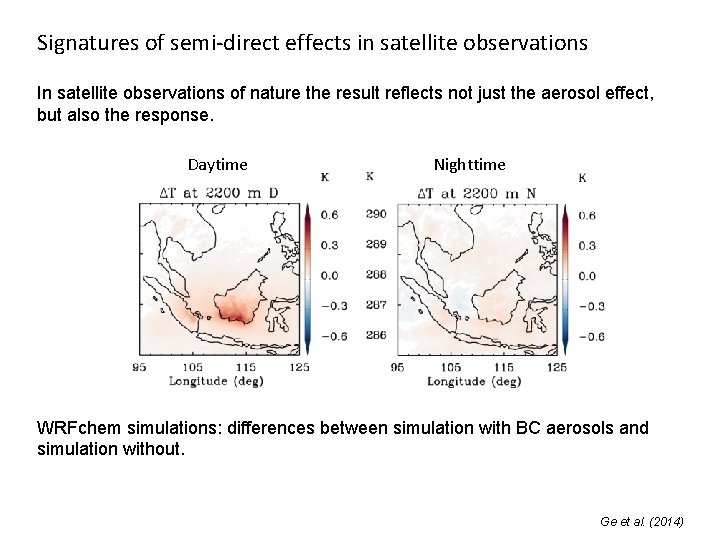
Signatures of semi-direct effects in satellite observations In satellite observations of nature the result reflects not just the aerosol effect, but also the response. Daytime Nighttime WRFchem simulations: differences between simulation with BC aerosols and simulation without. Ge et al. (2014)
Conclusions so far: • Over S. E. Atlantic Ocean, absorbing aerosols reduce turbulent entrainment in stratocumulus clouds, leading to thicker clouds and higher albedo. • Over N. Indian Ocean, similar response is seen for absorbing aerosols over cumulus clouds leading to higher albedo. • We seek satellite analysis to observe more generally the response to BC aerosols of: Temperature, humidity, boundary layer depth, albedo • Over Amazon, absorbing aerosols may also reduce turbulence. • However, boundary layer humidity decreases, rather than increases, so increasing solar radiation due to cloud “burn off” compensates for aerosol reduction in radiation.
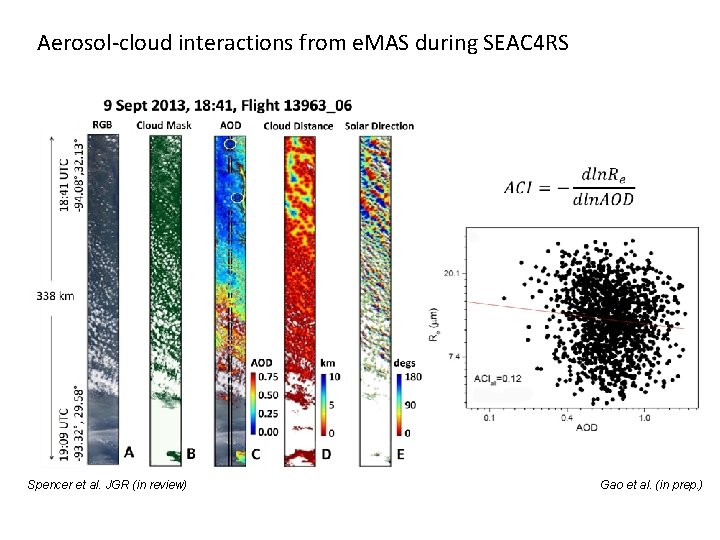
Aerosol-cloud interactions from e. MAS during SEAC 4 RS Spencer et al. JGR (in review) Gao et al. (in prep. )
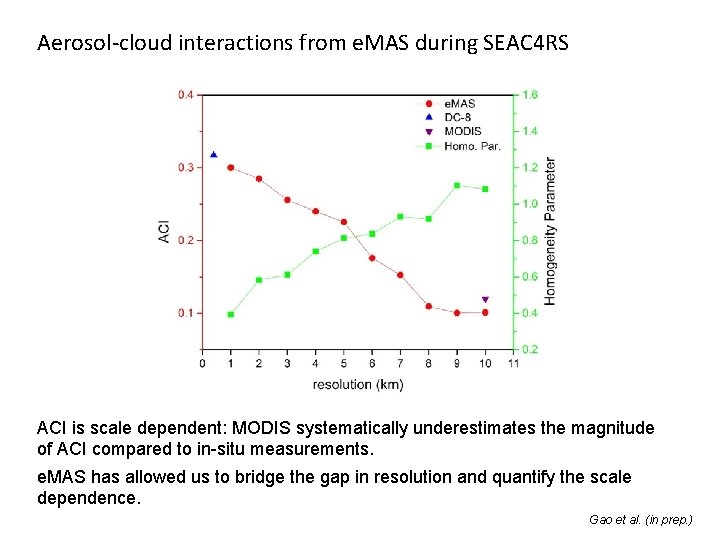
Aerosol-cloud interactions from e. MAS during SEAC 4 RS ACI is scale dependent: MODIS systematically underestimates the magnitude of ACI compared to in-situ measurements. e. MAS has allowed us to bridge the gap in resolution and quantify the scale dependence. Gao et al. (in prep. )
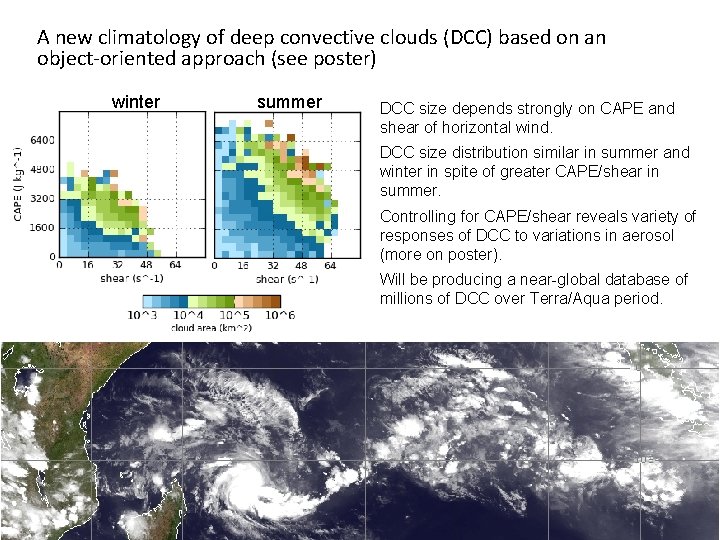
A new climatology of deep convective clouds (DCC) based on an object-oriented approach (see poster) winter summer DCC size depends strongly on CAPE and shear of horizontal wind. DCC size distribution similar in summer and winter in spite of greater CAPE/shear in summer. Controlling for CAPE/shear reveals variety of responses of DCC to variations in aerosol (more on poster). Will be producing a near-global database of millions of DCC over Terra/Aqua period.