
Dynamics Of Nuclear Spin Polarization investigated by simultaneous
Dynamics Of Nuclear Spin Polarization investigated by simultaneous NMR and polarized neutron scattering J. Kohlbrecher Paul Scherrer Institute CH-5232 Villigen Switzerland B. van den Brandt, P. Hautle, J. Kohlbrecher, J. A. Konter, S. Mango (PSI) H. Glättli, E. Leymarie (CEA-Saclay) I. Grillo, R. May (ILL) H. Jouve, H. B. Stuhrmann (IBS) O. Zimmer (TU München) J. Kohlbrecher, Polarized Solid Targets, Honnef 2003
Dynamics Of Nuclear Spin Polarization investigated by simultaneous NMR and polarized neutron scattering Joachim Kohlbrecher Contents: DNP: a two step process How to measure clusters of polarized protons 1. scattering of polarized neutron on polarized nuclei 2. small angle neutron scattering (SANS) model system: EHBA-Cr(V) time-resolved SANS and NMR experiments J. Kohlbrecher, Polarized Solid Targets, Honnef 2003
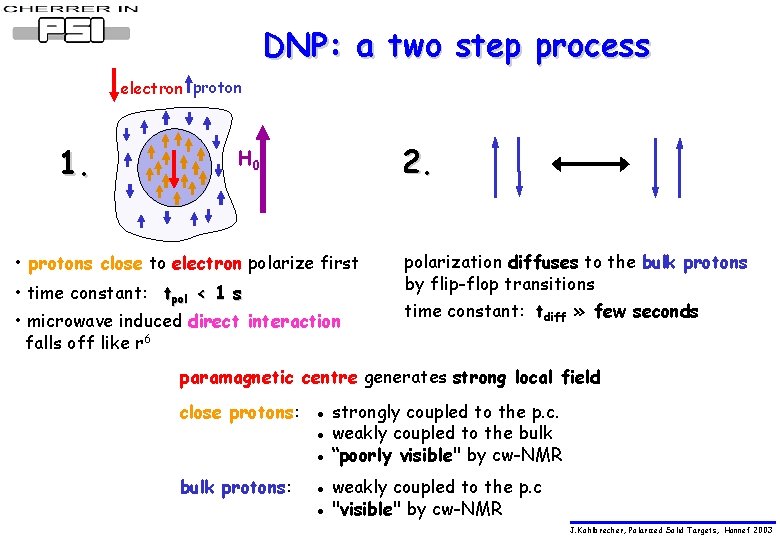
DNP: a two step process electron proton 1. 2. H 0 • protons close to electron polarize first • time constant: tpol < 1 s • microwave induced direct interaction falls off like r 6 polarization diffuses to the bulk protons by flip-flop transitions time constant: tdiff » few seconds paramagnetic centre generates strong local field close protons: ● strongly coupled to the p. c. ● weakly coupled to the bulk ● “poorly visible" by cw-NMR bulk protons: ● weakly coupled to the p. c ● "visible" by cw-NMR J. Kohlbrecher, Polarized Solid Targets, Honnef 2003
How to measure clusters of polarized protons what do we want to see: 1. time-dependent polarization built-up of the proton spins around the radical 2. and in the bulk requirements for experimental method: 1. sensitive on polarization of protons 2. sensitive on length scale in nm-range experimental method: 1. cw-NMR (bulk protons) 2. neutron scattering technique (close protons) J. Kohlbrecher, Polarized Solid Targets, Honnef 2003
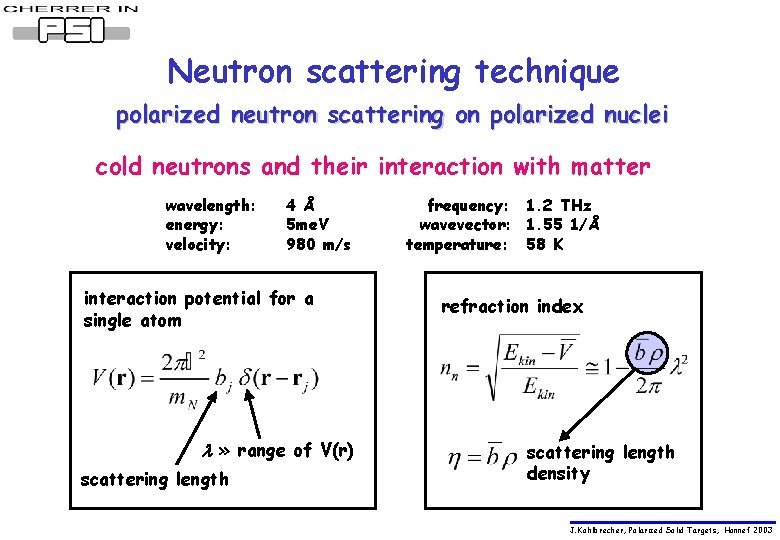
Neutron scattering technique polarized neutron scattering on polarized nuclei cold neutrons and their interaction with matter wavelength: energy: velocity: 4 Å 5 me. V 980 m/s interaction potential for a single atom l » range of V(r) scattering length frequency: 1. 2 THz wavevector: 1. 55 1/Å temperature: 58 K refraction index scattering length density J. Kohlbrecher, Polarized Solid Targets, Honnef 2003
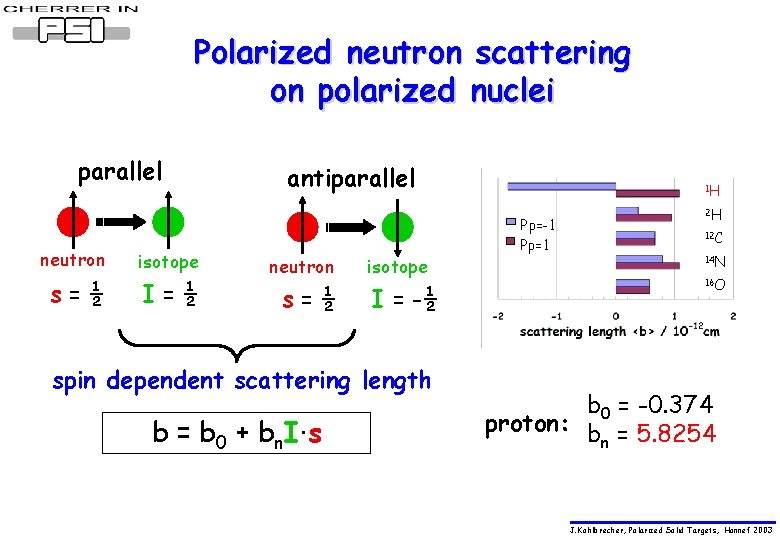
Polarized neutron scattering on polarized nuclei parallel neutron s=½ isotope I=½ antiparallel neutron s=½ isotope I = -½ spin dependent scattering length b = b 0 + bn. I. s 1 H Pp=-1 Pp=1 2 H 12 C 14 N 16 O b 0 = -0. 374 proton: b = 5. 8254 n J. Kohlbrecher, Polarized Solid Targets, Honnef 2003
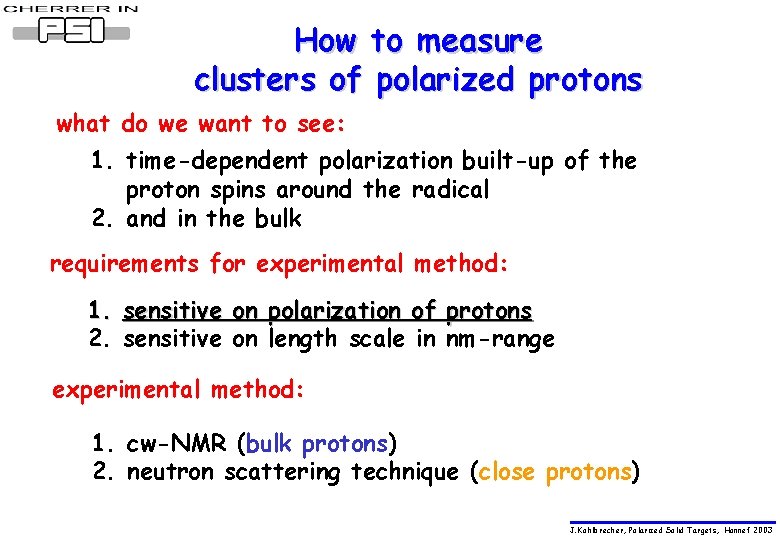
How to measure clusters of polarized protons what do we want to see: 1. time-dependent polarization built-up of the proton spins around the radical 2. and in the bulk requirements for experimental method: 1. sensitive on polarization of protons 2. sensitive on length scale in nm-range experimental method: 1. cw-NMR (bulk protons) 2. neutron scattering technique (close protons) J. Kohlbrecher, Polarized Solid Targets, Honnef 2003
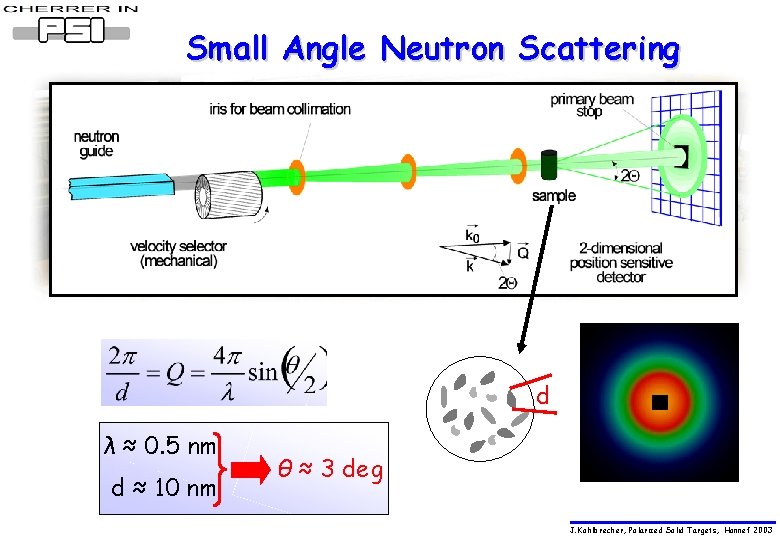
Small Angle Neutron Scattering sample incident neutrons, l scattered neutrons detector d λ ≈ 0. 5 nm d ≈ 10 nm θ ≈ 3 deg J. Kohlbrecher, Polarized Solid Targets, Honnef 2003
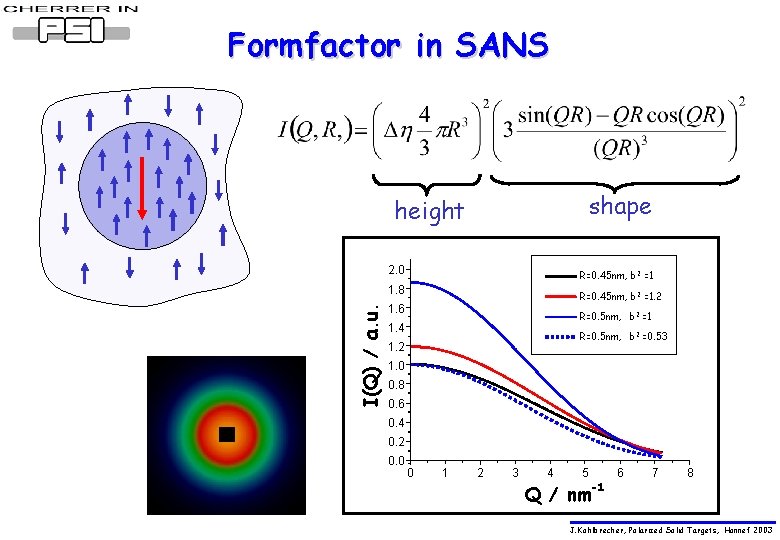
Formfactor in SANS shape height 2. 0 R=0. 45 nm, b 2 =1 I(Q) / a. u. 1. 8 R=0. 45 nm, b 2 =1. 2 1. 6 R=0. 5 nm, b 2 =1 1. 4 R=0. 5 nm, b 2 =0. 53 1. 2 1. 0 0. 8 0. 6 0. 4 0. 2 0. 0 0 1 2 3 4 5 -1 6 7 8 Q / nm J. Kohlbrecher, Polarized Solid Targets, Honnef 2003
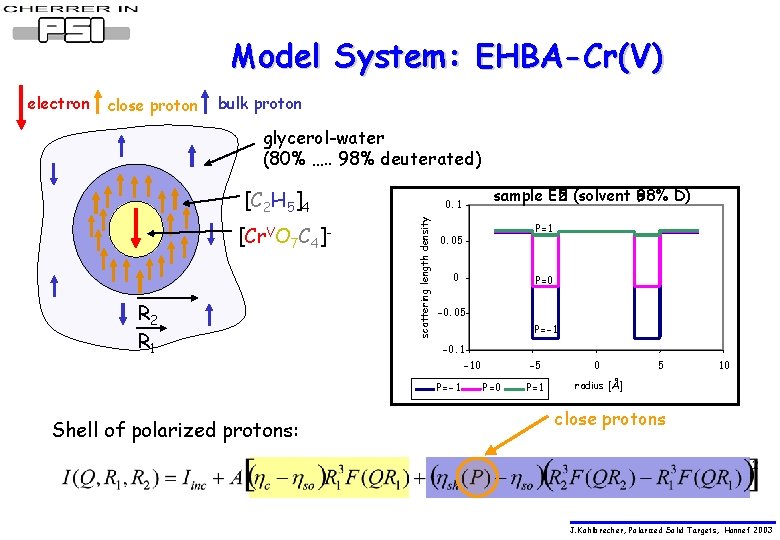
Model System: EHBA-Cr(V) electron close proton bulk proton glycerol-water (80% …. . 98% deuterated) [C 2 H 5]4 R 2 R 1 scattering length density [Cr. VO 7 C 4]- sample E 2 E 5 (solvent 88% 98% D) 0. 1 P=1 0. 05 0 P=0 -0. 05 P=-1 -0. 1 -10 P=-1 Shell of polarized protons: P=0 -5 0 P=1 radius [Å] 5 10 close protons J. Kohlbrecher, Polarized Solid Targets, Honnef 2003
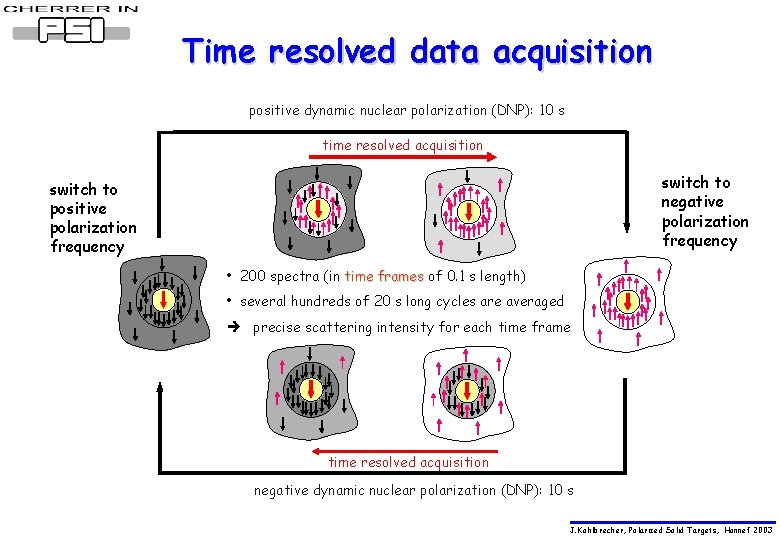
Time resolved data acquisition positive dynamic nuclear polarization (DNP): 10 s time resolved acquisition switch to negative polarization frequency switch to positive polarization frequency • 200 spectra (in time frames of 0. 1 s length) • several hundreds of 20 s long cycles are averaged precise scattering intensity for each time frame time resolved acquisition negative dynamic nuclear polarization (DNP): 10 s J. Kohlbrecher, Polarized Solid Targets, Honnef 2003
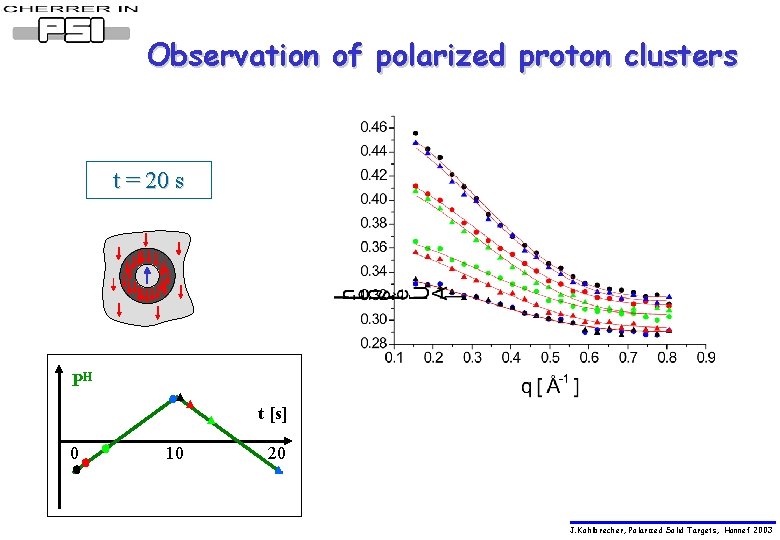
Observation of polarized proton clusters ttt===13. 4 10. 1 10. 9 0. 1 0. 9 3. 4 10 sss 20 PH t [s] 0 10 20 J. Kohlbrecher, Polarized Solid Targets, Honnef 2003
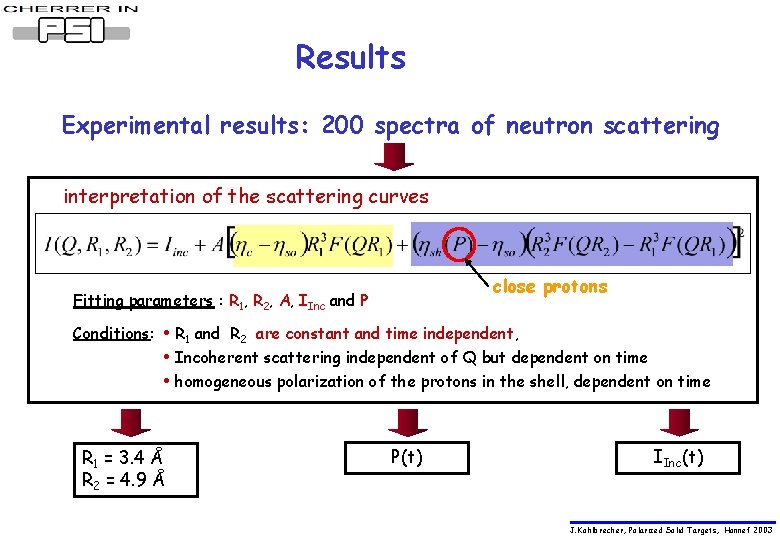
Results Experimental results: 200 spectra of neutron scattering interpretation of the scattering curves close protons Fitting parameters : R 1, R 2, A, IInc and P Conditions: • R 1 and R 2 are constant and time independent, • Incoherent scattering independent of Q but dependent on time • homogeneous polarization of the protons in the shell, dependent on time R 1 = 3. 4 Å R 2 = 4. 9 Å P(t) IInc(t) J. Kohlbrecher, Polarized Solid Targets, Honnef 2003
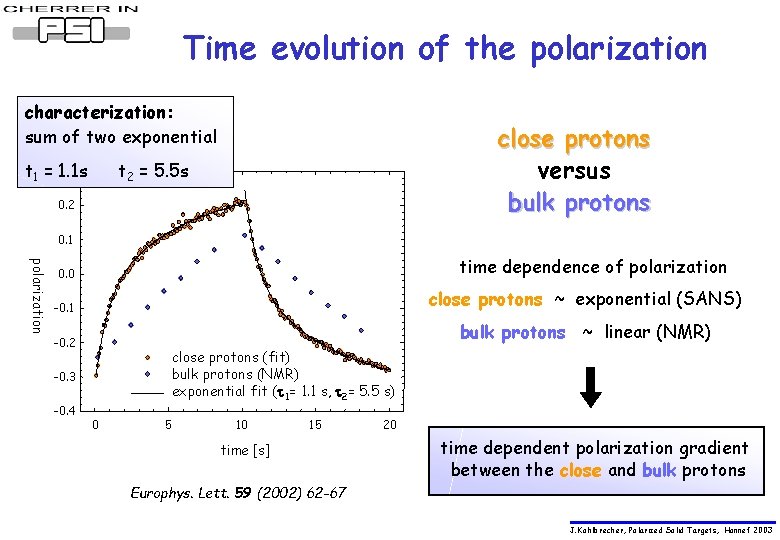
Time evolution of the polarization characterization: sum of two exponential t 1 = 0. 3 1. 1 s close protons versus bulk protons t 2 = 5. 5 s 0. 2 0. 1 polarization time dependence of polarization 0. 0 close protons ~ exponential (SANS) -0. 1 bulk protons ~ linear (NMR) -0. 2 close protons (fit) bulk protons (NMR) exponential fit (t 1= 1. 1 s, t 2= 5. 5 s) -0. 3 -0. 4 0 5 10 15 time [s] 20 time dependent polarization gradient between the close and bulk protons Europhys. Lett. 59 (2002) 62 -67 J. Kohlbrecher, Polarized Solid Targets, Honnef 2003
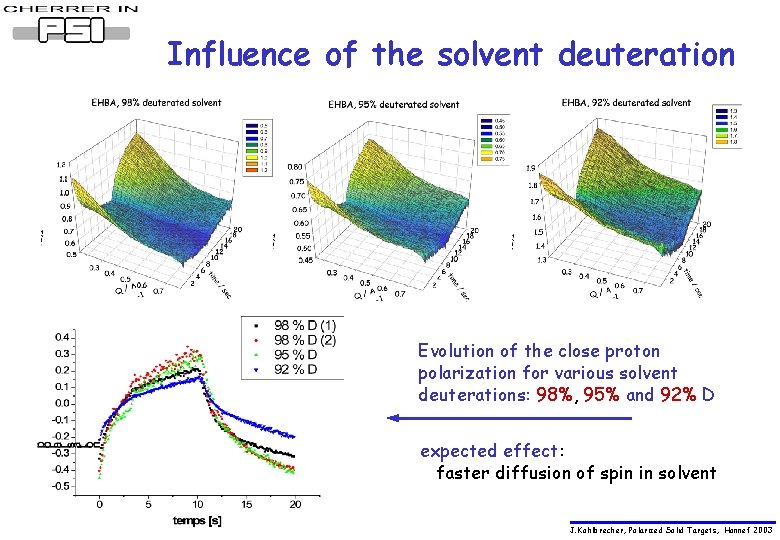
Influence of the solvent deuteration Evolution of the close proton polarization for various solvent deuterations: 98%, 95% and 92% D expected effect: faster diffusion of spin in solvent J. Kohlbrecher, Polarized Solid Targets, Honnef 2003
- Slides: 15