
Dynamics of nuclear pairing model ChinaJapan collaboration workshop

Dynamics of nuclear pairing model China-Japan collaboration workshop 2017/06/26 -28 Univ. of Tsukuba NI Fang (倪 放) Collaborator: NAKATSUKASA Takashi (中務 孝)
Outline • Introduction Pairing collective motion, Motivation • Dynamics in nuclear pairing model 1. Exact solution 2. Approximation method • Summary
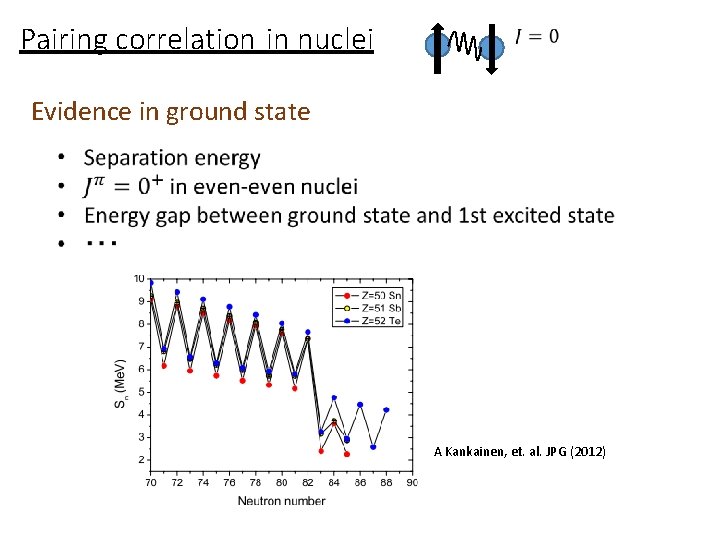
Pairing correlation in nuclei Evidence in ground state A Kankainen, et. al. JPG (2012)
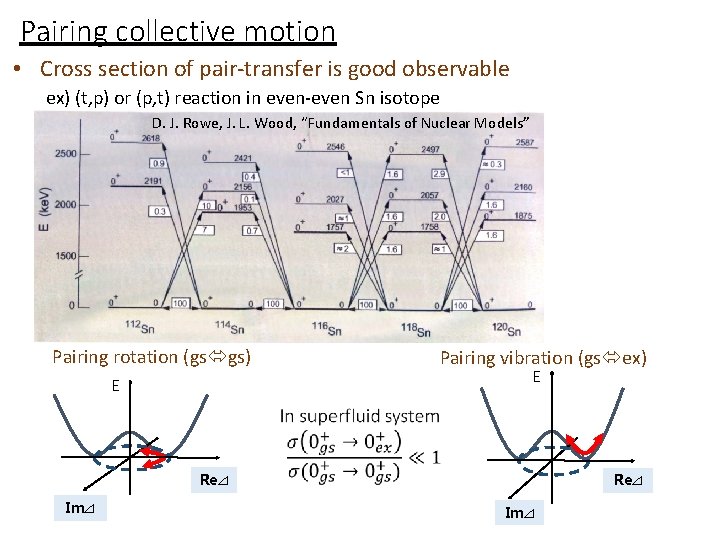
Pairing collective motion • Cross section of pair-transfer is good observable ex) (t, p) or (p, t) reaction in even-even Sn isotope D. J. Rowe, J. L. Wood, “Fundamentals of Nuclear Models” Pairing rotation (gs gs) E Pairing vibration (gs ex) E Re⊿ Im⊿
Motivation Low-lying excited states in nuclei… • Coupling between pairing and quadrupole is important Large amplitude collective motion q Quadrupole correlation Bohr Hamiltonian q Pairing ? ? Final goal: Elucidate large amplitude pairing collective motion in nuclei First step: Elucidate pairing dynamics in simple pairing model
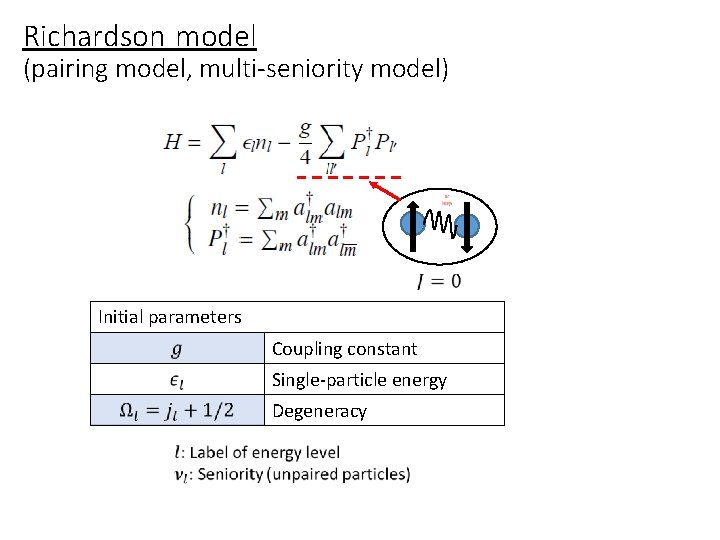
Richardson model (pairing model, multi-seniority model) Initial parameters Coupling constant Single-particle energy Degeneracy
Outline • Introduction Pairing collective motion, Motivation • Dynamics in nuclear pairing model 1. Exact solution 2. Approximation method • Summary
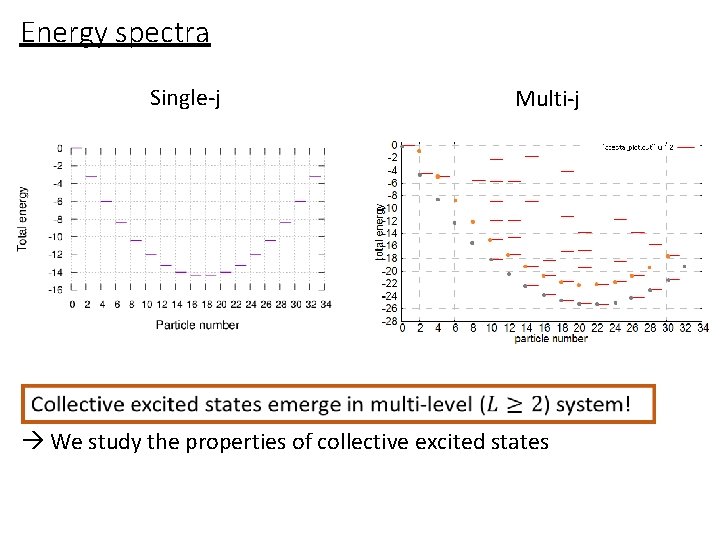
Energy spectra Single-j Multi-j We study the properties of collective excited states
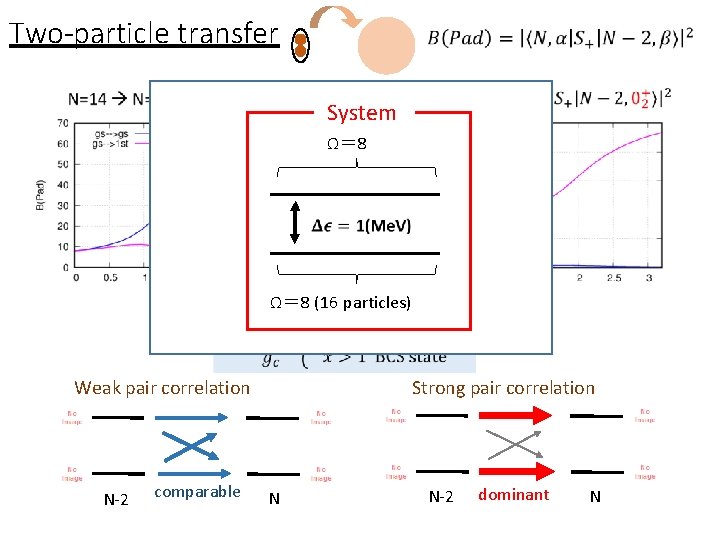
Two-particle transfer System Ω= 8 (16 particles) Weak pair correlation N-2 comparable Strong pair correlation N N-2 dominant N
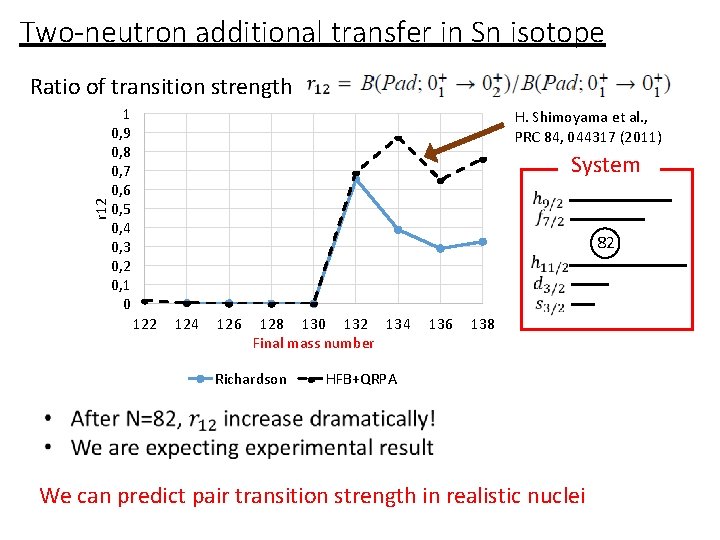
Two-neutron additional transfer in Sn isotope r 12 Ratio of transition strength 1 0, 9 0, 8 0, 7 0, 6 0, 5 0, 4 0, 3 0, 2 0, 1 0 H. Shimoyama et al. , PRC 84, 044317 (2011) System 82 124 126 128 130 132 134 Final mass number Richardson 136 138 HFB+QRPA We can predict pair transition strength in realistic nuclei
Outline • Introduction Pairing collective motion, Motivation • Dynamics in nuclear pairing model 1. Exact solution 2. Approximation method • Summary
Why we apply approximation method? 1. Understand classical picture of pairing dynamics § Classical trajectory in phase space § Collective coordinate 2. Explore reasonable method to describe pairing dynamics in realistic system from microscopic theory § Combine some new approach with DFT (HFB)
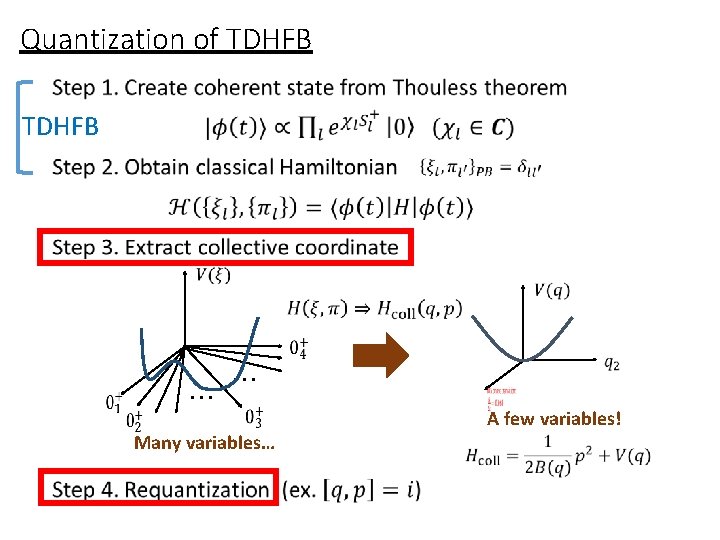
Quantization of TDHFB ・・・ Many variables… A few variables!
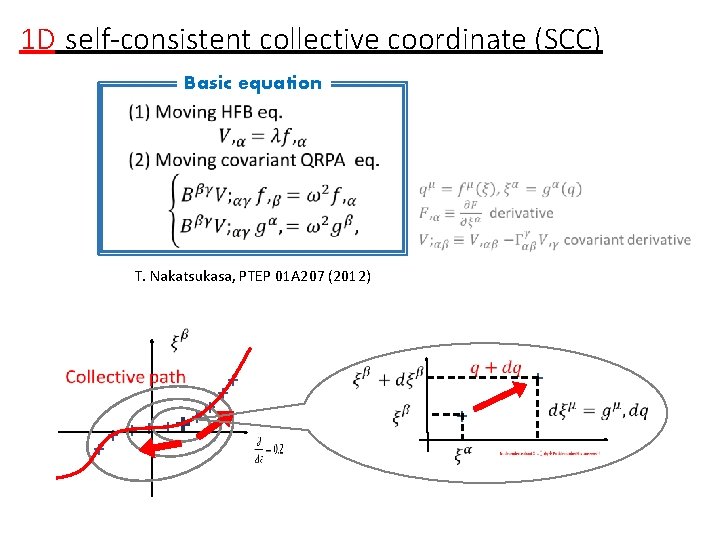
1 D self-consistent collective coordinate (SCC) Basic equation T. Nakatsukasa, PTEP 01 A 207 (2012) + ++ + + + +

Requantization Wave function ○ Pair transfer △ 2. Semiclassical approach T. Suzuki et al PTP Vol. 79 No. 2 (1988) • Time dependent wave function Path integral TDHFB trajectory • Microscopic wave function macroscopic wave func. from canonical quantization • Particle number projection is automatically contained
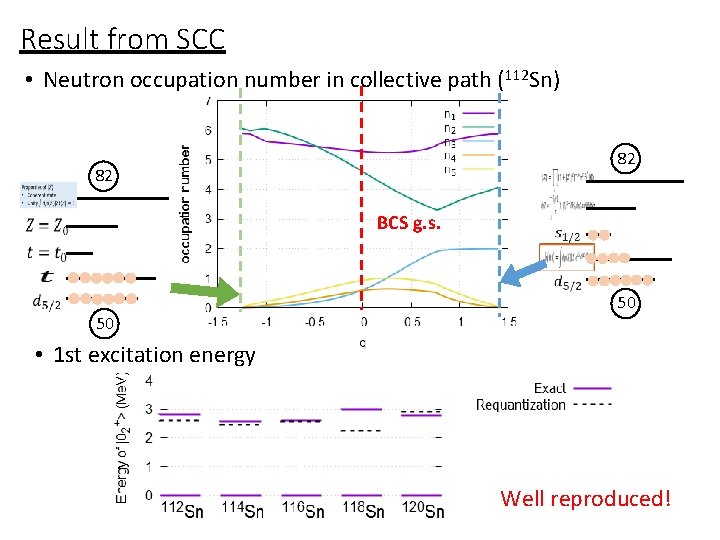
Result from SCC • Neutron occupation number in collective path (112 Sn) 82 82 BCS g. s. 50 50 • 1 st excitation energy Well reproduced!
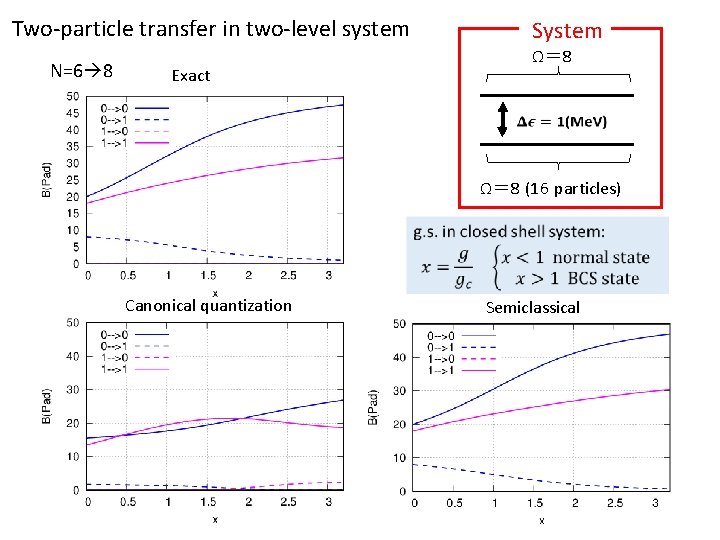
Two-particle transfer in two-level system N=6 8 Exact System Ω= 8 (16 particles) Canonical quantization Semiclassical
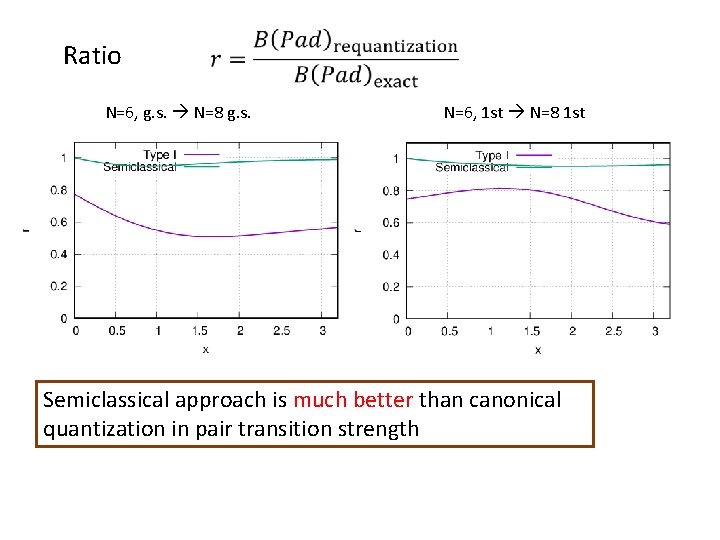
Ratio N=6, g. s. N=8 g. s. N=6, 1 st N=8 1 st Semiclassical approach is much better than canonical quantization in pair transition strength
Summary • We studied pairing dynamics in Richardson model From exact solution • It is useful to predict pair transition strength qualitatively in nuclei From time-dependent theory • We attempt to describe large amplitude pairing collective motion by self-consistent collective coordinate method • Semiclassical approach is reasonable to deal with pair transition Next step, toward realistic system… • Combine semiclassical approach with SCC Thank

Back up
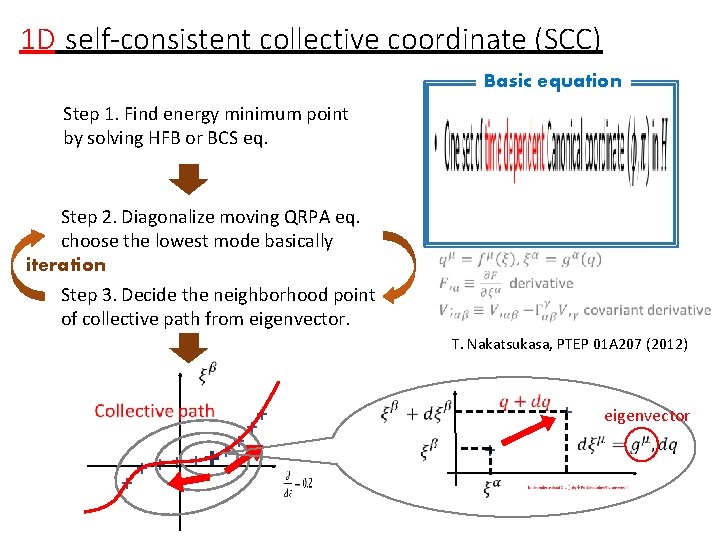
1 D self-consistent collective coordinate (SCC) Basic equation Step 1. Find energy minimum point by solving HFB or BCS eq. Step 2. Diagonalize moving QRPA eq. choose the lowest mode basically iteration Step 3. Decide the neighborhood point of collective path from eigenvector. T. Nakatsukasa, PTEP 01 A 207 (2012) + ++ + + + + eigenvector
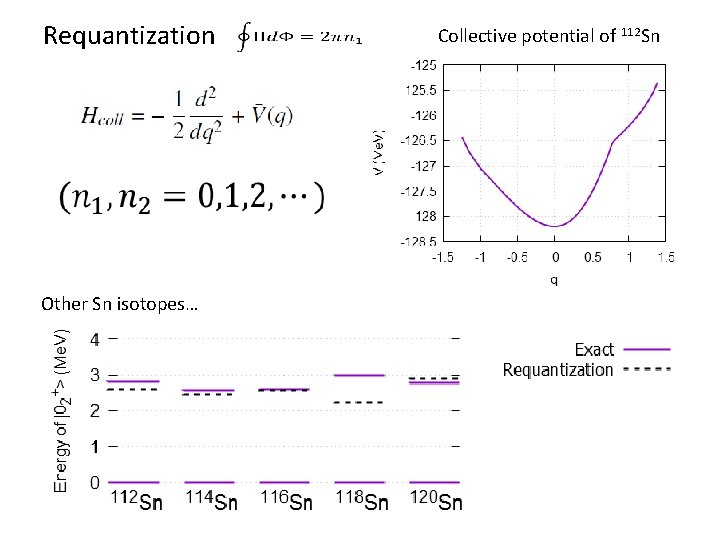
Requantization Other Sn isotopes… Collective potential of 112 Sn
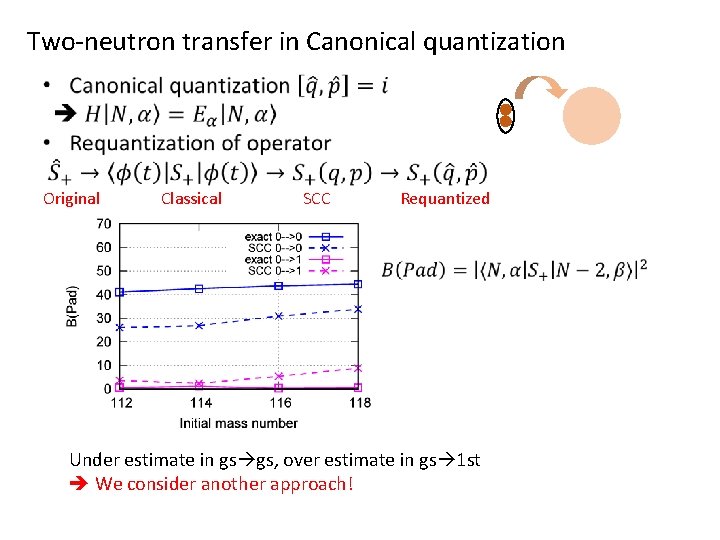
Two-neutron transfer in Canonical quantization Original Classical SCC Requantized Under estimate in gs gs, over estimate in gs 1 st We consider another approach!
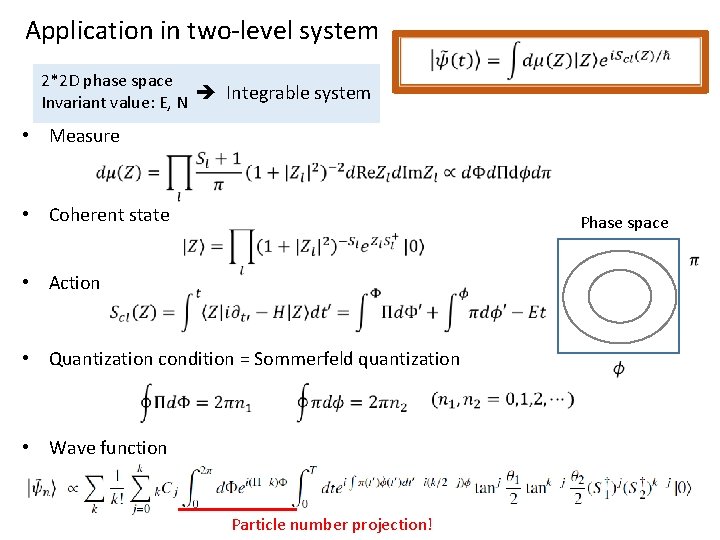
Application in two-level system 2*2 D phase space Invariant value: E, N Integrable system • Measure • Coherent state Phase space • Action • Quantization condition = Sommerfeld quantization • Wave function Particle number projection!
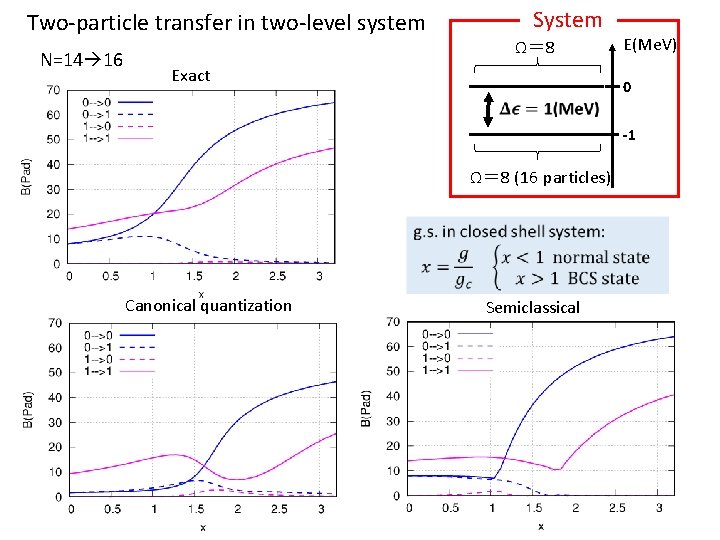
Two-particle transfer in two-level system N=14 16 System Ω= 8 Exact E(Me. V) 0 -1 Ω= 8 (16 particles) Canonical quantization Semiclassical
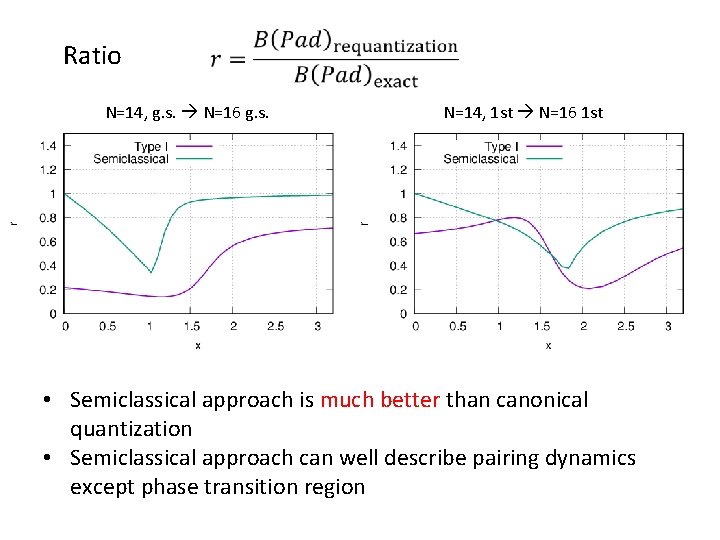
Ratio N=14, g. s. N=16 g. s. N=14, 1 st N=16 1 st • Semiclassical approach is much better than canonical quantization • Semiclassical approach can well describe pairing dynamics except phase transition region
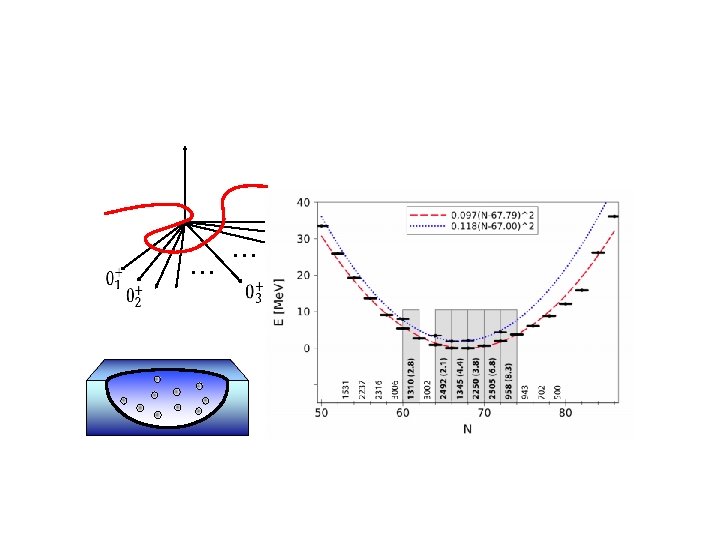
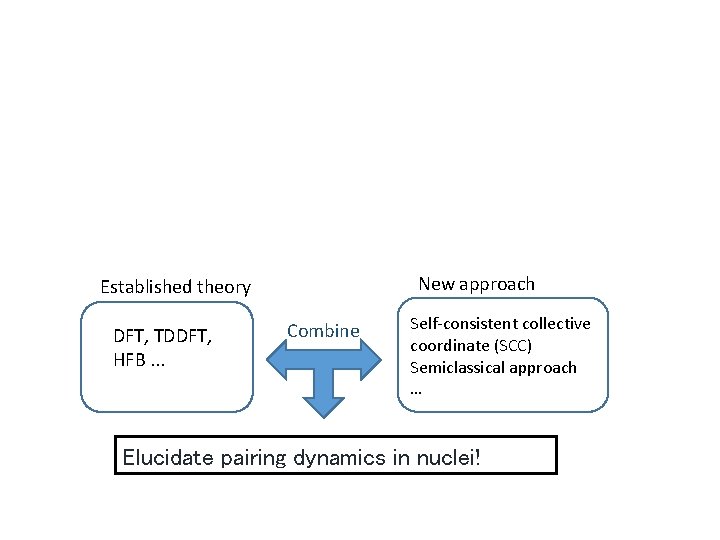
New approach Established theory DFT, TDDFT, HFB. . . Combine Self-consistent collective coordinate (SCC) Semiclassical approach … Elucidate pairing dynamics in nuclei!
- Slides: 28