
Dynamics of concentrated swimming microorganisms Bacillus subtilis from

Dynamics of concentrated swimming micro-organisms Bacillus subtilis, from individuals to great, concentrated populations: What we see, what we suspect, what we think we know, and at least some of what we ought to know. John O Kessler Physics Dept, University of Arizona, Tucson, AZ kessler@physics. arizona. edu DOE W 31 -109 -ENG 38; NSF PHY 0551742 ANL SO 2007 movie 1
AND Martin Bees. . . . Glasgow Luis Cisneros. . . Arizona Ricardo Cortez. . . Tulane Chris Dombrowski. . . . Arizona Ray Goldstein. . . DAMTP ************************ Igor Aronson. . . . Argonne Andrey Sokolov. . . Argonne AND

Bacillus subtilis TEM Pic by C. Dombrowski & D. Bentley (near cell division) Width apprx 0. 7 mm
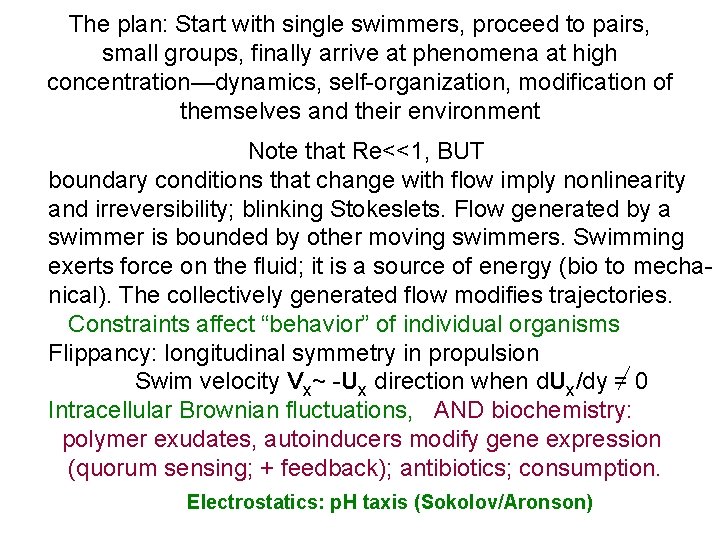
The plan: Start with single swimmers, proceed to pairs, small groups, finally arrive at phenomena at high concentration—dynamics, self-organization, modification of themselves and their environment Note that Re<<1, BUT boundary conditions that change with flow imply nonlinearity and irreversibility; blinking Stokeslets. Flow generated by a swimmer is bounded by other moving swimmers. Swimming exerts force on the fluid; it is a source of energy (bio to mechanical). The collectively generated flow modifies trajectories. Constraints affect “behavior” of individual organisms Flippancy: longitudinal symmetry in propulsion Swim velocity Vx~ -Ux direction when d. Ux/dy = 0 Intracellular Brownian fluctuations, AND biochemistry: polymer exudates, autoinducers modify gene expression (quorum sensing; + feedback); antibiotics; consumption. Electrostatics: p. H taxis (Sokolov/Aronson)
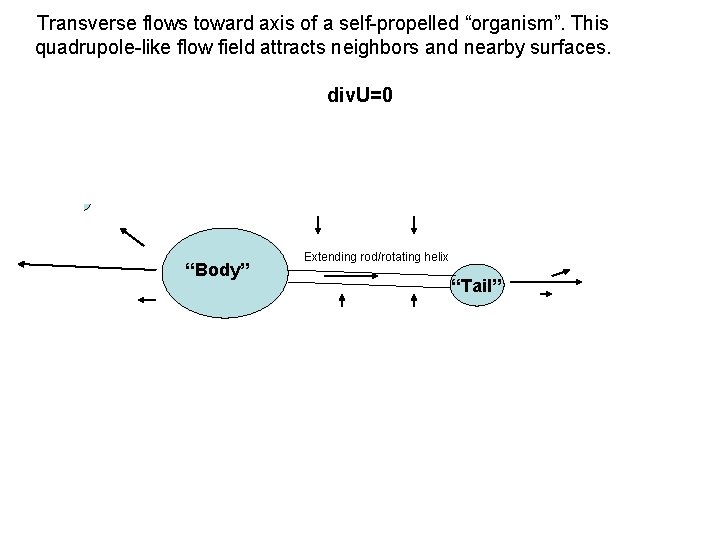
Transverse flows toward axis of a self-propelled “organism”. This quadrupole-like flow field attracts neighbors and nearby surfaces. div. U=0 “Body” Extending rod/rotating helix “Tail”
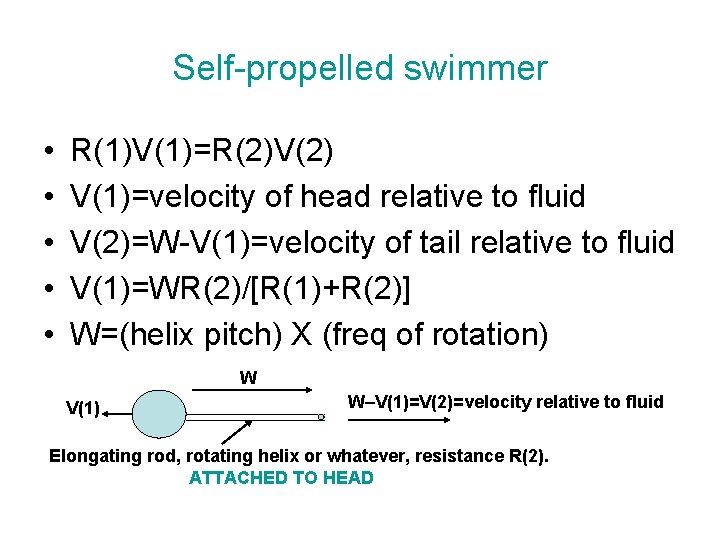
Self-propelled swimmer • • • R(1)V(1)=R(2)V(2) V(1)=velocity of head relative to fluid V(2)=W-V(1)=velocity of tail relative to fluid V(1)=WR(2)/[R(1)+R(2)] W=(helix pitch) X (freq of rotation) W V(1) W–V(1)=V(2)=velocity relative to fluid Elongating rod, rotating helix or whatever, resistance R(2). ATTACHED TO HEAD
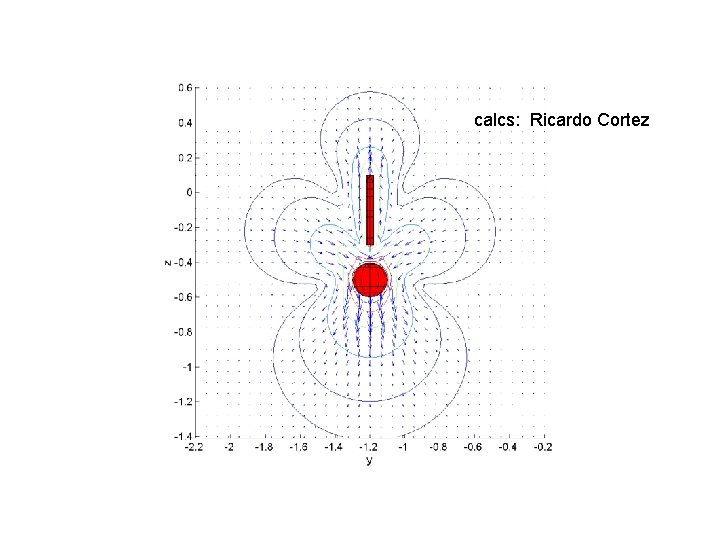
calcs: Ricardo Cortez
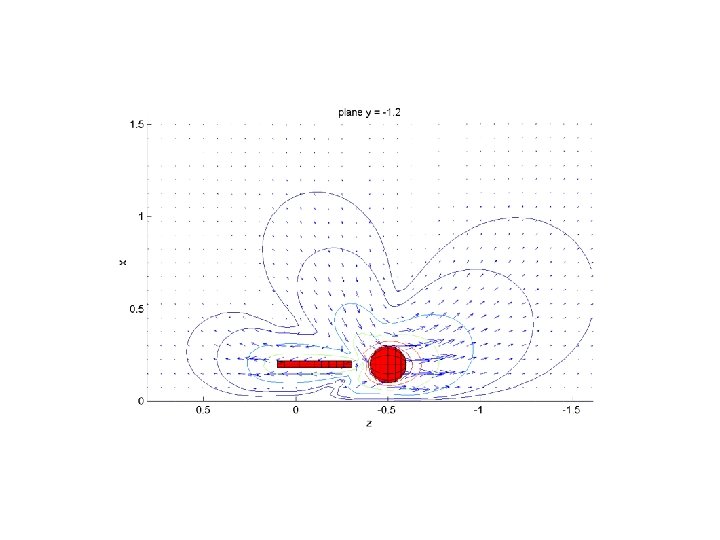
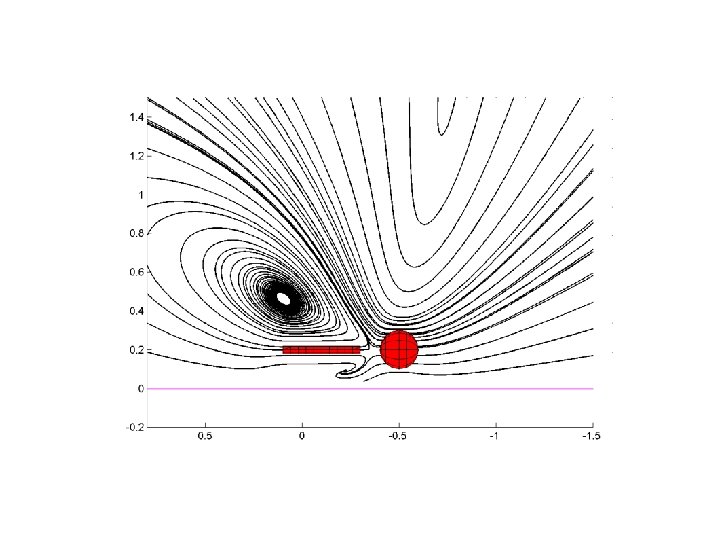
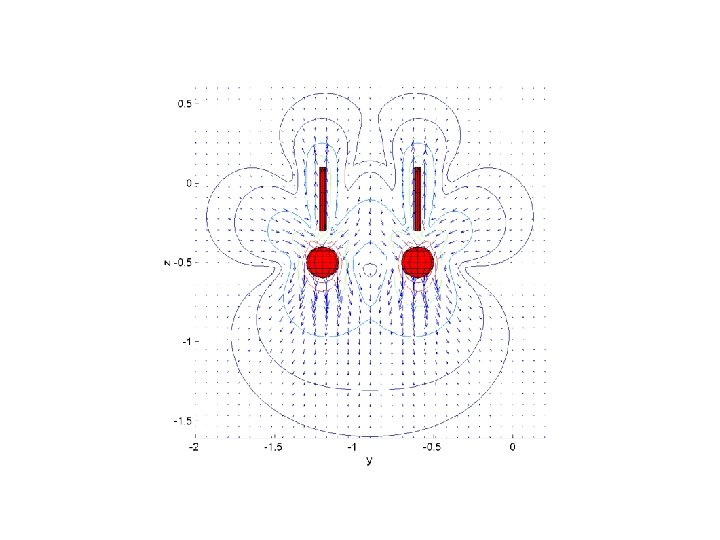
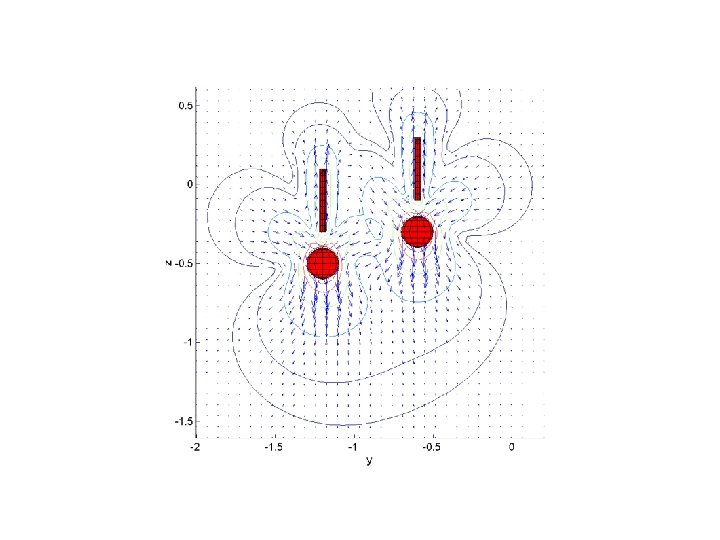
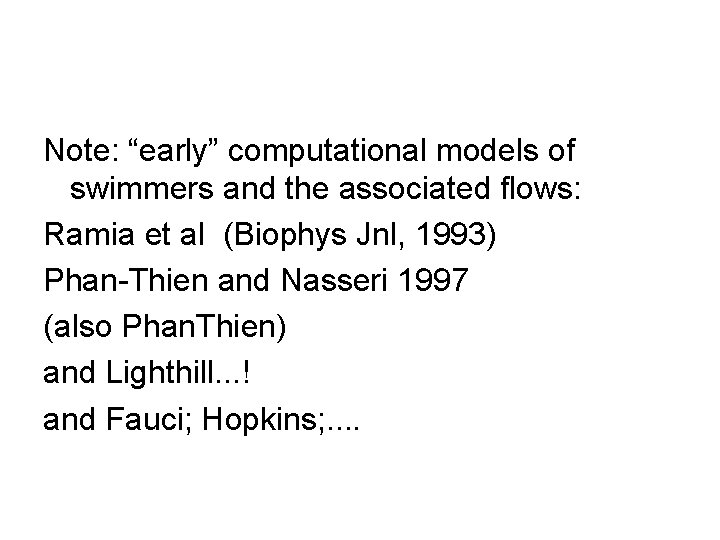
Note: “early” computational models of swimmers and the associated flows: Ramia et al (Biophys Jnl, 1993) Phan-Thien and Nasseri 1997 (also Phan. Thien) and Lighthill. . . ! and Fauci; Hopkins; . .
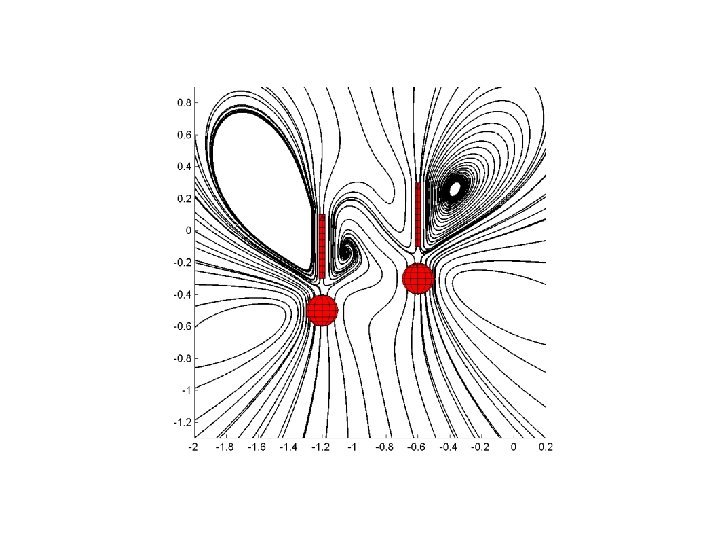
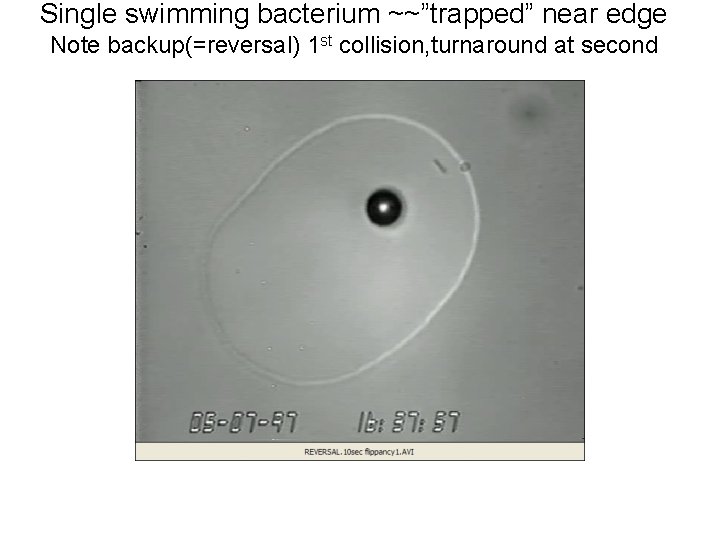
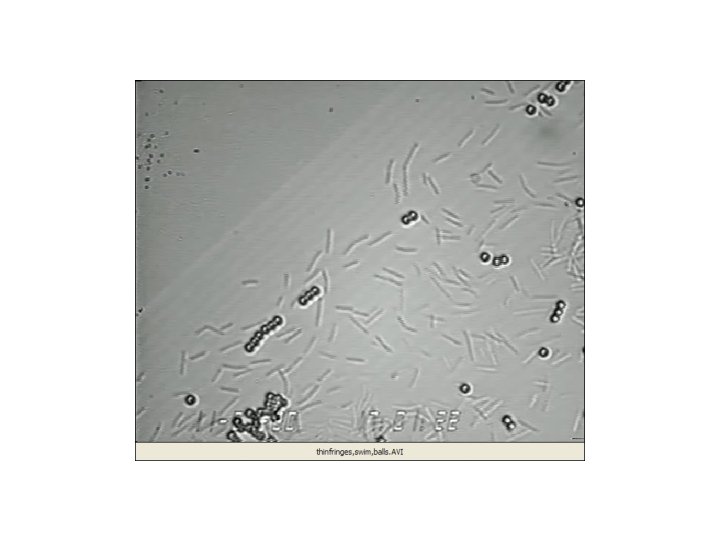
Single swimming bacterium ~~”trapped” near edge Note backup(=reversal) 1 st collision, turnaround at second
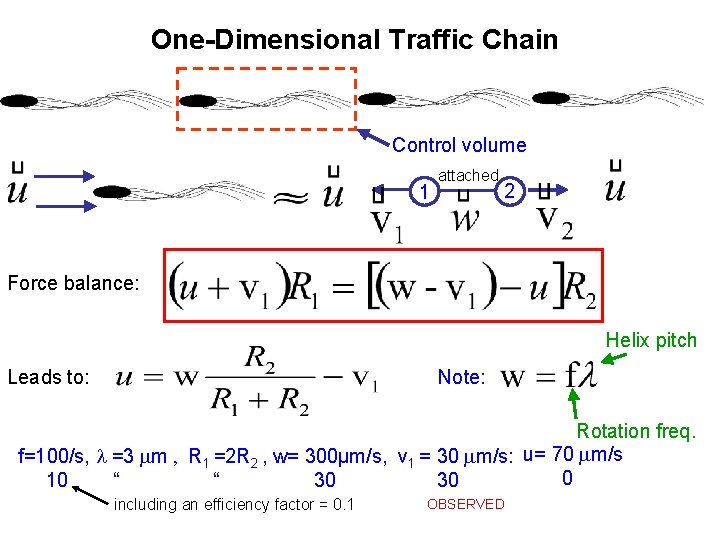
One-Dimensional Traffic Chain Control volume 1 attached 2 Force balance: Helix pitch Note: Leads to: Rotation freq. f=100/s, l =3 mm , R 1 =2 R 2 , w= 300μm/s, v 1 = 30 mm/s: u= 70 mm/s 0 10 “ “ 30 30 including an efficiency factor = 0. 1 OBSERVED
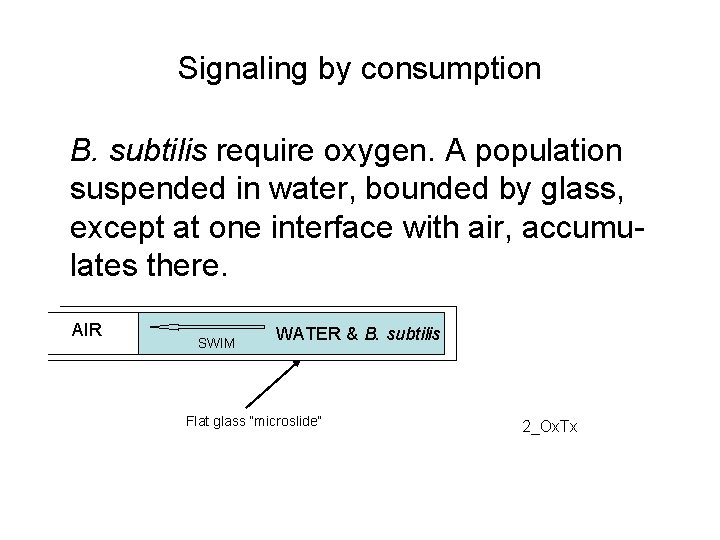
Signaling by consumption B. subtilis require oxygen. A population suspended in water, bounded by glass, except at one interface with air, accumulates there. AIR SWIM WATER & B. subtilis Flat glass “microslide” 2_Ox. Tx

• movie 2_ Ox. Tx. cin • movie 3_Blp. Trb 10. cin
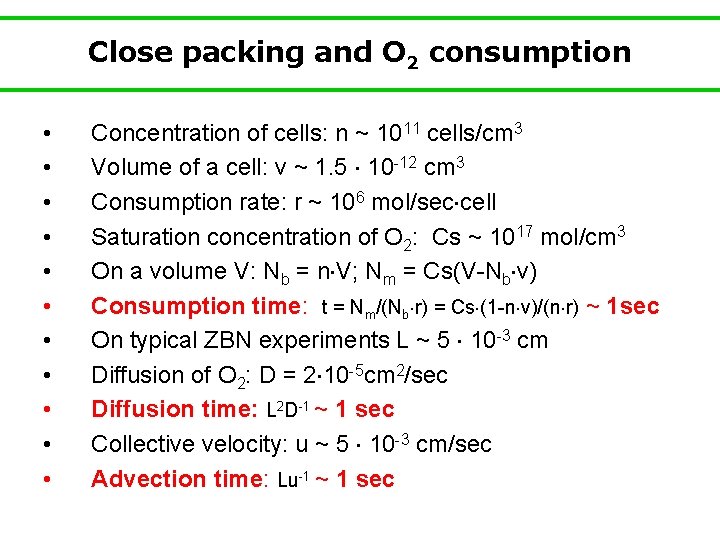
Close packing and O 2 consumption • • • Concentration of cells: n ~ 1011 cells/cm 3 Volume of a cell: v ~ 1. 5 10 -12 cm 3 Consumption rate: r ~ 106 mol/sec cell Saturation concentration of O 2: Cs ~ 1017 mol/cm 3 On a volume V: Nb = n V; Nm = Cs(V-Nb v) Consumption time: t = Nm/(Nb r) = Cs (1 -n v)/(n r) ~ 1 sec On typical ZBN experiments L ~ 5 10 -3 cm Diffusion of O 2: D = 2 10 -5 cm 2/sec Diffusion time: L 2 D-1 ~ 1 sec Collective velocity: u ~ 5 10 -3 cm/sec Advection time: Lu-1 ~ 1 sec
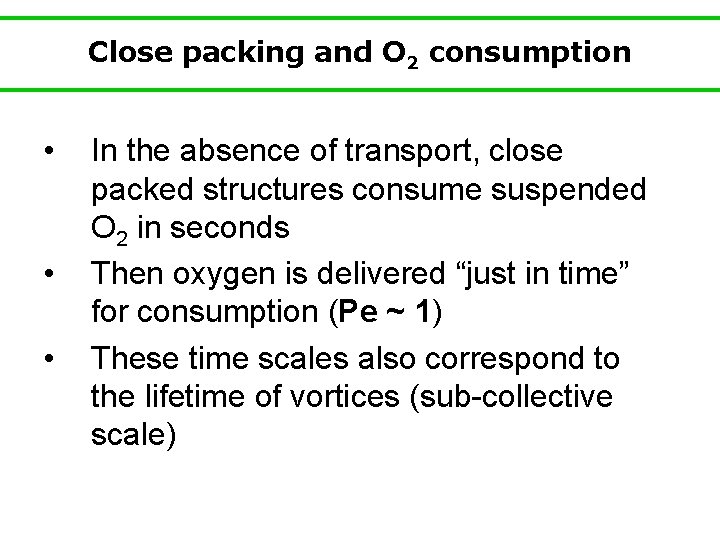
Close packing and O 2 consumption • • • In the absence of transport, close packed structures consume suspended O 2 in seconds Then oxygen is delivered “just in time” for consumption (Pe ~ 1) These time scales also correspond to the lifetime of vortices (sub-collective scale)
What is the distribution of the fluid’s velocity in the interior of, and around the periphery of a phalanx?
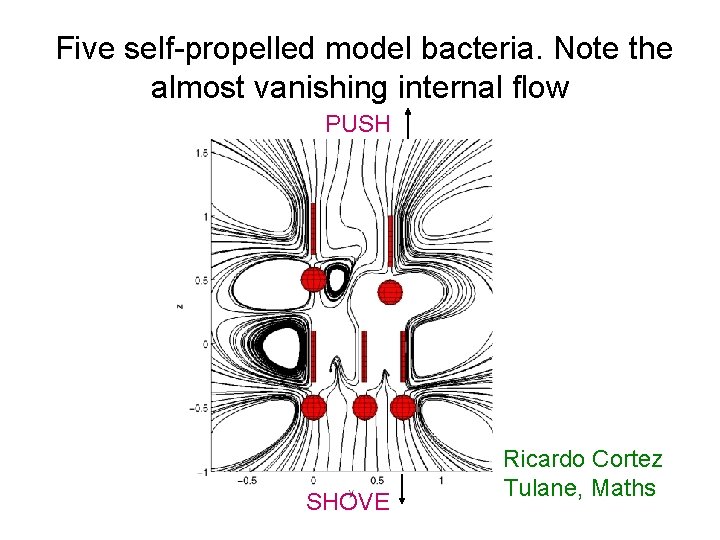
Five self-propelled model bacteria. Note the almost vanishing internal flow PUSH SHOVE Ricardo Cortez Tulane, Maths
conclusions? There is not much flow in the interior. The push by the flagella is counteracted by the drag of the heads. Fluid is pushed forward by the leading heads, backward by the trailing (propelling) tails, the bundles of flagella. Do lateral flows stabilize the phalanx?
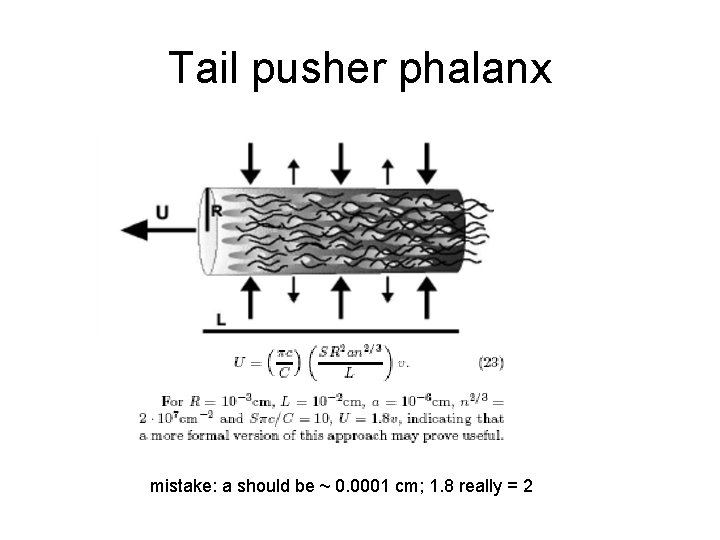
Tail pusher phalanx mistake: a should be ~ 0. 0001 cm; 1. 8 really = 2
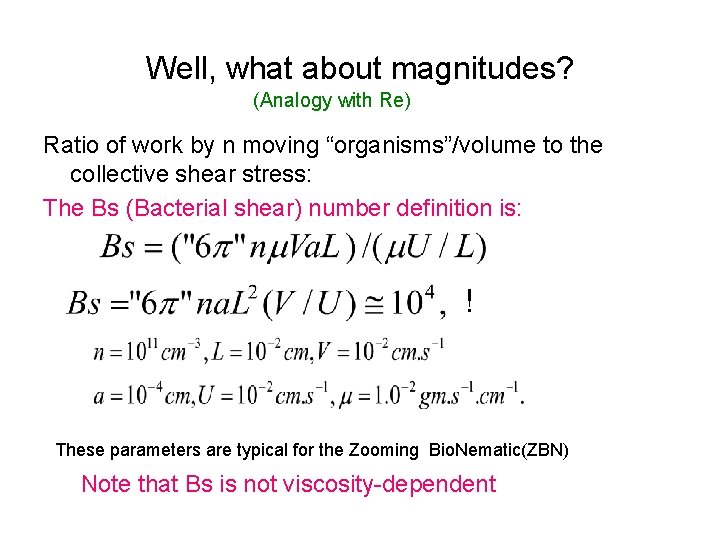
Well, what about magnitudes? (Analogy with Re) Ratio of work by n moving “organisms”/volume to the collective shear stress: The Bs (Bacterial shear) number definition is: ! These parameters are typical for the Zooming Bio. Nematic(ZBN) Note that Bs is not viscosity-dependent
Chemical exudates? Communication? Also need to consider: Quorum sensing, diffusion sensing, efficiency sensing. Biofilm production, crowding out (via production of antibiotics), topology. . . S Park, P Wolanin et al, PNAS 03; B L Bassler (lots); B A Hense et al. , Nature Reviews Microbiology 2007. movie 4 (also note Lévy flights and superdiffusion; Kate Remick). movie 5
3 Regions: ZBN, bioconvection and dynamically concentrated biofilm The ~chaotic (ZBN) transport region sweeps auto-connected groups of bacteria (biofilms) away from the “action” = “upwards”, into deeper region. Similarly, in deeper layers of fluid, dominated by bioconvection + ZBN, that dynamic also concentrates the biofilm, now downwards, toward shallower fluid. movie 6
• Can collective efforts alter the environment? Moving grains, pasting them together ? (Az “desert” surface) • gravity + oxygen taxis in natural environment? movie 7
- Slides: 29